Showing posts with label Loosen. Show all posts

Thursday, May 06, 2021

Relaxing and Loosening Up

 "True relaxation is always a dropping into ourselves, a movement toward our core and very center of self.  In addition to distorting what we can see, hear, and feel, the inability to relax and release tension will inevitably fuel the involuntary internal monologue of the mind.  As we become more enmeshed in the drama that our mind is scripting about ourselves, our ability to relate in a wholesome and relaxed manner with the current condition and circumstances of our lives becomes further distorted. ... The relaxation of tension in our bodies melts the armoring that keeps our bodies hard and inflexible.  This hardening of the tissue creates a layer of numbness that keeps our awareness of the rich web of shimmering sensations concealed and contained.  Relaxation allows the armoring to begin to soften and melt away.  The inevitable result is a much greater awareness of sensational presence and a diminution of the ongoing involuntary monologue of the mind.  Learning how to relax by surrendering the weight of the body to the pull of gravity and remaining standing at the same time significantly catalyzes the practice of mindfulness."

-  Will Johnson, Aligned, Relaxed and Resilient, 2000, p. 55


"To be relaxed means to release tension, but not to let go of substance.  There is a quality in-between stiff and loose which is stable, yet flexible, that has fullness without being rigid, that is calm in motion yet conveys a vigorous presence.  For lack of an equivalent English word, I refer to this concept as flowing within firmness, firmness within flowing.  Flowing and firmness do not gain support from a rigid skeletal posture or strength from muscular tension.  Rather, their integrity comes from expansion.  Expansion is the ability to spread out in all directions.  This is the key to relaxing without collapsing."
-  Ting Kuo-Piao, Understanding Flowing and Firmness, 2000


"Relaxation of the whole body means the conscious relaxation of all the joints, and this organically links up all parts of the body in a better way.  This does not mean softness.  It requires a lot of practice in order to understand this point thoroughly.  Relaxation also means the "stretching" of the limbs, which gives you a feeling of heaviness.  (This feeling of heaviness or stiffness is a concrete reflection of strength.)  This feeling is neither a feeling of softness nor stiffness, but somewhere in between.  It should not be confined to a specific part, but involves the whole body.  It is like molten iron under high temperature.  So relaxation "dissolves" stiff strength in very much the same way.  Stiff strength, also called "clumsy strength," undergoes a qualitative change after thousands of times of "dissolution" exercises.  Just like iron which can be turned into steel, so "clumsy strength" can be turned into force, and relaxation is a means of gradually converting it into force.  Our ancestors put it well: "Conscious relaxation will unconsciously produce force."  There is truth in this statement."
-  Yang Zhenduo, "Yang Style Taijiquan", p 16


Relaxed (Sung, Song, Fan Song):  Quotations, Bibliography, Resources

Standing Meditation

T'ai Chi Ch'uan

Somaesthetic Practices and Theory


Wednesday, September 09, 2020

Loosen Up and Stand Tall

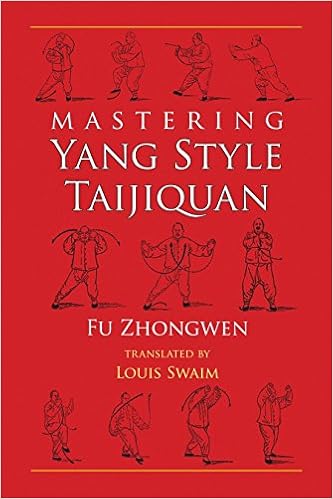
 "Throughout this book one encounters the terms song and fang song.  These are often translated as "relaxed" and "relax."  Etymologically the term song is based on a character for "long hair that hangs down ─that is, hair that is loosened and expanded, not "drawn up."  Therefore, "loosened" and "loosen" are more accurate renderings for song and fang song.  The phonetic element that gives the character song its pronunciation means, by itself, "a pine tree,"" which carries an associated imagery of "longevity," much as evergreens are associated with ongoing vitality in the West.  This may provide a clue to the Taijiquan usage of this term, which must not be confused with total relaxation, but is closer to an optimal state of the condition referred to as tonus in English anatomical parlance: that is, the partial contraction of the musculature, which allows one to maintain equilibrium and upright posture.  The aligned equilibrium that is prescribed in Taijiquan is associated with imagery of being "suspended" from the crown of the head.  One can, therefore, draw upon the available imagery of both something that is loosened and hangs down, and that of the upright pine, whose limbs do not droop down, but are buoyant and lively."
Mastering Yang Style Taijiquan.  Bu Fu Zhongwen (1903-1994).  Translated by Louis Swaim. p. xv.  


"True relaxation is always a dropping into ourselves, a movement toward our core and very center of self.  In addition to distorting what we can see, hear, and feel, the inability to relax and release tension will inevitably fuel the involuntary internal monologue of the mind.  As we become more enmeshed in the drama that our mind is scripting about ourselves, our ability to relate in a wholesome and relaxed manner with the current condition and circumstances of our lives becomes further distorted. ... The relaxation of tension in our bodies melts the armoring that keeps our bodies hard and inflexible.  This hardening of the tissue creates a layer of numbness that keeps our awareness of the rich web of shimmering sensations concealed and contained.  Relaxation allows the armoring to begin to soften and melt away.  The inevitable result is a much greater awareness of sensational presence and a diminution of the ongoing involuntary monologue of the mind.  Learning how to relax by surrendering the weight of the body to the pull of gravity and remaining standing at the same time significantly catalyzes the practice of mindfulness."
-  Will Johnson, Aligned, Relaxed and Resilient, 2000, p. 55


"Sung is probably one of the most important terms in t'ai chi ch'uan. It implies a very high level of alertness, sensitivity, nimbleness and lightness, with an inordinate mindfulness for the conservation of energy.  ...  Sung is the very modus operandi of all energies in t'ai chi ch'uan."
 -   Stuart A. Olson, Intrinsic Energies of T'ai Chi Ch'uan, 1994, p. 55


Loosen, Relaxed, Loose, Open, Yielding, Free, Responsive, Upright, Effortless, Spacious, Song, Sung, Fang Song.  A Defining Characteristic and Essential Quality of Taijiquan and Qigong Practice.  Notes, Quotes, Bibliography.  By Mike Garofalo.

Cloud Hands Taijiquan Website.  By Mike Garofalo.