Showing posts with label Martial Arts. Show all posts

Tuesday, September 30, 2025

Ba Gua Zhang


A repost from 2006:  

Ba Gua Zhang (Pa Kua Chang)
This webpage features many links, an extensive bibliography, quotations, notes, and some charts about Eight Trigrams (Bagua or Pa Kua) Boxing (Zhang or Chang)


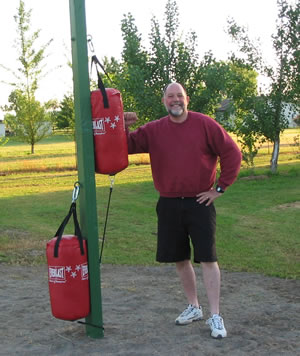
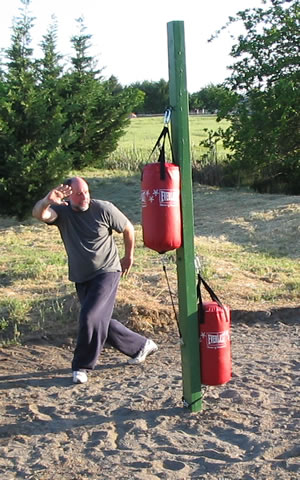
Mike Garofalo, Bagua Circle Training Area

Here is my Bagua Zhang Circle training area in my backyard in Red Bluff, California. I had hung the Everlast punching bags to the post before I started the baguazhang practice. Then, as I do my baguazhang circle training practice, I get a energy boost by smashing the upper bag with palm strikes and the lower bag with side heel kicks or sweeping take-down kicks as I circle around the post. This practice session took place at around 7 in the morning.

Mike Garofalo, Bagua Circle Training Area

Here I'm practicing the Yin style of Baguazhang, the Bear Posture/Forms. This practice session took place at around 7 in the evening.


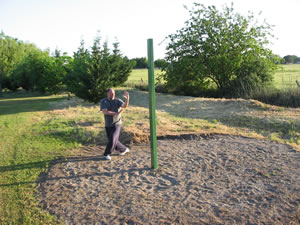
Mike Garofalo, Bagua Circle Training Area

I am fortunate to have a large outdoor area for practicing Baguazhang, Taijiquan and Qigong. This baguazhang practice session took place at around 7 in the evening.

The sandy surface is slower than hard clay, bricks or concrete. Just toss shovelfulls of sand around every so often, rake smooth and level, and then resume your practice on a like-new circle. This has been a much better solution than the mucky clay in the wet winters in Red Bluff.

Friday, July 04, 2025

Cannon Cane: Eight Immortals Chen Taijiquan Cane Routine II


Eight Immortals Taijiquan Cane
Cannon Cane, Routine Two
Based on the Chen Style of Taijiquan

Created and Taught by Master Jesse Tsao, PhD.

List of Postures, Movements, Forms 

Section I

1.  Opening Form

2.  Lazily Tying Coat

3.  Six-Seal and Four Close
4.  Single Whip
5.  Striking Left and Right
6.  Wrapping Head with the Cane
7.  Uppercuts Left and Right
8.  Grand Eagle Spreads Wings
9.  Embracing the Moon
10.  Cat Catches Rat
11.  Golden Rooster Standing on One Foot
12.  Whipping Sleeves and Slamming Cane
13.  Overturn the Ocean
 

Section II

14.  Dragon’s Tail Stirring Water
15.  Pinwheel Cane
16.  Fair Lady Works at Shuttles
17.  Batting a Home Run
18.  Ruthless Lord Holds Up Flag
 

Section III

19.  Strike Low and Strike High
20.  Dragon Descends into Ocean
21.  Dragon Emerges from Water
22.  Parry Left and Right
23.  Turn-Around Strike
24.  Dragon Swings Tail
25.  Head Smashing Cane
26.  Lock Front Door
 

Section IV 

27.  Black Bear Turns Around
28.  Lock Back Door
29.  Heart Thrusting Cane
30.  Waist Blocking Cane
31.  Crotch Striking Cane
32.  Head Striking Cane
33.  Dragon’s Head Up
34.  Dragon Coiling Around Pillar
35.  Wind Devil Cane
36.  Closing Form
 

Mastering Tai Chi Cane for Health and Self-Defense. By Jesse Tsao, PhD. Tai Chi Healthways, 2022, 225 pages.


Traditional Tai Chi Eight Immortals Cane, Routine 2 (Cannon Cane, Chen Style).  By Jesse Tsao, PhD.  Tai Chi Healthways, Instructional DVD 62 Minutes. 

Way of the Short Staff  By Michael P. Garofalo, M.S.  A comprehensive guide to the practice of the short staff, cane, jo, walking stick, gun, zhang, whip staff, 13 Hands Staff, and related wood short staff weapons.  A detailed and annotated guide, bibliography, lists of links, resources, instructional media, online videos, and lessons.  Includes use of the short staff and cane in martial arts, self-defense, walking and hiking.  Separate sections on Aikido Jo, Cane, Taijiquan cane and staff, Jodo, exercises with a short staff, selected quotations, techniques, selecting and purchasing a short staff, tips and suggestions, and a long section on the lore, legends, and Magick of the short staff.  Includes "Shifu Miao Zhang Points the Way."

 Cloud Hands Taijiquan, Valley Spirit Center, Fir Grove, Vancouver, Washington.  List by Michael P. Garofalo, September 24, 2022. 


Eight Immortals Taijiquan Cannon Cane Routine

1.  Opening Form  Section 1

2.  Lazily Tying Coat

3.  Six-Seal and Four Close
4.  Single Whip
5.  Striking Left and Right
6.  Wrapping Head with the Cane
7.  Uppercuts Left and Right
8.  Grand Eagle Spreads Wings
9.  Embracing the Moon
10.  Cat Catches Rat
11.  Golden Rooster Standing on One Foot
12.  Whipping Sleeves and Slamming Cane
13.  Overturn the Ocean

14.  Dragon’s Tail Stirring Water  Section 2
15.  Pinwheel Cane
16.  Fair Lady Works at Shuttles
17.  Batting a Home Run
18.  Ruthless Lord Holds Up Flag

19.  Strike Low and Strike High  Section 3
20.  Dragon Descends into Ocean
21.  Dragon Emerges from Water
22.  Parry Left and Right
23.  Turn-Around Strike
24.  Dragon Swings Tail
25.  Head Smashing Cane
26.  Lock Front Door

27.  Black Bear Turns Around  Section 4
28.  Lock Back Door
29.  Heart Thrusting Cane
30.  Waist Blocking Cane
31.  Crotch Striking Cane
32.  Head Striking Cane
33.  Dragon’s Head Up
34.  Dragon Coiling Around Pillar
35.  Wind Devil Cane
36.  Closing Form


Tuesday, April 27, 2021

Practice the Taijiquan Form Faster

Here a repost from the Cloud Hands Blog from December 26, 2017:

Grandmaster Yang Jwing-Ming advises us to practice the Taijiquan form (sequence) by 1) practicing the sequence slower and slower, 2) developing a sense of an enemy, and 3) practicing fast Taijiquan.  He says,


    "In order for the sequence to be meaningful, Jing and technique must be combined.  An important way to do this is to PRACTICE FAST TAI CHI CHUAN.  Once you can do the sequence of movements automatically, and can coordinate your breathing and Chi circulation with the movements, you should practice the form faster.  Remember, if you ever get into a fight, things are likely to move pretty fast, so you have to be able to respond fast in order to defend yourself effectively.  If you only practice slowly, then when you need to move fast your Chi will be broken, your postures unstable, and you Yi scattered.  If any of this happens, you will not be able to use your Jing to fight.  Therefore, once you have developed your Chi circulation you should practice the sequence faster until you can do it at fighting speed.  Make sure you don't go too fast too soon, or you will sacrifice the essentials such as Yi concentration, Chi balance, breath coordination, and the storage of Jing in the postures.  When doing fast Tai Chi, do not move at a uniform speed.  Incorporate the pulsing movement of Jing so that you are responding appropriately to the actions for your imaginary enemy.  It is difficult to develop the pulsing movement of Jing solely by doing the sequence, so you should also do Jing training either before or concurrently with the fast Tai Chi."

-  Dr. Yang Jwing-Ming.  Advanced Yang Style Tai Chi Chuan.  Volume One: Tai Chi Theory and Tai Chi Jing.  By Dr. Yang, Jwing-Ming.  Boston, Massachusetts, Yang's Martial Arts Academy, YMAA, 1986, p. 67.  


Tai Chi Chuan Martial Power: Advanced Yang Style. By Dr. Wang, Jwing Ming. Foreword by Tsung-Hwa Jou. YMAA Publication Center, 3rd Edition, 2015. 320 pages. ISBN: 978-1594392948. 

Tai Chi Chuan Martial Applications: Advanced Yang Style. By Dr. Wang, Jwing Ming. YMAA Publications, 3rd Edition, 2016. 400 pages. ISBN: 978-1594392993. VSCL.


Also, you might take a look at Yang Style Tai Chi Fast Form by Master Jesse Tsao from San Diego, California.  

"Yang Style Tai Chi Fast Form is a traditional practice with self-defense as its main focus. It trains the body in a dynamic energy flow, with agility in dodging, stepping and jumping along with solid strikes in flashing speed. The fast form is secretly carried forward by a limited population, as Tung Yingjie (one of Yang Chengfu's students) mentioned that the fast form is regarded as advanced-level training in old times. Tai Chi Healthways presents this routine for those who love to practice Tai Chi for martial arts applications. It is a good reference for home study, or a resource for instructor's teaching preparation. Suggest 50 class hours. (Difficulty: Beginner through Advanced Levels). DVD-R, (61 minutes)."

I viewed this instructional DVD on Amazon for $1.99, and then ordered a DVD copy ($34.95) from Tai Chi Healthways.  I like to view and listen to instructional DVDs using my small CooVu portable DVD player.  


When I lived in Red Bluff, California, on a 5 acre homestead in the rural North Sacramento Valley, I used many instructional DVD's created by Master Jesse Tsao, Master Jiang Jian Ye, and Grandmaster Yang, Jwing-Ming.  Master Tsao's instructional DVDs appealed to me because of their pace, breakdowns by sections, summary demonstrations, clarity of audio, diversity of styles presented, and background scenery around some very familiar San Diego locations (my brother lives in nearby Carlsbad).  

I particulary enjoyed learning, from Master Tsao's instructional DVD, the Eight Immortals Tai Chi Cane, Routine 1, in the Yang Style of Taijiquan.

Sunday, March 21, 2021

Ward Off


Ward Off Left by Yang Cheng Fu (1883-1936)


The movement called "Ward Off" appears 10 times in the Long 108 Taijiquan Form.  There are 5 right Ward Offs, as part of the sequence Grasping the Sparrow's Tail to the Right.  There are 5 left Ward Offs, but no sequence of Grasping the Sparrow's Tail to the Left.  No other movement appears so often in the Long 108 as Ward Off.  Also, movements like Fair Lady Works Shuttles are similar.  


Ward Off  (Peng) is one of the basic Eight Energies or Eight Gates of Taijiquan.  Its energy display is variously described as being outward and upward, bouncy, whip like, circular, off-setting.    

Peng Ching is outward expanding and moving Energy (Jing, Ching).  It is a quality of responding to incoming energy by adhering to that energy, maintaining one's own posture, and bouncing the incoming energy back like a large inflated rubber ball.  You don't really respond to force with your own muscular force to repel, block, or ward off the attack.  Ward Off is a response of the whole body, the whole posture, unified in one's center, grounded, and capable of gathering and then giving back the opponent's energy.  

Peng is often referred to as a kind of "bouncing" energy.  It is also considered the fundamental way of delivering energy and embodied in some way in each of the other Eight Gates.  


"When moving, receiving, collecting, and striking, Peng Ching is always used.  It is not easy to complete consecutive movements and string them together without flexibility.  Pen Ching is T'ai Chi boxing's essential energy.  The body becomes like a spring; when pressed it recoils immediately."
-  Kuo, Lien-Ying, "The T'ai Chi Boxing Chronicle," p. 44


"Peng is a form of Jing that responds to incoming energy by adhering or sticking to it, and then bouncing the incoming energy back like a large inflated rubber ball. It is the primary Yang or “projecting” energy force in Tai Chi, and can be equally defensive and offensive. Peng is expressed by the entire body as a whole, unified in your center and grounded. When one standing in the correct Peng posture, it is almost impossible to move them.  The first energy is Ward Off, expressed as you Step Forward into the left Bow Stance, round the left arm forward and float the right hand to the hip.  Peng puts a curved barrier between you and your opponent; creating a buffer zone that prevents the first shock of an incoming attack from penetrating your defenses. This buffer zone also gives you the critical microsecond to avoid being overwhelmed by an attack, giving you neurological space to to deflect, absorb or counter an attack.  Peng energy can be compared to the type of force that causes wood to float on water or a balloon to inflate, or a garden hose to fill with a torrent of water. It has a “bounce off” sensation, like the feeling of rebounding off of a beach ball or Yoga ball. It is Peng that enables the Tai Chi fighter to hit opponents and cause them, as the Chinese like to say, “to fly away.”  magine a young mother standing on a crowded beach pier, searching frantically for her child. After a moment, she spots her toddler climbing up the pier railing, some 60 feet above the ocean. As she rushing to grab her child, anyone in her way would literally be “bounced away” by her singularly-focused forward energy. This is Peng."
Tai Chi Transformation


"One exercise style I enjoy practicing at home, and often in my Taijiquan classes (2000-2017), is straight line repetition drills.  For example, do Ward Off Left, then Ward Off Right, then Ward Off Left ... alternating and repeating in a straight line direction till the end of the room, then turn, and go back to the other side of the workout space doing alternating Ward Off Left and Right.  Those who have practiced Hsing Yi drills are familiar with this style of movement.  I did this exercise style with Brush Knee Right and Left, Kick Right and Left, Fair Lady Right and Left, etc.  This can get vigorous with more speed and/or explosive moves.  Also, you can do Ward of Right and Left to the four cardinal directions, as with Fair Lady Works Her Shuttles to four sides."
-  Michael P. Garofalo


Wednesday, September 16, 2020

A T'ai Chi Masters' Guiding Principles for Living


Anyone who begins the study of Taijiquan, Qigong, Chinese martial arts, or other Asian martial arts will quickly be introduced to rules for proper behavior, ethical principles, lifestyle and heath recommendations, social duties and responsibilities, and spiritual ideas from the East.  The main influences and doctrines come from Confucianism, Chinese Buddhism, Taoism, Zen, and pragmatic secular thinking.  

There are many books and articles on this subject.  For example, Zen in the Martial Arts (1982),  The Bodhisattva Warriors (1994),  Cultivating the Civil and Mastering the Martial (2016),  The Protector Ethic: Morality, Virtue and Ethics in the Martial Way (2018), and many others.  

Please refer to my hypertext notebook on this topic of the martial artist and ethical guidelines.  

You will find many examples of ethical, moral, and behavioral rules and recommendations in nearly all books on Taijiquan.  The mind, body, and spirit are all three trained in martial arts, and especially in internal martial arts.  

Here are some daily guiding principles from Gordon Muir in his book: Yang Style Traditional Long Form T'ai Chi Ch'uan; As Taught by Master T. T. Liang.  By Gordon Muir.  Berkeley, California, Blue Snake Books, 2008, 225 pages.

 "To accomplish T'ai Chi physically and technically is relatively easy, but to accomplish it mentally is much more difficult.  From my more that thirty years' experience of learning and practicing T'ai Chi, I have formulated ten theorems for my daily guiding principles to help me know how to deal with people and myself:

1.  Nobody can be perfect.  Take what is good and discard what is bad.

2.  If I believe entirely in books, better not to read books; if I rely entirely on teachers, better not to have teachers.

3.  To remove a mountain is easy, but to change a man's character is more difficult.

4.  If there is anything wrong with me, I don't blame others, I only blame myself.

5.  If I want to live longer, I must learn and practice T'ai Chi, and accomplish it both physically and mentally.  To accomplish it mentally is much more difficult.

6.  I must learn how to yield, to be tactful, not to be aggressive; to lose (small loss, small gain; great loss, great gain), not to take advantage of others; to give (the more you give the more you have.)

7.  Make one thousand friends, but don't make one enemy.

8.  One must practice what he preaches.  Otherwise it is empty talk or a bounced check.

9.  To conceal the faults of others and praise their good points is the best policy.  

10.  Life begins at seventy.  Everything is beautiful!  Health is a matter of the utmost importance and all the rest is secondary.  Now I must find out how to enjoy excellent health in my whole life and discover the way to immortality."   


How to Live a Good Life: Advice From Wise Persons.  Compiled by Michael Garofalo.


Also, you might enjoy reading:  Master of the Three Ways: Reflections of a Chinese Sage on Living a Satisfying Life  By Hung Ying-ming.  Translated by William Scott Wilson.  Foreword by Red Pine.  Boston, Shambhala, 2012.  Notes, Bibliography, 196 pages.  VSCL. 


Saturday, May 12, 2018

Cane Weapon Practices


Cane, Walking Stick, Short Staff
Bibliography, Links, Resources, Lessons, Guides, History, Lore
Hypertext Notebook by Mike Garofalo.  


Cane Fighting: The Authoritative Guide to Using the Cane or Walking Stick for Self-Defense. By Sammy Franco. Contemporary Fighting Arts, 2016. 242 pages. ISBN: 978-1941845301. More emphasis on using a thicker and longer walking stick, like a Japanese Jo, rather than an inconspicuous cane. VSCL.


Raising Cane: The Unexpected Martial Art. By Octavio Ramos. Velluminous Press, 2006. 188 pages. ISBN: 1905605102. This book features fairly detailed explanations with illustrations of many cane strikes, blocks, and maneuvers by a former sheriff. Black and white photographs and descriptions of all cane techniques. VSCL.


Essential Jo: Comprehensive Techniques and 2 Person Drills for the Japanese 4-foot Staff. By Dan Djurdjevic. Pikkeljig, 2015. 156 pages. ISBN: 978-0992511333. "The jo is the Japanese 4-foot staff, originally taught with the ken (sword) in the samurai arts. Essential Jo is arguably the most comprehensive text on the subject to date, offering a course of study from white through to black belt in this practical, yet elegant, art. The book features over 900 professional black and white photographs accompanied by clear, detailed textual explanations. While it is intended primarily for students with experience in weapons arts, particularly jodo, the book can also be used by beginners for home study. The art of jodo makes an excellent addition to any martial art system. This is the first instructional text by award-winning martial arts writer and teacher Dan Djurdjevic."


Monday, May 07, 2018

Cane: Exercises and Self-Defense

The Eight Immortals Cane Form.  Created by Master Jesse Tsao from San Diego, California.  Part I of this cane form is based on the Yang style of T'ai Chi Ch'uan.  This form has 36 movements.

Traditional Tai Chi Eight Immortals Cane, Routine One.  Demonstrated by Master Jesse Tsao.  Instructional DVD, 64 minutes.  Produced by Tai Chi Healthways, San Diego, 2008.  Routine One is based on the Yang Style of Taijiquan.  Master Tsao developed this cane form himself, with grandmaster Zhu Tiancai's support.    


Traditional Tai Chi Eight Immortals Cane, Routine Two (Cannon Cane).  Demonstrated by Master Jesse Tsao.  Instructional DVD, 65 minutes.  Produced by Tai Chi Healthways, San Diego, 2008.  Routine Two, Cannon Cane, is based on the Chen Style of Taijiquan.  Master Tsao developed this cane form himself, with grandmaster Zhu Tiancai's support.  


Dr. Andy Fitz-Gibbon teaches Taijiquan and maintains a blog for the Way of Peace Taijiquan Association.  He is also the Abbot for the Lindisfarne Community in Ithaca, New York.  He is shown performing the Eight Immortals Cane form in the UTube video below. 


Exercises, Self-Defense, History, Lore


Way of the Short Staff.  By Michael P. Garofalo, M.S.  A comprehensive guide to the practice of the short staff, cane, jo, walking stick, gunzhang, whip staff, 13 Hands Staff, and related wood short staff weapons.  A detailed and annotated guide, bibliography, lists of links, resources, instructional media, online videos, and lessons.   Includes use of the short staff and cane in martial arts, self-defense, walking and hiking.  Separate sections on Aikido Jo, Cane, Taijiquan cane and staff, Jodo, exercises with a short staff, selected quotations, techniques, selecting and purchasing a short staff, tips and suggestions, and a long section on the lore, legends, and magick of the short staff.  Includes "Shifu Miao Zhang Points the Way."  Published by Green Way Research, Valley Spirit Taijiquan, Red Bluff, California, 2008-.  Related to Mike's popular webpage on the Staff.


Sunday, December 24, 2017

Taijiquan Thirteen Postures

"Tai Chi Chuan is based on this theory, and therefore it is smooth, continuous, and round. When it is necessary to be soft, the art is soft, and when it is necessary to be hard, the art can be hard enough to defeat any opponent.  Yin-Yang theory also determines Tai Chi fighting strategy and has led to thirteen concepts [Jings] which guide practice and fighting.  Thus, Tai Chi Chuan is also called "Thirteen Postures."  

"Chang San-Feng Tai Chi Chuan treatise states "What are the thirteen postures?  Peng (Wardoff), Lu (Rollback), Ghi (Press), An (Push), Chai (Pluck), Lie (Split), Zou (Elbow-Stroke), Kau (Shoulder-Stroke), these are the Eight TrigramsJinn Bu (Forward), Twe Bu (Backward), Dsao Gu (Beware of the Left), Yu Pan (Look to the Right), Dsung Dien (Central EQuilibrium), these are the Five Elements.  Wardoff, Rollback, Press, and Push are Chyan (Heaven), Kuen (Earth), Kann (Water), and Lii (Fire) are the four main sides.  Pluck, Split, Elbow-Stroke, and Shoulder-Stroke are Shiunn (Wind), Jenn (Thunder), Duey (Lake), and Genn (Mountain), the four diagonal corners.  Forward, Backward, Beware of the Left, Look to the Right and Central Equilibrium are Gin (Metal), Moo (Wood), Sui (Water), For (Fire), and Tu (Earth).  All together they are thirteen postures."

"The eight postures are the eight basic fighting moves of the art, and can be assigned directions according to where the opponents force is moved.  Wardoff rebounds the opponent back in the direction from which he came from.  Rollback leads him further that he intended to go in the direction he was attacking.  Split and Shoulder-Stroke lead him forward and deflect him slightly sideward.  Pluck and Elbow-Stroke can be done so as to catch the opponent just as he is starting forward, and strike or unbalance him diagonally to his rear.  Push and Press deflect the opponent and attack at right angles to his motion.  The five directions refer to stance, footwork, and fighting strategy.  They concern the way one moves around in response to the opponent's attack, and how one sets up one's own attacks."

-  Dr. Yang Jwing-Ming.  Advanced Yang Style Tai Chi Chuan.  Volume One: Tai Chi Theory and Tai Chi Jing.  By Dr. Yang, Jwing-Ming.  Boston, Massachusetts, Yang's Martial Arts Academy, YMAA, 1986.  Glossary, 276 pages.  ISBN: Unknown.  This book includes a detailed explanation of the concepts of Jing, Yi, and Chi; and an outstanding discussion of the Jings (pp. 68-210) of Tai Chi Chuan.  VSCL.  Quotes from p. 9, and p. 253 (Appendix 13). 


Tai Chi Chuan Martial Power: Advanced Yang Style. By Dr. Wang, Jwing Ming. Foreword by Tsung-Hwa Jou. Wolfeboro, New Hampshire, YMAA Publication Center, 3rd Edition, 1986, 1996, 2015. Index, glossary, bibliography, 274 pages. ISBN: 978-1594392948. VSCL.


Taijiquan Jings Eight Trigrams and Five Elements
Wardoff   (Peng Heaven   (Chyan)  
Rollback   (Lu) Earth   (Kuen)
Press   (Ghi) Water   (Kann)
Push   (An Fire   (Lii)
Pluck   (Chai Wind   (Shiunn)
Split   (Lie Thunder  (Jenn)
Elbow-Stroke   (Zou Lake   (Duey)
Shoulder-Stroke   (Kau Mountain (Genn) 
Forward   (Jinn Bu Metal   (Gin
Backward  (Twe Bu Wood   (Moo) 
Left   (Sou Gu Water   (Sui) 
Right   (Yu Pan Fire   (For
Center (Sung Dien Earth   (Tu


Monday, November 13, 2017

Taijiquan and Virtues

"Perhaps the want of literature addressing heartfulness in the realm of T'ai Chi stems from the very personal nature of the topic.  Our paths are unique, and along these paths each of us may or may not choose to confront our own standards of integrity and morality while exploring our potential for becoming fully realized spiritual/human beings.  For myself, the issues of morality, integrity, empathy, responsibility, respect and appreciation for life, purposefulness, and joy are inextricably woven into the pursuit of martial arts mastery, and particularly so in the case of internal arts such as T'ai Chi.  This is not to say that I consider there to be only one constant standard for any of these qualities, and certainly I do not see myself as the designated arbiter of any such standards.  I do believe, however, that T'ai Chi practitioners have a unique opportunity, and an incentive, to explore and expand their growth.  They can develop heartfulness according to their own individual scope by virtue of T'ai Chi's emphasis on integrative mind/body experience through the discipline of practice.  To me, this only seems congruent with T'ai Chi's alleged potential as a tool for mastery of self."
-  John Loupos, Inside Tai Chi, 2002, p. 74


"Philosophical ideals in the martial arts:
1. To strive for perfection of character
2. To defend the paths of truth
3. To foster the spirit of effort
4. To honor the principles of etiquette
5. To guard against impetuous courage."

- Herman Kauz, The Martial Spirit: An Introduction to the Origin, Philosophy and Psychology of the Martial Arts.


Tuesday, February 16, 2016

T'ai Chi Ch'uan Cane Practices

The only martial arts weapon that I practice with is a cane.  I practice all the Taijiquan sword and broadsword forms that I know with a cane. 

Every time I take a walk I carry my cane with me.  Using various cane strikes and stretches while walking is an excellent way to exercise the upper torso.


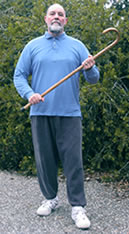
I use an Instructor's Walking Cane, 40" (103 cm) long and 1" (2.54 cm) in diameter, from Cane Masters.  This cane weights 1lb, 2 oz (510 gm).  This beautiful martial arts combat cane is made of pure hickory heartwood, has multiple notches at three key gripping points, has a rounded hooked horn, and has a rubber covered tip.  I also own the same Instructor's Walking Cane made of oak - a gift from my children.
 
Way of the Short Staff.  By Michael P. Garofalo, M.S.  A comprehensive guide to the practice of the short staff, cane, jo, walking stick, gunzhang, whip staff, 13 Hands Staff, and related wood short staff weapons.  A detailed and annotated guide, bibliographies, lists of links, resources, instructional media, online videos, and lessons.   Includes use of the short staff and cane in martial arts, self-defense, walking and hiking.  Separate sections on Aikido Jo, Cane, Taijiquan cane and staff, Jodo, exercises with a short staff, selected quotations, techniques, selecting and purchasing a short staff, tips and suggestions, and a long section on the lore, legends, and magick of the short staff.  Includes "Shifu Miao Zhang Points the Way."  Published by Green Way Research, Valley Spirit Taijiquan, Red Bluff, California.  Updated on a regular basis since October, 2008.  Filesize: 265Kb.  Related to Mike's popular webpage on the Staff.


"The correct use of the bo (sai, tonfa, kama, naginata, sword) can produce a stimulating and practical means of "extension" training. It offers a means of martial arts training and discipline. Weapons training teaches the meaning of control, timing, distance, and flexibility as one unit. The practitioner is required to possess speed, coordination, strength, and endurance in utilizing the respective weapons."
-  
History of the Bo Staff


"The jo can be used to strike like a sword, sweep like a naginata, thrust like a spear (yari). Its two ends can be used, unlike the single point of a sword, and its ma-ai (fighting distance) can be varied according to the hand grip you take. Because of its speed and changeable ma-ai, it is a formidable weapon."
-  
Muso Shindo-Ryu Jodo   


"In Chinese shamanism, a staff represents the power of the universe. With a staff, a shaman had the power to pass on the universal knowledge to others. Later, when teachers took over part of the shaman's job, they always taught with a small staff in their hands like a shaman."
- Master Zhongxian Wu, Vital Breath of the Dao, p. 106


Thursday, July 23, 2015

Martial Arts Cults

Is Your Martial Art a Cult?

Posted at Mokuren Dojo

  • The group displays excessively zealous and unquestioning commitment to its leader and (whether he is alive or dead) regards his belief system, ideology, and practices as the Truth, as law.‪ 
  • Questioning, doubt, and dissent are discouraged or even punished.‪ Mind-altering practices (such as meditation, chanting, speaking in tongues, denunciation sessions, and debilitating work routines) are used in excess and serve to suppress doubts about the group and its leader(s).‪ 
  • The leadership dictates, sometimes in great detail, how members should think, act, and feel (for example, members must get permission to date, change jobs, marry—or leaders prescribe what types of clothes to wear, where to live, whether or not to have children, how to discipline children, and so forth).‪ 
  • The group is elitist, claiming a special, exalted status for itself, its leader(s) and members (for example, the leader is considered the Messiah, a special being, an avatar—or the group and/or the leader is on a special mission to save humanity).‪ 
  • The group has a polarized us-versus-them mentality, which may cause conflict with the wider society.‪ 
  • The leader is not accountable to any authorities (unlike, for example, teachers, military commanders or ministers, priests, monks, and rabbis of mainstream religious denominations).‪ 
  • The group teaches or implies that its supposedly exalted ends justify whatever means it deems necessary. This may result in members' participating in behaviors or activities they would have considered reprehensible or unethical before joining the group (for example, lying to family or friends, or collecting money for bogus charities).‪ 
  • The leadership induces feelings of shame and/or guilt in order to influence and/or control members. Often, this is done through peer pressure and subtle forms of persuasion.‪ 
  • Subservience to the leader or group requires members to cut ties with family and friends, and radically alter the personal goals and activities they had before joining the group.‪ 
  • The group is preoccupied with bringing in new members.‪ 
  • The group is preoccupied with making money.‪ 
  • Members are expected to devote inordinate amounts of time to the group and group-related activities.‪ 
  • Members are encouraged or required to live and/or socialize only with other group members.‪ 
  • The most loyal members (the “true believers”) feel there can be no life outside the context of the group. They believe there is no other way to be, and often fear reprisals to themselves or others if they leave (or even consider leaving) the group.

Wednesday, July 09, 2014

Hsing I Chuan Five Animals

"Dragon Body - This imaginary beast is common in Chinese fables and folklore. The dragon could fly high, riding the mists, contracting and twisting it's body like a snake through the clouds. Xingyi places high importance on this for every transitional movement in the art should embody the spirit of the dragon, expanding and contracting, striking out with mystical prowess.

Chicken Leg - This is one of the most basic fundamentals of the art of Xingyiquan. A chicken can run very quickly and stop suddenly, keeping it's weight on one leg, ready to peck. Xingyi's five elements all encompass this theory by stepping forward onto one leg before it issues it's strike much like a chicken does. By mastering this, you can advance, retreat, turn and change forms very quickly because the weight is always ready to transfer.

Eagle Claw - While the hands are relaxed and held in gentle curves when in transitional movements, when striking, they must become like the fearless bird of prey's attacking talons, digging and grasping with an iron grip. This is especially seen in the beginning movement of Pi Quan when the hands draw down towards the Dan Tian. This is also very important in Xingyi, for many of the art's applications consist of grabbing with one hand while simultaneously striking with the other.

Bear Shoulders - Bears are large animals that can can generate a great deal of power from their great rounded shoulders. The Xingyi practitioner must mimic this to obtain maximum power in his art. By rounding the shoulders and hollowing the chest, the body actually "gets behind" the arms and hands, so when you strike, the power doesn't come from the arms, but from the whole body.

Tiger's Head Embrace - The tiger is a very regal beast. They are powerful and strong animals that exude the finest and most fearsome aspects of nature. In Xingyi, the head must be held erect and slightly back, but spiritually, it must also capture the imposing manner of the tiger, letting it's blank cunning show in your eyes and it's ability to pounce.

- Xonghua Xinyiquan

Xing Yi Quan (Hsing I Chuan): Bibliography, Links, Resources, Quotes, Notes. By Mike Garofalo.


Xing Yi Quan Xue: The Study of Form-Mind Boxing.   By Sun Lu Tang.  Translated by Albert Liu.  Compiled and edited by Dan Miller.  Burbank, CA, Unique Publications, 2000.  ISBN: 0865681856.  312 pages.  Includes a biography of Sun Lu Tang (pp.1-41) by Dan Miller.  The work was encouraged and supported by Sun Jian Yun, and an interview with her is included.  Translations by Tim Cartmell, Gu Feng Mei, and Huang Guo Qi.  This original book was first published in 1915.  It was the first book ever published that integrated Chinese martial arts with Chinese philosophy and Daoist Qi cultivation theories.  The book includes many photographs of Sun Lu Tang.  


"Of the three internal arts, Xing Yi is probably the most straightforward to understand in terms of practical fighting applications. Grandmaster Sun, however, believed that the most important reason to practice martial arts was the improvement of one's health; developing fighting ability was merely of secondary importance. Sun himself certainly benefited in both respects. In 1933, at the age of 73 and shortly before his death, Sun was examined by a physician and found to have the body of a 40-year old. Furthermore, throughout his life he was an awesome fighter: He worked as a professional bodyguard, taught martial arts at the Presidential Palace, and never lost a challenge match.

Certain health benefits of Xing Yi training are obvious. It is a low-impact exercise requiring little jumping, few low stances, and smooth rather than ballistic movements. As Sun notes in his book, it can be practiced by anyone, both the young and old, and the sick and infirm. Healthy people will grow stronger, while those with a disease will recover their health. However, in addition to the external physical benefits, Xing Yi practice offers a sophisticated system of internal energy training that stimulates the major energetic pathways within the body.

At the core of Sun Lu Tang's Xing Yi Quan system is the 12 animals set. This set consists of 12 lines of movements, each emulating the fighting techniques of the 12 animals that come from heaven and earth. These are the Dragon, Tiger, Monkey, Horse, Water Lizard, Chicken, Sparrow Hawk, Swallow, Snake, Tai Bird, Eagle, and Bear. Regular practice of the 12 animals set benefits the practitioner both externally and internally. Externally, one learns the physical characteristics of each animal-the explosive power of the tiger, or the strength of the bear, for example. Internally, each animal form stimulates the internal energy, or Qi, in a particular and beneficial manner. The remainder of this article describes both the energetic work and the fighting applications of four of the animal forms: the Dragon, Tiger, Eagle, and Bear."
-  Justin Liu,
 Cultivation and Combat: The Fighting Animals of Xing Yi Quan.


Monday, May 05, 2014

Virtues Cultivated in Martial Arts Training

"Philosophical ideals in the martial arts:
1. To strive for perfection of character
2. To defend the paths of truth
3. To foster the spirit of effort
4. To honor the principles of etiquette
5. To guard against impetuous courage."
- Herman Kauz, The Martial Spirit: An Introduction to the Origin, Philosophy and Psychology of the Martial Arts.

Seven Essential Principles Of Bushido (The Way Of The Warrior):
1. GI: the right decision, taken with equanimity, the right attitude, the truth. Rectitude.
2. YU: bravery tinged with heroism
3. JIN: universal love, benevolence toward mankind. Compassion.
4. REI: right action - a most essential quality. Courtesy.
5. MAKOTO: utter sincerity. Truthfulness.
6. MELYO: honor and glory.
7. CHUGO: devotion. Loyalty.
- Taisen

"It is said that a calm and stable mind can achieve anything. This is an idea that I hold strong to. If we are not thinking with our wisdom mind then we are thinking out of impulse and reaction, like most animals do. This thinking out of impulse is known as the "emotional mind" (xin). The martial arts are very much a tool to shape reaction, both mentally and physically. Through diligent practice, and study of the martial virtues one can begin to act from the wisdom mind.

The virtues fall into two categories; morality of action, and morality of mind. Of those that are associated with action, there is:

Humility
Respect
Righteousness
Trust
Loyalty

as well as those which are associated with the mind:

Will
Endurance
Perseverance
Patience
Bravery."
- R. Scott Moylan, Wu De Quan


"We are what we think. All that we are arises with our thought. With our thoughts, we make our world."
- The Buddha


Monday, December 02, 2013

Cane Weapon Practices

The only martial arts weapon that I practice with is a cane.  I practice all the Taijiquan sword and broadsword forms that I know with a cane. 

Every time I take a walk I carry my cane with me.  Using various cane strikes and stretches while walking is an excellent way to exercise the upper torso.

I use an Instructor's Walking Cane, 40" (103 cm) long and 1" (2.54 cm) in diameter, from Cane Masters.  This cane weights 1lb, 2 oz (510 gm).  This beautiful martial arts combat cane is made of pure hickory heartwood, has multiple notches at three key gripping points, has a rounded hooked horn, and has a rubber covered tip.  I also own the same Instructor's Walking Cane made of oak - a gift from my children.  
 
Way of the Short Staff.  By Michael P. Garofalo, M.S.  A comprehensive guide to the practice of the short staff, cane, jo, walking stick, gun, zhang, whip staff, 13 Hands Staff, and related wood short staff weapons.  A detailed and annotated guide, bibliographies, lists of links, resources, instructional media, online videos, and lessons.   Includes use of the short staff and cane in martial arts, self-defense, walking and hiking.  Separate sections on Aikido Jo, Cane, Taijiquan cane and staff, Jodo, exercises with a short staff, selected quotations, techniques, selecting and purchasing a short staff, tips and suggestions, and a long section on the lore, legends, and magick of the short staff.  Includes "Shifu Miao Zhang Points the Way."  Published by Green Way Research, Valley Spirit Taijiquan, Red Bluff, California.  Updated on a regular basis since October, 2008.  Filesize: 265Kb.  Related to Mike's popular webpage on the Staff.

"The correct use of the bo (sai, tonfa, kama, naginata, sword) can produce a stimulating and practical means of "extension" training. It offers a means of martial arts training and discipline. Weapons training teaches the meaning of control, timing, distance, and flexibility as one unit. The practitioner is required to possess speed, coordination, strength, and endurance in utilizing the respective weapons."
History of the Bo Staff


"The jo can be used to strike like a sword, sweep like a naginata, thrust like a spear (yari). Its two ends can be used, unlike the single point of a sword, and its ma-ai (fighting distance) can be varied according to the hand grip you take. Because of its speed and changeable ma-ai, it is a formidable weapon."
Muso Shindo-Ryu Jodo   


"In Chinese shamanism, a staff represents the power of the universe. With a staff, a shaman had the power to pass on the universal knowledge to others. Later, when teachers took over part of the shaman's job, they always taught with a small staff in their hands like a shaman."
- Master Zhongxian Wu, Vital Breath of the Dao, p. 106


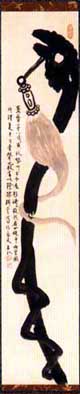
Hakuin's Dragon Staff Inka Scroll


Zen Master Hakuin (1686-1768) painted a Dragon Staff with a horsehair whisk attached.  He gave the above painting to a lay student who passed the Zen koan, "What is the sound of one hand clapping."