Showing posts with label Alan Watts. Show all posts

Saturday, November 04, 2023

The Sorry-Go-Round Goes Round (1951) and Round (2020)


The Wisdom of Insecurity: A Message for an Age of Anxiety.  

By Alan Watts. (1915-1973)
Vintage, 1951, 153 pages.  

I first read this short collection of essays in 1962, then in 2000, and again in 2020.  His ideas and recommendations in this short book, and many other books and recorded lectures by Alan Watts, influenced me greatly in high school, college, and my adult life.  I heard him lecture while in college and I remember just laughing a lot with the young audience, and somehow being lifted up into intellectual sophistication.  His use of metaphors, analogies, examples, and humor is quite clever.  He is full of pithy, wise, and accurate observations; and, his thoughts are relevant in 2022.  His popular explanation of various philosophical and religious views sometimes wavers, falters, and misses the mark; however, he hits the mark more often than not.  

The main thrust of the book is that our lived experience, always in the present, does not provide us with evidence for an enduring self or soul.  That ideas and concepts are useful, but are not to be confused with the reality of our current experience.  That thinking and language can separate us from our existential body-mind.  That memories of past experiences or anticipation of future experiences may be misleading us about our true identity.  That since we cannot loose what we never had (an eternal, enduring, essential self/soul); our anxiety and insecurity should be dissolved by awareness of our actual experiences.  That science and technology are indeed useful, but may condition us in ways that cause more stress and anxiety.  That the fact that uncertainty and death are real, and how we should abandon hope in life being otherwise and being fundamentally insecure.  That American society is stumbling towards insecurity and unhappiness.  

His critiques of American social views and practices are very insightful, and still quite relevant:

     "Thus the "brainy" [over-emphasis of thinking over immediate direct experience] economy designed to produce this happiness is a fantastic vicious circle which must either manufacture more and more pleasures or collapse- providing a constant titillation of the ears, eyes, and nerve ends with incessant streams of almost inescapable noise and visual distractions.  The perfect "subject" [viewer, customer] for the aims of this economy is the person who continuously itches his ears with the radio, preferably using the portable kinds which can go with him at all hours and in all places [smartphones in 2020].  His eyes flit without rest from television screen, to newspaper, [to Internet], to magazine, keeping him in a sort of orgasm-without-release through a series of teasing glimpses of shiny automobiles, shiny female bodies, and other sensuous surfaces, interspersed with such restorers of sensitivity - shock treatments - as "human interest" shots of criminals, mangled bodies, wrecked airplanes, prize fights and burning buildings.  The literature or discourse that goes along with this is similarly manufactured to tease without satisfaction, to replace every partial gratification with a new desire.
     For this stream of stimulants is designed to produce cravings for more and more of the same, though louder and faster, and these cravings drive us to do work which is of no interest save for the money it pays - to buy more lavish radios, sleeker automobiles, glossier magazines, and better television sets, all which will conspire to persuade us that happiness lies just around the corner if we will buy one more."
The Wisdom of Insecurity, p. 62.  


Friday, January 07, 2022

A Peach of a Surprise

A repost from 2012:  

This past week, I reread the Bhagavad Gita (translated by Eknath Easwaran) and The Upanishads (translated by Swami Prabhavananda).  I first read these important works in 1963.  These classic spiritual texts from India, written down in Sanskrit between 1200 and 400 BCE, are essential reading for Yogis.  
In many ways, realizing Brahman depends upon good actions and selfless service (Karma yoga), concentration and meditation, study of scriptures (Jhana yoga), heartfelt love and devotion (Bhakti yoga), guidance from a worthy and wise teacher (Guru), the healthy development of the body and calmness and evenness of mind (Hatha yoga), worship and rituals, faith, and to some extent, and a bit of luck or Grace.   
 
"Now the secret is that the other eventually turns out to be you.  The element of surprise in life is when suddenly you find the thing most alien turns out to be yourself.  Go out at night and look at the stars and realize that they are millions and billions of miles away, vast conflagrations far out in space.  You can lie back and look at that and say, "Well, surely I hardly matter.  I am just a tiny little speck aboard this weird spotted bit of dust called earth, and all that was going on out there billions of years before I was born and will still be going on out there billions of years after I die."  Nothing seems stranger to you that that, or more different from you, yet there comes a point, if you watch long enough, when you will say, "Why that's me!"  It is the other that is the condition of your being yourself, as the back is the condition of being the front, and when you know that, you know you never die."
Alan Watts, Swimming Headless, 1966

I first heard Alan Watts speak at California State University at Los Angeles in 1966.  I had read The Way of Zen and Beat Zen and Square Zen while in high school in 1962.  I was also well versed in the books on Zen, Buddhism, and Japanese culture by Professor D. T. Suzuki. 
Mr. Watts was a charming and engaging public speaker.  He made us laugh and he made us think. 

In 1966, I was then an undergraduate majoring in Philosophy at CSULA, and working 30 hours per week at the City of Commerce Public Library.   Since then, I've read all of the books by Alan Watts, and have listened to audiotapes of his lectures and radio broadcasts.  He was definitely an intellectual and lifestyle influence in my life.  


For me, the "realization" or "surprise" comes while gazing at our garden, working and tending our garden, thinking about gardening, and eating from our garden.  Within these experiences are myriad levels of meaning and complexity: ordinary human level, metaphorical, imaginative, microscopic, molecular, atomic, subatomic ...  This spot of earth where I live has been here for millions of years and will continue long after I die.  We animals and plants come and go, interdependent, interrelated, inter-being, a changing manifestation of the Here-Now, a snapshot of the divine realm.    

This peach, these peppers,
These grapes, these tomatoes
Will all soon become me.
Such a tasty fact.
I am That and That is Me. 
Bless the gardens!
Bless the gardeners!

Bless the kitchens!
Bless the cooks!  
Bless the food! 
-  Mike Garofalo, Pulling Onions


"Out of Brahman, who is the Self, came ether; out of ether, air; out of air, fire; out of fire, water; out of water, earth; out of earth, vegetation; out of vegetation, food; out of food, the body of man.  The body of man, composed of the essence of food, is the physical sheath of the Self.  From food are born all creatures, which live upon food and after death return to food.  Food is the chief of all things.  It is therefore said to be the medicine of all diseases of the the body.  Those who worship food as Brahman gain all material objects.  From food are born all beings which, being born, grow by food.  All beings feed upon foot, and, when they die, food feeds upon them."
Taittiriya Upanishad, p.59


"The sages of the Upanishads teach that Brahman is the ultimate essence of material phenomena (including the original identity of the human self) that cannot be seen or heard but whose nature can be known through the development of self-knowledge (atma jana).  According to Advaita, a liberated human being (jivanmukta) has realised Brahman as his or her own true self (see atman)."  - Brahman

Peach trees and peaches have a special place in my heart.  I carefully tend the peach trees in our orchard, but a bountiful crop is often just a gift, grace, luck. 

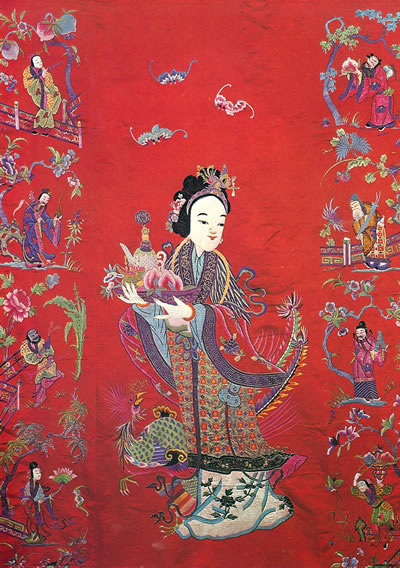
"In China, the peach was said to be consumed by the immortals due to its mystic virtue of conferring longevity on all who ate them. The divinity Yu Huang, also called the Jade Emperor, and his mother called Xi Wangmu also known as Queen Mother of the West, ensured the gods' everlasting existence by feeding them the peaches of immortality. The immortals residing in the palace of Xi Wangmu were said to celebrate an extravagant banquet called the Pantao Hui or "The Feast of Peaches". The immortals waited six thousand years before gathering for this magnificent feast; the peach tree put forth leaves once every thousand years and it required another three thousand years for the fruit to ripen. Ivory statues depicting Xi Wangmu's attendants often held three peaches. The peach often plays an important part in Chinese tradition and is symbolic of long life. One example is in the peach-gathering story of Zhang Daoling, who many say is the true founder of Taoism. Elder Zhang Guo, one of the Chinese Eight Immortals, is often depicted carrying a Peach of Immortality." - Wikipedia

Peaches are native to China and introduced to Persia via the Silk Road before Christian times.

Xi Wang Mu, Queen Mother of the West, keeps the Immortals fed with the Sacred Peaches.  "No one knows Her beginning, no one knows Her end."

Ripening Peaches: Taoist Studies and Practices


Xi Wangmu, Braham, the Divine, the Supreme Universal Spirit, the Unmanifested and Manifested, the Absolute, the Everlasting, the Shining, Everything, Food for Life, God ...

AUM, OM  ...  Shanti, Shanti, Shanti.  

Such a tasty peach!!  


Saturday, June 07, 2014

Zen Tenets for Artists

1.   The realities of the life are most truly seen in everyday things and actions.
2.   Everything exists according to its own nature.  One's individual perceptions of worth, correctness, beauty, size, and value exist inside our heads, not outside them.
3.   Everything exists in relation to other things.
4.   The self and the rest of the universe are not separate entities but one functioning whole.
5.   Man arises from nature and gets along most effectively by collaborating with nature, rather than by trying to master it.
6.   There is no ego in the sense of an endlessly enduring, unchanging private soul or personality that temporarily inhabits the body.
7.   True insight does not issue from specialized knowledge, from membership in coteries, from doctrines or dogmas.  It comes from the preconscious intuitions of one's whole being, from one's own code.
8.   In emptiness, forms are born.  When one becomes empty of the assumptions, inferences, and judgments he has acquired over the years, he comes close to his original nature and is capable of conceiving original ideas and reacting freshly. 
9.   Being a spectator while one is also a participant spoils one's performance.
10.  Security and changelessness are fabricated by the ego-dominated mind and do not exist in nature.  To accept insecurity and commit oneself to the unknown creates a relaxing faith in the universe.
11.  One can live only in the present moment.
12.  Living process and words about it are not the same and should not be treated equal in worth.
13.  When we perceive the incongruity between theories about life and what we feel intuitively to be true on the nonverbal, nonjudging plane, there is nothing to do but laugh. 
14.  Zen art has this characteristic quality, that it can fuse delight in a work of visual art, knowledge of life, and personal experiences and intuitions into one creative event. 
15.  Each of us develops into a unique individual who enters into unique transactions with the world as it exists for him.  
-  Stewart W. Holmes and Chimyo Horioka, Zen Art for Meditation, 1973 


 Photograph of Alan Watts (1915-1973)

Monday, August 22, 2011

Faceless Obscurity

"What is the color of your head from the standpoint of your eyes?  You feel that you head is black, or that it has not any color at all.  Outside you see your field of vision as an oval because your two eyes act as two centers of an ellipse.  But what is beyond the field of vision?  What color is it where you can't see?  It is not black, and this is an important point; there is no color at all beyond your field of vision.  This little mental exercise gives us an idea of what is mean by the character hsüan.  Although its dictionary definition is "dark, deep, obscure," it actually refers to this kind of no color that is the color of your head - as far as your eyes are concerned.  Perhaps we could say that the invisibility of one's head, in a certain sense the lack of a head, is the secret of being alive.  To be headless, or have no head in just the same sense I am talking about, is our way of talking about the Chinese expression wu hsin, or "no mind."  As a matter of fact, if you want to see the inside of your head all you have to do is keep your eyes open, because all that you are experiencing in the external, visual field is a state of your brain."
-  Alan Watts, Swimming Headless, 1966 

"Easter Wisdom, Modern Life: Collected Talks, 1960-1969."  By Alan Watts.  Novato, California, New World Library, 1994, 2006.