Showing posts with label Five Animal Frolics. Show all posts

Sunday, April 05, 2026

Crane Frolic, Exercise #2

Crane Frolics Qigong Exercises

2.  The Red-Headed Crane Delights in Seeing Its Mate  

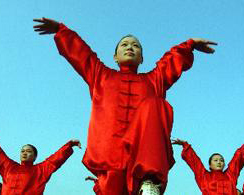
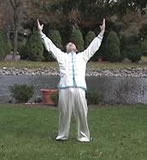
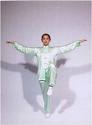
Lift both arms up to the sides until they are both above shoulder level.  The hands take the shape of the Crane's Hand they move above shoulder height.  (The ladies in the pictures below exemplify the posture desired when hands and knees are raised to the highest levels.) 

As the arms raise up, lift the left knee up until it is about at hip level.  Breathe in as you lift both arms up.  Pause for a moment at the highest point and look forward as if recognizing your mate or sweet-heart in a group.  Then lower the left leg and arms simultaneously as you exhale.  As the hands come down to the sides of your thighs, bend the knees slightly and dip down a little.  Then raise the arms up again as you lift the right knee up to hip height.  Inhale as you rise, exhale as you lower down.  Alternate the raising of arms and one leg for 4 to 10 repetitions.   
The height to which you will raise your knee depends upon your balancing skills, coordination, strength, confidence, and degree of skill.  Do try your best to raise the knee upward and draw your foot off of the floor. 
Folklore favors the idea that Cranes mate for life.  Some scientific research indicates that they do mate monogamously for long periods, but may change mates after a long period of time - serial monogamy.   Keeping the same mate means that their partner is special, recognizable, identifiable, and can be spotted in a group of Cranes feeding in a marsh or flying in formation during migration.  


Monday, September 25, 2023

Frolic Like a Deer

"The Deer Play is to imitate the shape and movement of a deer hoping to attain long life and pure soul like a deer. The features of a deer are its gentle disposition, swift movement, love to push with horns, and good at running. When it stands it likes to stretch its neck to glance at things afar. The deer also likes looking at left and right and its rear foot. It is also good at moving its tail bones (sacrum). The tail bone is the place where the Jen and Du meridians meet. Thus, during practice, the practitioner not only needs to imitate the attitude of a deer with swift movement and calm spirit, but also need to focus attention on the tail bone. This will guide Qi to the whole body, open meridians, circulate blood, relax tendons and bones, and benefit kidney and strengthen waist. It can also enhance blood circulation in the abdomen. This play is suitable for curing dysfunctional nerves in the internal organs, chronicle infections of the internal organs in the abdomen, fatigue in the waist muscles, nerve pain in the pelvis, deteriorated thigh bones, and the lack of sex drives."
-   Five Animal Frolics  


"Breathing in and out in various manners, spitting out the old and taking in the new, walking like a bear and stretching their neck like a bird to achieve longevity - this is what such practitioners of Daoyin, cultivators of the body and all those searching for long life like Ancestor Peng, enjoy."
-   Chuang-tzu, circa 300 BCE. 


"Firstly, we analyze its function in the aspect of psychological regulation as it is required that the practitioner should do it before and during each routines in the exercise of the Health Qigong Wu Qin Xi. The practitioner should mind on the Dantian and rid of the distracted thoughts with quiet mind and spirit before the exercise, get into the imitation of its physical activities of each animal in the exercise. When practicing the tiger exercise, try to imagine yourself as a fierce tiger in the mountains who is looking down upon other beasts and stretching its own pawns and about to pounce on its prey; in the deer exercise, imagine that you are prudent and mild, jogging on a green field; in the exercise of the bear, you are a clumsy bear, composed and steady, freely roaming the forests; in the monkey exercise, you become a happy and agile monkey; in the bird exercise, you are a free bird with quiet mind and flying in the sky. Therefore you can continuously regulate the mind state in the exercise and it is helpful to the relaxation of the mind. The regular exercise of this skill can transform and regulate the mind of the practitioner to relieve the spiritual nervousness, improve the emotional stability, reduce the mental stress and keep the healthy mind."
-   The Effect of Precaution against Sub-health of the Health Qigong Wu Qin Xi.  Chinese Health Qigong Association.  2008.   


Deer Frolic 

[Note: This was posted in March of 2015.]


Friday, June 02, 2023

Bear Frolics Dao Yin, Exercise #1

1.  The Big Bear Turns from Side to Side


Movement Description of Big Bear Turns from Side to Side 

Face towards N12.  
Bent the upper torso down, flexing forward, keep the back straight and head up. 
Move the upper torso slowly towards the right side of E3.  Try to remain bent forward until you reach E3.
Keep your hands on your hips throughout this exercise. 
Gradually lift the head and torso until you are upright and the face and chest are facing towards E3. 
Your right elbow should be pointing towards S6 and your left elbow pointing towards N12. 
Gently turn the head only to the left and look towards N12. 
Gently bring the head back to face towards E3, the whole body is in an upright posture. 
Bend forward at the waist and draw the head and torso downward towards E3.

Move the upper body, flexed forward, from right side to the left side for 180 degrees, moving from E3 to W9. 
Gradually lift the head and torso until you are upright, and the face and chest are facing towards W9. 
Your right elbow should be pointing towards N12 and your left elbow pointing towards S6. 
Gently turn the head only to the right and look towards N12. 
Gently turn the head only back to the left, and W9.
Bend forward at the waist and draw the head and torso downward towards W9.
Move the upper body, flexed forward, from the left side to the right side for 180 degrees, moving from W9 to E3. 
Repeat the movement sequence from side to side, 3 to 8 eight repetitions. 

Breathe freely, comfortably, and deeply during this exercise. 
Return to Bear Spirit Posture or Wu Ji Stance

Compare this version of "Big Bear Turns from Side to Side" with the version in the Eight Section Brocade Qigong, and with the demonstration.   


Bear Frolic Qigong Exercise Set

Eight Animals Frolics Mind/Body Fitness Practices (Chi Kung) by Mike Garofalo

The webpages for the eight specific animals will also have photographs of me or others doing these exercises.  There are also five, eight or twelve animals in Shaolin Kung Fu, Ba Gua Zhang, Taijiquan, and Xing Yi Quan.  Movements or postures called a "crane" or "hawk" or "rooster" are found in most of these mind-body internal arts.   

Chinese exercises recommended for improving fitness, maintaining good health, overcoming diseases, increasing energy and vitality, contributing to good mental health, and improving one's chances for longevity have a very long documented history going back to as early as 160 BCE in the Daoyin Tu.      


Repost from June 4, 2013

Sunday, August 28, 2022

Bear Frolics


Grizzly Bear, Art by Sue Coccia, from Edmunds, WA, Earth Art International


Bear Frolic, One of the Five Animal Frolics Exercise and Qigong Sets
By Michael P. Garofalo, 2009


Grizzly Bear blanket, Art by Sue Coccia, from Edmunds, WA,
 
Earth Art International

Friday, June 10, 2022

Deer Frolics Qigong


"The Deer Play is to imitate the shape and movement of a deer hoping to attain long life and pure soul like a deer. The features of a deer are its gentle disposition, swift movement, love to push with horns, and good at running. When it stands it likes to stretch its neck to glance at things afar. The deer also likes looking at left and right and its rear foot. It is also good at moving its tail bones (sacrum). The tail bone is the place where the Jen and Du meridians meet. Thus, during practice, the practitioner not only needs to imitate the attitude of a deer with swift movement and calm spirit, but also need to focus attention on the tail bone. This will guide Qi to the whole body, open meridians, circulate blood, relax tendons and bones, and benefit kidney and strengthen waist. It can also enhance blood circulation in the abdomen. This play is suitable for curing dysfunctional nerves in the internal organs, chronicle infections of the internal organs in the abdomen, fatigue in the waist muscles, nerve pain in the pelvis, deteriorated thigh bones, and the lack of sex drives."
- Five Animal Frolics

"Breathing in and out in various manners, spitting out the old and taking in the new, walking like a bear and stretching their neck like a bird to achieve longevity - this is what such practitioners of Daoyin, cultivators of the body and all those searching for long life like Ancestor Peng, enjoy." - Chuang-tzu, circa 300 BCE.


"Firstly, we analyze its function in the aspect of psychological regulation as it is required that the practitioner should do it before and during each routines in the exercise of the Health Qigong Wu Qin Xi. The practitioner should mind on the Dantian and rid of the distracted thoughts with quiet mind and spirit before the exercise, get into the imitation of its physical activities of each animal in the exercise. When practicing the tiger exercise, try to imagine yourself as a fierce tiger in the mountains who is looking down upon other beasts and stretching its own pawns and about to pounce on its prey; in the deer exercise, imagine that you are prudent and mild, jogging on a green field; in the exercise of the bear, you are a clumsy bear, composed and steady, freely roaming the forests; in the monkey exercise, you become a happy and agile monkey; in the bird exercise, you are a free bird with quiet mind and flying in the sky. Therefore you can continuously regulate the mind state in the exercise and it is helpful to the relaxation of the mind. The regular exercise of this skill can transform and regulate the mind of the practitioner to relieve the spiritual nervousness, improve the emotional stability, reduce the mental stress and keep the healthy mind."
- The Effect of Precaution against Sub-health of the Health Qigong Wu Qin Xi. Chinese Health Qigong Association. 2008. 


Thursday, June 04, 2020

Tiger Frolic Chi Kung Exercises #1

Tiger Frolics Mind-Body Fitness Practices

Chinese Health and Fitness Exercises (Chi Kung, Qigong, Dao Yin)
Webpages by Michael P. Garofalo, M.S.


Tiger Frolic Chi Kung (Energy Work, Qigong) Exercise Routines  


1.  The Tiger Lunges and Attacks

Feet together.  Stand up straight.  Arms at sides.
Bring hands to waist level with tiger claw hands (fingers open and curled).
Step out to left side at a 45 degree angle with the left leg.  Step into a high lunge posture.
As the left foot lifts and steps to the side, draw both hands up the body to above the head, lift the head, circling both arms up and down.
As the left foot comes to the floor, both hands, separated by a foot or so, claw downward to about waist level.
Draw the arms back to the waist (as if pulling the captured prey close to your Tiger body) and the left foot is drawn back to beside the right foot. 


Do the same movement to the right side.
Step out to right side at a 45 degree angle with the right leg.  Step into a high lunge posture.
As the right foot lifts and steps to the side, draw both hands up the body to above the head, lift the head, circling both arms up and down.
As the right foot comes to the floor, both hands, separated by a foot or so, claw downward to about waist level.
Draw the arms back to the waist (as if pulling the captured prey close to your Tiger body) and the right foot is drawn back to beside the left foot. 


Try to do 4 repetitions to the left side and also to the right side.  

Movement source citation:  Tiger Frolic #3, Big Lunge.  UTube Video, 1:34 minutes.  Performed by Anson Rathbone, 2007.  As taught by Deguang at NESA's Medical Qigong Class.


Tiger Frolic Qigong Exercise #1

Eight Animals Frolics Mind/Body Fitness Practices (Chi Kung) by Mike Garofalo

Qigong (Chi Kung) Exercises 

Green Way Research Subject Index


Each Monday for the next year I will be posting short descriptions of exercises from the Eight Animal Frolics Chi Kung Practices.  By the end of this project, you will have 52 exercises: Eight Animals with 6 or 7 Exercises for each Animal Frolic.  The webpage for the specific animal will also have photographs of me doing these exercises on the webpage.    


Chinese exercises to improve fitness, maintain good health, increase energy, and improve the chances for longevity have a very long documented history in China.  


Thursday, January 25, 2018

There's so much to be done


To experience the Five Animal Frolics we need to keep in mind the "Frolics" aspect of this movement art: being playful and exuberant, freeing up our time for fun, delighting in bodily movements, enjoying games of imitation, taking pleasure in the moment, and delighting in the exercise of fantasy and imagination.  We should be smiling as we enjoy our playful frolics.  We should strive to return to our youth, and rekindle those memories of our joyful childhood games, innocence, freedom of fancies, and silliness.  We are never too old to embrace that precious child within each of us.  

Bear Frolics: Lessons, Bibliography, Notes

The Complete Tales of Winnie-the-Pooh.  By A. A. Milne.  With decorations by Ernest H. Shepard.  New York, Dutton's Children's Books, 1994.  344 pages.  Color illustrations, hardbound.  ISBN: 9780525457237.  Originally published in 1926, 1954.  This book includes: Winnie-the-Pooh, and The House at Pooh Corner, VSCL.  
 
The Te of Piglet.  By Benjamin Hoff.  New York, Penguin Books, 1992.  257 pages.  ISBN: 0140230165.  VSCL.  

The Tao of Pooh.  By Benjamin Hoff.  New York, Penguin Books.  VSCL 
  

The most famous literary Bear is Winnie the Pooh.  Over 26 million English language books by A. A. Milne about the Pooh Bear and his friends have been sold since 1926, the books have been translated into scores of languages, and Disney Films has made him even more famous and a lucrative commodity line.  Benjamin Hoff has explored how Pooh Bear is a quintessential "Taoist Bear."   

So ... it is just fine for you to Dance like a Bear.
Become a Silly Bear for a awhile.
Enjoy the real honey of just being right were you are,
   here and now, content,
   Pooh, it is quite easy.


"Christopher Robin and I walked along
Under branches lit up by the moon
Posing our questions to Owl and Eeyore
As our days disappeared all too soon
But I've wandered much further today than I should
And I can't seem to find my way back to the Wood

So help me if you can
I've got to get back
To the House at Pooh Corner by one
You'd be surprised
There's so much to be done
Count all the bees in the hive
Chase all the clouds from the sky
Back to the days of Christopher Robin and Pooh."
- Return to Pooh Corner Words and lyrics by Kenny Loggins, 1969, MCA Musi


Wednesday, April 05, 2017

Deer Raises Its Antlers


"To learn and practice “Deer Show”, it is indispensable to understand the fitness functions of it. In the first place, it can strengthen the waist and kidney. The traditional Chinese medicine claims that the Du meridian has close relationship with brain, marrow and kidney, which can prevent from the pathological changes for the above three organs. By means of turning waist as well as twisting coccygeal end, it is conductive to clear the meridians, improve blood circulation, and strengthen the exchange of congenital and acquired blood. All the above functions can control and prevent from the symptoms such as waist virtual cold, pain, enuresis and diarrhea, exert a strong efficacy of kidney. In the second place, it can play the role of arousing the Yang-Energy. By means of gravity moving backward, the whole spine bending, the coccygeal end folder, Ming Men protruding backward, clearing the Da Zhui to raise the Yang-Energy. Furthermore, it is positive to promote the blood transmission to the body meridians, nourishing the body from top to bottom, from inside to outside, so that it can contribute greatly to restore normal physiological and psychological functions. In the third place, it can fully rotate the spine, enhance muscle strength and prevent from the disorders of waist. The arms with the state of internal rotation, the shoulder and back muscles with the state of free stretch, can exert favorable effects on preventing from the neck and shoulder syndromes."
-   Connotations of “Deer Show” of Wu Qin Xi,  Chinese Health Qigong Association 

Five Animal Frolics Qigong   Hypertext research notebooks of Mike Garofalo.


Monday, March 06, 2017

Playing like a Deer

"The Deer Play is to imitate the shape and movement of a deer hoping to attain long life and pure soul like a deer. The features of a deer are its gentle disposition, swift movement, love to push with horns, and good at running. When it stands it likes to stretch its neck to glance at things afar. The deer also likes looking at left and right and its rear foot. It is also good at moving its tail bones (sacrum). The tail bone is the place where the Jen and Du meridians meet. Thus, during practice, the practitioner not only needs to imitate the attitude of a deer with swift movement and calm spirit, but also need to focus attention on the tail bone. This will guide Qi to the whole body, open meridians, circulate blood, relax tendons and bones, and benefit kidney and strengthen waist. It can also enhance blood circulation in the abdomen. This play is suitable for curing dysfunctional nerves in the internal organs, chronicle infections of the internal organs in the abdomen, fatigue in the waist muscles, nerve pain in the pelvis, deteriorated thigh bones, and the lack of sex drives."
-   Five Animal Frolics  


"Breathing in and out in various manners, spitting out the old and taking in the new, walking like a bear and stretching their neck like a bird to achieve longevity - this is what such practitioners of Daoyin, cultivators of the body and all those searching for long life like Ancestor Peng, enjoy."
-   Chuang-tzu, circa 300 BCE. 


"Firstly, we analyze its function in the aspect of psychological regulation as it is required that the practitioner should do it before and during each routines in the exercise of the Health Qigong Wu Qin Xi. The practitioner should mind on the Dantian and rid of the distracted thoughts with quiet mind and spirit before the exercise, get into the imitation of its physical activities of each animal in the exercise. When practicing the tiger exercise, try to imagine yourself as a fierce tiger in the mountains who is looking down upon other beasts and stretching its own pawns and about to pounce on its prey; in the deer exercise, imagine that you are prudent and mild, jogging on a green field; in the exercise of the bear, you are a clumsy bear, composed and steady, freely roaming the forests; in the monkey exercise, you become a happy and agile monkey; in the bird exercise, you are a free bird with quiet mind and flying in the sky. Therefore you can continuously regulate the mind state in the exercise and it is helpful to the relaxation of the mind. The regular exercise of this skill can transform and regulate the mind of the practitioner to relieve the spiritual nervousness, improve the emotional stability, reduce the mental stress and keep the healthy mind."
-   The Effect of Precaution against Sub-health of the Health Qigong Wu Qin Xi.  Chinese Health Qigong Association.  2008.   


Deer Frolic  (Someday I might finish this webpage.  Oh well!  No hurry!) 


Monday, March 14, 2016

Bear Frolic Chi Kung Exercise #1

1.  The Big Bear Turns from Side to Side

Movement Description of Big Bear Turns from Side to Side 
Chi Kung (Qigong) Exercises

Bear Frolic Exercise #1: The Big Bear Turns from Side to Side
This webpage provides a detailed description, including photographs, of this movement.


Step out into a Horse Stance.  Face towards N12.  The Horse Stance should feel be rooted, centered, balanced, and stable. 
Place your hands on your hips. 
Bend the upper torso down, flexing forward, keep the back straight and head up. 
Move the upper torso slowly towards the right side to E3.  Try to remain bent forward until you reach E3.  Inhale. 
Keep your hands on your hips throughout this exercise.
Gradually lift the head and torso until you are upright and the face and chest are facing towards E3. 
Your right elbow should be pointing towards S6 and your left elbow pointing towards N12. 
Gently turn the head only to the left and look towards N12.  Intently gaze towards N12.  Enjoy the stretch.  Exhale. 
Gently bring the head back to face towards E3, the whole body is in an upright posture. 
Bend forward at the waist and draw the head and torso downward towards E3.


Move the upper body, flexed forward, from right side to the left side for 180 degrees, moving from E3 to W9.  Inhale. 
Gradually lift the head and torso until you are upright, and the face and chest are facing towards W9. 
Your right elbow should be pointing towards N12 and your left elbow pointing towards S6. 
Gently turn the head only to the right and look towards N12.  Intently gaze towards N12.  Enjoy the stretch.  Exhale. 
Gently turn the head only back to the left, and face W9.
Bend forward at the waist and draw the head and torso downward towards W9.
Move the upper body, flexed forward, from the left side to the right side for 180 degrees, moving from W9 to E3.  Inhale. 

Repeat the movement sequence from side to side, 3 to 8 eight repetitions. 
Breathe freely, comfortably, and deeply during this exercise.  Inhale-Exhale listed are suggestions. 
Try to avoid too much muscular tension as you move from side to side and up and down.  Extend rather than tense muscles. 
Move slowly and comfortably. 
Try to stay relaxed (Sung), alert, calm, and peaceful. 
Visualize, if you like, a mother bear coming out of a cave and powerfully turning from side to side to survey the outside world. 

Return to Bear Spirit Posture or Wu Ji Stance


This version of "Big Bear Turns from Side to Side" is the same as exercise in the Eight Section Brocade Qigong.


Bear Frolics Chi Kung Exercises


Bear Frolic Exercise #1: The Big Bear Turns from Side to Side
This webpage provides a detailed description, including photographs, of this movement.


Five Animal Frolics Chi Kung (Qigong, Nourshing Life) Exercises


Dragon Chi Kung Exercises


Valley Spirit Chi Kung


Each Monday, for the next year, I will be posting on this blog short descriptions of exercises from the Five Animal Frolics Chi Kung Practices. I began this project on 3/7/2016.  By the end of this project, you will have 52 Animal Frolics Qigong exercises.  Each webpage for the specific Animal Frolic Chi Kung exercise will also have photographs of me doing the exercise described each week.

Nourishing Life practices and exercises to improve fitness, maintain good health, increase energy, calm the mind, and improve the chances for longevity have a very long documented history in China.  A healthy and long life are goals of Taoist theory and practices.  Animal Frolics Chi Kung exercises date back to Dr. Hua Tuo (207 CE).  


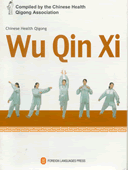
"Wu Qin Xi (Five Animal Frolics): Chinese Health Qigong. Compiled by the Chinese Health Qigong Association. Beijing, Chine, Foreign Languages Press, 2007. 102 pages, includes an instructional DVD. ISBN: 9787119047799. VSCL. "In 2001 the Chinese government showed great interest in regulating the Qigong movement. The State Sport General Administration of China founded the Chinese Health Qigong Association, as a mass-organization to popularize, spread and research Health Qigong in cooperation with the Peking Sport University. 


In 2003 the organization presented the newly developed four Health Qigong Exercises on the base of excellent traditional Qigong, including: Yì JÄ«n JÄ«ng (tendon-changing classic), Wu Qin Xi (frolics of five animals 五禽戲), Liu Zi Jue (the art of expiration in producing six different sounds), Ba Duan Jin (eight excellent movements), to fit the people's needs of promoting their health and body, and to develop traditional Chinese national culture further. 
The Chinese Health Qigong Association is a member of the All-China Sports Federation. During the process of developing the exercises, strictly scientific research methods have been followed. Primary experiments took place under supervision of Traditional Chinese Medicine, Modern Medicine, Psychology, Athletic Science and other related subjects. 
The Four Health Qigong Exercises can be seen as the essences from the related Qigong in various schools, inherited and developed traditional Chinese national culture. The new Health Qigong represented by the Chinese Health QiGong Association is breaking with the old tradition of family-styles and close teacher-student relation. 

It is hoped that the new standardisation is supporting the international spread of Qigong in the western hemisphere. Starting in September 2004 the "Health Qigong Magazine" became the association magazine of the CHQA. It is the only national health qigong publication in China; edtited through China Sports Press. After the successful 1st International Health Qigong Demonstration and Exchange in 2005 the CHQA organized in August 2007 the 2nd International Health Qigong Demonstration and Exchange in Peking including an international competition and the first Duan examination on Health Qigong. At the same time, the 2007 International Symposium on Health Qigong Science was organized where important scientific studies were made public."
- Wikipedia


Wednesday, October 28, 2015

Crane Frolics Chi Kung Exercises

6.  The Crane Opens and Closes Its Wings

Begin in the basic Crane stance with the hands at the waist.  The legs are separated with a shoulder's width.  Stretch the fingers open.  Inhale as you lift both hands up the center of the body, fingers pointing forward, arms about 24" apart.


As the hands reach the neck begin to move both hands to the side, upwards, and backwards.  Spread the arms as far apart as you can and to either side of the body as you lift both arms high above the head.  Draw the arms up and back as you gently bend backwards.


At the same time as the arms are lifted up and back, try to lift both heels off the ground, and come up on your toes.  Look up at the sky with your head drawn back. 
As you begin to exhale, gently draw the arms forward and down, straighten the back, look forward, and move the arms down to the waist.  


Repeat for 4 to 8 repetitions in a gentle, slow, calm, deliberate, and smooth manner. 

This movement is found in the Wild Goose Qigong (Dayan Chi Kung) routine.  Refer to "Wild Goose Qigong" by Hong-Chao Zhang, pp.20-21.  

Back-bending while standing with the arms lifted above the head and with the hands touching is a commonly used hatha yoga posture called Anyvittasana.   
This exercise is a hyperextension of the back, stretching of the latissimus dorsi muscles of sides of the upper back, a stretching of the upper rectus abdominis, engaging the pectoralis major, and a tensing of the trapezius muscles in the upper back and neck. 
This movement opens and fills with Qi (Chi, Energy) the Middle Dan Tien (i.e., 中丹田, Zhong Dantian, middle elixir fields, cauldron) of the esoteric body system explained in Chinese Qigong (Yoga); or, analogously, opens the Heart Chakra (Anhata) of Hatha Yoga.  Exercise of this area in the front of the body helps heal disturbed emotions, calms the spirit, strengthens the heart and lungs, and opens the Heart-Soul to the grace of light energy. 
The wide-spread arms held up high help establish a feeling of opening up, freeing oneself, and uplifting one's mood and spirit.  


You often see this ritual body posture in Christian revival meetings as a kind of "Saying Hallelujah" posture.


If the movement was done forcefully and with power and quickly it would be the flapping of the wings of a powerful bird like a Crane or wild Goose or for a human bodybuilder the performance of incline dumbbell flys. 


Crane Frolic Qigong Exercise Set

Eight Animals Frolics Mind/Body Fitness Practices (Chi Kung) by Mike Garofalo
 

The webpages for the eight specific animals will also have photographs of me or others doing these exercises.  There are also five, eight or twelve animals in Shaolin Kung Fu, Ba Gua Zhang, Taijiquan, and Xing Yi Quan.  Movements or postures called a "crane" or "hawk" or "rooster" are found in most of these mind-body internal arts.   

Chinese exercises recommended for improving fitness, maintaining good health, overcoming diseases, increasing energy and vitality, contributing to good mental health, and improving one's chances for longevity have a very long documented history going back to as early as 160 BCE in the Daoyin Tu.    

Thursday, June 25, 2015

Bear Frolics Exercises


To experience the Five Animal Frolics we need to keep in mind the "Frolics" aspect of this movement art: being playful and exuberant, freeing up our time for fun, delighting in bodily movements, enjoying games of imitation, taking pleasure in the moment, and delighting in the exercise of fantasy and imagination.  We should be smiling as we enjoy our playful frolics.  We should strive to return to our youth, and rekindle those memories of our joyful childhood games, innocence, freedom of fancies, and silliness.  We are never too old to embrace that precious child within each of us.  

Bear Frolics: Lessons, Bibliography, Notes

The Complete Tales of Winnie-the-Pooh.  By A. A. Milne.  With decorations by Ernest H. Shepard.  New York, Dutton's Children's Books, 1994.  344 pages.  Color illustrations, hardbound.  ISBN: 9780525457237.  Originally published in 1926, 1954.  This book includes: Winnie-the-Pooh, and The House at Pooh Corner, VSCL.  
 
The Te of Piglet.  By Benjamin Hoff.  New York, Penguin Books, 1992.  257 pages.  ISBN: 0140230165.  VSCL.  

The Tao of Pooh.  By Benjamin Hoff.  New York, Penguin Books.  VSCL 
  

The most famous literary Bear is Winnie the Pooh.  Over 26 million English language books by A. A. Milne about the Pooh Bear and his friends have been sold since 1926, the books have been translated into scores of languages, and Disney Films has made him even more famous and a lucrative commodity line.  Benjamin Hoff has explored how Pooh Bear is a quintessential "Taoist Bear."   

So ... it is just fine for you to Dance like a Bear.
Become a Silly Bear for a awhile.
Enjoy the real honey of just being right were you are,
   here and now, content,
   Pooh, it is quite easy.


"Christopher Robin and I walked along
Under branches lit up by the moon
Posing our questions to Owl and Eeyore
As our days disappeared all too soon
But I've wandered much further today than I should
And I can't seem to find my way back to the Wood

So help me if you can
I've got to get back
To the House at Pooh Corner by one
You'd be surprised
There's so much to be done
Count all the bees in the hive
Chase all the clouds from the sky
Back to the days of Christopher Robin and Pooh."
- Return to Pooh Corner Words and lyrics by Kenny Loggins, 1969, MCA Musi