Showing posts with label Transcendentalism. Show all posts

Monday, September 23, 2024

Tao Te Ching, Chapter 4

Daodejing, Laozi
Chapter 4


"Tao is like an empty vessel,
yet use will not drain it.
Never needing to be filled,
it is the deep and unfathomable source
of the ten thousand things.

Blunt the sharpness.
Untangle the knots.
Soften the glare.
Settle like dust.
Let your wheels move only along old ruts.

Darkly visible,
it only seems as if it were there.
I know not its name.
It existed before the ten thousand things.
I call it Tao."
-  Translated by Kari Hohne, 2009, Chapter 4  


"Tao is a whirling emptiness, yet when used it cannot be exhausted.
Out of this mysterious well flows everything in existence.
Blunting sharp edges, Untangling knots, Softening the glare, It evolves us all and makes the whole world one.
Something is there, hidden and deep!
But I do not know whose child it is.
It came even before God."
-  Translated by Brian Browne Walker, 1996, Chapter 4  


"Tao is infinite.
If we use It, we find It inexhaustible,
Deep!
It appears to be Ancestor of all things.
It rounds our angles. It unravels our difficulties. It harmonizes our Light. It brings our atoms into Unity.
Pure!
It appears to be everlasting in principle.
I do not know whose Son It is,
It existed before God was manifest in Form."
-  Translated by Isabella Mears, 1916, Chapter 4 


"The Tao is like an empty bowl, 
Which in being used can never be filled up.
Fathomless, it seems to be the origin of all things.
It blunts all sharp edges,
It unties all tangles,
It harmonizes all lights,
It unites the world into one whole.
Hidden in the deeps,
Yet it seems to exist for ever.
I do not know whose child it is;
It seems to be the common ancestor of all, the father  of things."
-  Translated by John C. H. Wu, 1961, Chapter 4  


道沖而用之或不盈.
淵兮似萬物之宗.
挫其銳.
解其紛.
和其光同其塵.
湛兮似或存.
吾不知誰之子.
象帝之先.
-  Chinese characters, Chapter 4, Tao Te Ching


dao chang er yong zhi huo bu ying.
yuan xi si wan wu zhi zong.
cuo qi rui.
jie qi fen.
he qi guang tong qi chen.
zhan xi si huo cun.
wu bu zhi shui zhi zi.
xiang di zhi xian.  
-  Pinyin Romanization, Chapter 4, Daodejing


"Existence, by nothing bred,
Breeds everything.
Parent of the universe,
It smoothes rough edges,
Unties hard knots,
Tempers the sharp sun,
Lays blowing dust,
Its image in the wellspring never fails.
But how was it conceived?--this image
Of no other sire."
-  Translated by Witter Bynner, 1944, Chapter 4 


"Tao is empty, used yet never filled.
It is deep, like the forefather of all things.
It dulls sharpness, and sorts tangles,
Blends with the light, becoming one with the dust.
So serene, as if it hardly existed.
I do not know whose son it is.
It seems to have preceded God."
-  Translated by Paul J. Lin, Chapter 4 


"El Tao es como un jarrón
que el uso nunca llena.
Es iqual que un abismo,
origen de todas las cosas del mundo.

El embota cualquier filo,
El desmadeja cualquier ovillo,
El fusiona todas las cuces,
El unifica todos los polvos.

El parece muy frofundo,
parece durar siempre.
Higo de un no sé qué,
debe de ser el antepasado de los dioses."
-  Translated by Alba, 1998, Tao Te Ching, Capítulo 4 


"The subtle Way of the universe appears to lack strength,
yet its power is inexhaustible.
Fathomless, it could be the origin of all things.
It has no sharpness,
yet it rounds off all sharp edges.
It has no form,
yet it unties all tangles.
It has no glare,
yet it merges all lights.
It harmonizes all things and unites them as one integral whole.
It seems so obscure,
yet it is the Ultimate Clarity.
Whose offspring it is can never be known.
It is that which existed before any divinity."
-  Translated by Hua-Ching Ni, 1995, Chapter 4  


"Tao is an empty vessel;
it is used but never exhausted.
It is the fathomless source
of the ten thousand beings!
It blunts the sharp
and untangles the knots.
It softens the glare
and unites with the dust of the world.
It is tranquil and serene
and endures forever.
I don't know form where it comes
yet it is the ancestor of all."
-  Translated by Solala Towler, 2016, Chapter 4 


"Tao is a container
Though used again and again
It is never full
Profound!  As though the ancestor of all things

Rounding the points
Untying the knots
Softening the glare
Unifying the dust


Tranquil!  Although having a life of its own
I do not know whose child it is
It appears to have preceded the primordial ruler"
-  Translated by Dan G. Reid, 2016, Chapter 4 


"The Tao is like an empty container: 
 it can never be emptied and can never be filled.
 Infinitely deep, it is the source of all things.
 It dulls the sharp, unties the knotted,
 shades the lighted, and unites all of creation with dust.

It is hidden but always present.
 I don't know who gave birth to it.
 It is older than the concept of God."
-  Translated by John H. McDonald, 1996, Chapter 4  


A typical webpage created by Mike Garofalo for each one of the 81 Chapters (Verses, Sections) of the Tao Te Ching (Daodejing) by Lao Tzu (Laozi) includes 25 different English language translations or interpolations for that Chapter, 5 Spanish language translations for that Chapter, the Chinese characters for that Chapter, the Wade-Giles and Hanyu Pinyin transliterations (Romanization) of the Mandarin Chinese words for that Chapter, and 2 German and 1 French translation of that Chapter.  Each webpage for each one of the 81 Chapters of the Tao Te Ching includes extensive indexing by key words, phrases, and terms for that Chapter in English, Spanish, and the Wade-Giles Romanization.  Each webpage on a Chapter of the Daodejing includes recommended reading in books and websites, a detailed bibliography, some commentary, research leads, translation sources, a Google Translate drop down menu, and other resources for that Chapter.  These are hypertext documents, and available online under Creative Commons 4.


Chapter 4, Tao Te Ching by Lao Tzu.  Compiled and indexed by Mike Garofalo.  

Chapter and Thematic Index (Concordance) to the Tao Te Ching by Lao Tzu


English Language Daodejing Translators' Source Index


Spanish Language Daodejing Translators' Source Index


Ripening Peaches: Taoist Studies and Practices


Taoism: A Selected Reading List


Wednesday, July 14, 2021

They Speak to Me, and My Heart Soars


"The beauty of the trees,
the softness of the air,
the fragrance of the grass,
speaks to me.
The summit of the mountain,
the thunder of the sky,
speaks to me.
The faintness of the stars,
the trail of the sun,
the strength of fire,
and the life that never goes away,
they speak to me.
And my heart soars."
-  Chief Dan George  


"I did however used to think, you know, in the woods walking, and as a kid playing the the woods, that there was a kind of immanence there - that woods, a places of that order, had a sense, a kind of presence, that you could feel; that there was something peculiarly, physically present, a feeling of place almost conscious ... like God.  It evoked that."
-  Robert Creely, Robert Creely and the Genius of the American Common Place, p. 40   


"I like to walk about amidst the beautiful things that adorn the world."
- George Santayana


Zen Poetry

Buddhism

Haiku Poetry

Gardening and Spirituality

Trees


Saturday, June 03, 2017

Sowing and Reaping the Ordinary

"This is the realm of true reality where you forget what is on your mind and stop looking.  In a wild field, not choosing, picking up whatever comes to hand, the obvious meaning of Zen is clear in the hundred grasses.  Indeed, the green bamboo, the clusters of yellow flowers, fences, walls, tiles, and pebble us the teaching of the inanimate; rivers, birds, trees, and groves expound suffering, emptiness, and selflessness.  This is based on the one true reality, producing unconditional compassion, manifesting uncontrived, supremely wondrous power in the great jewel light of nirvana.

An ancient master said, "Meeting a companion on the Way, spending a life together, the whole task of study is done."  Another master said, "If I pick up a single leaf and go into the city, I move the whole of the mountain."  That is why one ancient adept was enlightened on hearing the sound of pebbles striking bamboo, while another was awakened on seeing peach trees in bloom.  An ancient worthy, working in the fields in his youth , was breaking up clumps of earth when he saw a big clod, which he playfully smashed with a fierce blow; as it shattered, he was suddenly greatly enlightened.  One Zen master attained enlightenment on seeing the flagpole of a teaching center from the other side of a river.  Another spoke of the staff of the spirit.  One adept illustrated Zen realization by planting a hoe in the ground; another master spoke of Zen in term of sowing the fields.  All of these instances were bringing out this indestructible true being, allowing people to visit a greatly liberated true teacher without moving a step.

Carrying out the unspoken teaching, attaining unhindered eloquence, thus they forever studied all over from all things, embracing the all-inclusive universe, detaching from both abstract and concrete definitions of buddhahood, and transcendentally realizing universal, all pervasive Zen in the midst of all activities.  Why necessarily consider holy places, teachers' abodes, or religious organizations and forms prerequisite to personal familiarity and attainment of realization?"

-  Yuan-Wu, The House of Lin-Chi, "The Five Houses of Zen," translated by Thomas Cleary, Shambhala Press, 1997, p. 58.  


"I did however used to think, you know, in the woods walking, and as a kid playing the the woods, that there was a kind of immanence there - that woods, a places of that order, had a sense, a kind of presence, that you could feel; that there was something peculiarly, physically present, a feeling of place almost conscious ... like God.  It evoked that."
-  Robert Creely, Robert Creely and the Genius of the American Common Place, p. 40   


"The beauty of the trees,
the softness of the air,
the fragrance of the grass,
speaks to me.
The summit of the mountain,
the thunder of the sky,
speaks to me.
The faintness of the stars,
the trail of the sun,
the strength of fire,
and the life that never goes away,
they speak to me.
And my heart soars."
-  Chief Dan George  


Zen Poetry

Buddhism

Haiku Poetry

Gardening and Spirituality


Saturday, May 30, 2015

These Hieroglyphics Which My Eyes Behold

"I live so much in my habitual thoughts that I forget there is any outside to the globe, and am surprised when I behold it as now--yonder hills and river in the moonlight, the monsters. Yet it is salutary to deal with the surface of things. What are these rivers and hills, these hieroglyphics which my eyes behold? There is something invigorating in this air, which I am peculiarly sensible is a real wind, blowing from over the surface of a planet. I look out at my eyes. I come to my window, and I feel and breathe the fresh air. It is a fact equally glorious with the most inward experience. Why have we ever slandered the outward?"
Henry David Thoreau (1817-1862), Journal Vol. 4, 1852


"Look hard at what pleases you and harder at what doesn't."
-  Colette    

"It is easy to suppose that few people realize on that occasion, which comes to all of us, when we look at the blue sky for the first time, that is to say: not merely see it, but look at it and experience it and for the first time have a sense that we live in the center of a physical poetry, a geography that would be intolerable except for the non-geography that exists there - few people realize that they are looking at the world of their own thoughts and the world of their own feelings." 
-   Wallace Stevens, The Necessary Angel 


Spirituality and Nature


Thursday, November 20, 2014

Study All Over From All Things

"This is the realm of true reality where you forget what is on your mind and stop looking.  In a wild field, not choosing, picking up whatever comes to hand, the obvious meaning of Zen is clear in the hundred grasses.  Indeed, the green bamboo, the clusters of yellow flowers, fences, walls, tiles, and pebble us the teaching of the inanimate; rivers, birds, trees, and groves expound suffering, emptiness, and selflessness.  This is based on the one true reality, producing unconditional compassion, manifesting uncontrived, supremely wondrous power in the great jewel light of nirvana.

An ancient master said, "Meeting a companion on the Way, spending a life together, the whole task of study is done."  Another master said, "If I pick up a single leaf and go into the city, I move the whole of the mountain."  That is why one ancient adept was enlightened on hearing the sound of pebbles striking bamboo, while another was awakened on seeing peach trees in bloom.  An ancient worthy, working in the fields in his youth , was breaking up clumps of earth when he saw a big clod, which he playfully smashed with a fierce blow; as it shattered, he was suddenly greatly enlightened.  One Zen master attained enlightenment on seeing the flagpole of a teaching center from the other side of a river.  Another spoke of the staff of the spirit.  One adept illustrated Zen realization by planting a hoe in the ground; another master spoke of Zen in term of sowing the fields.  All of these instances were bringing out this indestructible true being, allowing people to visit a greatly liberated true teacher without moving a step.

Carrying out the unspoken teaching, attaining unhindered eloquence, thus they forever studied all over from all things, embracing the all-inclusive universe, detaching from both abstract and concrete definitions of buddhahood, and transcendentally realizing universal, all pervasive Zen in the midst of all activities.  Why necessarily consider holy places, teachers' abodes, or religious organizations and forms prerequisite to personal familiarity and attainment of realization?"

-  Yuan-Wu, The House of Lin-Chi, "The Five Houses of Zen," translated by Thomas Cleary, Shambhala Press, 1997, p. 58.  


"I did however used to think, you know, in the woods walking, and as a kid playing the the woods, that there was a kind of immanence there - that woods, a places of that order, had a sense, a kind of presence, that you could feel; that there was something peculiarly, physically present, a feeling of place almost conscious ... like God.  It evoked that."
-  Robert Creely, Robert Creely and the Genius of the American Common Place, p. 40   


"The beauty of the trees,
the softness of the air,
the fragrance of the grass,
speaks to me.
The summit of the mountain,
the thunder of the sky,
speaks to me.
The faintness of the stars,
the trail of the sun,
the strength of fire,
and the life that never goes away,
they speak to me.
And my heart soars."
-  Chief Dan George  


Zen Poetry

Buddhism

Haiku Poetry

Gardening and Spirituality


Saturday, November 01, 2014

Can Inanmite Realms Show the Way?

A monk asked, "Can inanminate things expound Dharma?"
Daopi said, "The jade dog roams at night, never knowing the daylight."


"Zen Master Yunmen Wenyan (864-949 CE) once took his staff and struck a pillar in the hall, saying, "Are the three vehicles and twelve divisions of scripture talking?"
He then answered himself by saying, "No, they're not talking."
Then he shouted, "Bah!  A wild fox spirit!"
A monk asked, "What does the master mean?"
Yunmen said, "Mr. Shang drinks the wine, and Mr. Li gets drunk."


"In the works of Emerson, Thoreau, and Whitman in particular, nature is portrayed as a beneficent living force that can, if studied and understood through careful and intentional reflection, offer enduring lessons about what it means to be human. In “Self-Reliance,” and the main ideas behind Thoreau’s “Walden”, as well as “Leaves of Grass”, the respective authors are deeply reverent of nature, and it is through their intimate relationship with the natural world that they construct their own identities and their philosophies about how to live a right life in the natural world. For Emerson, Thoreau, and Whitman, nature is viewed as possessing all the knowledge that man needs to know, if only he is attentive and willing enough to study its messages and apply them to his life."
-  Nicole Smith, The Role of Nature in Transcendental Poetry


Yunmen said, "A true person of the Way can speak fire without burning his mouth.  He can speak all day with moving his lips and teeth or uttering a word.  The entire day he just wears his clothes and eats his food, but never comes in contact with a single grain of rice or thread of cloth.
When we speak in this fashion it is jut the manner of our school.  It must be set forth like this to be realized.  But if you meet a true patch-robed monk of our school and try to reveal the essence through words, it will be a waste of time and effort.  Even if you get some great understanding by means of a single word you are still just dozing."
 

"Zen's Chinese Heritage: The Masters and Their Teachings."  Translated by Any Ferguson.  Boston, Wisdom Publications, 2000, p. 262.  


Way of the Short Staff.  By Michael P. Garofalo, M.S.  A comprehensive guide to the practice of the short staff, cane, jo, walking stick, gun, zhang, whip staff, 13 Hands Staff, and related wood short staff weapons.  A detailed and annotated guide, bibliographies, lists of links, resources, instructional media, online videos, and lessons.   Includes use of the short staff and cane in martial arts, self-defense, walking and hiking.  Separate sections on Aikido Jo, Cane, Taijiquan cane and staff, Jodo, exercises with a short staff, selected quotations, techniques, selecting and purchasing a short staff, tips and suggestions, and a long section on the lore, legends, and magick of the short staff.  Includes "Shifu Miao Zhang Points the Way."  Published by Green Way Research, Valley Spirit Taijiquan, Red Bluff, California.  Updated on a regular basis since October, 2008.  Filesize: 265Kb.  Related to Mike's popular webpage on the Staff.


"Zhaozhou, who had been in poor health, asked his friend Miao Zhang, "Do the bees have Buddha nature?"  Miao Zhang smiled and said, "The roses are so fragrant today, and the cherries so sweet.  Let's walk in the garden and leave our crutches behind." 

    Gathering together in an orchard of blooming sweet lime trees, the students waited for their esteemed teacher, Kasyapa.  Slowly walking down the dirt path, relying on his danda walking staff for balance, Kasyapa joined his students.  He sat quietly for a long time, enjoying the fragrance of the lime blossoms.  Finally, he raised his danda staff.  Everyone stared at Kasyapa - serious, intent, focused, and silent.  Only Shifu Miao Zhang smiled, and then lifted his cane and pointed at a lime blossom.  Kasyapa pointed his danda at Shifu Zhang.  Another transmission was completed.  The sacred thread remained unbroken."
- Shifu Miao Zhang Points the Way


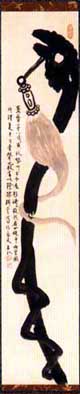
Hakuin's Dragon Staff Inka Scroll


Zen Master Hakuin (1686-1768) painted a Dragon Staff with a horsehair whisk attached.  He gave the above painting to a lay student who passed the Zen koan, "What is the sound of one hand clapping."