Showing posts with label Resting. Show all posts

Sunday, September 10, 2023

Lucid Dreaming

 "The brain is wider than the sky,
For, put them side by side,
The one the other will contain
With ease, and you beside."
- Emily Dickinson 


Lucid Dreaming: A Concise Guide to Awakening in Your Dreams and in Your Life.  By Stephen La Berge, Ph.D.  Sounds True, 2004, 2009, 75 pages, audio CD.  FVRL.

As soon as you awaken, stay very still, and try to recall your dream.

Record your dreams in a dream journal, or audio recording.

Before you go to sleep: Resolve to remember your dreams; Set an intention to remember your dreams; Look forward to remembering your dreams.

Try to distinguish, clarify, understand, differentiate between when you are awake and when you are asleep.

There may be times when you think you are awake but you are dreaming. 

Make sure you get enough sleep.

Dreams occur in 90 minute intervals.  

My Fitbit wrist watch records: Total time asleep, Time awake during nighttime when you suppose you are sleeping, REM sleep time, Light sleep time and Deep sleep time.  Acknowledge that there are different phases and dimensions of sleep.

When dreaming, try to acknowledge to yourself that you are dreaming.

Don't use recreational drugs three hours before sleeping.

Make sure you are hydrated with adequate amounts of water.

Make sure your bed and room temperature is comfortable.


Thursday, May 25, 2023

How to Sleep Better Each Day

 How to Sleep Better Each Day

Follow a schedule and routine for sleep
Prepare for sleeping at 9:00 pm
Sleeping around 7-9 hours is best for most
Don’t use stimulants: drugs, ideas, worry
Get enough sunlight during the day
Get enough exercise during the day
Avoid foods that prevent sleep
Alcohol or drugs might reduce your sleep
Don’t drink liquids a few hours before sleeping
Reduce or eliminate naps during the day
Turn off the television or radio or pod-cast
Bathe if dirty, and change into clean pajamas
Listen only to soft, gentle, relaxing instrumental music
Do any gentle stretching or gentle yoga well before sleeping
Sleep in a cooler room
Reduce, avoid, dim, or turn off any lights in bedroom
Don’t look at clocks if you awaken
Use pillows or bolsters to relieve bodily discomfort
Use clean sheets, covers, pillows and mattress
Don’t work in bed
Reduce reading books or eReader in bed
Sexual activity may or may not help you sleep
Excessive sex will keep you awake
Use techniques to turn off your thinking
Don’t talk a lot or write in bed
Try changing the smell of your bedroom
Go to sleep and get up at the same time each day
Don’t over-sleep beyond your normal wake up time
Keep bugs out of your sleeping area
Other people need to be quiet from 9 pm to 5 am
Some people favor a cup of warm soporific tea
There are many soporific supplemental medicines
  available, but use care with combining medicines
Some people elevate the upper torso and sleep better
If you suffer from insomnia, restless legs syndrome,
  sleep apnea, or narcolepsy consult a physician
Sleep apnea sometimes can be helped with equipment
Keep the CPAP equipment clean
Use meditation techniques to turn off thinking too much

By Michael P. Garofalo  August 23, 2022

I have been dealing with some sleep problems: insomnia, mild sleep apnea,
nighttime urination, tossing and turning when sleeping, no dreams.  

Today, I have an appointment for a consultation with Dr. Steven Hill at the Vancouver Clinic in east Vancouver.  He is a M.D. Sleep Medicine specialist.  Medicare requires an overnight sleep test before any follow up equipment (CPAP, dental devices) or medicine can be prescribed. 

I am reading the following book on the subject:

Say Good Night to Insomnia: The Six Week, Drug Free Program Developed at the Harvard Medical School.  By Gregg D. Jacob.  2009, 256 pages. VSCL.

The Harvard Medical School Guide to Tai Chi: 12 Weeks to a Healthy Body, Strong Heart, and Sound Mind.  By Peter Wayne, Ph.D.. Harvard Health Publications.
Shambhala Press, 2013, 240 pages.  

Friday, November 18, 2022

Back Home and Reading to Go

 I unloaded my Ford Escape and put away all of my Yurt camping gear on Thursday and Friday.  
Delighted to shower.
Read and watched television.

Hoping to recover from my cold symptoms: coughing, sneezing, blowing my runny nose, mucous mostly thin and clear, no temperature, no chills, not super energetic.  

Update my calendar.
Clean up and rearrange my home office.  
Prepare for social events.
Gardening around the house.
Reserve Yurt in May 2023.  

Sports: Warriors/Knicks on Friday, USC/UCLA on Saturday.

"A goal without a plan is just a wish."

What does in mean to plan? 
How do we use tools to accomplish our plans?  

Time to get busy.  


Friday, March 26, 2021

Dao De Jing Chapter 35 Tao Te Ching


Tao Te Ching  Chapter 35  Dao De Jing  


"One who holds fast to the Great Symbol
Gains the whole world
Bestows purest peace
Serenity and bliss.
Yet the hasty wayfarer
Attracted only by outer characteristics
Tastes Tao and is not aware of it
Sees Tao and does not perceive it
Listens to Tao and does not hear it.
But whoever
Grasps and holds it
Amid impermanence
Is grasped by the permanent
And attains duration."
-  Translated by K. O. Schmidt, 1975, Chapter 35


"Reside in the center
where understanding does not require words or images,
and folk will come to you to be taught
how to be serene.
Where there is good music and food
people stop to rest and regain their energy.
But though the Tao seems unmelodious or even bland
it is an inexhaustible source of refreshment."
-  Translated by Crispin Starwell, Chapter 35


"To him who holds to the Great Form all the world go.
It will go and see no danger, but tranquility, equality and community.
Music and dainties will make the passing stranger stop.
But Tao when uttered in words is so pure and void of flavor
When one looks at it, one cannot see it;
When one listens to it, one cannot hear it.
However, when one uses it, it is inexhaustible."
-  Translated by Ch'u Ta-Kao, 1904, Chapter 35 


"The owner of the biggest image attracts the whole world.
When all who come have been safely settled,
The world will then be peaceful.
Melodious music and delicious food
Can only attract passers-by.
But the Way is, when put into one's mouth, tasteless,
When looked at, colorless,
When listened to, uninteresting,
And, when used, limitlessly bountiful."

-  Translated by Liu Qixuan, Chapter 35 


執大象, 天下往.
往而不害, 安平大.
樂與餌, 過客止.
道之出口, 淡乎其無味.
視之不足見.
聽之不足聞.
用之不足既. 

-  Chinese characters, Tao Te Ching, Chapter 35

zhi da xiang, tian xia wang.
wang er bu hai, an ping tai.
le yu er, guo ke zhi.
dao zhi chu kou, dan hu qi wu wei.
shi zhi bu zu jian.
ting zhi bu zu wen.
yong zhi bu zu ji.

-  Pinyin Romanization, Daodejing, Chapter 35 


"Hold the Great Symbol
and all the world follows,
Follows without meeting harm,
And lives in health, peace, commonwealth.
Offer good things to eat
And the wayfarer stays.
But Tao is mild to the taste.
Looked at, it cannot be seen;
Listened to, it cannot be heard;
Applied, its supply never fails."
-  Translated by Lin Yutang, 1955, Chapter 35 


"Apprehend the inimitable conception, you attract the world;
coming it receives no harm, but it tranquil, peaceful, satisfied.
Like transient guests, music and dainties pass away.
The Tao entering the mouth is insipid and without flavour;
when looked at it evades sight;
when listened for it escapes the ear.
Yet, its operations are interminable."
-  Translated by C. Spurgeon Medhurst, 1905, Chapter 35 


"The owner of the biggest image attracts the whole world.
When all who come have been safely settled,
The world will then be peaceful.
Melodious music and delicious food
Can only attract passers-by.
But the Way is, when put into one's mouth, tasteless,
When looked at, colorless,
When listened to, uninteresting,
And, when used, limitlessly bountiful."

-  Translated by Liu Qixuan, Chapter 35 


"El Tao carece de forma y aroma;
No puede ser visto ni oido,
Y su aplicación no puede ser agotada.
Si ofreces música y comida
Los extraños se detienen a tu lado;
Pero si estás de acuerdo con el Tao
La gente del Mundo te mantendrá
En seguridad, salud, compañía y paz."
-  Translated by Antonio Rivas Gonzálvez, 1998, Capítulo 35 


"If you offer music and food
Strangers may stop with you;
But if you accord with the Way
All the people of the world will keep you
In safety, health, community and peace.
The Way lacks art and flavor;
It can neither be seen or heard,
But its benefits cannot be exhausted."

-  Translated by Peter Merel, 1992, Chapter 35


"Hold fast the idea of "The Great,"
Then all men will be drawn to you.  
They will come to you and receive no hurt,
But rest, peace and great calm.
When you provide music and exquisite food
The traveller will stay with you gladly.
When the Tao flows out from you to him
By his palate he does not detect its savour,
By his eye he cannot perceive it,
By his ears he cannot hear it,
But in using it he finds it to be inexhaustible." 
- Translated by Isabella Mears, 1916, Chapter 35 


A typical webpage created by Mike Garofalo for each one of the 81 Chapters (Verses, Sections) of the Tao Te Ching (Daodejing) by Lao Tzu (Laozi) includes over 25 different English language translations or interpolations for that Chapter, 5 Spanish language translations for that Chapter, the Chinese characters for that Chapter, the Wade-Giles and Hanyu Pinyin transliterations (Romanization) of the Mandarin Chinese words for that Chapter, and 2 German and 1 French translation of that Chapter.  Each webpage includes a Google Translate option menu for reading the entire webpage in many other languages.  Each webpage for each one of the 81 Chapters of the Tao Te Ching [246 CE Wang Bi version] includes extensive indexing by key words, phrases, and terms (concordance) for that Chapter in English, Spanish, and the Wade-Giles Romanization.  Each webpage on a Chapter of the Daodejing includes recommended reading in books and websites, a detailed bibliography, some commentary, links, research leads, translator sources, and other resources for that Chapter.  
     A Top Tier online free resource for English and Spanish readers, researchers, Daoist devotees, scholars, students, fans and fellow travelers on the Way. 


Tuesday, September 15, 2020

Nurturing a Peaceful Mind


"You've probably experienced something similar after finishing a long and difficult job, whether it involved physical labor or the type of mental effort involved in writing a report or completing some sort of financial analysis.  When you finish the job, your mind and body naturally come to rest in a state of happy exhaustion.  This perfectly effortless state of relaxation is what is meant by natural peace." ... 


"First, assume a position in which your spine is straight, and you body is relaxed.  Once your body is positioned comfortably, allow your mind to simply rest for three minutes or so. Just let your mind go, as though you just have finished ad long and difficult task.
Whatever happens, whether thoughts or emotions occur, whether you notice some  physical discomfort, whether you are aware of sounds or smells around you, or you mind is a total blank, don't worry.  Anything that happens or ─doesn't happen─ is simply part of the experience of allowing you mind to rest.
So now, just ret inn the awareness of whatever is passing through you mind ...
Just rest ...
Just rest ..."

"Let me confide in you a big secret.  Whatever you experience when you simply rest your attention on whatever's going on in your mind at any moment is meditation.  Simply resting in this way is the experience of natural mind." ...

"In fact, experiencing natural peace is easier than drinking water.  In order to drink, you have to expend effort.  You have to reach for the glass, tip the glass so that the water pours into your mouth, swallow the water, and then put the glass down.  No such effort is required to experience natural peace.  All you have to do is rest your mind in its natural openness.  No special focus, no special effort is required."
-  Yongey Mingyur Rinpoche, "The Joy of Living," 2007, pp. 55-58


So, I relax, breathe gently and easily, stand up straight, unloosen myself from thinking and judging, settle down into ease, rest the mind, and begin a slow and easy Taiji form ... one path to "natural peace."


Relaxation, Sung, Fang Song, Rest, Ease

Tai Chi Chuan

Buddhism


Thursday, June 08, 2017

Nurturing Natural Peace


"You've probably experienced something similar after finishing a long and difficult job, whether it involved physical labor or the type of mental effort involved in writing a report or completing some sort of financial analysis.  When you finish the job, your mind and body naturally come to rest in a state of happy exhaustion.  This perfectly effortless state of relaxation is what is meant by natural peace." ...

"First, assume a position in which your spine is straight, and you body is relaxed.  Once your body is positioned comfortably, allow your mind to simply rest for three minutes or so. Just let your mind go, as though you just have finished ad long and difficult task.
Whatever happens, whether thoughts or emotions occur, whether you notice some physical discomfort, whether you are aware of sounds or smells around you, or you mind is a total blank, don't worry.  Anything that happens or ─doesn't happen─ is simply part of the experience of allowing you mind to rest.
So now, just ret inn the awareness of whatever is passing through you mind ...
Just rest ...
Just rest ..."

"Let me confide in you a big secret.  Whatever you experience when you simply rest your attention on whatever's going on in your mind at any moment is meditation.  Simply resting in this way is the experience of natural mind." ...

"In fact, experiencing natural peace is easier than drinking water.  In order to drink, you have to expend effort.  You have to reach for the glass, tip the glass so that the water pours into your mouth, swallow the water, and then put the glass down.  No such effort is required to experience natural peace.  All you have to do is rest your mind in its natural openness.  No special focus, no special effort is required."
-  Yongey Mingyur Rinpoche, "The Joy of Living," 2007, pp. 55-58


So, I relax, breathe gently and easily, stand up straight, unloosen myself from thinking and judging, settle down into ease, rest the mind, and begin a slow and easy Taiji form ... one path to "natural peace."


Relaxation, Sung, Fang Song, Rest, Ease

Tai Chi Chuan

Buddhism


Saturday, August 08, 2015

Taiji Meditation Postures


Standing Meditation
By Mike Garofalo. 
Resources, Bibliography, Links, Methods, Quotations, Comments.  


"The most basic method of training is zhan zhuang.  Zhan zhuang is an exercise common to many Chinese martial arts, including Taijiquan.  Usually, the practitioner stands with the arms held as if holding a large ball.  However, the zhan zhuang exercise can be practiced using any of the end postures of the Taiji form.  During "standing" practice a static posture is maintained for a period of time while using just enough strength to maintain the posture.  ...  Benefits of zhan zhuang include deep relaxation, strengthening of the legs, and increased internal qi.  The first requirement is to have a calm mind.  This can be achieved in a number of ways - for instance, concentrating on the Dantian, paying attention to one's breath, or silently counting.  Through standing practice, emphasis is place upon developing awareness of maintaining the most efficient and relaxed structural alignment necessary to hold the position.  Prolonged practice, along with enhancing postural awareness and tranquility of mind, greatly develops the strength of the legs.  When the legs are strong and can bear weight firmly, then the upper body can relax and sink down into them, making the top more flexible.  ... Taijiquan requires lightness and sensitivity in the upper body.  At the same time, the lower body should have a feeling of extreme heaviness and connection to the ground.  This feeling is often compared to a large tree with deep roots.  While the branches move and sway in the wind, the trunk is solidly anchored by its roots."
-   Davidine Siaw-Voon Sim and David Gaffney, Chen Style Taijiquan, 2002, p. 106.


Secrets to Living Younger Longer: The Self-Healing Path of Qigong Standing Meditation and Tai Chi.  By Michael Mayer, Ph.D..  Orinda, California, Body Mind Healing Publications, 2004.  Index, bibliography, 281 pages.  ISBN: 0970431066.  This book has a companion instructional video/DVD called "Body Mind Healing Qigong." Website:  Body Mind Healing.  VSCL.  Good coverage of standing meditation and Animal Frolics exercises.  

Warriors of Stillness: Meditative Traditions in the Chinese Martial Arts.  Volume 1.  The Teachings of Grandmaster Cai Song Fang.  Qigong Qi of the Center, Essence of Taijiquan.   By Jan Diepersloot.  Walnut Creek, California, Center for Healing and the Arts.  Glossary, 226 pages.  ISBN:  0964997606.  A study of Wu Ji meditation and its T'ai Chi Ch'uan applications.     

Opening the Energy Gates of Your Body (The Tao of Energy Enhancement.  By Bruce Kumar Frantzis.  Illustrated by Husky Grafx.  North Atlantic Books, 1993.  Second Edition.  174 pages.  ISBN: 1556431643.

"Zhan Zhuang: What Really Happens When We Stand?"
By Mark Cohen
Qi: Journal of Traditional Eastern Health and Fitness, Volume 23, No. 4, Winter, 2013-2014, pp.36-44.

Inside Zhan Zhuang: First Edition  By Mark Cohen.  MSC Creative Enterprises, 2013.  258 pages.  ISBN: 978-0988317888.
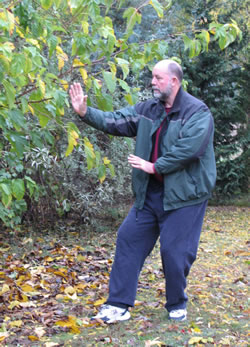
Standing Meditation
By Mike Garofalo.  Resources, Bibliography, Links, Methods, Quotations, Comments.  


Qigong (Chi Kung) by Mike Garofalo


Grandmaster Chen Zhenglei briefly discusses standing, chair seated, and floor seated meditation postures in the instructional video shown below.

Taii Ji Hunyuan Stance (Zhan Zhung) -- Tai Chi for Health by Chen Zhenglei.
陈正雷陈式太极养生功