Showing posts with label Hinduism. Show all posts

Tuesday, October 28, 2025

B. K. S. Iyengar and Yoga


Iyengar, B.K.S.  1918-2014 Yogacharya Iyengar

The renowned Yoga Grand Master (Yogacharya) B. K. S. Iyengar was born in Bellur, Karnataka, India on December 14, 1918; and died at the age of 96 on August 20, 2014..  He has taught in Pune, India, since 1936; and all around the world.  "Bellur Krishnamachar Sundararaja Iyengar, (B. K. S. Iyengar)  is the founder of Iyengar Yoga. He is considered one of the foremost yoga teachers in the world and has been practicing and teaching yoga for more than 75 years. He has written many books on yoga practice and philosophy, and is best known for his books Light on YogaLight on Pranayama, and Light on the Yoga Sutras of Patanjali.  Iyengar yoga classes are offered throughout the world, and it is believed that millions of students practice Iyengar Yoga." 


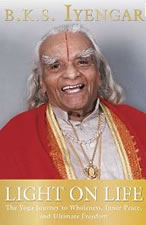
Light on Life: The Yoga Journey to Wholeness, Inner Peace, and Ultimate Freedom  By B.K.S. Iyengar.  With John J. Evans and Douglas Abrams.  Rodale Books, 2005.  Index, 282 pages.  ISBN: 1594862486.  VSCL. 


Light on Prānāyāma: The Yogic Art of Breathing  By B.K.S. Iyengar.  Introduction by Yehudi Menuhin.  New York, Crossroad Pub. Co., 2012.  Originally published in 1985 in English.  Index, glossary, appendices, 296 pages.  ISBN: 9780824506865.  VSCL.


Light on the Yoga Sutras of Patanjali.   By B. K. S. Iyengar.  Foreword by Yehudi Menuhin.  London, Thorsons, 1993.  Index, 337 pages.  ISBN: 1855382253.  VSCL. 


Light on Yoga: Yoga Dipika.   
B.K.S. Iyengar.  New York, Schocken Books, 1966, Revised Edition 1977, 1979.  Glossary, index, 544 pages.  ISBN: 0805210318.   Subtitle: Yoga Dipika.  I own the revised paperback edition, 1979.  VSCL.   

 
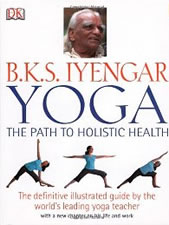
Yoga: The Path to Holistic Health  By B.K.S. Iyengar.  London, Dorling Kindersley, 2001.  Index, glossary, appendices, 415 pages.  ISBN: 0789471655.  
Lavishly illustrated compendium of essential poses, routines, prop use, and yoga routines to help specific health problems.  VSCL.   


Books by "Iyengar Yoga" Teachers


Yoga: The Iyengar Way.  By Mira Silva and Shyam Mehta.  New York, Alfred A. Knopf, 1995.  Index, appendices, 192 pages.  ISBN: 0679722874.  A very good reference tool for the study and practice of yoga poses.  VSCL. 


Iyengar Yoga Institute of San Francisco


Tuesday, August 13, 2024

White Tara - The Female Buddha: Protects Us


Tara, Drolma, Green Tārā, White Tara, Liberator, Star Goddess, Savioress, Protector Bodhisattva, Maha-Devi, Divine Feminine, The Mother, Shakti
A Buddhist Goddess Worshipped in Tibet and India
Bibliography, Links, Quotations, Prayers, 21 Praises, Notes


Goddesses: Bibliography, Quotations, Links, Lore


"Goddess Tara is probably the oldest goddess who is still worshipped extensively in modern times. Tara originated as a Hindu goddess, a Great Goddess -- the Mother Creator, representing the eternal life force that fuels all life.  There are many embodiments of Tara, but the best known are the White Tara and the Green Tara.  The peaceful, compassionate White Tara gently protects and brings long life and peace. The more dynamic goddess, Green Tara is the "Mother Earth", and a fierce goddess who overcomes obstacles, and saves us from physical and spiritual danger.  In Sanskrit, the name Tara means Star, but she was also called She Who Brings Forth Life, The Great Compassionate Mother, and The Embodiment of Wisdom, and the Great Protectress.  Adopted by Buddhism, she become the most widely revered deity in the Tibetan pantheon.   In Buddhist tradition, Tara is actually much greater than a goddess -- she is a female Buddha, an enlightened one was has attained the highest wisdom, capability and compassion. . . one who can take human form and who remains in oneness with the every living thing."
-   Tara: Goddess of Peace and Protection 


"Mother of enlightened activity who creates all the enlightened ones,
By the power of supplicating to you through approaching, practice and devotion, bless me always
    to practice with devotion to you.
So that I and all sentient being may complete the two accumulations of merit and wisdom.
Then, may the four activities be accomplished and extraordinary and common siddhis be granted.
May pure vision of the deities and the mantra rise from the dharmadhatu,
And may we take enlightened activity as our path and stir the depths of samsara.
In the realm of the great dharmakaya, all appearances and existence are non-dual,
The two aspects of enlightened form appear according to the capacities of sentient beings,
May it always being benefit and well-being through the countless acts of perfect merit!
I take refuge until I am enlightened
In the buddhas, the dharma, and the sangha.
Through the merit I create by practicing giving and the other perfections,
May I attain buddhahood for the sake of all sentient beings. 
May all sentient beings have happiness and the causes of happiness;
May all sentient beings be free from suffering and the causes of suffering;
May all sentient beings never be separated from the happiness that knows no suffering;
May all sentient beings live in equanimity, free from attachment and aversion."
Green Tara: Two Meditation Practices


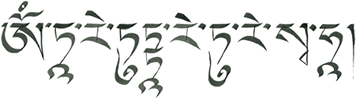
Om Tare Tuttare Ture SoHa
"Om Tah Ray Too Tah Ray Too Ray Svā Ha"       (Suggested English Pronunciation)

The meanings of this mantra are suggested as: 

"One who saves, save me.”

Om
=  The most sacred sound (Aum, Om, Ohm, Hum) for the Divine discussed in the Upanishads 
          OM is the body, speech, and mind of the Buddha.


Tare
= The One who liberates us from suffering,
          The One who frees us from suffering
          Tare is Dharma, the true path away from suffering, the wise words 
          Protection from mundane worldly dangers. 
          The Savioress from physical dangers, fears, and worries. 
          You are the mother, TARE, who liberates us from samsara and absolute dangers 


Tuttare
=  The One who liberates us from the eight fears,
               The One that liberates beings from danger
               The One who can vanquish the eight terrors
               The One who can protect and lead us on the right spiritual path.
               The Savioress from delusion, negative emotions, doubt, greediness. 
               She who ferries us across to safety. 
               You free us from the eight dangers, fears, harms, relative dangers 


Ture
= The One who liberates us from illness
           The One who that releases beings from sickness
           The One who can make us healthy and end our illnesses
           You protect us from all illnesses


Svāha or So Ha = Laying the Foundation, So Be It, Make it So
                          Svaha, according to "Monier-William’s Sanskrit Dictionary,"
                          means: "Hail!", "Hail to!" or "May a blessing rest on!"
                          May this come about
                          May blessings be upon 


Thursday, September 14, 2023

Form is Not Emptiness

              The Fireplace Records, Chapter 30


Scholar Eagle Ask Questions
About the Heart Sutra

Form is Not Emptiness


Scholar Eagle asked Professor Coyote "The Heart Sutra says that,
" '
Form Does not Differ From the Void, And the Void Does Not Differ From Form. Form is Void and Void is Form.' Is this true?"

Professor Coyote said, "Did I not discuss this question yesterday? The Heart Sutra says that Profound Insight is a Supreme Spell, a magical incantation. Why concern yourself with spells?

Scholar Eagle said, "But reaching the supreme understanding will remove all obstructions, fears, and confused imagination. Can't you help  me understand that Supreme Enlightenment?"

Professor Coyote said, "If you could even attain non-attainment, and if all your perceptions and consciousness were empty, and nothing could be made of nothing, then I don't believe you would need Supreme Enlightenment. Why do you reach for the comet, and ignore the smell of the wet earth? Just be here and now, and have a cup of tea."

Scholar Eagle replied, "You are avoiding my question. You are evasive."

Professor Coyote said, "So be it! Even Sutras are often less useful to real wisdom and clear understanding. Listen, I'm sorry, but I am nauseated today and don't feel like answering metaphysical questions. Go ask Raven Roshi."

Scholar Eagle then went and asked Raven Roshi the same questions about emptiness.  

Raven Roshi said,
"The moon shines brightly in the empty sky.
The bucket bottom broke and all the water emptied out.
I wrote the characters for 'True" and "False' on an empty page.
I have nothing more to say, nothing!"

Raven Roshi then paused, then laughed. He told Scholar Eagle to go ask Reverend Toad the same questions.

Scholar Eagle went and asked Reverend Toad the same questions about emptiness.

Reverend Toad said, "Croak! Croak! Empty Nonsense! Your soul will live for all eternity. You might be reborn as a old woman with Alzheimer's disease and think about and remember nothing; or, find yourself as a young beautiful woman arguing with two obnoxious ugly men in Sartre's Hell; or, sing with the Angels in the blissful Afterworld's Choir; or, be reborn as a croaking toad, like me. Much more interesting than being dissolved into nothingness."  

Reverend Toad than smacked Scholar Eagle three times on his back with a dirty wash rag.  He laughed and said, Go ask Badger Nerdy the same questions.

Scholar Eagle gave up, stopped asking questions, went home, and brewed some tea.  It was refreshing! The cup warmed his hands. The steamy tea tickled his nostrils. That afternoon, he drank all the tea, until the small kettle was completely empty (except for wet tea leaves).  


Comments, Sources, Observations

If Forms are Empty, Idealism is sadly triumphant.
There is nothing to concern yourself about Nothing.
When nothing is left, there is no more You.
Fret less about ideas, and feel more.
Leave such puzzles for bored adults to figure out.
Magic spells seldom work for useful purposes.
Void does differ from Forms, otherwise confusion reigns.
Form does differ from Void, otherwise mindlessness triumphs.
So you get over to the other shore--- what then do you do?
Never abandon your boat, you or others may need it again.
Nothing is ever Completely Empty!
Truth or falsity don't apply to meaningless pronouncements.


Emptiness is the subject of over 50 Zen Koans.

Meetings with Master Chang San-Feng 

Zen Master Raven

Sunyata, Emptiness


Refer to my Cloud Hands Blog Posts on the topic of Koans/Stories. 

Subject Index to 1,975 Zen Buddhist Koans

Zen Buddhist Koans: Indexes, Bibliography, Commentary, Information


The Daodejing by Laozi

Pulling Onions  Over 1,043 One-line Sayings by Mike Garofalo

Chinese Chan Buddhist and Taoist Stories and Koans

The Fireplace Records  By Michael P. Garofalo


Or


The Heart Sutra

"When the Bodhisattva Avalokitesvara
Was Discoursing in the Deep Prajna Paramita,
He Perceived That All Five Skandhas Are Empty.
Thus He Overcame All Ills and Suffering.
Oh, Sariputra, Form Does not Differ From the Void,
And the Void Does Not Differ From Form.
Form is Void and Void is Form;
The Same is True For Feelings,
Perceptions, Volitions and Consciousness.
Sariputra, the Characteristics of the
Voidness of All Dharmas
Are Non-Arising, Non-Ceasing, Non-Defiled,
Non-Pure, Non-Increasing, Non-Decreasing.
Therefore, in the Void There Are No Forms,
No Feelings, Perceptions, Volitions or Consciousness.
No Eye, Ear, Nose, Tongue, Body or Mind;
No Form, Sound, Smell, Taste, Touch or Mind Object;
No Realm of the Eye,
Until We Come to No realm of Consciousness.
No ignorance and Also No Ending of Ignorance,
Until We Come to No Old Age and Death and
No Ending of Old Age and Death.
Also, There is No Truth of Suffering,
Of the Cause of Suffering,
Of the Cessation of Suffering, Nor of the Path.
There is No Wisdom, and There is No Attainment Whatsoever.
Because There is Nothing to Be Attained,
The Bodhisattva Relying On Prajna Paramita Has
No Obstruction in His Mind.
Because There is No Obstruction, He Has no Fear,
And He passes Far Beyond Confused Imagination.
And Reaches Ultimate Nirvana.
The Buddhas of the Past, Present and Future,
By Relying on Prajna Paramita
Have Attained Supreme Enlightenment.
Therefore, the Prajna Paramita is the Great Magic Spell,
The Spell of Illumination, the Supreme Spell,
Which Can Truly Protect One From All Suffering Without Fail.
Therefore He Uttered the Spell of Prajnaparmita,
Saying 'Gate, Gate, Paragate, Parasamgate, Bodhi Svaha.' "

The Heart Sutra of Buddhism


The Heart Sutra (PDF Version) 

Green Way Wisdom - Zen Buddhist Poems and Scriptures

Emptiness (Sunyata, Mu, Inter-Dependent Arising)

Wednesday, February 01, 2023

A Healing Prayer


"We, who need help, pray for the healing of our physical, emotional, and spiritual pains and afflictions. 

Source of all blessings and power, heal us, empower us, and bless us. 

We realize that we can't do it alone, and we ask for blessings from all those who have the power to help, elevate, and heal.

We ask for help from the sacred above us.

We ask for the support of those around us, our friends, families, and communities. 

We pray for the wisdom to find ways to help ourselves.

We ask for guidance to help us ease our way and heal our hearts.

May we open ourselves to the mystery that is beyond us, the source from which we are never apart.

May we be happy and hole.

May energy pour through us for the benefit of one and all.

May we dance and lift up our hands and our hearts in praise and rejoicing."

- Lama Surya Das, Awakening to the the Sacred.  Prayers: pp. 254-291.


"Don't misunderstand me.  I don't believe in prayer.  I only do it.  Or perhaps it does me."
- Sam Keen

Tuesday, October 15, 2019

Monday, June 01, 2015

Three Jewels of Goddess Tara

Homages in Twenty One Verses to Arya Tara
A Tibetan Buddhist Scripture
Verse 9


"Homage to you beautifully adorned
By the Three Jewels' gesture at your heart.
Your wheel shines in all directions
With a whirling mass of light."
-  Translated by Thubten Chodron  

Hail you whose heart is beautiful
with hands in the Three-Jew'l gesture,
Their exquisite royal wheel-marks
Shining their light-rays everywhere!
-  Translated by Robert Thurman

"Homage, Lady holding her hand over her breast
with a gesture that symbolizes the Three Jewels,
her palms adorned with the universal wheel
radiating a turbulent host of its own beams."
-  Translated by Stephan Beyer

"Home to her whose fingers in the mudra symbol
Of the Three Jewels adorn the heart,
Who by radiating the rays of her own light,
Adorns the wheel of all directions."
-  Translated by Bokar Rinpoche

"Homage! She adorned with fingers,
   at Her heart, in Three-Jewel mudra!
Wheel of all quarters adorned,
   filled with masses of Her own light!"
-  Translated by Martin Wilson 


"Homage, Mother, her hand adorns her heart
In a mudra that symbolizes the Three Jewels.
Adorned with the universal wheel
She radiates turbulent light."
-  Translated by Anna Orlova


The Goddess Arya Tara (Green Tara or White Tara) holds the long stem of a lotus flower.  The lotus flower (Padma) has been used since ancient times as a key symbol in Hinduism and Buddhism and other religions.  The lotus is most often held in the left hand of Arya Tara.  Her left hand is held near her heart.  The huge bloom of the lotus typically appears above her left shoulder.  Tara is often seated on a lotus.  She typically holds the stem of the lotus flower between her left thumb and left ring finger, and the other three fingers are gently held open.  This particular ritual hand position or symbolic hand gesture (mudra) is referred to as the Prithivi Mudra which recharges the root chakra (Muladhara) aligning it with earth energies (Gertrud Hirschi, Mudras, p.84).  "Her left hand is in the gesture of the Three Jewels, with the thumb and ring finger touching and the other three fingers stretched upward.  These three fingers represent the Three Jewels [Buddha, Dharma, Sanga].  They indicate that by entrusting ourselves to these three objects of refuge and practicing their teachings, we can actualize the unity of compassion, bliss, and wisdom, which is symbolized by the joining of her ring finger and thumb." (Ven. Thuben Chodron, How to Free Your Mind, p. 21)  The Hindu Goddess Lakshmi also holds a lotus flower or is standing on a lotus.  

Goddess Tara: Bibliography, Quotations, Notes, 21 Praises


So, what are your Three Jewels?  Your three essential principles of faith?  Your three core values? 

Friday, December 07, 2012

The Eight Limbs of Yoga

"If you engage earnestly in the various practices of making yourself whole,
all your impurities will be destroyed:
and then you will gain the light of wisdom,
a revelation beyond even discrimination.
The eight limbs are self-control, commitments,
the physical poses, control of the breath,
withdrawal of the senses,
focus, fixation, and perfect meditation."
Yoga Sutra, II 28-29

"The commitments are to be clean,
to be contented with whatever we have,
to embrace hardships for higher goals,
to engage in regular study,
and to seek our Master's blessings."
-   Yoga Sutra, II 32
    Translated by Geshe Michael Roach

The Essential Yoga Sutra: Ancient Wisdom for Your Yoga.  By Geshe Michael Roach and Lama Christie McNally.  New York, Doubleday, Three Leaves Press, 2005.  Index, no pagination.  ISBN: 9780385515368.  Commentaries on Patanjali's Yoga Sutra, circa 200 CE.  


"I bow to the lotus feet of the gurus,
 The awakening happiness of one's own self revealed,
 Beyond better, acting like the jungle physician,
 Pacifying delusion, the poison of samsara.
 Taking the form of a man to the shoulders,
 Holding a conch, a discus, and a sword,
 One thousand heads white,
 To Patanjali, I salute."
 -  Ashtanga Vinyasa Yoga Mantra