Showing posts with label Willapa Bay. Show all posts

Tuesday, November 05, 2024

Grayland State Park, Coastal Southwest Washington

Grayland Beach State Park, Coastal Southwest Washington
Near Westport, Washington


Drove to Raymond on Washington Route 106.
Visited the Carriage Museum in Raymond.
Shopped at Dennis Mercantile, visited South Bend, stopped at Tokeland Cannabis Store.
Nice clear day, little wind, cool temperatures.
We enjoyed a campfire.
Fine food dining: steak, wine, veggies.
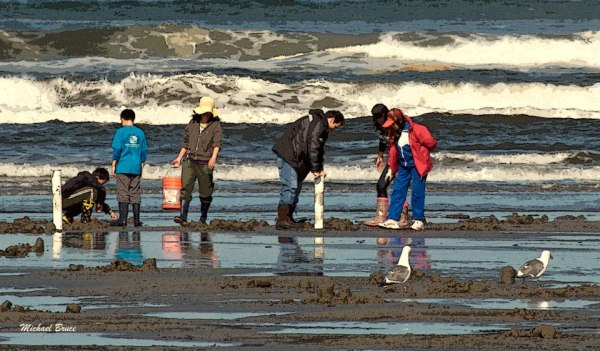
Mick and April went clamming until 10 at night. 
I was not feeling well all day.
Karen and I were too tired to clam at night ... asleep by 7 pm.


Monday, November 04, 2024

Grayland State Park, Coastal Southwest Washington

Grayland Beach State Park, Coastal Southwest Washington
Near Westport, Washington

We drove from Vancouver to Grayland in cold, windy, and raining weather.

Karen and I enjoyed our lunch at the Tokeland Hotel's, the Wandering Goose Restaurant. I ate 6 beautifully fried oysters and cole slaw ... delightful.


We went yurt camping at Grayland Beach State Park with Michael Delmer, April, Karen, and I.

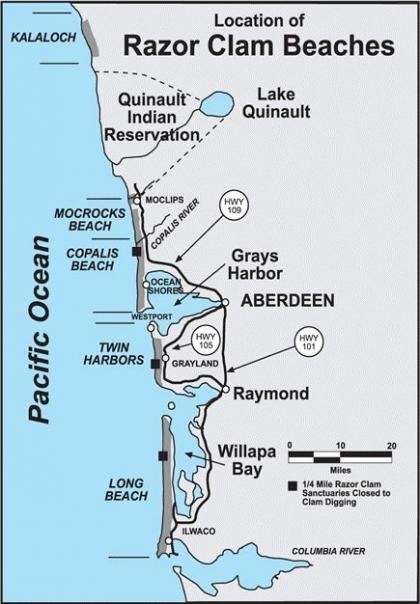
We tried razor clamming at around the low tide at 7 pm. Very dark and extremely windy.


Tokeland Hotel
Karen and I enjoyed our lunch at
The Wandering Goose Restaurant
in the Tokeland Hotel


Thursday, November 09, 2023

Twin Harbors State Park, Washington

We are going to camp at Twin Harbors State Park next week: Karen, April, Mick and I.

We plan to visit Centralia downtown and the Satsop decommissioned nuclear reactor along the Chehalis River as we drive into Aberdeen and then Westport.

I will be walking in the Shifting Sands Nature Trails inside Twin Harbors State Park.  

Clam digging from 4:30 to 7 pm. 

My Atrial Fibrillation heart disease has been acting up after 6 months of remission.  Hopefully, I can enjoy the activities at the beach.  I have a cardio conversion scheduled the day before Thanksgiving this month.  We shall see.  Studying the excellent book by John D. Day, MD, and T. Jared Bunch, MD, titled: The AFib Cure: Get Off Your Medications, Take Control of Your Health, and Add Years to Your Life. 2021.


Up before daybreak at our wood cabin C3.


Four Days in Grayland
By Michael P. Garofalo

Friday, April 14, 2023

Our New Travel Plans

For the past three months, Karen and I have been at home in Vancouver.  We both had medical problems and surgeries.  No travel during this period of 2023.  

Karen and I plan to stay two nights in Pendleton, Oregon, in late April
Trip with Mick and April to Long Beach WA for clamming in May.
Karen and I plan to stay three nights at Quinault Lake, Washington, in May.

Here is a Cloud Hands Blog repost from September 2022.  It was a trip to Cape Disappointment State Park for Yurt camping.  


I was very surprised to find that the campground was full of trailers, RVs, large vans, small vans, trucks with campers, and a few folks in tents.  Very overcast, foggy, and cool all day.  I walked around all day in the Park and accumulated 10,945 Steps.  Drizzling at times: rain expected on Wednesday.

I enjoyed practicing Taijiquan in a flat area along the North Jetty at the Mouth of the Columbia River.  The North Jetty is nearly two miles long.  A paved road leads halfway, and many sandy trails take you out to Benson Beach and the Park campgrounds.  I made some decisions about my Taijiquan goals for 2023 and 2024.  

Few stores were open in Port Ilwaco.  I did enjoy browsing at "Time Enough Books" in Ilwaco.  I purchased two excellent books about the Sea:

"The Sea and Civilization: A Maritime History of the World."  By Lincoln Paine.  Vintage Books, 2013, 744 pages, extensive notes, bibliography, and index.  VSCL.

"Waves and Beaches: The Powerful Dynamics of Sea and Coast."  By Willard Bascom and Kim McCoy.  Patagonia, 1964 and 2020, 401 pages, index.  VSCL


Home for four days, Yurt Y88, Cape Disappointment State Park.


Inside, dry, locked tight, warmed by a small electric heater.
I bring my own 2'x3' desk, chair, books, Jackery power, toys, games, crafts.
I bring plenty of extra lighting.
For food I eat oranges, apples, dried apricots, nuts, crackers, coffee, dried beef, cookies.
Cozy Yurt Camping.
Y88 had a sturdy small 3'x3' table and two woods chairs. 
Sofabed OK.  Used bunk bed to store all my gear.  No wastebasket.


I drove and walked the road
along the North Jetty.  Very windy.


My Taijiquan practice area.


200 yards west of my Yurt Campsite
is a couple of miles of sandy beach.
Lots of driftwood from King High Tides.


There is a long drive from the Visitor Center
to the Yurt Campsite.  Many sloughs, lagoons, lowlands, trees, shrubs,
mosses, and grasses along the roadway


Black Lake north of Ilwaco
Many trails around the lake.


Cape Disappointment State Park  CR  Camping, Yurts, Fishing, Trails     Images

Cape Disappointment Lighthouse  In operation since 1856. 

Cape Disappointment Weather

Lewis and Clark Interpretative Center   History     Wikipedia

Discovery Bicycling and Walking Trail

Fort Canby State Park is the old name for Cape Disappointment State Park   

Travel Adventure and Ghost Tales and History  

North Head Lighthouse     Images

U.S. Coast Guard Station  

"Cape Disappointment State Park (formerly Fort Canby State Park) is a public recreation area on Cape Disappointment, located southwest of Ilwaco, Washington, on the bottom end of Long Beach Peninsula, the northern headlands where the Columbia River meets the Pacific Ocean. The state park's 2,023 acres (819 ha) encompass a diverse landscape of old-growth forest, freshwater lakes, freshwater and saltwater marshes, and oceanside tidelands. Park sites include Fort Canby, the Lewis and Clark Interpretive Center, North Head Lighthouse, and Cape Disappointment Lighthouse.[2] Cape Disappointment is one of several state parks and sites in Washington and Oregon that are included in Lewis and Clark National Historical Park.[3]"

   I have camped here twice. 


Monday, November 14, 2022

Willapa Bay, Washington

Report from November 14, 2022:

Mick and April are joining me on this trip.  They are staying in a Yurt from 11/12-11/16.  I am staying from 11/14-11/17.  

Previous Report from October 18, 2021:

I enjoyed the drive from Vancouver to Westport.  Here is my online tour guide for this driving trip.

Today was a very nice day with wide fairly clear views.  I encountered little traffic on WA 4.  I pulled off at my favorite viewpoint rest stops for the Columbia River before Skamokava.  Inland WA4 and US101 was covered with plantation reforestation and with many beautiful large trees in their fading autumn yellow-brown rusted leaves, and the scarlet-green-brown fading leaves of the wild berry vines.  


Then BAM!!  A sough wandering under 101, and vast stretches of wild grasses and then grand views of Willapa Bay all the way to South Bend.

Willapa Bay Hypertext Notebook by Michael P. Garofalo.

I enjoyed eating at the River View Restaurant along the Willapa River docks in South Bend.  I watched one chef tending a big 6 foot long steel steamer.  He added wood logs and used a flame torch to arouse the fire.  Then he placed many fresh Willapa Bay Oysters on the huge steel grill.  He closed the top of the steamer and talked amicably with a passing walker for a few minutes.  The cook looked Nordic, and the walker looked Indian-Asian.   Then, the big man, went back to tending his steamer oysters, and he added some magical pasting for local flavor.  

I enjoyed two oysters, and a bowl of clam chowder.  Memorable eating and seeing!  Two women and a man at a nearby table ordered a dozen oysters and more for their feast of the day.  

The word for oyster in the Chinook Jargon was chet'-lo, or jet'-lo.    
Clams were called o'-na, luk'-ut-chee, la-kwit'-chee.
Water or River called chuck

Native peoples, speaking different languages, lived for thousands of years along the Willapa River, the Chelais River, the Cowlitz River, the Naselle River, the Lewis River, and the Columbia River.  

Here are the books I have been reading about Willapa Bay:

Coast Country: A History of Southwest Washington.  By Lucile McDonald.  Long Beach, Midway Printery, 1989.  Index, 183 pages.  TRLS = Timberland Regional Library System, WA [I pick up my reserved books and videos as the Westport Branch of the TRLS.].   

Shoalwater Willapa.,  By Douglas Allen.  Snoose Peak Publishing, South Bend, WA, 2004.  Index, notes, sources, 286 pages.  TRLS.  

Telling Our Stories: Voices of Grays Harbor.  By students of the Evergreen State College, Grays Harbor Campus.  Gorham Printing, Centralia, WA, 2012.  155 pages.  TRLS.  

A Tidewater Place: Portrait of the Willapa Ecosystem.  By The Willapa Alliance, Long Beach, WA, 1993.  Color photographs and text, 50 pages.  TRLS.  


Willapa Bay Estuaries   There are many estuaries at the mouths of the various rivers that flow into Willapa Bay, and the Bay itself is an estuary. 

"Willapa Bay is a major estuary on the Pacific Coast and at mean high tide encompasses approximately 70,400 acres (28,500 hectares). An estuary is defined as the area near the mouth of a river, or rivers, in the case of Willapa Bay, where oceanic tidal waters and freshwater currents collide and mix. Biologically, estuaries are among the most productive environments on earth and provide important habitat for a large variety of organisms. This high productivity is due basically to physical and biological processes unique to estuaries. Dissolved organic nutrients from detrital (dead plants and animals, and excrement) material enter the estuary from inflowing rivers. Saltwater pushed along the estuary bottom by the incoming tide brings in other nutrients of marine origin. Currents and tides circulate fresh and salt water, distributing and, to a certain extent, trapping dissolved and suspended matter. Deposition of these substances fertilizes the estuary and plant life flourishes. This plant life includes grasses, rushes, sedges  of estuarine marshes, benthic algae (diatoms), epi-benthic algae, and eelgrass on intertidal sediments. Some plants are fed upon directly by fish and wildlife but most die and enter the food chain in the form of detritus or partly decomposed plant material. This detritus, suspended in the water and deposited on the bottom, is a high-quality food for consumers because of its high nutritional value. A number of studies have shown that many species of fish and invertebrates feed wholly or partially on detritus. Therefore, detritus feeders are the critical link between plant production and the production of higher consumers. Consequently, the ultimate ecological value of primary production in marshes occurs when detritus of marsh plant origin enters the food web of the estuary."  Willapa Estuary

"An estuary is a partially enclosed coastal body of brackish water with one or more rivers or streams flowing into it, and with a free connection to the open sea. Estuaries form a transition zone between river environments and maritime environments and are an example of an ecotone. Estuaries are subject both to marine influences such as tides, waves, and the influx of saline water and to riverine influences such as flows of freshwater and sediment. The mixing of seawater and freshwater provides high levels of nutrients both in the water column and in sediment, making estuaries among the most productive natural habitats in the world."

"Estuaries are a happy land, rich in the continent itself, stirred by the forces of nature like the soup of a French chef; the home of myriad forms of life from bacteria and protozoans to grasses and mammals; the nursery, resting place, and refuge of countless things."  -  Stanely A. Cain


Four Days in Grayland, Part I    
Grays Harbor and Willapa Bay: A Traveler's Hypertext Notebook and Guide 


Four Days in Grayland, Part II   
Grayland Beach: A Camper's Hypertext Notebook, Studies, and Comments 


Four Days in Grayland, 
Part III   
Photographs, Blog Posts, and Notes from 2021-2022  


Four Days in Grayland
, Part IV   
Reflections of a Beachcomber:  Poetry, Short Essays, Commentary, Quotations   


The Four Days in Grayland Series began in September, 2021.