Showing posts with label Love. Show all posts

Saturday, March 07, 2026

Personal Improvement Prayer


“Lord, make me an instrument of Your peace.
Where there is hatred, let me show love;
Where there is injury, pardon;
Where there is doubt, faith;
Where there is despair, hope;
Where there is darkness, light; and
Where there is sadness, joy.
Oh Divine Master, grant that I may not so much
Seek to be consoled as to console;
To be understood as to understand;
To be loved as to love.”
- St. Francis of Assisi (1128-1226)

An informative old book by Dean Ornish, M.D., "Reversing Heart Disease," 1995, includes a chapter on the power of praying, meditating, and guided thinking.  A newer version of this book came out in 2022, "Undo It."  I quickly browsed and reread some of this useful old book last month.  I have tried to follow his advice for many years.  

Many people told me they prayed for my recovery from my cryo-genic ablation surgery on February 4, 2023.  The positive thoughts from others helped me stay calm, feel appreciated, and hopeful. 

Good and positive thoughts, sayings, prayers, mantras, scriptures, poems, well wishes, and encouragement can help others and ourselves.  


"Don't misunderstand me.  I don't believe in prayer.  I only do it.  Or perhaps it does me."
- Sam Keen

Believing is an important step in transformation.  If you don't believe in achieving your goals and objectives, it is very hard to keep working steadily on actualizing your specific goals.  Your not going to have the grit to stick with a self-improvement tactic unless you believe the tactic is beneficial, useful, doable, and achievable.  

Saturday, February 21, 2026

These Dear Friends of the Buddha Mind


The Fireplace Records Case #51


These Dear Friends of the Buddha Mind

          I never
     grasped emptiness
or hiked around Mt. Sumeru,
or patted Chao-chou's dog,
or teased Nansen's cat,

blocked the Bodhidharma's uppercut,
or slept in Han Shan's dirty hut,
or borrowed Wendy Johnson's garden rake
or rode the Ox through the Gateless Gate,
or solved any of Rinzai's riddles,

I never, ever
suffered the Great Doubt,
looked for sticks in Yun-men's crapper,
or broke Tassajara bread with Shunryu Suzuki,
or minded the flapping flag for Hui-neng the sage,

or heard Jiyu-Kennett move her whisk in Mt. Shasta's shade,
or chanted on Mt. Tamalpais with Whalen, Ginsberg and Snyder,
or saw Dogen's True Eye open just a little bit wider.
     I never did.
     Nope, never!

Not in 55 lifetimes.
               Yet, it seems like I did.
Yep, dayinanddayout,
appearances notwithstanding,
Reality appeared just So.

This I know:
Their Heritage
Is in my Heart,
Their Myths mine,
These Dear Friends of the Buddha Mind.


Zen Koans: The Fireplace Records

Koans by Mike Garofalo


Zen Koan Collections Studies


Subject Index to 1,975 Zen Buddhist Koans


Reading Wittgenstein


Buddhism


Friday, February 13, 2026

Happy Valentine's Day


"In Ancient Rome, Lupercalia was observed February 13–15 on behalf of Pan & Juno, pagan gods of love, marriage & fertility. It was a rite connected to purification and health, and had only slight connection to fertility (as a part of health) and none to love. 

The earliest description of February 14 as an annual celebration of love appears in the Charter of the Court of Love. The charter, allegedly issued by Charles VI of France at Mantes-la-Jolie in 1400, describes lavish festivities to be attended by several members of the royal court, including a feast, amorous song and poetry competitions, jousting and dancing. Amid these festivities, the attending ladies would hear and rule on disputes from lovers. No other record of the court exists, and none of those named in the charter were present at Mantes except Charles's queen, Isabeau of Bavaria, who may well have imagined it all while waiting out a plague."


"The rose is red, the violet's blue,
The honey's sweet, and so are you.

Thou art my love and I am thine;
I drew thee to my Valentine:
The lot was cast and then I drew,

And Fortune said it shou'd be you."


Since the 19th century, handwritten notes have given way to mass-produced greeting cards. In the UK, just under half of the population spend money on their Valentines, and around £1.9 billion was spent in 2015 on cards, flowers, chocolates and other gifts. The mid-19th century Valentine's Day trade was a harbinger of further commercialized holidays in the U.S. to follow.


For my wife, Blanche Karen Eubanks-Garofalo, I offer her a nice Valentine's Day card, a few chocolates, and roses. 
We celebrate together!  


On Valentine's Day, I think about
 The people who are dear,
 How much they add to life's delight
 Whenever they are near.

You've always been a total joy,
Such pleasant company,
I very much appreciate
Our compatibility!

By Joanna Fuchs


"I love you all through February,
Not just on Valentine's Day!
I cherish you when flowers of spring,
Appear in the midst of May."

"I adore you in the summer,
When the air is filled with heat!
Without you in my life each day,
I wouldn't be complete."

"I treasure you in fall,
When leaves are turning gold!
I loved you when you were younger,
I'll love you when you're old."

"I prize you in the winter,
When colder days are here!
I love you, love you all the time,
Every minute of the year."

"So I'll give to you this Valentine,
But I want to let you know!
It's not just today, but always,
That I will love you so."


Wednesday, October 08, 2025

Don't Do Unto Others

                      The Fireplace Records, Chapter 33


Don't Do Unto Others


An acquaintance of mine, a devout Catholic, ends all his email letters with "Love, Arthur."

He has frequently mentioned the Biblical verse "Thou shalt love thy neighbor as thyself." (Matthew 22: 38)  Love and loving phrases pepper his conversations. 

My underlying feeling was that these references to "love" were rather insincere and somewhat ungrounded, since I could not understand how two people with radically different opinions about life, religion, and politics could actually "love" one another; socialize and tolerate maybe, but "love," unlikely.  

In my teenage years, I questioned how this verse would apply to people who don't like themselves, hate themself, are ashamed of themself, denigrate themself, or don't love themselves in the slightest, etc. They would seem quite handicapped or incapable of loving their neighbor, insofar as they don't love themselves. On the opposite side, self-respect and self-love has some positive connotations, and can lead to loving others; however, carried to excess it becomes flawed and appears as egotism and narcissism.

I grew up in East Los Angeles, in the Bandini Barrio, for 20 years. It was a low income suburban LA neighborhood. I had a few friends and some good neighbors. However, as with most suburban neighborhoods, I did not know or have any relationships with 96% of my neighbors. I did not love them, nor did I have any opinion or emotion regarding them other than live and let live, let's stay at peace, and mind your own business. "Loving" them was not my concern; and, I had no ill will towards people I did not know. 

I also read, "In everything, do to others what you would have them do to you." (Matthew 7:12) If I wanted hard drugs, does this mean I should give or sell hard drugs to others? If I thought I should be severely punished if I chose not to follow Catholic doctrines, does this give me license to severely punish non-believers? If someone liked perverted sexual play, should they being doing these acts with others? Knowing that others have cheated me, should I cheat others? This moral maxim had some good applications; and, some bad/evil/wrong/destructive applications.  

In high school in 1961, I read Confucian texts.  I came across the Confucian maxim "Don't do to others what you don't want done to you." (Analects, V. 12, VI. 30, 500 BCE)  This ethical/moral/behavioral advice seemed to resonate with me more than the Christian advice. I thought I could apply this maxim more effectively in my daily life with the many people I encountered but did not know, or love. It was a way of caring for others by not harming them. I have tied to follow this practical maxim for six decades.


Comments, Sources, Observations

Gold is malleable, soft, valued, and long lasting; but, limited in other ways.
Rather than a ruler of gold, a flexible cloth tape is more practical.
Rules are useful if properly and intelligently applied.
Acknowledging exceptions to rules is a good rule to apply sometimes. 
The disadvantages loving yourself to excess are numerous.
"Love" is often just another boring cliche, a charming metaphor.
A church sign says "God is Love!" The Devil also loves his work.
Liking, preferring, and loving are cousins, sometimes distant cousins.
Yes, gold is valuable; but of what value is this value?

"Love" is rarely mentioned in Zen Koans; maybe 6 times out of 1,975 Koans. Egoistic-restraint, kindness without reciprocity, control of desires, patience, gentleness, helpfulness, asceticism, toughening, and wisdom are emphasized more.  


Golden Rule - Wikipedia

Ten Reasons Why Self-Love is Bad


Refer to my Cloud Hands Blog Posts on the topic of Koans/Stories. 

Subject Index to 1,975 Zen Buddhist Koans

Zen Buddhist Koans: Indexes, Bibliography, Commentary, Information


The Daodejing by Laozi

Pulling Onions  Over 1,043 One-line Sayings by Mike Garofalo

Chinese Chan Buddhist and Taoist Stories and Koans

The Fireplace Records  By Michael P. Garofalo


Saturday, July 26, 2025

Metta Sutra


Metta Sutta

translated by Gil Fronsdal

A Buddhist Sutra


To reach the state of peace
One skilled in the good
Should be
Capable and upright,
Straightforward and easy to speak to,
Gentle and not proud,
Contented and easily supported,
Living lightly and with few duties,
Wise and with senses calmed,
Not arrogant and without greed for supporters,
And should not do the least thing that the wise would criticize.

[One should reflect:]
“May all be happy and secure;
May all beings be happy at heart.
All living beings, whether weak or strong,
Tall, large, medium, or short,
Tiny or big,
Seen or unseen,
Near or distant,
Born or to be born,
May they all be happy.
Let no one deceive another
Or despise anyone anywhere;
Let no one through anger or aversion
Wish for others to suffer.”

As a mother would risk her own life
To protect her child, her only child,
So toward all beings should one
Cultivate a boundless heart.
With loving-kindness for the whole world should one
Cultivate a boundless heart,
Above, below, and all around
Without obstruction, without hate and without ill-will.
Standing or walking, sitting or lying down,
Whenever one is awake,
May one stay with this recollection.
This is called a sublime abiding, here and now.

One who is virtuous, endowed with vision,
Not taken by views,
And having overcome all greed for sensual pleasure
Will not be reborn again.

Sunday, June 15, 2025

Father's Day

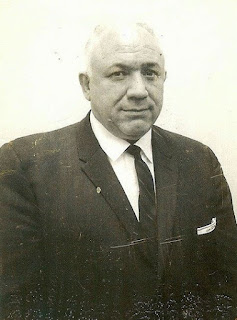
Michael James Garofalo (1/10/1916-4/2/1997)

My father, Michael James Garofalo, died on April 2nd, around 3 am in 1997.

He had a series of strokes, beginning in 1992, and then, due to complications from diabetes, increasing dementia, old age, inactivity, overeating, a broken hip from a fall, and congestive heart failure ... all led to his death.

In his youth, he was always strong, active, hard working, diligent, and demanding.
He built himself the three houses in which he lived, in starting in 1945.
He and my mom, June, raised three sons.
When he retired, at 62, he was the Chief Piping Engineer at the Fluor Corporation.

He was a Catholic believer. His outlook was conservative, Republican. He worked with all white men in a non-union workplace. He did not think well of people of other races and creeds. He thought all poor people were just lazy and stupid. Compassion and kindness were not high on his list of virtues. He also had a low opinion of women rights. His income was sufficient to provide for us when growing up.

I'd say he was an untreated manic-depressive. After he was 65, he resisted all my many recommendations to consult with better physicians or a counselor. He could be quite stubborn at times with not complying with medical recommendations. 

He paid to send me to Catholic Schools, 1st to 12 grade. I was indoctrinated properly by nuns and priests. It was just "get good grades, study, obey, do what we say" everyday. 

He liked to travel in the Western Regions and Deserts: Southern California, Nevada, Mexico, Utah, Arizona. 

For more Information about my Dad.

He did not read very much. Listened to sports on the radio and right wing talk a lot. Not conversant much with modern thought, and viewed the 1960's changes a low class sinful rot. He spoke in stereotypes and racial slurs a lot. His Italian identity, was touted a lot. Also, he enjoyed bossing others around a lot.

After he retired, he mellowed a bit, and he was really a good grandfather with our two children.

My wife and I cared for him every day, he lived in a Granny Flat apartment next door. We helped him daily from 1993 to 1997. 

Frankly, for me, he was hard to love or like at times very much. 

I thank him for paying the way in my youth, providing for decent room and board, a good education, a safe home, and providing me with a useful inheritance from him from his final estate. 

I'd say he was a decent father, a good provider, but a friend to few. 

Yes, I loved my Dad - with Reservations.


Sunday, April 20, 2025

The Man Who Planted Trees


The Man Who Planted Trees. By Jean Giono. Illustrated by Michael McCurdy. Chelsea Green, 2007, 72 pages. 


From a Facebook Post on March 18, 2025. One reviewer suggested that this is an artificially AI generated post to sell the book. You be the judge:

I found "The Man Who Planted Trees" three days after the diagnosis. Terminal, they said. Six months, maybe less. I hurled books across my hospital room, cursing the universe for its cruelty, until a thin volume slipped from the pile, landing open-faced on the sterile floor. A nurse picked it up, glanced at the first page, and against protocol, left it on my bedside table instead of reshelving it.
"You might need this one," she whispered.
She was right. But not for the reasons either of us could have imagined.
Let me tell you about resurrection.
Not the biblical kind—though what Jean Giono created in his slender 4,000-word masterpiece borders on the miraculous—but the kind that begins with dirt under fingernails and an obstinate refusal to accept desolation as the final word.
Most readers encounter "The Man Who Planted Trees" as ecological parable or gentle inspiration. They admire its message of environmental stewardship, nod appreciatively at its humanistic optimism, perhaps feel momentarily better about our species' potential. Then they return it to the shelf and continue their lives fundamentally unchanged.
I couldn't return it to the shelf. Because Elzéard Bouffier wouldn't let me go.
The story's premise is deceptively simple: In 1913, a young hiker traverses the barren, wind-scoured highlands of Provence, a landscape so bleak it drives inhabitants to madness or exodus. There he encounters a silent shepherd methodically planting oak trees—one hundred perfect acorns daily, year after year, asking nothing in return. The narrator returns after both world wars to discover this solitary man's quiet, relentless labor has miraculously transformed thousands of acres of wasteland into a vibrant, water-rich forest ecosystem where communities once again thrive.
A simple summary that betrays nothing of the story's devastating power.
I began reading in that antiseptic hospital room, my body already betraying me at thirty-six, the scan results still burning in my mind. By page three, something shifted. Giono's sparse prose—devoid of sentimentality yet pulsing with life—bypassed my intellectual defenses and struck directly at something primal within me.
His description of that initial landscape—"everything was barren and colorless, a desert without even the drama of traditional deserts"—mirrored my interior state with such precision that I gasped audibly. The nurse looked up, concerned, but I waved her away, already descending deeper into Giono's world.
When the narrator first meets Bouffier, the shepherd is described with haunting simplicity: "His beard was black, and his shoulders slightly hunched, but his figure was tall and straight, more suggestive of an athlete than an old man." Something in this portrait of contained power, of vitality harnessed for purpose rather than display, seized me. I read the entire story without moving, the hospital machinery beeping in counterpoint to my racing heart.
That night, I dreamed of acorns—hundreds of them, cool and smooth in my palms.
What makes "The Man Who Planted Trees" truly dangerous isn't its ecological message but its fundamental challenge to our understanding of time, purpose, and what constitutes a meaningful life.
Bouffier plants trees he will never sit beneath. He creates forests without recognition or reward. He persists through two world wars, through personal tragedy, through complete societal collapse and reconstruction, doing exactly one thing: planting perfectly selected seeds in precisely the right places, then letting nature and time do what they will.
This radical patience—this refusal of instant gratification, external validation, or even measurable short-term progress—represents a direct assault on everything our culture holds sacred. Bouffier's calm, methodical labor exposes the poverty of our addictions to immediacy, recognition, and tangible results.
And yet, the miracle happens. The wasteland transforms. Life returns. Not through dramatic intervention or technological salvation, but through one man's stubborn, daily choice to believe in a future he personally will barely glimpse.
By day three in the hospital, something unprecedented occurred. I found myself examining my own wasteland with different eyes. What if my diagnosis wasn't an ending but a clarification? What if the time I had—whether six months or six years—could be measured not in duration but in seeds planted?
I began making calls. Family members I'd avoided for decades. Former colleagues I'd betrayed climbing corporate ladders. My estranged son, now eighteen, who'd stopped taking my calls five years earlier.
Many rejected my overtures. Some responded with suspicious caution. A few engaged more openly. I didn't explain the diagnosis—this wasn't about extracting forgiveness or pity. It was about planting whatever seeds I could in the time remaining.
I started volunteering at a youth center near my apartment, teaching chess to kids with life circumstances far more challenging than my privileged trajectory. I allocated my savings to establish a small foundation focused on reforesting a degraded watershed in my grandfather's rural hometown.
The doctors were baffled by my sudden shift from rage to focused engagement. My oncologist suggested the medication might be affecting my cognition. I smiled and told her I'd simply found a better way to measure what remained of my life.
One acorn at a time.
The true power of Giono's story isn't its gentle hopefulness but its ruthless rejection of excuses. Bouffier begins his work as an old man, already sixty-five when the narrator first meets him. He has suffered devastating personal loss. The landscape itself actively resists regeneration. The broader society remains oblivious to his efforts for decades.
None of this matters to him. None of it interrupts the steady rhythm of his planting.
When I returned to the hospital for treatment six weeks after that first reading, I brought my own dog-eared copy of the book. As chemicals designed to kill rapidly dividing cells dripped into my veins, I read aloud to two other patients receiving treatment. One wept silently by the end. The other asked to borrow it when I finished.
We formed an unlikely book group in that chemo ward—discussing Bouffier's methods, his solitude, his monastic patience. The oncology nurses began calling us "the forest people," not understanding our private reference but sensing the strange energy our discussions generated amid the clinical despair.
Seven months later—already longer than my initial prognosis—a second scan showed something unexpected. Not remission, not yet, but a significant slowing of the disease's progression. My oncologist called it "unusual but not unprecedented." I had a different explanation.
I'd begun to dream regularly of Bouffier—not as Giono described him but as a presence beside me, teaching me to distinguish promising acorns from those that would never germinate. In these dreams, we worked together in comfortable silence, filling pockets with seeds, walking barren ridgelines, kneeling in dust and stone.
During my waking hours, I continued my own planting—reconciliations where possible, new connections where not, small contributions to strangers' lives, seeds of possibility in whatever soil would receive them.
Inexplicably, improbably, I was still alive.
What "The Man Who Planted Trees" offers isn't gentle inspiration but a radical alternative to despair. Giono doesn't just tell a pretty story about environmentalism—he demonstrates that meaning exists precisely in the face of apparent futility, that purpose transcends outcome, that transformative power often lies in the humblest, most repetitive actions.
The story's most devastating passage describes Bouffier's work during World War I: "The war of 1914 had taken away all his sons, all three of them... He resumed his planting." This breathtaking understatement contains volumes—both the immensity of Bouffier's personal tragedy and the immensity of his refusal to surrender to it.
Three years after my diagnosis, against all medical predictions, I remain. The disease and I have reached a standoff of sorts—it advances more slowly than expected; I live more fully than I ever did in health. I've since learned that Giono wrote this story for an American magazine that requested "the most extraordinary character I've encountered." He invented Bouffier entirely, later explaining: "My goal was to make trees likeable, or more specifically, to make planting trees likeable."
But here's what Giono himself may not have fully understood: he didn't create a character; he created a template for living meaningfully in the face of apparent hopelessness. He didn't make trees likeable; he made perseverance without guarantee of personal reward not just likeable but essential.
Last week, I visited the youth center where I still teach chess. One of my first students—now heading to college on scholarship—asked why I never seem afraid despite my illness. I showed him my worn copy of Giono's book.
"The man in this story," I explained, "plants trees knowing three things for certain: many will fail to grow, he won't live to see most that do succeed, and he has no guarantee the world won't destroy his work through war or greed or simple indifference."
"Then why bother?" the young man asked.
"Because the planting itself matters," I said. "Because transformation always begins in apparent futility. Because life, ultimately, is measured not in what we harvest but in what we plant."
I don't know if he understood. But later that day, I saw him reading the book in a corner, his expression intense with discovery.
Another acorn planted.
If you value comfort over transformation, avoid "The Man Who Planted Trees." This isn't inspirational literature; it's a literary detonation device disguised as a simple tale. Once you truly absorb Bouffier's example, you lose all excuses for inaction. You forfeit the luxury of despair. You find yourself, against all reason, planting seeds in whatever barren landscape you've been given—with no guarantee except that the planting itself may be the most profound expression of being fully alive.
And somewhere in your dreams, a forest is already rising.

Like
Comment
Send
Share
Facebook
Facebook
Facebook
Facebook
Facebook
Facebook
Facebook