Showing posts with label Wudang. Show all posts

Tuesday, April 12, 2022

Wudang Chi Kung: The Eight Section Brocade Chi Kung

"The Eight Verses of Wudang Mountain Badunjin :

1. Lift the ground and hold the sky to take care of the three internal cavities
2. Draw a bow to the left and right, just like shooting a vulture
3. Lift the hand up singly to tone and caress the spleen and the stomach
4. Look backwards to cure the five strains and seven injuries
5. Reach down the leg by both hands to strengthen the kidney and the reproductive organ
6. Swivel the head and rock the bottom to calm down
7. Rotate fists and stare to add stamina
8. Vibrate the back seven times to expel illness


The first segment takes care of the three chiaos (internal organs), the second segment strengthens the heart and the lung, the third regulates the spleen and the stomach, the fourth cures strains and injuries, the fifth toughens the kidney and reproductive organ, the sixth calms the nervous system, the seventh increases stamina, the eighth gets rid of illnesses. It has materialised the merging of the theory and movements of Badunjin with clinical sports, as well as specified the importance of life-nourishment and health-preservation. Badunjin Qigong, uplifted by the modern medical confirmation from Chinese and western professionals and scholars, continues to be revitalised and made to perfection. Thus it has been made even more suitable and practical to serve the needs of the modern era, and advances with time.

The theory and movements of Wudang Badunjin is thorough; it is safe and easy to learn, and has a wide application on medical cure. Externally, it exercises the skin, muscles, tendons and bones; internally, it strengthens the organs, improves the circulatory system, and consolidates the spirit of well being. Its movements involve breathing naturally, and are smart & light, continuous and lively, elegant and beautiful, stretchy and graceful, alternating relaxing with tightening, synchronising harmoniously, can be fast or slow but with distinct rhythm, can be complicated or simple, active or quiet, and cohere the opening with the closing. It stresses on the mutual use of toughness and gentleness, the training of the internal and external body parts, the merging of activity and quietness, the balancing of the left and the right, the top and the bottom, alternating the real and the virtual, and nourishing both the body and the spirit. The amount of exercise and the length of the practice session can be adjusted anytime, and it can be practised alongside with other exercises. Age, sex, body nature, location, equipment, time, season, etc do not restrict the practice. It can be practised individually, with the whole family, or with a group. The all-encompassing effect and value of its body-strengthening and medical aspects is evergreen."
-  Wudang Mountain Badunjin Qigong 20Kb. Original (in Chinese) written in Hong Kong by Woo Kwong Fat, the 28th Generation Master of Dragon Gate Branch, Wudang Mountain.

Wudang Qigong

Eight Section Brocade Qigong (Baduanjin)


Tuesday, June 16, 2015

Zhang Sanfeng Lore

Chang San-Feng, Taoist Grand Master: Bibliography, Quotes, Writings, Lore, Encounters
Research by Mike Garofalo


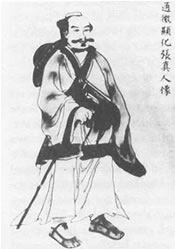
    "Zhang Sanfeng ("Zhang Triple Abundance" or "Zhang Three Peaks") is a famous Taoist said to have live between the end of the Yuan and beginning of the Ming periods.  His historical existence, however, is unproved.  In early biographies―including the one in the Mingshi (History of Ming)―he is usually said to be a native of Yizhou (Liaoning), but other sources give different birthplaces.  According to these works he was seven feet tall and had enormously big ears and eyes, his appearance suggested the longevity of a turtle and the immortality of a crane, and his beard and whiskers bristled like the blades of a halberd.  He tied his hair in a knot and, regardless of the season, wore only a garment made of leaves.  In his youth, Zhang is supposed to have studied Buddhism under the Chan master Haiyun (1021-56), but then mastered neidan and reached immortality.  He was known for his extraordinary magical powers as well as his ability to prophesy.
    In the first years of the Ming period, Zhang reportedly established himself on Mount Wudang (Wudang Shan, Hubei), where he lived in a thatched hut.  With his pupils he rebuilt the mountain monasteries destroyed during the wars at the end of the Mongol dynasty.  From Mount Wudang, Zhang went to the Jintai guan (Abbey of the Golden Terrace) in Baoji (Shananxi), where he announced his departure, composed a hymn, and passed away.  Later he came back to life, travelled to Sichuan, and visited Mount Wudang.
    The belief in the real existence of Zhang Sanfeng during the Ming Dynasty is reflected in the emperor's continued efforts to locate him.  The search for Zhang started in 1391 by order of the Hongwu Emperor (1368-1398) and was extended from 1407 to 1419 by the Yongle Emperor (1403-1424).  Both sent out delegates several times, but they all returned without success.  Promoted by the Ming emperor's interest, a cult developed around Zhang that spread widely and lasted until the later years of the Qing dynasty.
    As time went on, the legends about Zhang Sanfeng multiplied and became increasingly exaggerated.  Zhang is known as the founder of taiji quan (a claim without historical evidence) and the patron saint of practitioners of this technique.  During the sixteenth and seventeenth centuries, a connection to the sexual techniques (fangzhong shu) was also established and texts dealing with these practices were ascribed to him.  The belief that Zhang was the master of Shen Wansan, a popular deity of wealth, led to his own identity as a god of wealth in the seventeenth century.  The Western Branch (Xipai) of neidan and various Qing sects also regarded Zhang Sanfeng as their first patriarch."
-  Martina Darga.  The Routledge Encyclopedia of Taoism (EoT), 2008, 2011, Volume II, p. 1233-35, article about Zhang Sanfeng in the EoT by Martina Darga. 


Wednesday, August 06, 2014

Wudang Qigong: Eight Section Brocade

"The Eight Verses of Wudang Mountain Badunjin :

1. Lift the ground and hold the sky to take care of the three internal cavities
2. Draw a bow to the left and right, just like shooting a vulture
3. Lift the hand up singly to tone and caress the spleen and the stomach
4. Look backwards to cure the five strains and seven injuries
5. Reach down the leg by both hands to strengthen the kidney and the reproductive organ
6. Swivel the head and rock the bottom to calm down
7. Rotate fists and stare to add stamina
8. Vibrate the back seven times to expel illness


The first segment takes care of the three chiaos (internal organs), the second segment strengthens the heart and the lung, the third regulates the spleen and the stomach, the fourth cures strains and injuries, the fifth toughens the kidney and reproductive organ, the sixth calms the nervous system, the seventh increases stamina, the eighth gets rid of illnesses. It has materialised the merging of the theory and movements of Badunjin with clinical sports, as well as specified the importance of life-nourishment and health-preservation. Badunjin Qigong, uplifted by the modern medical confirmation from Chinese and western professionals and scholars, continues to be revitalised and made to perfection. Thus it has been made even more suitable and practical to serve the needs of the modern era, and advances with time.

The theory and movements of Wudang Badunjin is thorough; it is safe and easy to learn, and has a wide application on medical cure. Externally, it exercises the skin, muscles, tendons and bones; internally, it strengthens the organs, improves the circulatory system, and consolidates the spirit of well being. Its movements involve breathing naturally, and are smart & light, continuous and lively, elegant and beautiful, stretchy and graceful, alternating relaxing with tightening, synchronising harmoniously, can be fast or slow but with distinct rhythm, can be complicated or simple, active or quiet, and cohere the opening with the closing. It stresses on the mutual use of toughness and gentleness, the training of the internal and external body parts, the merging of activity and quietness, the balancing of the left and the right, the top and the bottom, alternating the real and the virtual, and nourishing both the body and the spirit. The amount of exercise and the length of the practice session can be adjusted anytime, and it can be practised alongside with other exercises. Age, sex, body nature, location, equipment, time, season, etc do not restrict the practice. It can be practised individually, with the whole family, or with a group. The all-encompassing effect and value of its body-strengthening and medical aspects is evergreen."
-  Wudang Mountain Badunjin Qigong 20Kb. Original (in Chinese) written in Hong Kong by Woo Kwong Fat, the 28th Generation Master of Dragon Gate Branch, Wudang Mountain.

Wudang Qigong

Eight Section Brocade Qigong (Baduanjin)


Thursday, October 24, 2013

Wudang Mountain Badunjin

"The Eight Verses of Wudang Mountain Badunjin :

1. Lift the ground and hold the sky to take care of the three internal cavities
2. Draw a bow to the left and right, just like shooting a vulture
3. Lift the hand up singly to tone and caress the spleen and the stomach
4. Look backwards to cure the five strains and seven injuries
5. Reach down the leg by both hands to strengthen the kidney and the reproductive organ
6. Swivel the head and rock the bottom to calm down
7. Rotate fists and stare to add stamina
8. Vibrate the back seven times to expel illness


The first segment takes care of the three chiaos (internal organs), the second segment strengthens the heart and the lung, the third regulates the spleen and the stomach, the fourth cures strains and injuries, the fifth toughens the kidney and reproductive organ, the sixth calms the nervous system, the seventh increases stamina, the eighth gets rid of illnesses. It has materialised the merging of the theory and movements of Badunjin with clinical sports, as well as specified the importance of life-nourishment and health-preservation. Badunjin Qigong, uplifted by the modern medical confirmation from Chinese and western professionals and scholars, continues to be revitalised and made to perfection. Thus it has been made even more suitable and practical to serve the needs of the modern era, and advances with time.

The theory and movements of Wudang Badunjin is thorough; it is safe and easy to learn, and has a wide application on medical cure. Externally, it exercises the skin, muscles, tendons and bones; internally, it strengthens the organs, improves the circulatory system, and consolidates the spirit of well being. Its movements involve breathing naturally, and are smart & light, continuous and lively, elegant and beautiful, stretchy and graceful, alternating relaxing with tightening, synchronising harmoniously, can be fast or slow but with distinct rhythm, can be complicated or simple, active or quiet, and cohere the opening with the closing. It stresses on the mutual use of toughness and gentleness, the training of the internal and external body parts, the merging of activity and quietness, the balancing of the left and the right, the top and the bottom, alternating the real and the virtual, and nourishing both the body and the spirit. The amount of exercise and the length of the practice session can be adjusted anytime, and it can be practised alongside with other exercises. Age, sex, body nature, location, equipment, time, season, etc do not restrict the practice. It can be practised individually, with the whole family, or with a group. The all-encompassing effect and value of its body-strengthening and medical aspects is evergreen."
-  Wudang Mountain Badunjin Qigong 20Kb. Original (in Chinese) written in Hong Kong by Woo Kwong Fat, the 28th Generation Master of Dragon Gate Branch, Wudang Mountain.

Wudang Qigong

Eight Section Brocade Qigong (Baduanjin)


Sunday, August 12, 2012

Taijiquan in a Summer Garden

The setting and scenery of this performance are very beautiful. Michael Vollero's performance of this lovely form is inspiring .

"Although it's called "13 Postures" generally, I believe "13 Principles" could be a more appropriate translation. The form is about the same length as the Wudang Sanfeng Pai Taijiquan 28 Postures, which is a short version of the 108 Movement long form. This form is thought to be a more modern creation, but dedicates a segment to each of the 13 principles of Taijiquan, and contains a unique energy and feeling from any other Taijiquan form I've come across. This is demonstrated is performed at Wudangshan's Ba Xian Guan (Eight Immortals Temple) by Michael A. Vollero. Filmed by Teake Chen & Georg Nagy."
- UTube Notes


Wednesday, May 09, 2012

Dragon Chi Kung

Dragon Chi Kung features exercises that involve twisting, turning, screwing, spiraling, curving, wiggling, undulating, spinning, sinking down and rising up, swimming, circling, swinging, or twining movements are often associated with snakes, serpents and dragons.  There are many Qigong sets and specific Qigong movements that have been called "Dragon" forms, sets, or exercises.  Baguazhang martial arts feature much twisting, turning and circling; and, also include many "Dragon" sets and movements. Silk Reeling exercises in Chen Style Taijiquan include twisting, twining, circling, and screwing kinds of movements. 


    "Laozi's Dao Te Jing in the third chapter says "Empty the mind, fill the belly. Weaken the ambition, strengthen the character." So then, this is the motto for practicing China's Wudang Daoist Qigong. To study each method, each method must be understood, the energy processed must be understood. If there is one type of practice Daoist qigong method not mastered, temporarily don't practice other training methods. If one type of movement has not been mastered, concentrate on that posture, do not study or practice other postures. Do not reach too high, must empty the mind, have patience, cultivate both inside and outside, step-by-step achieve an abdomen relaxed inside and breath ascending correctly, so then cultivate the breath continuously, and you will not contract illness. When the dan tian is full and sufficient, the inner breath is unimpeded and not obstructed.  Breath and strength are sent out from the spine, following that which the mind desires. Strive for the substantial, don't let practice become lax, maintain it so it will be lasting; abide by the regulations, follow the rules; refine the breath, cultivate the body; cultivate the Mind, develop the character; thus seek emptiness and stillness, complete emptiness, and long life.
    Wudang Qigong has eighteen types of practice exercises and methods: Extreme Emptiness, Pushing the Mountain, Wild Goose Flying, Crane Bending, Supporting Heaven, Both Appear, Four Directions, Ward Off and Pull Down, Pipa, Shaking Tail Feathers, Offering Fruit, Facing the Sun, Stirring the Grass, Dragon and Tiger, Coiling Snake, Spitting a Core, Climbing a Tree, and Bowing To The Top."
-   Wudang Qigong: China's Wudang Mountain Daoist Breath Exercises.  By Yuzeng Liu, and Terri Morgan. 


Saturday, December 31, 2011

The Sword of Wisdom

The Sword of Wisdom

"Ever since the adepts handed on
The secret of the sword,
The true imperative has been upheld
Completely, truly adamant.

If someone asks me about
Looking for its origin,
I say it is not ordinary iron.
This lump of iron
Comes from receptive stillness;
When you obtain it, it rises up.

Forging it in a glowing fire,
Through repeated efforts
It is refined
And forged into steel.

When students of the Tao
Know this secret,
The spirit of light is intensely powerful,
And devils of darkness vanish.

The subtle function of spiritual work
Is truly hard to measure;
I now give an explanation for you.
In telling you about it
I divulge the celestial mechanism.

Setting to work when one yang comes back,
First have the six yangs pump the furnace bellows;
Then the six yins work the tongs and hammer.
When the work of firing is complete,
It produces the sword;
When it is first done,
It flashes like lightning.

Brandish it horizontally
And a cold clear breeze arises;
Hold it upright,
And the shining bright moon appears.
Auspicious light illumines heaven and earth;
Sprites and ghosts are distressed.

It stops turbidity, brings out clarity,
Sweeps away weird defilements;
It slays volatility,
Cuts down aggressiveness,
Destroys monsters:
Influences draining away
Vitality, energy and spirit
All vanish in the light of the sword.

Entanglements are cut off, rumination dies down,
And the web of feelings is rent asunder.
Where the spiritual edge is aimed, mountains crumble;
The demon kinds of mundane planes are all routed.

This precious sword fundamentally has no form;
The name is set up because it has spiritual effect.
Learning the Tao and practicing reality
Depend on this sword:
Without this sword,
The Tao cannot be achieved.

Opening up the vast darkness,
Distinguishing heaven and earth,
Dissolving obstructions, transmuting objects -
All is included.
If you ask me to show it to you,
I bring it out before you -
Do you understand or not?"

The Sword of Wisdom
From "The Book of Balance and Harmony"
Translated by Thomas Cleary, 1989, p. 115-117


Taijiquan Sword: Bibliography, Links, Resources, Instruction, Guides, All Styles

T'ai Chi Ch'uan Sword: Poems, Sayings, Quotations, Wisdom


Monday, March 29, 2010

Zhang San Feng and Wudang Mountain

"Mount Wudang, also known as Can Shang Mountain or Tai He Mountain, is located in the Qin Ling Mountain Range of northwestern Hubei Province. Because the scenery around Mount Wudang is so majestic and beautiful, it has been given the name The Famous Mountain Under Heaven. Wudang is a major center for the sudy of Daoism and self-cultivation.

The legendary founder of Wudang wushu was Zhang San Feng. Zhang San Feng was a Daoist who lived in these mountains to cultivate the Dao during the Ming Dynasty. Zhang San Feng was born in 1247 A.D. in the area of what is known today as Liao Ning. Zhang San Feng is a very famous figure in the history of Chinese wushu. His martial abilities and healing techniques were superb and he was known to have cured many people of illnesses. This brought about great admiration from the common people. The emperor of the Ming Dynasty erected a monument on the mountain to commerate the contributions of Zhang San Feng. During Zhang's younger years he met Daoist Huo Lung (Fire Dragon) with whom he studied the Dao. After attaining the Dao, Zhang moved to Wudang Mountain and cultivated an additional nine years. Many historical documents suggest that Zhang San Feng was the person responsible for synthesizing the wushu of the common people with the internal methodology and philosphical principles of Daoism. Wudang wushu is primarily known for its internal styles.

Zhang San Feng created Wudang wushu by researching the basic theory of Yin and Yang, the Five Elements, and the Eight Diagrams (Ba Gua). Wudang wushu has a very close relationship with the theories of Taiji, Yin and Yang, the Five Elements, the Eight Diagrams, and the Nine Palaces. Zhang San Feng was able to incorporate the Daoist practice of changing the Essence into Internal Energy , Internal Energy into Spirit , and Spirit into Emptiness to form the theory of Wudang wushu."
- Introduction to Wudang Martial Arts

Chang San-Feng

Grandmaster Zhang San Feng: Bibliography, Resources, Links, Quotes, Notes

Wudang Qigong

Friday, February 12, 2010

Wudang Qigong

"The Eight Verses of Wudang Mountain Badunjin :

1. Lift the ground and hold the sky to take care of the three internal cavities
2. Draw a bow to the left and right, just like shooting a vulture
3. Lift the hand up singly to tone and caress the spleen and the stomach
4. Look backwards to cure the five strains and seven injuries
5. Reach down the leg by both hands to strengthen the kidney and the reproductive organ
6. Swivel the head and rock the bottom to calm down
7. Rotate fists and stare to add stamina
8. Vibrate the back seven times to expel illness


The first segment takes care of the three chiaos (internal organs), the second segment strengthens the heart and the lung, the third regulates the spleen and the stomach, the fourth cures strains and injuries, the fifth toughens the kidney and reproductive organ, the sixth calms the nervous system, the seventh increases stamina, the eighth gets rid of illnesses. It has materialised the merging of the theory and movements of Badunjin with clinical sports, as well as specified the importance of life-nourishment and health-preservation. Badunjin Qigong, uplifted by the modern medical confirmation from Chinese and western professionals and scholars, continues to be revitalised and made to perfection. Thus it has been made even more suitable and practical to serve the needs of the modern era, and advances with time.

The theory and movements of Wudang Badunjin is thorough; it is safe and easy to learn, and has a wide application on medical cure. Externally, it exercises the skin, muscles, tendons and bones; internally, it strengthens the organs, improves the circulatory system, and consolidates the spirit of well being. Its movements involve breathing naturally, and are smart & light, continuous and lively, elegant and beautiful, stretchy and graceful, alternating relaxing with tightening, synchronising harmoniously, can be fast or slow but with distinct rhythm, can be complicated or simple, active or quiet, and cohere the opening with the closing. It stresses on the mutual use of toughness and gentleness, the training of the internal and external body parts, the merging of activity and quietness, the balancing of the left and the right, the top and the bottom, alternating the real and the virtual, and nourishing both the body and the spirit. The amount of exercise and the length of the practice session can be adjusted anytime, and it can be practised alongside with other exercises. Age, sex, body nature, location, equipment, time, season, etc do not restrict the practice. It can be practised individually, with the whole family, or with a group. The all-encompassing effect and value of its body-strengthening and medical aspects is evergreen."


Wudang Mountain Badunjin Qigong 20Kb. Original (in Chinese) written in Hong Kong by Woo Kwong Fat, the 28th Generation Master of Dragon Gate Branch, Wudang Mountain.

Wudang Qigong

Eight Section Brocade Qigong (Baduanjin)

Monday, February 08, 2010

Wudang Sanfeng Pai Taijiquan 13 Postures Pattern

The setting and scenery of this performance are very beautiful. Michael Voller's performance of this lovely form is inspiring .

"Although it's called "13 Postures" generally, I believe "13 Principles" could be a more appropriate translation. The form is about the same length as the Wudang Sanfeng Pai Taijiquan 28 Postures, which is a short version of the 108 Movement long form. This form is thought to be a more modern creation, but dedicates a segment to each of the 13 principles of Taijiquan, and contains a unique energy and feeling from any other Taijiquan form I've come across. This is demonstrated is performed at Wudangshan's Ba Xian Guan (Eight Immortals Temple) by Michael A. Vollero. Filmed by Teake Chen & Georg Nagy."
- UTube Notes