Showing posts with label Understanding. Show all posts

Saturday, May 16, 2026

Subject Indexes to The Sound of One Hand 148 Koans Collection

 The Sound Of One Hand (SOH)


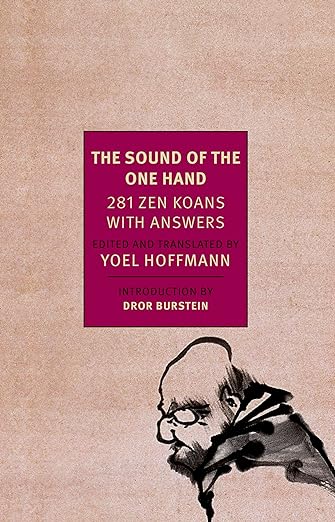
The Sound of One Hand: 281 Zen Koans with Answers. Translation, research and commentary by Joel Hoffmann. Introduction by Dror Burstein. NRYB, 2016, 304 pages. VSCL, Paperback.

There are 144 koan cases, starting on page 75. The full text for each case is followed by possible acceptable answers or responses to the koan. The first 74 pages are very brief questions and answers regarding 137 other cases, without the full text for each case. Therefore, the total cases discussed are 281 koan cases. I have indexed only 148 Cases.

Indexed by Michael P. Garofalo.

Subject Index to the Sound of One Hand 148 Koans. PDF, 10/26/2023, 30 pages.

Case Number List to the Sound of One Hand 148 Koans. PDF, 10/26/2023, 6 pages.

Case Title List to the Sound of One Hand 148 Koans. PDF, 10/26/2023, 6 pages.


Subject Index to 1,975 Zen Buddhist Koans
Indexing and webpage by Michael P. Garofalo.
578 pages, December 28, 2024, PDF


Buddhism: Bibliography, Links, Information, Resources
. Compiled by Michael P. Garofalo.


Taoism: Bibliography, Links, Resources, Information. Compiled by Michael P. Garofalo.
 

Monday, January 19, 2026

I Tripped at the Hole

Repost from August, 2020:

"Astronomers reached across intergalactic space to a giant galaxy known as Messier 87, in the constellation Virgo. There, a black hole about seven billion times more massive than the sun is unleashing a violent jet of energy some 5,000 light years into space."
- New York Times, April 10, 2019


Oil drillers dig holes into the earth that release gas and oil energies.  Not the same as the astronomer's "Black Holes"; but names vary as realities and our living interactions and language games vary or are sustained with others.    

Today, I will dig a hole into our back yard black soil, along our vertical trellis, and then plant a third evergreen clematis vine.  The plant will flourish in that black hole.

Last week a dermatological surgeon incised a squamous tumor from in my left hand, and covered the wound with 10 stitches.  Healed well, and I can return to lifting more than 10 pounds today.  It was a red hole in my flesh for a brief time.  

I've looked down into that multicolored hole called the Grand Canyon and the green Columbia Gorge, big holes in the earth, all with powerful energy producing Rivers flowing Down, down, down ...

The dead human beings are often buried in black holes.  

The Universe expands and contracts in ways to tax and challenge our and my scientific imagination and understanding.  

Yin and Yang, Emptinesses and Energies.  


Tuesday, September 16, 2025

Listening to Change

 Listening to Change

By Mike Garofalo

I listened to another say
what I resisted to hear
what was alien to me
what outlined my ire
what I wanted to fight

But then I settled down
loosened my blockhead mind

Thought things over patiently,
listened more carefully,
saw matters from other sides,
respected the integrity
and sincerity of other kinds

Of thinking outside my closed boxes
of my habits of opinions needing overhaul.


Bundled Up, Volume 1
Quintains, Pentastichs, Tankas

Gushen Grove Sonnets

Highway 101 and 1: A Docu-Poem
California, Oregon, Washington

25 Steps and Beyond
The Poetry by Mike Garofalo


Thursday, July 10, 2025

Tao Te Ching, Chapter 33

Daodejin, Laozi
Chapter 33


"It is wisdom to know others;
It is enlightenment to know one's self.
The conqueror of men is powerful;
The master of himself is strong.
It is wealth to be content;
It is willful to force one's way on others.
Endurance is to keep one's place;
Long life it is to die and not perish."
-  Translated by R. B. Blakney, 1955, Chapter 33  


"Those who know others are intelligent;
Those who know themselves have insight.
Those who master others have force;
Those who master themselves have strength.
Those who know what is enough are wealthy.
Those who persevere have direction.
Those who maintain their position endure.
And those who die and yet do not perish, live on."
-  Translated by R. L. Wing, 1986, Chapter 33 


"He who knows men is wise,
He who knows himself can see clearly.
He who conquers men has strength,
He who conquers himself has power
He who knows that he has enough is rich,
He who acts with energy has a strong will.
He who fails not to find the Self shall endure,
He who dies, but does not perish, shall endure for ever."
-  Translated by Isabella Mears, 1916, Chapter 33


"Understanding other people is wisdom,
understanding other religions is knowledge,
understanding oneself is enlightenment.
Strength is necessary to overcome others
power is necessary to overcome oneself.

Being content with what one already has is wealth.
Violence may achieve a quick result
but nothing permanent.
Stay in place, content with what you have,
to live a long life.
Death is a return to the native elements."
-  Translated by Tom Kunesh, Chapter 33  


知人者智.
自知者明. 
勝人者有力.
自勝者強. 
知足者富. 
強行者有志. 
不失其所者久. 
死而不亡者壽. 

-  Chinese characters, Tao Te Ching, Chapter 33


chih jên chê chih.
tzu chih chê ming.
shêng jên chê yu li.
tzu shêng chê ch'iang.
chih tsu chê fu.
ch'iang hsing chê yu chih.
pu shih ch'i so chê chiu.
ssu erh pu wang chê shou.
-  Wade-Giles Romanization, Tao Te Ching, Chapter 33 


"He who knows others is clever;
He who knows himself has discernment.
He who overcomes others has force;
He who overcomes himself is strong.
He who knows contentment is rich;
He who perseveres is a man of purpose;
He who does not lose his station will endure;
He who lives out his days has had a long life."
-  Translated by D. C. Lau, 1963, Chapter 33 


"Those who know others are wise; those who know themselves are enlightened.
Those who overcome others are powerful; those who overcome themselves are strong.
Those who are contented are rich; those who act strongly have will.
Those who do not lose their place endure; those who die without perishing live long."
-   Translated by Thomas Cleary, 1991, Chapter 33


"He who knows others is wise; he who knows himself is enlightened.
He who overcomes others is powerful; he who overcomes himself is strong.
He who feels self-contentment is rich; he who practises self-cultivation is resolute.
He who abides by his original nature endures; he who follows Truth throughout life enjoys immortality."

-  Translated by Cheng Lin, Chapter 33


"Quien conoce a los demás es inteligente.
Quien se conoce a sí mismo tiene visión interna.
Quien conquista a los demás tiene fuerza; quien se conquista a sí mismo es realmente poderoso.
Quien sabe cuándo ha obtenido bastante es rico, y quien sigue asiduamente
     el sendero del Tao es alguien de propósito constante.
Quien permanece en el lugar en el que ha encontrado su verdadera casa vive mucho tiempo,
     y quien muere, pero no perece, goza de la auténtica longevidad."
-  Translation from Chinese to English by John C. H. Wu, translated into Spanish by Alfonso Colodrón, Capítulo 33


"One who knows others is clever.
One who knows himself has insight.
One who overcomes others is forceful.
One who overcomes himself is truly strong.
One who knows he has enough is rich.
One who does not divert his mind from the realization of integral virtue is wisely willful.
One who preserves his natural integrity will endure.
One who embraces the subtle essence dies yet does not perish and thus enjoys true immortality."
-  Translated by Hua-Ching Ni, 1995, Chapter 33 


"Whoever knows others has wisdom;
Whoever knows himself has insight.
Whoever conquers others has force;
Whoever conquers himself has strength.
Whoever knows he has enough has wealth.
Whoever perseveres has purpose. Whoever keeps to one place endures.
Whoever dies without perishing lives long."
-  Translated by Herrymoon Maurer, 1985, Chapter 33


Chapter 33Tao Te Ching by Lao Tzu
A Philosopher's Notebooks 


Thursday, July 25, 2024

Dao De Jing, Chaper 70, Laozi

Tao Te Ching by Lao Tzu
Chapter 70

"My words are very easy to know,
Very easy to follow.
Yet the world is unable to know them,
Unable to follow them.

My words have a source,
My efforts have mastery.
Indeed, since none know this,
They do not know me.
The rare ones who know me
Must treasure me.

Therefore, Evolved Individuals
Wear a coarse cloth covering
With precious jade at the center."
-  Translated by R. L. Wing, 1986, Chapter 70


"My words are easy to understand and very easy to apply.
But no Ego is able to understand them or apply them.
Words have authority.
Affairs have a history!
It is simply because of their ignorance
that Egos do not understand me.
Those who understand me are few, and
thus I am ennobled.
For this reason, Sages may wear homespun cloth over their shoulders,
but they carry a jewel beyond price in their heart."
-  Translated by Jerry C. Welch, 1998, Chapter 70  


"Easy are my words to know, and also to practice.
Yet none is able to understand nor yet to practice them.
For there is a remote origin for my words, and a supreme law for my actions.
Not knowing these, men cannot know me.
Those who know me are few, and by them I am esteemed.
For the wise man is outwardly poor, but he carries his jewel in his bosom."
-  Translated by Walter Gorn Old, 1904, Chapter 70


My words are very easy to understand and very easy to put into practice, yet in all the world no one appears to understand them or to practice them. 
Words have an ancestor (a preceding idea), deeds have a master (a preceding purpose), and just as these are often not understood, so I am not understood. 
They who understand me are very few, and on that account I am worthy of honor.
The wise man wears wool (rather than silk) and keeps his gems out of sight."
-  Translated by Dwight Goddard and Henri Borel, 1919, Chapter 70 


"My words are very easy to understand,
And very easy to put into practice,
Yet there should have been no one in the world
Who can understand them
Or can put them into practice.
Words must be purpose-oriented,
Deeds must be reasonably grounded.
People cannot understand me
Because they fail to understand what is said above.
Those who understand me are few;
Those who can follow my advice are even less.
That is why the sage
Is always dressed in coarse cloth
But conceals about him a beautiful piece of jade (the Tao)."
-  Translated by Gu Zengkun, Chapter 70  


吾言甚易知, 甚易行.
天下莫能知, 莫能行.
言有宗.
事有君.
夫唯無知, 是以不我知.
知我者希.
則我者貴.
是以聖人被褐懷玉.
-  Chinese characters, Tao Te Ching, Chapter 70

wu yen shên yi chih, shên yi hsing.
t'ien hsia mo nêng chih, mo nêng hsing.
yen yu tsung.
shih yu chün.
fu wei wu chih, shih yi pu wu chih.
chih wu chê hsi. 
tsê wu chê kuei.
shih yi shêng jên pei ho huai yü. 
-  Wade-Giles Romanization, Tao Te Ching, Chapter 70 


"Though the words of the sage are simple,
and his actions easily performed,
they are few among many,
who can speak or act as a sage.

For the ordinary man it is difficult
to know the way of a sage,
perhaps because his words
are from the distant past,
and his actions naturally disposed.

Those who know the way of the sage
are few and far between,
but those who treat him with honesty,
will be honoured by him and the Tao.

He knows he makes no fine display,
and wears rough clothes, not finery.
It is not in his expectancy of men
that they should understand his ways,
for he carries his jade within his heart."
-  Translated by Stan Rosenthal, 1984, Chapter 70  


"My words are so simple to understand
and so easily put into practice
that no one in all beneath heaven understands them
and no one puts them into practice.
Words have their ancestral origins and actions their sovereign:
it's only because people don't understand this that they don't understand me.
And the less people understand me the more precious I become.
So it is that a sage wears sackcloth, keeping pure jade harbored deep."
-  Translated by David Hinton, Chapter 70 


"La palabras tienen un origen; los hechos, una ley.
Mis palabras son fáciles de comprender y fáciles de seguir,
Y, sin embargo, nadie las comprende y nadie las practica.
Es la sabiduría la que impide al hombre acercarse a mi.
Son pocos los que me siguen, porque estoy más allá de toda alabanza.
Por ello el Sabio se cubre con una tela tosca, pero guarda joyas en su seno.
Conoce su valor, pero no lo ostenta. 
Se ama a sí mismo, pero no se tiene en alta estima.
Rechaza lo último y se ciñe a lo primero."
-  Translated from Chinese into English by Ch'u Ta-Kao, Translated from English into Spanish by Caridad Diaz Faes,
Capítulo 70


"My words are most easily known,
Most easy to practice, too,
But none in the world my words can know,
And their practice can pursue.
 
There's an Ancestry in my words,
There's a Head for the things I preach,
But, because they are all misunderstood,
They know not what I teach.
 
The ones who know me are few,
But the few who know me prize,
Though the sage may wear a hair-cloth garb,
The gem in his bosom lies."
-  Translated by Isaac Winter Heysinger, 1903, Chapter 70


"My teaching is very easy to understand,
And very easy to carry out.
Yet the world is incapable of understanding it,
And incapable of carrying it out.
My teaching has an ancient source,
My practices have a ruling principle.
As people are ignorant of this,
So they fail to understand me.
When those who understand me are few,
Then I am distinguished indeed.
That's why the Sage wears a coarse cotton robe,
To conceal the jade ornament worn on his bosom."
-  Translated by Henry Wei, 1982, Chapter 70 


"My words are easy to understand, easy to put in practice; yet the world can neither understand nor practice them.
My words have an underlying intent; my actions have a ruling motive.
It is only ignorance that causes men not to understand my doctrine. 
Those who understand me are few; those who copy me are worthy.
Wherefore the Sage dresses in coarse robes while hiding a jewel in his breast."
-  Translated by Frederic Henry Balfour, 1884, Chapter 70 


Chapter 71, Tao Te Ching by Lao Tzu

Chapter and Thematic Index (Concordance) to the Tao Te Ching by Lao Tzu

English Language Daodejing Translators' Source Index

Spanish Language Daodejing Translators' Source Index

Ripening Peaches: Taoist Studies and Practices

Taoism: A Selected Reading List  

How to Live a Good Life: Advice from Wise Persons

One Old Daoist Druid's Final Journey   


Tuesday, May 14, 2024

Are Things as Such as They Are?


"If you understand, things are such as they are;
If you don't understand, things are such as they are."|
-  Zen Master Gensha


If you don't understand, things are changing.
If you understand, things are changing.
Impermanence is the permanent condition.

-  Mike Garofalo, Cuttings

Friday, January 20, 2017

Dao De Jing, Chapter 14

Tao Te Ching by Lao Tzu
Chapter 14

"What you don't see when you look
is called the unobtrusive.
What you don hear when you listen
is called the rarefied.
What you don't get when you grasp
is called the subtle.
These three cannot be completely fathomed,
so they merge into one:
above is not bright, below is not dark.
Continuous, unnameable, it returns again to
     nothing.
This is called the stateless state,
the image of no thing;
this is called mental abstraction.
When you face it you do not see its head,
when you follow it you do not see its back.
Hold the ancient Way
so as to direct present existence:
only when you can know the ancient
can this be called the basic cycle of the Way."
-  Translated by Thomas Cleary, 1991, Chapter 14


"Looked at, but cannot be seen -
That is called the Invisible (yi).
Listened to, but cannot be heard -
That is called the Inaudible (hsi).
Grasped at, but cannot be touched -
That is called the Intangible (wei).
These three elude our inquiries
And hence blend and become One.

Not by its rising, is there light,
Nor by its sinking, is there darkness.
Unceasing, continuous,
It cannot be defined,
And reverts again to the realm of nothingness.

That is why it is called the Form of the Formless,
The Image of Nothingness.
That is why it is called the Elusive:
Meet it and you do not see its face;
Follow it and you do not see its back."
-  Translated by Lin Yutang, 1955, Chapter 14  


"Look for it, you won't see It;
It is called 'fleeting.'
Listen for It, you won't hear It;
It is called 'thin.' 
Grasp at It, You can't get It;
It is called 'subtle.'
These three lines
Are about something that evades scrutiny.
Yes, in it everything blends and becomes one.
Its top is not bring
Its underside is not dim.
Always unnamable,
It runs back to nothingness. 
This is the shape of something shapeless
The form of a nothing
This is elusive and evasive. 
Encountering it, you won't see the front
Following it, you won't see its back.
Keep to the Tao of the ancients
And so manage things happening today.
The ability to know the ancient sources
This is the main thread of Tao."
-  Translated by Michael LaFargue, 1992, Chapter 14 


視之不見名曰夷.
聽之不聞名曰希.
搏之不得名曰微.
此三者不可致詰.
故混而為一.
其上不皦其下不昧.
繩繩不可名.
復歸於無物.
是謂無狀之狀.
無物之象.
是謂惚恍.
迎之不見其首.
隨之不見其後.
執古之道.
以御今之有.
能知古始.
是謂道紀.
-  Chinese characters, Tao Te Ching, Chapter 14


shih chih pu chien ming yüeh yi. 
t'ing chih pu wên ming yüeh hsi.
po chih pu tê ming yüeh wei.
tz'u san chê pu k'o chih chieh.
ku hun erh wei yi.
ch'i shang pu chiao ch'i hsia pu mei.
shêng shêng pu k'o ming.
fu kuei yü wu wu.
shih wei wu chuang chih chuang.
wu wu chih hsiang.
shih wei hu huang.
ying chih pu chien ch'i shou.
sui chih pu chien ch'i hou.
chih ku chih tao. 
yi yü chin chih yu. 
nêng chih ku shih.
shih wei tao chi. 
-  Wade-Giles Romanization, Tao Te Ching, Chapter 14


"We look for it but do not see it:
    we name it "subtle."
We listen for it but do not hear it;
    we name it "rare."
We grope for it but do not grasp it;
    we name it "serene." 
These three cannot be fully fathomed,
Therefore,
They are bound together to make unity.
Of unity,
its top is not distant,
its bottom is not blurred.
Infinitely extended
and unnameable,
It returns to non-entity.
This is called
"the form of the formless,"
"the image of nonentity."
This is called "the amorphous."
Following behind it,
    you cannot see its back;
Approaching it from the front,
    you cannot see its head.
Hold to the Way of today
    to manage the actualities of today
    thereby understanding the primeval beginning.
This is called "the thread of the Way.""
-  Translated by Victor H. Mair, 1990, Chapter 14 


"When you look, it isn't there
 Listen and you cannot hear it
 It seems to be beyond your reach
 Because you are so near it
 This single source of everything
 Appears to be an empty image
 Though it cannot be understood
 You can see its naked visage
 Follow it to nothingness
 Approach it where you have no face
 From nowhere to infinity
 This vacant image leaves no trace
 From never to eternity
 This naked face is what you are
 An empty, vacant, open door
 Forevermore ajar"
 -  Translated by Jim Clatfelder, 2000, Chapter 14   


"Se le llama invisible porque mirándole no se le ve.
Se le llama inaudible porque escuchándole no se le oye.
Se le llama impalpable porque tocándole no se le siente.
Estos tres estados son inescrutables y se confunden en uno solo.
En lo alto no es luminoso, en lo bajo no es oscuro.
Es eterno y no puede ser nombrado, retorna al no-ser de las cosas.
Es la forma sin forma y la imagen sin imagen.
Es lo confuso e inasible.
De frente no ves su rostro, por detrás no ves su espalda.
Quien es fiel al Tao antiguo domina la existencia actual.
Quien conoce el primitivo origen posee la esencia del Tao."   

-  Translation from Wikisource, 2013, Tao Te Ching, Capítulo 14


"Look at it: nothing to see.
Call it colorless.
Listen to it: nothing to hear.
Call it soundless.
Reach for it: nothing to hold.
Call it intangible.
Triply undifferentiated,
it merges into oneness,
not bright above,
not dark below.
Never, oh! never
can it be named.
It reverts, it returns
to unbeing.
Call it the form of the unformed,
the image of no image.
Call it the unthinkable thought.
Face it: no face.
Follow it: no end.
Hold fast to the old Way,
we can live in the present.
Mindful of the ancient beginnings,
we hold the thread of the Tao."
-  Translated by Ursula K. Le Guin, 1997, Chapter 14 


A typical webpage created by Mike Garofalo for each one of the 81 Chapters (Verses, Sections) of the Tao Te Ching (Daodejing) by Lao Tzu (Laozi) includes 25 different English language translations or interpolations for that Chapter, 5 Spanish language translations for that Chapter, the Chinese characters for that Chapter, the Wade-Giles and Hanyu Pinyin transliterations (Romanization) of the Mandarin Chinese words for that Chapter, and 2 German and 1 French translation of that Chapter.  Each webpage for each one of the 81 Chapters of the Tao Te Ching includes extensive indexing by key words, phrases, and terms for that Chapter in English, Spanish, and the Wade-Giles Romanization.  Each webpage on a Chapter of the Daodejing includes recommended reading in books and websites, a detailed bibliography, some commentary, research leads, translation sources, a Google Translate drop down menu, and other resources for that Chapter.   

Chapter 14, Tao Te Ching by Lao Tzu


Chapter and Thematic Index (Concordance) to the Tao Te Ching by Lao Tzu


English Language Daodejing Translators' Source Index


Spanish Language Daodejing Translators' Source Index


Ripening Peaches: Taoist Studies and Practices


Taoism: A Selected Reading List


Friday, October 28, 2016

Tao Te Ching, Chapter 21

Daodejing, Laozi
Chapter 21


"A virtuous person comes into being only according to the Tao.
Tao is something which is obscure and indistinct.
Indistinct and obscure —
yet there is an appearance.
Obscure and indistinct —
yet there is a substance.
Vague and dim —
yet there is an essence within it.
This essence is genuine.
There is truth within it.
Since ancient times until now, its name never forsaken,
it stands there to guard all the good deeds.
How do I know all the good deeds are guarded by this Tao?
I know.
-  Translated by Chao-Hsiu Chen, 2004, Chapter 21  


"The grandest aspects of producing force
Find Tao their energizing way and source;
In Tao things move unseen, impalpable,
Yet in it form and semblance brood and dwell;
Impalpable, invisible, yet things
Float forth within on transcendental wings;
Dark and profound, yet lo! within it there,
Are the pure essences which aeons bear;
It holds the truth, it keeps its ancient name,
And watches all that from the beginning came;
From the Beginning! How know I this is so?
By this, it is the Tao, by this I know!"
-  Translated by Isaac Winter Heysinger, 1903, Chapter 21


"The impression made by magnificent Te comes only from Tao.
Tao is a something but elusive, but evasive.
Evasive, elusive, inside it lies the mind's true form.
Elusive, evasive, inside it lies something substantial.
Shadowy, dim.
Inside it lies vital energy.
This energy is very strong inside it lies true genuineness.
From ancient times until today
Its name has not been forgotten allowing us to see the beginnings of everything.
How do I recognize the form of the beginnings of everything?
By this low in the cycle of Change, which is Love and Beauty.
How do I know this?
By my comprehension of the Dao."
-  Translated by Michael LaFargue, 1992, Chapter 21  


"The complete manifestation of things visible proceeds only from Life.
In its nature Life is always coming into activity, yet in itself it eludes our sight and tough.
Eluding sight! eluding touch!
Within it are hid the plane of created things.
Eluding touch! eluding sight!
Within it are hid all created beings.
It is profound! It is obscure!
Within it is hid pure Spirit.
It is pure Spirit, enfolding Truth!
Within it is hid an infallible witness.
Free of Old until Now
Its Name remains unchanged.
Through its Doorway comes the Universe into existence.
How do I know that the Universe is coming to full perfection through Life?
The witness is in Life itself."
-  Translated by Isabella Mears, 1916, Chapter 21 


孔德之容, 唯道是從.
道之為物, 唯恍唯惚.
惚兮恍兮, 其中有象.
恍兮忽兮, 其中有物.
窈兮冥兮, 其中有精.
其精甚,  其中有信.
自古及今其名不去.
以閱衆甫.
吾何以知衆甫之狀哉.
以此.

-  Chinese characters, Tao Te Ching, Chapter 21


k'ung tê chih jung, wei tao shih ts'ung.
tao chih wei wu, wei huang wei hu.
hu hsi huang hsi, ch'i chung yu hsiang.
huang hsi hu hsi, ch'i chung yu wu.
yao hsi ming hsi, ch'i chung yu ching.
ch'i ching shên, chên ch'i chung yu hsin. 
tzu ku chi chin ch'i ming pu ch'ü.
yi yüeh chung fu.
wu ho yi chih chung fu chih jan tsai.
yi tz'u.
-  Wade-Giles Romanization, Tao Te Ching, Chapter 21


"The great virtue as manifested is but following the Tao.
Tao is a thing that is both invisible and intangible.
Intangible and invisible, yet there are forms in it;
Invisible and intangible, yet there is substance to it;
Subtle and obscure, there is essence in it;
This essence being invariably true, there is faith in it.
From of old till now, it has never lost its nameless name,
Through which the origin of all things has passed.
How do I know it is so with the origin of all things?
By this Tao."
-  Translated by Ch'u Ta-Kao, 1904, Chapter 21 


"One of deep virtue cherishes the subtle essence of the universe.
 The subtle essence of the universe is elusive and evasive.
 Though it is elusive and evasive,
 it unveils itself as images and forms.
 Evasive and elusive,
 it discloses itself as indefinable substance.
 Shadowy and indistinct,
 it reveals itself as impalpable subtle essence.
 This essence is so subtle, and yet so real.
 It is the subtle origin of the whole of creation and non-creation.
 It existed prior to the beginning of time as the single deep and subtle reality of the universe.
 It brings all into being."
 -  Translated by Ni Hua Ching, 1995, Chapter 21


"La virtud se expresa siguiendo al Tao.
Tao es evasivo e intengible
Pero expresa toda forma y sustancia;
Tao es oscuro y sútil
Pero expresa toda la Naturaleza;
La Naturaleza no cambia,
Pero expresa toda sensación.
Desde antes del conocimiento
El Tao ha expresado todas las cosas.
¿Cómo puedo saber?
Confiando en mis sentidos."
-  Translated by Antonio Rivas, 1998, Chapter 21 


"In his every movement a man of great virtue
Follows the way and the way only.
As a thing the way is
Shadowy and indistinct.
Indistinct and shadowy,
Yet within it is an image;
Shadowy and indistinct,
Yet within it is a substance.
Dim and dark,
Yet within it is an essence.
This essence is quite genuine
And within it is something that can be tested.
From the present back to antiquity,
Its name never deserted it.
It serves as a means for inspecting the fathers of the multitude.
How do I know that the fathers of the multitude are like that?
By means of this."
-  Translated by D. C. Lau, 1963, Chapter 21  


"The mightiest manifestations of active force flow solely from Tao.
Tao in itself is vague, impalpable, how impalpable, how vague!
Yet within it there is Form.
How vague, how impalpable!
Yet within it there is Substance.
How profound, how obscure!
Yet within it there is a Vital Principle.
This principle is the Quintessence of Reality, and out of it comes Truth.
From of old until now, its name has never passed away.
It watches over the beginning of all things.
How do I know this about the beginning of things?
Through Tao."
-  Translated by Lionel Giles, 1905, Chapter 21 


"The features (yung) of the vast (k'ung) Te,
Follows entirely (wei) from Tao.
Tao as a thing,
Is entirely illusive (huang) and evasive (hu).
Evasive and illusive,
In it there is image (hsiang).
Illusive and evasive,
In it there is thinghood (wu).
Dark and dim,
In it there is life seed (ching).
Its life seed being very genuine (chen),
In it there is growth power (hsin).
As it is today, so it was in the days of old (ku),
Its name goes not away (ch'ü),
So that we may survey (yüeh) the origins of the many (chung fu).
How do I know that the origins of the many are such?
Because of this."
-  Translated by Ellen Marie Chen, 1989, Chapter 21


"For effective contrast, this chapter is best read together with chapter 14.  Both chapters call Tao, the illusive and evasive (hu-huang), i.e., the primal Chaos or Hun-tun described in chapter 25.  In chapter 14, Tao recedes and becomes the nothing; here in chapter 21 the same illusive and evasive Tao moves forward to become the realm of beings.  There Tao is nameless; here Tao is the name that never goes away.  There Tao is the formless form, the image of nothing; here Tao contains the seeds and images of all beings that are to be.  The dominant character of Tao in chapter 14 is wu, nothing; in this chapter it is yu, being or having.  The conclusion of chapter 14 traces Tao to the beginning of old; this chapter arrives at the realm of the many in the now."
-  Ellen M. Chen, The Tao Te Ching: A New Translation with Commentary, 1989, p.107


A typical webpage created by Mike Garofalo for each one of the 81 Chapters (Verses, Sections) of the Tao Te Ching (Daodejing) by Lao Tzu (Laozi) includes up to 25 different English language translations or interpolations for that Chapter, 5 Spanish language translations for that Chapter, the Chinese characters for that Chapter, the Wade-Giles and Hanyu Pinyin transliterations (Romanization) of the Mandarin Chinese words for that Chapter, and 2 German and 1 French translation of that Chapter.  Each webpage for each one of the 81 Chapters of the Tao Te Ching includes extensive indexing by key words, phrases, and terms for that Chapter in English, Spanish, and the Wade-Giles Romanization.  Each webpage on a Chapter of the Daodejing includes recommended reading in books and websites, a detailed bibliography, some commentary, research leads, translation sources, a Google Translate drop down menu, and other resources for that Chapter.   

Chapter 22, Tao Te Ching by Lao Tzu


Chapter and Thematic Index (Concordance) to the Tao Te Ching by Lao Tzu

English Language Daodejing Translators' Source Index

Spanish Language Daodejing Translators' Source Index

Ripening Peaches: Taoist Studies and Practices


Taoism: A Selected Reading List


Saturday, August 30, 2014

Ask About a Truth You Should Seek

"Don't cling to your own understanding.  Even if you do understand something, you should ask yourself if there might be something you have not yet fully resolved, or if there may be some higher meaning yet.
Although a suspicious mind is bad, still it is wrong to cling to what you shouldn't believe in, or fail to ask about a truth you should seek.
Even if you have thoroughly studied the stories of the ancients and you sit constantly like iron or stone, as long as you are attached to yourself you cannot find the Way of the enlightened, ever.
Although the Way is complete in everyone, realization of the Way depends on a combination of conditions.
Tenacious opinionation is not transmitted by your parents; it is just that you have tacitly come to believe in opinions for no reason other than that over time you have picked up what people say.
Whether or not beginners are imbued with the spirit of the Way, they should carefully read and study the sagacious teachings of the scriptures and treatises.
Once having understood, you should read the teachings of the sages many times.
Truth is not greater or lesser, but people are shallow or deep."

-  Japanese Zen Grand Master Dogen, 1200-1253
   Translated by Thomas Cleary


"Do you want to study Zen?
You must let go.
Let go of what?
Let go of the four elements and five clusters,
Let go of consciousness conditioned over incalculable time.
Focus on right where you stand;
Try to figure our what the reason is.
Keep on pondering ...
Suddenly the flower of mind will bloom with enlightenment,
illuminating the whole universe."
-  Chien-ju, Studying Zen
The Pocket Zen Reader.  Edited and translated by Thomas Cleary.   p. 104


active3.gif (2786 bytes)

"Zen practice in the midst of activity
is superior to that pursued within tranquility."
Hakuin, 1688-1769


The Pocket Zen Reader.   Compiled and translated by Thomas Cleary.  Shambhala Pocket Classics.  Boston, Shambhala, 1999.  218 pages.  ISBN: 157062447X.  VSCL.  

Zen Buddhism: A Reading List