Showing posts with label Contemplation. Show all posts

Saturday, May 16, 2026

Subject Indexes to The Sound of One Hand 148 Koans Collection

 The Sound Of One Hand (SOH)


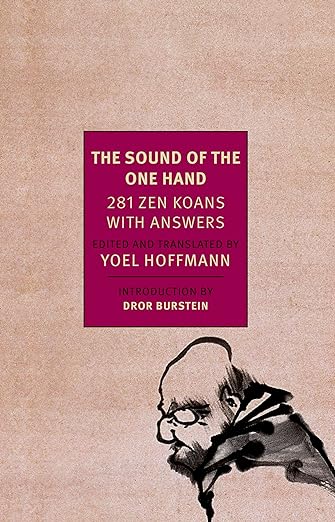
The Sound of One Hand: 281 Zen Koans with Answers. Translation, research and commentary by Joel Hoffmann. Introduction by Dror Burstein. NRYB, 2016, 304 pages. VSCL, Paperback.

There are 144 koan cases, starting on page 75. The full text for each case is followed by possible acceptable answers or responses to the koan. The first 74 pages are very brief questions and answers regarding 137 other cases, without the full text for each case. Therefore, the total cases discussed are 281 koan cases. I have indexed only 148 Cases.

Indexed by Michael P. Garofalo.

Subject Index to the Sound of One Hand 148 Koans. PDF, 10/26/2023, 30 pages.

Case Number List to the Sound of One Hand 148 Koans. PDF, 10/26/2023, 6 pages.

Case Title List to the Sound of One Hand 148 Koans. PDF, 10/26/2023, 6 pages.


Subject Index to 1,975 Zen Buddhist Koans
Indexing and webpage by Michael P. Garofalo.
578 pages, December 28, 2024, PDF


Buddhism: Bibliography, Links, Information, Resources
. Compiled by Michael P. Garofalo.


Taoism: Bibliography, Links, Resources, Information. Compiled by Michael P. Garofalo.


Monday, May 11, 2026

Walking Amidst Beautiful Things

"Today I have grown taller from walking with the trees."
-  Karle Wilson


"I like to walk about amidst the beautiful things that adorn the world."
-  George Santayana


"I was never less alone than when by myself."
-  Edward Gibbon


"The walking stick serves the purpose of an advertisement that the bearer's hands are employed otherwise that in useful effort, and it therefore has utility as an evidence of leisure."
-  Thorstein Veblen, Theory of the Leisure Class


"... the brisk exercise imparts elasticity to the muscles, fresh and healthy blood circulates through the brain, the mind works well, the eye is clear, the step is firm, and the day's exertion always make the evening's repose thoroughly enjoyable."
-  Dr. David Livingstone


Currently, 2010, I am reading the following two books:

The Birth of Hedonism: The Cyrenaic Philosophers and Pleasure as a Way of Life. By Kurt Lampe. Princeton University Press, 2014. 304 pages. ISBN: 978-0691161136. VSCL.


Happiness: A History By Darrin M. McMahon. New York, Atlantic Monthly Press, Grove Press, 2006. Index, notes, 544 pages. ISBN: 97808022142894. VSCL.
Walking - Quotations, Sayings, Poems, Lore

Solitude - Quotations  

Traveling, Camping and Hiking in Oregon

Pleasure, Satisfaction, Desire - Quotations


I walk four miles along a quiet paved country lane.  The photograph below, taken by Karen in 2010, was on a early Spring day.  In the summer, I walk at first daylight - the Dawn Walk.  

Today, there was a half-moon in the morning sky.      


Tuesday, April 28, 2026

Dao De Jing Chapter 16

Tao Te Ching by Lao Tzu
Chapter 16


"Attaining perfect emptiness
 Remain patient and sincere
 The myriad beings arise as one
 Through this we observe the return
 Of beings in numberless multitudes
 Each coming home to its root
 Return to the root means serenity
 It may be called a return to a higher order
 Return to higher order speaks of the enduring
 To comprehend the enduring speaks of clarity
 To not comprehend the enduring
 Is to recklessly create suffering
 To comprehend the enduring (is) tolerance
 Tolerance becomes justice
 Justice becomes sovereignty
 Sovereignty becomes celestial
 The celestial becomes the path
 The path is then continuous
 The death of self is nothing to fear"
 -  Translated by Bradford Hatcher, 2005, Chapter 16


"Bring about emptiness to the extreme.
Guard true stillness.
The ten-thousand things rise together.
I therefore observe their return:
Those ten-thousand plants—each plant—returns
Going back to its root.
Going back to the root is said to be stillness.
This is called returning to life.
Returning to life is called the Constant.
Understanding the Constant is called clarity.
Not understanding the Constant:
Reckless actions—misfortune.
Understanding the Constant, forgive.
Forgive, then be unbiased.
Be unbiased, then be whole.
Be whole, then be Heaven.
Be Heaven, then be Tao.
Be Tao, then be eternal.
Not having a body, there is no danger."
-  Translated by Aalar Fex, 2006, Chapter 16  


"Empty the self completely; Embrace perfect peace.
 Realize that all beings alike go through their processes of activity and life,
 and then they return to the original source.
 Returning to the source brings peacefulness and stillness.
 This stillness is the flow of nature, and signifies that the beings have lived their allotted span of life.
 Accepting this brings enlightenment and tranquility,
 ignoring this brings confusion and sorrow
 If one can accept this flow of nature; one can cherish all things.
 Being all-cherishing you become impartial;
 Being impartial you become magnanimous;
 Being magnanimous you become natural;
 Being natural you become one with The Way;
 Being one with The Way you become immortal:
 Though the body will decay, the Way will not."
 -  Translated by John Discus, 2002, Chapter 16   


致虛極.
守靜篤.
萬物並作.
吾以觀復.
夫物芸芸, 各復歸其根.
歸根曰靜.
是謂復命.
復命曰常.
知常曰明.
不知常, 妄作凶知常容.
容乃公.
公乃王.
王乃天.
天乃道.
道乃久.
沒身不殆.
-  Chinese characters, Tao Te Ching, Chapter 16


zhi xu ji.
shou jing du.
wan wu bing zuo.
wu yi guan fu.
fu wu yun yun, ge fu gui qi gen.  
gui gen yue jing.
shi yue fu ming.
fu ming yue chang.
zhi chang yue ming.
bu zhi chang, wang zuo xiong zhi chang rong.
rong nai gong.
gong nai quan.
quan nai tian.
tian nai dao.
dao nai jiu.
mo shen bu dai.
-  Pinyin translation, Daodejing, Chapter 16 


"Effect emptiness to the extreme.
 Keep stillness whole.
 Myriad things act in concert.
 I therefore watch their return.
 All things flourish and each returns to its root.
 Returning to the root is called quietude.
 Quietude is called returning to life.
 Return to life is called constant.
 Knowing this constant is called illumination.
 Acting arbitrarily without knowing the constant is harmful.
 Knowing the constant is receptivity, which is impartial.
 Impartiality is kingship.
 Kingship is Heaven.
 Heaven is Tao
 Tao is eternal.
 Though you lose the body, you do not die."
 -  Translated by Charles Muller, 1891, Chapter 16


"Vacía tu Ego completamente;
Abraza la paz perfecta.
El Mundo se mueve y gira;
Observale regresar a la quietud.
Todas las cosas que florecen
Regresarán a su origen.

Este regreso es pacífico;
Es el camino de la Naturaleza,
Eternamente decayendo y renovandose.
Comprender ésto trae la iluminación,
Ignorar esto lleva a la miseria.

Aquel que comprende el camino de la Naturaleza llega a apreciarlo todo;
Apreciandolo todo, se convierte en imparcial;
Siendo imparcial, se convierte en magnánimo;
Siendo magnánimo, se convierte en parte de la Naturaleza;
Siendo parte de la Naturaleza, se hace uno con el Tao;
Siendo uno con el Tao, se alcanza la inmortalidad:
Piensa que el cuerpo perecerá, el Tao no."
-  Translated by Antonio Rivas Gonzálvez, 1998, Tao Te Ching, Capítulo 16


"To arrive at ultimate quietness
Steadfastly maintain repose.
All creatures together have form;
I see them return again to their root.
The Master creatures come to perfect form,
Continuously they return to their root.
Continuous return to the root is called repose,
Repose is called the law of return,
The law of return is called eternity.
To know eternity is called illumination.
To ignore eternity is to draw misfortune on oneself,
To know eternity is to be great of Soul,
To be great of soul is to be a ruler,
To be a ruler is to be greater than all,
To be greater than all is to be conscious of Life,
To be conscious of Life is to endure.
The body shall disappear but not decay."
-  Translated by Isabella Mears, 1916, Chapter 16  


Audio Recordings (Podcasts) in English by Mike Garofalo

Here is an audio recording of selected translations from Chapter 16 of the Tao Te Ching. This reading includes translations by Isabella Mears 1916, Charles Muller 1891, John Discus 2002, Bradford Hatcher 2005, Stephen Addis 1993.  Reading and recording by Michael P. Garofalo at the Valley Spirit Center in Red Bluff, California.  Recorded on December 5, 2016. MP3 format.  12.7 MB.    


A typical webpage created by Mike Garofalo for each one of the 81 Chapters (Verses, Sections) of the Tao Te Ching (Daodejing) by Lao Tzu (Laozi) includes 25 different English language translations or interpolations for that Chapter, 5 Spanish language translations for that Chapter, the Chinese characters for that Chapter, the Wade-Giles and Hanyu Pinyin transliterations (Romanization) of the Mandarin Chinese words for that Chapter, and 2 German and 1 French translation of that Chapter.  Each webpage for each one of the 81 Chapters of the Tao Te Ching includes extensive indexing by key words, phrases, and terms for that Chapter in English, Spanish, and the Wade-Giles Romanization.  Each webpage on a Chapter of the Daodejing includes recommended reading in books and websites, a detailed bibliography, some commentary, research leads, translation sources, a Google Translate drop down menu, and other resources for that Chapter.   

Chapter 16, Tao Te Ching by Lao Tzu


Chapter and Thematic Index (Concordance) to the Tao Te Ching by Lao Tzu


English Language Daodejing Translators' Source Index


Spanish Language Daodejing Translators' Source Index


Ripening Peaches: Taoist Studies and Practices


Taoism: A Selected Reading List


Sunday, April 19, 2026

Art, Symbolism, and Creative Interpretations: The Tarot

Today, I am enjoying using a new copy of the:
Voyager Tarot, Intuition Cards for the 21st Century
By James Wanless, Ph.D.. Artist Ken Knutson. 
78 full color collage art Tarot cards.  117 page mini booklet. 
Fair Winds: ISBN 978-1-59233-322-6, 2017.  First edition 1984.  


Has anyone seen a chart or list correlating the 78 cards in the Voyager Tarot (or other Tarot decks) with the 64 Hexagrams of the I Ching???

For examples:

I Ching Number = Tarot Card Name

#1 Creative, Initiating = Magician, 1

#4, Childhood, Youthful Folly, Impermanence = Fool, 0

#52 Mountain = Hermit, 9

During a morning Voyager Tarot card reading, I usually select one card as the most significant for the day.  I would like to write on each Tarot card the corresponding, related, correlated, comparable, similar themed, or relevant I Ching Hexagram Number.  

Also, this is a different way for selecting an I Ching Hexagram other than yarrow sticks or coin tossing.  


A Repost from 2018:


I first purchased and used Tarot decks in 1979.  I studied numerous books on the subject of the Tarot.  I purchased numerous decks over the decades.  First, I enjoyed the variety of artwork and symbolism in the 78 cards in the different decks from different centuries.  Second, the creator of each deck brings some new insights into the overall structure and meanings for the cards in the deck.  Third, I enjoyed "reading" and creatively interpreting the symbols and images in these small art objects in the context of my own life and questions.  

I even made, in 2011, some very incomplete notes in hypertext documents on the Tarot.

My method over the years is to ask a question or reflect on my current consciousness and situation in my life.  Then, I randomly pull from 3 to 5 cards from the deck.  I try to interpret, reflect upon, and consider the meaning of each card.  I may use The Voyager Tarot book to refresh or expand my understanding or memories.  Then, I arrange the cards in some order to "tell a story."  I do this once a day, at night; then, in the morning, reconsider the meanings and relevance of that 3-5 card reading in my life.  I only look at cards right side up; although, I do sometimes reverse the meaning of the cards depending upon the story I create.  

I enjoy using the 1991 Voyager Tarot deck the most.  

This photomontage deck was designed by James Wanless, Ph.D.  The photographic collage artwork was created by Ken Knutson.  It was first published in 1984, and then in 1991 and 2008. 

The Voyager Tarot: Way of the Great Oracle Book.  By James Wanless, 1989.  Book and Deck


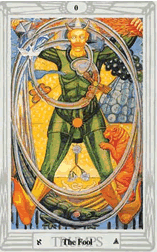
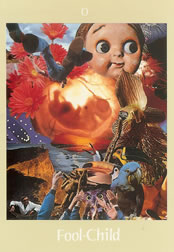
 The Fool, 0


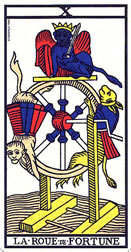
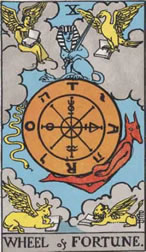
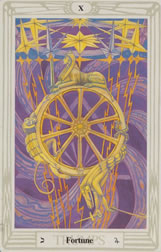
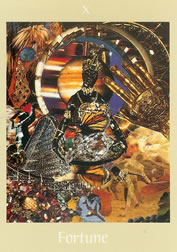
The Wheel of Fortune, 10


Thursday, May 22, 2025

Subject Indexes to Dogen Zenji's 300 Koans Collection

 Eihei Dogen's 300 Koans Collection: Indexing by Michael P. Garofalo


Dogen's Shinji Mana Shobogenzo 300 Koans Collection DSMS

Buddhism: Dogen's Shinji Mana Shobogenzo Koan Collection 
DSMS 300 Koan Cases
Text Authority:
The True Dharma Eye: Zen Master Dōgen's Three Hundred Koans.
Translated by Kazuaki Tanahashi and John Daido Loori. Shambhala, 2005, index, glossary, lineage charts, biographies, 472 pages.


Indexing by Michael P. Garofalo
Green Way Research, Vancouver, Washington
2nd Draft, May 30, 2023


Subject Index to All Cases in Dogen's 300 Koans Collection. 
DSMS, May 30, 2023, PDF, 51 pages.


Alphabetical Order List of English Titles of Cases in Dogen's 300 Koans Collection. DSMS, May 30, 2023, PDF, 11 pages.

Cases in Numerical Order of English Titles in Dogen's 300 Koans Collection. 
DSMS, May 30, 2023, PDF, 11 pages.


Alphabetical Order List of the Teachers in 
Dogen's 300 Koans Collection.
DSMS, May 30, 2023, PDF, 11 pages.


Subject Index to 1,001 Zen Buddhist Koans


DSMS


DSSS


Subject Index to 1,001 Zen Buddhist Koans

Sparks: Brief Spiritual Lessons and Stories

Matches to Start a Kindling of Insight.
May the Light from Our Inner Fireplace Help All Beings.
Taoist, Chan Buddhist, Zen Buddhist, Philosophers.
Catching Phrases, Inspiring Verses, Koans, Meditations.
Indexing, Bibliography, Quotations, Notes, Resources.
Koans Database Project.
Research by Michael P. Garofalo


The Fireplace Records
By Michael P. Garofalo


Tuesday, April 15, 2025

Hillcrest by Edward Arlington Robinson

Hillcrest

By Edward Arlington Robinson

1916

(To Mrs. Edward MacDowell)


No sound of any storm that shakes  
Old island walls with older seas  
Comes here where now September makes  
An island in a sea of trees.  
 
Between the sunlight and the shade
A man may learn till he forgets  
The roaring of a world remade,  
And all his ruins and regrets;  
 
And if he still remembers here  
Poor fights he may have won or lost,—
If he be ridden with the fear  
Of what some other fight may cost,—  
 
If, eager to confuse too soon,  
What he has known with what may be,  
He reads a planet out of tune
For cause of his jarred harmony,—  
 
If here he venture to unroll  
His index of adagios,  
And he be given to console  
Humanity with what he knows,—
 
He may by contemplation learn  
A little more than what he knew,  
And even see great oaks return  
To acorns out of which they grew.  
 
He may, if he but listen well,
Through twilight and the silence here,  
Be told what there are none may tell  
To vanity’s impatient ear;  
 
And he may never dare again  
Say what awaits him, or be sure
What sunlit labyrinth of pain  
He may not enter and endure.  
 
Who knows to-day from yesterday  
May learn to count no thing too strange:  
Love builds of what Time takes away,
Till Death itself is less than Change.  
 
Who sees enough in his duress  
May go as far as dreams have gone;  
Who sees a little may do less  
Than many who are blind have done;
 
Who sees unchastened here the soul
Triumphant has no other sight
Than has a child who sees the whole
World radiant with his own delight.
 
Far journeys and hard wandering
Await him in whose crude surmise
Peace, like a mask, hides everything
That is and has been from his eyes;
 
And all his wisdom is unfound,
Or like a web that error weaves
On airy looms that have a sound
No louder now than falling leaves.

25 Steps and Beyond: Collected Works
Poetry, Indexes, Anthologies, Research
By Michael P. Garofalo

Tanka Poetry - Quintains
By Mike Garofalo

Tuesday, December 12, 2023

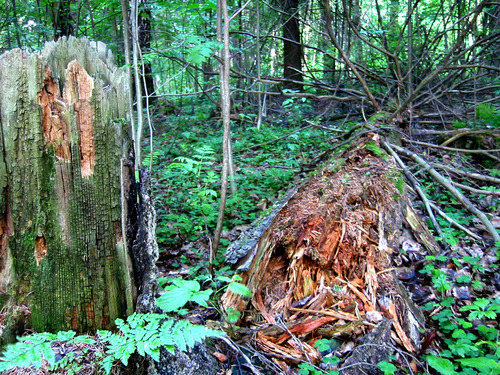
The Decaying Tree

                The Fireplace Records, Chapter 42


The Decaying Tree

The smell of the sea hugged the fog in the redwood trees,
All cool and dank, dimly lit and rank with green,
And in shadowed limbs the Stellar jays jabbered free,
And me, standing silently, an alien in this enchanted scene.

From behind the mossy grey stumps
the sounds of footsteps crunching fronds of ferns
caught my suddenly wary mind ...
What?

"Hello, old friend," said Chang San Feng.
"Master Chang, what a surprise," said I.
Master Chang sat on a stump, smiled, and said,

"Can you hear the Blue Dragon singing in the decaying tree;
Or is it the White Tiger roaring in the wilderness of your bright white skull?
No matter!  The answer is in the questioning; don't you Chan men see?
In the red ball flesh of this decaying tree
Sapless woody shards of centuries of seasons
Nourish the new roots of mindfulness sprouting. 
Yes, Yes, but how can it be?
The up-surging waves of life sprout forth from the decaying tree,
As sure as sunrise rolling over the deep black sea. 
Coming, coming, endlessly coming; waves of Chi
 

Tan Qian's raven roosts for 10,000 moons
     in the withered branches of the rotting tree;
     then, one day, the weathered tree falls,
     nobody hearing, soundlessly crashing
     on the forest floor, on some unknown noon. 
 

Over and over, over and over, life bringing death, death bringing life,
Beyond even the miraculous memories of an old Xian like me;
Watching, watching, sequestered from the strife,
Turning my soul away sometimes because I cannot bear to see. 

Even minds may die, but Mind is always free
Bounding beyond, beyond, far beyond you and me;
Somehow finding the Possibility Keys
And unlocking the Door out of the Voids of Eternities."

Master Chang somehow, someway,
slowly disappeared into the red brown heart of the decaying tree.


Then the squawk of the jay
opened my mind's eye to the new day -
Namaste."    

-  Michael P. Garofalo
   Remembering Prairie Creek Redwoods State Park, California
   April 27, 2012


Comments, Sources, Observations, Koans, Poems, Quips:

Dead things help produce life.
Don't underestimate the power of Nature.
Mysteries upon mysteries upon mysteries.
Dragons appear and disappear.
Ravens roosting in the boughs of trees for centuries.


Trees

Trees: Magick, Lore, Myths

Master Chang San-Feng


636 Riddles, Jokes, Witticisms, Humor

Refer to my Cloud Hands Blog Posts on the topic of Koans/Stories. 

Subject Index to 1,975 Zen Buddhist Koans

Zen Buddhist Koans: Indexes, Bibliography, Commentary, Information

The Daodejing by Laozi

Pulling Onions  Over 1,043 One-line Sayings, Quips, Maxims, Humor

Chinese Chan Buddhist and Taoist Stories and Koans

The Fireplace Records (Blog Version) By Michael P. Garofalo


Monday, December 11, 2023

The Sounds of One Hand

             The Fireplace Records, Chapter 41


The Sounds of One Hand


Zen Master Hakuin Ekaku (1686-1769) was dedicated to help others attain insight, good behavior, generosity, and enlightenment. He was famous for his outstanding calligraphy and ink paintings. He composed many essays and sermons on Buddhism. 

One koan he frequently used to help his students was "What is the sound of one hand?" 


The Sounds of One Hand

Hakuin's cane struck the shoulders of his sleeping student.

The infant raised one hand and cried out.

He reached out and handed the child a book.

He slapped his hand on the table and said "No!"

The drummer's stick hit the snare drum.

He cut his hand with the sharp knife and cried out.

The soldier's severed hand rotted in the mud.

The pupil composed himself and then extended one hand forward.

The student slapped Hakuin's face.

The sound of silence in one hand.

The mother patted her hand on her daughter's shoulder

His hand made a fist.

He shook the hand of his rival.

He handed the beggar a $20.00 bill.

He dreamt that his one hand was stuck in the rocks.

He felt pain in his one hand thrust into the ice cold water.

He held the burning cigarette in his left hand.

The judge struck his gavel on the desk to return order in the court.

Her beautiful hand gently touched his face as he smiled.

The soccer players exchanged high-fives after one scored a goal.

He extended his hand to help up the old woman who had fallen down.

They lovers held hands and gently kissed.

He slurped the Mizo soup from the spoon in his right hand.

He clapped one hand on his knee to applaud the child singing.

The Dragon's claws scratched the Pearl that he grasped in his fist.

Hakuin's dragon cane clicked on the hardwood floor as he walked out.


Comments, Sources, Observations, Koans, Poems, Quips:

Now I understand the difference between reality and Reality.
If when clapping both hands a sound is heard; what is the sound of the one hand?
Making a sound or hearing a sound; which came first?
Did you hear the sound of one hand from the front or from the back?
Many sounds can be made with one hand.
You must do something to make a sound with one hand.
The sound of one hand is "one hand."

The moving hand and its sound are simultaneous.
The still hand is silent.

"The hand is the cutting edge of the mind."  - Jacob Bronowski

“We leave traces of ourselves wherever we go, on whatever we touch.”

-  Lewis Thomas
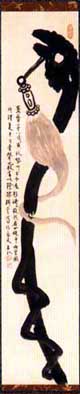

Hakuin's Dragon Staff Inka Scroll


Zen Master Hakuin Ekaku (1686-1769) painted a Dragon Staff with a horsehair whisk attached. He would give this painting to his lay students who passed the Zen koan, "What is the sound of one hand clapping."


Magic Pearl Qigong

Dragon Qigong

Staff, Cane, Stick, Whisk

Hands, Fingers, Touch, Feeling, Manipulation

Sounds, Listening, Silence, Hearing


636 Riddles, Jokes, Witticisms, Humor

Refer to my Cloud Hands Blog Posts on the topic of Koans/Stories. 

Subject Index to 1,975 Zen Buddhist Koans

Zen Buddhist Koans: Indexes, Bibliography, Commentary, Information

The Daodejing by Laozi

Pulling Onions  Over 1,043 One-line Sayings, Quips, Maxims, Humor

Chinese Chan Buddhist and Taoist Stories and Koans

The Fireplace Records (Blog Version) By Michael P. Garofalo


Monday, January 16, 2023

Bandon, Oregon

I will be Yurt Camping at Bullard's Beach State Park near Bandon, Oregon.  I will be exploring the smaller areas around Bandon for three nights and four days.  

The drive from Vancouver to Bandon takes 5 to 6 hours.  I drive south on Interstate 5 until I reach Curtin, OR.  Then I take Road 38 west through Drain, Elkton, and into Reedsport.  Road 38 follows the Umpqua River.  Then south on 101 through the Oregon Coastal Sand Dunes, Tugman State Park, North Bend, Coos Bay, and then on to Bandon.  


Drain, Oregon - Images

Elkton, Oregon - Images

Reedsport, Oregon - Images

Reedsport, Oregon - Information

Oregon Coastal Sand Dunes

Tugman State Park

Coos Bay, Oregon - Images

Coos Bay - Information  

Bullards Beach State Park, Bandon

Bandon - Images

Bandon - Information  

Four Days in Grayland


Here is my Yurt campsite for four days.
Since it rained a lot while I was here,
having good dry indoor shelter was important.


Old lighthouse on the north jetty at Bandon.

View from the south jetty at Bandon.


When I go yurt camping on January 13-16 at Bullard's Beach State Park near Bandon, Oregon, I plan to include a number of spiritual practices while on Retreat.  I will read two books:

Eight Mindful Steps to Happiness: Walking the Buddha's Path.  By Bhante Henepola Gunaratana.  Wisdom Pubs., 2001, 268 pages, VSCL.  


Awakening the Buddha Within: Tibetan Wisdom for the Modern World.  By Lama Surya Das.  432 pages, 1997.  VSCL.  


Lama Surya Das


In 2023, I will be studying books by Deng Ming-Dao.


Waves of Reflections at the Bandon Jetty
By Michael P. Garofalo
January 2023

Friday, April 22, 2022

Stoic Spiritual Exercises

"  "Spiritual exercises."  The expression is a bit disconcerting for the contemporary reader.  In the first place, it is no longer quite fashionable these days to use the word "spiritual."  It is nevertheless necessary to use this term, I believe, because none of the other adjectives we could use — "psychic," "moral," "ethical," "intellectual," "of thought," "of the soul" — covers all the aspects of the reality we want to describe.  Since, in these exercises, it is though which, as it were, takes itself as its own subject-matter, and seeks to modify itself, it would be possible for us to speak in terms of "thought exercises."  Yet the word "thought" does not indicate clearly enough that imagination and sensibility play a very important role in these exercises.  For the same reason, we cannot be satisfied with "intellectual exercises," although such intellectual factors as definition, division, ratiocination, reading, investigation, and rhetorical amplification play a large role in them.  "Ethical exercises" is a rather a tempting expression, since, as we shall see, the exercises in question contribute in a powerful way to the therapeutics of the passions, and have to do with the conduct of life.  Yet, here again, this would be too limited a view of things.  As we can glimpse through Friedmann's text, these  exercises in fact correspond to a transformation of our vision of the world, and to a metamorphosis of our personality.  The word "spiritual" is quite apt to make us understand that these exercises are the result, not merely of thought, but of the individuals entire psychism.  Above all, the word "spiritual" reveals the true dimensions of these exercises.  By means of them, the individual raises himself up to the life of the objective Spirit; that is to say, he re-places himself within the perspective of the Whole ("Become eternal by transcending yourself.")"
-  Pierre Hadot, Philosophy as a Way of Life, 1995, p. 81; Spiritual Exercises, pp. 81-125. 


Stoicism  A hypertext notebook by Michael P. Garofalo.  

Virtues and the Good Life

Stoic Philosophers and Spiritual Exercises


Pierre Hadot   (1922 - 2010) 


"These exercises, involving not just the intellect or reason, but all a human being's faculties, including emotion and imagination, had the same goal as all ancient philosophy: reducing human suffering and increasing happiness, by teaching people to detach themselves from their particular, egocentric, individualistic viewpoint and become aware of their belonging, as integral component parts, to the Whole constituted by the entire cosmos. In its fully developed form, exemplified in such late Stoics as Epictetus and Marcus Aurelius, this change from our particularistic perspective to the universal perspective of reason had three main aspects. First, by means of the discipline of thought, we are to strive for objectivity; since, as the Stoics believe, what causes human suffering is not so much things in the world, but our beliefs about those things, we are to try to perceive the world as it is in itself, without the subjective coloring we automatically tend to ascribe to everything we experience ("That's lovely," "that's horrible," "that's ugly," "that's terrifying," etc., etc.). Second, in the discipline of desire, we are to attune our individual desires with the way the universe works, not merely accepting that things happen as they do, but actively willing for things to happen precisely the way they do happen. This attitude is, of course, the ancestor of Nietzsche’s “Yes” granted to the cosmos, a “yes” which immediately justifies the world's existence.  Finally, in the discipline of action, we are to try to ensure that all our actions are directed not just to our own immediate, short-term advantage, but to the interests of the human community as a whole.  Hadot finally came to believe that these spiritual attitudes—“spiritual” precisely because they are not merely intellectual, but involve the entire human organism, but one might with equal justification call them “existential” attitudes—and the practices or exercises that nourished, fortified and developed them, were the key to understanding all of ancient philosophy. In a sense, the grandiose physical, metaphysical, and epistemological structures that separated the major philosophical schools of Antiquity—Platonism, Aristotelianism, Stoicism, Epicureanism—were mere superstructures, intended to justify the basic philosophical attitude. Hadot deduced this, among other considerations, from the fact that many of the spiritual exercises of the various schools were highly similar, despite all their ideological differences: thus, both Stoics and Epicureans recommended the exercise of living in the present."
-  Michael Chase, Remembering Pierre Hadot


Stoic Spiritual Exercises.  By Elen Buzaré.  2010.  32 pages.  PDF File.

Dismantling the Self: Deleuze, Stoicism and Spiritual Exercises.  By Luke Skrebowski, 2005, 18 pages, PDF File.

Philosophical Therapeutics: Pierre Hadot and Ancient Philosophy as a Way of Life.  By Christopher Vitale, Networkologies, 2012.  

Philosophy as a Way of Life: Spiritual Exercises from Socrates to Foucault  By Pierre Hadot.  Edited with an introduction by Arnold Davidson.  Translated by Michael Chase.  Malden, Massachusetts, Wiley-Blackwell, 1995.  Index, extensive bibliography, 320 pages.  ISBN: 978-0631180333.  VSCL.


Friday, November 24, 2017

Dao De Jing, Chapter 5


Tao Te Ching by Lao Tzu
Chapter 5


"Nature is non-benevolent. 
It regards the masses as straw dogs.
The Holy Man is non-benevolent.
He regards the masses as straw dogs.
The space between the heaven and the earth is like a bellows;
though unsupported, it does not warp; when in motion the more it expels.
Though words could exhaust this theme, they would not be so profitable
As the preservation of its inner essence."
-  Translated by C. Spurgeon Medhurst, 1905, Chapter 5


"Nature is indifferent to life.
It realizes everything is as a straw dog
(a sacrificial animal-image).
The truly wise are also indifferent to life.
They realize humanity is as a straw dog.
The universe is like a bellows:
empty, yet quite full.
As it proceeds, it produces.
Much talk, much exhaustion.
Keep your thoughts within!"
-  Translated by C. Ganson, Chapter 5 


"Heaven and Earth do not claim to be kindhearted or pitiful.
To them all things and all creatures are as straw dogs brought to the sacrifice and afterwards discarded.
Nor is the Sage kindhearted or pitiful.
To him to the people are as straw dogs.
But the space between Heaven and Earth may be likened to a bellows:
It seems empty, and yet it gives all that is required of it.
The more it is worked, the more it yields.
Whereas the force puffed up by words is soon exhausted.
Better to hold fast to that which dwells within the heart."
-  Translated by Herman Ould, 1946, Chapter 5  


天地不仁, 以萬物為芻狗.
聖人不仁, 以百姓為芻狗.
天地之間, 其猶橐籥乎.
虛而不屈.
動而愈出.
多言數窮.
不如守中.  
-  Chinese characters, Chapter 5, Tao Te Ching


t'ien ti pu jên, yi wan wu wei ch'u kou.
shêng jên pu jên, yi pai hsing wei ch'u kou.
t'ien ti chih chien, ch'i yu t'o yo hu.
hsü erh pu ch'u.
tung erh yü ch'u.
to yen shu ch'iung.
pu ju shou chung.
-  Wade-Giles Romanization, Chapter 5, Tao Te Ching


"Heaven and Earth have no humanity;
They regard all things as straw-dogs.
The sage has no humanity;
He regards the people as straw-dogs.
Between Heaven and Earth, it is like a bellows or a flute!
Empty, but not exhausted;
With movement, more comes out.
Too much talk always exhausts;
It is better to keep to the inside."
-  Translated by Yi Wu, Chapter 5


"Heaven and earth are not merciful,
They treat all things as straw dogs;
The sage is not merciful,
He treats the people as straw dogs.
Does not the space between heaven and earth form like a bellows?
It is empty but the air in it can never be exhausted;
The more air it expels, the more comes out.
That is why too many government decrees only result in more failures.
It is better, therefore, to hold fast to moderation and the void."
-  Translated by Gu Zhengkun, Chapter 5


"Heaven and Earth are not humane.
They regard all things a straw dogs.
The sage is not humane.
He regards all people as straw dogs.
How Heaven and Earth are like a bellows.
While vacuous, it is never exhausted.
When active, it produces even more.
Much talk will of course come to a dead end.
It is better to keep to the centre."
-  Translated by Chan Wing-Tsit, 1963, Chapter 5   


"El universo no tiene afecciones humanas:
todas las cosas del mundo son para él como un perro de paja.
El santo no tiene affeciones humanas;
el pueblo es para él como un perro de paja.

El universo es iqual que un fuelle de forja;
vacío, pero no aplanado.
Cuanto máa se le mueve, más exhala,
cuanto más se habla de él, menos se le comprende,
más vale insertarse en el."
-  Translated by Alba, 1998, Tao Te Ching, Capítulo 5 


"Heaven and Earth are impartial; 
They see the ten thousand things as straw dogs.
The wise are impartial;
They see the people as straw dogs.
The space between heaven and Earth is like a bellows.
The shape changes but not the form;
The more it moves, the more it yields.
More words count less.
Hold fast to the center."
-  Translated by Gia-fu Feng and Jane English, 1989, Chapter 5  


"The Sage does not take sides,
He welcomes both saints and sinners.
The Tao works upon man as it works upon the grasses of the fields.
Sages act out of the need for rightness, not purely compassion.
The Tao is like a bellows, even though it appears empty, its workings are obvious,
Yet the more you use it the more it produces, it is inexhaustible.
Yet speaking of it will not increase the comprehension.
Hold to the center path."
-  Translated by John Dicus, 2002, Chapter 5 


"Heaven and Earth are not (willfully) benevolent
The myriad things are treated no differently
Than grass for dogs
Sages are not (willfully) benevolent
The hundred clans are treated no differently
Than grass for dogs
The gate of Heaven and Earth
Is it not like a bagpipe:
Empty yet not finished.
It moves, and again more is pushed forth
To speak countless words is worthless
This is not as good ad guarding balance within."
-  Translated by Dan G. Reid, 2016, Chapter 5 


"Heaven and earth are ruthless, and treat the myriad creatures as straw dogs;
the sage is ruthless, and treats the people as straw dogs.
Is not the space between heaven and earth like a bellows?
It is empty without being exhausted:
The more it works the more comes out.

Much speech leads inevitably to silence.
Better to hold fast to the void."
-  Translated by D. C. Lau, 1963, Chapter 5 


A typical webpage created by Mike Garofalo for each one of the 81 Chapters (Verses, Sections) of the Tao Te Ching (Daodejing) by Lao Tzu (Laozi) includes 25 different English language translations or interpolations for that Chapter, 5 Spanish language translations for that Chapter, the Chinese characters for that Chapter, the Wade-Giles and Hanyu Pinyin transliterations (Romanization) of the Mandarin Chinese words for that Chapter, and 2 German and 1 French translation of that Chapter.  Each webpage for each one of the 81 Chapters of the Tao Te Ching includes extensive indexing by key words, phrases, and terms for that Chapter in English, Spanish, and the Wade-Giles Romanization.  Each webpage on a Chapter of the Daodejing includes recommended reading in books and websites, a detailed bibliography, some commentary, research leads, translation sources, a Google Translate drop down menu, and other resources for that Chapter.  These are hypertext documents, and available online under Creative Commons 4.


Chapter 5, Tao Te Ching by Lao Tzu.  Complied by Mike Garofalo.  

Chapter and Thematic Index (Concordance) to the Tao Te Ching by Lao Tzu


English Language Daodejing Translators' Source Index


Spanish Language Daodejing Translators' Source Index


Ripening Peaches: Taoist Studies and Practices


Taoism: A Selected Reading List