Showing posts with label Training Methods. Show all posts

Tuesday, May 12, 2026

Yang Style Tai Chi Chuan Training Principles

"1.) Head upright to let the shen [spirit of vitality] rise to the top of the head. Don't use li [external strength], or the neck will be stiff and the ch'i [vital life energy] and blood cannot flow through. It is necessary to have a natural and lively feeling. If the spirit cannot reach the headtop, it cannot raise.

2.) Sink the chest and pluck up the back. The chest is depressed naturally inward so that the ch'i can sink to the tan-t'ien [field of elixir]. Don't expand the chest: the ch'i gets stuck there and the body becomes top-heavy. The heel will be too light and can be uprooted. Pluck up the back and the ch'i sticks to the back; depress the chest and you can pluck up the back. Then you can discharge force through the spine. You will be a peerless boxer.

3.) Sung [Relax] the waist. The waist is the commander of the whole body. If you can sung the waist, then the two legs will have power and the lower part will be firm and stable. Substantial and insubstantial change, and this is based on the turning of the waist. It is said "the source of the postures lies in the waist. If you cannot get power, seek the defect in the legs and waist."

4.) Differentiate between insubstantial and substantial. This is the first principle in T'ai Chi Ch'uan. If the weight of the whole body is resting on the right leg, then the right leg is substantial and the left leg is insubstantial, and vice versa. When you can separate substantial and insubstantial, you can turn lightly without using strength. If you cannot separate, the step is heavy and slow. The stance is not firm and can be easily thrown of balance.

5.) Sink the shoulders and drop the elbows. The shoulders will be completely relaxed and open. If you cannot relax and sink, the two shoulders will be raised up and tense. The ch'i will follow them up and the whole body cannot get power. "Drop the elbows" means the elbows go down and relax. If the elbows raise, the shoulders are not able to sink and you cannot discharge people far. The discharge will then be close to the broken force of the external schools.

6.) Use the mind instead of force. The T'ai Chi Ch'uan Classics say, "all of this means use I [mind-intent] and not li." In practicing T'ai Chi Ch'uan the whole body relaxes. Don't let one ounce of force remain in the blood vessels, bones, and ligaments to tie yourself up. Then you can be agile and able to change. You will be able to turn freely and easily. Doubting this, how can you increase your power?

The body has meridians like the ground has ditches and trenches. If not obstructed the water can flow. If the meridian is not closed, the ch'i goes through. If the whole body has hard force and it fills up the meridians, the ch'i and the blood stop and the turning is not smooth and agile. Just pull one hair and the whole body is off-balance. If you use I, and not li, then the I goes to a place in the body and the ch'i follows it. The ch'i and the blood circulate. If you do this every day and never stop, after a long time you will have nei chin [real internal strength]. 

The T'ai Chi Ch'uan Classics say, "when you are extremely soft, you become extremely hard and strong." Someone who has extremely good T'ai Chi Ch'uan kung fu has arms like iron wrapped with cotton and the weight is very heavy. As for the external schools, when they use li, they reveal li. When they don't use li, they are too light and floating. There chin is external and locked together. The li of the external schools is easily led and moved, and not too be esteemed.

7.) Coordinate the upper and lower parts of the body. The T'ai Chi Ch'uan Classics say "the motion should be rooted in the feet, released through the legs, controlled by the waist and manifested through the fingers." Everything acts simultaneously. When the hand, waist and foot move together, the eyes follow. If one part doesn't follow, the whole body is disordered.

8.) Harmonize the internal and external. In the practice of T'ai Chi Ch'uan the main thing is the shen. Therefore it is said "the spirit is the commander and the body is subordinate." If you can raise the spirit, then the movements will naturally be agile. The postures are not beyond insubstantial and substantial, opening and closing. That which is called open means not only the hands and feet are open, but the mind is also open. That which is called closed means not only the hands and feet are closed, but the mind is also closed. When you can make the inside and outside become one, then it becomes complete.

9.) Move with continuity. As to the external schools, their chin is the Latter Heaven brute chin. Therefore it is finite. There are connections and breaks. During the breaks the old force is exhausted and the new force has not yet been born. At these moments it is very easy for others to take advantage. T'ai Chi Ch'uan uses I and not li. From beginning to end it is continuous and not broken. It is circular and again resumes. It revolves and has no limits. The original Classics say it is "like a great river rolling on unceasingly." and that the circulation of the chin is "drawing silk from a cocoon " They all talk about being connected together.

10.) Move with tranquility [Seek stillness in movement]. The external schools assume jumping about is good and they use all their energy. That is why after practice everyone pants. T'ai Chi Ch'uan uses stillness to control movement. Although one moves, there is also stillness. Therefore in practicing the form, slower is better. If it is slow, the inhalation and exhalation are long and deep and the ch'i sinks to the tan-t'ien. Naturally there is no injurious practice such as engorgement of the blood vessels. The learner should be careful to comprehend it. Then you will get the real meaning."

-  By Yang Cheng-fu (1883 - 1936) as researched by Lee N. Scheele


 T'ai Chi Ch'uan Bibliography

Yang Style Taijiquan

Mastering Yang Style Taijiquan  By Fu Zhongwen.  Translated by Louis Swaim.  Berkeley, California, Blue Snake Books, c 1999, 2006.  Bibliography, glossary, 226 pages.  ISBN: 9781583941522.  VSCL.  Fu Zongwen (1919-1994) was a student of Yang Cheng Fu.  Translations of many Tai Chi classics are included.  A list of 85 movements are provided.  251 movement analysis illustrations.  Over 76 of the illustrations are traced and drawn from photographs of Yang Chengfu.  Detailed descriptions of the long form, pp. 26-162.  Push hands information.  Yang Tai Chi essentials.


Master Cheng's Thirteen Chapters On Tai Chi Ch'uan. By Cheng Man-ch'ing. Translated by Douglas Wile. 101 pages. Sweet Chi Press, 1982. 101 pages. ISBN: 978-0912059006. Originally written in Chinese in 1949. VSCL.


The Essence and Applications of Taijiquan. By Yang, Chengfu (1883-1936). Translated by Louis Swaim. The original publication date was in 1934. The original book was edited by Professor Cheng Man-Chi'ng. Berkeley, California, North Atlantic Books, 2005. Introduction, appendices, bibliography, 124 pages. ISBN: 1556435452. In this book, the entire sequence of the specialized and named martial movements/postures/sections/forms is numbered from Section 1 up to Section 94; thus, the popular long taijiquan from, the Yang 94 Form. VSCL.


Tuesday, September 30, 2025

Ba Gua Zhang


A repost from 2006:  

Ba Gua Zhang (Pa Kua Chang)
This webpage features many links, an extensive bibliography, quotations, notes, and some charts about Eight Trigrams (Bagua or Pa Kua) Boxing (Zhang or Chang)


Mike Garofalo, Bagua Circle Training Area

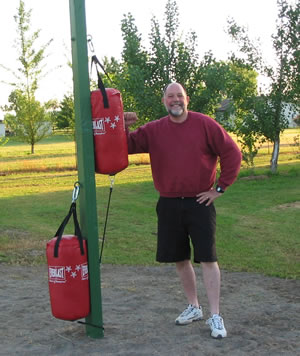
Here is my Bagua Zhang Circle training area in my backyard in Red Bluff, California. I had hung the Everlast punching bags to the post before I started the baguazhang practice. Then, as I do my baguazhang circle training practice, I get a energy boost by smashing the upper bag with palm strikes and the lower bag with side heel kicks or sweeping take-down kicks as I circle around the post. This practice session took place at around 7 in the morning.

Mike Garofalo, Bagua Circle Training Area

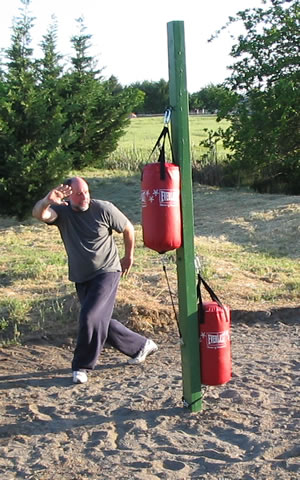
Here I'm practicing the Yin style of Baguazhang, the Bear Posture/Forms. This practice session took place at around 7 in the evening.


Mike Garofalo, Bagua Circle Training Area

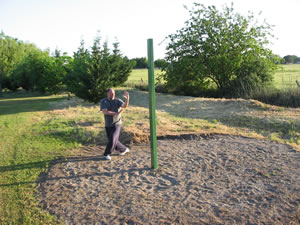
I am fortunate to have a large outdoor area for practicing Baguazhang, Taijiquan and Qigong. This baguazhang practice session took place at around 7 in the evening.

The sandy surface is slower than hard clay, bricks or concrete. Just toss shovelfulls of sand around every so often, rake smooth and level, and then resume your practice on a like-new circle. This has been a much better solution than the mucky clay in the wet winters in Red Bluff.

Wednesday, January 22, 2025

Weightlifting Exercises for Older Men

A Repost from June of 2014, when I was 68 years of age.

Strength Training for Persons Over 55 Years of Age  by Mike Garofalo


I lift weights 5 days each week at the Tehama Family Fitness Center in Red Bluff, California. 

My current weight training partner, since January, 2014, is Roger Andresen.  Roger is 64 years of age, highly motivated, and competitive.  His legs are very strong.  I've seen him do 12 repetitions on the incline sled leg press machine with 620 pounds.  I am 68 years of age.  I can do incline sled leg presses 5 times with 480 pounds.  We do free barbell squats with up to 245 pounds for 6-8 reps.

My one repetition best ever in the bench press was 255 pounds, but I now train regularly at around 195 for 5-10 reps.  

We do from 16 to 20 sets, 8-12 reps per set, during each workout.  We sometimes drop to 5 reps for our heaviest lifts. We lift some comparatively heavy weights for a couple of older men!! 

My current summer season (6/12-8/15) fitness, bodybuilding, and weight training schedule is as follows:

Monday:   Walk for 4 miles 5am; Weightlifting for Legs 4pm; Yoga class 5:30pm; Taijiquan practice 6am; Gardening in morning.

Tuesday:   Walk for 4 miles 5am; Weightlifting for Back and Shoulders 4pm; Yoga class 5:30pm; Taijiquan practice 6am.
Wednesday:  Walk for 4 miles 5am; Taijiquan practice 6am; Gardening in morning.
Thursday:   Walk for 4 miles 5am; Weightlifting for Chest and Arms 4pm; Yoga class 5:30pm; Taijiquan practice 6am. 
Friday:   Walk for 4 miles 5am; Weightlifting for Legs 4 pm; Taijiquan practice 6am; Gardening in morning. 
Saturday:  Walk for 4 miles 5am; Taijiquan practice 6am; Gardening in morning.
Sunday:  Walk for 4 miles 5am; Weightlifting for Chest and Arms 4am; Taijiquan practice 6 am; Gardening in morning.

For more information about Strength Training for Persons Over 55 Years of Age, please check my webpage on the subject.  This webpage also gives more details on my exercise program. 

The Principles of Weight Training:  Overload, Progression, Specificity, Rest and Recovery, Nutrition, Variety, and Proper Attitude. 

Listen to what some other people have said about having the Proper Attitude: motivation, intention, desire, goals, determination, willpower, and focus:

“Weight lifting is about lifting the impossible, overcoming the unachievable. If you don’t lift things that are hard, and only do the things you can do, it’s only going to get boring.  Unless you want to lift beyond your limits to get stronger, to achieve new goals, and to be satisfied, you got to lift past these challenges, and still lift the things you think are impossible to really understand how your true strength will show.  Lift how I lift, see how I lift, watch how I lift, learn how I lift, and your true strength will come forth and be revealed”
– Chasers Holmes


“When it comes to eating right and exercising, there is no ‘I’ll start tomorrow.’ Tomorrow is disease.”
– V.L. Allinear


“To feel strong, to walk amongst humans with a tremendous feeling of confidence and superiority is not at all wrong. The sense of superiority in bodily strength is borne out by the long history of mankind paying homage in folklore, song and poetry to strong men”.
– Fred Hatfield


"Take care of your body.  It’s the only place you have to live.”
–  Jim Rohn


“When health is absent, wisdom cannot reveal itself, art cannot become manifest, strength cannot be exerted, wealth is useless, and reason is powerless.”
– Herophiles


By trying hard we often achieve more than we dare hope.

You can't push yourself forward by patting yourself on the back.  

 
Waiting to do something isn't enough, you must do it.

You can never achieve great success without great exertion.

“Training gives us an outlet for suppressed energies created by stress and thus tones the spirit just as exercise conditions the body.”
– Arnold Schwarzenegger


"There is no point in being alive if you cannot do the deadlift."
- Jon Pall Sigmarsson

"We either make ourselves miserable or we make ourselves strong. The amount of work is the same."
- Carlos Castaneda

"Strength does not come from winning. Your struggles develop your strengths. When you go through hardships and decide not to surrender, that is strength."
- Arnold Schwarzenegger

"Winning is not normal, and people who win do so by following an abnormal path. The discipline and dedication and sacrifices are incomprehensible to the thousands, standing outside looking in, who are capable of joining, yet unwilling to pay the price of admission."
- Steve Trippe

"It is no use saying, "We are doing our best." You have got to succeed in doing what is necessary."
- Winston Churchill

“The higher your energy level, the more efficient your body. The more efficient your body, the better you feel and the more you will use your talent to produce outstanding results.”
– Anthony Robbins


“Most of us think we don’t have enough time to exercise. What a distorted paradigm! We don’t have time not to. We’re talking about three to six hours a week – or a minimum of thirty minutes a day, every other day. That hardly seems an inordinate amount of time considering the tremendous benefits in terms of the impact on the other 162 – 165 hours of the week.”
– Stephen Covey


"To give anything less than your best is to sacrifice the gift."
-  Steve Prefontaine

"If you fully believe you will be successful and can visualize yourself being successful, you will succeed."
- Tom Platz

“I do it as a therapy. I do it as something to keep me alive. We all need a little discipline. Exercise is my discipline.”
– Jack LaLanne


I don't have time to lift, I make time.

“Intensity builds immensity”
– Kevin Levrone


“To keep the body in good health is a duty… otherwise we shall not be able to keep our mind strong and clear.”
– Buddha


Have the courage to accept what you can't alter and to alter what you can't accept.

Thoughts are mere dreams until you put them into practice.

If you waste today crying over yesterday, you'll be able to waste tomorrow crying over today.

"Perfection is not attainable, but if we chase perfection we can catch excellence."
- Vince Lombardi

"Accept the challenges so that you can feel the exhilaration of victory."
- General George Patton

"There is no failure except in no longer trying."
- Elbert Hubbard

"Bodybuilding is much like any other sport. To be successful, you must dedicate yourself 100% to your training, diet and mental approach."
- Arnold Schwarzenegger

"If",."perhaps" and "but" never got any person anywhere.  

The most important day of your life is today.  
 
"Permanence, perseverance and persistence in spite of all obstacles, discouragement, and impossibilities: It is this, that in all things distinguishes the strong soul from the weak"
- Thomas Carlysle

"I have found the Iron to be my greatest friend. It never freaks out on me, never runs. Friends may come and go. But two hundred pounds is always two hundred pounds"
- Henry Rollins.

"Squat more!"
- Jesse Marunde

"That which does not kill us makes us stronger"
- Friedrich Nietzsche

"Sell yourself short on nutrition and you're selling yourself short on maximizing your physique development."
- Ernie Taylor

"If you believe in yourself, have dedication, pride, and never quit, you'll be a winner. The price of victory is high, but so are the rewards."
- Paul "Bear" Bryant

"Strength is happiness. Strength is itself victory. In weakness and cowardice there is no happiness"
- Daisaku Ikeda

"We don't know who we are until we see what we can do."
- Martha Grimes


Friday, July 19, 2024

Tai Chi Chuan at a Faster Pace

Repost from 2012 from Red Bluff, regarding some of the Taijiquan Practices when I was 66 years of age. Now, at the age of 78, my energy levels are lower. Slow Taijiquan, qigong/yoga, moderate strength training, and walks on flat ground are more my style now.  Heart disease has slowed my pace.

For two decades I have practiced the Yang style of Taijiquan at a slow, steady, even, smooth and meditative pace.  The Sun style of Taijiquan is a bit faster with short quick steps.  Since I began to practice martial arts routines and forms with a cane weapon, and with my beginning the practice of Chen Style Taijiquan, I have been increasing my speed and power while doing these forms.  This has posed a new challenge for my cardio-vascular conditioning level, for my physical agility and coordination levels, and for my 66 year old body overall.  I really enjoy the new challenge. 

"Chen Style Taiji is perhaps the most overtly martial of all Taijiquan styles.  Most Chen Style forms are fast.  These include Second Form (Cannon Bashing), saber, double saber, spear, long staff, short staff, three-opponent staff, flaive, punching bags, and several combat exercises.  The only two forms that are decidedly slow are the First Form and the straight sword.  

Kinetic movements (meaning, again, movements that depend on momentum) must be trained at speed.  Any time you have a weapon in your hands that swings or spins, you must actually swing it or spin it in order to learn its behavior.  If you try to practice it slowly, you will not receive feedback from the weapon's own kinetic properties, and will consequently never learn how to exploit them.  Without kinetic training, you will always be fighting the weapon.  

In certain situations, you need to wield your own body kinetically.  Chen Taiji's Second Form (Cannon Bashing) is designed for exactly that purpose.  Any movement in which you sweep, leap, close quickly with the opponent, change orientation in mid-air, or swing around to attack from a different direction must similarly be trained at speed.  These are all movements that exploit the body's mass and momentum."
-  Mark Chen, Old Frame Chen Family Taijiquan, p. 86

Thursday, September 09, 2021

Tai Chi Chuan at Grayland Beach

Want to practice your Taijiquan or Qigong at the Beach?

I will be camping at Grayland Beach State Park in Grayland, Washington, on Monday 9/20, Tuesday 9/21, and Wednesday 9/22, 2021, Yurt 80.    Grayland Beach is about 7 miles south of Westport.  Clamming and surf fishing are options.  

I plan to practice Taijiquan while I am at this beach campground.  

Tai Chi and Chinese Yoga by Michael P. Garofalo. 

I practice the Yang Style of Taijiquan using the Long 108 Form and the Short 24 Form and the Eight Immortals Cane Form

I taught yoga, tai chi chuan, and qigong at the Tehama Family Fitness Center in Red Bluff, California, from 2000-2017.  My Qualifications?

Let's walk the tide line at Grayland and talk Taoism.  

Let's sit in the shade of shore pines and savor the sayings of Lao Tzu

I keep my notes about traveling in this area in my:
Gray's Harbor and Willapa Bay Hypertext Notebook and Guide


Thursday, September 24, 2020

Ending Postures, DingDian, Snapshots in a Sequence


The dingdian for Golden Rooster Stands on Left Leg
One point in a sequence of movements in Yang Style Taijiquan.
I continue to move thereafter; but my cat keeps the same posture while watching.

"Fu Zhongwen uses a number of terms that require additional explanation.  One of these is the term for what is typically called the ending postures of the forms, that is, the terminus point of a given posture such as White Crane Displays Wings.  The term that Fu Zhongwen uses for these ending postures is dingdian, or "fixed points."  In Taijiquan, however, these "fixed points" are not really fixed, and "ending postures" are not really the end of anything.  Fu Zhongwen therefore advises the reader that " as each movement reaches a fixed point (dingdian), one must accomplish what is called "seems to stop, does not stop."  The dingdian, then must be understood to be both the culmination of one sequence as well as the beginning of the next."

-  Mastering Yang Style Taijiquan  By Fu Zhongwen.  Translated by Louis Swaim.  Blue Snake Books, 2006, p. xix.  


The dingdian is an experienced physical posture, a temporary fixed form, a still photograph, a line drawing, a mental picture, an icon, a temporary fixed point in a flow of movements.  It is a name for a fixed point somewhere in or near the end of a particular numbered posture sequence in a taijiquan form. Here is Yang Cheng Fu's version of the dingdian for Single Whip:


Sort of looks like Virabadrasana II in Hatha Yoga.  In Hatha Yoga you just hold the above posture, don't move, settle, endure, tough it out.  Hold for one or more minutes, then shift to right leg forward lunge in Virabadrasana II (Warrior Pose) or Single Whip Right for one or more minutes.  Hold for longer periods for increased strength and endurance training.      

Taijiquan is like Vinyassa Yoga, you keep moving slowly all the time.  One posture transforms into another posture.  "Seems to stop, but does not stop."  

Wednesday, March 06, 2019

Northwest Fighting Arts in Portland

Northwest Fighting Arts (NWFA)

Sifu Jeff Patterson

1200 SE Morrison St
Portland, Oregon 97214
Phone: 503-235-3435
Buckman, Belmont, Southeast Portland Area

I enrolled in the Tai Chi and Qigong Training Program at NWFA
on March 4, 2019.  The Dojo is 20 miles by freeway from my home in Vancouver.  They offer Tai Chi and Qigong classes 10 times each week.  

At my home, doing the Qigong Walking Exercises for improving my balance and concentration that is taught at NWFA.  Also, practicing the Tai Chi Yang 24 and Yang 108.  Sifu Patterson said everyone is first taught to do a 37 movement form designed by Sifu Sam Tam.  It is not the 37 form of Cheng Man-ch'ing.  


Sunday, December 31, 2017

Northwest Tai Chi and Qigong Studio, Vancouver, Washington


Northwest Taijiquan and Qigong
The Vancouver Tai Chi Chuan and Qigong Studio
Sifu Brian Knack
Assistant Instructors: Bill, Sandy, Joel

Vancouver Health and Wellness Building

202 E. Mcloughlin Blvd., Vancouver, Washington, 98663
360-607-8240
Also, on Facebook
The information on the Northwest Taijiquan website has not been updated.

Class Schedule:
Tuesday Morning 9-11 am
Tuesday Evening 5:30 - 7:30 pm
Thursday Morning 9-11 am  (Class Cancelled Jan-Mar 2018)
Saturday Morning 10-12 am

I plan to attend these classes in 2018.  


The facility is clean and attractive, and located in downtown Vancouver, near Main Street and Mcloughlin Blvd.  An excellent peaceful atmosphere with many very accomplished and knowledgeable students.  Good mature attitudes all around, and peaceful, polite, and friendly people.  


Here are the kinds of Taijiquan and Qigong we have been learning and practicing at the Vancouver Studio (Dojo/Training Center) with Sifu Knack, and the assistant Instructors Sandy, Bill, Joel, and Camille along with four to eight other other students.  I also use DVDs by Sifu Knack for home study.  Curriculum:  

Yang Style Taijiquan 24 Form
Yang Style Taijiquan 108 Long Form

Hunyuan Chen Taijiquan 24 Form
Eight Gates Warmup Yang Taijiquan

Push Hands
Da Lu

Hunyuan Qigiong, Primordial Qigong, Mixed Circles Qigong

Kuan Yin Sitting Qigong
Bagua Qigong: Liang Shen Pu
Eight Immortals Flute Form
Hun Yuan Taiji Stick and Qigong Ruler.  


32 Sword Form
Chen Broadsword Form


About Sifu Bryan Knack Ph.D./Ma.Sc.D.


"Bryan Knack was inducted to the U.S.A. Martial Arts Hall of Fame as "Chinese Martial Arts Master of the Year" and "International Sifu of the Year."

"Sifu Bryan Knack began studying martial arts in the mid-70's, begining with the external martial arts of Goju-ryu (Okinawan karate) and Siu Lum Kung Fu in the 1980's. Then he turned his studies to Tai Chi and Qi Gong and had a training center in Portland, Oregon.
He returned to his hometown of Spokane to open his own studio, Northwest Tai Chi for Health in 2000. Sifu Knack returned to the Vancouver/Portland area in 2011 to be close to his family."


"Tai Chi is fun!  The Vancouver Tai Chi and Qigong Studio offers an affordable program for multiple section classes for a monthly charge, or for a small fee for each class you attend."


Come and Join Us in Practicing and Learning Taijiquan and Qigong.  


Tuesday, December 26, 2017

Vancouver Tai Chi Chuan Studio


Northwest Taijiquan and Qigong
The Vancouver Tai Chi Chuan and Qigong Studio
Sifu Brian Knack

Assistant Instructors: Bill, Sandy, Joel

Vancouver Health and Wellness Building

202 E. Mcloughlin Blvd., Vancouver, Washington, 98663
360-607-8240
Also, on Facebook
The information on the Northwest Taijiquan website has not been updated.

Class Schedule:
Tuesday Morning 9-11 am
Tuesday Evening 5:30 - 7:30 pm
Thursday Morning 9-11 am  (Class Cancelled Jan-Mar 2018)
Saturday Morning 10-12 am

I plan to attend these classes in 2018.  


The facility is clean and attractive, and located in downtown Vancouver, near Main Street and Mcloughlin Blvd.  An excellent peaceful atmosphere with many very accomplished and knowledgeable students.  Good mature attitudes all around, and peaceful and friendly people.  


Here are the kinds of Taijiquan and Qigong we have been practicing at the Vancouver Studio with Sifu Knack, and the advanced students and assistant Instructors Sandy, Bill, Joel, Camille and with four to eight other other students. I also use DVDs by Sifu Knack for home study.  Curriculum: 

Yang Style Taijiquan 24 Form
Yang Style Taijiquan 108 Long Form

Hunyuan Chen Taijiquan 24 Form
Eight Gates Warmup Yang Taijiquan

Push Hands
Da Lu

Hun Yuan Qigiong

Kuan Yin Sitting Qigong
Bagua Qigong: Liang Shen Pu
Eight Immortals Flute Stick Form
Hun Yuan Taiji Stick and Qigong Ruler


32 Sword Form
Chen Broadsword Form


About Sifu Bryan Knack Ph.D./Ma.Sc.D.


"Bryan Knack was inducted to the U.S.A. Martial Arts Hall of Fame as "Chinese Martial Arts Master of the Year" and "International Sifu of the Year."

Sifu Bryan Knack began studying martial arts in the mid-70's, begining with the external martial arts of Goju-ryu (Okinawan karate) and Siu Lum Kung Fu in the 1980's. Then he turned his studies to Tai Chi and Qi Gong and had a training center in Portland, Oregon.
He returned to his hometown of Spokane to open his own studio, Northwest Tai Chi for Health in 2000. Sifu Knack returned to the Vancouver/Portland area in 2011 to be close to his family."


"Tai Chi is fun!  The Vancouver Tai Chi and Qigong Studeio offers an affordable program for multiple section classes for a monthly charge, or for a small fee for each class you attend."

Come and Join us in Practicing and Learning Taijiquan and Qigong. 


Friday, September 29, 2017

Returning to Feeling Better and Training

In May of 2016, I was lifting weights for 45 minutes at the gym 5 days a week.  I walked 2 to 3 miles four days every week.  I taught 3 yoga classes and 3 taijiquan classes each week.  I worked 24 hours a week for the Corning School District.  I was feeling strong, energetic, and positive.  Medical tests were positive.  I was 70 years of age.  

After July of 2017, my health declined.  My 1st degree AV heart block (which I had since 1990) became a 2nd degree AV heart block and Bradycardia (excessively slow heartbeat) caused great concern and distress.  I had a pacemaker inserted in 6/17. 

We sold our home in Red Bluff, CA, and purchased a home in 6/17 in Vancouver WA.  This was challenging and stressful. 

During this period I fell twice and injured both knees and my right hip.  My damaged right rotator cuff tendon continued to limit my motions. 

My Type II diabetes, under reasonable control since 1990, began to worsen.  My new physician, Dr. Anna, switched my medicines in 7/17 and my recent blood sugar AIC was 7.2.  I must improve. 

I was depressed and drugged.  Disheartening!  Little energy!  Lighteaded! 

I smoked cannabis during this period to ease the pain and dull my senses.  This was a mistake.  I stopped smoking! 

I did not write much or research/study much for 14 months. 

I health started to improve in September, 2017.  I am now hoping to resume a more comprehensive physical training program in October, 2017. 

Karen and I are now eating more vegetarian based meals.  We are both greatly reducing our intake of  meats, dairy products, and eggs. 

I am now walking every day for 30 to 40 minutes. 

I garden some everyday at our new home.  

I go to the gym at LA Fitness four days a week. 

Hopefully, this autumn season will bring improved stamina and vitality to my life. 

I know that I have told my recent story before in this blog.  I apologize for the repetition. 

I hope my future writing and posts help me recover.  Productive work of this kind is uplifting for me.  Maybe, in addition, it might help others in some way.

Best wishes, 

Mike


Sunday, November 06, 2016

Yang Style Tai Chi Chuan Principles

"1.) Head upright to let the shen [spirit of vitality] rise to the top of the head. Don't use li [external strength], or the neck will be stiff and the ch'i [vital life energy] and blood cannot flow through. It is necessary to have a natural and lively feeling. If the spirit cannot reach the headtop, it cannot raise.

2.) Sink the chest and pluck up the back. The chest is depressed naturally inward so that the ch'i can sink to the tan-t'ien [field of elixir]. Don't expand the chest: the ch'i gets stuck there and the body becomes top-heavy. The heel will be too light and can be uprooted. Pluck up the back and the ch'i sticks to the back; depress the chest and you can pluck up the back. Then you can discharge force through the spine. You will be a peerless boxer.

3.) Sung [Relax] the waist. The waist is the commander of the whole body. If you can sung the waist, then the two legs will have power and the lower part will be firm and stable. Substantial and insubstantial change, and this is based on the turning of the waist. It is said "the source of the postures lies in the waist. If you cannot get power, seek the defect in the legs and waist."

4.) Differentiate between insubstantial and substantial. This is the first principle in T'ai Chi Ch'uan. If the weight of the whole body is resting on the right leg, then the right leg is substantial and the left leg is insubstantial, and vice versa. When you can separate substantial and insubstantial, you can turn lightly without using strength. If you cannot separate, the step is heavy and slow. The stance is not firm and can be easily thrown of balance.

5.) Sink the shoulders and drop the elbows. The shoulders will be completely relaxed and open. If you cannot relax and sink, the two shoulders will be raised up and tense. The ch'i will follow them up and the whole body cannot get power. "Drop the elbows" means the elbows go down and relax. If the elbows raise, the shoulders are not able to sink and you cannot discharge people far. The discharge will then be close to the broken force of the external schools.

6.) Use the mind instead of force. The T'ai Chi Ch'uan Classics say, "all of this means use I [mind-intent] and not li." In practicing T'ai Chi Ch'uan the whole body relaxes. Don't let one ounce of force remain in the blood vessels, bones, and ligaments to tie yourself up. Then you can be agile and able to change. You will be able to turn freely and easily. Doubting this, how can you increase your power?

The body has meridians like the ground has ditches and trenches. If not obstructed the water can flow. If the meridian is not closed, the ch'i goes through. If the whole body has hard force and it fills up the meridians, the ch'i and the blood stop and the turning is not smooth and agile. Just pull one hair and the whole body is off-balance. If you use I, and not li, then the I goes to a place in the body and the ch'i follows it. The ch'i and the blood circulate. If you do this every day and never stop, after a long time you will have nei chin [real internal strength]. 

The T'ai Chi Ch'uan Classics say, "when you are extremely soft, you become extremely hard and strong." Someone who has extremely good T'ai Chi Ch'uan kung fu has arms like iron wrapped with cotton and the weight is very heavy. As for the external schools, when they use li, they reveal li. When they don't use li, they are too light and floating. There chin is external and locked together. The li of the external schools is easily led and moved, and not too be esteemed.

7.) Coordinate the upper and lower parts of the body. The T'ai Chi Ch'uan Classics say "the motion should be rooted in the feet, released through the legs, controlled by the waist and manifested through the fingers." Everything acts simultaneously. When the hand, waist and foot move together, the eyes follow. If one part doesn't follow, the whole body is disordered.

8.) Harmonize the internal and external. In the practice of T'ai Chi Ch'uan the main thing is the shen. Therefore it is said "the spirit is the commander and the body is subordinate." If you can raise the spirit, then the movements will naturally be agile. The postures are not beyond insubstantial and substantial, opening and closing. That which is called open means not only the hands and feet are open, but the mind is also open. That which is called closed means not only the hands and feet are closed, but the mind is also closed. When you can make the inside and outside become one, then it becomes complete.

9.) Move with continuity. As to the external schools, their chin is the Latter Heaven brute chin. Therefore it is finite. There are connections and breaks. During the breaks the old force is exhausted and the new force has not yet been born. At these moments it is very easy for others to take advantage. T'ai Chi Ch'uan uses I and not li. From beginning to end it is continuous and not broken. It is circular and again resumes. It revolves and has no limits. The original Classics say it is "like a great river rolling on unceasingly." and that the circulation of the chin is "drawing silk from a cocoon " They all talk about being connected together.

10.) Move with tranquility [Seek stillness in movement]. The external schools assume jumping about is good and they use all their energy. That is why after practice everyone pants. T'ai Chi Ch'uan uses stillness to control movement. Although one moves, there is also stillness. Therefore in practicing the form, slower is better. If it is slow, the inhalation and exhalation are long and deep and the ch'i sinks to the tan-t'ien. Naturally there is no injurious practice such as engorgement of the blood vessels. The learner should be careful to comprehend it. Then you will get the real meaning."

-  By Yang Cheng-fu (1883 - 1936) as researched by Lee N. Scheele


 T'ai Chi Ch'uan Bibliography

Yang Style Taijiquan

Mastering Yang Style Taijiquan  By Fu Zhongwen.  Translated by Louis Swaim.  Berkeley, California, Blue Snake Books, c 1999, 2006.  Bibliography, glossary, 226 pages.  ISBN: 9781583941522.  VSCL.  Fu Zongwen (1919-1994) was a student of Yang Cheng Fu.  Translations of many Tai Chi classics are included.  A list of 85 movements are provided.  251 movement analysis illustrations.  Over 76 of the illustrations are traced and drawn from photographs of Yang Chengfu.  Detailed descriptions of the long form, pp. 26-162.  Push hands information.  Yang Tai Chi essentials.


Master Cheng's Thirteen Chapters On Tai Chi Ch'uan. By Cheng Man-ch'ing. Translated by Douglas Wile. 101 pages. Sweet Chi Press, 1982. 101 pages. ISBN: 978-0912059006. Originally written in Chinese in 1949. VSCL.


The Essence and Applications of Taijiquan. By Yang, Chengfu (1883-1936). Translated by Louis Swaim. The original publication date was in 1934. The original book was edited by Professor Cheng Man-Chi'ng. Berkeley, California, North Atlantic Books, 2005. Introduction, appendices, bibliography, 124 pages. ISBN: 1556435452. In this book, the entire sequence of the specialized and named martial movements/postures/sections/forms is numbered from Section 1 up to Section 94; thus, the popular long taijiquan from, the Yang 94 Form. VSCL.


Wednesday, April 06, 2016

Internal Mental Cultivation and Taijiquan


"The three educational schools are: Buddhism, Daoism, and Confucianism. These three schools are the most influential groups that have long dominated Chinese thinking and philosophy. Each of these three schools focuses on the philosophical development of human nature (i.e. internal mental cultivation) through comprehension and physical health through physical activities (i.e., martial activities). Moreover, each of these schools believes that the mind is the master of the entire being, and controls our thinking and physical activities. In order to reach the goal mental or spiritual cultivation and physical health, you must know how to protect and firm you essence (Gu Jing), nourish your Qi (Yang Qi), and raise up your spirit (Ti Shen). These three things are considered the three treasures of life (San Bao). Only if you know how to do these things are you then able to have a peaceful, calm, and profound mind to think, ponder and understand. Moreover, you will be able to perform you physical activities healthily."
- Dr. Yang, Jwing-Ming, Tai Chi Secrets of the Yang Style, 2001, p. 138


Virtues and a Good Life


How to Live a Good Life: Advice from Wise Persons

Epicureans

Stoics


Tai Chi Chuan Classical Yang Style: The Complete Form and Qigong. By Dr. Yang, Jwing-Ming. Boston, MA, 2010. 396 pages. ISBN: 978-1594392009. "Awards: Gold Winner, 2011 IP's Living Now Awards; Gold Winner, 2011 eLit Award, Finalist - 2011 Eric Hoffer Award, Finalist - 2011 USA Best Book Award. Taijiquan is a slow and relaxed moving meditation. It is also a sophisticated martial arts system. Through practicing Taijiquan, you are able to calm down the mind, locate your spiritual center, and consequently find your entire being. From the relaxed moving exercise, you can bring your physical body into an ultimate level of relaxation and natural ease, resulting in smooth Qi (inner energy) and blood circulation. This is a key to maintaining health and recovering from sickness. This book is an in-depth guide for beginners to learn Taijiquan properly. It offers a general plan for practicing Taijiquan, and then goes into great depth to present enough content for proper learning." If you have practiced a version of the Yang style based on the Yang Cheng Fu (1920's) version, as documented by Fu Zhongwen, then you will find differences from the Dr. Yang Jwing-Ming version of the "classical" Yang Style Taijiquan movement sequence.  The postures are the same, the sequence is somewhat different.  VSCL.


Alan Watts


Cheng Man-ch'ing


Yang Cheng Fu


Monday, April 04, 2016

Maintain Your Vertical Center-Line

"1.  Develop your ability to maintain your vertical centerline as an axis from the Bai Hui downwards through the perineum.
2.  Develop your ability to always move fluidly from your center.
3.  Maintain your root so that you do not bounce up.
4.  Allow  your spirit and intention to manifest within each movement.
5.  Develop your Ting Jing skill in order to listen and perceive what needs to be perceived.
6.  Always strive to integrate the different parts of your body, as well as the different parts of your self.
7.  Always attend to stregthening the weakest part.
8.  Breath naturally.
9.  Like water, seek the most natural path.  Employ the least amount of force necessary for any given action.
10.  When issuing force forward, root down to the back and draw in the front.  When receiving for from the front, root to the front and ground down to the back.
11.  Remember that both life and T'ai Chi are temporary gifts.  Celebrate them accordingly."
-   John Loupos, Inside Tai Chi, p. 181


Here are three very good Taijiquan books by Sifu John Loupos that I have studied for a many years.  Sifu Loupos has been studying and teaching external and internal martial arts since 1966.  He has a B.S. degree in psychology.  His writing is clear, informative, insightful, and very useful for Taijiquan practitioners at all levels. 

Inside Tai Chi: Hints, Tips, Training, and Process for Students and Teachers.  By John Loupos.  Boston, Massachusetts, YMAA Publications, 2002.  Glossary, resources, index, 209 pages.  ISBN: 1886969108.  
    
Exploring Tai Chi: Contemporary Views on an Ancient Art.  By John Loupos.  Boston, Massachusetts,  YMAA Publications, 2003.  135 illustrations.  Glossary, index, 206 pages.  ISBN: 0940871424. 


Tai Chi Connections: Advancing Your Tai Chi Experience.  By John Loupos.  Boston, MA, YMAA Publication Center, 2005.  Index, 194 pages.  ISBN: 1594390320.       


太 極 拳