Showing posts with label Soldiers. Show all posts

Tuesday, May 27, 2025

Crying on Memorial Day

A repost from May of 2017:

Today is an American holiday called 'Memorial Day.'  It is a day to remember American soldiers who were injured or died in wars of the past.  Yes, sometimes fighting in wars is necessary in self-defense; but, still an evil and not to be glorified.  

Even the god Krishna tried to convince Arjuna (a professional soldier) in the Bhavagad Gita that fighting and killing were a duty and necessity.  The Bible and Koran tell of how "God" slaughters people, and how murder is acceptable to punish "sinners" and non-believers. Fervent religious people are often quite pleased with killing other people.  

Scores of millions of people have died in the many useless, stupid, tragic, horrible, cruel, and crushing wars of the past. Most of the men that started or fought in these destructive rampages where merely pawns in the hands of nations or dogmas or greed or dictators or petty warlords.  There were a few heroes, and many evil men, and mostly just extremely scared soldiers and civilians crying and screaming as the bombs exploded and bullets whizzed by and their loved ones and friends were torn apart and murdered.  60 million people died because of World War II.  

So, let us instead remember on this Memorial Day to celebrate the real joy that everyone felt when we heard "The War Has Ended" and people could live again in peace.  Let us remember the millions of civilians slaughtered by soldiers marching under ten different flags.

I recommend that we adopt an amendment to the U.S. Constitution to Limit the War Making Powers of the U.S. Government. 


I served in the United States Air Force from 1969-1973.  I served because the United States forced men of my age, through "The Draft," to serve in the Vietnam War.  Penalties, social ostracism, and imprisonment were imposed on young men if they did not "serve their country" in the military.  I had been indoctrinated in my youth in Catholic Schools to hate communists and have few moral reservations about killing atheistic communists.  Again, sadly, we were merely pawns in the hands of nations or dogmas or ideology or religions or greed or dictators or petty warlords.  

When I hear women and men talking these days about how we need to fight and kill those cruel Islamist ISIS brutes in the Middle East, and that Mr. Trump is going to get "tough" and greatly increase military spending, this worries me greatly.  These war mongering nationalists very likely never gave one single hour of their life in being a soldier and/or seeing and smelling the carnage of battle.  They fret about Jidhadists 20,000 miles away, and ignore the fact that over 100,000 people are shot each year in America by Americans.    

Peace and Memorials to Peace, Less Thinking about War "Heroes."  

Beware of worshiping flags, signs, emblems, and symbols.  We, and every nation, including our "enemies," indoctrinates its ruled population to stand up and show worshipful reverence to their own nation's flags and favored religious symbols and fallen soldiers and heroes.  On Memorial Day the graves of dead soldiers in America are decorated with U.S. flags and the Christian cross and gunfire salutes to their following orders.  But, remember, the map is not the territory.   

Before you get too worked this Memorial Day about our military "heroes," our brave fighting men, our courageous soldiers ... please recall just a few of the cruel acts they did to earn such glorious distinctions, to wit:


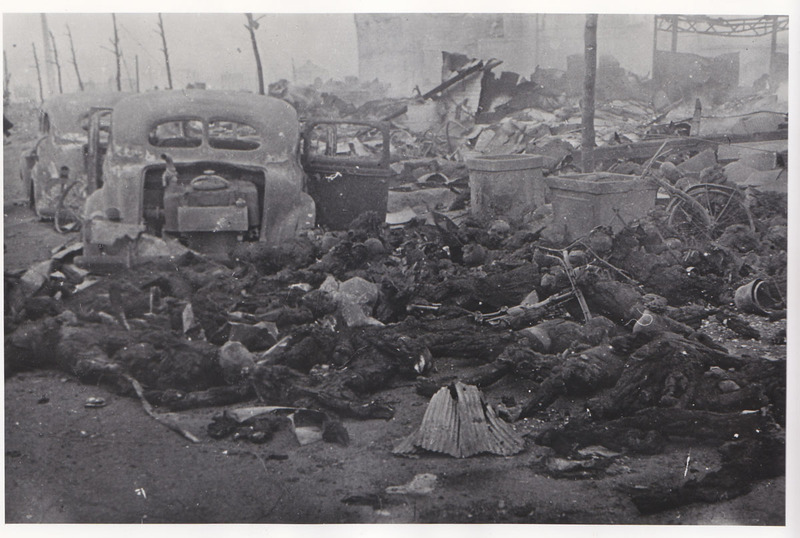
"On March 9, 1945, United States military warplanes launched a bombing offensive against Japan, dropping 2,000 tons of incendiary bombs on Tokyo over the course of the next 48 hours. Almost 16 square miles in and around the Japanese capital were incinerated, and between 80,000 and 130,000 Japanese civilians were killed in the worst single firestorm in recorded history."  
 

The United States military, during Operation Rolling Thunder, killed over 90,000 civilians in North Vietnam from 1965-1968.  Listen to a "heroic" professional U.S. soldier tell of "silencing" the Hanoi defenses to rescue one downed pilot, and the "business" of war.  


On February 14, 1945, the United States military dropped 3,900 tons of bombs on the city of Dresden in Germany, and killed over 25,000 civilians.


The United States military dropped atomic bombs on the cities of Hiroshima and Nagasaki in 1945 and killed over 129,000 civilians.  


The United States military killed over 550,000 civilians in North and South Vietnam from bombing, artillery attacks, and heavy weapons attacks.


And, in 2003, we made a "mistake" about Iraq having any weapons
of mass destruction and for having anything to do with 9/11.
American military soldiers killed over 120,000 Iraqi noncombatant civilians.  


Heroes?  Artillery men, air bombers and gunners, snipers, tank gunners ...

Only crying on Memorial Day.


Yes, the horrors of war and the intense survival necessities of battle for he conscripted soldiers is nearly unfathomable.  


Only crying on Memorial Day.


I recommend that we adopt an amendment to the U.S. Constitution
to Limit the War Making Powers of the U.S. Government. 

Memorial Day: Sorrow, Guilt, Shame, Revulsion


My Facebook Memorial Day Post on May 29, 2017:

"Every very brave and patriotic soldier knows that his enemy is also a very brave and patriotic soldier. Many patriotic soldiers and patriotic civilians, from all countries, believe some god is on their side, and that their enemy is unworthy or evil. The brave and patriotic soldiers on both sides, sworn enemies, will kill each other, and kill tenfold the number of civilians. The fighting will be hell on earth, millions will die, cities will be destroyed, famine and disease will prevail, and billions of dollars will be wasted. Each country will erect memorials and set aside days for patriotic citizens to honor their brave and patriotic soldiers. Patriotism will become a religion that few will dare to question, and doubters will be called cowards, ungrateful, and unpatriotic sinners. Such is the worldwide human condition.
We displayed a U.S. flag on our porch this Memorial Day. I am a Vietnam era veteran. While walking this morning, I noticed that 60% of my neighbors did not display a flag. I often think that they are wiser than I."

Tuesday, June 01, 2021

The Horrors of War

A repost from May 30, 2016:

Today is an American holiday called 'Memorial Day.'  It is a day to remember American soldiers who were injured or died in wars of the past.  I take some time to think about and grieve for all the the men and women lost in the horrors of war, both good soldiers and civilians.  Yes, sometimes fighting in wars is necessary in self-defense; but, still an evil and not to be glorified.  

Really, though, a "holiday?" Something is amiss here; something is disrespectful.  Most Americans party, celebrate, treat it as a three day weekend to kick off summertime fun.  

"In my opinion, there never was a good war, or a bad peace.  What vast additions to the conveniences and comforts of living might mankind had acquired, if the money spent in wars had been employed in works of public utility."
- Benjamin Franklin, 1783


Even the god Krishna tried to convince Arjuna (a professional soldier) in the Bhavagad Gita that fighting and killing, even his relatives, was a duty and a necessity.  The Bible and Koran tell of how "God" slaughters people, and how murder is acceptable to punish "sinners" and non-believers.  Fervent religious people are often quite pleased with killing other people.  Ruthless dictators and misguided politicians manipulate and force people into killing and dying for the Fatherland by inflaming patriotic, xenophobic, ethnic and racist emotions.  The carnage that results is horrific - revolting and beyond comprehension.  


Scores of millions of people have died in the many useless, stupid, tragic, horrible, cruel, and crushing wars of the past. Most of the men that started or fought in these destructive rampages were merely conscripts and pawns in the hands of nations or dogmas or greed or dictators or petty warlords.  There were a few heroes, and many evil macho men, and mostly just extremely scared people crying and screaming as the bombs exploded and bullets whizzed by and their loved ones and friends were torn apart and murdered.  


So, let us instead remember on this Memorial Day to celebrate the real joy that everyone felt when we heard "The War Has Ended" and people could live again in peace.  Let us remember the millions of civilians slaughtered by soldiers marching under ten different flags.

I recommend that we adopt an amendment to the U.S. Constitution to Limit the War Making Powers of the U.S. Government. 


I served in the United States Air Force from 1969-1973.  I served because the United States of America forced men of my age, through "The Draft," to serve in the Vietnam War.  Penalties, social ostracism, employment restrictions, and imprisonment were imposed on young men if they did not "serve their country" in the military.  I had been indoctrinated in my youth in Catholic Schools to hate communists, and have few moral reservations about killing atheistic communists.  Again, sadly, we were merely pawns in the hands of nations or dogmas or ideology or religions or greed or dictators or petty warlords.  Was killing our "enemies" in Vietnam justifiable on the grounds that doing so was crucial and vital to our national self-defense? - hardly!    


When I hear women and men talking these days about how we need to fight and kill those cruel Islamist ISIL brutes in the Middle East, and that President Obama is not "tough" enough, and these same warmongering people never gave one single hour of their life in being a soldier and/or seeing and smelling the carnage of battle, it makes me want to vomit.  


In the Iraq-Iran war in the 1980's over one million soldiers and civilians lost their lives, and countless more were injured or maimed, towns were destroyed ... Shites and Sunnis and Jihadhis fighting each other.  They are still fighting today in 2016 in the Middle East.  Likewise, we have our own real threat from "terror" from all the bozo angry Americans with boxes of guns in their homes - over 11,000 Americans are murdered every year in the USA.   

Peace and Memorials to Peace, Less Thinking about War "Heroes"  


Beware of worshiping flags, signs, emblems, and symbols.  We, and every other  nation, including our "enemies," indoctrinates its ruled population to stand up and show worshipful reverence to their own nation's flags and favored religious symbols and fallen soldiers and heroes.  On Memorial Day the graves of dead soldiers in America are decorated with U.S. flags, and the Christian cross, and gunfire salutes to them for loyally following orders.  But, remember, the map is not the territory.   


Be very wary of demagogues that want to 'Make America Great.'  I am quite satisfied with making America decent, making steady improvements, being respectful of one another, and enjoying peace.  

I recommend that we adopt an amendment to the U.S. Constitution to Limit the War Making Powers of the U.S. Government.  


"I confess I am a little cynical on some topics, and when a whole nation is roaring Patriotism at the top of its voice, I am fain to explore the cleanness of
its hands and the purity of its heart."
-  Ralph Waldo Emerson, 1847


I am sure the Germans cried over their brave Nazi soldiers who died in battle, and so too did the Japanese honor their brave soldiers of World War II. And, along the way of glory, these brave warriors, from many nations, including America, just laid waste to scores of cities and over 60 million people died.  


Before you get too nostalgic and weepy this Memorial Day about our military "heroes," our brave fighting men, our courageous American soldiers ... please recall just a few of the cruel acts they did to earn such glorious distinctions, to wit:


"On March 9, 1945, United States military warplanes launched a bombing offensive against Japan, dropping 2,000 tons of incendiary bombs on Tokyo over the course of the next 48 hours. Almost 16 square miles in and around the Japanese capital were incinerated, and between 80,000 and 130,000 Japanese civilians were killed in the worst single firestorm in recorded history."  


The United States military, during Operation Rolling Thunder, killed over 90,000 civilians in North Vietnam from 1965-1968.  Listen to a "heroic" professional U.S. soldier tell of "silencing" the Hanoi defenses to rescue one downed pilot, and the "business" of war.  


On February 14, 1945, the United States and Royal Air Force military planes dropped 3,900 tons of bombs on the city of Dresden in Germany, and killed over 25,000 civilians.


The United States military dropped atomic bombs on the cities of Hiroshima and Nagasaki in 1945 and killed over 129,000 civilians.  


The United States military killed over 550,000 civilians in North and South Vietnam from bombing, artillery attacks, machine guns, napham, and heavy weapons attacks.


 And, recently, we made a "mistake" about Iraq having any weapons
of mass destruction and for having anything to do with 9/11 in New York.
American military soldiers killed over 120,000 Iraqi noncombatant civilians.  


Heroes?  Artillery men, air bombers and gunners, snipers, infantry men, tank gunners ...

Only crying on Memorial Day.


Yes, the horrors of war and the intense survival necessities of battle for the conscripted soldiers is nearly unfathomable.  


"The worst barbarity of war is that if forces men collectively to commit acts against which individually they would revolt with their whole being."
-  Ellen Key, War, Peace, and the Future, 1916


Only crying on Memorial Day.
      Not a "holiday."


Memorial Day:
Sorrow, Guilt, Shame, Revulsion, Loss
Mixed Feelings, Regrets, Sadness
Paradoxes, Dilemmas, Ambiguity


Nevertheless, I, like others, do mourn our dead soldiers.
I cry along with their grieving families.

In Memory of Staff Sgt. Daniel A. Quintana
Semper Fidelis


Saturday, November 11, 2017

Veteran's Day


We attended an elementary school assembly for Veteran's Day last Thursday.

The principal and staff kept over 800 people productive, safe, respectful, and responsible. All veterans were honored.

I am a proud veteran of serving elementary school students in libraries and schools for 50 years.

I once served in the U.S. Air Force from 1969-1973, Air Training Command.
However, weapons and warrior soldiers are bad omens to me. 

Peace, Productivity, Prosperity, Satisfaction, Growth, Progress, Learning


The post assembly photo includes Makenna, Casey and I.  They are two very smart fourth grade students at Chinook Elementary School in Salmon Creek, Vancouver, Washington.    


Friday, May 13, 2016

Dao De Jing, Chapter 30

Tao Te Ching by Lao Tzu
Chapter 30

"He who would assist a lord of men in harmony with the Tao will not assert his mastery in the kingdom by force of arms.
Such a course is sure to meet with its proper return.
Wherever a host is stationed, briars and thorns spring up.
In the sequence of great armies there are sure to be bad years.
A skilful commander strikes a decisive blow, and stops.
He does not dare by continuing his operations to assert and complete his mastery.
He will strike the blow, but will be on his guard against being vain or boastful or arrogant in consequence of it.
He strikes it as a matter of necessity; he strikes it, but not from a wish for mastery.
When things have attained their strong maturity they become old.
This may be said to be not in accordance with the Tao.
What is not in accordance with the Tao soon comes to an end."
-  Translated by James Legge, 1891, Chapter 30  


"He who relied on the Tao to aid a ruler of men
 Would not seek to conquer with weapons.
 The man of Tao holds back from such instruments of recoiling violence.
 For where armies have camped there spring up thistles and thorns;
 And in the wake of marching armies follow years of drought.
 Having achieved his aim, the good commander stops;
 He does not venture to follow up his advantages with greater force.
 He achieves his aim, but does not plume himself.
 He achieves his aim, but is not boastful.
 He achieves his aim but is not proud of what he has done.
 He achieves his aim by means which could not be avoided.
 He achieves his aim without violence.
 For it is when creatures reach the climax of their strength that they start to grow old;
 Thus violence runs counter to the Tao,
 And what runs counter to the Tao is soon spent."
 -  Translated by Herman Old, 1946, Chapter 30   


"Who knows how to guide a leader in the path of Tao (the Laws of the Universe),
Does not try to conquer the world with military force.
It is in the nature of a military force to turn against its user.
(Economic Force strengthens the Society) 


Wherever armies are stationed, thorny bushes grow.
After a great war, bad years always follow.
(Over spending for military might only overtaxes the people)

Protect efficiently your own state,
But not to aim at selfishness.
After you have attained your purpose,
You must not show off your success,
You must not brag of your ability,
You must not feel proud,
You must rather regret that you had not been able to prevent the war.

You must never think of taking control of others by force.
To be over-developed is to quicken decay,
And this is against Tao (the Laws of the Universe),
And what is against Tao (the Laws of the Universe) will soon end."
- Translated by J. L. Trottier, 1994, Chapter 30


"Those rulers who use the Tao to assist mankind
Do not use soldiers to force the world.
Those doings can be paid back to them.

The place of the army’s encampment—
Thorns and brambles grow there.
In the wake of the military
There indeed exists a famine-year.

The good have success and stop
Not daring thereby to grab for power.
They succeed but never boast.
Succeed but never strike down.
Succeed but never arrogantly.
Succeed but do not gain thereafter.
Succeed but never force.

A strong thing ruling over what is Old—
This is called “non-Tao.”
The non-Tao soon ends."
- Translated by Aalar Fex, 2006, Chapter 30


"When one uses the Tao in assisting his sovereign, he will not employ arms to coerce the state.
Such methods easily react.
When military camps are established.
Briers and thorns flourish.
When great armies have moved through the land calamities are sure to follow.
The capable are determined, but no more.
They will not venture to compel; determined, but not conceited;
determined, but not boastful; determined, but not arrogant;
determined because it cannot be helped; determined, but not forceful.
When things reach their prime, they begin to age.
This cannot be said to be the Tao.
What is Not the Tao soon ends."
-  Translated by Spurgeon C. Medhurst, 1905, Chapter 30 


"He who would help a Ruler of men by Tao
Does not take soldiers to give strength to the kingdom.
His service is well rewarded.
Where troops dwell, there grow thorns and briers.
After great wars, there follow bad years.
He who loves, bears fruit unceasingly,
He does not dare to conquer by strength.
He bears fruit, but not with assertiveness,
He bears fruit, but not with boastfulness,
He bears fruit, but not with meanness,
He bears fruit, but not to obtain it for himself,
He bears fruit, but not to shew his strength.
Man is great and strong, then he is old,
In this he is not of Tao.
If he is not of Tao
He will quickly perish."
-  Translated by Isabella Mears, 1916, Chapter 30 


以道佐人主者, 不以兵強天下.
其事好還.
師之所處, 荊棘生焉.
大軍之後, 必有凶年.
善有果而已.
不敢以取強.
果而勿矜.
果而勿伐.
果而勿驕.
果而不得已.
果而勿強.
物壯則老.
是謂不道.
不道早已.
-  Chinese characters, Tao Te Ching, Chapter 30 


yi tao tso jên chu chê, pu yi ping ch'iang t'ien hsia.
ch'i shih hao huan.
shih chih so ch'u, ching chi shêng yen.
ta chün chih hou, pi yu hsiung nien
shan chê kuo erh yi.
pu kan yi ch'ü ch'iang.
kuo erh wu ching.
kuo erh wu fa.
kuo erh wu chiao.
kuo erh pu tê yi.
kuo erh wu ch'iang.
wu chuang tsê lao.
shih wei pu tao.
pu tao tsao yi.
-  Wade-Giles Romanization, Tao Te Ching, Chapter 30 


"Those who use Tao in assisting their Sovereign do not employ soldiers to force the Empire.
The methods of government they adopt are such as have a tendency to react upon themselves.
Where garrisons are quartered, briars and thorns spring up, and the the land is deserted by the people.
Disastrous years inevitably follow in the wake of great armies.
Wise rulers act with decision, and nothing more.
They do not venture to use overbearing measures.
They are decided without self-conceit, or boasting, or pride.
They are decided in spite of themselves, and without presuming on brute force.
After a man has arrived at the prime of his strength, he begins to age.
This is attributable to his not possessing the Tao.
Those who do not possess Tao die before their time."
-  Translated by Frederic H. Balfour, 1884, Chapter 30


"Quien sabe guiar al gobernante en el sendero del Tao no intenta dominar el mundo mediante la fuerza de las armas.
Está en la naturaleza de las armas militares volverse contra quienes las manejan.
Donde acampan ejércitos, crecen zarzas y espinos.
A una gran guerra, invariablemente suceden malos años.
Lo que quieres es proteger eficazmente tu propio estado, pero no pretender tu propia expansión.
Cuando has alcanzado tu propósito, no debes exhibir tu trifuno, ni jactarte de tu capacidad, ni sentirte orgulloso;
     más bien debes lamentar no haber sido capaz de impedir la guerra.
No debes pensar nunca en conquistar a los demás por la fuerza.
Pues expandirse excessivamente es precipitar el decaimiento, y esto es contrario al Tao, y lo que es contrario al Tao
    pronto dejará de existir."
-  Translation from Chinese to English by John C. H. Wu, translated into Spanish by Alfonso Colodrón, Capitulo 30 


"A ruler faithful to Tao will not send the army to a foreign country.
This would incur calamity onto him, first of all.

The land where an army passed becomes desolated.
After war, lean years come.

A wise commander is never bellicose.
A wise warrior never gets angry.
He who can defeat the enemy does not attack.
He who achieved victory stops and does not do violence to the defeated enemies.
The victorious does not praise himself.
He wins, but does not feel proud.
He does not like to wage wars.
He wins because he is forced to fight.
Though he wins, he is not bellicose.

If man in the prime of life begins to weaken and gets ill?
This happens only because he has lived not in the harmony with Tao.
The life of such a person ends before a due time."
-  Translated by Mikhail Nikolenko, Chapter 30  


A typical webpage created by Mike Garofalo for each one of the 81 Chapters (Verses, Sections) of the Tao Te Ching (Daodejing) by Lao Tzu (Laozi) includes over 25 different English language translations or interpolations for that Chapter, 5 Spanish language translations for that Chapter, the Chinese characters for that Chapter, the Wade-Giles and Hanyu Pinyin transliterations (Romanization) of the Mandarin Chinese words for that Chapter, and 2 German and 1 French translation of that Chapter.  Each webpage for each one of the 81 Chapters of the Tao Te Ching includes extensive indexing by key words, phrases, and terms for that Chapter in English, Spanish, and the Wade-Giles Romanization.  Each webpage on a Chapter of the Daodejing includes recommended reading in books and websites, a detailed bibliography, some commentary, research leads, translation sources, a Google Translate drop down menu, and other resources for that Chapter.   

Chapter 30, Tao Te Ching by Lao Tzu

Chapter and Thematic Index (Concordance) to the Tao Te Ching by Lao Tzu

English Language Daodejing Translators' Source Index

Spanish Language Daodejing Translators' Source Index

Ripening Peaches: Taoist Studies and Practices

Taoism: A Selected Reading List

One Old Daoist Druid's Final Journey  


Saturday, May 07, 2016

Tao Te Ching, Chapter 31

Dao De Jing, by Laozi
Chapter 31


"Now, weapons are instruments of ill omen;  Divinity abhors them.
Therefore, one who abides in Dao does not abide weapons.
The Superior Person, at home, honors the more powerful Left-side;
on the battlefield, the more gentle Right-side;
they put Peace above all else,
and refuse to glorify weapons.
If one glorifies weapons, this propagates killing.
One who delights in killing people has no influence with Heaven.
On occasions of celebration, one honors the Left-side;
on occasions of grief, the Right-side is honored more.
A Deputy General stands on the Left side;
their Commander stands at the Right..
in other words, they stand in the order of their gravity of offense.
The killing of masses of people we ought bewail with sorrow and grief.
Victory in battle we ought commemorate with mournful rites."
-  Translated by Jerry C. Welch, 1998, Chapter 31 


"The Master who is a Captain of soldiers
Does not give blessings with his weapons.
Soldiers' weapons are hated by most men,
Therefore he who has the Tao gives them no place.
In the dwelling of the man of peace the left side is the place of honour.
In soldiers' usage the right side is the place of honour.
A soldier does not give blessings with his weapons.
They are not the instruments of a man of peace.
A man of peace will not possess them, nor use them;
He gives the first place to calmness and repose.
If he conquers, he does not rejoice.
Without joy is he who wounds and kills men.
The Master who wounds and kills men
Cannot succeed in ruling his kingdom.
In time of joy, the left hand is preferred,
In time of mourning, the right hand is preferred.
In war, the second in command is placed on the left,
The first in command is placed on the right,
That is, he stands in the place of mourning.
He who has killed many men should weep with many tears.
He who has conquered in battle should stand in the place of mourning."

-  Translated by Isabella Mears, 1916, Chapter 31  


"Even victorious arms are unblest among tools, and people had better shun them.
Therefore he who has Reason does not rely on them. 
The superior man when residing at home honors the left.
When using arms, he honors the right. 
Arms are unblest among tools and not the superior man's tools.
Only when it is unavoidable he uses them.
Peace and quietude he holdeth high.  
He conquers but rejoices not.
Rejoicing at a conquest means to enjoy the slaughter of men.
He who enjoys the slaughter of men will most assuredly not obtain his will in the empire."
-  Translated by Daisetsu Teitaro Suzuki and Paul Carus, 1913, Chapter 31 


夫佳兵者不祥之器.
物或惡之, 故有道者不處. 
君子居則貴左.
用兵則貴右. 
兵者不祥之器.
非君子之器.
不得已而用之.
恬淡為上. 
勝而不美.
而美之者, 是樂殺人. 
夫樂殺人者, 則不可以得志於天下矣. 
吉事尚左.
凶事尚右. 
偏將軍居左.
上將軍居右.
言以喪禮處之. 
殺人之衆, 以哀悲泣之.
戰勝以喪禮處之. 
-  Chinese characters, Tao Te Ching, Chapter 31 


fu chia ping chê pu hsiang chih chi'i.
wu huo wu chih, ku yu tao chê pu ch'u.
chün tzu chü tsê kuei tso.
yung ping tsê kuei yu.
ping chê pu hsiang chih ch'i.
fei chün tzu chih ch'i.
pu tê yi erh yung chih.
t'ien tan wei shang.
shêng erh pu mei.
erh mei chih chê, shih lo sha jên.
fu lo sha jên chê, tsê pu k'o yi tê chih yü t'ien hsia yi.
chi shih shang tso.
hsiung shih shang yu.
p'ien chiang chün chü tso.
shang chiang chün chü yu.
yen yi sang li ch'u chih.
sha jên chih chung, yi ai pei ch'i chih.
chan shêng yi sang li ch'u chih.
-  Wade-Giles Romanization, Tao Te Ching, Chapter 31


"Even the finest warrior is defeated
     when he goes against natural law
By his own hand he is doomed
     and all creatures are likely to despise him

One who knows Tao
     never turns from life calling
When at home he honors the side of rest
When at war he honors the side of action
Peace and tranquility are what he holds most dear
     so he does not obtain weapons
But when their use is unavoidable
     he employs them with fortitude and zeal

Do not flaunt your excellence
Do not rejoice over victory
With the loss of others
     weep with sorrow and grief
After winning a battle
     do not celebrate
     observe the rites of a funeral

One who is bound to action, proud of victory,
    and delights in the misfortune of others
will never gain a thing
     from this world below Heaven"
-  Translation by Jonathan Star, 2001, Chapter 31 


"Weapons of war are instruments of death.
All people fear them.
Therefore, all men of peace avoid them.
The sage prefers Infinity.
The man of war prefers the earth.
Weapons are instruments of death
and the tools of a warrior.
The sage avoids them at all cost;
and sometimes prefers death rather
than touching them.
Peace and harmony are the sage's reality.
She considers victory to be the bastard
child of war.
If you revel in victory,
then you sanction war and the killing of
human beings.
If you accept killing,
you have forgotten your oneness with all
beings.
In time of celebration the left is the dominant
position;
In times of grief the right.
During wartime the general always stands on the
left
and the king on the right.
If even one person is killed in war,
it is cause for great grief and mourning.
Victory is simply the maker of widows and orphans."
-  Translated by John Worldpeace, Chapter 31   


"Las armas son instrumentos nefastos.
El hombre del Tao nunca se sirve de ellas.
El hombre de bien considera a la izquierda
como sitio de honor,
pero se inclina a la derecha cuando porta armas.
El sabio prefiere la izquierda.
El soldado prefiere la derecha.
Las armas son instrumentos nefastos,
no adecuados para el hombre de bien.
Sólo las usa en caso de necesidad,
y lo hace comedidamente,
sin alegría en la victoria.
El que se alegra de vencer
es el que goza con la muerte de los hombres.
Y quien se complace en matar hombres
no puede prevalecer en el mundo.
Para los grandes acontecimientos
el sitio de honor es la izquierda,
y la derecha para los hechos luctuosos.
En el ejército,
El comandante adjunto se coloca a la izquierda,
El comandante en jefe, a la derecha.
Esta es la misma disposición que se usa en los ritos fúnebres.
Esto significa que la guerra se compara a un servicio funerario.
Cuando ha sido matada mucha gente,
sólo es justo que los supervivientes lloren por los muertos.
Por esto, incluso una victoria es un funeral."
-  Translation from Wikisource, 2013,
Capítulo 31 


"The Killing Fields: War is a last resort

Now, weapons are instruments of misfortune,
and despised by the whole world.
So those who are with the Tao will have nothing to do with them.

When a noble person is at home
he grants most importance to those at his left side.
But when he is at war
he grants most importance to those at his right side.

Weapons are instruments of misfortune.
They are not the instrument of the noble person.
Only when he has no choice will he use them.

It is best to be cool and calm. Victory is not beautiful.
But those who think it is beautiful, enjoy killing people.
Those who enjoy killing people
will not find what they want anywhere in the world.

In good times the place of honor is on the left.
In bad times the place of honor is on the right.
It is the second-in-command of the army who sits on the left,
and the first-in-command of the army who sits on the right.
This is to say;
these are the same positions they would take when at a funeral.

When a great number of people have been killed,
it is an occasion for sorrow and mourning.
When the battle is won, conduct a funeral for those slain."
-  Translated by Roderic and Amy Sorrell, 2003, Chapter 31  


"Of all things, soldiers are instruments of evil,
   Hated by men.
Therefore the religious man (possessed of Tao) avoids them.
The gentleman favors the left in civilian life,
But on military occasions favors the right.
Soldiers are weapons of evil.
   They are not the weapons of the gentleman.
When the use of soldiers cannot be helped,
   The best policy is calm restraint.
Even in victory, there is no beauty,
And who calls it beautiful
   Is one who delights in slaughter.
He who delights in slaughter
   Will not succeed in his ambition to rule the world.
[The things of good omen favor the left.
The things of ill omen favor the right.
The lieutenant-general stands on the left,
The general stands on the right.
That is to say, it is celebrated as a Funeral Rite.]
The slaying of multitudes should be mourned with sorrow.
A victory should be celebrated with the Funeral Rite."
-  Translated by Lin Yutang, 1955, Chapter 31  


A typical webpage created by Mike Garofalo for each one of the 81 Chapters (Verses, Sections) of the Tao Te Ching (Daodejing) by Lao Tzu (Laozi) includes over 25 different English language translations or interpolations for that Chapter, 5 Spanish language translations for that Chapter, the Chinese characters for that Chapter, the Wade-Giles and Hanyu Pinyin transliterations (Romanization) of the Mandarin Chinese words for that Chapter, and 2 German and 1 French translation of that Chapter.  Each webpage for each one of the 81 Chapters of the Tao Te Ching includes extensive indexing by key words, phrases, and terms for that Chapter in English, Spanish, and the Wade-Giles Romanization.  Each webpage on a Chapter of the Daodejing includes recommended reading in books and websites, a detailed bibliography, some commentary, research leads, translation sources, a Google Translate drop down menu, and other resources for that Chapter.   

Chapter 31, Tao Te Ching by Lao Tzu

Chapter and Thematic Index (Concordance) to the Tao Te Ching by Lao Tzu

English Language Daodejing Translators' Source Index

Spanish Language Daodejing Translators' Source Index

Ripening Peaches: Taoist Studies and Practices

Taoism: A Selected Reading List

One Old Daoist Druid's Final Journey