Showing posts with label Hsing I Chuan. Show all posts

Sunday, December 07, 2025

Heart-Mind Boxing

"Dragon Body - This imaginary beast is common in Chinese fables and folklore. The dragon could fly high, riding the mists, contracting and twisting it's body like a snake through the clouds. Xingyi places high importance on this for every transitional movement in the art should embody the spirit of the dragon, expanding and contracting, striking out with mystical prowess.

Chicken Leg - This is one of the most basic fundamentals of the art of Xingyiquan. A chicken can run very quickly and stop suddenly, keeping it's weight on one leg, ready to peck. Xingyi's five elements all encompass this theory by stepping forward onto one leg before it issues it's strike much like a chicken does. By mastering this, you can advance, retreat, turn and change forms very quickly because the weight is always ready to transfer.

Eagle Claw - While the hands are relaxed and held in gentle curves when in transitional movements, when striking, they must become like the fearless bird of prey's attacking talons, digging and grasping with an iron grip. This is especially seen in the beginning movement of Pi Quan when the hands draw down towards the Dan Tian. This is also very important in Xingyi, for many of the art's applications consist of grabbing with one hand while simultaneously striking with the other.

Bear Shoulders - Bears are large animals that can can generate a great deal of power from their great rounded shoulders. The Xingyi practitioner must mimic this to obtain maximum power in his art. By rounding the shoulders and hollowing the chest, the body actually "gets behind" the arms and hands, so when you strike, the power doesn't come from the arms, but from the whole body.

Tiger's Head Embrace - The tiger is a very regal beast. They are powerful and strong animals that exude the finest and most fearsome aspects of nature. In Xingyi, the head must be held erect and slightly back, but spiritually, it must also capture the imposing manner of the tiger, letting it's blank cunning show in your eyes and it's ability to pounce.

Xonghua Xinyiquan

Xing Yi Quan (Hsing I Chuan): Bibliography, Links, Resources, Quotes, Notes. By Mike Garofalo.


Xing Yi Quan Xue: The Study of Form-Mind Boxing.   By Sun Lu Tang.  Translated by Albert Liu.  Compiled and edited by Dan Miller.  Burbank, CA, Unique Publications, 2000.  ISBN: 0865681856.  312 pages.  Includes a biography of Sun Lu Tang (pp.1-41) by Dan Miller.  The work was encouraged and supported by Sun Jian Yun, and an interview with her is included.  Translations by Tim Cartmell, Gu Feng Mei, and Huang Guo Qi.  This original book was first published in 1915.  It was the first book ever published that integrated Chinese martial arts with Chinese philosophy and Daoist Qi cultivation  theories.  The book includes many photographs of Sun Lu Tang.  


"Of the three internal arts, Xing Yi is probably the most straightforward to understand in terms of practical fighting applications. Grandmaster Sun, however, believed that the most important reason to practice martial arts was the improvement of one's health; developing fighting ability was merely of secondary importance. Sun himself certainly benefited in both respects. In 1933, at the age of 73 and shortly before his death, Sun was examined by a physician and found to have the body of a 40-year old. Furthermore, throughout his life he was an awesome fighter: He worked as a professional bodyguard, taught martial arts at the Presidential Palace, and never lost a challenge match.
Certain health benefits of Xing Yi training are obvious. It is a low-impact exercise requiring little jumping, few low stances, and smooth rather than ballistic movements. As Sun notes in his book, it can be practiced by anyone, both the young and old, and the sick and infirm. Healthy people will grow stronger, while those with a disease will recover their health. However, in addition to the external physical benefits, Xing Yi practice offers a sophisticated system of internal energy training that stimulates the major energetic pathways within the body.At the core of Sun Lu Tang's Xing Yi Quan system is the 12 animals set. This set consists of 12 lines of movements, each emulating the fighting techniques of the 12 animals that come from heaven and earth. These are the Dragon, Tiger, Monkey, Horse, Water Lizard, Chicken, Sparrow Hawk, Swallow, Snake, Tai Bird, Eagle, and Bear. Regular practice of the 12 animals set benefits the practitioner both externally and internally. Externally, one learns the physical characteristics of each animal-the explosive power of the tiger, or the strength of the bear, for example. Internally, each animal form stimulates the internal energy, or Qi, in a particular and beneficial manner. The remainder of this article describes both the energetic work and the fighting applications of four of the animal forms: the Dragon, Tiger, Eagle, and Bear."
-  Justin Liu, 
 Cultivation and Combat: The Fighting Animals of Xing Yi Quan.


Friday, August 08, 2025

Heart-Mind Connections

 "Research in the relatively new discipline of neuro-cardiology has confirmed that the heart is a sensory organ and acts as a sophisticated information encoding and processing center that enables it to learn, remember, and make independent functional decisions that do not involve the cerebral cortex. Additionally, numerous studies have demonstrated that patterns of cardiac signals to the brain affect autonomic regulatory centers and higher brain centers involved in perception and emotional processing.\."
-  Thomas R. Verny, M.D., The Embodied Mind, Pegasus Books, 2021, p. 125.

"Common Heart Expressions

Follow your heart.
He had a big heart.
If you find it in your heart.
My heartfelt sympathies on you loss.
Wear one's heart on one's sleeve.
He died of a broken heart.
His heart is in the right place.
Eat your heart out.
She was a lighthearted person.
She had a change of heart.
Her heart was not in it.
He has a heart of gold.
He was a heartless villain.
A bleeding heart.
A faint heart.
Absence makes the heart grow fonder.
With an aching heart.
She is all heart.
Open one's heart to.
Pour open's heart out to.
With a heavy heart."

-  Thomas R. Verny, M.D., The Embodied Mind, Pegasus Books, 2021, p. 116, and Mike Garofalo.


"Put your heart, mind, and soul into even your smallest acts.  This is the secret of success."
- Swami Sivananda

"Your heart is full of fertile seeds, waiting to sprout."
- Morihei Ueshiba

"A loving heart is the beginning of all knowledge."
Thomas Carlyle


Tai Chi Chuan, Chi Kung, Nei Gung, and Yoga Masters all mention the role of our hearts and lungs in our brief lives.  

Chinese medical theorists and martial artists (Heart-Mind Boxing) point to the Heart or Middle Dantian or Hsing-Ming (Heart-Mind) as a locus for energy and consciousness. Breathing techniques involving the lungs is also a constant point of emphasis.

"The nearest equivalent to the English term for mind in the classical period is xin 心, which originated as a picture of the heart in human beings and animals and directs body’s behavior. Since ethical guidance in Chinese thought arises from both the cognitive function of the mind and the affective states attributed to the heart, xin is frequently translated as “heart-mind”. This translation will be used here. The xin is credited with thinking si 思, understanding míng 明, knowing zhi 知, intention zhi 志, felt moods and/or emotions qing 情, and desire yu 欲. Xin plays a central role in Chinese ethics, epistemology, and metaphysics; and philosophical disputes often turn on how different schools or Masters portray the role of xin. How it arrives at ethical guidance is a central point of contention between those who treat the guidance as internal (Mengzi) to those who treat xin as navigating an external normative structure and those who advocate emptying or ignoring the xin and taking guidance from some other organ or authority."
Mind (Heart-Mind) in Chinese Philosophy


I have more doubts about the efficacy of the Lower Dan Tien, and its role as an energy source, reservoir, and generator.  See my post titled:
Dantian: A Baffling Legacy.  The area below and behind our belly button is primarily used for digestion, elimination, the female reproductive organs (womb), and some big muscles involved with leg movement and balancing. Digestion is critical for life and has its own biochemistry and automatic functioning.  However, A TCM "Dantian" is invisible and undetectable to modern medical anatomy.

I've never heard any Chi Kung or Tai Chi Chuan teacher talk about sending Chi energy from the heart and lungs out to the arms, hand, legs, feet, or brain; or Chi energy circulation to and from the Middle Dantian or Heart area. This seems remiss to me.  

I have heard both taijiquan and qigong teachers talk about their large bellies as the Dantian source of their power and a chi resovoir.  Men don't have a womb for reproduction, but I guess they envy a woman's power.  People who eat too much and don't exercise, as they age, accumulate fat: men morso in the abdomen and women in the hips. Since the lower Dantian is invisible and non-existent, people can still imagine what they want to imagine about "It" as with other supernatural entities.  

Heart and vascular diseases are the highest cause of death in the world. Far fewer die of kidney or bowel or excretory diseases.  If your heart or lungs fail you die quickly.  If your lower intestine is diseased you die far less quickly.  The heart and lungs never rest; but, you can live a week without water and a month without food. Which is more important to immediate good health and life?  

Yoga masters and Indian doctors speak about the Heart Charkra (Anhata) in a similar way. Yoga practitioners practice a variety of breathing exercises (Pranayama). 

"The middle dantian is located at the center of the chest and is most closely related to the heart chakra, or Anahata. It’s associated with the thymus gland and is considered to be the seat of qi.  “Qi is more subtle and less dense of an energy than jing, and as you elevate through the dantians, you also evolve through the purity of consciousness and subtlety of energy, just like you would in looking at the chakras,” says Soffer. “Qi, like prana, is as ubiquitous in the body as it is in nature. It’s the basis of form and function for universal energy.” According to practitioners, the middle dantian is the spark of all living things. The energy in this dantian is considered unique when compared with the other two. “The energy here is created from the food and fluids we consume and the air we breathe, and is appropriately located around the upper abdomen, where we consume, digest, and distribute energy throughout the body,” explains Ali Vander Baan, a licensed acupuncturist and founder of Yintuition Wellness in Boston. According to Soffer, when a person’s essence (jing) is properly cultivated, their life force rises to support the middle dantian and the opening of the heart. “This is a common occurrence on the path of enlightenment, to become open-hearted, loving, compassionate, and a source of good for the world around you,” explains Soffer."
- What are Dantian

When I teach Tai Chi Chuan, Qigong, Nei Gong, and Yoga I place much more emphasis on strengthening the heart, improving the functioning of the heart, using the emotional-mental aspects of the heart, having the heart and desire for training, having a big and kind heart, and heartfelt understanding; and proper breathing methods and exercises. Sending energy from the heart and lungs to all parts of our body via blood and the circulatory system is my focus.  Blood and nerves transmissions seem a more understandable anatomical and physiological concept to me.  I place little or no emphasis upon the Lower Dantian except for centering and balance in the lower back and hip areas. 


Saturday, December 21, 2019

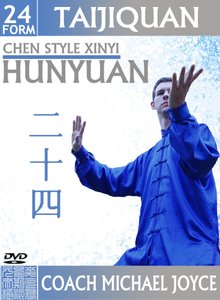
Hun Yuan Chen Taijiquan


"In the Hun Yuan Tai Chi form, each movement flows into the next in an endless circle of energy. The first stage of learning involves remembering the individual movements which are all based on the following Tai Chi principles:

1. Keep the spine straight and relaxed - not tense.
2. Bend your knees to enable weight transfer.
3. Let your weight sink down to the soles of the feet - not held in the upper body or the thighs. Develop natural weight transfer – from ground to ground.
4. Legs are the foundation. Each movement starts from the legs, to the waist (which also enables the spine to rotate) and then to the arms. The waist controls the upper body.
Avoid leaning with the upper body.
5. Distinguish between empty and solid. Control your centre of gravity. Step out empty with no weight, so that you may be able to retrieve your step if necessary.
6. Be aware of relaxing the shoulders.
7. Use minimum amount of strength to move the body. Anything more is tension. Relax, relax, relax.
8. Coordinate the lower and the upper body.
9. Distinguish between open and close within the movement. Feel your back and chest. Avoid leaning.
10. Use your mind, that is, your intention, to lead the movement."

- Brett Wagland, Experiencing the First Stage of Hun Yuan Tai Chi


Monday, October 05, 2015

Grandmaster Sun Lu Tang (1861-1933)

"When a modern day "New Age" practitioner of tai chi speaks of the art as being "good for his health and a way to align his energy with the energy of the Tao," that viewpoint came largely from Sun Lu Tang. Or when pa kua practitioners walk the pa kua circle on a California beach and talk of how "pa kua forms are physical embodiments of the I-Ching," their ideas derive largely from Sun Lu Tang. Or when modern day practitioners of xing yi opine that "the five forms of xing yi interact like the five basic elements in Taoist cosmology," they to owe their thinking largely to Sun Lu Tang."
- Elisabeth Guo and Brian L. Kennedy, Sun Lu Tang: Fighter, Scholar and Image Maker.

Sun Style Taijiquan: Bibliography, Links, Resources, Quotes
By Michael P. Garofalo


Saturday, August 15, 2015

Form-Mind Internal Arts (Hsing I Chuan)

"Dragon Body - This imaginary beast is common in Chinese fables and folklore. The dragon could fly high, riding the mists, contracting and twisting it's body like a snake through the clouds. Xingyi places high importance on this for every transitional movement in the art should embody the spirit of the dragon, expanding and contracting, striking out with mystical prowess.

Chicken Leg - This is one of the most basic fundamentals of the art of Xingyiquan. A chicken can run very quickly and stop suddenly, keeping it's weight on one leg, ready to peck. Xingyi's five elements all encompass this theory by stepping forward onto one leg before it issues it's strike much like a chicken does. By mastering this, you can advance, retreat, turn and change forms very quickly because the weight is always ready to transfer.

Eagle Claw - While the hands are relaxed and held in gentle curves when in transitional movements, when striking, they must become like the fearless bird of prey's attacking talons, digging and grasping with an iron grip. This is especially seen in the beginning movement of Pi Quan when the hands draw down towards the Dan Tian. This is also very important in Xingyi, for many of the art's applications consist of grabbing with one hand while simultaneously striking with the other.

Bear Shoulders - Bears are large animals that can can generate a great deal of power from their great rounded shoulders. The Xingyi practitioner must mimic this to obtain maximum power in his art. By rounding the shoulders and hollowing the chest, the body actually "gets behind" the arms and hands, so when you strike, the power doesn't come from the arms, but from the whole body.

Tiger's Head Embrace - The tiger is a very regal beast. They are powerful and strong animals that exude the finest and most fearsome aspects of nature. In Xingyi, the head must be held erect and slightly back, but spiritually, it must also capture the imposing manner of the tiger, letting it's blank cunning show in your eyes and it's ability to pounce.

- Xonghua Xinyiquan

Xing Yi Quan (Hsing I Chuan): Bibliography, Links, Resources, Quotes, Notes. By Mike Garofalo.


Xing Yi Quan Xue: The Study of Form-Mind Boxing.   By Sun Lu Tang.  Translated by Albert Liu.  Compiled and edited by Dan Miller.  Burbank, CA, Unique Publications, 2000.  ISBN: 0865681856.  312 pages.  Includes a biography of Sun Lu Tang (pp.1-41) by Dan Miller.  The work was encouraged and supported by Sun Jian Yun, and an interview with her is included.  Translations by Tim Cartmell, Gu Feng Mei, and Huang Guo Qi.  This original book was first published in 1915.  It was the first book ever published that integrated Chinese martial arts with Chinese philosophy and Daoist Qi cultivation theories.  The book includes many photographs of Sun Lu Tang.  


"Of the three internal arts, Xing Yi is probably the most straightforward to understand in terms of practical fighting applications. Grandmaster Sun, however, believed that the most important reason to practice martial arts was the improvement of one's health; developing fighting ability was merely of secondary importance. Sun himself certainly benefited in both respects. In 1933, at the age of 73 and shortly before his death, Sun was examined by a physician and found to have the body of a 40-year old. Furthermore, throughout his life he was an awesome fighter: He worked as a professional bodyguard, taught martial arts at the Presidential Palace, and never lost a challenge match.
Certain health benefits of Xing Yi training are obvious. It is a low-impact exercise requiring little jumping, few low stances, and smooth rather than ballistic movements. As Sun notes in his book, it can be practiced by anyone, both the young and old, and the sick and infirm. Healthy people will grow stronger, while those with a disease will recover their health. However, in addition to the external physical benefits, Xing Yi practice offers a sophisticated system of internal energy training that stimulates the major energetic pathways within the body.

At the core of Sun Lu Tang's Xing Yi Quan system is the 12 animals set. This set consists of 12 lines of movements, each emulating the fighting techniques of the 12 animals that come from heaven and earth. These are the Dragon, Tiger, Monkey, Horse, Water Lizard, Chicken, Sparrow Hawk, Swallow, Snake, Tai Bird, Eagle, and Bear. Regular practice of the 12 animals set benefits the practitioner both externally and internally. Externally, one learns the physical characteristics of each animal-the explosive power of the tiger, or the strength of the bear, for example. Internally, each animal form stimulates the internal energy, or Qi, in a particular and beneficial manner. The remainder of this article describes both the energetic work and the fighting applications of four of the animal forms: the Dragon, Tiger, Eagle, and Bear."
-  Justin Liu,
 Cultivation and Combat: The Fighting Animals of Xing Yi Quan.


Wednesday, February 18, 2015

Xing Yi Quan Internal Martial Arts

"Dragon Body - This imaginary beast is common in Chinese fables and folklore. The dragon could fly high, riding the mists, contracting and twisting it's body like a snake through the clouds. Xingyi places high importance on this for every transitional movement in the art should embody the spirit of the dragon, expanding and contracting, striking out with mystical prowess.

Chicken Leg - This is one of the most basic fundamentals of the art of Xingyiquan. A chicken can run very quickly and stop suddenly, keeping it's weight on one leg, ready to peck. Xingyi's five elements all encompass this theory by stepping forward onto one leg before it issues it's strike much like a chicken does. By mastering this, you can advance, retreat, turn and change forms very quickly because the weight is always ready to transfer.

Eagle Claw - While the hands are relaxed and held in gentle curves when in transitional movements, when striking, they must become like the fearless bird of prey's attacking talons, digging and grasping with an iron grip. This is especially seen in the beginning movement of Pi Quan when the hands draw down towards the Dan Tian. This is also very important in Xingyi, for many of the art's applications consist of grabbing with one hand while simultaneously striking with the other.

Bear Shoulders - Bears are large animals that can can generate a great deal of power from their great rounded shoulders. The Xingyi practitioner must mimic this to obtain maximum power in his art. By rounding the shoulders and hollowing the chest, the body actually "gets behind" the arms and hands, so when you strike, the power doesn't come from the arms, but from the whole body.

Tiger's Head Embrace - The tiger is a very regal beast. They are powerful and strong animals that exude the finest and most fearsome aspects of nature. In Xingyi, the head must be held erect and slightly back, but spiritually, it must also capture the imposing manner of the tiger, letting it's blank cunning show in your eyes and it's ability to pounce.

- Xonghua Xinyiquan

Xing Yi Quan (Hsing I Chuan): Bibliography, Links, Resources, Quotes, Notes. By Mike Garofalo.


Xing Yi Quan Xue: The Study of Form-Mind Boxing.   By Sun Lu Tang.  Translated by Albert Liu.  Compiled and edited by Dan Miller.  Burbank, CA, Unique Publications, 2000.  ISBN: 0865681856.  312 pages.  Includes a biography of Sun Lu Tang (pp.1-41) by Dan Miller.  The work was encouraged and supported by Sun Jian Yun, and an interview with her is included.  Translations by Tim Cartmell, Gu Feng Mei, and Huang Guo Qi.  This original book was first published in 1915.  It was the first book ever published that integrated Chinese martial arts with Chinese philosophy and Daoist Qi cultivation theories.  The book includes many photographs of Sun Lu Tang.  


"Of the three internal arts, Xing Yi is probably the most straightforward to understand in terms of practical fighting applications. Grandmaster Sun, however, believed that the most important reason to practice martial arts was the improvement of one's health; developing fighting ability was merely of secondary importance. Sun himself certainly benefited in both respects. In 1933, at the age of 73 and shortly before his death, Sun was examined by a physician and found to have the body of a 40-year old. Furthermore, throughout his life he was an awesome fighter: He worked as a professional bodyguard, taught martial arts at the Presidential Palace, and never lost a challenge match.
Certain health benefits of Xing Yi training are obvious. It is a low-impact exercise requiring little jumping, few low stances, and smooth rather than ballistic movements. As Sun notes in his book, it can be practiced by anyone, both the young and old, and the sick and infirm. Healthy people will grow stronger, while those with a disease will recover their health. However, in addition to the external physical benefits, Xing Yi practice offers a sophisticated system of internal energy training that stimulates the major energetic pathways within the body.

At the core of Sun Lu Tang's Xing Yi Quan system is the 12 animals set. This set consists of 12 lines of movements, each emulating the fighting techniques of the 12 animals that come from heaven and earth. These are the Dragon, Tiger, Monkey, Horse, Water Lizard, Chicken, Sparrow Hawk, Swallow, Snake, Tai Bird, Eagle, and Bear. Regular practice of the 12 animals set benefits the practitioner both externally and internally. Externally, one learns the physical characteristics of each animal-the explosive power of the tiger, or the strength of the bear, for example. Internally, each animal form stimulates the internal energy, or Qi, in a particular and beneficial manner. The remainder of this article describes both the energetic work and the fighting applications of four of the animal forms: the Dragon, Tiger, Eagle, and Bear."
-  Justin Liu,
 Cultivation and Combat: The Fighting Animals of Xing Yi Quan.


Wednesday, July 09, 2014

Hsing I Chuan Five Animals

"Dragon Body - This imaginary beast is common in Chinese fables and folklore. The dragon could fly high, riding the mists, contracting and twisting it's body like a snake through the clouds. Xingyi places high importance on this for every transitional movement in the art should embody the spirit of the dragon, expanding and contracting, striking out with mystical prowess.

Chicken Leg - This is one of the most basic fundamentals of the art of Xingyiquan. A chicken can run very quickly and stop suddenly, keeping it's weight on one leg, ready to peck. Xingyi's five elements all encompass this theory by stepping forward onto one leg before it issues it's strike much like a chicken does. By mastering this, you can advance, retreat, turn and change forms very quickly because the weight is always ready to transfer.

Eagle Claw - While the hands are relaxed and held in gentle curves when in transitional movements, when striking, they must become like the fearless bird of prey's attacking talons, digging and grasping with an iron grip. This is especially seen in the beginning movement of Pi Quan when the hands draw down towards the Dan Tian. This is also very important in Xingyi, for many of the art's applications consist of grabbing with one hand while simultaneously striking with the other.

Bear Shoulders - Bears are large animals that can can generate a great deal of power from their great rounded shoulders. The Xingyi practitioner must mimic this to obtain maximum power in his art. By rounding the shoulders and hollowing the chest, the body actually "gets behind" the arms and hands, so when you strike, the power doesn't come from the arms, but from the whole body.

Tiger's Head Embrace - The tiger is a very regal beast. They are powerful and strong animals that exude the finest and most fearsome aspects of nature. In Xingyi, the head must be held erect and slightly back, but spiritually, it must also capture the imposing manner of the tiger, letting it's blank cunning show in your eyes and it's ability to pounce.

- Xonghua Xinyiquan

Xing Yi Quan (Hsing I Chuan): Bibliography, Links, Resources, Quotes, Notes. By Mike Garofalo.


Xing Yi Quan Xue: The Study of Form-Mind Boxing.   By Sun Lu Tang.  Translated by Albert Liu.  Compiled and edited by Dan Miller.  Burbank, CA, Unique Publications, 2000.  ISBN: 0865681856.  312 pages.  Includes a biography of Sun Lu Tang (pp.1-41) by Dan Miller.  The work was encouraged and supported by Sun Jian Yun, and an interview with her is included.  Translations by Tim Cartmell, Gu Feng Mei, and Huang Guo Qi.  This original book was first published in 1915.  It was the first book ever published that integrated Chinese martial arts with Chinese philosophy and Daoist Qi cultivation theories.  The book includes many photographs of Sun Lu Tang.  


"Of the three internal arts, Xing Yi is probably the most straightforward to understand in terms of practical fighting applications. Grandmaster Sun, however, believed that the most important reason to practice martial arts was the improvement of one's health; developing fighting ability was merely of secondary importance. Sun himself certainly benefited in both respects. In 1933, at the age of 73 and shortly before his death, Sun was examined by a physician and found to have the body of a 40-year old. Furthermore, throughout his life he was an awesome fighter: He worked as a professional bodyguard, taught martial arts at the Presidential Palace, and never lost a challenge match.

Certain health benefits of Xing Yi training are obvious. It is a low-impact exercise requiring little jumping, few low stances, and smooth rather than ballistic movements. As Sun notes in his book, it can be practiced by anyone, both the young and old, and the sick and infirm. Healthy people will grow stronger, while those with a disease will recover their health. However, in addition to the external physical benefits, Xing Yi practice offers a sophisticated system of internal energy training that stimulates the major energetic pathways within the body.

At the core of Sun Lu Tang's Xing Yi Quan system is the 12 animals set. This set consists of 12 lines of movements, each emulating the fighting techniques of the 12 animals that come from heaven and earth. These are the Dragon, Tiger, Monkey, Horse, Water Lizard, Chicken, Sparrow Hawk, Swallow, Snake, Tai Bird, Eagle, and Bear. Regular practice of the 12 animals set benefits the practitioner both externally and internally. Externally, one learns the physical characteristics of each animal-the explosive power of the tiger, or the strength of the bear, for example. Internally, each animal form stimulates the internal energy, or Qi, in a particular and beneficial manner. The remainder of this article describes both the energetic work and the fighting applications of four of the animal forms: the Dragon, Tiger, Eagle, and Bear."
-  Justin Liu,
 Cultivation and Combat: The Fighting Animals of Xing Yi Quan.