Chen Style Tai Chi Chuan Saber (Dao, Broadsword) Form. 23 Movement Form.
This 23 Movement Single Broadsword (Dao) Form was Created by Chen Zhaopei (1893-1972), 18th Generation Chen Style Taijiquan Grandmaster, in the 1930's.
Chen Style Taijiquan Broadsword Form, List of 23 Movements (PDF)
Chen Style Taijiquan
Chen Taijiquan Old Frame First Form
Chen Tai Chi
Broadsword Form. Instructional DVD by Sifu Ken Gullette. "Sifu
Gullette takes you into the Chen Tai Chi Broadsword Form in a way that no other
DVD or VCD does. Ken's experience with the broadsword, both as a tournament
champion and teacher, adds a new level of information that martial artists
around the world have come to expect from him. For centuries, this form
had only 13 movements. In the 1930's Chen Zhaopei added 9 more to create the
form that's practiced today by the Chen family. This is the form that Sifu
Gullette learned from Grandmaster Chen Xiaowang's students, Master Ren Guangyi
and disciples Jim and Angela Criscimagna. In this DVD, you'll see the
complete form with front and rear views. You'll get individual instruction on
each movement in the form--step by step--with an emphasis on the internal body
mechanics. You'll also learn the fighting applications for each movement. In a
special section, you'll also learn basic broadsword techniques that can be used
in any style of martial arts -- blocks, deflections, cutting techniques,
stances, plus you'll learn how to use a scabbard in combat."
"The Chen-style Single Broadsword Routine is a kind of the Chen-style Taiji short weapons. There are thirteen movement in the routine, so it is called the 'thirteen broadswords.' From 1930 to 1938, the famous Taijiquan master, the Chen-Family descendent of the eighteenth generation, Chen Zhaopei had added nine movements at the basic of original routine during teaching Taijiquan in Nanjing city. So it became the popular Taiji Single Broadsword routine in Chenjiagou village.
The Chen-style Taiji Single Broadsword routine is short and refined, the usages of the forms are clear. There are thirteen kinds of rolling, closing, pricking, blocking, cutting, hacking, scooping, cross-cutting, twisting, shaking, supporting, slicing and tilting. They really reflect the characteristics of the Chen-style Taiji Single Broadsword, combining hardness and softness in harmony, equaling stress the quickness and slowness, dodging and transfers, relaxing and nimble, springing and shaking, sticking to each other without being separated, twine to neutralize the force. It remains the momentum of liking a fierce tiger and cutting forcefully to the Hua Mountain. It's short weapon, but it can be used as a long weapon."
- Chen Zenglei, Chen Style Taijiquan, Sword and Broadsword, 2003, p. 322
Showing posts with label Saber. Show all posts
Showing posts with label Saber. Show all posts
Friday, June 23, 2023


Wednesday, November 25, 2015
Broadsword From in Chen Taijiquan
Chen Style Tai Chi Chuan Saber (Dao, Broadsword) Form. 23 Movement Form.
Chen Style Taijiquan Broadsword Form, List of 23 Movements (PDF)
This 23 Movement Single Broadsword (Dao) Form was Created by Chen Zhaopei (1893-1972), 18th Generation Chen Style Taijiquan Grandmaster, in the 1930's.
"The Chen-style Single Broadsword Routine is a kind of the Chen-style Taiji short weapons. There are thirteen movement in the routine, so it is called the 'thirteen broadswords.' From 1930 to 1938, the famous Taijiquan master, the Chen-Family descendent of the eighteenth generation, Chen Zhaopei had added nine movements at the basic of original routine during teaching Taijiquan in Nanjing city. So it became the popular Taiji Single Broadsword routine in Chenjiagou village.
The Chen-style Taiji Single Broadsword routine is short and refined, the usages of the forms are clear. There are thirteen kinds of rolling, closing, pricking, blocking, cutting, hacking, scooping, cross-cutting, twisting, shaking, supporting, slicing and tilting. They really reflect the characteristics of the Chen-style Taiji Single Broadsword, combining hardness and softness in harmony, equaling stress the quickness and slowness, dodging and transfers, relaxing and nimble, springing and shaking, sticking to each other without being separated, twine to neutralize the force. It remains the momentum of liking a fierce tiger and cutting forcefully to the Hua Mountain. It's short weapon, but it can be used as a long weapon."
- Chen Zenglei, Chen Style Taijiquan, Sword and Broadsword, 2003, p. 322
Chen Style Taijiquan Broadsword Form, List of 23 Movements (PDF)
This 23 Movement Single Broadsword (Dao) Form was Created by Chen Zhaopei (1893-1972), 18th Generation Chen Style Taijiquan Grandmaster, in the 1930's.
"The Chen-style Single Broadsword Routine is a kind of the Chen-style Taiji short weapons. There are thirteen movement in the routine, so it is called the 'thirteen broadswords.' From 1930 to 1938, the famous Taijiquan master, the Chen-Family descendent of the eighteenth generation, Chen Zhaopei had added nine movements at the basic of original routine during teaching Taijiquan in Nanjing city. So it became the popular Taiji Single Broadsword routine in Chenjiagou village.
The Chen-style Taiji Single Broadsword routine is short and refined, the usages of the forms are clear. There are thirteen kinds of rolling, closing, pricking, blocking, cutting, hacking, scooping, cross-cutting, twisting, shaking, supporting, slicing and tilting. They really reflect the characteristics of the Chen-style Taiji Single Broadsword, combining hardness and softness in harmony, equaling stress the quickness and slowness, dodging and transfers, relaxing and nimble, springing and shaking, sticking to each other without being separated, twine to neutralize the force. It remains the momentum of liking a fierce tiger and cutting forcefully to the Hua Mountain. It's short weapon, but it can be used as a long weapon."
- Chen Zenglei, Chen Style Taijiquan, Sword and Broadsword, 2003, p. 322
Thursday, July 10, 2014
Chen Taijiquan Saber Form of 23 Movements
Chen Style Tai Chi Chuan Saber (Dao, Broadsword) Form. 23 Movement Form.
Chen Style Taijiquan Broadsword Form, List of 23 Movements (PDF)
This 23 Movement Single Broadsword (Dao) Form was Created by Chen Zhaopei (1893-1972), 18th Generation Chen Style Taijiquan Grandmaster, in the 1930's.
"The Chen-style Single Broadsword Routine is a kind of the Chen-style Taiji short weapons. There are thirteen movement in the routine, so it is called the 'thirteen broadswords.' From 1930 to 1938, the famous Taijiquan master, the Chen-Family descendent of the eighteenth generation, Chen Zhaopei had added nine movements at the basic of original routine during teaching Taijiquan in Nanjing city. So it became the popular Taiji Single Broadsword routine in Chenjiagou village.
The Chen-style Taiji Single Broadsword routine is short and refined, the usages of the forms are clear. There are thirteen kinds of rolling, closing, pricking, blocking, cutting, hacking, scooping, cross-cutting, twisting, shaking, supporting, slicing and tilting. They really reflect the characteristics of the Chen-style Taiji Single Broadsword, combining hardness and softness in harmony, equaling stress the quickness and slowness, dodging and transfers, relaxing and nimble, springing and shaking, sticking to each other without being separated, twine to neutralize the force. It remains the momentum of liking a fierce tiger and cutting forcefully to the Hua Mountain. It's short weapon, but it can be used as a long weapon."
- Chen Zenglei, Chen Style Taijiquan, Sword and Broadsword, 2003, p. 322
Monday, April 07, 2014
Tai Chi Broadsword Practices
"The single edged, curved bladed dao, or saber, dates from around the
13th -14th centuries. The curved blade was introduced to China as a
result of the Mongol invasions, and its popularity is shown by the fact
that it had eclipsed the straight bladed jian as the dominant military
side arm from the 15th century onward. The "willow leaf" (liu ye) dao is
an old blade pattern which displays considerable variety in shape and
dimensions. Generally averaging about 26 -30 inches in length, its blade
curves gently throughout its entire length. The blade may remain almost
the same width for its whole length, or it may gradually taper towards
the point. It often had a sharpened back edge, indicating a higher
degree of sophistication in its technical usage. A military issue
weapon, its blade shape, size, types of fittings and ornamentation were
regulated by documented imperial specifications. Each blade size was
intended for a specific military application. For example, a relatively
short dao might be used by vanguard troops scaling walls on climbing
ladders, where a long, difficult to draw sword would be awkward to put
into use. The willow leaf saber was almost completely eclipsed by the
"oxtail" blade pattern made for civilian use by the mid 19th century."
- David F. Dolbear, Introduction to Antique Chinese Swords of the Qing Dynasty Period
The following webpages include links, bibliographies, lists of movements, techniques, history, quotations, and resources.
Broadsword: All Styles
Chen Taijiquan Broadsword
Yang Taijiquan Broadsword
Cloud Hands Taijiquan
I practice the Chen Taijiquan 23 Movement Broadsword Form. Here is a list of the 23 movements of the Chen Broadsword form.
- David F. Dolbear, Introduction to Antique Chinese Swords of the Qing Dynasty Period
The following webpages include links, bibliographies, lists of movements, techniques, history, quotations, and resources.
Broadsword: All Styles
Chen Taijiquan Broadsword
Yang Taijiquan Broadsword
Cloud Hands Taijiquan
I practice the Chen Taijiquan 23 Movement Broadsword Form. Here is a list of the 23 movements of the Chen Broadsword form.


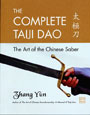
The Complete Taiji Dao. "The Art of the Chinese Saber. By Zhang, Yun. Blue Snake Books, 2009. 464 pages. ISBN:1583942270. "This is a very complete book about the Chinese saber, or Dao. It presents the history, mechanics, skills and philosophy of Taiji Dao. There is a detailed description of the traditional Taiji Dao form, including applications for combat with many photos. There are descriptions and photos of two-handed Dao skills and fighting skills training. There are over 1,000 photos. Paperback. 427 pp. 8 X 10." "The Complete Taiji Dao introduces the principles and practice of Taiji Dao and provides illustrated discussions of the history of Chinese swords. The book covers the history and features of the dao; the Taiji principles from which Taiji Dao practice derives; the basic skills and techniques of the art; detailed descriptions and photographs of the traditional Taiji Dao form; and Taiji Dao fighting principles and training methods. Broad in scope and detailed in its presentation of the principles and practice of Taiji Dao, The Complete Taiji Dao represents a significant contribution to the field of traditional Chinese weapons practice." VSCL.
Taijiquan broadsword forms are quite easily adapted for practice with a wooden cane.
Saturday, November 02, 2013
Morning Practices: Walking, Taijiquan and Ding Shi
It looks like a beautiful morning for walking outdoors and practicing Taijiquan forms and reenacting the Taijiquan principles. Also, I will walk around my 5 acre parcel of property with my dog, Bruno, and we will practice "heeling." My bodybuilding workout before noon at the TFFC gym will focus on weightlifting exercises for my legs. It is very nice to be semi-retired and have more time for my hobbies, reading, writing, interests, and playing.
I've been practicing doing movements numbered 1-11 of the Chen Taijiquan Broadsword 23 movement form.
Today, I will focus on Movement 11, Three Rings Around the Sun, or in the Chinese transliterations: Ti Tao San Huan, Ri Tao San Huan, Jir To San Wan.
I also play with practicing the eight Ding Shi palm postures while walking in a circle, which is a Neidan body-mind Taoist practice described by Master Tom Bisio.
Ba Gua Circle Walking Nei Gong: The Meridian Opening Palms of Ba Gua Zhang By Tom Bisio. Denver, Colorado, Outskirts Press, 2012. Bibliography,
249 pages. ISBN:
978-1432796891. VSCL.
By Tom Bisio. Denver, Colorado, Outskirts Press, 2012. Bibliography,
249 pages. ISBN:
978-1432796891. VSCL.
Baguazhang (Pa Kua Chang), Eight Trigrams Circle Walking Exercises
Study Tai Chi Chuan and Chi Kung with Mike Garofalo
In the photograph below, taken back in 2007, I am walking in a circle around a green pole. My posture is supposedly the "Moon Embracing Palm," but my hands (palms) should be lower - more at shoulder height rather than above my head. (In 2011, this area was converted into our "Sunny Garden," and the green pole removed.)

I've been practicing doing movements numbered 1-11 of the Chen Taijiquan Broadsword 23 movement form.
Today, I will focus on Movement 11, Three Rings Around the Sun, or in the Chinese transliterations: Ti Tao San Huan, Ri Tao San Huan, Jir To San Wan.
I also play with practicing the eight Ding Shi palm postures while walking in a circle, which is a Neidan body-mind Taoist practice described by Master Tom Bisio.
Ba Gua Circle Walking Nei Gong: The Meridian Opening Palms of Ba Gua Zhang
By Tom Bisio. Denver, Colorado, Outskirts Press, 2012. Bibliography,
249 pages. ISBN:
978-1432796891. VSCL. Baguazhang (Pa Kua Chang), Eight Trigrams Circle Walking Exercises
Study Tai Chi Chuan and Chi Kung with Mike Garofalo
In the photograph below, taken back in 2007, I am walking in a circle around a green pole. My posture is supposedly the "Moon Embracing Palm," but my hands (palms) should be lower - more at shoulder height rather than above my head. (In 2011, this area was converted into our "Sunny Garden," and the green pole removed.)

Thursday, October 03, 2013
Taijiquan Broadsword Form
"The single edged, curved bladed dao, or saber, dates from around the
13th -14th centuries. The curved blade was introduced to China as a
result of the Mongol invasions, and its popularity is shown by the fact
that it had eclipsed the straight bladed jian as the dominant military
side arm from the 15th century onward. The "willow leaf" (liu ye) dao is
an old blade pattern which displays considerable variety in shape and
dimensions. Generally averaging about 26 -30 inches in length, its blade
curves gently throughout its entire length. The blade may remain almost
the same width for its whole length, or it may gradually taper towards
the point. It often had a sharpened back edge, indicating a higher
degree of sophistication in its technical usage. A military issue
weapon, its blade shape, size, types of fittings and ornamentation were
regulated by documented imperial specifications. Each blade size was
intended for a specific military application. For example, a relatively
short dao might be used by vanguard troops scaling walls on climbing
ladders, where a long, difficult to draw sword would be awkward to put
into use. The willow leaf saber was almost completely eclipsed by the
"oxtail" blade pattern made for civilian use by the mid 19th century."
- David F. Dolbear, Introduction to Antique Chinese Swords of the Qing Dynasty Period
The following webpages include links, bibliographies, lists of movements, techniques, history, quotations, and resources.
Broadsword: All Styles
Chen Taijiquan Broadsword
Yang Taijiquan Broadsword
Cloud Hands Taijiquan
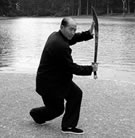
I practice the Chen Taijiquan 23 Movement Broadsword Form. Here is a list of the 23 movements of the Chen Broadsword form.
- David F. Dolbear, Introduction to Antique Chinese Swords of the Qing Dynasty Period
The following webpages include links, bibliographies, lists of movements, techniques, history, quotations, and resources.
Broadsword: All Styles
Chen Taijiquan Broadsword
Yang Taijiquan Broadsword
Cloud Hands Taijiquan
I practice the Chen Taijiquan 23 Movement Broadsword Form. Here is a list of the 23 movements of the Chen Broadsword form.
Wednesday, September 25, 2013
Taiji Sword
"The same principles of the basic t'ai chi ch'uan form are used with
both the tao and chien: natural breathing, body upright, keeping the
movements integrated, coordinated, and flowing smoothly, etc. The
difference is in the focus. For the tao, the broadsword, the focus is on
the blade. For the chien, the narrow, double-edged sword, the focus is
on the tip. The chien is considered the higher art form, and is more
difficult to learn. The tao is basically a chopping and slicing weapon;
little skill is needed for that It was generally the weapon of the
common soldier. The chien was used by the more scholarly and
aristocratic Chinese. ... Sword tai chi is a very rewarding experience
at any level. It’s movements, done correctly, develop one’s awareness,
timing, grace, and continued good health"
- Dorothy A. Odsen, Tai Chi Chien
The Taijiquan broadsword (Tao, Dao) or sword (Jian, Chien) forms are frequently taught to intermediate level Taijiquan students. Each Taijiquan style (Yang, Sun, Wu, Chen, etc.) has their own sword movement forms.
"To practice the Tai Chi Sword correctly, the first thing a practitioner must be able to do is to have a flexible body and wrist so that the sword and the body will coordinate and move in unity. The second thing is that the intent should direct each movement so that all the movements have applications, speed and accuracy. The third thing is to have spirit and natural breathing in each movement. In usage, it also emphasizes the concepts of sticking and adhering, running and following. In summary, in order to practice the Tai Chi Sword correctly, a practitioner must execute all the movements in an even, soft, continuous and smooth manner. All the movements are initiated by the waist, controlled by the wrist, with the upper and lower parts of the body coordinated so that when one part of the body moves, all parts follow. When one part stops, all stop. Therefore, all the movements are very light, speedy, flexible, nimble and stable. People often describe these kinds of motions as
like a "swimming dragon and flying phoenix."
- Vincent Chu, Gin Soon Tai Chi Chuan Federation Tai Chi Sword Practice
Tai Chi Double Edged Sword (Jian): Bibliography, Links, Resources, Quotations, Instructions Research by Mike Garofalo.
Tai Chi Saber/Broadsword (Dao): Bibliography, Links, Resources, Quotations Research by Mike Garofalo.
32 Standard Sword Form: Bibliography, Links, List of Movements
Research by Mike Garofalo.

- Dorothy A. Odsen, Tai Chi Chien
The Taijiquan broadsword (Tao, Dao) or sword (Jian, Chien) forms are frequently taught to intermediate level Taijiquan students. Each Taijiquan style (Yang, Sun, Wu, Chen, etc.) has their own sword movement forms.
"To practice the Tai Chi Sword correctly, the first thing a practitioner must be able to do is to have a flexible body and wrist so that the sword and the body will coordinate and move in unity. The second thing is that the intent should direct each movement so that all the movements have applications, speed and accuracy. The third thing is to have spirit and natural breathing in each movement. In usage, it also emphasizes the concepts of sticking and adhering, running and following. In summary, in order to practice the Tai Chi Sword correctly, a practitioner must execute all the movements in an even, soft, continuous and smooth manner. All the movements are initiated by the waist, controlled by the wrist, with the upper and lower parts of the body coordinated so that when one part of the body moves, all parts follow. When one part stops, all stop. Therefore, all the movements are very light, speedy, flexible, nimble and stable. People often describe these kinds of motions as
like a "swimming dragon and flying phoenix."
- Vincent Chu, Gin Soon Tai Chi Chuan Federation Tai Chi Sword Practice
Tai Chi Double Edged Sword (Jian): Bibliography, Links, Resources, Quotations, Instructions Research by Mike Garofalo.
Tai Chi Saber/Broadsword (Dao): Bibliography, Links, Resources, Quotations Research by Mike Garofalo.
32 Standard Sword Form: Bibliography, Links, List of Movements
Research by Mike Garofalo.
Subscribe to:
Posts (Atom)