Showing posts with label Weapons. Show all posts

Saturday, June 14, 2025

Dao De Jing, Laozi, Chapter 31

Tao Te Ching, Lao Tzu
Chapter 31


"Even the finest arms are an instrument of evil,
A spread of plague,
And the way for a vital man to go is not the way of a soldier.
But in time of war men civilized in peace
Turn from their higher to their lower nature.
Arms are an instrument of evil,
No measure for thoughtful men
Until there fail all other choice
But sad acceptance of it.
Triumph is not beautiful.
He who thinks triumph beautiful
Is one with a will to kill,
And one with a will to kill
Shall never prevail upon the world.
It is a good sign when man's higher nature comes forward,
A bad sign when his lower nature comes forward,
When retainers take charge
And the master stays back
As in the conduct of a funeral.
The death of a multitude is cause for mourning:
Conduct your triumph as a funeral."
-  Translated by Witter Bynner, 1944, Chapter 31  


"So far as arms are concerned, they are implements of ill-omen.
They are not implements for the man of Tao.
For the actions of armies will be well requited; where armies have quartered, brambles and thorns grow.
Great wars are for certain followed by years of scarcity.
The man of Tao when dwelling at home makes the left as the place of honour, and when using arms makes the right the place of honour.
He uses them only when he cannot avoid it.
In his conquests he takes no delight.
If he take delight in them, it would mean that he enjoys the slaughter of men.
He who takes delight in the slaughter of men cannot have his will done in the world."
-  Translated by Ch'u Ta-Kao, 1904, Chapter 31 


"Even the finest arms are an instrument of evil,
A spread of plague,
And the way for a vital man to go is not the way of a soldier.
But in time of war men civilized in peace
Turn from their higher to their lower nature.
Arms are an instrument of evil,
No measure for thoughtful men
Until there fail all other choice
But sad acceptance of it.
Triumph is not beautiful.
He who thinks triumph beautiful
Is one with a will to kill,
And one with a will to kill
Shall never prevail upon the world.
It is a good sign when man's higher nature comes forward,
A bad sign when his lower nature comes forward,
When retainers take charge
And the master stays back
As in the conduct of a funeral.
The death of a multitude is cause for mourning:
Conduct your triumph as a funeral."
-  Translated by Witter Bynner, 1944, Chapter 31  


夫佳兵者不祥之器.
物或惡之, 故有道者不處. 
君子居則貴左.
用兵則貴右. 
兵者不祥之器.
非君子之器.
不得已而用之.
恬淡為上. 
勝而不美.
而美之者, 是樂殺人. 
夫樂殺人者, 則不可以得志於天下矣. 
吉事尚左.
凶事尚右. 
偏將軍居左.
上將軍居右.
言以喪禮處之. 
殺人之衆, 以哀悲泣之.
戰勝以喪禮處之. 
-  Chinese characters, Tao Te Ching, Chapter 31  


fu bing zhe bu xiang zhi qi.
wu huo wu zhi, gu you dao zhe bu chu.
jun zi ju ze gui zuo.
yong bing ze gui you.
bing zhe bu xiang zhi qi.
fei jun zi zhi qi.
bu de yi er yong zhi.
tian dan wei shang.
sheng er bu mei.
er mei zhi zhe, shi le sha ren.
fu le sha ren zhe, tse bu ke yi de zhi yu tian xia yi.
ji shi shang zuo.,
xiong shi shang you.
pian jiang jun ju zuo.
shang jiang jun ju you.
yan yi sang li chu zhi.
sha ren zhi zhong, yi ai bei qi zhi.
zhan sheng yi sang li chu zhi.
-  Pinyin Romanization, Dao De Jing, Chapter 31  


"Weapons of war are omens of doom,
To be loathed by every living thing
And shunned by those who keep the Way.
Presiding at court the leader honours the left.
Resorting to war he honours the right.
But weapons are never the leader’s choice.
Weapons of war are omens of doom,
Not to be used unless compelled.
Above all, with mind and heart unstirred,
To arms give no glory:
For to glory in arms
Is to sing and rejoice in the slaughter of men.
And singers in praise of the slaughter of men
Shall not in this world gain their ends.
Thus the left is for deeds that are blessed,
The right is for deeds that bring death.
To the left the minor commander,
To the right the chief general:
Placed for the rites to honour the dead.
When the slaughter is great,
Let the leader come forth to keen for the slain;
The victory won,
To perform solemn rites in mourning the day."
-  Translated by Moss Roberts, 2001, Chapter 31  


"Las armas son instrumentos nefastos.
El hombre del Tao nunca se sirve de ellas.
El hombre de bien considera a la izquierda
como sitio de honor,
pero se inclina a la derecha cuando porta armas.
El sabio prefiere la izquierda.
El soldado prefiere la derecha.
Las armas son instrumentos nefastos,
no adecuados para el hombre de bien.
Sólo las usa en caso de necesidad,
y lo hace comedidamente,
sin alegría en la victoria.
El que se alegra de vencer
es el que goza con la muerte de los hombres.
Y quien se complace en matar hombres
no puede prevalecer en el mundo.
Para los grandes acontecimientos
el sitio de honor es la izquierda,
y la derecha para los hechos luctuosos.
En el ejército,
El comandante adjunto se coloca a la izquierda,
El comandante en jefe, a la derecha.
Esta es la misma disposición que se usa en los ritos fúnebres.
Esto significa que la guerra se compara a un servicio funerario.
Cuando ha sido matada mucha gente,
sólo es justo que los supervivientes lloren por los muertos.
Por esto, incluso una victoria es un funeral."
-  Translation from Wikisource, 2013, Capitulo 31


"Of all things, soldiers are instruments of evil,
   Hated by men.
Therefore the religious man (possessed of Tao) avoids them.
The gentleman favors the left in civilian life,
But on military occasions favors the right.
Soldiers are weapons of evil.
   They are not the weapons of the gentleman.
When the use of soldiers cannot be helped,
   The best policy is calm restraint.
Even in victory, there is no beauty,
And who calls it beautiful
   Is one who delights in slaughter.
He who delights in slaughter
   Will not succeed in his ambition to rule the world.
[The things of good omen favor the left.
The things of ill omen favor the right.
The lieutenant-general stands on the left,
The general stands on the right.
That is to say, it is celebrated as a Funeral Rite.]
The slaying of multitudes should be mourned with sorrow.
A victory should be celebrated with the Funeral Rite."
-  Translated by Lin Yutang, 1955, Chapter 31   


Chapter and Thematic Index (Concordance) to the Tao Te Ching


Taoism: A Selected Reading List


 A typical webpage created by Mike Garofalo on a Chapter of the Tao Te Ching (Daodejing) by Lao Tzu (Laozi) includes at least 16 different translations or interpolations of the Chapter in English, two Spanish translations, the Chinese characters for the Chapter, a Wade-Giles and Hanyu Pinyin Romanization of the Mandarin Chinese words for the Chapter, recommended reading lists, a detailed bibliography; indexing by key words and terms for the Chapter in English, Spanish, and the Wade-Giles Romanization; some commentary, and other resources for the Chapter. 


Monday, April 28, 2025

Taijiquan Sword: Yang Style 32 Sword Form


This popular webpage includes a comprehensive bibliography, scores of links to webpages; an extensive listing of the names and name variations for each movement in English, Chinese, French, German, and Spanish; a detailed analysis of each posture and movement sequence with explanations and numbered illustrations and detailed instructions; selected quotations; comments on 20 Taijiquan sword techniques; a comprehensive media bibliography; a chart of performance times; recommendations for starting to learn this form at home one your own with instructional DVDs, books and practice methods; and, a comparison of the 32 and 55 sword forms in the Yang style. 

This is the standard, simplified, orthodox, 1957, 32 Taiji Sword Form, in the Yang Style of T'ai Chi Ch'uan. 

32 Sword Form Pamphlet by Geoffrey Hugh Miller.  Adapted from information and graphics found on the 32 Sword Form webpage by Michael P. Garofalo.  22 pages, 9/7/2015, PDF Format.  Excellent job by Mr. Miller.  This is a handy practice tool.  


Tuesday, April 01, 2025

Cannon Cane Taijiquan Routine

Cloud Hands Blog Repost from 2023:

Cannon Cane, Eight Immortals Cane Routine #2.  

A Hypertext Notebook by Michael P. Garofalo


Traditional Tai Chi Eight Immortals Cane, Routine Two (Cannon Cane). Demonstrated by Master Jesse Tsao. Instructional DVD, 65 minutes. Produced by Tai Chi Healthways, San Diego, 2008. Routine Two, Cannon Cane, is based on the Chen Style of Taijiquan. Master Tsao developed this cane form himself, with grandmaster Zhu Tiancai's support. "This is the answer for people looking for the martial arts aspect of Tai Chi. You will surely love the way Master Jessee Tsao presents to you this unique auncient practice. A short stick, umbrella, or any everyday object of the proper length can be used as a substitute for a cane. Like the Chen Style Tai Chi Cannon Fist, this routine is full of powerful moves and explosive strikes. Detailed instruction is provided in English, with front and back views. It is a good reference for home study, or a resource for instructor's teaching preparation. Suggest 30 class hours. (Difficulty: Intermediate through Advanced Levels). DVD-R, (62 minutes). There is a streaming version available through Amazon." VSCL


Mastering Tai Chi Cane for Health and Self-Defense. By Jesse Tsao, Ph.D., Tai Chi Healthways, 2022, 225 pages, $27.00.
"The cane has been used as a self-defense weapon for centuries. But it is more than just a weapon or a walking aid—it is a useful tool to practice the ancient Chinese art of tai chi and gain all the benefits of relaxation, health, and wellness for students of any age or fitness level. For the very first time, Master Jesse Tsao brings his fifty years of tai chi practice and training, combined with his PhD in Traditional Chinese Martial Arts Education, to this comprehensive guide to mastering the tai chi cane with routines he has created.
Rooted in the Taoist Eight Immortals legends, this book takes you through the steps of tai chi cane stretch and self-massage to increase flexibility, loosen tight muscles, and prepare the body for daily activities as well as stimulating energy points to open the body’s blockages and flush out stagnation and toxins to promote self-healing. Routine I blends the softer flow and circular movements of the popular Yang-style tai chi for stress management and personal fitness. And for students looking for training in cane self-defense, Routine II is based on the fast and vigorous practice of traditional Chen-style Cannon Fist that mixes robust leaps with explosive strikes—ideal for diehard martial artists.
With more than 300 photographs and illustrations, Mastering Tai Chi Cane for Health & Self-Defense provides clear, step-by-step instructions for each posture followed by key points for mastery, making it a perfect manual for beginners while the in-depth content will be invaluable to martial artists and tai chi instructors." VSCL.


Wednesday, December 06, 2023

Tao Te Ching, Chapter 53

Tao Te Ching by Lao Tzu
Chapter 53


"Ah, that I were wise enough to follow the great Tao!
Administration is a great undertaking.
The great Tao is extremely simple, but the people prefer the complex ways.
While the palace is extremely well appointed, the fields may be full of tares, and the granaries may be empty.
To dress grandly, to carry sharp swords, to eat and drink excessively, and to amass great wealth,
this I call stylish theft.
That it is not Tao is certain."
-  Translated by Walter Gorn Old, 1904, Chapter 53 


"If I were possessed of the slightest knowledge, traveling on the great Way,
My only fear would be to go astray.
The great Way is quite level,
but the people are much enamored of mountain trails.
The court is thoroughly deserted,
The fields are choked with weeds,
The granaries are altogether empty.
Still there are some who wear clothes with fancy designs and brilliant colors,
sharp swords hanging at their sides,
are sated with food,
overflowing with possessions and wealth.
This is called "the brazenness of a bandit."
The brazenness of a bandit is surely not the Way!"
-  Translated by Victor H. Mair, 1990, Chapter 53   


"If, in some unexpected manner, I
As one endowed with knowledge should appear,
To walk according to the mighty Tao,
T'is only bold display that I should fear;
For plain and simple ways Great Tao suggest,
But people love cross-paths and by-ways best.
The halls and courts are splendid, but the fields
Uncultivated are, the granaries
Empty; to put on ornamented robes,
And keen-edged swords, to gorge with gluttonies,
To pile up wealth; this, robbers' pride I call,
But, of a surety, not Great Tao at all."
-  Translated by Isaac Winter Heysinger, 1903, Chapter 53  


"If I had but little knowledge I should, in walking on a broad way,
Fear getting off the road.
Broad ways are extremely even,
But people are fond of bypaths.
The courts are exceedingly splendid,
While the fields are exceedingly weedy,
And the granaries are exceedingly empty.
Elegant clothes are worn,
Sharp weapons are carried,
Food and drinks are enjoyed beyond limit,
And wealth and treasures are accumulated in excess.
This is robbery and extravagance.
This is indeed not Tao."
-  Translated by Wing-Tsit Chan, 1963, Chapter 53   


使我介然有知.
行於大道. 
唯施是畏. 
大道甚夷而民好徑. 
朝甚除.
田甚蕪.
倉甚虛.
服文綵. 
帶利劍.
厭飲食.
財貨有餘.
是謂盜夸. 
非道也哉. 

-  Chinese characters, Tao Te Ching, Chapter 53


shih wo chieh jan yu chih.
hsing yü ta tao.
wei shih shih wei.
ta tao shên yi erh min hao ching.
chao shê ch'u. 
t'ien shên wu.
ts'ang shên hsü.
fu wên ts'ai. 
tai li chien.
yen yin shih.
ts'ai huo yu yü. 
shih wei tao k'ua.
fei tao yeh tsai.
-  Wade-Giles Romanization, Tao Te Ching, Chapter 53


"If I had the smallest seed of wisdom,
I would walk the Great Way,
And my only fear
would be to lose my way from it.
The Great Way is very smooth and straight;
And yet the people like better the complicated paths.
The courtyard is very clean and well decorated,
(Their cities appear powerful.)
But the fields are very weedy and wild,
And the grain silo's are very empty!
(But they have lost the skill to feed themselves.)
They wear beautiful clothes,
(They value appearances over substance.)
They carry destructive weapons,
They use the tools of destruction to get their needs.)
They over fill themselves with food and drink,
(They indulge themselves in the fruits of the conquered.)
They own more riches than they can use!
(They are greedy.)
They are the messengers of lawlessness!
As for Tao (the Laws of the Universe),
what do they know about it?"
-  Translated by John Trottier, Chapter 53


"Quisiera poseer la sabiduría
para poder marchar por el Gran Camino
sin temor a desviarme.
El Gran Camino es llano y recto,
pero la gente elige los senderos tortuosos.
Cuando la corte imperial se adorna de esplendor,
los campos se llenan de malas hierbas
y los graneros quedan vacíos.
Los barones y reyes visten ropas lujosas,
Tienen mas posesiones de las que llegan a usar,
se hartan de bebida y de manjares,
Acumulan tesoros y riquezas en exceso.
Son gobernantes-ladrones.
Robar y ostentar no es seguir al Tao."
-  Translation from Wikisource, 2013, Tao Te Ching, Capítulo 53


"If I have a grain of wisdom,
I walk along the great Tao
And fear only to stray.
The great Tao is easy indeed,
But the people choose by-paths.
The court is very resplendent;
Very weedy are the fields,
And the granaries very empty.
They wear gaudy clothes,
Carry sharp swords,
Exceed in eating and drinking,
Have riches more than they can use.
Call them robber-braggarts:
They are anti-Tao indeed!"
-  Translated by Herrymoon Maurer, Chapter 53  


Chapter and Thematic Index (Concordance) to the Tao Te Ching


Taoism: A Selected Reading List


Tao Te Ching English Language Corncordance by Gerold Claser.  An excellent English language concordance providing terms, chapter and line references, and the proximal English language text.  No Chinese language characters or Wade-Giles or Pinyin Romanizations.  Based on the translation by John H. McDonald.  


Friday, June 23, 2023

Chen Taijiquan Broadsword Routine

Chen Style Tai Chi Chuan Saber (Dao, Broadsword) Form.  23 Movement Form.

This 23 Movement Single Broadsword (Dao) Form was Created by Chen Zhaopei (1893-1972), 18th Generation Chen Style Taijiquan Grandmaster, in the 1930's. 

Chen Style Taijiquan Broadsword Form, List of 23 Movements (PDF)

Chen Style Taijiquan

Chen Taijiquan Old Frame First Form


Chen Tai Chi Broadsword Form.  Instructional DVD by Sifu Ken Gullette.  "Sifu Gullette takes you into the Chen Tai Chi Broadsword Form in a way that no other DVD or VCD does. Ken's experience with the broadsword, both as a tournament champion and teacher, adds a new level of information that martial artists around the world have come to expect from him.  For centuries, this form had only 13 movements. In the 1930's Chen Zhaopei added 9 more to create the form that's practiced today by the Chen family. This is the form that Sifu Gullette learned from Grandmaster Chen Xiaowang's students, Master Ren Guangyi and disciples Jim and Angela Criscimagna.  In this DVD, you'll see the complete form with front and rear views. You'll get individual instruction on each movement in the form--step by step--with an emphasis on the internal body mechanics. You'll also learn the fighting applications for each movement. In a special section, you'll also learn basic broadsword techniques that can be used in any style of martial arts -- blocks, deflections, cutting techniques, stances, plus you'll learn how to use a scabbard in combat."


   "The Chen-style Single Broadsword Routine is a kind of the Chen-style Taiji short weapons.  There are thirteen movement in the routine, so it is called the 'thirteen broadswords.'  From 1930 to 1938, the famous Taijiquan master, the Chen-Family descendent of the eighteenth generation, Chen Zhaopei had added nine movements at the basic of original routine during teaching Taijiquan in Nanjing city.  So it became the popular Taiji Single Broadsword routine in Chenjiagou village.
    The Chen-style Taiji Single Broadsword routine is short and refined, the usages of the forms are clear.  There are thirteen kinds of rolling, closing, pricking, blocking, cutting, hacking, scooping, cross-cutting, twisting, shaking, supporting, slicing and tilting.  They really reflect the characteristics of the Chen-style Taiji Single Broadsword, combining hardness and softness in harmony, equaling stress the quickness and slowness, dodging and transfers, relaxing and nimble, springing and shaking, sticking to each other without being separated, twine to neutralize the force.  It remains the momentum of liking a fierce tiger and cutting forcefully to the Hua Mountain.  It's short weapon, but it can be used as a long weapon."
-   Chen Zenglei, Chen Style Taijiquan, Sword and Broadsword, 2003, p. 322  


Thursday, July 07, 2022

Daodejing, Chapter 80

Tao Te Ching by Lao Tzu
Chapter 80


"You want a small state with a minimal population.

Have ready to hand weaponry for a sufficient number of military units
Yet have no recourse to use them.

Make sure that the common people take dying seriously
So that they have no taste for venturing far from home.

Though you have ships and chariots enough
Have no reason to man them;
Though you have armor and weapons enough
Have no reason to parade them.

Bring the common people back to keeping their records with knotted stong,
To relishing their food,
To finding beauty in their garments,
To enjoying their customs,
An to finding security in their homes.

Although your neighboring states are within eyesight
And the sounds of their dogs and cocks are within earshot,
Your people will grow old and die without having anything to do with them."
-  Translated by Roger T. Ames and David L. Hall, 2003, Chapter 80


"The wise person reduces the importance of governments
And simplifies the modes of living,
So that people use fewer tools and wares
And treasure simplicity in their lives,
So that, though there are vehicles,
People do not take them.
And, though there are weapons,
People do not carry them.
And, though there are records,
Tying knots will serve the record-keeping purpose.
Thus, the highest political achievement is one
In which people savor their food,
Like the beauty of their clothes,
Appreciate their safe and peaceful homes,
Enjoy their social customs;
And in which roosters and dogs
Can be heard between countries;
But people, all their lives,
Have no need to go across the borders."
-  Translated by Liu Qixuan, Chapter 80   


"A small state with few people.
Let the implements (ch'ih) for ten and hundred men be unused,
Let the people fear death such that they do not move far away.
Although there are boats and carriages,
There are no places to ride them to.
Although there are weapons and armours,
There are no occasions to display them.
Let the people again tie ropes and use them (as memory aids).
Let them enjoy their food,
Consider their clothing beautiful,
Be contented with their dwellings,
And happy with their customs.
The neighbouring states overlooking one another,
The dogs' barkings and cocks' crowings are heard from other states,
Yet till they are old and dying the people do not visit one another."
-  Translated by Ellen M. Chen, Chapter 80 


小國寡民.
使有什伯之器而不用.
使民重死而不遠徙.
雖有舟輿無所乘之.
雖有甲兵無所陳之. 
使民復結繩而用之.
甘其食.
美其服安其居.
樂其俗. 
鄰國相望.
雞犬之聲相聞.
民至老死不相往來. 
-  Chinese characters, Chapter 80, Tao Te Ching


hsiao kuo kua min.
shih yu shih po chih ch'i erh pu yung.
shih min chung ssu erh pu yüan hsi.
sui yu chou yü wu so ch'êng chih.
sui yu chia ping wu so ch'ên chih.
shih jên fu chieh shêng erh yung chih.
kan ch'i shih.
mei ch'i fu an ch'i chü. 
lo ch'i su.
lin kuo hsiang wang.
chi ch'üan chih shêng hsiang wên.
min chih lao ssu pu hsiang wang lai.
-  Wade-Giles Romanization, Chapter 80, Tao Te Ching


"The ideal state is a small intimate community.
Where all the necessities of life are present in abundance.
There everyone is satisfied to live and die without looking around for greener pastures.
Even if they have cats or boats, they do not use them for traveling abroad.
Even if they have police and fortifications, these are never put to use.
Business transactions are simple enough to be calculated on one's fingers rather than requiring complicated bookkeeping.
The people are satisfied with their food,
Contented with their clothing,
Comfortable in their dwellings,
And happy with their customs.
Even though neighboring communities are within sight,
And the crowing of the neighbor's cocks and barking of the neighbor's dogs are within hearing,
They grow old and die without ever troubling themselves to go outside of their own communities."
-  Translated by Archie J. Bahm, Chapter 80  


"Let every state be simple like a small village with few people
There may be tools to speed things up ten or a hundred times yet no one will care to use them
There may be boats and carriages yet they will remain without riders
There may be armour and weaponry yet they will sit collecting dust
The people must take death seriously and not waste their lives in distant lands
Let them return to the knotting of cord
Let them enjoy their food and care for their clothing
Let them be content in their homes and joyful in the way they live
Neigbouring villages are within sight of each other
Roosters and dogs can be heard in the distance
Should a man grow old and die without ever leaving his village let him feel as though there was nothing he missed "
-  Translated by Jonathan Star, 2001, Chapter 80 


"Imaginemos que gobierno un pequeño país de pocos habitantes.
Mis súbditos tendrían embarcaciones que no utilizarían.l
Les enseñaría a temer a la muerte y a no alejarse.
Por muchos carruajes que hubiese, no viajarían en ellos.
Aunque tuviesen armas y corazas, no las mostrarían. 
Les llevaría de nuevo al uso de cuerdas con nudos (en lugar de escritura).

Encontrarían sabroso su alimento;
Ricos sus vestidos;
Cómodas sus casas;
Felicidad en sus costumbres.

Aunque los reinos vecinos se hallasen tan cerca
Que pudiesen oír el ladrido de los perros y el canto de los gallos,
Los hombres de este pequeño reino no desearían nunca abandonarlo."
-  Translated by Caridad Diaz Faes, 1970, Capítulo 80  


"Suppose I had a country small,
With people few, and I had there
Some officers of ten,
Or of a hundred men,
I'd not employ those men at all;
Though death were feared, unfrightened then,
My people would not emigrate elsewhere.
They might have carriages and boats,
But not in them to ride away,
They might have warlike arms,
But never war s alarms
Would call them with their hateful notes;
They d even forget how writing charms,
And knotted cords again they would display.
Then would they relish homely food,
Their plain clothes would seem elegant,
Though dwellings might be poor,
Content would guard the door,
And simple habits, plain and good, Far better than they knew before,
A sense of fresh enjoyment would implant.
A neighboring state might be in sight,
The voice of fowls and dogs be heard,
But life like that would make
My people such joy take
In their own state, that till the night
Of age should their enjoyment slake,
And they should die, they'd not exchange a word."
-  Translated by Isaac Winter Heysinger, 1903, Chapter 80  


"If I had a small kingdom and but ten or a hundred men of ability, I would not administrate with them.
I would teach the people to look upon death as a grievous thing, and then they would not go abroad to meet it.
Though they had boats and carriages, yet they would not go away in them.
Though they had armour, yet they would never have occasion to wear it.
The people would return to the use of the quipu.
They should find their coarse food sweet, think their plain clothes grand, regard their homes as places of rest, and take delight in their own simple pleasures.
Though the neighbouring state could be seen by us, and the crowing of the cocks and the barking of the dogs could be heard,
Yet my people would grow old, and die before ever feeling the need of having intercourse with it."
-  Translated by Walter Gorn Old, 1904, Chapter 80


A typical webpage created by Mike Garofalo for each one of the 81 Chapters (Verses) of the Tao Te Ching (Daodejing) by Lao Tzu (Laozi) includes over 25 different English language translations or interpolations for that Chapter, 5 Spanish language translations for that Chapter, the Chinese characters for that Chapter, the Wade-Giles and Hanyu Pinyin Romanization of the Mandarin Chinese words for that Chapter, and 2 German and 1 French translation of that Chapter.  Each webpage for each one of the 81 Chapters of the Tao Te Ching includes extensive indexing by key words and terms for that Chapter in English, Spanish, and the Wade-Giles Romanization.  Each webpage on a Chapter of the Daodejing includes recommended reading in books and websites, a detailed bibliography, some commentary, research leads, translation sources, and other resources for that Chapter.   

Chapter 80, Tao Te Ching by Lao Tzu

Chapter and Thematic Index (Concordance) to the Tao Te Ching by Lao Tzu

English Language Daodejing Translators' Source Index

Spanish Language Daodejing Translators' Source Index

Ripening Peaches: Taoist Studies and Practices

Taoism: A Selected Reading List

One Old Daoist Druid's Final Journey  


Monday, December 13, 2021

Taijiquan Cane or Staff


Taiji cane forms are typically performed slowly and deliberately.  Hard and powerful strikes are seldom used in T'ai Chi Ch'uan walking stick forms.  The pace of the Taijiquan cane forms are seldom fast and vigorous.  There are few if any vigorous leaps and jumps.  Taiji forms seldom use very low stances.  Taiji cane forms are particularly suitable for fit persons over 50 years of age.  Good examples of a Taiji Cane Form are: the Standard Beijing 24 Form with Cane created by Master Wen-Ching Wu; the Eight Immortals Cane Form, Part I, created by Master Jesse Tsao;  the Plum Blossom Taiji Cane Form; the Tai Chi Stick 18 Form;  the Bodhi Dharma Walking Stick Form; Master Michael Gilman's Three Powers Cane Form; the Wu Tang Cane Form of Master T.T. Liang; the Standard 32 Sword Form; etc.  

There are also many examples of more vigorous "Taiji" cane forms, with hard strikes, leaps, fast moves, spins, and low moves.  Taijiquan saber or broadsword forms are readily adapted for use with a cane, and some are fast and vigorous.  Normally, Taijiquan sword forms are not very well adapted as cane forms, but I practice the Standard 32 Sword Form with my cane as do many others.  Karate, kung fu, Shaolin, Bagua and HsingI cane or stick forms are often fast, vigorous, powerful, twisting, agile, and with some very low stances.  Of course, when first learning any new cane form, begin with a slower, more deliberate, less vigorous practice to help the body adapt to the moves of the new form.  Thus, even a fast and vigorous cane form from any style can be done more in the "Taiji" fashion outlined and shown above.  

Many Qigong (Chi Kung) forms can also we done while holding a cane.  Adaptations are quite easily arranged.  Most often, however, Qigong forms are adapted or created for use with a short 6"-12" wooden stick called a Tai Chi Ruler or Bang.  

I consider a cane or walking stick to be, normally, a straight strong wooden stick with a curved (hook) handle that is from 30" (76 cm) to 42" (107 cm) long.  The cane will typically extend from the floor to the height of your hip socket and maybe up to your belly button.  The cane might also be made out of plastic, aluminum, steel, or rattan.  The cane might have a straight rather than curved or hooked end with a round ball shaped (pommel) end or some sort of straight or carved handle at the end.  The cane might be very simple, natural and plain; or be carved, painted or decorated.  


Each day I use an Instructor's Walking Cane, 40" (103 cm) long and 1" (2.54 cm) in diameter, purchased from Cane Masters.  This cane weights 1lb, 2 oz (510 gm).  This beautiful martial arts combat cane is made of pure hickory heartwood, has multiple notches at three key gripping points, has a ample rounded hooked horn, and has a rubber covered tip inserted over the tip end.  I also own the same Instructor's Walking Cane made of oak - a gift from my children.  I am 6'6" (198 cm) tall, and a 40" cane (103 cm) is perfect for using on my long walks and for my Taiji cane practices.  The only weapon I practice with on a daily basis is a wooden cane; and the only weapon I teach now in my Taijiquan classes is the cane.  Also, whenever I take a walk, anywhere, I bring my cane along for support, exercising the arms, and for self-defense.     


Taijiquan Cane Weapon Research, Bibliography, and Practices

Way of the Short Staff

Long Staff Weapons Practices 


Friday, September 17, 2021

Dao De Jing, Laozi, Chapter 50

Tao Te Ching by Lao Tzu
Chapter 50

"From coming out to life to going back to death:
Those companions (t'u) of life,
They are one-third (shih-yu-san);
Those companions of death,
They are one-third;
Those living but moving toward the place of death,
They are also one-third.
Why?
Because of the intense (hou) life-producing activity.
I have heard that one who knows how to nourish life,
On land meets no tigers or wild buffaloes,
In battle needs to wear no armors or weapons,
A wild buffalo has nowhere to butt its horns,
A tiger has nowhere to sink its claws,
A weapon has nowhere to enter its blade.
Why?
Because such a one has no place of death."
-   Translated by Ellen M. Chen, Chapter 50 


"People are born on the Earth and die.
Out of ten about three continue then paradisiacal existence; three go to hell by the path of death; and three yet are those who have not succeeded in the development of soul due to attachments to worldly affairs.
He who mastered the true life when living on the Earth is not afraid of rhinoceros or tigers; in the battle he is not afraid of armed soldiers.
A rhinoceros has no place to plunge its horn into him, a tiger has no place to fasten its claws onto him, soldiers have no place to stab him with swords.
It is so, because to him there is no death."
-   Translated by Vladimir Antonov, Chapter 50  


"The Source gives life and penetrates death.
Life is a companion to the four directions that exist within Heaven, Humanity and Earth.
Death is a companion to the four directions that exist within Heaven, Humanity and Earth.
People are born, live, and die, on earth, also as companions to the four directions that exist within Heaven, Humanity and Earth.
What is the purpose?
To give life.
To give life abundantly.
Indeed, we have heard of people who are good at sustaining life.
On land they travel and do not encounter rhinoceroses.
Tigers enter the battlefield and they do not need to wear armor or carry weapons.
Rhinoceroses have no place to butt with their horns.
Tigers have no place to put their claws.
Soldiers have no place to thrust their blades.
How can this be so?
Because of the not-dying Earth."
-   Translated by Alan Sheets, Chapter 50  


"Men go forth into life, And return in death.
Out of ten men, three prolong their life (through cleanliness), three hasten their death (through their excesses), three compromise their life by the attachment they have to it, (And only one stays alive until his term, because he is not attached to it).
He who is not attached to his life, does not turn aside to avoid an encounter with a rhinoceros or a tiger; he throws himself into the fray without armour or weapons;
And he comes to no harm because he is proof against the rhinoceros horn, the tiger's claws, And weapons of combat.
Why is this? ...
Because, exteriorized through his indifference, death cannot take a hold on him."
-   Translated by Derek Bryce, Chapter 50 


"People born into life enter death.
Constant companion in life
and in death,
this body is the kill-site animating their lives.
And isn't that because
they think life is the fullness of life?
I've heard those who encompass the whole of life
could walk on and on without meeting rhinoceros or tiger,
could charge into armies without feeling shield or sword.
A rhinoceros would find nowhere to gore them,
a tiger nowhere to claw them,
a sword nowhere to slice them.
And isn't that because
for them there's no kill-site?"
-   Translated by David Hinton, Chapter 50 


Friday, February 19, 2021

Daodejing Chapter 31 Tao Te Ching

 Dao De Jing by Laozi, Tao Te Ching by Lao Tzu 

Chapter 31, Tao Te Ching by Lao Tzu  

[The order of the 81 Chapters is found in Wang Bi's commentary on the Dao De Jing in 246 CE.  This is the standard 81 Chapter order used in English versions.]


"Now, weapons are instruments of ill omen;  Divinity abhors them.
Therefore, one who abides in Dao does not abide weapons.
The Superior Person, at home, honors the more powerful Left-side;
on the battlefield, the more gentle Right-side;
they put Peace above all else,
and refuse to glorify weapons.
If one glorifies weapons, this propagates killing.
One who delights in killing people has no influence with Heaven.
On occasions of celebration, one honors the Left-side;
on occasions of grief, the Right-side is honored more.
A Deputy General stands on the Left side;
their Commander stands at the Right..
in other words, they stand in the order of their gravity of offense.
The killing of masses of people we ought bewail with sorrow and grief.
Victory in battle we ought commemorate with mournful rites."
-  Translated by Jerry C. Welch, 1998, Chapter 31 


"The Master who is a Captain of soldiers
Does not give blessings with his weapons.
Soldiers' weapons are hated by most men,
Therefore he who has the Tao gives them no place.
In the dwelling of the man of peace the left side is the place of honour.
In soldiers' usage the right side is the place of honour.
A soldier does not give blessings with his weapons.
They are not the instruments of a man of peace.
A man of peace will not possess them, nor use them;
He gives the first place to calmness and repose.
If he conquers, he does not rejoice.
Without joy is he who wounds and kills men.
The Master who wounds and kills men
Cannot succeed in ruling his kingdom.
In time of joy, the left hand is preferred,
In time of mourning, the right hand is preferred.
In war, the second in command is placed on the left,
The first in command is placed on the right,
That is, he stands in the place of mourning.
He who has killed many men should weep with many tears.
He who has conquered in battle should stand in the place of mourning."

-  Translated by Isabella Mears, 1916, Chapter 31  


"Even victorious arms are unblest among tools, and people had better shun them.
Therefore he who has Reason does not rely on them. 
The superior man when residing at home honors the left.
When using arms, he honors the right. 
Arms are unblest among tools and not the superior man's tools.
Only when it is unavoidable he uses them.
Peace and quietude he holdeth high.  
He conquers but rejoices not.
Rejoicing at a conquest means to enjoy the slaughter of men.
He who enjoys the slaughter of men will most assuredly not obtain his will in the empire."
-  Translated by Daisetsu Teitaro Suzuki and Paul Carus, 1913, Chapter 31 


夫佳兵者不祥之器.
物或惡之, 故有道者不處. 
君子居則貴左.
用兵則貴右. 
兵者不祥之器.
非君子之器.
不得已而用之.
恬淡為上. 
勝而不美.
而美之者, 是樂殺人. 
夫樂殺人者, 則不可以得志於天下矣. 
吉事尚左.
凶事尚右. 
偏將軍居左.
上將軍居右.
言以喪禮處之. 
殺人之衆, 以哀悲泣之.
戰勝以喪禮處之. 
-  Chinese characters, Tao Te Ching, Chapter 31 


fu chia ping chê pu hsiang chih chi'i.
wu huo wu chih, ku yu tao chê pu ch'u.
chün tzu chü tsê kuei tso.
yung ping tsê kuei yu.
ping chê pu hsiang chih ch'i.
fei chün tzu chih ch'i.
pu tê yi erh yung chih.
t'ien tan wei shang.
shêng erh pu mei.
erh mei chih chê, shih lo sha jên.
fu lo sha jên chê, tsê pu k'o yi tê chih yü t'ien hsia yi.
chi shih shang tso.
hsiung shih shang yu.
p'ien chiang chün chü tso.
shang chiang chün chü yu.
yen yi sang li ch'u chih.
sha jên chih chung, yi ai pei ch'i chih.
chan shêng yi sang li ch'u chih.
-  Wade-Giles Romanization, Tao Te Ching, Chapter 31


"Now, fine weapons, they are not tools of good fortune.
 Creatures detest them, no matter what. 
 Therefore, he who possesses Dao does not live by them.
 When a noble man is in his dwelling, then he honors the left.
 When he commands troops, then he honors the right.
 Weapons, they are not tools of good fortune. 
 They are not the tools of a noble man. 
 When he has no choice but to use them, 
 To be calm and indifferent is superior;
 Never pleased, indeed! 
 And he who is pleased enjoys killing people.
 Now, he who enjoys killing people
 Can not get what he desires from the world! 
 Therefore, in fortunate affairs honor the left,
 In unfortunate affairs honor the right. 
 Thus the assistant general of the army resides on the left,
 The supreme general of the army resides on the right.
 Thus we say they are dwelling at a funeral,
 When many people are killed,
 Then mourn and weep with grief for them.
 Victory in war thus means they will dwell at a funeral."
 -  Translated by Bruce R. Linnell, 2015, Chapter 31


"Even the finest warrior is defeated
     when he goes against natural law
By his own hand he is doomed
     and all creatures are likely to despise him

One who knows Tao
     never turns from life calling
When at home he honors the side of rest
When at war he honors the side of action
Peace and tranquility are what he holds most dear
     so he does not obtain weapons
But when their use is unavoidable
     he employs them with fortitude and zeal

Do not flaunt your excellence
Do not rejoice over victory
With the loss of others
     weep with sorrow and grief
After winning a battle
     do not celebrate
     observe the rites of a funeral

One who is bound to action, proud of victory,
    and delights in the misfortune of others
will never gain a thing
     from this world below Heaven"
-  Translation by Jonathan Star, 2001, Chapter 31 


"Weapons of war are instruments of death.
All people fear them.
Therefore, all men of peace avoid them.
The sage prefers Infinity.
The man of war prefers the earth.
Weapons are instruments of death
and the tools of a warrior.
The sage avoids them at all cost;
and sometimes prefers death rather
than touching them.
Peace and harmony are the sage's reality.
She considers victory to be the bastard
child of war.
If you revel in victory,
then you sanction war and the killing of
human beings.
If you accept killing,
you have forgotten your oneness with all
beings.
In time of celebration the left is the dominant
position;
In times of grief the right.
During wartime the general always stands on the
left
and the king on the right.
If even one person is killed in war,
it is cause for great grief and mourning.
Victory is simply the maker of widows and orphans."
-  Translated by John Worldpeace, Chapter 31   


"Las armas son instrumentos nefastos.
El hombre del Tao nunca se sirve de ellas.
El hombre de bien considera a la izquierda
como sitio de honor,
pero se inclina a la derecha cuando porta armas.
El sabio prefiere la izquierda.
El soldado prefiere la derecha.
Las armas son instrumentos nefastos,
no adecuados para el hombre de bien.
Sólo las usa en caso de necesidad,
y lo hace comedidamente,
sin alegría en la victoria.
El que se alegra de vencer
es el que goza con la muerte de los hombres.
Y quien se complace en matar hombres
no puede prevalecer en el mundo.
Para los grandes acontecimientos
el sitio de honor es la izquierda,
y la derecha para los hechos luctuosos.
En el ejército,
El comandante adjunto se coloca a la izquierda,
El comandante en jefe, a la derecha.
Esta es la misma disposición que se usa en los ritos fúnebres.
Esto significa que la guerra se compara a un servicio funerario.
Cuando ha sido matada mucha gente,
sólo es justo que los supervivientes lloren por los muertos.
Por esto, incluso una victoria es un funeral."
-  Translation from Wikisource, 2013, 
Capítulo 31 


"The Killing Fields: War is a last resort

Now, weapons are instruments of misfortune,
and despised by the whole world.
So those who are with the Tao will have nothing to do with them.

When a noble person is at home
he grants most importance to those at his left side.
But when he is at war
he grants most importance to those at his right side.

Weapons are instruments of misfortune.
They are not the instrument of the noble person.
Only when he has no choice will he use them.

It is best to be cool and calm. Victory is not beautiful.
But those who think it is beautiful, enjoy killing people.
Those who enjoy killing people
will not find what they want anywhere in the world.

In good times the place of honor is on the left.
In bad times the place of honor is on the right.
It is the second-in-command of the army who sits on the left,
and the first-in-command of the army who sits on the right.
This is to say;
these are the same positions they would take when at a funeral.

When a great number of people have been killed,
it is an occasion for sorrow and mourning.
When the battle is won, conduct a funeral for those slain."
-  Translated by Roderic and Amy Sorrell, 2003, Chapter 31  


"Of all things, soldiers are instruments of evil,
   Hated by men.
Therefore the religious man (possessed of Tao) avoids them.
The gentleman favors the left in civilian life,
But on military occasions favors the right.
Soldiers are weapons of evil.
   They are not the weapons of the gentleman.
When the use of soldiers cannot be helped,
   The best policy is calm restraint.
Even in victory, there is no beauty,
And who calls it beautiful
   Is one who delights in slaughter.
He who delights in slaughter
   Will not succeed in his ambition to rule the world.
[The things of good omen favor the left.
The things of ill omen favor the right.
The lieutenant-general stands on the left,
The general stands on the right.
That is to say, it is celebrated as a Funeral Rite.]
The slaying of multitudes should be mourned with sorrow.
A victory should be celebrated with the Funeral Rite."
-  Translated by Lin Yutang, 1955, Chapter 31  


A typical webpage created by Mike Garofalo for each one of the 81 Chapters (Verses, Sections) of the Tao Te Ching (Daodejing) by Lao Tzu (Laozi) includes over 25 different English language translations or interpolations for that Chapter, 5 Spanish language translations for that Chapter, the Chinese characters for that Chapter, the Wade-Giles and Hanyu Pinyin transliterations (Romanization) of the Mandarin Chinese words for that Chapter, and 2 German and 1 French translation of that Chapter.  Each webpage includes a Google Translate option menu for reading the entire webpage in many other languages.  Each webpage for each one of the 81 Chapters of the Tao Te Ching [246 CE Wang Bi version] includes extensive indexing by key words, phrases, and terms (concordance) for that Chapter in English, Spanish, and the Wade-Giles Romanization.  Each webpage on a Chapter of the Daodejing includes recommended reading in books and websites, a detailed bibliography, some commentary, links, research leads, translator sources, and other resources for that Chapter.  
     A Top Tier online free resource for English and Spanish readers, researchers, Daoist devotees, scholars, students, fans and fellow travelers on the Way. 


How to Live a Good Life: Advice from Wise Persons


Michael P. Garofalo, M.S.
2019
At the Klickitat River, Washington

Tuesday, February 11, 2020

Taijiquan Cane Practices and Lore

[Here is a Cloud Hands Blog repost from May 14, 2014.  Six years ago I lived in a rural area south of Red Bluff, California.  


a foggy morning,
cows watching -
practicing taijiquan cane


2014:


The only martial arts weapon that I practice with is a cane.  I practice all the Taijiquan sword and broadsword forms that I know with a cane. 

Every time I take a walk I carry my cane with me.  Using various cane strikes and stretches while walking is an excellent way to exercise the upper torso.

I use an Instructor's Walking Cane, 40" (103 cm) long and 1" (2.54 cm) in diameter, from Cane Masters.  This cane weights 1lb, 2 oz (510 gm).  This beautiful martial arts combat cane is made of pure hickory heartwood, has multiple notches at three key gripping points, has a rounded hooked horn, and has a rubber covered tip.  I also own the same Instructor's Walking Cane made of oak - a gift from my children.
 
Way of the Short Staff.  By Michael P. Garofalo, M.S.  A comprehensive guide to the practice of the short staff, cane, jo, walking stick, gun, zhang, whip staff, 13 Hands Staff, and related wood short staff weapons.  A detailed and annotated guide, bibliographies, lists of links, resources, instructional media, online videos, and lessons.   Includes use of the short staff and cane in martial arts, self-defense, walking and hiking.  Separate sections on Aikido Jo, Cane, Taijiquan cane and staff, Jodo, exercises with a short staff, selected quotations, techniques, selecting and purchasing a short staff, tips and suggestions, and a long section on the lore, legends, and magick of the short staff.  Includes "Shifu Miao Zhang Points the Way."  Published by Green Way Research, Valley Spirit Taijiquan, Red Bluff, California.  Updated on a regular basis since October, 2008.  Filesize: 265Kb.  Related to Mike's popular webpage on the Staff.


"The correct use of the bo (sai, tonfa, kama, naginata, sword) can produce a stimulating and practical means of "extension" training. It offers a means of martial arts training and discipline. Weapons training teaches the meaning of control, timing, distance, and flexibility as one unit. The practitioner is required to possess speed, coordination, strength, and endurance in utilizing the respective weapons."
History of the Bo Staff


"The jo can be used to strike like a sword, sweep like a naginata, thrust like a spear (yari). Its two ends can be used, unlike the single point of a sword, and its ma-ai (fighting distance) can be varied according to the hand grip you take. Because of its speed and changeable ma-ai, it is a formidable weapon."
Muso Shindo-Ryu Jodo   


"In Chinese shamanism, a staff represents the power of the universe. With a staff, a shaman had the power to pass on the universal knowledge to others. Later, when teachers took over part of the shaman's job, they always taught with a small staff in their hands like a shaman."
- Master Zhongxian Wu, Vital Breath of the Dao, p. 106


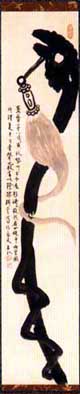
Hakuin's Dragon Staff Inka Scroll


Zen Master Hakuin (1686-1768) painted a Dragon Staff with a horsehair whisk attached.  He gave the above painting to a lay student who passed the Zen koan, "What is the sound of one hand clapping."