Showing posts with label Tai Chi Cane. Show all posts
Saturday, June 07, 2025
Tai Chi Ruler
The Tai Chi Ruler is a wooden stick about 12 inches long used in Qigong exercises. There is some theory involved which is related to Hand Reflexology and hand acupressure and massage. The Taiji Ruler exercises also involve gentle movements, stretching, and breathing coordination.
You can check my research on the subject of the Tai Chi Ruler.
Labels:
Cane,
Chi Kung,
Exercise,
Mind-Body,
Moving Meditation,
Qigong,
Ruler,
Stick,
T'ai Chi Ruler,
Tai Chi Cane
Wednesday, November 29, 2017
Eight Immortals Cane Form
Tai Chi Chuan Cane/Stick/Staff/Zhang Weapons
Bibliography, Links, Styles, Instruction, Notes, Media, Resources, Lore
A hypertext notebook (374 KB) by Michael P. Garofalo, M.S., 11/24/2017


Bibliography, Links, Styles, Instruction, Notes, Media, Resources, Lore
A hypertext notebook (374 KB) by Michael P. Garofalo, M.S., 11/24/2017
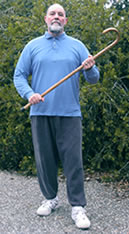
Mike Garofalo in Red Bluff, California.


Labels:
Cane,
Eight Immortals Cane,
Exercise,
Staff,
Tai Chi Cane,
Taijiquan Cane
Tuesday, November 28, 2017
Taiji Cane - Gene Burnett
Taiji Cane, Tai Chi Chuan Cane/Stick/Staff/Zhang
Bibliography, Links, Styles, Instruction, Notes, Resources
By Mike Garofalo
He combines traditional Chinese principles of health, balance and self-defense with a Western, psychological, Bioenergetic approach in an on-going exploration of the body/mind connection."
Water Study Chi Kung with Gene Burnett
Gene Burnett teaches a two part cane form which can be used in partner practice. He said that Andrew Dale created this interesting and valuable cane form, and it was based on an Aikido short staff form.
I do not know how to do this cane form. I am attracted to the types of strong offensive strikes. You would need to be trained, practiced, calm, gentle, trusting, and follow formal rules for "safe' partner practice of this cane form.
Anyone in Vancouver, Washington, want to learn and practice this cane form? Write me.
Gene Burnett offers many instructional videos on the Taiji Cane on Utube.
Anyone in Vancouver, Washington, want to learn and practice this cane form? Write me.
Gene Burnett offers many instructional videos on the Taiji Cane on Utube.
Labels:
Cane,
Exercises,
Fighting,
Hands,
Partner Exercises,
Staff,
Tai Chi Cane,
Tai Chi Chuan,
Taiji Cane,
Weapons
Wednesday, November 22, 2017
Eight Immortals Cane
Here is a T'ai Chi Ch'uan Cane form that I enjoy practicing and have taught to many of my students:
The Eight Immortals Cane Form. Created by Master Jesse Tsao from San Diego, California. Part I of this cane form is based on the Yang style of T'ai Chi Ch'uan. This form has 36 movements.
Traditional Tai Chi Eight Immortals Cane, Routine One. Demonstrated by Master Jesse Tsao. Instructional DVD, 64 minutes. Produced by Tai Chi Healthways, San Diego, 2008. Routine One is based on the Yang Style of Taijiquan. Master Tsao developed this cane form himself, with grandmaster Zhu Tiancai's support.
Traditional Tai Chi Eight Immortals Cane, Routine Two (Cannon Cane). Demonstrated by Master Jesse Tsao. Instructional DVD, 65 minutes. Produced by Tai Chi Healthways, San Diego, 2008. Routine Two, Cannon Cane, is based on the Chen Style of Taijiquan. Master Tsao developed this cane form himself, with grandmaster Zhu Tiancai's support.
The Eight Immortals Cane Form. Created by Master Jesse Tsao from San Diego, California. Part I of this cane form is based on the Yang style of T'ai Chi Ch'uan. This form has 36 movements.
Traditional Tai Chi Eight Immortals Cane, Routine One. Demonstrated by Master Jesse Tsao. Instructional DVD, 64 minutes. Produced by Tai Chi Healthways, San Diego, 2008. Routine One is based on the Yang Style of Taijiquan. Master Tsao developed this cane form himself, with grandmaster Zhu Tiancai's support.
Traditional Tai Chi Eight Immortals Cane, Routine Two (Cannon Cane). Demonstrated by Master Jesse Tsao. Instructional DVD, 65 minutes. Produced by Tai Chi Healthways, San Diego, 2008. Routine Two, Cannon Cane, is based on the Chen Style of Taijiquan. Master Tsao developed this cane form himself, with grandmaster Zhu Tiancai's support.
Way of the Short
Staff. By Michael P. Garofalo, M.S. A comprehensive guide to the
practice of the short staff, cane, jo, walking stick, gun, zhang,
whip staff, 13 Hands Staff, and related wood short staff weapons. A
detailed and annotated guide, bibliography, lists of links, resources,
instructional media, online videos, and lessons.
Includes use of the short staff and cane in martial arts, self-defense, walking
and hiking. Separate sections on Aikido Jo, Cane, Taijiquan cane and
staff, Jodo, exercises with a short staff, selected quotations, techniques,
selecting and purchasing a short staff, tips and suggestions, and a long section
on the lore, legends, and magick of the short staff. Includes "Shifu
Miao Zhang Points the Way." Published by Green Way Research,
Valley Spirit Taijiquan,
Red Bluff, California. Updated on a regular basis since October, 2008. Related to Mike's popular webpage on the
Staff.
Toju Zenchu brandished his staff before Daoist Shifu Miao Zhang
and challenged him "Miao Zhang, speak and you get
whacked with Nanten's
staff.
Do not speak and you still get whacked with Nanten's staff."
Shifu Zhang stood up quickly, lifted his cane strongly in defense, and quietly said, "Yunmen's shit stick stinks and Nanten's staff is cracked! I am leaving now to take my evening walk. Goodbye."
Taijiquan Cane Weapon Research, Bibliography, and Practices
Way of the Short Staff
Long Staff Weapons Practices
Dr. Andy Fitz-Gibbon teaches Taijiquan and maintains a blog for the Way of Peace Taijiquan Association. He is also the Abbot for the Lindisfarne Community in Ithaca, New York. He is shown performing the Eight Immortals Cane form in the UTube video below.
Shifu Zhang stood up quickly, lifted his cane strongly in defense, and quietly said, "Yunmen's shit stick stinks and Nanten's staff is cracked! I am leaving now to take my evening walk. Goodbye."
Taijiquan Cane Weapon Research, Bibliography, and Practices
Way of the Short Staff
Long Staff Weapons Practices
Dr. Andy Fitz-Gibbon teaches Taijiquan and maintains a blog for the Way of Peace Taijiquan Association. He is also the Abbot for the Lindisfarne Community in Ithaca, New York. He is shown performing the Eight Immortals Cane form in the UTube video below.
Labels:
Cane,
Eight Immortals Cane,
Exercise,
Staff,
Tai Chi,
Tai Chi Cane,
Yang Taijiquan
Monday, November 20, 2017
Tai Chi Chuan Cane
Taiji cane forms are typically
performed
slowly and deliberately. Hard and powerful strikes are seldom used in
T'ai
Chi Ch'uan walking stick forms.
The pace of the Taijiquan cane forms are seldom fast and vigorous.
There are few if any
vigorous leaps and jumps. Taiji forms seldom use very low stances.
Taiji cane forms are particularly suitable for fit persons over 50 years
of age. Good examples of a Taiji Cane Form are: the Standard Beijing
24 Form
with Cane created by Master Wen-Ching Wu;
the Eight Immortals Cane Form, Part I, created by
Master Jesse Tsao; the
Plum Blossom Taiji Cane Form; the
Tai Chi Stick 18 Form; the
Bodhi Dharma Walking Stick Form;
Master Michael Gilman's Three Powers Cane
Form; the Wu Tang Cane Form of
Master T.T. Liang; the Standard 32 Sword
Form; etc.
There are also many examples of more
vigorous "Taiji" cane forms, with hard strikes, leaps, fast moves, spins, and
low moves. Taijiquan saber or broadsword forms are readily adapted for use
with a cane, and some are fast and vigorous. Normally, Taijiquan sword
forms are not very well adapted as cane forms, but I practice the
Standard 32 Sword Form with my cane as do
many others. Karate, kung fu, Shaolin,
Bagua and HsingI cane or stick forms are often fast, vigorous, powerful,
twisting, agile, and with some very low stances. Of course, when first learning any new cane form,
begin with a slower, more deliberate, less vigorous practice to help the body
adapt to the moves of the new form. Thus, even a fast and vigorous cane
form from any style can be done more in the "Taiji" fashion outlined and shown
above.
Many
Qigong (Chi Kung) forms
can also we done while holding a cane. Adaptations are quite easily
arranged. Most often, however, Qigong forms are adapted or created for use
with a short 6"-12" wooden stick called a Tai Chi Ruler
or Bang.
I consider a cane or walking stick to be,
normally, a straight strong wooden stick with a curved (hook) handle that is from 30"
(76 cm) to 42" (107 cm)
long. The cane will typically extend from the floor to the height of your
hip socket and maybe up to your belly button. The cane might also be made out of plastic, aluminum, steel, or
rattan. The cane might have a straight rather than curved or hooked end with a
round ball shaped (pommel) end or some sort of straight or carved handle at the end. The cane might be
very simple, natural and plain; or be carved, painted or decorated.
Each day I use an
Instructor's Walking Cane, 40" (103 cm) long and 1" (2.54 cm) in
diameter, purchased from
Cane Masters.
This cane weights 1lb, 2 oz (510 gm). This beautiful martial arts combat cane is made of pure hickory heartwood, has
multiple notches at three key gripping points, has a ample rounded hooked horn, and has a rubber
covered tip inserted over the tip end. I also own the same
Instructor's Walking Cane made of oak
- a gift from my children. I am 6'6" (198 cm) tall, and a 40" cane (103
cm) is perfect for using on my long walks and for my Taiji cane practices.
The only weapon I practice with on a daily basis is a wooden cane; and the only weapon I
teach now in my Taijiquan classes is
the cane. Also, whenever I take a
walk, anywhere, I bring my cane along
for support, exercising the arms, and for self-defense.
Taijiquan Cane Weapon Research, Bibliography, and Practices
Way of the Short Staff
Long Staff Weapons Practices
Labels:
Cane,
Exercise,
Staff,
Stick,
Tai Chi Cane,
Taijiquan,
Walking Stick
Tuesday, March 21, 2017
Taijiquan Cane Practices
Walking and exercising with a cane has many health benefits. Tai Chi Chuan practices with a cane are an interesting addition to a walker's pleasures and fitness.

When I take long walks (3.6 + miles), I walk six times, east then west, .6 mile per whole lap. I stop between laps to practice Taijiquan (24, 37, 108 Yang; 18 Chen), and the 8 Immortals Cane Form, Part 1. The only martial arts weapon that I practice with is a cane. I practice all the Taijiquan sword and broadsword forms that I know with a cane.
Every time I take a long walk or hike I carry my cane with me. A cane provides support to a walker (like a staff or trekking pole sticks), and a cane can be used effectively for self-defense. Using various cane strikes and stretches while walking is an excellent way to exercise the upper torso. I practice the 8 Immortals Cane Form, Part 1.
I use an Instructor's Walking Cane, 40" (103 cm) long and 1" (2.54 cm) in diameter, from Cane Masters. This cane weights 1lb, 2 oz (510 gm). This beautiful martial arts combat cane is made of pure hickory heartwood, has multiple notches at three key gripping points, has a rounded hooked horn, and has a rubber covered tip. I also own the same Instructor's Walking Cane made of oak - a gift from my children.
Way of the Short Staff. By Michael P. Garofalo, M.S. A comprehensive guide to the practice of the short staff, cane, jo, walking stick, gun, zhang, whip staff, 13 Hands Staff, and related wood short staff weapons. A detailed and annotated guide, bibliographies, lists of links, resources, instructional media, online videos, and lessons. Includes use of the short staff and cane in martial arts, self-defense, walking and hiking. Separate sections on Aikido Jo, Cane, Taijiquan cane and staff, Jodo, exercises with a short staff, selected quotations, techniques, selecting and purchasing a short staff, tips and suggestions, and a long section on the lore, legends, and magick of the short staff. Includes "Shifu Miao Zhang Points the Way." Published by Green Way Research, Valley Spirit Taijiquan, Red Bluff, California. Updated on a regular basis since October, 2008. Filesize: 265Kb. Related to Mike's popular webpage on the Staff.
"The correct use of the bo (sai, tonfa, kama, naginata, sword) can produce a stimulating and practical means of "extension" training. It offers a means of martial arts training and discipline. Weapons training teaches the meaning of control, timing, distance, and flexibility as one unit. The practitioner is required to possess speed, coordination, strength, and endurance in utilizing the respective weapons."
- History of the Bo Staff
"The jo can be used to strike like a sword, sweep like a naginata, thrust like a spear (yari). Its two ends can be used, unlike the single point of a sword, and its ma-ai (fighting distance) can be varied according to the hand grip you take. Because of its speed and changeable ma-ai, it is a formidable weapon."
- Muso Shindo-Ryu Jodo
"In Chinese shamanism, a staff represents the power of the universe. With a staff, a shaman had the power to pass on the universal knowledge to others. Later, when teachers took over part of the shaman's job, they always taught with a small staff in their hands like a shaman."
- Master Zhongxian Wu, Vital Breath of the Dao, p. 106
Monday, October 24, 2016
Using a Cane
Every time I take a long walk or hike I carry my cane with me. A cane provides support to a walker (like a staff or trekking pole sticks), and a cane can be used effectively for self-defense. Using various cane strikes and stretches while walking is an excellent way to exercise the upper torso.
I practice the 8 Immortals Cane Form, Part 1. The only martial arts weapon that I practice with is a cane.
I use an Instructor's Walking Cane, 40" (103 cm) long and 1" (2.54 cm) in diameter, from Cane Masters. This cane weights 1lb, 2 oz (510 gm). This beautiful martial arts combat cane is made of pure hickory heartwood, has multiple notches at three key gripping points, has a rounded hooked horn, and has a rubber covered tip. I also own the same Instructor's Walking Cane made of oak - a gift from my children.
Way of the Short Staff. By Michael P. Garofalo, M.S. A comprehensive guide to the practice of the short staff, cane, jo, walking stick, gun, zhang, whip staff, 13 Hands Staff, and related wood short staff weapons. A detailed and annotated guide, bibliographies, lists of links, resources, instructional media, online videos, and lessons. Includes use of the short staff and cane in martial arts, self-defense, walking and hiking. Separate sections on Aikido Jo, Cane, Taijiquan cane and staff, Jodo, exercises with a short staff, selected quotations, techniques, selecting and purchasing a short staff, tips and suggestions, and a long section on the lore, legends, and magick of the short staff. Includes "Shifu Miao Zhang Points the Way." Published by Green Way Research, Valley Spirit Taijiquan, Red Bluff, California. Related to Mike's popular webpage on the Staff.
"The correct use of the bo (sai, tonfa, kama, naginata, sword) can produce a stimulating and practical means of "extension" training. It offers a means of martial arts training and discipline. Weapons training teaches the meaning of control, timing, distance, and flexibility as one unit. The practitioner is required to possess speed, coordination, strength, and endurance in utilizing the respective weapons."
- History of the Bo Staff
"The jo can be used to strike like a sword, sweep like a naginata, thrust like a spear (yari). Its two ends can be used, unlike the single point of a sword, and its ma-ai (fighting distance) can be varied according to the hand grip you take. Because of its speed and changeable ma-ai, it is a formidable weapon."
- Muso Shindo-Ryu Jodo
"In Chinese shamanism, a staff represents the power of the universe. With a staff, a shaman had the power to pass on the universal knowledge to others. Later, when teachers took over part of the shaman's job, they always taught with a small staff in their hands like a shaman."
- Master Zhongxian Wu, Vital Breath of the Dao, p. 106
Labels:
Cane,
Exercise,
Tai Chi Cane,
Tai Chi Chuan,
Taijiquan,
Weapons
Subscribe to:
Posts (Atom)