Showing posts with label Rituals. Show all posts

Monday, September 09, 2024

Autumn Equinox Celebration Preparations: Mabon

Repost from 2008:

We Druid/Taoists prepare for the upcoming Autumnal Equinox celebration, also called Mabon, Autumn Moon Festival, Alban Elfed, Harvest Home Festival, Apple Feast, etc.

“Mabon, or Autumn Equinox, is named for the Welsh God of the Harvest, Mabon ap Modron (“divine son of the divine mother).  As told in the Mabinogion, Mabon was stolen from his mother three nights after his birth, and swelt in Annwfn (the Underworld) until he was rescued by Culhwch.  Because of his time in the Underworld, Mabon stayed a young man forever, and was equated with the Roman Apollo.  He is the Green Man whose blood is an intoxicating beverage; Dionysos (wine), Osiris (beer), and John Barleycorn (whiskey).  The bay tree is sacred to Mabon as its magickal action is preservation, a time-honored harvest occupation.  Also known as the Harvest Home, Kirn Feast, Mell Day, Ingathering, and Harvest’s Height, this festival commemorates the ritual sacrifice of the God and his descent into the Underworld, and the brewer’s art that produces the sacrament of this season.  In California Wine Country, where we live, it is the festival of the Grape Harvest.  Whiskey, the spirit of the barley, is also readily consumed during this festival.”
-  Oberon and Morning Glory Zell-Ravencraft, Creating Circles and Ceremonies, p. 227

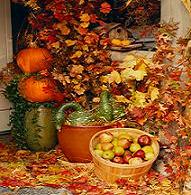
“Your altar is a great place for fruits, such as squash and apples set in an old wooden bowl.  You will also want to add pomegranate, in association with Peresphone.  Decorate your altar with orange, brown and yellow altar cloths and candles.  Arrange colorful autumn leaves and small gourds, nuts, dried corn, seed, acorns, pine cones, etc.  You also might want to add a bowl of water, since autumn is associated with water, emotion, and relationships.”
-  Oberon and Morning Glory Zell-Ravencraft, Creating Circles and Ceremonies, p. 228


Ask yourself these questions in the month of September:
What is your personal harvest from self-improvement resolutions planted last spring?
In what specific and creative ways can you honor the productivity of Mother Earth? 
What is something new that you produced in the last six months?
How can you best celebrate your productive efforts during the year?
How have others helped you to be more creative?
How can you best celebrate the autumnal equinox holiday? 


September: Poems and Quotes

Autumn Equinox, Mabon, Harvest Festival, NeoPagan High Day


The Moon Festival, Zhong Qiu Jie, a very popular Chinese autumn festival, occurs when the moon is full in September. 


"Equal dark, equal light
Flow in Circle, deep insight
Blessed Be, Blessed Be
The transformation of energy!
So it flows, out it goes
Three-fold back it shall be
Blessed Be, Blessed Be
The transformation of energy!"
-   Night An'Fey, Transformation of Energy


"The last of Summer is Delight --
Deterred by Retrospect.
'Tis Ecstasy's revealed Review --
Enchantment's Syndicate.

To meet it -- nameless as it is --
Without celestial Mail --
Audacious as without a Knock
To walk within the Veil."
-   Emily Dickinson, The Last of Summer is Delight 
  
September: Quotes, Poems, Lore


"Great Goddess, Mistress of cats,
Lady of love, beautiful Vana-Goddess,
Fulfill my greatest needs, O glorious one.
Teach me the magic I need.
Give me a glimpse of your deep wisdom.
Teach me in dreams. Enrich my life.
O Lady, you are Golden-Tears of Asgard
Lady of love, beautiful Vana-Goddess,
You are the Shape-shifter, the Sayer,
The Independent One.
Give me the strength and the magic I need."
Prayers to Freyja   


General Preparations for Mabon 

We gather dry corn stalks and make background arrangements and corn dollys; collect, dry and display all kinds of gourds and squash; we cut long grape vines and tie into circular forms for wheel symbols; we cut fire wood for a outdoor pre-dawn campfire in our sacred circle garden; we do reading in literature relevant to the Mabon seasonal theme; we make special meals with the vegetables and fruits of the season; we make moon cakes with rice.  We tend to do pre-dawn fireplace celebrations in the summer because it is too hot in the evening. 
 

Wednesday, February 22, 2023

Ashes to Ashes

Palm Sunday--
heroes smiling,
people cheering

Mardi Gras and 
Shrove Tuesday's
debaucheries--
reasons for repenting.

Cleaning out
the fireplace--
Ash Wednesday

Ashes to ashes--
yet departed Guides
live on

Forty days
of austerities--
questioning demons

Buds emerging 
on leafless branches--
metaphors of
Rising from the Dead.

Devastating EARTHQUAKES--
Nature
does not care.  


Ash Wednesday

Origins of Ash Wednesday


Ash Wednesday

By T. S. Eliot, 1930


"The silent sister veiled in white and blue
Between the yews, behind the garden god,
Whose flute is breathless, bent her head and signed but spoke
no word

But the fountain sprang up and the bird sang down
Redeem the time, redeem the dream
The token of the word unheard, unspoken

Till the wind shake a thousand whispers from the yew

And after this our exile


V
If the lost word is lost, if the spent word is spent
If the unheard, unspoken
Word is unspoken, unheard;
Still is the unspoken word, the Word unheard,
The Word without a word, the Word within
The world and for the world;
And the light shone in darkness and
Against the Word the unstilled world still whirled
About the centre of the silent Word.

O my people, what have I done unto thee.

Where shall the word be found, where will the word
Resound? Not here, there is not enough silence
Not on the sea or on the islands, not
On the mainland, in the desert or the rain land,
For those who walk in darkness
Both in the day time and in the night time
The right time and the right place are not here
No place of grace for those who avoid the face
No time to rejoice for those who walk among noise and deny
the voice"  

Friday, September 23, 2022

Autumn Equinox Celebration

Repost from 9/23/2011!

The Autumn Equinox occurs today, Friday, September 23, at 2:05 am (PDT).  Today is the first day of the Fall season.  In Red Bluff, California we are expecting a low today of 63F and a high of 102F.  

Today is one of the Eight High Days for celebration or feasting by Neopagans around the world, and the day is variously named: Welsh Mabon, Late Summer Harvest Feast, Autumnal Equinox, Alban Elfed, Harvest Home, Second Harvest Festival, Cornucopia, Feast of Avalon, Festival of Dionysus, Harvest Tide, Witch's Thanksgiving, Night of the Hunter, Apple Festival, High Mysteries of Demeter and Persephone, September 21st - 23rd, September Celebrations, NeoPagan Thanksgiving, Winter Finding (Teutonic), Equinozio di Autunno (Strega), Wine Festival, Winter Nights, Zhong Qiu Jie (Moon Festival).  Check out my webpage on the subject of Mabon.  

Autumn Equinox: The Enchantment of Mabon.   By Ellen Dugan.  Woodbury, Minnesota, Llewellyn Pubs., 2005.  Bibliography, index, 208 pages.  ISBN: 0738706248.  VSCL.  A very informative book on the subject.  


This morning, at 5:30 am, I lit a fire our Sacred Circle Garden.  I sipped Irish coffee (a tip of the hat to John Barleycorn's gift to us).  I meditated.  I opened the Circle and called the Quarters, made some offerings, and called on spirits for healing support.  The element of Water, Autumn, aging, intuition, Demeter, waning of the year, the Crone, feelings and emotions were the themes.  After sunrise, I read Druid and Taoist books and scriptures, and made some notes.  I did my daily Tarot reading.  I enjoyed playing Taijiquan and Qigong.  I listened to an MP3 recording from the Order of Bards, Ovates, and Druids during the day.  

I am a NeoPagan and borrow from modern Druid and ancient Taoist practices, legends and ideas to acknowledge and celebrate our many gifts from the Tao, Mother Earth, the Goddesses/Gods, our Ancestors, and the Nature Spirits.  I am mostly a solitary Druid/Taoist.  My temple is my home garden.  I have ample reasons for gratitude, respect, reverence, awe, and inspiration.  What I believe has more to do with mysticism, creativity, vitality, and beauty than any fixed set of religious doctrines or dogmas. 


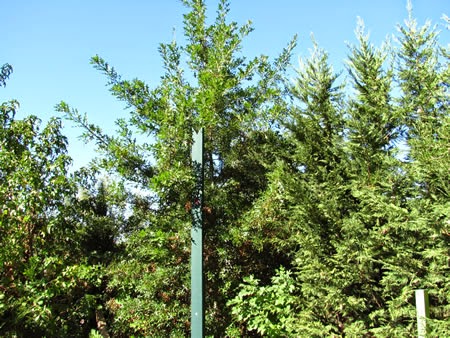
Our Gushen Grove Sacred Circle Garden is used for outdoor fireplace activities, relaxing during the cooler hours of the day, and for meditation and rituals.  The blue pole, set in the west side of the garden, was the place for a Mabon altar.  The blue ceramic pot in front of the blue pole is filled to the brim with water.


Thursday, April 15, 2021

Pan and the Green Man


"There lies within
A hidden glen
An altar made of stone.
Creeping vine
And moss entwine
To hide this ancient throne.
Tangled thorn
Grows thick to scorn
Those who seek to enter.
For though they strive
No man alive
Shall ever reach its center.
Known as Pan,
To some Green Man,
This glen is his sacred place.
He dons his hood
Of wildwood
To hide his leafy face.
The roving clans
That raped the lands,
Cut down his beloved trees.
And so, alas
As time did pass
The Green God fell to his knees. ..."

- Kristina Peters Moone, The Green Man


"The force that through the green fuse drives the flower
Drives my green age; that blasts the roots of trees
Is my destroyer.
And I am dumb to tell the crooked rose
My youth is bent by the same wintry fever.

The force that drives the water through the rocks
Drives my red blood; that dries the mouthing streams
Turns mine to wax.
And I am dumb to mouth unto my veins
How at the mountain spring the same mouth sucks."

-   Dylan Thomas, The Force That Through the Green Fuse Drives the Flower


Lore, Legends, Tales, Celebrations, Springtime Symbols, Folk Stories and Plays
From the hypertext research notebooks of Mike Garofalo


This cabbage, these carrots, these potatoes,
these onions ... will soon become me.
Such a tasty fact!
- Mike Garofalo, Cuttings


Portrait of the Emperor Rudolph II as Autumn.By Arcimboldo, 1591, Held at the Museo Civico, Brescia. 


Thursday, June 01, 2017

Chi Kung: On Smiling and Doubting

In nearly all of the photographs of persons doing standing meditation their faces are impassive, close mouthed, neutral, glum, even mean looking.  Do you ever see any pictures of persons doing Zhan Zhuang with a nice smile on their face?  Don't the majority look rather stern, stiff, and aloof?  Is the coolness, toughness, frowning, and closed eyes of these faux standing posts a defiant reaction to the many other people who look at them and smile or laugh at them?  Is the gruff expression a bodily mudra to affirm the Buddhist claim about the inherent unhappiness and suffering of human existence?  Is the Yiquan toughness required to endure this demanding standing physical exercise the source of this hard, 'don't mess with me' facial expression?  C'mon Man!  Why all the serious, sad, and stern looks? 

Also, most persons doing hours and hours of seated zazen mostly look, to me, just tired, frustrated, aching, and pissed off about their inner insights. 

I don't resist smiling or having pleasant and easy going look on my face when I do seated or standing meditation.  I've read about smiling meditation, laughing yoga, smiling heart qigong, and Inner Smile Taoist Neidan.  Seek and embrace more options than glum, neutral, stern postures and attitudes.  More Yin, Less Yang!!

Hours and hours of these standing or seated "meditation" practices are often just boring, dull, uneventful, uninspiring, and non-productive for me.  Twenty minutes a couple of times a week are more than ample.  I lay odds that if you try to do standing meditation for an hour a day you will end up frowning, stiff, tired, grumpy, and ready to quit.  It would be far better to take a walk each day and enjoy yourself.

I enjoy doing Chi Kung (Qigong), Taijiquan and Yoga movements because they are fun and provide fitness exercise variety.  Their gentle stretching benefits have be objectively verified. Their benefits can also be explained scientifically.  

On the other hand, when the qigong or yoga teachers drone on about invisible organs and esoteric anatomy, contradict one another, discourage questioning, are vague and confusing, share only anecdotal reports of benefits, overuse flaccid metaphors, worship specific lineage traditions and bad mouth competing styles, don't explain much or seldom talk, or are too secretive ...  then I just loose my interest and move on.  I recommend learning early on about how to smell out that kind of bull crap qigong or bull crap yoga.  

I would question the claims that long sessions of standing post will make your legs stronger, build up your Qi, or give you super powers (siddhis) of some kind.  I would argue confidently for more benefits to your legs and overall fitness from walking, jogging, squats, weight lifting, stretching, form practice, sports, and other leg intensive exercises.  I often call Tai Chi "Thigh Chi."  

Since there is no known way of quantifying and measuring Qi, how do you know you have built up, increased, or amplified your Qi??  Increase in leg strength in squats is easy to quantify and measure, as are positive blood pressure and other physiological changes.  

And, as for those super powers (siddhis), they are the unreal stuff of our playful imaginations, fantasies, reading too many Wuxia novels and comic books, and watching amazing motion picture special effects. 

I don't deny that a few, rare, and unique persons have unusual and powerful inner martial arts skills.  Likewise, a few yogis are superior contortionists and gymnasts that can do extreme postures, or lower their heartbeat.  But, so what!   So you can defeat everyone you meet in push hands, so you can stand on one leg for two hours, so you can walk/run 70 miles in a day .... fine, and some of us will be amazed.  However, most reasonable people don't aspire to Olympic standards of performance, and don't need to endure the strict training regimes of the extremely rare Amazing Masters and Siddhi Adepts.  Further, I do not have much of a pressing need to fly up walls, defeat 40 swordsmen like the blind Zatoichi, repulse ten men with a single magical push, kill a man with the touch of a finger, disappear through walls (doors work quite well), read your mind (probably as hohum as mine), or live to 300 years of age and have to dutifully work at seven careers.  Since I am a poor swimmer, I might have an occasional need to walk on water, but I might die before completing the required discipline of forty days and nights in the desert alone fasting, doing yoga and chanting - so that particular unpleasant task and marginal benefit are now off of my bucket list. Playing drums, dancing, and chanting for three hours before walking on burning hot coals might appeal to some, but I will pass on that experience also.  

Some people claim profound inner experiences, mystical insights, revelations, epiphanies, ecstasy, personal gnosis, satori, kensho, illumination, or enlightenment as a result of enduring these strict bodily disciplines.  Even the Buddha tried these physical austerities for many years until he "realized" that enough is enough and that moderation is a better course.  I hear LSD takers and steady alcohol drinkers and marihuana pot heads claim the same "benefits" of consciousness expansion.  Personally, I'd rather water my garden each day, do some Taijiquan, take walks, play, and read good books; and not be a drug user or face a cave wall in stiff seated meditation for seven years like the Bodhidharma.  Some say they practiced for many years, even decades, to gain a "glimpse" of some degree of profound, unified, or universal consciousness.  Seems to me like a very big investment of time and effort for very little return.  Sharpening your critical thinking and reasoning skills, and obtaining more scientific knowledge, would reap more "insight" rewards and much faster.

Some people take up these hard physical practices because their guru, preacher, master, roshi, sifu, or other authority or leader tells them or orders them to do so.  Students are taught to trust, obey, submit, respect, and kow-tow to the guru.  I say, keep your independence!!  Sensibly respect and learn from worthy teachers, but don't be slavish.  Some degree of healthy skepticism is valuable.  Practice on your own rather than humble yourself before some faker, phony, braggart, secretive or expensive master.  Discover what works for you to earn better fitness and well being rather than dumbly following an unbending formulaic physical regimen lineage invented by some illiterate old man 400 years ago.  Not obeying a goofy or exploitative guru is quite sensible.  Some rich gurus, preachers and masters are often merely just trying to tap the soul of your wallet.  Beware of quacks, and keep thinking clearly.

Long periods of standing, fasting, sitting, and self-humiliation may be required as a kind of initiation or hazing ritual before the neophyte applicant is allowed into the practice group.  These disciplinary practices are to test the mettle, seriousness, intent and grit of the applicant.  Stories abound about monks being struck with a stick, insulted and rebuffed and made to wait standing outside in the cold for weeks until the "master" allowed them into the temple or training center.  College fraternities have bizarre hazing rituals, and occasionally young applicants have died in the process.  Criminal gangs may beat up new members or make that potential gang member beat up, rape, or kill some enemy or random person before they are admitted to the gang.  ISIS recruits probably have to blow up some antiquity or decapitate a retired museum director to get into the inner circle of that cabal of True Believers.  Military recruits must endure Boot Camp to prove they have guts, are obedient, and have a killer attitude.   Sports have their "hell week" of double practices to test the toughness of new players. Likewise, new Tai Chi players may be made to stand like a post for long periods of time, maybe for weeks, before the exalted Taiji Wizard will teach them anything.  You have to prove to the regular members of the group that you are trustworthy, obedient, loyal, submissive, and can endure discipline.  In some cases it makes sense and the initiation is worth the effort; but, in many cases the hazing and self-humiliation are unnecessary and just humbug. 

Yes, I do exaggerate here to try to make a few points.  I do greatly enjoy and benefit from TaijiquanYoga, and Qigong.  But, in addition, being a doubter and skeptic and smiler all do have their own benefits. 


I might not push hands with this guy.
He probably could have flung my disrespectful and sassy rear end ten feet away.
Maybe not!  I'm pretty tough, big, and strong myself - but with a smile.


Another sad looking group doing serious
standing meditation to find inner peace.


The 'enlightened' and sour puss Bodhidharma.
He might cut off your finger if you question him improperly.


An "unenlightened" and smiling old Taijiquan player.
Me!

Sunday, April 10, 2016

Sacred Circle Gardens

I've put together a webpage on the subject of Sacred Circles.

This webpage provides links, bibliographic citations, resources, quotations, notes, and comments on medicine wheels, henges, labyrinths, neopagan sacred circles, holy circles, the symbolism and myths about circles and spheres, sacred circle gardens, the four elements, and related topics.

This webpage includes information and photographs of our sacred circle garden at our home in Red Bluff, California.

Those folks who walk the circle in labyrinthswalking meditation or baguazhang might find some of the information in sacred circles to be of interest to them.

Here are a few pictures from our sacred circle garden.  They were all taken a few years ago.  Everything is the same today, except all the trees and shrubs are larger.  


Monday, August 18, 2014

Sacred Circle Gardens

I've put together a webpage on the subject of Sacred Circles.

This webpage provides links, bibliographic citations, resources, quotations, notes, and comments on medicine wheels, henges, labyrinths, neopagan sacred circles, holy circles, the symbolism and myths about circles and spheres, sacred circle gardens, the four elements, and related topics.

This webpage includes information and photographs of our sacred circle garden at our home in Red Bluff, California.

Those folks who walk the circle in labyrinths, walking meditation or baguazhang might find some of the information in sacred circles to be of interest to them.

Here are a few pictures from our sacred circle garden.  They were all taken a few years ago.


Sunday, February 24, 2013

Sacred Circle Garden

The four-quartered Circle of Magick is a central element in most Western magickal rituals. It is called the "portal between the worlds," a means of connecting with the Deities, Spirits, and Elemental Powers of a realm beyond the material universe. It is envisioned as a vortex with which we focus on our own innate psychic powers, called forth by ritual actions from the subliminal depths of the mind and soul. It is a "sacred space," a sanctuary for communion with the old ones, the deities of our faith.
Many levels of symbolism are intrinsic to the Magick Circle. Among these metaphors are metaphysical and mystical concepts that describe the greater reality within which our lives are experienced. The four "corners" of the Circle of Magick correspond with the compass directions and their associated Elements (Earth, Air, Fire or Water). A fifth Element, Spirit, is often associated with the center of the Circle or with the Circle as a whole."
- Bran the Blessed, Circle Symbolism

Valley Spirit Sacred Circle

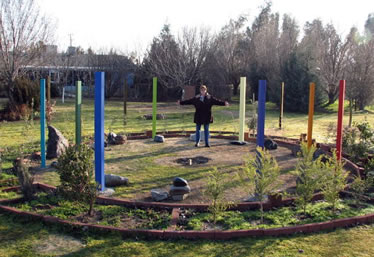
Karen stands near in the center of the Valley Spirit Sacred Circle. Behind Karen is the yellow post which marks the Eastern direction, and the Element of Air, Mind, Consciousness, or Intellect; and the Eastern Quadrant is planted with five olive trees, the sacred plant of Athena, the Goddess of Wisdom. Further behind Karen, 26 feet from the center, are some of the seventeen posts marking the boundary of the outer fifth circle. This photo was taken on February 4, 2007.

Sacred Circles
Bibliography, Resources, Links, Quotations, Notes
Researched by Mike Garofalo


One Old Druid's Final Journey

Sunday, July 29, 2012

The Month of August


Months and Seasons
Quotes, Poems, Sayings, Verses, Lore, Myths, Holidays
Celebrations, Folklore, Reading, Links, Quotations
Information, Weather, Gardening Chores
Compiled by Mike Garofalo


Lughnasadh, Lammas, Midsummer Feast, August 1st   

August: Quotes, Poems, Lore, Garden Chores


We have been busy with gardening and watering plants during the hottest days of the year in Red Bluff.  Evenings are for watching the Olympic Games in London on DishTV.  

We just got back from a vacation trip to the Olympic National Park in Washington.  


Sunday, January 22, 2012

Taoism and Circle Walking

"Tung Hai-Chuan (1813-1882) became a member of the Chuan Chen (Complete Truth) sect of Taoism. This sect was part of the Lung Men (Dragon Gate) school of Taoism which was originated by Chou Chang-Ch'uan. Interestingly enough, Chou also invented a method of meditation whereby the practitioner would walk in a circle and, wouldn't you know, this method was practiced by the Chuan Chen sect. Delving further into this Taoist connection, Professor K'ang Kuo Wu was able to find a section in the Taoist Canon which reads:

'A person's heart and mind are in chaos.

Concentration on one thing makes the mind pure.
If one aspires to reach the Tao, one should practice walking in a circle.'

This bit of evidence inspired Professor K'ang Kuo Wu of Beijing to try and find out more about the circle walk meditation method practiced by the Chuan Chen Taoists. What he discovered was that this practice, which the Taoists called Chuan T'ien Tsun (Rotating in Worship of Heaven) is very similar in principle to the circle walk practice of Pa Kua Chang.


Researching Wang Chun-Pao's book, 'Taoist Method of Walking the Circle,' Professor K'ang found that while walking, the Taoists repeated one of two mantras. The first of these mantras was used in the morning practice and translates to mean 'When Rotating in Worship of Heaven, the sound of thunder is everywhere and transforms everything.' The second mantra was used in the evening practice and translates to mean 'When Rotating in Worship of Heaven, the great void saves us from the hardship of existence.' It was said that the practitioner should repeat the mantra with each movement in the circle walk practice so that 'one replaces one's myriad thoughts with a single thought in order to calm and ease one's mind.' The Taoists said that in walking the circle the body's movements should be unified and the practitioner strives for stillness in motion. This practice was described as a method of training the body while harnessing the spirit."

- Jiang Hao-Quan Chinese Martial Arts Institute


"The solo aspect of its circular solo practice is beautiful, yet exotic, full of graceful twisting movement, sudden stops and changes of direction, swooping and lifting actions as well as explosive hand movements. The functional aspect is harshly effective, without sporting elements as its martial effectiveness was refined by the many practitioners at the turn of the century who earned their living as personal bodyguards and merchant convoy escorts.  Like the other internal arts, pa-kua emphasizes balance, natural breathing and relaxation, stability of stance, the development of twisting strength and internal power both for healing and martial purposes as well as the use of the mind to create intent and lead chi flow.  Most defensive and offensive movements are done with the open hand; the horizontal energy of the twisting torso is emphasized; the weight of the body stays on the back foot when walking in a circle (though not necessarily when doing postures within each "change"; the steps are rather tight, the knees staying in close proximity one-to-the-other; and, kicks are normally aimed low, to the ankles, shins and knees.  The essence of the art is learning to be upright, stable and comfortable in your posture and body mechanics while cultivating the ability to change quickly to deal with the tactics of an opponent. The smaller student learns to evade strikes while counter-attacking and the larger learns to batter his/her way through the attacker's arms as a prelude to counter-attacking."
-  Michael Babin, Studying Pa Kua Chang 


Wednesday, September 21, 2011

Rootless Tree by Chang San Feng

Does anyone know where I might be able to find an English language translation of The Rootless Tree verses in either a book, journal article, online, or in a private collection?  

無根樹  Wugen Shu  The Rootless Tree

The Rootless Tree is an Taoist alchemical text attributed to Taoist Master Zhang San Feng.  The text has 24 verses and was written between 1100-1400 CE.  The content reflects Complete Reality Taoism - a blend of Buddhism and Taoism.  

I did find one translation online:  The Rootless Tree.  Translated by Akrishi.  2009.  The seven webpages include a short introduction, then webpages with facing Chinese characters and an English language translation, and a separate English only translation.     

Please comment to this blog post, or send me an email

Thank you very much for any assistance!! 

Here are the first two verses of Akrishi's translation:

1
Rootless tree, the flower is shattered.
Cling to vanity who will cease? 
Wretched life, sea of sufferings.
Drifting here and there ain’t not free. 
No shore nor end, no berth to park.
All day sail around sharks and fishes. 
If you repent, there is the shore,
Not until the wind and waves break your vessel. 

2
Rootless tree, the flower is withering,
Renew old tree and graft green branch.
Plum on willow, mulberry with pear,
Pass to devotees as an example. 
Ancient method of transplanting immortals,
There is really a cure to aging.
Seek a guru, ask for the recipe
Proceed to practice less too late.