Showing posts with label Epicurean. Show all posts

Monday, May 11, 2026

Walking Amidst Beautiful Things

"Today I have grown taller from walking with the trees."
-  Karle Wilson


"I like to walk about amidst the beautiful things that adorn the world."
-  George Santayana


"I was never less alone than when by myself."
-  Edward Gibbon


"The walking stick serves the purpose of an advertisement that the bearer's hands are employed otherwise that in useful effort, and it therefore has utility as an evidence of leisure."
-  Thorstein Veblen, Theory of the Leisure Class


"... the brisk exercise imparts elasticity to the muscles, fresh and healthy blood circulates through the brain, the mind works well, the eye is clear, the step is firm, and the day's exertion always make the evening's repose thoroughly enjoyable."
-  Dr. David Livingstone


Currently, 2010, I am reading the following two books:

The Birth of Hedonism: The Cyrenaic Philosophers and Pleasure as a Way of Life. By Kurt Lampe. Princeton University Press, 2014. 304 pages. ISBN: 978-0691161136. VSCL.


Happiness: A History By Darrin M. McMahon. New York, Atlantic Monthly Press, Grove Press, 2006. Index, notes, 544 pages. ISBN: 97808022142894. VSCL.
Walking - Quotations, Sayings, Poems, Lore

Solitude - Quotations  

Traveling, Camping and Hiking in Oregon

Pleasure, Satisfaction, Desire - Quotations


I walk four miles along a quiet paved country lane.  The photograph below, taken by Karen in 2010, was on a early Spring day.  In the summer, I walk at first daylight - the Dawn Walk.  

Today, there was a half-moon in the morning sky.      


Sunday, October 05, 2025

Ten Golden Rules

 Ten Golden Rules for Living the Good Life

  
“1. Examine life, engage life with vengeance; always search for new pleasures and new destines to reach with your mind.

 2.  Worry only about the things that are in your control
the things that can be influenced and changed by your actions, not about the things that are beyond your capacity to direct or alter.  

 3.  Treasure Friendship, the reciprocal attachment that fills the need for affiliation. Friendship cannot be acquired in the market place, but must be nurtured and treasured in relations imbued with trust and amity.  

 4.  Experience True Pleasure
Avoid shallow and transient pleasures. Keep your life simple. Seek calming pleasures that contribute to peace of mind. True pleasure is disciplined and restrained.  

 5.  Master Yourself. Resist any external force that might delimit thought and action; stop deceiving yourself, believing only what is personally useful and convenient; complete liberty necessitates a struggle within, a battle to subdue negative psychological and spiritual forces that preclude a healthy existence; self mastery requires ruthless cador.  

 6.  Avoid Excess. Live life in harmony and balance. Avoid excesses. Even good things, pursued or attained without moderation, can become a source of misery and suffering.  

 7.  Be a Responsible Human Being
Approach yourself with honesty and thoroughness; maintain a kind of spiritual hygiene; stop the blame-shifting for your errors and shortcomings.  

 8.  Don’t Be a Prosperous Fool. Prosperity by itself, is not a cure-all against an ill-led life, and may be a source of dangerous foolishness. Money is a necessary but not a sufficient condition for the good life, for happiness and wisdom.  

 9.  Don’t Do Evil to Others. Evildoing is a dangerous habit, a kind of reflex too quickly resorted to and too easily justified that has a lasting and damaging effect upon the quest for the good life. Harming others claims two victims—the receiver of the harm, and the victimizer, the one who does harm.  

 10.  Kindness towards others tends to be rewarded
Kindness to others is a good habit that supports and reinforces the quest for the good life. Helping others bestows a sense of satisfaction that has two beneficiaries—the beneficiary, the receiver of the help, and the benefactor, the one who provides the help.” 


-   By M. A. Soupious and Panos Mourdoukoutas, The Ten Golden Rules: Ancient Wisdom from the Greek Philosophers on Living the Good Life, 2009. 


Friday, June 06, 2025

Epicurean Wisdom

 I think that Professor Catherine Wilson has a through understanding of Epicurean history and philosophy.  She provides many key insights into how to we might reflect on our lives today, using Epicurean ideas and principles.  Her writing is clear, balanced, and uplifting.  

 How to be an Epicurean: The Ancient Art of Living Well.  By Catherine Wilson, Ph.D.  New York, Basic Books, 2019.  293 pages, notes.  An excellent book for the lay reader with an inquiring mind ready to consider Epicurean viewpoints on a variety of modern issues.  VSCL. 

Epicureanism at the Origins of Modernity  By Catherine Wilson.  Oxford University Press, 2008.  320 pages.  ISBN:  978-0199238811.  A study of Epicurean influences on many of the ideas that pervaded seventeenth and eighteenth century metaphysics, epistemology, ethics, and natural and political philosophy.  VSCL. 

Epicureanism: A Very Short Introduction   By Catherine Wilson.  Oxford University Press, 2016.  144 pages.  ISBN: 9780199688326.  VSCL.

I have prepared a hypertext document on Epicureanism that includes a bibliography, quotations, links, references, and notes.  


Sunday, March 23, 2025

Don't Draw Attention to Yourself

"The most well-known Epicurean verse, which epitomizes his philosophy, is "lathe biōsas λάθε βιώσας "(Plutarchus De latenter vivendo 1128c; Flavius Philostratus Vita Apollonii 8.28.12), meaning "live secretly", "get through life without drawing attention to yourself", i. e. live without pursuing glory or wealth or power, but anonymously, enjoying little things like food, the company of friends, etc."

Epicurus, 341-270 BCE

Epicurean Philosophy Online

Epicurean History

How to Live a Good Life: Lifestyle Advice from Wise Persons

Taoism  


Epicureanism   A hypertext notebook by Mike Garofalo.  

From a Letter to William Short by Thomas Jefferson, 1819

"I take the liberty of observing that you are not a true disciple of our master Epicurus, in indulging the indolence to which you say you are yielding. One of his canons, you know, was that "that indulgence which prevents a greater pleasure, or produces a greater pain, is to be avoided." Your love of repose will lead, in its progress, to a suspension of healthy exercise, a relaxation of mind, an indifference to everything around you, and finally to a debility of body, and hebetude of mind, the farthest of all things from the happiness which the well-regulated indulgences of Epicurus ensure; fortitude, you know is one of his four cardinal virtues. That teaches us to meet and surmount difficulties; not to fly from them, like cowards; and to fly, too, in vain, for they will meet and arrest us at every turn of our road. Weigh this matter well; brace yourself up ..."


Syllabus of the doctrines of Epicurus (By Thomas Jefferson)

"Physical.—The Universe eternal.

Its parts, great and small interchangeable.

Matter and Void alone.

Motion inherent in matter which is weighty and declining.

Eternal circulation of the elements of bodies.

Gods, an order of beings next superior to man, enjoying in their sphere, their own felicities;
but not meddling with the concerns of the scale of beings below them.

Moral.—Happiness the aim of life.

Virtue the foundation of happiness.

Utility the test of virtue.


Pleasure active and In-do-lent.

In-do-lence, is the absence of pain, the true felicity.

Active, consists in agreeable motion; it is not happiness, but the means to produce it.

Thus the absence of hunger is an article of felicity; eating the means to obtain it.

The summum bonum is to be not pained in body, nor troubled in mind.

i.e. In-do-lence of body, tranquillity of mind.

To procure tranquillity of mind we must avoid desire and fear, the two principal diseases of the mind.

Man is a free agent.

Virtue consists in 1) Prudence. 2) Temperance. 3) Fortitude. 4) Justice." 


The Spirit of Gardening


Tuesday, February 04, 2025

Subject Index to 813 Stoic Lessons, Discourses, and Letters

Subject Index to 813 Stoic Lessons, Discourses, and Letters

Indexing by Michael P. Garofalo
First Draft, July 23, 2023. Updated Quarterly.  30 Pages.
Green Way Research, Vancouver, Washington


Daily Stoic 366 Lessons Philosophy (STOA)

Epictetus 95 Discourses (EPI)

Fireplace Records 30 Chapters (TFR)

Meditations Marcus Aurelius (AUR)

Philosopher's Garden of Insights (PG)

Seneca 124 Letters (SEN)


Lessons, Letters, and Discourses from Stoics:
https://www.egreenway.com/buddhism/koans.htm


Subject Index to 3.855 Lessons From
Zen Buddhists, Stoics, and Solitary Taoists

Subject Index to 1,685 Zen Buddhist Koans

Subject Index to 813 Stoic Lessons, Discourses, and Letters

Subject Index to 1,546 Taoist Lessons, Chapter, and Stories


Wednesday, November 30, 2022

Pulling Onions Again - Religion


Pulling Onions

By Michael P. Garofalo
Over 1,055 Sayings, One Liners, Adages, Quips, Observations
Obviously, I'm a more philosophical rather than a religions person.  


Life after death is armchair speculation; life before death requires intelligent engagement, practical actions, and the cultivation of virtues. 

To put a bigger hat on an idea─Capitalize its Key Words.

Talk of God's Commandments and Church Doctrines often gets in the way of charity, compassion, fairness, and reason.

Some former widespread "truths" are now abandoned, discarded, or irrelevant, just historical oddities. 

Non-believers can become virtuous, and devout believers can become evil; and vice-versa.  

One Book is better than none; but, more books introduce one to other facts, ideas, information, and wisdom. 

Doing well, acting well, may increase individual happiness or it may not; duties often drive us to sacrifice our contentment.  


Absolutes squirm beneath realities.  9
It is better to cultivate spiritual fruits than religious nuts.  523
I believe in "God"; I just spell It "Fiction."  756   
When the Divine knocks, don't send a prophet to the door.  48
Dogmatists are less useful than dogs.  711
Gardens are more useful than churches.  787 
The City of God does not meet any of our current building codes.  890 
God and I get along quite well, he ignores me all the time and I ignore him.  845
Perfection can be the opponent of betterment.  788

We did not come from dust, nor shall we return to dust, nor are we dust in the wind.  23
There is not much to say about the "Unknown."  3  


R. Buckminster-Fuller once suggested that "God is a verb, not a noun."  Which verb?  Pretending?  Storytelling?  Fantasizing?  Believing?  833
In general, be more specific.  79 

If the first man was created in the image of God, then it is obvious that God is mediocre and prone to evil.  786

Nothing grows in Hell.  134
The fear of the Lord is a corner stone of indoctrination and the beginning of the end of wisdom.  850 
After understanding thousands of the details, a common variety god is really quite superfluous.  725 


The root illusion is a belief in that which does not change.  451 
Roundness is the Holy Shape.  629
God may be very smart, but he is a poor communicator.  779
There is absolutely a place for Absolutes and Ideals in our rational/logical way of choosing to think about our experiences.  982

We already live in the Garden of Eden, but we now have to work to keep it growing.  136
God may have created the first garden, but, typical of Him, He got bored with trying to keep it up and make it better.  149
Say a prayer for a good harvest; but don't forget to weed and water.  288
The Bible is morally inconsistent and often morally reprehensible.  842
I never found God in my garden, but goddesses and gods and faeries dance everywhere.  492
Yes, God and Allah are both still dead, yet plenty is still not permitted and 
virtues and ideals still persist.  330   
Before you swear at the overgrown ivy, beware of Dionysus.  602 


The Garden of Eden is a badly painted backdrop to a lousy stage play.  860 
Even a god cannot listen to a billion prayers a day.  412
Beware of the man who speaks of God only as a father or a son.  573 
The real "miracle" is cause and effect.  584
Christians and Moslems love to lie about their own righteousness, and rant about the immorality of the non-believers in their fantasies.  986


The "eternal truths" are sometimes clearly false.  430
Have you noticed that people praying close their eyes?  People, please open your eyes and think instead.  444
If God existed it would be necessary to have a Goddess because God is just to lazy and incompetent.  471
If God gave us technology, why did he wait so long to give us a box of matches or solar power panels.  454 


What?   Another damn Garden of Eden analogy!  476
The seed idea for "God" is springtime.  596 
A God who is understood is really misunderstood ... actually no God at all.  598 
Variety, Creativity and Fertility are the Songs of the 
Great Goddess.  509
Hell is a silent dark world where nothing grows.  512  
Even Allah cannot alter the past; but our knowledge of the past changes each year.  549   
Is the the God of scriptures the Absolute?  Absolutely not!  996
Stop looking for the Green Man and He will appear.  601 


The gardener is a priestess, the garden her temple and followers, gardening her liturgy.  603 
Religion is intimate with awe, anxiety, fear, danger, and death.  608 
Avoid dogmatists, they often end up treating you like a dog.   623 
What good is All Powerful and All Wise "God" or "Allah" who can supposedly count every hair on your head, but can't find
a house for a homeless family, stop terrorists, get rid of the alcoholic thief next door, or save your citrus trees from frostbite?   681


Mother Nature is always pregnant.  702
It is best to shut one's mouth in face of the sacred.  719   
Create your own garden, the god's certainly won't.  736 
That something is eternal is unverifiable; it is one premise.  746  
If there is a "Divine Lawgiver," then He/She/It seems a rather poor judge and inconsistent.  978
Ordinary reality is good enough for most sensible people; a "higher" calling is answered by few.  759 
Don't kid yourself: seeing is not necessarily believing.  761 
To many the sun is a god and the earth is a goddess; and, our imaginations are boundless.  762 


To save some time, don't let them get a foot in the door.  795 
I may not be able to precisely define religious nonsense, but I know it when I hear it.  791 
I think, therefore I am a living person; dead bodies don't display thinking, just stinking.  826 
Disrespect and contempt for the body is a common trump card for spiritualists; but, our game of life does not use trump cards.  829 
Is the the God of scriptures the Absolute?  Absolutely not!  996 
A sure path to the perversion of truth is to make it a belief.  841 
The Bible is morally inconsistent and often morally reprehensible.  842
God is not dead─ he never existed in the first place.  887 


"Just believe" is the weakest argument for adopting an opinion.  888 
Seeing the "Big Picture" is just viewing a pleasant painting created by your imagination.  846
I have faith that science will help explain our world; but, I don't "believe in" or worship science.  908
Some questions just dissolve─when our spell is broken.  921 
Spinoza's God was Nature─by definition.  937 
Rather than seeking an answer we sometimes need to stop asking the question.  938 


I am not a marionette in the Hands of Deus (or Zeus, Yahweh, Allah, God, Shiva, Coyote, Great Father, etc.)  940 
Beliefs tend to channel the mind, wonder opens it up.  953 
If you are seeking certainty, the search will likely be tiresome and futile.  955 


Wednesday, April 21, 2021

Living and Thinking

I have been reading books on American Pragmatism, a biography about William James (1840-1910), and five lectures/essays by William James.  


My current reading includes:

The American Pragmatists.  By Cheryl Misak.  Oxford University Press, 2013.  Index, bibliography, 286 pages.  VSCL.  The thorough and informative summary of key pragmatist thinkers in America. 

Maps of the Mind: Charts and Concepts of the Mind and Its Labyrinths.  By Charles Hampden-Turner.  Collier, 1981, index, 224 pages. VSCL.  An excellent overview of modern theories about our minds, consciousness, and its biological foundation. 

Ars Vitae: The Fate of Inwardness and the Return of the Ancient Arts of Living.  By Elisabeth Lasch-Quinn.  University of Notre Dame Press, 2020, index, bibliography, 432 pages.  VSCL.  Hellenistic thinkers applied to modern concerns.  

Genuine Reality: A Life of William James (1840-1910).  By Linda Simon.  Houghton Mifflin Harcourt, 1998, index, bibliography, notes, 496 pages.  VSCL. 

Pragmatism, Old And New: Selected Writings  Edited by Susan Haack, with associate editor Robert Lane.  Amherst, New York, Prometheus Books, 2006.  Glossary, index, 741 pages.  Subjects:  Pragmatism, Philosophy, Neopragmatism, American Philosophy, Philosophy of Language, Belief, Usefulness, Action.  VSCL.  Includes five essays/lectures by William James.  

Pragmatism and American Philosophy


Thursday, December 03, 2020

Reflections on Spinoza

Baruch Spinoza, 1632-1677

Free Thought, Enlightenment and Religion  

Spinoza's Religion

The Philosophy of Baruch Spinoza

How to Live a Good Life: Advice from Wise and Respected Persons


“When Einstein gave lectures at U.S. universities, the question students asked him most was: Do you believe in God? And he always answered: I believe in the God of Spinoza.

Baruch de Spinoza was a Dutch philosopher considered one of the great rationalists of 17th century philosophy, along with Descartes.

According to Spinoza, God would say: “Stop praying. I want you to go out into the world and enjoy your life. I want you to sing, have fun and enjoy everything I've made for you.

“Stop going into those dark, cold temples that you built yourself and saying they are my house. My house is in the mountains, in the woods, rivers, lakes, beaches. That's where I live and there I express my love for you.

“Stop blaming me for your miserable life; I never told you there was anything wrong with you or that you were a sinner, or that your sexuality was a bad thing. Sex is a gift I have given you and with which you can express your love, your ecstasy, your joy. So don't blame me for everything that others made you believe.

“Stop reading alleged sacred scriptures that have nothing to do with me. If you can't read me in a sunrise, in a landscape, in the look of your friends, in your son's eyes—you will find me in no book!

“Stop asking me, ‘Will you tell me how to do my job?’ Stop being so scared of me. I do not judge you or criticize you, nor get angry or bothered. I am pure love.

“Stop asking for forgiveness, there's nothing to forgive. If I made you, I filled you with passions, limitations, pleasures, feelings, needs, inconsistencies, and best of all, free will. Why would I blame you if you respond to something I put in you? How could I punish you for being the way you are, if I'm the one who made you? Do you think I could create a place to burn all my children who behave badly for the rest of eternity? What kind of god would do that?

“Respect your peers, and don't give what you don't want for yourself. All I ask is that you pay attention in your life—alertness is your guide.

“My beloved, this life is not a test, not a step on the way, not a rehearsal, not a prelude to paradise. This life is the only thing here and now—and it is all you need.

“I have set you absolutely free, no prizes or punishments, no sins or virtues, no one carries a marker, no one keeps a record.

You are absolutely free to create in your life. It’s you who creates heaven or hell.

“Live as if there is nothing beyond this life, as if this is your only chance to enjoy, to love, to exist. Then you will have enjoyed the opportunity I gave you. And if there is an afterlife, rest assured that I won't ask if you behaved right or wrong, I'll ask, ‘Did you like it? Did you have fun? What did you enjoy the most? What did you learn?’

“Stop believing in me; believing is assuming, guessing, imagining. I don't want you to believe in me, I want you to believe in you. I want you to feel me in you when you kiss your beloved, when you tuck in your little girl, when you caress your dog, when you bathe in the sea.

“Stop praising me. What kind of egomaniac God do you think I am? I'm bored with being praised. I'm tired of being thanked. Feeling grateful? Prove it by taking care of yourself, your health, your relationships, the world. Express your joy! That's the way to praise me.

“Stop complicating things and repeating as a parrot what you've been taught about me. Why do you need more miracles? So many explanations?

“The only thing for sure is that you are here, that you are alive, that this world is full of wonders.””

Facebook Post by John Stitely, 11/30/2020

Spinoza was a Rationalist and not a Pragmatist.  I do think he might agree with some of the above reinterpretations and highlights of his free thought and religious views.  Epicureans might also support the above viewpoints. William James is maybe closer to Spinoza in acknowledging the role of religion in people's spiritual and social lives.  God, for Spinoza, was Nature and it lacked meddling miracles and anthropomorphic personality.  


Wednesday, September 25, 2019

Brace Yourself Up


"I take the liberty of observing that you are not a true disciple of our master Epicurus, in indulging the indolence to which you say you are yielding. One of his canons, you know, was that “that indulgence which prevents a greater pleasure, or produces a greater pain, is to be avoided.” Your love of repose will lead, in its progress, to a suspension of healthy exercise, a relaxation of mind, an indifference to everything around you, and finally to a debility of body, and hebetude of mind, the farthest of all things from the happiness which the well-regulated indulgences of Epicurus ensure; fortitude, you know is one of his four cardinal virtues. That teaches us to meet and surmount difficulties; not to fly from them, like cowards; and to fly, too, in vain, for they will meet and arrest us at every turn of our road. Weigh this matter well; brace yourself up!"
- Thomas Jefferson's letters

New Epicurean Website Articles, Links, Bibliography, News, Discussion, History

Tuesday, September 24, 2019

Epicurus and the Pleasant Life


By Haris Dimitriadis.  Lulu Press, 2018.  448 pages.  ISBN: 138735308X.  VSCL.  

Epicurean Philosophy.  A hypertext document by Mike Garofalo.  This document will explain my admiration of Epicurean philosophy.

Wednesday, December 20, 2017

Responding to Changing Circumstances


Lately, I have been reading the letters and short essays by the Roman philosopher, Lucius Annaeus Seneca, 4 BCE - 65 CE.  Seneca was a wealthy Roman, influential writer, political advisor, and aristocrat.  Many consider him a Stoic. He grew up in Spain.  Once, he was banished to Corsica for seven years; and, later, ordered to commit suicide by the Emperor Nero.  

"And we ought to make ourselves adaptable.  We should not be partial to a rigid program but pass easily where chance has taken us without shrinking from change or plan or status, provided we do not fall into the vice of fickleness, which is an enemy to repose.  Obstinacy is necessarily anxious and unhappy because Fortune often forces it askew, but fickleness is a more serious fault because it never holds its posture.  Each, inability to change and inability to persevere, is hostile to tranquility.  In any case, the mind must be recalled from externals and focus upon itself.  It must confide in itself, find pleasure in itself, respect its own interests, withdraw as far as may be from what is foreign to it and devote itself to itself; it must not feel losses and must even construe adversity charitably."
-  Seneca, On Tranquility, Section 14, p.99 in the Hadas' translation; online version transleated by Aubrey Stewart.   


Letters from a Stoic. By Seneca. Translated with an introduction by Robin Campbell. Illustrated by Coralie Bickford-Smith. Hardcover Classics Series. New York, Penguin Classics, Reissue Edition, 2015. Index of persons, appendix, notes, 352 pages. ISBN: 978-0141395852. VSCL. 


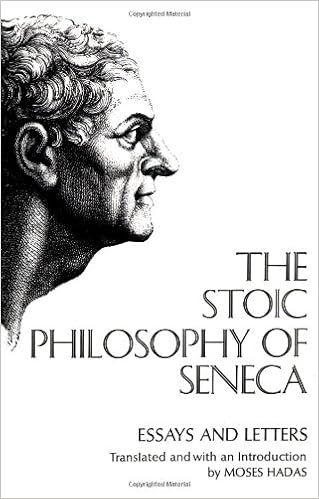
Seneca The Stoic Philosophy of Seneca: Essays and Letters. By Seneca. Translated with and introduction by Moses Hadas.  New York, W. W. Norton, 1958, 1968. 261 pages. ISBN: 0393004597. VSCL. 


Stoicism: Bibliography, Links, Notes, Quotations, Reflections, Resources.
A hypertext notebook by Michael P. Garofalo.


Personally, I favor the metaphysics and natural philosophy of the Epicureans over the Stoics.  


Saturday, December 16, 2017

Cherish and Enjoy Old Age


Lately, I have been reading the letters and short essays by the Roman philosopher, Lucius Annaeus Seneca, 4 BCE - 65 CE.  Seneca was a wealthy Roman, influential writer, political advisor, and aristocrat.  Many consider him a Stoic. He was raised and educated in Rome.  Once, he was banished to Corsica for seven years; and, later, ordered to commit suicide by the Emperor Nero.  

"We should cherish old age and enjoy it.  It is full of pleasure if you know how to use it.  Fruit tastes most delicious when its season is ending.  The charms of youth are at their greatest at the time of its passing.  It is the final glass which pleases the inveterate drinker, the one that sets the crowning touch on his intoxication and sends him off into oblivion. Every pleasure defers till its last its greatest delights. The time of life which offers the greatest delight is the age that sees the downward movement - not the steep decline - already begun; and in my opinion, even the age that stands on the brink has pleasures of its own - or else the very fact of not experiencing the want of any pleasures takes their place.  How nice it is to have out-worn one's desires and left them behind."
-  Seneca, Letters, XII, p. 37 in the Campbell translation; online version by R. M. Gummere.   


Letters from a Stoic. By Seneca. Translated with an introduction by Robin Campbell. Illustrated by Coralie Bickford-Smith. Hardcover Classics Series. New York, Penguin Classics, Reissue Edition, 2015. Index of persons, appendix, notes, 352 pages. ISBN: 978-0141395852. VSCL. 


Seneca The Stoic Philosophy of Seneca: Essays and Letters. By Seneca. Translated with and introduction by Moses Hadas.  New York, W. W. Norton, 1958, 1968. 261 pages. ISBN: 0393004597. VSCL. 

Stoicism: Bibliography, Links, Notes, Quotations, Reflections, Resources.
A hypertext notebook by Michael P. Garofalo.


Personally, I favor the metaphysics and natural philosophy of the Epicureans over the Stoics.  The Stoics remind me of the Confucians, and the Epicureans remind me of the Taoist thinkers of around 300 BCE.  


Monday, May 15, 2017

The Choicest Pleasures in Life


"Stranger, here you do well to tarry; here our highest good is pleasure."
- On a sign at the entrance to the Garden of Epicurus in Athens. 

"They that seldom take pleasure, seldom give pleasure."
- Fulke Greville, Maxims

"The choicest pleasures of life lie within the ring of moderation."
- Martin Tupper, Proverbial Philosophy


Pleasures and Satisfaction: Quotes and Sayings

From the Principal Doctrines of Epicurus:

3. Desires can be based on false, groundless, empty ideals. Be practical and efficient about what you want or desire. What is necessary for a calm, peaceful, satisfying life? If you live simply and more down to earth, what is needed can be rather easily procured. What do you really need rather than what you imagine you might enjoy?

"Of our desires some are natural and necessary, others are natural but not necessary; and others are neither natural nor necessary, but are due to groundless opinion." Principal Doctrines #29

"Those natural desires which entail no pain when unsatisfied, though pursued with an intense effort, are also due to groundless opinion; and it is not because of their own nature they are not got rid of but because of man's groundless opinions." PD #30

"The wealth required by nature is limited and is easy to procure; but the wealth required by vain ideals extends to infinity." PD #15

4. Go unnoticed. Mind your own business. Be content with a simple, quiet, private, unnoticed life. Stay clear of public and political notoriety. Don't seek fame.

"Some men want fame and status, thinking that they would thus make themselves secure against other men. If the life of such men really were secure, they have attained a natural good; if, however, it is insecure, they have not attained the end which by nature's own prompting they originally sought."
PD #7

Epicurean Philosophy:  Bibliography, Links, Notes, Documents, Sayings.
Compiled by Mike Garofalo.  

Epicurean Philosophy on Facebook


Sunday, June 12, 2016

The Essence of Pleasure

"No pleasure endures unseasoned by variety."
-  Publilius Syrus  


"The essence of pleasure is spontaneity."
-  Germaine Greer

"Why not seize the pleasure at once, how often is happiness destroyed by preparation, foolish preparations."
-  Jane Austen


"Perhaps all pleasure is only relief."
- William Burroughs


"Man, Nietzsche contended, is a being that has leapt beyond the "bestial bounds of the mating season" and seeks pleasure not just at fixed intervals but perpetually.  Since, however, there are fewer sources of pleasure than his perpetual desire for pleasure demands, nature has forced man on the "path of pleasure contrivance."  Man, the creature of consciousness whose horizons extend to the past and the future, rarely attains complete fulfillment within the present, and for this reason experiences something most likely unknown to any animal, namely boredom.  This strange creature seeks a stimulus to release him from boredom.  If no such stimulus is readily available, it simply needs to be created.  Man becomes the animal that plays.  Play is an invention that engages the emotions; it is the art of stimulating the emotions.  Music is a prime example.  Thus, the anthropological and physiological formula for the secret of art: "The flight from boredom is the mother of all art." "
-  Rudiger Safranski, Nietzsche: A Philosophical Biography, p. 23


Seven Pleasures: Essays on Ordinary Happiness  By Willard Spiegelman.  The seven simple pleasures discussed are: dancing, reading, walking, looking, listening, swimming, and writing.  If you included Taijiquan as "dancing" then all of these can be solitary activities.  Picador, 2010.  208 pages.  ISBN: 9780312429676. 

Pleasure and the Good Life: Concerning the Nature, Varieties, and Plausibility of Hedonism.  By Fred Feldman.  Clarendon Press, 2006.  240 pages.  ISBN: 978-0199297603.  VSCL. 


Pleasure and Enjoyment: Quotations, Sayings, Information

Hedonistic and Epircurean Philosophy

The Five Senses  

Play


Thursday, June 09, 2016

How to Be Happy

Happiness Activities

1.  Expressing Gratitude
2.  Cultivating Optimism
3.  Avoiding Over-Thinking and Social Comparisons
4.  Practicing Acts of Kindness
5.  Nurturing Social Relationships
6.  Developing Strategies for Coping
7.  Learning to Forgive 
8.  Increasing Flow Expectations
9.  Savoring Life's Joys
10.  Committing to Your Goals
11.  Practicing Spirituality
12.  Taking Care of Your Body (Psychological Methods)
13.  Taking Care of Your Body (Physical Activity)
14.  Taking Care of Your Body (Acting Like a Happy Person)
15.  The Hows Behind Sustainable Happiness: Positive Emotions,
       Optimal Timing and Variety, Social Support, Motivation, Effort,
       Commitment, and Habit.  


The How of Happiness: A Scientific Approach to Getting the Life You Want  By Sonja Lyubomirsky.  New York, Penguin Books, 2008.  Index, extensive notes, appendix, 366 pages.  ISBN: 978-1594201486.  Ms. Lyubomirsky, Ph.D., is a Professor of Psychology at the University of California at Riverside, and a leader in the field of positive psychology.  

Professor Lyubomirsky analyzes what determines happiness.  Her research indicates that "happiness" is determined approximately 50% by our internal biological "Set Point", 10% by our circumstances in life, and 40% by our intentional activity.  Her explanations and suggestions are clear, reasonable, and grounded in psychological research.  Gaining effective use of our intentional activities is the focus of this book.  "This much happiness - up to 40% - is within your power to change."  

How to Live a Good Life: Advice from Wise Persons

Virtues and a Good Life

An Old Philosopher's Notebooks

Pleasure

Reading

Epicureanism


Sunday, February 21, 2016

No Pleasure Endures Unseasoned by Variety


"No pleasure endures unseasoned by variety."
-  Publilius Syrus  


"The essence of pleasure is spontaneity."
-  Germaine Greer

"Why not seize the pleasure at once, how often is happiness destroyed by preparation, foolish preparations."
-  Jane Austen


"Perhaps all pleasure is only relief."
- William Burroughs


"Man, Nietzsche contended, is a being that has leapt beyond the "bestial bounds of the mating season" and seeks pleasure not just at fixed intervals but perpetually.  Since, however, there are fewer sources of pleasure than his perpetual desire for pleasure demands, nature has forced man on the "path of pleasure contrivance."  Man, the creature of consciousness whose horizons extend to the past and the future, rarely attains complete fulfillment within the present, and for this reason experiences something most likely unknown to any animal, namely boredom.  This strange creature seeks a stimulus to release him from boredom.  If no such stimulus is readily available, it simply needs to be created.  Man becomes the animal that plays.  Play is an invention that engages the emotions; it is the art of stimulating the emotions.  Music is a prime example.  Thus, the anthropological and physiological formula for the secret of art: "The flight from boredom is the mother of all art." "
-  Rudiger Safranski, Nietzsche: A Philosophical Biography, p. 23


Seven Pleasures: Essays on Ordinary Happiness  By Willard Spiegelman.  The seven simple pleasures discussed are: dancing, reading, walking, looking, listening, swimming, and writing.  If you included Taijiquan as "dancing" then all of these can be solitary activities.  Picador, 2010.  208 pages.  ISBN: 9780312429676. 


Pleasure and the Good Life: Concerning the Nature, Varieties, and Plausibility of Hedonism.  By Fred Feldman.  Clarendon Press, 2006.  240 pages.  ISBN: 978-0199297603.  VSCL. 


Pleasure and Enjoyment: Quotations, Sayings, Information

Epircurean Philosophy

The Five Senses  

Play


Thursday, February 04, 2016

Celebration in Honor of Epicurus

On February 4th we honor the memory of Epicurus (341-270 BCE), the founder (Hegemon) of the school of philosophy in Athens, Greece, that we now call "Epicureanism."  His school was called "The Garden" (Ho Kepos).

His followers celebrated together in his honor on the 10th of Gamelion.  Gamelion was a lunar period of the Attic Calendar used by the ancient Athenian Greeks. Gamelion was the period in January or February, each Winter, occurring  after a full moon.  Consequently, the celebration of the life and philosophy of Epicurus was a movable feast.  
Vincent Cook reports that Epicurus was born on February 4th.


I am content to use February 4th for the purpose of honoring the memory of Epicurus.  Friends of Epicurus, please celebrate and enjoy yourself today.  Epicurus would have encouraged us to: enjoy wholesome pleasures, be cheerful, have peace of mind (ataraxia), be uplifted by our decent friendships, practice kind speech (suavity), find beauty and factuality in the natural world, respect our bodies and our senses, flourish as human beings (eudaimonia), cultivate wisdom through good conversation, reasoning and reading, and let go of superstitious and false beliefs.  We tip our hats to the founder and master! 


Recommended Reading about Epicureanism and Epicurus

Virtue Ethics

A Philosopher's Notebooks


“Let no one be slow to seek wisdom when he is young nor weary in the search of it when he has grown old. For no age is too early or too late for the health of the soul. And to say that the season for studying philosophy has not yet come, or that it is past and gone, is like saying that the season for happiness is not yet or that it is now no more. Therefore, both old and young alike ought to seek wisdom, the former in order that, as age comes over him, he may be young in good things because of the grace of what has been, and the latter in order that, while he is young, he may at the same time be old, because he has no fear of the things which are to come. So we must exercise ourselves in the things which bring happiness, since, if that be present, we have everything, and, if that be absent, all our actions are directed towards attaining it.” 
-  Epicurus, Letter to Menoeceus


Sunday, April 20, 2014

Utility is the Test of Virtue

"The wealth required by nature is limited and is easy to procure;
but the wealth required by vain ideals extends to infinity."

"The most well-known Epicurean verse, which epitomizes his philosophy, is "lathe biōsas λάθε βιώσας "(Plutarchus De latenter vivendo 1128c; Flavius Philostratus Vita Apollonii 8.28.12), meaning "live secretly", "get through life without drawing attention to yourself", i. e. live without pursuing glory or wealth or power, but anonymously, enjoying little things like food, the company of friends, etc."

Epicurus, 341-271 BCE

Epicurean Philosophy Online

Epicurean History

Lifestyle Advice from Wise Persons

From a Letter to William Short by Thomas Jefferson, 1819

"I take the liberty of observing that you are not a true disciple of our master Epicurus, in indulging the indolence to which you say you are yielding. One of his canons, you know, was that "that indulgence which prevents a greater pleasure, or produces a greater pain, is to be avoided." Your love of repose will lead, in its progress, to a suspension of healthy exercise, a relaxation of mind, an indifference to everything around you, and finally to a debility of body, and hebetude of mind, the farthest of all things from the happiness which the well-regulated indulgences of Epicurus ensure; fortitude, you know is one of his four cardinal virtues. That teaches us to meet and surmount difficulties; not to fly from them, like cowards; and to fly, too, in vain, for they will meet and arrest us at every turn of our road. Weigh this matter well; brace yourself up ..."


Syllabus of the doctrines of Epicurus (By Thomas Jefferson)

"Physical.—The Universe eternal.

Its parts, great and small interchangeable.

Matter and Void alone.

Motion inherent in matter which is weighty and declining.

Eternal circulation of the elements of bodies.

Gods, an order of beings next superior to man, enjoying in their sphere, their own felicities;
but not meddling with the concerns of the scale of beings below them.

Moral.—Happiness the aim of life.

Virtue the foundation of happiness.

Utility the test of virtue.

Pleasure active and In-do-lent.

In-do-lence, is the absence of pain, the true felicity.

Active, consists in agreeable motion; it is not happiness, but the means to produce it.

Thus the absence of hunger is an article of felicity; eating the means to obtain it.

The summum bonum is to be not pained in body, nor troubled in mind.

i.e. In-do-lence of body, tranquillity of mind.

To procure tranquillity of mind we must avoid desire and fear, the two principal diseases of the mind.

Man is a free agent.

Virtue consists in 1) Prudence. 2) Temperance. 3) Fortitude. 4) Justice."