Showing posts with label Eight Section Brocade. Show all posts

Wednesday, May 06, 2026

Bone Marrow Washing Chi Kung

Repost from August 2013:

John wrote to me asking,

"Hello, Mike. I have enjoyed all of your guides and articles, and know if I have a guestion I just need to go to your website and I usually always find an answer.

I have been researching Xi Sui Jing or Bone Marrow Washing. I have had no success, and wonder if you may be able to guide me in the right direction to either find a teacher, literature or video on this system. I am told there are 18 forms or exercises. Is this true?  I have non-Hodgkins lymphoma cancer and thought this may help with my chemotherapy treatments, although the doctor thinks it's a waste of time and money. Thank you."


John,

Intelligently listen to your oncologist's "advice" about treating cancer in terms of complementary medicine and physical exercises.  Some favor exercise and others do not as a complementary therapy.  Many people do not feel much like doing qigong exercises while undergoing chemotherapy.

I can't agree with your doctor that practicing Qigong would be a waste of money since it is very inexpensive or totally free to learn and pracice.  Books and instructional DVDs are quite inexpensive these days, and free UTube video are readily available.  Some people argue that the current elaborate and extremely costly conventional medical treatments for cancer are a waste of time and money, and cause undue suffering, and decide on other options, including doing nothing (wu wei).  This makes for very difficult decisions by the patient.

Based on considerable worldwide research, people who are overweight and don't exercise and eat improperly and use unhealthy drugs have a higher incidence of poor health and diseases and die younger than people who are trim, fit, eat properly, don't use recreational drugs, and exercise regularly.  Nevertheless, I do not believe that Qigong or other fitness modalities can be of significant benefit in curing or slowing the progress of cancer; and people who actively practice Qigong may get cancer anyway.  Cancer has many causes and its appearance is currently unpredictable, although more likely above the age of 60, and cancer "cures" are actively being researched and evaluated.   There is lively debate on the subject of the best treatments for the complex and serious disease of cancer.  Read the book "The Emperor of All Maladies: A Biography of Cancer" by Dr. Stephen Hoye and Siddhartha Mukherje, 2010, for a thorough discussion of this important subject, although a depressing account.   

Some Qigong (Chi Kung) enthusiasts and teachers do believe that their exercises, breathing, meditation, and visualization methods do significantly help people with serious diseases, including cancer.  Medical Qigong offers clinics attempting to help people with all kinds of health problems, and schools training future Qigong medical practitioners and healers exist worldwide.  However, Caveat emptor.

High hopes that the body will heal iteself using some method is very important.  The placebo effect is a real factor.  If you have confidence that Qigong will help in your healing, then it just might work for you.


As for Bone Marrow Washing (Xi Sui Jing) Qigong:  

Gabi Greve from Japan sent me information on Daruma Bone and Marrow Washing Exercises.

Roberto Gravez recommended "The Scholar Warrior" by Deng Ming-Dao.  This book gives all 24 movements of Bone Marrow Washing Chi Kung with drawings and instructions. The book also provides guides for diet, meditation, and so forth.  Mr. Gravez criticized my skepticism about the use of qigong in healing cancer.  I agree with him that "Scholar Warrior" is a fine and useful book, and Deng Ming-Dao is a good writer and expert on Taoist matters. 

Dr. Bikum Hu in Berkeley, California, teaches Bone Marrow Washing Qigong.  

As for general well-being, an increased sense of vitality, feeling good, psycho-spiritual progress, positive visualization, and relaxation, qigong has helped many people. Most people who regularly practice qigong generally have positive comments to make about their experiences.


Yang Jwing-Ming and Mantak Chia have written books on the Bone Marrow Washing Chi Kung form, and, as I recall, give instructions on a version of the set. Yang Jwing-Ming's books are usually very informative and useful for learning forms, and have excellent, detailed background theory.


There are both harder and easier verions of the Xi Sui Jing exercise as with Shaolin White Crane Qigong. 18 Lohan Qigong, another Shaolin Qigong form, is also popular.

I'd recommend The Eight Section Brocade Qigong for a general introductory form, and you don't need to spend any extra money learning it (I explain it for free on a webpage); and, there are many free UTube verison online.  Please, don't spend more than 20 mintues a day, at first, doing the form in the early morning. Also, enjoy some walking if you feel up to it!

I find the exercises, postures, and movement routines of many "different" qigong forms to be quite similar.  Likewise, there are also many named "styles" of yoga, but the postures of physical (hatha) yoga are common and familiar, even if named differently.  For example, lunges or moving the shoulders/arms through a full range of motion are found in all qigong, taijiquan, and yoga practices.

Visualizations of energy flow inside and outside the body, philosophical emphasis, vigorous vs gentle movements, breathing instructions, and descriptions of esoteric anatomy or meridians vary more in qigong forms. 

John, my very best wishes for a long remission, improved well-being, and a peaceful soul.

Mike Garofalo

Wednesday, April 01, 2026

Eighteen Buddha Hands Qigong

Luohan Qigong, Lohan Qigong, Luohan Gong, Lohan Gong, 18 Buddha Hands

Shaolin Buddhist Qigong

Over the years, I have found many different versions of the 18 Buddha Hands Qigong or Luohan Qigong.  For example, last year, I read Stuart Alve Oson's "The Eighteen Lohan Skills: Traditional Shaolin Training Methods," Valley Spirit Arts, 2015.  

Resources, Lessons, History, Links, Bibliography, Notes, Research 
 http://www.egreenway.com/qigong/lohan.htm


 "One tradition is that the Buddhist teacher, Bodhidharma (448-527 CE), a famous Grand Master of Chan (Zen),introduced a set of 18 exercises to the Buddhist monks at the Shaolin Temple. These are known as the Eighteen Hands of the Lohan. This Shaolin Lohan Qigong (i.e., the art of the breath of the enlightened ones), "is an internal set of exercises for cultivating the "three treasures" of qi (vital energy), jing (essence), and shen (spirit)," according to Howard Choy. The Kung Fu master, Sifu Wong Kiew-Kit, referring to the Shaolin Wahnam style, says "the first eight Lohan Hands are the same as the eight exercises in a famous set of chi kung exercises called the Eight Pieces of Brocade." There are numerous versions,seated and standing, of Bodhiidharma's exercise sets - including the related "Tendon-Changing and Marrow-Washing" qigong set. Some versions of the 18 Lohan (Luohan) Hands have up to four levels, and scores of movement forms for qigong and martial purposes."
- Michael P. Garofalo, Eight Section Brocade


 For a comparison of some of the exercises in the Lohan Qigong with the Eight Section Brocade see my chart on the topic. 

 
 The Luohan Qigong includes a massage or patting training methods, and this is especially popular among Yin Fu Bagua enthusiasts. Master Xie Pei Qi has a DVD out on the topic. 


Thursday, November 03, 2022

Eight Section Brocade Chi Kung and the Eight Trigrams


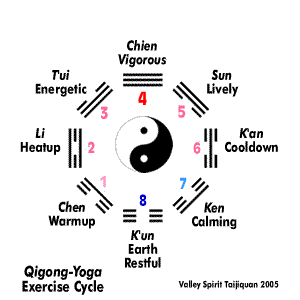
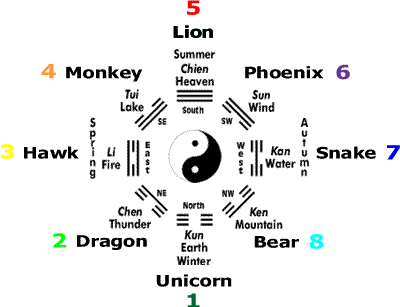
Sequence C:  Trigrams, Bagua, and Eight Section Brocade (Ba Duan Jin) Exercises Correlations

Soft Qigong (Rou Gong), Inner Qigong (Nei Gong); Slow Pace, Gentle, Soft, At Ease, Relaxed (Sung), Rooted/Sunk, Yin Style


Eight Section Brocade Exercise
I Ch'ing Trigram 
Parts of the Body Affected
1.  Pressing Up to the Heavens with
Two Hands
South, Summer
Ch'ien, Qián, Heaven, Sky, Air
Intense Yang
Lion
Heart, Small Intestine, Stomach, Lungs
(The Triple Warmer)
              
2.  Drawing the Bow and Letting the Arrow Fly Southwest, Mid-Summer
Sun, Wind
Yang
Phoenix
Kidneys, Spleen, Waist, Eyes, Legs
                     
4.  Wise Owl Gazes Backward West, Autumn
K'an, Water
Yang-Yin
Snake
Lungs, Immune System, Large Intestine
                   
5.  Big Bear Turns from Side to Side Northwest, Mid-Autumn
Ken, Gèn, Mountain
Yin-Yang
Bear
Heart, Waist, Legs
                   
3.  Separating Heaven and Earth North, Winter
K'un, Earth
Intense Yin
Unicorn, Qilin
Spleen, Kidneys, Bladder, Pancreas
                        

8.  Shaking the Body Northeast, Mid-Winter
Chen, Zhèn, Thunder
Yin
Dragon
Immune System, Calves, Feet
                         
6.  Punching with Angry Gaze Spring, East
Li, Fire
Yin-Yang
Hawk, Falcon
Liver, Gallbladder, Blood, Eyes
                      

8.  Touching Toes then Bending Backwards Southeast, Mid-Spring
Tui, Lake
Yang-Yin
Monkey

 
Kidneys, Waist, Legs, Back

The above three charts were proposed in 2005 by Mike Garofalo, in his webpage on the Eight Section Brocade.  See also Mike's webpage on the Eight Trigrams.  


In 2014, Christina Barea-Young and Peyton Young provided another set of associations for the Eight Section Brocade movements with the Eight Trigrams in Qi Magazine (Volume 24, No. 2, 2014, p. 48).  

I find these kinds of correlations, associations, and relational charts quite inconsistent between various authors.  Yoga, Western Esoteric Magic, and Qigong have many of the same kind of charts and tables of correlations; again, with considerable inconsistency between various "masters."  Other than the "traditions of specific esoteric schools", I find the associations rather arbitrary and fanciful, primarily aids to remembering clusters of ideas, poetic devices, magical-metaphysical lore, and lacking in much pragmatic-scientific meaningfulness.  Contrast these charming and pre-scientific tables with the modern and justifiably famous "Periodic Table of the Elements" for a real lesson in an objective and empirical approach to understanding the world.  Nevertheless, these clusters of ideas may stimulate the imagination, and are fun for playing thought games.  


"The names of the 108 Forms are each symbolic and signify concepts removed from the literal  physicality of the object - horse, tiger, bird, and so forth.  Each name has its separate allusion, and metaphorically may connote an aspiration, a philosophical attitude towards self and  conduct, a turn of mind, a sense of being, some thought about life and spirit.  The true meanings are revealed when the T'ai-Chi Ch'uan exponent has advanced to that stage of experience comprehension where he can utilize the implication of the philosophical  intentions, and where the symbols can be part of his growing consciousness.  This happens only when the mind and body have "changed" and absorbed the reasons for mental, emotional, and physical unity."
-   Sophia Delza, The T'ai Chi Ch'uan Experience, 1996, p. 24


The above long chart is more readable on my Eight Section Brocade webpage, 441 KB, last updated on June 20, 2014. 


Thursday, February 04, 2021

Eight Section Brocade Chi Kung Exercises

 "All students should learn the Eight Treasures first, because many people have serious energy blocks and the Eight Treasures are more effective in quickly breaking through them that the more subtle Tai Chi."
- Hua-Ching Ni, "Workbook for Spiritual Development," Tao of Wellness Press, 1992, p. 138


An excellent book to read regarding a seated version of the Eight Treasures is by Stuart Alve Olson, "Qigong Teachings of a Taoist Immortal: The Eight Essential Exercises of Master Li Ching-Yun.  


Eight Section Brocade Qigong

Eight Silken Treasures Qigong

Ba Duan Jin Qigong
History, Instructions, Bibliography, Links, Resources, Quotes
Researched by Michael P. Garofalo
Last Updated on October 24, 2017

Eight Section Brocade Qigong By Michael P. Garofalo.

this webpage provides information about the history and purpose of this popular Chi Kung practice. Detailed descriptions are provided for each of the eight movements; including information on movement variations, health benefits, qigong meaning, and cautions. The document includes the most extensive bibliography, link guide, and comments on Ba Duan Jin Qigong resources available anywhere. Some animated graphics are provided in linked files. This document is updated as new information is discovered. 

This qigong set is the most popular set practiced around the world, and is also known as: Baduanjin, Pa Tuan Jin, Eight Silken Treasures, Ba Duan Jin, Pal Dan Gum, Ba Duan Gin, Pa Tin Kam, Otto Pezzi di Tesoro, Acht Delen Brokaat, Les Huit Exercices del la Soie, Eight Silken Treasures, Brocade Qigong, Wudang Brocade Qigong, Brocade soft qigong (Rou Gong), Eight Treasures inner qigong (Nei Gong), Silk Treasures Qigong, and the first eight Buddha Lohan Hands. 

This hypertext document is 164 pages in length, over 39,000 words, and with a filesize of 448Kb.  This document has been online since 2002.  

Web File Location: http://www.egreenway.com/taichichuan/esb.htm.


Sunday, December 31, 2017

With Slow Movements ...


"The movements of Qigong exercise should be slow instead of fast because slow movements will nourish qi and combine the posture with qi. The training practice of Qigong should start with Wuji with slow movement until the closing of the training.  Every movement and step must be done slowly, opening and spreading of the body be slow, closing and sinking of the body be slow, and rising and falling of the body be slow.  With slow movements, one can keep thinking whether the upper, lower, left and right of the body are followed, and whether the interior and exterior are coordinated.  With the slow and gentle movements and posture, the internal qi is conducted to flow slowly in the body to integrate mindwill with qi, vitality with posture, and enter the realm of forgetting the substance and me."
-  Master Wang Fengming, Special Taoist Taji Stick and Ruler Qigong, p. 115. 


Hun Yuan Stick and Ruler Qigong

Hun Yuan Qigong, Primordial Qigong, Mixed Circles Qigong

Valley Spirit Qigong

Vancouver Tai Chi and Chi Kung Studio, Vancouver, Washington State


I was given a number of books by family and friends this holiday season, and for my 72nd birthday. I thank them for their generosity. 

A 5 DVD set of instructional DVDs from Brett Wagland and Fontane Ip from Canberra, Australia.  They teach Hunyuan Taijiquan and Qigong.  A $125 investment in coaching in Hunyuan:

Yang Tai Chi for Beginners. By Dr. Yang, Jwing-Ming. Instructional DVD, 293 minutes. YMAA, 2012. VSCL.

Tai Chi Chuan Martial Power: Advanced Yang Style. By Dr. Wang, Jwing Ming. Foreword by Tsung-Hwa Jou. Wolfeboro, New Hampshire, YMAA Publication Center, 3rd Edition, 1986, 1996, 2015. Index, glossary, bibliography, 274 pages. ISBN: 978-1594392948. VSCL.


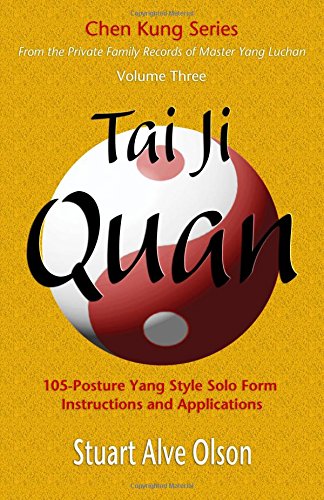
Tai Ji Quan: 105 Posture Yang Style Solo Form - Instructions and Applications. Chen Kung Series, From the Private Family Records of Master Yang Luchan, Volume Three. Translation and commentary by Master Stuart Alve Olson. Phoenix, Arizona, Valley Spirit Arts, 2017. Bibliography, appendices, 234 pages. ISBN: 978-1548105372. VSCL. "The long-awaited third volume in the Chen Kung Series presents the detailed instructions on the original Yang Style 105-Posture Taijiquan form, along with explanations of the practical self-defense applications, commentaries by Chen Kung, translations of the illustrations in the text, and notes by Stuart Alve Olson. A truly remarkable, insightful work that complements anyone’s library on the art of Taijiquan." "Born in 1906, Master Chen Kung (a.k.a., Yearning K. Chen and Chen Yen-lin) passed away in Shanghai, Chiina, in 1980. Master Chen Kung copied the Yang Family manuscripts in 1930."


Monday, November 27, 2017

Bau Daun Jin Research


Eight Section Brocade Chi Kung


Bibliography, Instructions, Links, Benefits, Exercises, History, Lore
A Hypertext Notebook
By Michael P. Garofalo, M.S.


463 Kb, November 28, 2017


Chi Kung (Dao-yin, Yang Sheng Gong, Qigong) are Various Ancient Chinese Exercise and Fitness Practices

The Eight Pieces of Beautiful Silk Brocade Chi Kung (Ba Duan Jin Qigong) is a popular Chi Kung Form.    

The Eight Treasures Dao-yin (Ways for Pulling, Stretching, and Guiding the Body-Mind Energies)

The Eight Useful Chi Kung Exercises for Improved Fitness, Vitality, Healing, and Longevity 

Eight Immortal Ones Taoist Longevity Practices  

Eight Beautiful Tapestries Chi Kung for Nourishing Life Training (Yang Sheng Gong)

A Shaolin Temple, Taijiquan and Martial Arts Warm-up Routine


Sunday, November 26, 2017

Eight Section Brocade


Draw the Bow and Let the Arrow Fly #2
Eight Section Brocade, Ba Duan Jin

Sifu Fetyko leads us in the practice of the Ba Duan Jin, Eight Beautiful Tapestries, every time we practice Taijiquan together on Tuesday and Thursday morning from 8:45 am to 10:15 am in Vancouver, WA.  His version is slightly different from the many other versions I have been taught since 1975.  


Sequence C:  Trigrams, Bagua, and Eight Section Brocade (Ba Duan Jin) Exercises Correlations

Soft Qigong (Rou Gong), Inner Qigong (Nei Gong); Slow Pace, Gentle, Soft, At Ease, Relaxed (Sung)Rooted/Sunk, Yin Style


Eight Section Brocade Exercise
I Ch'ing Trigram 
Parts of the Body Affected
1.  Pressing Up to the Heavens with
Two Hands
South, Summer
Ch'ienQián, Heaven, Sky, Air
Intense Yang
Lion
Heart, Small Intestine, Stomach, Lungs
(The Triple Warmer)
              
2.  Drawing the Bow   and Letting the Arrow FlySouthwest, Mid-Summer
Sun, Wind
Yang
Phoenix
Kidneys, Spleen, Waist, Eyes, Legs
                     
4.  Wise Owl Gazes BackwardWest, Autumn
K'an, Water
Yang-Yin
Snake
Lungs, Immune System, Large Intestine
                   
5.  Big Bear Turns from Side to SideNorthwest, Mid-Autumn
KenGèn, Mountain
Yin-Yang
Bear
Heart, Waist, Legs
                   
3.  Separating Heaven and EarthNorth, Winter
K'un, Earth
Intense Yin
Unicorn, Qilin
Spleen, Kidneys, Bladder, Pancreas
                        

8.  Shaking the BodyNortheast, Mid-Winter
ChenZhèn, Thunder
Yin
Dragon
Immune System, Calves, Feet
                         
6.  Punching with Angry GazeSpring, East
Li, Fire
Yin-Yang
Hawk, Falcon
Liver, Gallbladder, Blood, Eyes
                      

8.  Touching Toes then Bending BackwardsSoutheast, Mid-Spring
Tui, Lake
Yang-Yin
Monkey
Kidneys, Waist, Legs, Back

The above three charts were proposed in 2005 by Mike Garofalo, in his webpage on the Eight Section Brocade.  See also Mike's webpage on the Eight Trigrams.  


In 2014, Christina Barea-Young and Peyton Young provided another set of associations for the Eight Section Brocade movements with the Eight Trigrams in Qi Magazine (Volume 24, No. 2, 2014, p. 48).  

I find these kinds of correlations, associations, and relational charts quite inconsistent between various authors.  Yoga, Western Esoteric Magic, and Qigong have many of the same kind of charts and tables of correlations; again, with considerable inconsistency between various "masters."  Other than the "traditions of specific esoteric schools", I find the associations rather arbitrary and fanciful, primarily aids to remembering clusters of ideas, poetic devices, magical-metaphysical lore, and lacking in much pragmatic-scientific meaningfulness.  Contrast these charming and pre-scientific tables with the modern and justifiably famous "Periodic Table of the Elements" for a real lesson in an objective and empirical approach to understanding the world.  Nevertheless, these clusters of ideas may stimulate the imagination, and are fun for playing thought games.  


"The names of the 108 Forms are each symbolic and signify concepts removed from the literal  physicality of the object - horse, tiger, bird, and so forth.  Each name has its separate allusion, and metaphorically may connote an aspiration, a philosophical attitude towards self and  conduct, a turn of mind, a sense of being, some thought about life and spirit.  The true meanings are revealed when the T'ai-Chi Ch'uan exponent has advanced to that stage of experience comprehension where he can utilize the implication of the philosophical  intentions, and where the symbols can be part of his growing consciousness.  This happens only when the mind and body have "changed" and absorbed the reasons for mental, emotional, and physical unity."
-   Sophia Delza, The T'ai Chi Ch'uan Experience, 1996, p. 24

 
The above long chart is more readable on my Eight Section Brocade webpage, 441 KB, last updated on June 20, 2014.  


Sunday, October 29, 2017

Eight Treasures Chi Kung

"All students should learn the Eight Treasures first, because many people have serious energy blocks and the Eight Treasures are more effective in quickly breaking through them that the more subtle Tai Chi."
- Hua-Ching Ni, "Workbook for Spiritual Development," Tao of Wellness Press, 1992, p. 138


An excellent book to read regarding a seated version of the Eight Treasures is by Stuart Alve Olson, "Qigong Teachings of a Taoist Immortal: The Eight Essential Exercises of Master Li Ching-Yun.  

Eight Section Brocade Qigong

Eight Silken Treasures Qigong

Ba Duan Jin Qigong
History, Instructions, Bibliography, Links, Resources, Quotes
Researched by Michael P. Garofalo
Last Updated on October 24, 2017

Eight Section Brocade Qigong By Michael P. Garofalo.

this webpage provides information about the history and purpose of this popular Chi Kung practice. Detailed descriptions are provided for each of the eight movements; including information on movement variations, health benefits, qigong meaning, and cautions. The document includes the most extensive bibliography, link guide, and comments on Ba Duan Jin Qigong resources available anywhere. Some animated graphics are provided in linked files. This document is updated as new information is discovered. 

This qigong set is the most popular set practiced around the world, and is also known as: Baduanjin, Pa Tuan Jin, Eight Silken Treasures, Ba Duan Jin, Pal Dan Gum, Ba Duan Gin, Pa Tin Kam, Otto Pezzi di Tesoro, Acht Delen Brokaat, Les Huit Exercices del la Soie, Eight Silken Treasures, Brocade Qigong, Wudang Brocade Qigong, Brocade soft qigong (Rou Gong), Eight Treasures inner qigong (Nei Gong), Silk Treasures Qigong, and the first eight Buddha Lohan Hands. 

This hypertext document is 164 pages in length, over 39,000 words, and with a filesize of 448Kb.  This document has been online since 2002.  

Web File Location: http://www.egreenway.com/taichichuan/esb.htm.


Monday, April 03, 2017

Eight Beautiful Tapestries Chi Kung

Sequence C:  Trigrams, Bagua, and Eight Section Brocade (Ba Duan Jin) Exercises Correlations

Soft Qigong (Rou Gong), Inner Qigong (Nei Gong); Slow Pace, Gentle, Soft, At Ease, Relaxed (Sung)Rooted/Sunk, Yin Style


Eight Section Brocade Exercise
I Ch'ing Trigram 
Parts of the Body Affected
1.  Pressing Up to the Heavens with
Two Hands
South, Summer
Ch'ienQián, Heaven, Sky, Air
Intense Yang
Lion
Heart, Small Intestine, Stomach, Lungs
(The Triple Warmer)
              
2.  Drawing the Bow   and Letting the Arrow FlySouthwest, Mid-Summer
Sun, Wind
Yang
Phoenix
Kidneys, Spleen, Waist, Eyes, Legs
                     
4.  Wise Owl Gazes BackwardWest, Autumn
K'an, Water
Yang-Yin
Snake
Lungs, Immune System, Large Intestine
                   
5.  Big Bear Turns from Side to SideNorthwest, Mid-Autumn
KenGèn, Mountain
Yin-Yang
Bear
Heart, Waist, Legs
                   
3.  Separating Heaven and EarthNorth, Winter
K'un, Earth
Intense Yin
Unicorn, Qilin
Spleen, Kidneys, Bladder, Pancreas
                        

8.  Shaking the BodyNortheast, Mid-Winter
ChenZhèn, Thunder
Yin
Dragon
Immune System, Calves, Feet
                         
6.  Punching with Angry GazeSpring, East
Li, Fire
Yin-Yang
Hawk, Falcon
Liver, Gallbladder, Blood, Eyes
                      

8.  Touching Toes then Bending BackwardsSoutheast, Mid-Spring
Tui, Lake
Yang-Yin
Monkey
Kidneys, Waist, Legs, Back

The above three charts were proposed in 2005 by Mike Garofalo, in his webpage on the Eight Section Brocade.  See also Mike's webpage on the Eight Trigrams.  


In 2014, Christina Barea-Young and Peyton Young provided another set of associations for the Eight Section Brocade movements with the Eight Trigrams in Qi Magazine (Volume 24, No. 2, 2014, p. 48).  

I find these kinds of correlations, associations, and relational charts quite inconsistent between various authors.  Yoga, Western Esoteric Magic, and Qigong have many of the same kind of charts and tables of correlations; again, with considerable inconsistency between various "masters."  Other than the "traditions of specific esoteric schools", I find the associations rather arbitrary and fanciful, primarily aids to remembering clusters of ideas, poetic devices, magical-metaphysical lore, and lacking in much pragmatic-scientific meaningfulness.  Contrast these charming and pre-scientific tables with the modern and justifiably famous "Periodic Table of the Elements" for a real lesson in an objective and empirical approach to understanding the world.  Nevertheless, these clusters of ideas may stimulate the imagination, and are fun for playing thought games.  


"The names of the 108 Forms are each symbolic and signify concepts removed from the literal  physicality of the object - horse, tiger, bird, and so forth.  Each name has its separate allusion, and metaphorically may connote an aspiration, a philosophical attitude towards self and  conduct, a turn of mind, a sense of being, some thought about life and spirit.  The true meanings are revealed when the T'ai-Chi Ch'uan exponent has advanced to that stage of experience comprehension where he can utilize the implication of the philosophical  intentions, and where the symbols can be part of his growing consciousness.  This happens only when the mind and body have "changed" and absorbed the reasons for mental, emotional, and physical unity."
-   Sophia Delza, The T'ai Chi Ch'uan Experience, 1996, p. 24

 
The above long chart is more readable on my Eight Section Brocade webpage, 441 KB, last updated on June 20, 2014.  


Monday, February 22, 2016

Eight Treasures Chi Kung Exercise Set

I frequently teach the Chinese Eight Section Brocade Chi Kung exercise and fitness routine in my Taijiquan class and my Yoga class.  Naturally, I include many comments about Shaolin and Daoist fitness and healthy living concepts.

This Eight Treasures exercise and fitness routine has a varied and long history with ancient roots back to the Animal Frolics Dao-yin exercises of 300 CE.  Some of the Eight Treasures exercises involve toughening, courage, and fighting and were used in military exercise and conditioning drills.  Many versions of the Ba Duan Jin include 12 exercises or more.   

One recent book that provides good documentation on the history of Chinese exercise practices (Chi Kung, Qigong, Neigong), including five illustrated versions of the Eight Section Brocade, is:  

An Illustrated Handbook of Chinese Qigong Forms from the Ancient Texts  Complied by Li Jingwei and Zhu Jianping.  London, Singing Dragon, 2014.  No index or bibliography, 325 pages.  ISBN: 9781848191976.  Many excellent line drawings are included to illustrate the postures.  VSCL. 

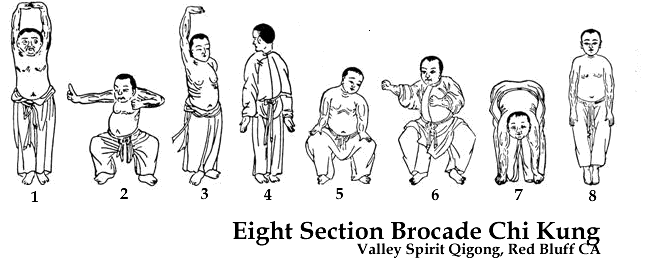
Back in 2002, I created the webpage titled:  The Eight Section Brocade Chi Kung.
  

The Ba Duan Jin Qigong form includes eight basic exercises to help you keep limber, become stronger, improve your balance, and increase your stamina.  There are opportunities for squatting movements and postures to strengthen the legs.  
  The entire Eight Beautiful Tapestries Chi Kung form is normally done while standing, although there are some versions done in a seated posture for meditative purposes or for frail persons. 


There are numerous versions of this popular Chi Kung form.  There are many good books, instructional DVDs, and UTube videos to choose from on this topic.  My webpage includes a long bibliography on the Eight Section Brocade Chi Kung with citations for resources, links, videos, books, and instructional DVDs on the subject.  
  I make a number of comments about each of the eight movements, including comments about the movement variations, physical training targets, muscles worked, attitude, internal alchemy (Neidan), benefits, options, comparisons with yoga asanas, and breathing patterns.  
  

I offer my own version with fairly detailed comments on each of the eight movements.  Here is my one page class handout for the Eight Section Brocade Chi Kung class.  


"The name “Ba Duan Jin” has been found as early as the Northern Song Dynasty. According to Hong Mai's (洪邁) Yi Jian Zhi (夷堅志, Song Dynasty), Zhenghe Seventh Year, Emperor's Chief Secretary, Li Shi-Ju, lived a simple life.  He spent a large portion of his time in his mediation room practicing Daoist Monk’s exercises expanding like a bear and stretching like a bird. In the early hours, he is often found breathing and massaging, practicing the so-called Eight-Section Brocade (Ba Duan Jin). This passage reveals that Ba Duan Jin has been developed and practiced since the Song Dynasty as a general health-keeping regime.
    
Both sitting and standing forms have been found in the history of Ba Duan Jin (
八段錦),. Standing forms were developed into two schools (northern and southern styles) in the Qing Dynasty. The Northern School, said to have been passed down by Yue Fei (岳飛), has tougher forms, and the Southern School, claimed the lineage from Liang Shi-Chang (梁世昌), focuses on softer trainings. Quite a few verses has been passed down during the period from Song Dynasty to Qing Dynasty, but all verses for the standing forms have evolved from the passages recorded in "The Chapter of Wonders, Pivot of Dao" (道樞·眾妙篇, Dao Shu, Zong Miao Pian, Song Dynasty) and verses of the sitting style from the forms recorded in "TheTen Books of Daoist Practices" (修真十書 Xiu Zhen Shi Shu, Ming Dynasty ).  or "The Methods of Curing"(活人心法, Huo Ren Xin Fa, Ming Dynasty). Sets Ba Duan Jin forms are not always limited to the number of eight. The number of forms in a set range from a single form to tens or as many as a hundred; nevertheless, they are all exercise regimes designed for health-keeping, preventive, and therapeutic purposes, and, liberally saying, all exercise regimes designed for such purposes are part of the Ba Duan Jin system."
-   Lee Chang-Chih, 
 A Brief Introduction to Ba Daun Jin.  "Reinterpreting Ba Duan Jing From the Theories of the Eight Extra Meridians" 2005 


Wednesday, November 05, 2014

Qigong (Chi Kung) Exercises Benefit the Elderly

The Anti-Aging Benefits of Chinese Qigong (Chi Kung) Exercises
Gentle Exercise, Breathing, and Meditation


Scientific Research  Many Reports on the Effect of Qigong on Improving the Health of the Elderly

"Qigong can do wonders to rejuvenate the elderly. In fact, more than 50 percent of the people who begin tai chi and qigong in China do so after the age of 60, when the realities of aging can no longer be pushed aside. Already, hundreds of millions of people over the age of 60 have found qigong to be uniquely effective."
-  Bruce Frantzis, Qigong for Seniors


Anti-Aging Benefits of Qigong   by Kenneth Sancier, Ph.D.

Qigong for the Elderly


"This report shows that regular qigong practice could relieve depression, improve self-efficacy and personal well being among elderly persons with chronic physical illness and depression"
Effect of a Qigong Program on Elderly Persons with Depression, International Journal of Geriatric Psychiatry.


Qigong (Chi Kung):  Styles,Bibliographies, Research, Resources, Links, Lessons, Benefits, Quotations.  Website by Mike Garofalo.

A review of clinical trials of t’ai chi and qigong in older adults reported in the March 2009 issue of the Western Journal of Nursing Research notes that qigong improves physical functioning, limits fall risk, alleviates symptoms of depression and anxiety, and lowers blood pressure in older adults.

"Why Every Elderly Citizen Should Do Qigong: Qigong can treat many diseases.  Qigong can prevent many diseases.  Qigong can extend life.  Qigong can improve the quality of life.  Qigong can prevent accidents."


"According to T'ai Chi and Qigong enthusiasts, the discipline can prevent many ailments, including high blood pressure, tuberculosis, and diabetes, and US scientists agree that T'ai Chi can offer some important fitness benefits, particularly for older adults." 
Modern Maturity, V. 35 June/July 92 p. 60-62


Qigong (Chi Kung): Recommended Reading, Bibliography, Resources, Links, Quotations.  Research by Mike Garofalo, Qigong Instructor


"The average person uses only five to ten percent of his or her 15 billion brain cells; yet studies show that Qi Gong activates 90 percent of the human brain by suffusing it with stimulating bioelectric currents.  This results in significant memory improvement, learning, and enhancement of the physiological functions controlled by the brain.  Studies also show that practicing Qi Gong increases the level of essential neurotransmitters in the blood.  Deficiency of these elements can cause Parkinsons, Alzheimer’s, chronic depression, and insomnia."
Lee Holden


According to the February 2009 issue of The Journal of Nursing, “evidence-based research supports the argument that qigong improves cardiovascular-respiratory function and lipid profile, decreases blood sugar, and relieves anxiety and depression.”

An Evidence-Based Review of Qi Gong by the Natural Standard Research Collaboration, 2010

The Healing Promise of Qi: Creating Extraordinary Wellness Through Qigong and Tai Chi.  By Roger Jahnke, O.M.D..  Chicago, Contemporary Books, 2002.   Index, notes, extensive recommended reading list, 316 pages.  ISBN: 0809295288.  VSCL.  
 
The Way of Qigong: The Art and Science of Chinese Energy Healing.  By Kenneth S. Cohen.  Foreword by Larry Dossey.  New York Ballantine Books, 1997.  Index, notes, appendices, 427 pages.  ISBN: 0345421094.  One of my favorite books: comprehensive, informative, practical, and scientific.  VSCL.  


Wednesday, September 24, 2014

Ba Duan Jin Chi Kung

I frequently teach the Chinese Eight Section Brocade Chi Kung exercise and fitness routine in my Taijiquan class and my Yoga class.  Naturally, I include many comments about Shaolin and Daoist fitness and healthy living concepts. 

This Eight Treasures exercise and fitness routine has a varied and long history with ancient roots back to the Animal Frolics Dao-yin exercises of 300 CE.  Some of the Eight Treasures exercises involve toughening, courage, and fighting and were used in military exercise and conditioning drills.  Many versions of the Ba Duan Jin include 12 exercises or more.   

One recent book that provides good documentation on the history of Chinese exercise practices (Chi Kung, Qigong, Neigong), including five illustrated versions of the Eight Section Brocade, is:  

An Illustrated Handbook of Chinese Qigong Forms from the Ancient Texts  Complied by Li Jingwei and Zhu Jianping.  London, Singing Dragon, 2014.  No index or bibliography, 325 pages.  ISBN: 9781848191976.  Many excellent line drawings are included to illustrate the postures.  VSCL. 
 
Back in 2002, I created the webpage titled:  The Eight Section Brocade Chi Kung.
  

The Ba Duan Jin Qigong form includes eight basic exercises to help you keep limber, become stronger, improve your balance, and increase your stamina.  There are opportunities for squatting movements and postures to strengthen the legs.  
  The entire Eight Beautiful Tapestries Chi Kung form is normally done while standing, although there are some versions done in a seated posture for meditative purposes or for frail persons. 


There are numerous versions of this popular Chi Kung form.  There are many good books, instructional DVDs, and UTube videos to choose from on this topic.  My webpage includes a long bibliography on the Eight Section Brocade Chi Kung with citations for resources, links, videos, books, and instructional DVDs on the subject.  
  I make a number of comments about each of the eight movements, including comments about the movement variations, physical training targets, muscles worked, attitude, internal alchemy (Neidan), benefits, options, comparisons with yoga asanas, and breathing patterns.  
 

I offer my own version with fairly detailed comments on each of the eight movements.  Here is my one page class handout for the Eight Section Brocade Chi Kung class.  


"The name “Ba Duan Jin” has been found as early as the Northern Song Dynasty. According to Hong Mai's (洪邁) Yi Jian Zhi (夷堅志, Song Dynasty), Zhenghe Seventh Year, Emperor's Chief Secretary, Li Shi-Ju, lived a simple life.  He spent a large portion of his time in his mediation room practicing Daoist Monk’s exercises expanding like a bear and stretching like a bird. In the early hours, he is often found breathing and massaging, practicing the so-called Eight-Section Brocade (Ba Duan Jin). This passage reveals that Ba Duan Jin has been developed and practiced since the Song Dynasty as a general health-keeping regime. 
   
Both sitting and standing forms have been found in the history of Ba Duan Jin (
八段錦),. Standing forms were developed into two schools (northern and southern styles) in the Qing Dynasty. The Northern School, said to have been passed down by Yue Fei (岳飛), has tougher forms, and the Southern School, claimed the lineage from Liang Shi-Chang (梁世昌), focuses on softer trainings. Quite a few verses has been passed down during the period from Song Dynasty to Qing Dynasty, but all verses for the standing forms have evolved from the passages recorded in "The Chapter of Wonders, Pivot of Dao" (道樞·眾妙篇, Dao Shu, Zong Miao Pian, Song Dynasty) and verses of the sitting style from the forms recorded in "TheTen Books of Daoist Practices" (修真十書 Xiu Zhen Shi Shu, Ming Dynasty ).  or "The Methods of Curing"(活人心法, Huo Ren Xin Fa, Ming Dynasty). Sets Ba Duan Jin forms are not always limited to the number of eight. The number of forms in a set range from a single form to tens or as many as a hundred; nevertheless, they are all exercise regimes designed for health-keeping, preventive, and therapeutic purposes, and, liberally saying, all exercise regimes designed for such purposes are part of the Ba Duan Jin system."
-   Lee Chang-Chih,
 A Brief Introduction to Ba Daun Jin.  "Reinterpreting Ba Duan Jing From the Theories of the Eight Extra Meridians" 2005