Showing posts with label Study. Show all posts

Tuesday, July 09, 2024

Reading Sheet Music: Discovery 2

Reading Sheet Music for Harmonica
Discoveries #2 (July 8, 2024)

Harmonica Studies by Michael P. Garofalo

I have been diligently working on learning to read standard music notation, sheet music, when
playing the harmonica. I had been using for many years the harmonica tablature notation showing what hole to blow or draw into. Sheet music notation tells me what note to play and the duration and sequence of the notes played. Most diatonic harmonica music books have lessons using a C Major harmonica, the sheet music for each song, and under each note the harmonica tablature. I focus now on the sheet music and ignore the harmonica tablature. I am using the book 'Easy Piano Sheet Music for Kids', by Avgusta Udartseva, while learning, which does not include harmonica tablature.

For me, what are the benefits of reading standard musical notation (sheet music):
1. A better sense of the flow and timing of a composition.
2. There is far more sheet music without harmonica tablature that is readily available.
3. Following traditional musical learning using sheet music is very valuable, and essential for real progress in music playing.
4. Learning to connect names of notes (CDEFGABC) with positions on the sheet music, and connecting these with diatonic harmonica holes for blow or draw notes (20 notes on a 10 hole diatonic harmonica).
5. Learning to read sheet music more efficiently, effectively, knowledgeably, and beneficial for playing properly.
6. I am learning more musical theory each day.
7. The visual spacing of the notes on the sheet music is more useful to precise playing and improving one's anticipation and timing.
8. Improves my learning how to play better.
9. I enjoy learning challenges, tests, new methods and techniques.
10. It is intellectually and emotionally satisfying to make progress in playing music.
11. The challenge of new ways of looking and seeing; new ways of communicating with symbols.
12. Harmonica tablature can be useful, but must be left behind for real progress to occur.

This has been a significant and transformative learning experience for me! Why did I wait so long to learn how to read and play from sheet music? Why did I not take classes from a music teacher? Why did I not take community college or private classes in musical theory and education? Nevertheless, this is all just muddy water gone past under the bridge for a 78 year old man playing the harmonica on his own. I must focus on learning NOW, and ignore my regrets and failings. PRACTICE NOW and enjoy myself.


Harmonica Studies by Michael P. Garofalo


Saturday, December 09, 2023

Studying Tai Chi Chuan


Five Beneficial Methods for the Study of Tai Chi Chuan

"1.  Your study should be broad and diversified.  Do not limit yourself.  This principle (virtue) can be compared to your stance, which moves easily in many different directions.  

2.  Examine and question.  Ask yourself how and why Tai Chi works.  This principle can be compared to your sensitivity, which is receptive to that which others ignore.  

3.  Be deliberate and careful in your thinking.  Use your mind to discover proper understanding.  This principle can be compared to your understanding power.

4.  Clearly examine.  Separate concepts distinctly, then decide upon the proper course.  This principle can be compared to the continuous motion of Tai Chi.

5.  Practice sincerely.  This principle can be compared to heaven and earth, the eternal."
T'ai Chi Classics, translations and commentary by Waysun Liao, p. 125 

Tai Chi Classics.  By Waysun Liao.  New translations of three essential texts of T'ai Chi Ch'uan with commentary and practical instruction by Waysun Liao.  Illustrated by the author.  Boston, Shambhala, 1990.  210 pages.  ISBN: 087773531X.  VSCL. 


Thursday, February 23, 2023

Studying Classic Texts

The task and daily practice of studying classic philosophical, spiritual, or religious texts is called "Svadhyaya" by B.K.S. Iyengar and others from the Hindu, Pantanjali, Raja and Hatha Yoga texts, sources, and traditions.

It is the education of the self via the wisdom literature.  

"To make life healthy, happy and peaceful, it is essential to study regularly divine literature in a pure place. The study of the ancient books of the world will enable the sadhaka to concentrate upon and solve the difficult problems of life when they arise.  It will put an end to ignorance and bring knowledge.  Ignorance has no beginning, but it has an end.  There is a beginning but no end to knowledge. By svadhyaya the sadhaka understands the nature of his soul and gains communion with the divine.  The sacred books of the world are for all to read.  They are not meant for the members of one particular faith alone.  As bees savor the nectar in various flowers, so the sadhaka absorbs things in other faiths which will enable him to appreciate his own faith better."
- B.K.S. Iyengar, Light on Yoga, 1966, p. 39


Pantanjali
Gonardiya or Gonikaputra
The Yoga Stura
Circa 200-400 CE


Sunday, December 31, 2017

With Slow Movements ...


"The movements of Qigong exercise should be slow instead of fast because slow movements will nourish qi and combine the posture with qi. The training practice of Qigong should start with Wuji with slow movement until the closing of the training.  Every movement and step must be done slowly, opening and spreading of the body be slow, closing and sinking of the body be slow, and rising and falling of the body be slow.  With slow movements, one can keep thinking whether the upper, lower, left and right of the body are followed, and whether the interior and exterior are coordinated.  With the slow and gentle movements and posture, the internal qi is conducted to flow slowly in the body to integrate mindwill with qi, vitality with posture, and enter the realm of forgetting the substance and me."
-  Master Wang Fengming, Special Taoist Taji Stick and Ruler Qigong, p. 115. 


Hun Yuan Stick and Ruler Qigong

Hun Yuan Qigong, Primordial Qigong, Mixed Circles Qigong

Valley Spirit Qigong

Vancouver Tai Chi and Chi Kung Studio, Vancouver, Washington State


I was given a number of books by family and friends this holiday season, and for my 72nd birthday. I thank them for their generosity. 

A 5 DVD set of instructional DVDs from Brett Wagland and Fontane Ip from Canberra, Australia.  They teach Hunyuan Taijiquan and Qigong.  A $125 investment in coaching in Hunyuan:

Yang Tai Chi for Beginners. By Dr. Yang, Jwing-Ming. Instructional DVD, 293 minutes. YMAA, 2012. VSCL.

Tai Chi Chuan Martial Power: Advanced Yang Style. By Dr. Wang, Jwing Ming. Foreword by Tsung-Hwa Jou. Wolfeboro, New Hampshire, YMAA Publication Center, 3rd Edition, 1986, 1996, 2015. Index, glossary, bibliography, 274 pages. ISBN: 978-1594392948. VSCL.


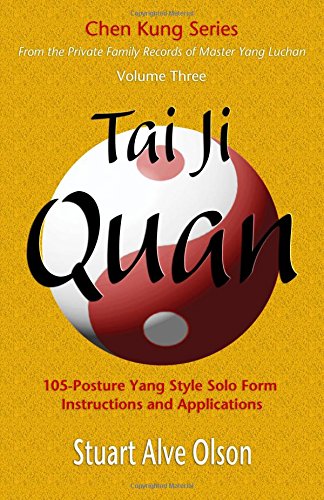
Tai Ji Quan: 105 Posture Yang Style Solo Form - Instructions and Applications. Chen Kung Series, From the Private Family Records of Master Yang Luchan, Volume Three. Translation and commentary by Master Stuart Alve Olson. Phoenix, Arizona, Valley Spirit Arts, 2017. Bibliography, appendices, 234 pages. ISBN: 978-1548105372. VSCL. "The long-awaited third volume in the Chen Kung Series presents the detailed instructions on the original Yang Style 105-Posture Taijiquan form, along with explanations of the practical self-defense applications, commentaries by Chen Kung, translations of the illustrations in the text, and notes by Stuart Alve Olson. A truly remarkable, insightful work that complements anyone’s library on the art of Taijiquan." "Born in 1906, Master Chen Kung (a.k.a., Yearning K. Chen and Chen Yen-lin) passed away in Shanghai, Chiina, in 1980. Master Chen Kung copied the Yang Family manuscripts in 1930."


Saturday, December 09, 2017

Five Beneficial Methods in the Study of Taijiquan

 Five Aims in the Study of Tai Chi Chuan

"1.  Your study should be broad and diversified.  Do not limit yourself.  This principle (virtue) can be compared to your stance, which moves easily in many different directions.  

2.  Examine and question.  Ask yourself how and why Tai Chi works.  This principle can be compared to your sensitivity, which is receptive to that which others ignore.  

3.  Be deliberate and careful in your thinking.  Use your mind to discover proper understanding.  This principle can be compared to your understanding power.

4.  Clearly examine.  Separate concepts distinctly, then decide upon the proper course.  This principle can be compared to the continuous motion of Tai Chi.

5.  Practice sincerely.  This principle can be compared to heaven and earth, the eternal."
T'ai Chi Classics, translations and commentary by Waysun Liao, p. 125 


Tai Chi Classics.  By Waysun Liao.  New translations of three essential texts of T'ai Chi Ch'uan with commentary and practical instruction by Waysun Liao.  Illustrated by the author.  Boston, Shambhala, 1990.  210 pages.  ISBN: 087773531X.  VSCL. 


Fair Lady Works the Shuttles
My upper torso and head are leaning a bit to much to the the right.
My lunge stance is strong.
A cold day in Winter in Red Bluff, California

Wednesday, March 25, 2015

Learning Tai Chi Chuan - Semi-Independent Study

The most frequent question I am asked is "Where I live there are no Taijiquan teachers of the the Taijiquan style X that I want to learn.  How do I go about learning Taijiquan Style X?"

You always need to learn Tai Chi by observing someone doing the Taijiquan form you are studying, and listening carefully to their instructions.  Fortunately, in 2015, for most Taijiquan forms, you have from two to ten different choices of very knowledgeable instructors or Masters who teach the Taijiquan form that you are learning by means of good instructional DVDs or videos.  Also, for some popular Taijiquan forms there are excellent books or manuals available for the form you are learning, or very good online webpages on the form.  Sometimes there are VCDs that can be played on a home computer.  Finally, there are some online courses and UTube demonstrations of the form you are learning.  

You are learning the "basics" from a good live teacher and/or a good writer.  All Taijiquan is learned this way.  

My own webpages provide extensive bibliographies of these many learning resources.  I also provide many suggestions and remarks about learning specific forms using DVDs, videos, and books, e.g.,  Standard 24 Taijiquan Form.  

Instructional DVDs come in NTSC and PAL formats, with NTSC format being used on DVD players in the United States.  If you are purchasing your DVD from outside the United States it is most likely in the PAL format and will not work properly on your DVD player.  Caveat Emptor.  

I use a small desktop DVD player.  My Vzon model, playing the NTSC format, has a hand held DVD controller and controls on the machine.  I no longer use instructional VHS videos, because you can't as easily cue as with DVDs. 

You want to purchase a DVD that teaches the Taijiquan form.  You want an instructional DVD, not a demonstration DVD.  Advanced Tai Chi students can sometimes learn from a demonstration DVD, but not without much difficulty.  All Tai Chi learners can benefit from a good instructional DVD that breaks the form down into discrete sections (lessons, blocks) and provides detailed verbal instructions on how to perform the movements in each section.  Sometimes a section is called a "lesson" and might include three or four movements of the form.  The best instructional DVDs feature frequent repetition of a movement, clear voice over narration, the use of different camera angles for showing a movement sequence, sectional performance demonstrations, and complete demonstrations of the form from a front and back view.  It is essential to get the narration in the language you use, because it is very hard to read subtitles and carefully study the the movements visually at the same time.   

Study each DVD lesson carefully, make notes, memorize the names of the movements in that lesson, then immediately practice each lesson until you can perform the movement sequence in the lesson on your own.  Repeat, repeat, repeat!!  Don't move on to the next lesson until you can perform the movements in the lesson you are studying on your own.  Give yourself a little slack and accept being just "satisfactory" at performing each lesson.  Over time you will refine and perfect your performance.   

After learning the first lesson, then proceed in the same manner to learn the second lesson.  Then combine the first and second lesson and practice them together until you can perform them on your own.  Don't move on to lesson three until you can easily and smoothly perform lessons one and two combined.  To "learn" means to me to be able to remember and easily, consistently, and smoothly perform a sequence of movements on your own.  Study Lesson 1, practice and learn Lesson 1; study Lesson 2, practice and learn Lessons 1 + 2; study Lesson 3, practice and learn Lessons 1 + 2 + 3; study Lesson 4, practice and learn Lessons 1 + 2 + 3 +4, etc. 

As with all learning the keys are: daily study, careful study, paying attention, remembering, daily practice, patience, repetition, visualization, verbal cues, making notes, and confidence.  Take your time, don't rush, be patient.  The process of learning might take months. 

Here are some suggestions from Robert Chuckrow: 

"Whereas a form-instruction video is no substitute for a qualified teacher, those who live far from any teacher are still better off learning from a video than if they had no instruction at all. For those who have a teacher, a video can augment and accelerate the learning process. Finally, those who have had prior instruction in internal arts should be able to attain a substantial benefit from a video.

One method of learning a form from a video is to repeatedly do the entire form or blocks of the form along with the video. However, this method is not efficient because there is insufficient opportunity to reinforce each movement. A better way is to refrain from doing movement while watching the video. Rather, it is good to choose a small block of material, watch it a few times. Then, without any major physical action, visualize the sequence of movements as clearly as possible. Next, go back to the beginning of that block of material, and view and visualize it again a few times. Only after clear and complete visualization is achieved should the movements be attempted physically.

At first it will seem extremely difficult to work this way. With persistence, however, it is possible to achieve a level of visualization so intense that the imagined movements are almost as vivid as those seen on a TV screen. The dividends of the process of visualization are twofold: (1) By subduing the physical aspects of movement (e.g., balance, coordination, kinetic sense, timing), you can completely focus the mind on the details of the movement. (2) By cultivating the ability to visualize and mentally encompass complex details, you become increasingly able to observe and learn new movements quickly, especially in situations where it is not feasible to move while observing (e.g., dreams, teacher showing movements while the class watches). Referring to the dimension of self-defense, the more you can observe and mentally encompass the movements of the opponent, the greater the advantage achieved."
- Robert Chuckrow, The Tai Chi Book, YMAA Publication Center, Boston, MA, 1998, pp. 119–120