Showing posts with label Eight Animal Frolics. Show all posts

Friday, June 02, 2023

Bear Frolics Dao Yin, Exercise #1

1.  The Big Bear Turns from Side to Side


Movement Description of Big Bear Turns from Side to Side 

Face towards N12.  
Bent the upper torso down, flexing forward, keep the back straight and head up. 
Move the upper torso slowly towards the right side of E3.  Try to remain bent forward until you reach E3.
Keep your hands on your hips throughout this exercise. 
Gradually lift the head and torso until you are upright and the face and chest are facing towards E3. 
Your right elbow should be pointing towards S6 and your left elbow pointing towards N12. 
Gently turn the head only to the left and look towards N12. 
Gently bring the head back to face towards E3, the whole body is in an upright posture. 
Bend forward at the waist and draw the head and torso downward towards E3.

Move the upper body, flexed forward, from right side to the left side for 180 degrees, moving from E3 to W9. 
Gradually lift the head and torso until you are upright, and the face and chest are facing towards W9. 
Your right elbow should be pointing towards N12 and your left elbow pointing towards S6. 
Gently turn the head only to the right and look towards N12. 
Gently turn the head only back to the left, and W9.
Bend forward at the waist and draw the head and torso downward towards W9.
Move the upper body, flexed forward, from the left side to the right side for 180 degrees, moving from W9 to E3. 
Repeat the movement sequence from side to side, 3 to 8 eight repetitions. 

Breathe freely, comfortably, and deeply during this exercise. 
Return to Bear Spirit Posture or Wu Ji Stance

Compare this version of "Big Bear Turns from Side to Side" with the version in the Eight Section Brocade Qigong, and with the demonstration.   


Bear Frolic Qigong Exercise Set

Eight Animals Frolics Mind/Body Fitness Practices (Chi Kung) by Mike Garofalo

The webpages for the eight specific animals will also have photographs of me or others doing these exercises.  There are also five, eight or twelve animals in Shaolin Kung Fu, Ba Gua Zhang, Taijiquan, and Xing Yi Quan.  Movements or postures called a "crane" or "hawk" or "rooster" are found in most of these mind-body internal arts.   

Chinese exercises recommended for improving fitness, maintaining good health, overcoming diseases, increasing energy and vitality, contributing to good mental health, and improving one's chances for longevity have a very long documented history going back to as early as 160 BCE in the Daoyin Tu.      


Repost from June 4, 2013

Saturday, June 01, 2013

Crane Frolic Chi Kung Exercise #6

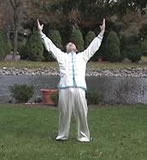
6.  The Crane Opens and Closes Its Wings

Begin in the basic Crane stance with the hands at the waist.  The legs are separated with a shoulder's width.  Stretch the fingers open.  Inhale as you lift both hands up the center of the body, fingers pointing forward, arms about 24" apart.
As the hands reach the neck begin to move both hands to the side, upwards, and backwards.  Spread the arms as far apart as you can and to either side of the body as you lift both arms high above the head.  Draw the arms up and back as you gently bend backwards.
At the same time as the arms are lifted up and back, try to lift both heels off the ground, and come up on your toes.  Look up at the sky with your head drawn back. 
As you begin to exhale, gently draw the arms forward and down, straighten the back, look forward, and move the arms down to the waist. 
Repeat for 4 to 8 repetitions in a gentle, slow, calm, deliberate, and smooth manner. 

This movement is found in the Wild Goose Qigong (Dayan Chi Kung) routine.  Refer to "Wild Goose Qigong" by Hong-Chao Zhang, pp.20-21. 
Back-bending while standing with the arms lifted above the head and with the hands touching is a commonly used hatha yoga posture called Anyvittasana.   
This exercise is a hyperextension of the back, stretching of the latissimus dorsi muscles of sides of the upper back, a stretching of the upper rectus abdominis, engaging the pectoralis major, and a tensing of the trapezius muscles in the upper back and neck. 
This movement opens and fills with Qi (Chi, Energy) the Middle Dan Tien (i.e., 中丹田, Zhong Dantian, middle elixir fields, cauldron) of the esoteric body system explained in Chinese Qigong (Yoga); or, analogously, opens the Heart Chakra (Anhata) of Hatha Yoga.  Exercise of this area in the front of the body helps heal disturbed emotions, calms the spirit, strengthens the heart and lungs, and opens the Heart-Soul to the grace of light energy. 
The wide-spread arms held up high help establish a feeling of opening up, freeing oneself, and uplifting one's mood and spirit. 
You often see this ritual body posture in Christian revival meetings as a kind of "Saying Hallelujah" posture.
If the movement was done forcefully and with power and quickly it would be the flapping of the wings of a powerful bird like a Crane or wild Goose or for a human bodybuilder the performance of incline dumbbell flys. 


Crane Frolic Qigong Exercise Set

Eight Animals Frolics Mind/Body Fitness Practices (Chi Kung) by Mike Garofalo
 

The webpages for the eight specific animals will also have photographs of me or others doing these exercises.  There are also five, eight or twelve animals in Shaolin Kung Fu, Ba Gua Zhang, Taijiquan, and Xing Yi Quan.  Movements or postures called a "crane" or "hawk" or "rooster" are found in most of these mind-body internal arts.   

Chinese exercises recommended for improving fitness, maintaining good health, overcoming diseases, increasing energy and vitality, contributing to good mental health, and improving one's chances for longevity have a very long documented history going back to as early as 160 BCE in the Daoyin Tu.    

Monday, May 27, 2013

Eight Animals Frolic Chi Kung Exercises

Eight Animals' Frolics Chi Kung Exercises
A webpage by Michael P. Garofalo

Five Animal Frolics Qigong (Wu Qin Xi)

Valley Spirit Qigong in Red Bluff, California


""Breathing in and out in various manners, spitting out the old and taking in the new, walking like a bear and stretching their neck like a bird to achieve longevity - this is what such practitioners of Daoyin, cultivators of the body and all those searching for long life like Ancestor Peng, enjoy."
-   Chuang-tzu, circa 300 BCE. (1)

 
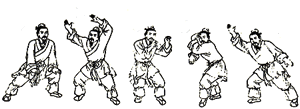
There was a feudal lord, the Marquis of Dai (King Ma), who lived around 160 BCE during the Western Han Dynasty.  When the Marquis of Dai, his wife, and his son died, there were many objects placed in their family tomb as part of funeral rites and customs.  In 1973, archeologists in China excavated the family tomb of the Dai family on the outskirts of the city of Changsha in Hunan Province.  In the son's tomb they discovered a lacquered box containing medical manuals, documents, and a silk scroll on which were drawn 44 humans in various poses or postures.  Under each pose was a caption with the name of an animal or the name of a disease that the posture might help prevent or cure.  The chart or diagram (Tu) on this scroll shows Daoyin (Guiding/Leading Energy and Stretching/Pulling Out) exercises or poses.  A number of the postures shown on this Daoyin Tu closely resemble some in the Eight Section Brocade and in the Five Animal Frolics (i.e., the bear, monkey, and bird).  (2)


Improved artistic rendition of the Daoyin Tu, circa 160 BCE.

Another medical manuscript with Daoyin methods, the Yinshu (Stretch Book), dated at 186 BCE, related to the Daoyin Tu, describes 100 exercises, and gives advice on seasonal health regimens, hygiene, diet, disease prevention, sleep, and sexual behavior. (2)   We have ample evidence that Chinese physicians, and the aristocratic and wealthy classes of ancient Chinese society, had access to therapeutic and holistic exercise and massage methods (Daoyin) well before the advent of the Eastern Han Dynasty (25-220 CE)."

Eight Animals' Frolics Chi Kung Exercises
Introduction to Animal Frolics by Michael P. Garofalo