Showing posts with label Ba Duan Jin. Show all posts

Thursday, November 03, 2022

Eight Section Brocade Chi Kung and the Eight Trigrams


Sequence C:  Trigrams, Bagua, and Eight Section Brocade (Ba Duan Jin) Exercises Correlations

Soft Qigong (Rou Gong), Inner Qigong (Nei Gong); Slow Pace, Gentle, Soft, At Ease, Relaxed (Sung), Rooted/Sunk, Yin Style
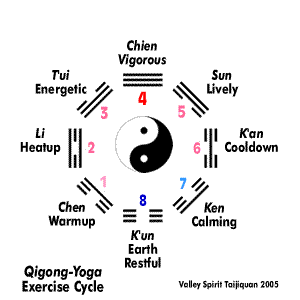
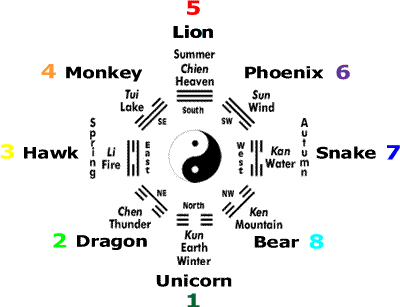


Eight Section Brocade Exercise
I Ch'ing Trigram 
Parts of the Body Affected
1.  Pressing Up to the Heavens with
Two Hands
South, Summer
Ch'ien, Qián, Heaven, Sky, Air
Intense Yang
Lion
Heart, Small Intestine, Stomach, Lungs
(The Triple Warmer)
              
2.  Drawing the Bow and Letting the Arrow Fly Southwest, Mid-Summer
Sun, Wind
Yang
Phoenix
Kidneys, Spleen, Waist, Eyes, Legs
                     
4.  Wise Owl Gazes Backward West, Autumn
K'an, Water
Yang-Yin
Snake
Lungs, Immune System, Large Intestine
                   
5.  Big Bear Turns from Side to Side Northwest, Mid-Autumn
Ken, Gèn, Mountain
Yin-Yang
Bear
Heart, Waist, Legs
                   
3.  Separating Heaven and Earth North, Winter
K'un, Earth
Intense Yin
Unicorn, Qilin
Spleen, Kidneys, Bladder, Pancreas
                        

8.  Shaking the Body Northeast, Mid-Winter
Chen, Zhèn, Thunder
Yin
Dragon
Immune System, Calves, Feet
                         
6.  Punching with Angry Gaze Spring, East
Li, Fire
Yin-Yang
Hawk, Falcon
Liver, Gallbladder, Blood, Eyes
                      

8.  Touching Toes then Bending Backwards Southeast, Mid-Spring
Tui, Lake
Yang-Yin
Monkey

 
Kidneys, Waist, Legs, Back

The above three charts were proposed in 2005 by Mike Garofalo, in his webpage on the Eight Section Brocade.  See also Mike's webpage on the Eight Trigrams.  


In 2014, Christina Barea-Young and Peyton Young provided another set of associations for the Eight Section Brocade movements with the Eight Trigrams in Qi Magazine (Volume 24, No. 2, 2014, p. 48).  

I find these kinds of correlations, associations, and relational charts quite inconsistent between various authors.  Yoga, Western Esoteric Magic, and Qigong have many of the same kind of charts and tables of correlations; again, with considerable inconsistency between various "masters."  Other than the "traditions of specific esoteric schools", I find the associations rather arbitrary and fanciful, primarily aids to remembering clusters of ideas, poetic devices, magical-metaphysical lore, and lacking in much pragmatic-scientific meaningfulness.  Contrast these charming and pre-scientific tables with the modern and justifiably famous "Periodic Table of the Elements" for a real lesson in an objective and empirical approach to understanding the world.  Nevertheless, these clusters of ideas may stimulate the imagination, and are fun for playing thought games.  


"The names of the 108 Forms are each symbolic and signify concepts removed from the literal  physicality of the object - horse, tiger, bird, and so forth.  Each name has its separate allusion, and metaphorically may connote an aspiration, a philosophical attitude towards self and  conduct, a turn of mind, a sense of being, some thought about life and spirit.  The true meanings are revealed when the T'ai-Chi Ch'uan exponent has advanced to that stage of experience comprehension where he can utilize the implication of the philosophical  intentions, and where the symbols can be part of his growing consciousness.  This happens only when the mind and body have "changed" and absorbed the reasons for mental, emotional, and physical unity."
-   Sophia Delza, The T'ai Chi Ch'uan Experience, 1996, p. 24


The above long chart is more readable on my Eight Section Brocade webpage, 441 KB, last updated on June 20, 2014. 


Thursday, February 04, 2021

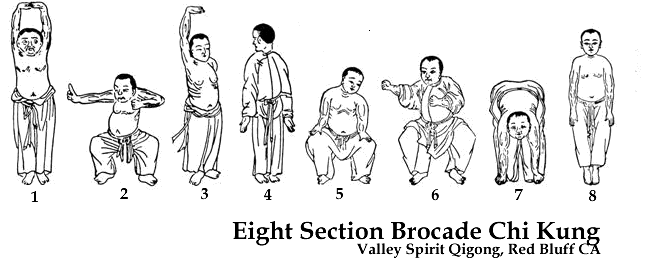
Eight Section Brocade Chi Kung Exercises

 "All students should learn the Eight Treasures first, because many people have serious energy blocks and the Eight Treasures are more effective in quickly breaking through them that the more subtle Tai Chi."
- Hua-Ching Ni, "Workbook for Spiritual Development," Tao of Wellness Press, 1992, p. 138


An excellent book to read regarding a seated version of the Eight Treasures is by Stuart Alve Olson, "Qigong Teachings of a Taoist Immortal: The Eight Essential Exercises of Master Li Ching-Yun.  


Eight Section Brocade Qigong

Eight Silken Treasures Qigong

Ba Duan Jin Qigong
History, Instructions, Bibliography, Links, Resources, Quotes
Researched by Michael P. Garofalo
Last Updated on October 24, 2017

Eight Section Brocade Qigong By Michael P. Garofalo.

this webpage provides information about the history and purpose of this popular Chi Kung practice. Detailed descriptions are provided for each of the eight movements; including information on movement variations, health benefits, qigong meaning, and cautions. The document includes the most extensive bibliography, link guide, and comments on Ba Duan Jin Qigong resources available anywhere. Some animated graphics are provided in linked files. This document is updated as new information is discovered. 

This qigong set is the most popular set practiced around the world, and is also known as: Baduanjin, Pa Tuan Jin, Eight Silken Treasures, Ba Duan Jin, Pal Dan Gum, Ba Duan Gin, Pa Tin Kam, Otto Pezzi di Tesoro, Acht Delen Brokaat, Les Huit Exercices del la Soie, Eight Silken Treasures, Brocade Qigong, Wudang Brocade Qigong, Brocade soft qigong (Rou Gong), Eight Treasures inner qigong (Nei Gong), Silk Treasures Qigong, and the first eight Buddha Lohan Hands. 

This hypertext document is 164 pages in length, over 39,000 words, and with a filesize of 448Kb.  This document has been online since 2002.  

Web File Location: http://www.egreenway.com/taichichuan/esb.htm.


Monday, November 27, 2017

Bau Daun Jin Research


Eight Section Brocade Chi Kung


Bibliography, Instructions, Links, Benefits, Exercises, History, Lore
A Hypertext Notebook
By Michael P. Garofalo, M.S.


463 Kb, November 28, 2017


Chi Kung (Dao-yin, Yang Sheng Gong, Qigong) are Various Ancient Chinese Exercise and Fitness Practices

The Eight Pieces of Beautiful Silk Brocade Chi Kung (Ba Duan Jin Qigong) is a popular Chi Kung Form.    

The Eight Treasures Dao-yin (Ways for Pulling, Stretching, and Guiding the Body-Mind Energies)

The Eight Useful Chi Kung Exercises for Improved Fitness, Vitality, Healing, and Longevity 

Eight Immortal Ones Taoist Longevity Practices  

Eight Beautiful Tapestries Chi Kung for Nourishing Life Training (Yang Sheng Gong)

A Shaolin Temple, Taijiquan and Martial Arts Warm-up Routine


Sunday, October 29, 2017

Eight Treasures Chi Kung

"All students should learn the Eight Treasures first, because many people have serious energy blocks and the Eight Treasures are more effective in quickly breaking through them that the more subtle Tai Chi."
- Hua-Ching Ni, "Workbook for Spiritual Development," Tao of Wellness Press, 1992, p. 138


An excellent book to read regarding a seated version of the Eight Treasures is by Stuart Alve Olson, "Qigong Teachings of a Taoist Immortal: The Eight Essential Exercises of Master Li Ching-Yun.  

Eight Section Brocade Qigong

Eight Silken Treasures Qigong

Ba Duan Jin Qigong
History, Instructions, Bibliography, Links, Resources, Quotes
Researched by Michael P. Garofalo
Last Updated on October 24, 2017

Eight Section Brocade Qigong By Michael P. Garofalo.

this webpage provides information about the history and purpose of this popular Chi Kung practice. Detailed descriptions are provided for each of the eight movements; including information on movement variations, health benefits, qigong meaning, and cautions. The document includes the most extensive bibliography, link guide, and comments on Ba Duan Jin Qigong resources available anywhere. Some animated graphics are provided in linked files. This document is updated as new information is discovered. 

This qigong set is the most popular set practiced around the world, and is also known as: Baduanjin, Pa Tuan Jin, Eight Silken Treasures, Ba Duan Jin, Pal Dan Gum, Ba Duan Gin, Pa Tin Kam, Otto Pezzi di Tesoro, Acht Delen Brokaat, Les Huit Exercices del la Soie, Eight Silken Treasures, Brocade Qigong, Wudang Brocade Qigong, Brocade soft qigong (Rou Gong), Eight Treasures inner qigong (Nei Gong), Silk Treasures Qigong, and the first eight Buddha Lohan Hands. 

This hypertext document is 164 pages in length, over 39,000 words, and with a filesize of 448Kb.  This document has been online since 2002.  

Web File Location: http://www.egreenway.com/taichichuan/esb.htm.


Monday, February 22, 2016

Eight Treasures Chi Kung Exercise Set

I frequently teach the Chinese Eight Section Brocade Chi Kung exercise and fitness routine in my Taijiquan class and my Yoga class.  Naturally, I include many comments about Shaolin and Daoist fitness and healthy living concepts.

This Eight Treasures exercise and fitness routine has a varied and long history with ancient roots back to the Animal Frolics Dao-yin exercises of 300 CE.  Some of the Eight Treasures exercises involve toughening, courage, and fighting and were used in military exercise and conditioning drills.  Many versions of the Ba Duan Jin include 12 exercises or more.   

One recent book that provides good documentation on the history of Chinese exercise practices (Chi Kung, Qigong, Neigong), including five illustrated versions of the Eight Section Brocade, is:  

An Illustrated Handbook of Chinese Qigong Forms from the Ancient Texts  Complied by Li Jingwei and Zhu Jianping.  London, Singing Dragon, 2014.  No index or bibliography, 325 pages.  ISBN: 9781848191976.  Many excellent line drawings are included to illustrate the postures.  VSCL. 

Back in 2002, I created the webpage titled:  The Eight Section Brocade Chi Kung.
  

The Ba Duan Jin Qigong form includes eight basic exercises to help you keep limber, become stronger, improve your balance, and increase your stamina.  There are opportunities for squatting movements and postures to strengthen the legs.  
  The entire Eight Beautiful Tapestries Chi Kung form is normally done while standing, although there are some versions done in a seated posture for meditative purposes or for frail persons. 


There are numerous versions of this popular Chi Kung form.  There are many good books, instructional DVDs, and UTube videos to choose from on this topic.  My webpage includes a long bibliography on the Eight Section Brocade Chi Kung with citations for resources, links, videos, books, and instructional DVDs on the subject.  
  I make a number of comments about each of the eight movements, including comments about the movement variations, physical training targets, muscles worked, attitude, internal alchemy (Neidan), benefits, options, comparisons with yoga asanas, and breathing patterns.  
  

I offer my own version with fairly detailed comments on each of the eight movements.  Here is my one page class handout for the Eight Section Brocade Chi Kung class.  


"The name “Ba Duan Jin” has been found as early as the Northern Song Dynasty. According to Hong Mai's (洪邁) Yi Jian Zhi (夷堅志, Song Dynasty), Zhenghe Seventh Year, Emperor's Chief Secretary, Li Shi-Ju, lived a simple life.  He spent a large portion of his time in his mediation room practicing Daoist Monk’s exercises expanding like a bear and stretching like a bird. In the early hours, he is often found breathing and massaging, practicing the so-called Eight-Section Brocade (Ba Duan Jin). This passage reveals that Ba Duan Jin has been developed and practiced since the Song Dynasty as a general health-keeping regime.
    
Both sitting and standing forms have been found in the history of Ba Duan Jin (
八段錦),. Standing forms were developed into two schools (northern and southern styles) in the Qing Dynasty. The Northern School, said to have been passed down by Yue Fei (岳飛), has tougher forms, and the Southern School, claimed the lineage from Liang Shi-Chang (梁世昌), focuses on softer trainings. Quite a few verses has been passed down during the period from Song Dynasty to Qing Dynasty, but all verses for the standing forms have evolved from the passages recorded in "The Chapter of Wonders, Pivot of Dao" (道樞·眾妙篇, Dao Shu, Zong Miao Pian, Song Dynasty) and verses of the sitting style from the forms recorded in "TheTen Books of Daoist Practices" (修真十書 Xiu Zhen Shi Shu, Ming Dynasty ).  or "The Methods of Curing"(活人心法, Huo Ren Xin Fa, Ming Dynasty). Sets Ba Duan Jin forms are not always limited to the number of eight. The number of forms in a set range from a single form to tens or as many as a hundred; nevertheless, they are all exercise regimes designed for health-keeping, preventive, and therapeutic purposes, and, liberally saying, all exercise regimes designed for such purposes are part of the Ba Duan Jin system."
-   Lee Chang-Chih, 
 A Brief Introduction to Ba Daun Jin.  "Reinterpreting Ba Duan Jing From the Theories of the Eight Extra Meridians" 2005 


Wednesday, September 24, 2014

Ba Duan Jin Chi Kung

I frequently teach the Chinese Eight Section Brocade Chi Kung exercise and fitness routine in my Taijiquan class and my Yoga class.  Naturally, I include many comments about Shaolin and Daoist fitness and healthy living concepts. 

This Eight Treasures exercise and fitness routine has a varied and long history with ancient roots back to the Animal Frolics Dao-yin exercises of 300 CE.  Some of the Eight Treasures exercises involve toughening, courage, and fighting and were used in military exercise and conditioning drills.  Many versions of the Ba Duan Jin include 12 exercises or more.   

One recent book that provides good documentation on the history of Chinese exercise practices (Chi Kung, Qigong, Neigong), including five illustrated versions of the Eight Section Brocade, is:  

An Illustrated Handbook of Chinese Qigong Forms from the Ancient Texts  Complied by Li Jingwei and Zhu Jianping.  London, Singing Dragon, 2014.  No index or bibliography, 325 pages.  ISBN: 9781848191976.  Many excellent line drawings are included to illustrate the postures.  VSCL. 
 
Back in 2002, I created the webpage titled:  The Eight Section Brocade Chi Kung.
  

The Ba Duan Jin Qigong form includes eight basic exercises to help you keep limber, become stronger, improve your balance, and increase your stamina.  There are opportunities for squatting movements and postures to strengthen the legs.  
  The entire Eight Beautiful Tapestries Chi Kung form is normally done while standing, although there are some versions done in a seated posture for meditative purposes or for frail persons. 


There are numerous versions of this popular Chi Kung form.  There are many good books, instructional DVDs, and UTube videos to choose from on this topic.  My webpage includes a long bibliography on the Eight Section Brocade Chi Kung with citations for resources, links, videos, books, and instructional DVDs on the subject.  
  I make a number of comments about each of the eight movements, including comments about the movement variations, physical training targets, muscles worked, attitude, internal alchemy (Neidan), benefits, options, comparisons with yoga asanas, and breathing patterns.  
 

I offer my own version with fairly detailed comments on each of the eight movements.  Here is my one page class handout for the Eight Section Brocade Chi Kung class.  


"The name “Ba Duan Jin” has been found as early as the Northern Song Dynasty. According to Hong Mai's (洪邁) Yi Jian Zhi (夷堅志, Song Dynasty), Zhenghe Seventh Year, Emperor's Chief Secretary, Li Shi-Ju, lived a simple life.  He spent a large portion of his time in his mediation room practicing Daoist Monk’s exercises expanding like a bear and stretching like a bird. In the early hours, he is often found breathing and massaging, practicing the so-called Eight-Section Brocade (Ba Duan Jin). This passage reveals that Ba Duan Jin has been developed and practiced since the Song Dynasty as a general health-keeping regime. 
   
Both sitting and standing forms have been found in the history of Ba Duan Jin (
八段錦),. Standing forms were developed into two schools (northern and southern styles) in the Qing Dynasty. The Northern School, said to have been passed down by Yue Fei (岳飛), has tougher forms, and the Southern School, claimed the lineage from Liang Shi-Chang (梁世昌), focuses on softer trainings. Quite a few verses has been passed down during the period from Song Dynasty to Qing Dynasty, but all verses for the standing forms have evolved from the passages recorded in "The Chapter of Wonders, Pivot of Dao" (道樞·眾妙篇, Dao Shu, Zong Miao Pian, Song Dynasty) and verses of the sitting style from the forms recorded in "TheTen Books of Daoist Practices" (修真十書 Xiu Zhen Shi Shu, Ming Dynasty ).  or "The Methods of Curing"(活人心法, Huo Ren Xin Fa, Ming Dynasty). Sets Ba Duan Jin forms are not always limited to the number of eight. The number of forms in a set range from a single form to tens or as many as a hundred; nevertheless, they are all exercise regimes designed for health-keeping, preventive, and therapeutic purposes, and, liberally saying, all exercise regimes designed for such purposes are part of the Ba Duan Jin system."
-   Lee Chang-Chih,
 A Brief Introduction to Ba Daun Jin.  "Reinterpreting Ba Duan Jing From the Theories of the Eight Extra Meridians" 2005 


Monday, May 12, 2014

Eight Section Brocade Exercise Routine

I frequently teach the Chinese Eight Section Brocade Chi Kung exercise and fitness routine in my Taijiquan class and my Yoga class.  Naturally, I include many comments about Shaolin and Daoist fitness and healthy living concepts. 

This Eight Treasures exercise and fitness routine has a varied and long history with ancient roots back to the Animal Frolics Dao-yin exercises of 300 CE.  Some of the Eight Treasures exercises involve toughening, courage, and fighting and were used in military exercise and conditioning drills.  Many versions of the Ba Duan Jin include 12 exercises or more.   

One recent book that provides good documentation on the history of Chinese exercise practices (Chi Kung, Qigong, Neigong), including five illustrated versions of the Eight Section Brocade, is:  

An Illustrated Handbook of Chinese Qigong Forms from the Ancient Texts  Complied by Li Jingwei and Zhu Jianping.  London, Singing Dragon, 2014.  No index or bibliography, 325 pages.  ISBN: 9781848191976.  Many excellent line drawings are included to illustrate the postures.  VSCL. 
 
Back in 2002, I created the webpage titled:  The Eight Section Brocade Chi Kung.
  

The Ba Duan Jin Qigong form includes eight basic exercises to help you keep limber, become stronger, improve your balance, and increase your stamina.  There are opportunities for squatting movements and postures to strengthen the legs.  
  The entire Eight Beautiful Tapestries Chi Kung form is normally done while standing, although there are some versions done in a seated posture for meditative purposes or for frail persons. 


There are numerous versions of this popular Chi Kung form.  There are many good books, instructional DVDs, and UTube videos to choose from on this topic.  My webpage includes a long bibliography on the Eight Section Brocade Chi Kung with citations for resources, links, videos, books, and instructional DVDs on the subject.  
  I make a number of comments about each of the eight movements, including comments about the movement variations, physical training targets, muscles worked, attitude, internal alchemy (Neidan), benefits, options, comparisons with yoga asanas, and breathing patterns.  
 

I offer my own version with fairly detailed comments on each of the eight movements.  Here is my one page class handout for the Eight Section Brocade Chi Kung class.  


"The name “Ba Duan Jin” has been found as early as the Northern Song Dynasty. According to Hong Mai's (洪邁) Yi Jian Zhi (夷堅志, Song Dynasty), Zhenghe Seventh Year, Emperor's Chief Secretary, Li Shi-Ju, lived a simple life.  He spent a large portion of his time in his mediation room practicing Daoist Monk’s exercises expanding like a bear and stretching like a bird. In the early hours, he is often found breathing and massaging, practicing the so-called Eight-Section Brocade (Ba Duan Jin). This passage reveals that Ba Duan Jin has been developed and practiced since the Song Dynasty as a general health-keeping regime. 
   
Both sitting and standing forms have been found in the history of Ba Duan Jin (
八段錦),. Standing forms were developed into two schools (northern and southern styles) in the Qing Dynasty. The Northern School, said to have been passed down by Yue Fei (岳飛), has tougher forms, and the Southern School, claimed the lineage from Liang Shi-Chang (梁世昌), focuses on softer trainings. Quite a few verses has been passed down during the period from Song Dynasty to Qing Dynasty, but all verses for the standing forms have evolved from the passages recorded in "The Chapter of Wonders, Pivot of Dao" (道樞·眾妙篇, Dao Shu, Zong Miao Pian, Song Dynasty) and verses of the sitting style from the forms recorded in "TheTen Books of Daoist Practices" (修真十書 Xiu Zhen Shi Shu, Ming Dynasty ).  or "The Methods of Curing"(活人心法, Huo Ren Xin Fa, Ming Dynasty). Sets Ba Duan Jin forms are not always limited to the number of eight. The number of forms in a set range from a single form to tens or as many as a hundred; nevertheless, they are all exercise regimes designed for health-keeping, preventive, and therapeutic purposes, and, liberally saying, all exercise regimes designed for such purposes are part of the Ba Duan Jin system."
-   Lee Chang-Chih,
 A Brief Introduction to Ba Daun Jin.  "Reinterpreting Ba Duan Jing From the Theories of the Eight Extra Meridians" 2005 


Thursday, April 10, 2014

Ba Duan Jin Chi Kung

I frequently teach the Chinese Eight Section Brocade Chi Kung exercise and fitness routine in my Taijiquan class and my Yoga class.  Naturally, I include many comments about Shaolin and Daoist fitness and healthy living concepts. 

This Eight Treasures exercise and fitness routine has a varied and long history with ancient roots back to the Animal Frolics Dao-yin exercises of 300 CE.  Some of the Eight Treasures exercises involve toughening, courage, and fighting and were used in military exercise and conditioning drills.  Many versions of the Ba Duan Jin include 12 exercises or more.  
 
Back in 2002, I created the webpage titled:  The Eight Section Brocade Chi Kung.  
  
The Ba Duan Jin Qigong form includes eight basic exercises to help you keep limber, become stronger, improve your balance, and increase your stamina.  There are opportunities for squatting movements and postures to strengthen the legs.  
The entire Eight Beautiful Tapestries Chi Kung form is normally done while standing, although there are some versions done in a seated posture for meditative purposes or for frail persons. 

There are numerous versions of this popular Chi Kung form.  There are many good books, instructional DVDs, and UTube videos to choose from on this topic.  My webpage includes a long bibliography on the Eight Section Brocade Chi Kung with citations for resources, links, videos, books, and instructional DVDs on the subject.  
I make a number of comments about each of the eight movements, including comments about the movement variations, physical training targets, muscles worked, attitude, internal alchemy (Neidan), benefits, options, comparisons with yoga asanas, and breathing patterns.  
I offer my own version with fairly detailed comments on each of the eight movements.  Here is my one page class handout for the Eight Section Brocade Chi Kung class.