Thursday, June 04, 2026
Standing Fully on a Single Leg
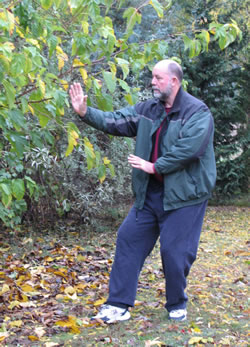
"The Taichi Classics say that the proper root is in the foot. A beginner can develop root by simply spending three to five minutes, morning and night, standing fully on a single leg. Alternate legs and gradually increase the time as you sink lower. This 'bitter work' not only develops a root, it stimulates the cardiovascular system, with benefits the brain. It is essential that your ch'i sinks to the tan-t'ien, both feet adhere to the floor, and you exert absolutely no force. When practicing this Standing Posture, you may assist your balance by lightly touching a chair or table with the middle and index fingers. After a while us only the middle finger. When you can stand unassisted, you my choose either the Lift Hands Posture or Playing the Guitar Posture to continue your practice. Do not fear bitter work. If you do you will never progress."
- Professor Cheng Man-ch'ing, New Method of Taichi Ch'uan Self-Cultivation, 1965, 1999, p. 11
Practitioners might also do the Golden Rooster Stands on One Leg Posture or the White Stork Spreads Its Wings Posture.
Standing on one leg, holding static poses, is also a common practice in Hatha Yoga, e.g., Tree Pose, Vriksasana.
Standing Meditation
You stand on one leg. You can hold the arms in a variety of positions. I suppose you could even hold weights in the hands. You can hold the lifted leg in a variety of positions. There are many possibilities for different static postures. You could use a cane or staff to help with balance. You "can develop root by simply spending three to five minutes, morning and night, standing fully on a single leg."
Effectively Using Rooting, Sinking, Centered, and Vertical Forces in Taijiquan
Effectively Using Rotating, Spiraling, Spinning, and Circular Forces in Taijiquan
Friday, October 17, 2025
Iconic Posture: A Picture to Represent a Taijiquan Form
Repost from April 3, 2016:
"Fu Zhongwen uses a number of terms that require additional explanation. One of these is the term for what is typically called the ending postures of the forms, that is, the terminus point of a given posture such as White Crane Displays Wings. The term that Fu Zhongwen uses for these ending postures is dingdian, or "fixed points." In Taijiquan, however, these "fixed points" are not really fixed, and "ending postures" are not really the end of anything. Fu Zhongwen therefore advises the reader that " as each movement reaches a fixed point (dingdian), one must accomplish what is called "seems to stop, does not stop." The dingdian, then must be understood to be both the culmination of one sequence as well as the beginning of the next."
- Mastering Yang Style Taijiquan
The dingdian is an experienced physical posture, a temporary fixed form, a still photograph, a line drawing, a mental picture, an icon, a temporary fixed point in a flow of movements, a name for a fixed point somewhere in or near the end of a particular numbered posture sequence in a taijiquan form. Here is Yang Cheng Fu's version of the dingdian for Single Whip Left:
Looks like Virabadrasana II in Hatha Yoga. Just hold the above posture, don't move, settle, endure, tough it out. Hold for one minute, then shift to right leg forward lunge in Single Whip Right for one more minute. Hold for longer periods for increased intensity.
Yang Taijiquan Quotes and Notes
Yang Style Standard 24 Form Taijiquan
Yang Family Style Taijiquan Long 108 Form
Tuesday, April 12, 2022
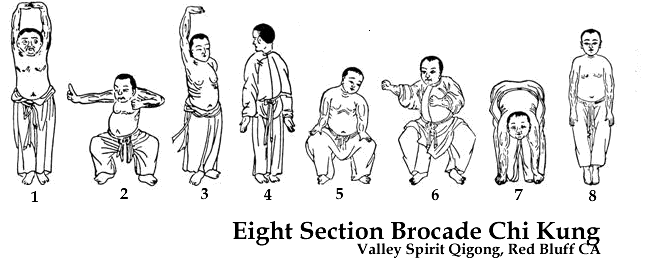
Wudang Chi Kung: The Eight Section Brocade Chi Kung
1. Lift the ground and hold the sky to take care of the three internal cavities
2. Draw a bow to the left and right, just like shooting a vulture
3. Lift the hand up singly to tone and caress the spleen and the stomach
4. Look backwards to cure the five strains and seven injuries
5. Reach down the leg by both hands to strengthen the kidney and the reproductive organ
6. Swivel the head and rock the bottom to calm down
7. Rotate fists and stare to add stamina
8. Vibrate the back seven times to expel illness
The first segment takes care of the three chiaos (internal organs), the second segment strengthens the heart and the lung, the third regulates the spleen and the stomach, the fourth cures strains and injuries, the fifth toughens the kidney and reproductive organ, the sixth calms the nervous system, the seventh increases stamina, the eighth gets rid of illnesses. It has materialised the merging of the theory and movements of Badunjin with clinical sports, as well as specified the importance of life-nourishment and health-preservation. Badunjin Qigong, uplifted by the modern medical confirmation from Chinese and western professionals and scholars, continues to be revitalised and made to perfection. Thus it has been made even more suitable and practical to serve the needs of the modern era, and advances with time.
The theory and movements of Wudang Badunjin is thorough; it is safe and easy to learn, and has a wide application on medical cure. Externally, it exercises the skin, muscles, tendons and bones; internally, it strengthens the organs, improves the circulatory system, and consolidates the spirit of well being. Its movements involve breathing naturally, and are smart & light, continuous and lively, elegant and beautiful, stretchy and graceful, alternating relaxing with tightening, synchronising harmoniously, can be fast or slow but with distinct rhythm, can be complicated or simple, active or quiet, and cohere the opening with the closing. It stresses on the mutual use of toughness and gentleness, the training of the internal and external body parts, the merging of activity and quietness, the balancing of the left and the right, the top and the bottom, alternating the real and the virtual, and nourishing both the body and the spirit. The amount of exercise and the length of the practice session can be adjusted anytime, and it can be practised alongside with other exercises. Age, sex, body nature, location, equipment, time, season, etc do not restrict the practice. It can be practised individually, with the whole family, or with a group. The all-encompassing effect and value of its body-strengthening and medical aspects is evergreen."
- Wudang Mountain Badunjin Qigong 20Kb. Original (in Chinese) written in Hong Kong by Woo Kwong Fat, the 28th Generation Master of Dragon Gate Branch, Wudang Mountain.
Wudang Qigong
Eight Section Brocade Qigong (Baduanjin)
Thursday, September 24, 2020
Ending Postures, DingDian, Snapshots in a Sequence
One point in a sequence of movements in Yang Style Taijiquan.
I continue to move thereafter; but my cat keeps the same posture while watching.
"Fu Zhongwen uses a number of terms that require additional explanation. One of these is the term for what is typically called the ending postures of the forms, that is, the terminus point of a given posture such as White Crane Displays Wings. The term that Fu Zhongwen uses for these ending postures is dingdian, or "fixed points." In Taijiquan, however, these "fixed points" are not really fixed, and "ending postures" are not really the end of anything. Fu Zhongwen therefore advises the reader that " as each movement reaches a fixed point (dingdian), one must accomplish what is called "seems to stop, does not stop." The dingdian, then must be understood to be both the culmination of one sequence as well as the beginning of the next."
- Mastering Yang Style Taijiquan By Fu Zhongwen. Translated by Louis Swaim. Blue Snake Books, 2006, p. xix.
The dingdian is an experienced physical posture, a temporary fixed form, a still photograph, a line drawing, a mental picture, an icon, a temporary fixed point in a flow of movements. It is a name for a fixed point somewhere in or near the end of a particular numbered posture sequence in a taijiquan form. Here is Yang Cheng Fu's version of the dingdian for Single Whip:
Sort of looks like Virabadrasana II in Hatha Yoga. In Hatha Yoga you just hold the above posture, don't move, settle, endure, tough it out. Hold for one or more minutes, then shift to right leg forward lunge in Virabadrasana II (Warrior Pose) or Single Whip Right for one or more minutes. Hold for longer periods for increased strength and endurance training.
Saturday, December 09, 2017
Five Beneficial Methods in the Study of Taijiquan
2. Examine and question. Ask yourself how and why Tai Chi works. This principle can be compared to your sensitivity, which is receptive to that which others ignore.
3. Be deliberate and careful in your thinking. Use your mind to discover proper understanding. This principle can be compared to your understanding power.
4. Clearly examine. Separate concepts distinctly, then decide upon the proper course. This principle can be compared to the continuous motion of Tai Chi.
5. Practice sincerely. This principle can be compared to heaven and earth, the eternal."
- T'ai Chi Classics, translations and commentary by Waysun Liao, p. 125
Tai Chi Classics. By Waysun Liao. New translations of three essential texts of T'ai Chi Ch'uan with commentary and practical instruction by Waysun Liao. Illustrated by the author. Boston, Shambhala, 1990. 210 pages. ISBN: 087773531X. VSCL.
Chen Taijiquan Quotations, Sayings, Lore, Classics, Principles
Thirteen Postures of Tai Chi Chuan
My lunge stance is strong.
A cold day in Winter in Red Bluff, California
Sunday, November 26, 2017
Eight Section Brocade
Eight Section Brocade, Ba Duan Jin
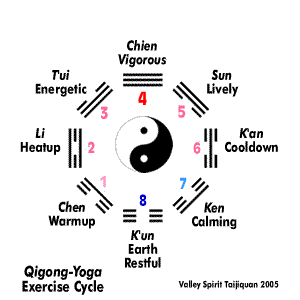
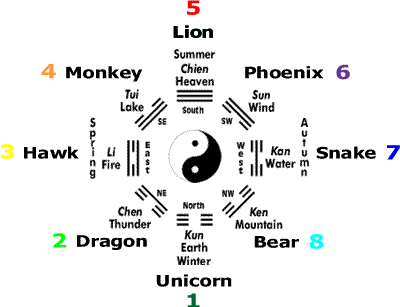
Sequence C: Trigrams, Bagua, and Eight Section Brocade (Ba Duan Jin) Exercises Correlations
Soft Qigong (Rou Gong), Inner Qigong (Nei Gong); Slow Pace, Gentle, Soft, At Ease, Relaxed (Sung), Rooted/Sunk, Yin Style
Eight Section Brocade Exercise
|
I Ch'ing Trigram
|
Parts of the Body Affected
|
| 1. Pressing Up to the Heavens with Two Hands | South, Summer Ch'ien, Qián, Heaven, Sky, Air Intense Yang Lion | Heart, Small Intestine, Stomach, Lungs (The Triple Warmer) |
| 2. Drawing the Bow and Letting the Arrow Fly | Southwest, Mid-Summer Sun, Wind Yang Phoenix | Kidneys, Spleen, Waist, Eyes, Legs |
| 4. Wise Owl Gazes Backward | West, Autumn K'an, Water Yang-Yin Snake | Lungs, Immune System, Large Intestine |
| 5. Big Bear Turns from Side to Side | Northwest, Mid-Autumn Ken, Gèn, Mountain Yin-Yang Bear | Heart, Waist, Legs |
| 3. Separating Heaven and Earth | North, Winter K'un, Earth Intense Yin Unicorn, Qilin | Spleen, Kidneys, Bladder, Pancreas |
| 8. Shaking the Body | Northeast, Mid-Winter Chen, Zhèn, Thunder Yin Dragon | Immune System, Calves, Feet |
| 6. Punching with Angry Gaze | Spring, East Li, Fire Yin-Yang Hawk, Falcon | Liver, Gallbladder, Blood, Eyes |
| 8. Touching Toes then Bending Backwards | Southeast, Mid-Spring Tui, Lake Yang-Yin Monkey | Kidneys, Waist, Legs, Back |
The above three charts were proposed in 2005 by Mike Garofalo, in his webpage on the Eight Section Brocade. See also Mike's webpage on the Eight Trigrams.
In 2014, Christina Barea-Young and Peyton Young provided another set of associations for the Eight Section Brocade movements with the Eight Trigrams in Qi Magazine (Volume 24, No. 2, 2014, p. 48).
I find these kinds of correlations, associations, and relational charts quite inconsistent between various authors. Yoga, Western Esoteric Magic, and Qigong have many of the same kind of charts and tables of correlations; again, with considerable inconsistency between various "masters." Other than the "traditions of specific esoteric schools", I find the associations rather arbitrary and fanciful, primarily aids to remembering clusters of ideas, poetic devices, magical-metaphysical lore, and lacking in much pragmatic-scientific meaningfulness. Contrast these charming and pre-scientific tables with the modern and justifiably famous "Periodic Table of the Elements" for a real lesson in an objective and empirical approach to understanding the world. Nevertheless, these clusters of ideas may stimulate the imagination, and are fun for playing thought games.
"The names of the 108 Forms are each symbolic and signify concepts removed from the literal physicality of the object - horse, tiger, bird, and so forth. Each name has its separate allusion, and metaphorically may connote an aspiration, a philosophical attitude towards self and conduct, a turn of mind, a sense of being, some thought about life and spirit. The true meanings are revealed when the T'ai-Chi Ch'uan exponent has advanced to that stage of experience comprehension where he can utilize the implication of the philosophical intentions, and where the symbols can be part of his growing consciousness. This happens only when the mind and body have "changed" and absorbed the reasons for mental, emotional, and physical unity."
- Sophia Delza, The T'ai Chi Ch'uan Experience, 1996, p. 24
The above long chart is more readable on my Eight Section Brocade webpage, 441 KB, last updated on June 20, 2014.
Sunday, April 17, 2016
Chen Taijiquan Workshop in Sacramento
On April 23rd and 24th Master Ronnie Yee will be giving a Chen style taiji (based on the practical method) workshop. The workshop will be covering some basics of Chen taiji, many validation drills (two person stuff) Push hands pattern and something that everyone in the last workshop really enjoyed more Mitzvah training. Mitzvah technique is a unique set postural exercises. Some of them to get your alignment all straight and others to help you stretch without pain. All about releasing into the movement. Ronnie attributes much of what he can do to what he has learned and practiced in Mitzvah technique. Not very many people in the US know about this. It is kind of an off shoot of the Alexander Technique but much more involved with the whole body.
Saturday will be from 12:00 to 4:30 so arrive already having eaten from lunch. There will be a free meet and greet from 9:00 to 10:30 on Saturday morning in the Fair Oaks Village Park. Then we break for lunch and go indoors the facility which is at 8066 Sunset Ave. Corner of Fair Oaks Blvd and Sunset. Held in the Level Up Martial arts school.
Sunday the workshop will be from 9:00 to 11:30 and from 1:00 to 4:00.
Cost for the workshop will be $60 for one day and $100 for two days. There will be a 10% discount if paid by April 15th. You can make Check out to Carmen Farruggia or to Eric Smith. Send it to 4864 Tommar Drive. Fair Oaks, CA 95628
Email me, Carmen Farruggia, if you have any questions. Or call 916-965-4469"
I plan to attend this workshop.
Thursday, October 08, 2015
Rooting and Centering
The characteristic manifestations, aspects, and qualities of "Rooting" in Taijiquan and Qigong to be cultivated through body-mind-spirit practices are as follows:
Maintain an upright posture, head lifted, chin tucked, back straight;
Keep the head, torso, and hips in a relatively straight "plumb" line;
Draw energy (Qi) up from the earth (Di 地) and allow energy to flow down into the earth through the "bubbling well" point on the bottom of the front pad of your foot (the Yong Quan acupoint KI-1);
Sink the body weight through the legs and feet into the Earth;
Stay balanced and relaxed (sung) while moving gracefully;
Keep the kneecaps over the center of the foot in settled positions;
Imagine roots branching out and down 3 feet or more into the earth from the "bubbling well" point on your foot with roots that are deep, strong, and flexible;
Develop an improved proprioceptive awareness of the skills needed for the specific activity;
Maintain a steady feeling state of being centered, stable, fixed, and strong in your position;
Resist pushes from others by sinking into the Earth and holding a fixed, strong, stable, and settled stance and footwork;
When pushing others use the earth, your feet, and your legs to generate leverage and power;
Connect with the Earth, relate to Earth energies, integrate with the Powers of the Earth, feel the Earth's Forces;
Keep a calm, grounded, relaxed, and centered mind;
Don't be so stiff and locked you cannot move with some fluidity and grace in response to situations and others;
Align the postures with the path of least resistance (wu wei) in the body;
Rooting is a feeling state and sensation-motor skill and less an intellectual concept;
Maintain postures and footwork while moving that prevent you from loosing balance, slipping, or falling;
Breathe easily, deeply, and effortlessly through the nose;
Be aware of one's footing, i.e., uneven surfaces, slippery or wet surfaces, poorly fitting or inappropriate shoes, hazards, etc.;
Avoid practicing when ill, uneasy, rushed or upset;
Maintain one's central equilibrium (Zhongding) in the postures and movements.
The characteristic manifestations, aspects, and qualities of "Central Equilibrium" (Zhongding 中定) in Taijiquan and Qigong to be cultivated through body-mind-spirit practices are as follows:
Maintain an upright posture, head lifted, chin tucked, back straight;
Keep the head, torso, and hips in a relatively straight "plumb" line;
Maintain dynamic stability, be stabilized within, be centered, be settled;
Develop an improved proprioceptive awareness of the skills needed for the specific activity;
Be calm, still and settled in one's mind and emotions;
Allow one's body to sink and settle into the ground;
Keep the kneecaps over the center of the foot in settled positions;
Direct bodily energy (Qi, Chi) downward into the earth;
Relax (Sung), loosen, untense, and unlock the joints of the body;
Avoid wobbling, getting out of balance, or straining.
Rooting and Centering. By Mike Garofalo.
T'ai Chi Chuan
Qigong
"In all qigong practice it is very important to be rooted. Being rooted means to be stable and in firm contact with the ground. If you want to push a car you have to be rooted; the force you exert into the car needs to be balanced by the force into the ground. If you are not rooted, when you push the car you will only push yourself away and not move the car. Your root is made up of your body's sinking, centering, and balance.
Before you can develop your root, you must first relax and let your body "settle." As you relax, the tension in the various parts of your body will dissolve, and you will find a comfortable way to stand. You will stop fighting the ground to keep your body up and will learn to rely on your body's structure to support itself. This lets the muscles relax even more. Since your body isn't struggling to stand up, your yi won't be pushing upward, and your body, mind, and qi will all be able to sink. If you let dirty water sit quietly, the impurities will gradually settle to the bottom, leaving the water above it clear. In the same way, if you relax your body enough to let it settle, your qi will sink to your dan tian and the bubbling wells (yongquan, K-1, 湧泉) in your feet and your mind will become clear. Then you can begin to develop your root.
To root your body you must imitate a tree and grow an invisible root under your feet. This will give you a firm root to keep you stable in your training. Your root must be wide as well as deep. Naturally, your yi must grow first because it is the yi that leads the qi. Your yi must be able to lead the qi to your feet and be able to communicate with the ground. Only when your yi can communicate with the ground will your qi be able to grow beyond your feet and enter the ground to build the root. The bubbling well cavity is the gate that enables your qi to communicate with the ground.
After you have gained your root, you must learn how to keep your center. A stable center will make your qi develop evenly and uniformly. If you lose this center, your qi will not be led evenly. In order to keep your body centered, you must first center your yi and then match your body to it. Only under these conditions will the qigong forms you practice have their root. Your mental and physical centers are the keys that enable you to lead your qi beyond your body.
Balance is the product of rooting and centering. Balance includes balancing the qi and the physical body. It does not matter which aspect of balance you are dealing with; first, you must balance your yi, and only then can you balance your qi and your physical body."
- Grandmaster Yang, Jwing-Ming
Saturday, August 08, 2015
Taiji Meditation Postures
Standing Meditation
By Mike Garofalo.
Resources, Bibliography, Links, Methods, Quotations, Comments.
- Davidine Siaw-Voon Sim and David Gaffney, Chen Style Taijiquan, 2002, p. 106.
"Zhan Zhuang: What Really Happens When We Stand?"
By Mark Cohen
Qi: Journal of Traditional Eastern Health and Fitness, Volume 23, No. 4, Winter, 2013-2014, pp.36-44.
Inside Zhan Zhuang: First Edition
Standing Meditation
By Mike Garofalo. Resources, Bibliography, Links, Methods, Quotations, Comments.
Qigong (Chi Kung) by Mike Garofalo
Grandmaster Chen Zhenglei briefly discusses standing, chair seated, and floor seated meditation postures in the instructional video shown below.
Taii Ji Hunyuan Stance (Zhan Zhung) -- Tai Chi for Health by Chen Zhenglei.
陈正雷陈式太极养生功