Showing posts with label TY1. Show all posts

Tuesday, February 24, 2015

Rising Wave, Falling Wave

"Let's start from the beginning with the very first move, the T'ai Chi Open Stance, in which you simply raise the hands prior to stepping off [to ward off right in the long 108 form].  When raising the arms and hands you want to simultaneously press your Bubbling Well [Yung Chuan, K-1, bottom center behind the ball of each foot] points down into the earth.  This downward press into your feet will lend a wavelike quality to your body and arms as you raise your arms up in front.  You'll feel this wave of force traveling up through your body and out to your fingertips before it returns back down through your body to the earth, (the returning down part being somewhat analogous to an undertow).  Though there are no corners per se, the hands and fingertips are where that wavelike force changes direction for "up and out" to "back in and down."  In order to really feel this quality you can exaggerate the movement of the hands as the fingers extend out and up so that they resemble the tail fin of a whale propelling itself forward through the ocean's depths."
-  Sifu John Loupos,  Inside Tai Chi: Hints, Tips, Training, and Process for Students and Teachers, 2002, p. 176.  

Explanations, Descriptions, Interpretations, Reflections

Here are three very good Taijiquan books by Sifu John Loupos that I have studied for a many years.  Sifu Loupos has been studying and teaching external and internal martial arts since 1966.  He has a B.S. degree in psychology.  His writing is clear, informative, insightful, and very useful for Taijiquan practitioners at all levels.  

Inside Tai Chi: Hints, Tips, Training, and Process for Students and Teachers.  By John Loupos.  Boston, Massachusetts, YMAA Publications, 2002.  Glossary, resources, index, 209 pages.  ISBN: 1886969108.   
   
Exploring Tai Chi: Contemporary Views on an Ancient Art.  By John Loupos.  Boston, Massachusetts,  YMAA Publications, 2003.  135 illustrations.  Glossary, index, 206 pages.  ISBN: 0940871424.  

Tai Chi Connections: Advancing Your Tai Chi Experience.  By John Loupos.  Boston, MA, YMAA Publication Center, 2005.  Index, 194 pages.  ISBN: 1594390320.   

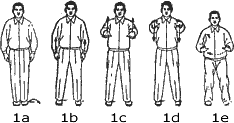
Raise Hands and Lower Hands, 1c - 1e  


Monday, February 23, 2015

Head High and Energy Lifted


 What Does "Xu Ling Ding Jin" Mean?

"One of the most vexing phrases in this body of texts appears in Wang Zongyue's "The Taijiquan Treatise."  This is the phrase that I've translated "An intangible and lively energy lifts the crown of the head."  The actual phrase in Chinese is xu ling ding jing Xu means "empty," "void," "abstract," "shapeless," or "insubstantial."  Ling can mean "neck," "collar," "to lead," "to guide," or "to receive."  Ding here means "the crown of the head."  Jin is a word that should be familiar to most Taijiquan practitioners, meaning "energy" or "strength."  To translate this phrase literally in a way that makes sense is seemingly impossible. ...  To demonstrate the difficulties presented in translating the phrase, I've assembled for comparison a number of different renderings:

Yang Jwing-Ming translates xu ling ding jin as:
"An insubstantial energy leads the head upward."


T.T. Liang renders it:
"A light and nimble energy should be preserved on the top of the head."


Benjamin Pang Jeng Lo translates the phrase:
"Effortlessly the jin reaches the headtop."


Douglas Wile translates the phrase variously:
"The energy at the top of the head should be light and sensitive."
and
"Open the energy at the crown of the head."


Guttmann gives one rendering as,
"... the head is upheld with the intangible spirit."
Elsewhere, he gives it a fairly plausible if incomprehensible literal rendering as a noun phrase:
"Empty dexterity's top energy."


Huang Wen-Shan translates it as:
"The head-top should be emptied, alert, and straight."


Robert Smith's version has it:
"The spirit of vitality reaches to the top of the head."


Jou Tsung Hwa's rendering is similiar:
"The spirit, or shen, reaches the top of the head."


Finally, in one of the freer renderings I've seen, T. Y. Pang renders the phrase:
"The spine and the head are held straight by strength, which is guided by the mind."


As the reader can see, the range of nuance in these diverse translations of this one phrase is considerable.  Virtually all of the readings are interpretive; that is, the four-character phrase as it has been handed down will not yield a dependable reading based on the characters alone.  One can only conclude that this phrase is a remnant of an oral formula whose original structure eludes our knowledge.  Our understanding of it inevitably depends upon the context─ the following phrase about sinking the qi to the dantian─ and upon commentaries of former masters, including Yang Chengfu's elaboration in the first of his "Ten Essentials."  The concept is also linked to differently worded but related phrases appearing in other classics, for example, "the spirit (shen) threads to the crown of the head" (shen guan ding) in the "Song of the Thirteen Postures," and the phrase about "suspending the crown of the head" (ding tou xuan) appearing in both "The Mental Elucidation of the Thirteen Postures" and the "Song of the Thirteen Postures." "

Mastering Yang Style Taijiquan  By Fu Zhongwen, pp. 182-183. 

Mastering Yang Style Taijiquan  By Fu Zhongwen.  Translated by Louis Swaim.  Berkeley, California, Blue Snake Books, c 1999, 2006.  Bibliography, glossary, 226 pages.  ISBN: 9781583941522.  VSCL.  Fu Zongwen (1919-1994) was a student of Yang Cheng Fu.  Translations of many Tai Chi classics are included.  A list of 85 movements are provided.  251 movement analysis illustrations.  Over 76 of the illustrations are traced and drawn from photographs of Yang Chengfu.  Detailed descriptions of the long form, pp. 26-162.  Push hands information.  Yang Tai Chi essentials.


Cloud Hands Taijiquan

Valley Spirit Qigong

Somatic Practices for Health, Well-Being and Mindfulness

Tao Te Ching Translations


Sunday, February 08, 2015

Raise Hands and Lower Hands - Taijiquan


Variations of names for this movement include: WuJi, Standing Quietly, Reconnecting with Oneness and Emptiness, Quiet Standing Mediation
Beginning, Commencement, Starting Posture, Commencing (Qishi), Taijiquan Opening Movement, and 预 备 : Yu Bei : Preparation Form.  


Face N 12 (1a) .  For an explanation of the directional scheme used in Cloud Hands webpages, please see below. 
Stand at attention for awhile.  In Taiji and Qigong, standing quietly in a meditative posture for awhile is the first phase Relax (Sung).  Shoulders are down, hands relaxed and gently touching the side of leg, and head is erect.  This is the phase of WuJi (empty state), or standing like a tree (Zhan Zhuang), and Reconnecting with Oneness and Emptiness.  Breathe easily and comfortably. 
Sink weight into right leg, and then step out to the left to shoulder width (1b). 
Gently raise both arms up (1c), palms facing down, to about shoulder height (1d). 
Lower both arms, palms down, to Dan Tien height, and lower knees (1e).  The lower Dan Tien is a sphere of energy located a few inches behind and below the level of the navel or belly button; the middle Dan Tien is located in the heart area, and the upper Dan Tien is located behind the eyes in the brain. The most important for Taijiquan is the lower Dan Tien.   Practitioners of Kundalini Yoga might consider correspondences of the 3rd Chakra (Manipurna) [Power, Will] with the Lower Dan Tien, the 4th Chakra (Anahata) [Compassion, Love] with the Middle Dan Tien, and the 6th Chakra (Aina) [Intuition, Vision, 6th Sense] with the Upper Dan Tien.  The Chinese energetic system is quite different from the Indian energetic system, so correspondences are weak in this case.  [Chris Akley wrote on 4/3/2012 that "Though I wouldn't say that this is wrong, I think there is a more accurate way to describe it. You could also say that the Dan Tien is in the second charka Swadhisthana which is where kundalini resides once it is awakened. But more accurately, I would say it is between the second and third chakra as this Qigong healer says, in between the energies of fire and water.]
     
This is movement often called "Raising Hands and Lowering Hands."
Breathe normally as you stand, relax, and center in position 1a.  Breathe in through nose, and out through the nose.  Slow the respiration rate to inhaling for 4-5 seconds, holding the full in-breath for 1-2 seconds, exhaling slowly for 4 to 5 seconds, pausing 1-2 seconds before beginning the yin/yang cycle of breathing again.  Breathe in at 1a, breathe out as you step to 1b. 
Breathe in as arms float up 1b-1c, and breathe out as arms float down (1d-1e).  

 
Here is a description of the beginning of the Opening Posture of Taijiquan (#1, 1b) from the book Traditional Chen Style Taijiquan by Fan Chun-Lei and A. Frank Shiery, p.37: 
    "1.  Preliminary Stance:  Stand naturally upright with the feet placed shoulder-width apart, toes pointed slightly inward, and arms hanging naturally at the side.  The body should be kept upright with the shoulders relaxed, eyes slightly closed and breathing naturally.  The body should face north.  The mind should remain empty, calm and clear.  This is the state of WuJi, (Negative Terminus in Taoist Teaching). 
    2.  Commencing Form:  The body should exhibit being relaxed externally while solid within.  The head is held naturally erect as if pulled upward by an invisible string.  Close the lips slightly with the tongue touching the upper palate.  The toes firmly grasp the ground with Yongquan point pulled upward.   The eyes are looking straight ahead with the chin drawn slightly inward.  The hip is turned up and the coccyx turned back and upward with the waist directed downwards.  The whole body should remain relaxed.  A mind state of intent is maintained while the vital energy flows upward from the Dantian to the Baihui point, while the turbid energy flows downward from the Dantian to the Yongquan point.  During this time, the body exhibits no external movement.  Yin/Yang, for example, closing/opening, supple-firm and fast-slow are manifested internally, portraying the image of the Taiji, (Grand Terminus) (1b).     
    Key Points to Remember:  For the beginner, the primary concern should be to cleanse the mind and spirit of tension and anxiety, removing all negative thoughts.  This develops even-temperedness and an alert mind for quick movement and response.  Once this technique has been mastered, the practitioner can begin to understand and practice Taijiquan more effectively."
-   Fan Chun-Lei and A. Frank Shiery, Traditional Chen Style Taijiquan


"Try this simple experiment now.  Raise your right hand toward the ceiling.  Just do it.  Then take it back down/  What did you see?  What did you experience?  Now, raise your right hand to the ceiling very slowly.  Take at least thirty seconds to do it.  Then take it back down again, just as slowly.  Don't think abou it, or try to analyze it.  "Just do it"─ but very slowly.
    Now, what did you notice; what did you see this time?  Were you able to notice the impulse that precedes the movement?  The complex mental/physical twinge that sets the arm in motion?  Did you see and feel the weight and volume of the arm?  Were there any changes in the quality of your mind or breath as the arm slowly rose or descended?  Were there mental formations, perhaps of boredom, irritation, curiosity, pleasure?  A whole cosmos arises, changes, and passes away in one simple movement, and generally we are completely blind to all of it.  Generally, until there has been a deep and real transformation at the base, when we simply "do what we are doing," we are merely dong conditioned, habitual actions.  Moving slowly allows us to see this more clearly and leads to ceto-vimutti, liberation of the mind.  It does this by giving us the time and space to see the constant process of conditioning arising here in this body-mind.  And in seeing the conditioning, we can begin the process of freely choosing how to respond, rather than blindly react."
-  Frank Jude Boccio, Mindfulness Yoga: The Awakened Union of Breath, Body, and Mind, 2004, p.89


Standard Bejing 24 Movement T'ai Chi Ch'uan Form in the Yang Style 

Taijiquan: Lessons, Styles, Forms, Practices