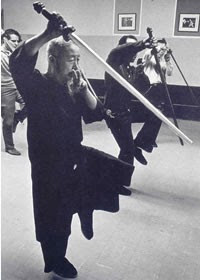
Showing posts with label 32 Sword. Show all posts

Monday, April 28, 2025

Taijiquan Sword: Yang Style 32 Sword Form


This popular webpage includes a comprehensive bibliography, scores of links to webpages; an extensive listing of the names and name variations for each movement in English, Chinese, French, German, and Spanish; a detailed analysis of each posture and movement sequence with explanations and numbered illustrations and detailed instructions; selected quotations; comments on 20 Taijiquan sword techniques; a comprehensive media bibliography; a chart of performance times; recommendations for starting to learn this form at home one your own with instructional DVDs, books and practice methods; and, a comparison of the 32 and 55 sword forms in the Yang style. 

This is the standard, simplified, orthodox, 1957, 32 Taiji Sword Form, in the Yang Style of T'ai Chi Ch'uan. 

32 Sword Form Pamphlet by Geoffrey Hugh Miller.  Adapted from information and graphics found on the 32 Sword Form webpage by Michael P. Garofalo.  22 pages, 9/7/2015, PDF Format.  Excellent job by Mr. Miller.  This is a handy practice tool.  


Saturday, January 04, 2025

Standard Taijiquan 32 Sword Form


This popular webpage includes a comprehensive bibliography, scores of links to webpages; an extensive listing of the names and name variations for each movement in English, Chinese, French, German, and Spanish; a detailed analysis of each posture and movement sequence with explanations and numbered illustrations and detailed instructions; selected quotations; comments on 20 Taijiquan sword techniques; a comprehensive media bibliography; a chart of performance times; recommendations for starting to learn this form at home one your own with instructional DVDs, books and practice methods; and, a comparison of the 32 and 55 sword forms in the Yang style. 

This is the standard, simplified, orthodox, 1957, 32 Taiji Sword Form, in the Yang Style of T'ai Chi Ch'uan. 

32 Sword Form Pamphlet by Geoffrey Hugh Miller.  Adapted from information and graphics found on the 32 Sword Form webpage by Michael P. Garofalo.  22 pages, 9/7/2015, PDF Format.  Excellent job by Mr. Miller.  This is a handy practice tool.  

Read about the Taoist magical sword finger hand sign:
"The sword finger hand sign is to draw your own magic power to the fingers and output a beam of energy for doing Taoist magic.  This beam of magical power isn’t just an imaginary thing, it’s a real visible beam if you can see it. Some of my students can see the beam of energy beams out like a long laser from the tip of the finger and extend all the way to the wall or somewhere far away. The beam is a beam a the magic power from one doing the handsign. This beam of power can be used for drawing FUs in the air, killing evils, doing magic in magic battles, healing or even saving lives!  This is like a multi-usage tool, which can be a pen, a chisel, a phone, or even a drill, it all depends on how you use it and what adaptor you put on it to make it function differently. The most commonly seen usage of this handsign in Tin Yat Lineage is by drawing Taoism FU in the air or on the incense. This allow you to “carve” the Taoism FU into the object or in the air to perform magic." 

The Wild Horse Jumps Over the Mountain Stream 


  "Mike, I wonder if you could give your thoughts on something.  For years I’ve been practicing 3. The Swallow Skims Across the Water with the left hand moving in a similar fashion to 5. Block and Sweep to the Left i.e. the little finger side of the hand brushing the left hip before raising above the head.  I’ve recently got a book by Li Deyin which has his daughter Faye Yip performing it slightly differently.  She points her fingers backwards with the back of the hand brushing the hip and mentions it in the essential points for the movement.  Looking at videos on the internet they all seem to be similar to Faye Yip.  Would you mind if I asked how you practice?"
-  A question from Simon Ellis, UK, 9/2/2015


Simon, I have found that the details of bodily positions for any Taijiquan movement vary somewhat according to the following standards: 

1.  Competition standards.  If you are preparing to compete in a Taijiquan event, then carefully study the standards for the forms you are performing.  In the case of the 32 sword form, check out books and DVDs by Li Deyin or his heirs. 
2.  Your teacher's standards.  If you are working closely with a Taijiquan teacher, then follow their instructions.  This simplifies your learning, and shows respect for the teacher.  Since I learned the 32 sword from Dr. Paul Lam, I practice this form in a manner fairly close to his instructions.   
3.  Your personal standards.  If you have been practicing for many years, mostly alone, then more variations in bodily positions will likely emerge.  Sensibly, as we age, we make adaptations in our Taijiquan form work to safely accommodate our declining physical abilities. 

As for how I practice, I'm rather unconcerned about details, a bit careless, playful, free, and seldom do things exactly the same way.  I just like skimming across the water, and leave the details about how to flap my wings to others.  Call me a lazy dilettante Daoist, with a penchant for ziran.  I don't even practice with a sword or saber anymore─ I only wield my sturdy cane.  As I recall, the front of my left hand crosses my waist while going to 3c; and, more important, I still make that magical Taoist sword finger hand sign with my left hand while doing this form. 

I think that modeling your performance on the standards set by Master Faye Yip's 32 Sword form instructions and demonstration would result in much grace, improved strength, and a beautiful style.   
Best wishes!  Mike.  9/8/2015 


Monday, February 28, 2022

Classical Skills

SKILLS

"Zither, chess, book, painting, sword.
These symbolize classical skill.

There was once a wanderer who cared nothing for fame. Although he
had many chances for position, he continued to search for teachers who
could help him master five things : zither, chess, book, painting, and
sword.

The zither gave him music, which expressed the soul. Chess
cultivated strategy and a response to the actions of another. Books gave
him academic education. Painting was the exercise of beauty and
sensitivity. Sword was a means for health and defense.

One day a little boy asked the wanderer what he would do if he lost
his five things. At first the wanderer was frightened, but he soon
realized that his zither could not play itself, the chess board was
nothing without players, a book needed a reader, brush and ink could not
move on their own accord, and a sword could not be unsheathed without a
hand. He realized that his cultivation was not merely for the
acquisition of skills. It was a path to the innermost part of his being."

-  Deng Ming-Dao, 365 Tao: Daily Meditations  

Standard 32 Sword Form: Black Dragon Whips His Tail


Tuesday, November 05, 2019

Learning the 32 Sword Form

Numbered lists, names, illustrations, pictures, books, DVDs, practice ...
all aides to memorizing.  


List of Standard 32 Movements Taijiquan Sword Form
One Page, 2007
By Mike Garofalo
Valley Spirit Taijiquan, Red Bluff, California


Taijiquan Standard 32 Double Edged Sword Form
Hypertext Document
By Mike Garofalo


I also practice the 32 Sword Form with my martial arts cane.  


Friday, October 11, 2019

Tai Chi Sword, 32 Form


This popular webpage includes a comprehensive bibliography, scores of links to webpages; an extensive listing of the names and name variations for each movement in English, Chinese, French, German, and Spanish; a detailed analysis of each posture and movement sequence with explanations and numbered illustrations and detailed instructions; selected quotations; comments on 20 Taijiquan sword techniques; a comprehensive media bibliography; a chart of performance times; recommendations for starting to learn this form at home one your own with instructional DVDs, books and practice methods; and, a comparison of the 32 and 55 sword forms in the Yang style. 

This is the standard, simplified, orthodox, 1957, 32 Taiji Sword Form, in the Yang Style of T'ai Chi Ch'uan. 

32 Sword Form Pamphlet by Geoffrey Hugh Miller.  Adapted from information and graphics found on the 32 Sword Form webpage by Michael P. Garofalo.  22 pages, 9/7/2015, PDF Format.  Excellent job by Mr. Miller.  This is a handy practice tool.  

Read about the Taoist magical sword finger hand sign:
"The sword finger hand sign is to draw your own magic power to the fingers and output a beam of energy for doing Taoist magic.  This beam of magical power isn’t just an imaginary thing, it’s a real visible beam if you can see it. Some of my students can see the beam of energy beams out like a long laser from the tip of the finger and extend all the way to the wall or somewhere far away. The beam is a beam a the magic power from one doing the handsign. This beam of power can be used for drawing FUs in the air, killing evils, doing magic in magic battles, healing or even saving lives!  This is like a multi-usage tool, which can be a pen, a chisel, a phone, or even a drill, it all depends on how you use it and what adaptor you put on it to make it function differently. The most  commonly seen usage of this handsign in Tin Yat Lineage is by drawing Taoism FU in the air or on the incense. This allow you to “carve” the Taoism FU into the object or in the air to perform magic." 

The Wild Horse Jumps Over the Mountain Stream 


  "Mike, I wonder if you could give your thoughts on something.  For years I’ve been practicing 3. The Swallow Skims Across the Water with the left hand moving in a similar fashion to 5. Block and Sweep to the Left i.e. the little finger side of the hand brushing the left hip before raising above the head.  I’ve recently got a book by Li Deyin which has his daughter Faye Yip performing it slightly differently.  She points her fingers backwards with the back of the hand brushing the hip and mentions it in the essential points for the movement.  Looking at videos on the internet they all seem to be similar to Faye Yip.  Would you mind if I asked how you practice?"
-  A question from Simon Ellis, UK, 9/2/2015


Simon, I have found that the details of bodily positions for any Taijiquan movement vary somewhat according to the following standards:

1.  Competition standards.  If you are preparing to compete in a Taijiquan event, then carefully study the standards for the forms you are performing.  In the case of the 32 sword form, check out books and DVDs by Li Deyin or his heirs.

2.  Your teacher's standards.  If you are working closely with a Taijiquan teacher, then follow their instructions.  This simplifies your learning, and shows respect for the teacher.  Since I learned the 32 sword from the instructional DVD by Dr. Paul Lam, I practice this form in a manner fairly close to his instructions.  

3.  Your personal standards.  If you have been practicing for many years, mostly alone, then more variations in bodily positions will likely emerge.  Sensibly, as we age, we make adaptations in our Taijiquan form work to safely accommodate our declining physical abilities.

As for how I practice, I'm rather unconcerned about details, a bit careless, playful, free, and seldom do things exactly the same way.  I just like skimming across the water, and leave the details about how to flap my wings to others.  Call me a lazy dilettante Daoist, with a penchant for ziran.  I don't often practice with a sword or saber anymore─ I only wield my sturdy cane.  

As I recall, the front of my left hand crosses my waist while going to 3c; and, more important, I still make that magical Taoist sword finger hand sign with my left hand while doing this form.

I think that modeling your performance on the standards set by Master Faye Yip's 32 Sword form instructions and demonstration would result in much grace, improved strength, and a beautiful style.  
Best wishes!  Mike.  9/8/2015 


Tuesday, April 24, 2018

World Tai Chi and Qigong Day in Vancouver Washington


World Tai Chi and Qigong Day 

Saturday, April 28, 2018

10:00 am - Noon
Clark College Campus
Vancouver, Washington


I will be attending this event on Saturday.  

For the next 9 weeks, my new Taijiquan 32 Sword Form teacher will be Jill Ross.  I learned and practiced this form back in 2005; however, I have not practiced this form in the last five years.  

Our class will participate in the World Tai Chi and Qigong Day festivities at
Clark College.  


Flyer for 4/28/2018 Tai Chi and Qigong Day Event.  


Thursday, May 26, 2016

Tai Chi Sword


This popular webpage includes a comprehensive bibliography, scores of links to webpages; an extensive listing of the names and name variations for each movement in English, Chinese, French, German, and Spanish; a detailed analysis of each posture and movement sequence with explanations and numbered illustrations and detailed instructions; selected quotations; comments on 20 Taijiquan sword techniques; a comprehensive media bibliography; a chart of performance times; recommendations for starting to learn this form at home one your own with instructional DVDs, books and practice methods; and, a comparison of the 32 and 55 sword forms in the Yang style. 

This is the standard, simplified, orthodox, 1957, 32 Taiji Sword Form, in the Yang Style of T'ai Chi Ch'uan. 

32 Sword Form Pamphlet by Geoffrey Hugh Miller.  Adapted from information and graphics found on the 32 Sword Form webpage by Michael P. Garofalo.  22 pages, 9/7/2015, PDF Format.  Excellent job by Mr. Miller.  This is a handy practice tool.  
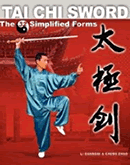
Read about the Taoist magical sword finger hand sign:
"The sword finger hand sign is to draw your own magic power to the fingers and output a beam of energy for doing Taoist magic.  This beam of magical power isn’t just an imaginary thing, it’s a real visible beam if you can see it. Some of my students can see the beam of energy beams out like a long laser from the tip of the finger and extend all the way to the wall or somewhere far away. The beam is a beam a the magic power from one doing the handsign. This beam of power can be used for drawing FUs in the air, killing evils, doing magic in magic battles, healing or even saving lives!  This is like a multi-usage tool, which can be a pen, a chisel, a phone, or even a drill, it all depends on how you use it and what adaptor you put on it to make it function differently. The most commonly seen usage of this handsign in Tin Yat Lineage is by drawing Taoism FU in the air or on the incense. This allow you to “carve” the Taoism FU into the object or in the air to perform magic." 

The Wild Horse Jumps Over the Mountain Stream 


Thursday, November 12, 2015

Taijiquan Sword Form, 32 Movements


This popular webpage includes a comprehensive bibliography, scores of links to webpages; an extensive listing of the names and name variations for each movement in English, Chinese, French, German, and Spanish; a detailed analysis of each posture and movement sequence with explanations and numbered illustrations and detailed instructions; selected quotations; comments on 20 Taijiquan sword techniques; a comprehensive media bibliography; a chart of performance times; recommendations for starting to learn this form at home one your own with instructional DVDs, books and practice methods; and, a comparison of the 32 and 55 sword forms in the Yang style. 

This is the standard, simplified, orthodox, 1957, 32 Taiji Sword Form, in the Yang Style of T'ai Chi Ch'uan. 

32 Sword Form Pamphlet by Geoffrey Hugh Miller.  Adapted from information and graphics found on the 32 Sword Form webpage by Michael P. Garofalo.  22 pages, 9/7/2015, PDF Format.  Excellent job by Mr. Miller.  This is a handy practice tool.  
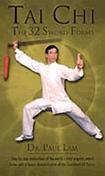
Read about the Taoist magical sword finger hand sign:
"The sword finger hand sign is to draw your own magic power to the fingers and output a beam of energy for doing Taoist magic.  This beam of magical power isn’t just an imaginary thing, it’s a real visible beam if you can see it. Some of my students can see the beam of energy beams out like a long laser from the tip of the finger and extend all the way to the wall or somewhere far away. The beam is a beam a the magic power from one doing the handsign. This beam of power can be used for drawing FUs in the air, killing evils, doing magic in magic battles, healing or even saving lives!  This is like a multi-usage tool, which can be a pen, a chisel, a phone, or even a drill, it all depends on how you use it and what adaptor you put on it to make it function differently. The most commonly seen usage of this handsign in Tin Yat Lineage is by drawing Taoism FU in the air or on the incense. This allow you to “carve” the Taoism FU into the object or in the air to perform magic." 

The Wild Horse Jumps Over the Mountain Stream 


  "Mike, I wonder if you could give your thoughts on something.  For years I’ve been practicing 3. The Swallow Skims Across the Water with the left hand moving in a similar fashion to 5. Block and Sweep to the Left i.e. the little finger side of the hand brushing the left hip before raising above the head.  I’ve recently got a book by Li Deyin which has his daughter Faye Yip performing it slightly differently.  She points her fingers backwards with the back of the hand brushing the hip and mentions it in the essential points for the movement.  Looking at videos on the internet they all seem to be similar to Faye Yip.  Would you mind if I asked how you practice?"
-  A question from Simon Ellis, UK, 9/2/2015


Simon, I have found that the details of bodily positions for any Taijiquan movement vary somewhat according to the following standards: 

1.  Competition standards.  If you are preparing to compete in a Taijiquan event, then carefully study the standards for the forms you are performing.  In the case of the 32 sword form, check out books and DVDs by Li Deyin or his heirs. 
2.  Your teacher's standards.  If you are working closely with a Taijiquan teacher, then follow their instructions.  This simplifies your learning, and shows respect for the teacher.  Since I learned the 32 sword from Dr. Paul Lam, I practice this form in a manner fairly close to his instructions.   
3.  Your personal standards.  If you have been practicing for many years, mostly alone, then more variations in bodily positions will likely emerge.  Sensibly, as we age, we make adaptations in our Taijiquan form work to safely accommodate our declining physical abilities. 

As for how I practice, I'm rather unconcerned about details, a bit careless, playful, free, and seldom do things exactly the same way.  I just like skimming across the water, and leave the details about how to flap my wings to others.  Call me a lazy dilettante Daoist, with a penchant for ziran.  I don't even practice with a sword or saber anymore─ I only wield my sturdy cane.  As I recall, the front of my left hand crosses my waist while going to 3c; and, more important, I still make that magical Taoist sword finger hand sign with my left hand while doing this form. 

I think that modeling your performance on the standards set by Master Faye Yip's 32 Sword form instructions and demonstration would result in much grace, improved strength, and a beautiful style.   
Best wishes!  Mike.  9/8/2015 


Thursday, June 18, 2015

Taijiquan Sword


This popular webpage includes a comprehensive bibliography, scores of links to webpages; an extensive listing of the names and name variations for each movement in English, Chinese, French, German, and Spanish; a detailed analysis of each posture and movement sequence with explanations and numbered illustrations and detailed instructions; selected quotations; comments on 20 Taijiquan sword techniques; a comprehensive media bibliography; a chart of performance times; recommendations for starting to learn this form at home one your own with instructional DVDs, books and practice methods; and, a comparison of the 32 and 55 sword forms in the Yang style. 

This is the standard, simplified, orthodox, 1957, 32 Taiji Sword Form, in the Yang Style of T'ai Chi Ch'uan. 

© Michael P. Garofalo, Valley Spirit Taijiquan, Green Way Research, Red Bluff, California, October 2, 2011.  235Kb+. 
The Wild Horse Jumps Over the Mountain Stream 


Thursday, August 07, 2014

Standard Tai Chi Sword Form


This popular webpage includes a comprehensive bibliography, scores of links to webpages; an extensive listing of the names and name variations for each movement in English, Chinese, French, German, and Spanish; a detailed analysis of each posture and movement sequence with explanations and numbered illustrations and detailed instructions; selected quotations; comments on 20 Taijiquan sword techniques; a comprehensive media bibliography; a chart of performance times; recommendations for starting to learn this form at home one your own with instructional DVDs, books and practice methods; and, a comparison of the 32 and 55 sword forms in the Yang style. 

This is the standard, simplified, orthodox, 1957, 32 Taiji Sword Form, in the Yang Style of T'ai Chi Ch'uan. 

© Michael P. Garofalo, Valley Spirit Taijiquan, Green Way Research, Red Bluff, California, October 2, 2011.  235Kb+. 
The Wild Horse Jumps Over the Mountain Stream 


Sunday, June 15, 2014

Taijiquan Sword Form, 32 Movements


This popular webpage includes a comprehensive bibliography, scores of links to webpages; an extensive listing of the names and name variations for each movement in English, Chinese, French, German, and Spanish; a detailed analysis of each posture and movement sequence with explanations and numbered illustrations and detailed instructions; selected quotations; comments on 20 Taijiquan sword techniques; a comprehensive media bibliography; a chart of performance times; recommendations for starting to learn this form at home one your own with instructional DVDs, books and practice methods; and, a comparison of the 32 and 55 sword forms in the Yang style. 

This is the standard, simplified, orthodox, 1957, 32 Taiji Sword Form, in the Yang Style of T'ai Chi Ch'uan. 

© Michael P. Garofalo, Valley Spirit Taijiquan, Green Way Research, Red Bluff, California, October 2, 2011.  235Kb+. 
The Wild Horse Jumps Over the Mountain Stream 


Saturday, March 16, 2013

Taijiquan Sword Form

32 Sword Form, Simplified, Yang Style, Taijiquan Jian.
Webpage by Michael P. Garofalo. 

This popular webpage includes a comprehensive bibliography, scores of links to webpages; an extensive listing of the names and name variations for each movement in English, Chinese, French, German, and Spanish; a detailed analysis of each posture and movement sequence with explanations and numbered illustrations and detailed instructions; selected quotations; comments on 20 Taijiquan sword techniques; a comprehensive media bibliography; a chart of performance times; recommendations for starting to learn this form at home one your own with instructional DVDs, books and practice methods; and, a comparison of the 32 and 55 sword forms in the Yang style. 

This is the standard, simplified, orthodox, 1957, 32 Taiji Sword Form, in the Yang Style of T'ai Chi Ch'uan. 

© Michael P. Garofalo, Valley Spirit Taijiquan, Green Way Research, Red Bluff, California, October 2, 2011.  235Kb+. 
The Wild Horse Jumps Over the Mountain Stream 


Friday, November 16, 2012

Tai Chi Sword Forms


32 Sword Form, Simplified, Yang Style, Taijiquan Jian. By Michael P. Garofalo. This popular webpage includes a comprehensive bibliography, scores of links to webpages; an extensive listing of the names and name variations for each movement in English, Chinese, French, German, and Spanish; a detailed analysis of each posture and movement sequence with explanations, and numbered illustrations and detailed instructions;  selected quotations; comments on 20 Taijiquan sword techniques; a comprehensive media bibliography; a chart of performance times; and, a comparison of the 32 and 55 sword forms in the Yang style. This is the standard, simplified, orthodox, 1957, 32 Taiji Sword Form, in the Yang Style of T'ai Chi Ch'uan.

32 Taijiquan Simplified Sword Form

20 T'ai Chi Ch'uan Sword Techniques

55 Classical Yang Taiji Sword


The Wild Horse Jumps Over the Mountain Stream


Zhong Kui
Vanquisher of Demons
Protector of the Home

Monday, September 10, 2012

The Sword of Wisdom


"Ever since the adepts handed on
The secret of the sword,
The true imperative has been upheld
Completely, truly adamant.

If someone asks me about
Looking for its origin,
I say it is not ordinary iron.
This lump of iron
Comes from receptive stillness;
When you obtain it, it rises up.

Forging it in a glowing fire,
Through repeated efforts
It is refined
And forged into steel.

When students of the Tao
Know this secret,
The spirit of light is intensely powerful,
And devils of darkness vanish.

The subtle function of spiritual work
Is truly hard to measure;
I now give an explanation for you.
In telling you about it
I divulge the celestial mechanism.

Setting to work when one yang comes back,
First have the six yangs pump the furnace bellows;
Then the six yins work the tongs and hammer.
When the work of firing is complete,
It produces the sword;
When it is first done,
It flashes like lightning.

Brandish it horizontally
And a cold clear breeze arises;
Hold it upright,
And the shining bright moon appears.
Auspicious light illumines heaven and earth;
Sprites and ghosts are distressed.

It stops turbidity, brings out clarity,
Sweeps away weird defilements;
It slays volatility,
Cuts down aggressiveness,
Destroys monsters:
Influences draining away
Vitality, energy and spirit
All vanish in the light of the sword.

Entanglements are cut off, rumination dies down,
And the web of feelings is rent asunder.
Where the spiritual edge is aimed, mountains crumble;
The demon kinds of mundane planes are all routed.

This precious sword fundamentally has no form;
The name is set up because it has spiritual effect.
Learning the Tao and practicing reality
Depend on this sword:
Without this sword,
The Tao cannot be achieved.

Opening up the vast darkness,
Distinguishing heaven and earth,
Dissolving obstructions, transmuting objects -
All is included.
If you ask me to show it to you,
I bring it out before you -
Do you understand or not?"

The Sword of Wisdom
From "The Book of Balance and Harmony"
Translated by Thomas Cleary, 1989, p. 115-117


Taijiquan Sword: Bibliography, Links, Resources, Instruction, Guides, All Styles


T'ai Chi Ch'uan Sword: Poems, Sayings, Quotations, Wisdom


Standard 32 Sword Form, Simplified, Yang Style


Thursday, November 03, 2011

Tai Chi Chuan 32 Sword Form

32 Sword Form, Simplified, Yang Style, Taijiquan Jian. This popular webpage by Mike Garofalo includes a comprehensive bibliography, scores of links to webpages; an extensive listing of the names and name variations for each movement in English, Chinese, French, German, and Spanish; a detailed analysis of each posture and movement sequence with explanations, and numbered illustrations and detailed instructions; selected quotations; comments on 20 Taijiquan sword techniques; a comprehensive media bibliography; a chart of performance times; and, a comparison of the 32 and 55 sword forms in the Yang style. This is the standard, simplified, orthodox, 1957, 32 Taiji Sword Form, in the Yang Style of T'ai Chi Ch'uan.

32 Taijiquan Simplified Sword Form


20 T'ai Chi Ch'uan Sword Techniques


55 Classical Yang Taiji Sword


The Wild Horse Jumps Over the Mountain Stream


Zhong Kui

Vanquisher of Demons
Protector of the Home

Sunday, September 18, 2011

Lady Gongsun's Sword Dance

"There lived many years ago the beautiful Lady Gongsun,
Who, dancing with her sword, drew from all four quarters
An audience like mountains lost among themselves.

Heaven and Earth moved back and forth, following her motions,
Bright as when the Archer shot the Nine Suns down from the sky
And rapid as angels before the wings of dragons.

She began like a thunderbolt, venting its anger,
And ended like the shining calm of rivers and sea.

But vanished are those red lips and those pearly sleeves;
And none but this one talented pupil bears the perfume of her fame,
This sword dancer from Lingying, the Town of the White Goddess,
Who still dances and sings in the carefree old ways.

After the dance, we chatted for awhile.
We sighed together, saddened by the changes that have come.
There were a thousand ladies in the late Emperor's court;
But Lady Gongsun's sword dance was first among them all.

Fifty years have passed, like the turning of a hand;
Wind and dust, filling the world, obscure the Imperial House.
Instead of the Pear Garden Players, gone like the fog,
Only two girl musicians remain to charm the cold Sun.

There are now man-sized trees by the Emperor's Golden Tomb.
I seem to hear dead grasses rustling on the windy cliffs of Qutang.
The song is done, the slow strings and quick flutes have ceased.
At the height of joy, sorrow comes with the eastern moon rising.

And I, a poor old man, not knowing where to go,
Walk away slowly into the lonely hills, tired, facing the sunset."

- Du Fu, The Sword Dance Performed by a Pupil of Lady Gongsun
"300 Chinese Poems" The poet Du Fu (712-770, 杜甫) mentioned in his poem "Witnessing Gongsun Da Niang's Disciple Sword Dance Performance" (观公孙大娘弟子舞剑器行) that there was a female sword dancer in the court of Emperor Xuan Zong (唐玄宗) who was probably the greatest in her field.

"Another aspect of the martial dance is the "sword dance," devised by master swordsmen. Ancients sought to combine the ethos of swordsmanship with the sword dance, calling it "sword vigor." The most famous sword dancer of the Tang Dynasty was legendary beauty, Lady Gongsun. As a child, the celebrated Tang poet Du Fu once watched her dance, and the specter created by her superb skill remained forever fresh in his memory. The square in Yancheng, Henan Province was a sea of people. Following a roll of drums, Lady Gongsun appeared, rapier in hand. The sword glinted with every change of posture and stance, whispering like silk on being unsheathed and flashing at each thrust. Her dancing seemed to evince a power that could hold back rivers and repulse oceans. Years later, Du Fu watched the sword dance performed by Li Shi'erniang, one of Gongsun's adherents. Her execution of it was so reminiscent of Gongsun's original performance that Du Fu, now in his 50s, was fired with new vitality, and wrote a poem, 'The Sword Dance Performed by a Girl-Pupil of Lady Gongsun.'"
- Tang Dynasty Dances


Taijiquan Sword: Bibliography, Links, Resources, Instruction, Guides, All Styles

T'ai Chi Ch'uan Sword: Poems, Sayings, Quotations, Wisdom

Tai Chi 32 Sword


Sunday, June 06, 2010

Taijiquan 32 Sword Form

32 Sword Form, Simplified, Yang Style, Taijiquan Jian. By Michael P. Garofalo. This popular webpage includes a comprehensive bibliography, scores of links to webpages; an extensive listing of the names and name variations for each movement in English, Chinese, French, German, and Spanish; a detailed analysis of each posture and movement sequence with explanations, and numbered illustrations and detailed instructions; selected quotations; comments on 20 Taijiquan sword techniques; a comprehensive media bibliography; a chart of performance times; and, a comparison of the 32 and 55 sword forms in the Yang style. This is the standard, simplified, orthodox, 1957, 32 Taiji Sword Form, in the Yang Style of T'ai Chi Ch'uan.

32 Taijiquan Simplified Sword Form

20 T'ai Chi Ch'uan Sword Techniques

55 Classical Yang Taiji Sword


The Wild Horse Jumps Over the Mountain Stream


Zhong Kui
Vanquisher of Demons
Protector of the Home

Monday, November 03, 2008

Tai Chi Chuan Practice Schedule

Current Taijiquan Class and Practice Schedule

Outdoors, Monday, 7:00 - 8:30 am, Valley Spirit Taijiquan Center

Indoors, Mondays, 5:30 - 6:30 pm, Tehama Family Fitness Center

Outdoors, Friday, 7:00 - 8:30 am, Valley Spirit Taijiquan Center

Indoors, Saturday, 9:30 - 11 am, Tehama Family Fitness Center

Sunday, 7:00 - 8:30 am, Valley Spirit Taijiquan Center

We practice the Yang Style of Taijiquan (24 Form and 108 Form), 32 Sword Form and Eight Immortals 36 Cane Form in the Yang Style of Taijiquan.

Instructor: Michael P. Garofalo, M.S.

Green Way Blog

Cloud Hands Blog

Cloud Hands Website

Valley Spirit Taijiquan Curriculum, Instructors, Class Schedule

Saturday, August 16, 2008

Sword Taijiquuan, 32 Standard, Yang Style

32 Sword Form, Simplified, Yang Style, Taijiquan Jian. By Michael P. Garofalo. This popular webpage includes a comprehensive bibliography, scores of links to webpages; an extensive listing of the names and name variations for each movement in English, Chinese, French, German, and Spanish; a detailed analysis of each posture and movement sequence with explanations and numbered illustrations and detailed instructions; selected quotations; comments on 20 Taijiquan sword techniques; a comprehensive media bibliography; a chart of performance times; and, a comparison of the 32 and 55 sword forms in the Yang style. This is the standard, simplified, orthodox, 1957, 32 Taiji Sword Form, in the Yang Style of T'ai Chi Ch'uan. © Michael P. Garofalo, Valley Spirit Taijiquan, Green Way Research, Red Bluff, California, January 2008. 245Kb+.

32 Taijiquan Simplified Sword Form

Wednesday, December 12, 2007

Tai Chi 32 Simplified Sword Form in the Yang Style

32 Sword Form, Simplified, Yang Style, Taijiquan Jian. By Michael P. Garofalo. This popular webpage includes a comprehensive bibliography, scores of links to webpages; an extensive listing of the names and name variations for each movement in English, Chinese, French, German, and Spanish; a detailed analysis of each posture and movement sequence with explanations and numbered illustrations and detailed instructions; selected quotations; comments on 20 Taijiquan sword techniques; a comprehensive media bibliography; a chart of performance times; and, a comparison of the 32 and 55 sword forms in the Yang style. This is the standard, simplified, orthodox, 1957, 32 Taiji Sword Form, in the Yang Style of T'ai Chi Ch'uan. © Michael P. Garofalo, Valley Spirit Taijiquan, Green Way Research, Red Bluff, California, January 2008. 245Kb+.

32 Taijiquan Simplified Sword Form

20 T'ai Chi Ch'uan Sword Techniques

55 Classical Yang Taiji Sword


The Wild Horse Jumps Over the Mountain Stream


Zhong Kui
Vanquisher of Demons
Protector of the Home