How to Boost One's Immune System
1. Daily moderate cross training exercises.
2. Adequate rest, relaxation, and sleep.
3. Proper diet and adequate protein.
4. Vitamin C supplementation.
5. Reduce stress, overdoing, overreaching, overachieving, unrealistic objectives.
6. Maintain cleanliness and sanitary conditions.
7. Adequate water intake.
8. Maintain an upbeat, positive, and realistic attitude.
9. Take all prescribed medicines on schedule.
10. Don't smoke or drink alcohol.
11. Develop and maintain positive social relationships.
12. Stimulate and engage your thinking processes.
13. Use effective vaccines and avoidance tactics to prevent communicable diseases.
There is plenty of evidence that Tai Chi, Yoga, Chi Kung, and Walking all can boost one's immune system. However, claims by advocates of each of these mind-body exercise systems seem to ignore the fact that regular moderate exercise of just about any type will improve functioning of the immune system, combined with the other healthy living practices listed above. I find little evidence that any one mind-body exercise system is "the best." The bottom line, for me, is daily moderate cross training exercises.
Thursday, April 30, 2026


Tuesday, April 28, 2026
Dao De Jing Chapter 16
Tao Te Ching by Lao Tzu
Chapter 16
"Attaining perfect emptiness
Remain patient and sincere
The myriad beings arise as one
Through this we observe the return
Of beings in numberless multitudes
Each coming home to its root
Return to the root means serenity
It may be called a return to a higher order
Return to higher order speaks of the enduring
To comprehend the enduring speaks of clarity
To not comprehend the enduring
Is to recklessly create suffering
To comprehend the enduring (is) tolerance
Tolerance becomes justice
Justice becomes sovereignty
Sovereignty becomes celestial
The celestial becomes the path
The path is then continuous
The death of self is nothing to fear"
- Translated by Bradford Hatcher, 2005, Chapter 16
"Bring about emptiness to the extreme.
Guard true stillness.
The ten-thousand things rise together.
I therefore observe their return:
Those ten-thousand plants—each plant—returns
Going back to its root.
Going back to the root is said to be stillness.
This is called returning to life.
Returning to life is called the Constant.
Understanding the Constant is called clarity.
Not understanding the Constant:
Reckless actions—misfortune.
Understanding the Constant, forgive.
Forgive, then be unbiased.
Be unbiased, then be whole.
Be whole, then be Heaven.
Be Heaven, then be Tao.
Be Tao, then be eternal.
Not having a body, there is no danger."
- Translated by Aalar Fex, 2006, Chapter 16
"Empty the self completely; Embrace perfect peace.
Realize that all beings alike go through their processes of activity and life,
and then they return to the original source.
Returning to the source brings peacefulness and stillness.
This stillness is the flow of nature, and signifies that the beings have lived their allotted span of life.
Accepting this brings enlightenment and tranquility,
ignoring this brings confusion and sorrow
If one can accept this flow of nature; one can cherish all things.
Being all-cherishing you become impartial;
Being impartial you become magnanimous;
Being magnanimous you become natural;
Being natural you become one with The Way;
Being one with The Way you become immortal:
Though the body will decay, the Way will not."
- Translated by John Discus, 2002, Chapter 16
致虛極.
守靜篤.
萬物並作.
吾以觀復.
夫物芸芸, 各復歸其根.
歸根曰靜.
是謂復命.
復命曰常.
知常曰明.
不知常, 妄作凶知常容.
容乃公.
公乃王.
王乃天.
天乃道.
道乃久.
沒身不殆.
- Chinese characters, Tao Te Ching, Chapter 16
El Mundo se mueve y gira;
Observale regresar a la quietud.
Todas las cosas que florecen
Regresarán a su origen.
Este regreso es pacífico;
Es el camino de la Naturaleza,
Eternamente decayendo y renovandose.
Comprender ésto trae la iluminación,
Ignorar esto lleva a la miseria.
Aquel que comprende el camino de la Naturaleza llega a apreciarlo todo;
Apreciandolo todo, se convierte en imparcial;
Siendo imparcial, se convierte en magnánimo;
Siendo magnánimo, se convierte en parte de la Naturaleza;
Siendo parte de la Naturaleza, se hace uno con el Tao;
Siendo uno con el Tao, se alcanza la inmortalidad:
Piensa que el cuerpo perecerá, el Tao no."
- Translated by Antonio Rivas Gonzálvez, 1998, Tao Te Ching, Capítulo 16
"To arrive at ultimate quietness
Steadfastly maintain repose.
All creatures together have form;
I see them return again to their root.
The Master creatures come to perfect form,
Continuously they return to their root.
Continuous return to the root is called repose,
Repose is called the law of return,
The law of return is called eternity.
To know eternity is called illumination.
To ignore eternity is to draw misfortune on oneself,
To know eternity is to be great of Soul,
To be great of soul is to be a ruler,
To be a ruler is to be greater than all,
To be greater than all is to be conscious of Life,
To be conscious of Life is to endure.
The body shall disappear but not decay."
- Translated by Isabella Mears, 1916, Chapter 16
Audio Recordings (Podcasts) in English by Mike Garofalo
Here is an audio recording of selected translations from Chapter 16 of the Tao Te Ching. This reading includes translations by Isabella Mears 1916, Charles Muller 1891, John Discus 2002, Bradford Hatcher 2005, Stephen Addis 1993. Reading and recording by Michael P. Garofalo at the Valley Spirit Center in Red Bluff, California. Recorded on December 5, 2016. MP3 format. 12.7 MB.
A typical webpage created by Mike Garofalo for each one of the 81 Chapters (Verses, Sections) of the Tao Te Ching (Daodejing) by Lao Tzu (Laozi) includes 25 different English language translations or interpolations for that Chapter, 5 Spanish language translations for that Chapter, the Chinese characters for that Chapter, the Wade-Giles and Hanyu Pinyin transliterations (Romanization) of the Mandarin Chinese words for that Chapter, and 2 German and 1 French translation of that Chapter. Each webpage for each one of the 81 Chapters of the Tao Te Ching includes extensive indexing by key words, phrases, and terms for that Chapter in English, Spanish, and the Wade-Giles Romanization. Each webpage on a Chapter of the Daodejing includes recommended reading in books and websites, a detailed bibliography, some commentary, research leads, translation sources, a Google Translate drop down menu, and other resources for that Chapter.
Chapter 16, Tao Te Ching by Lao Tzu
Chapter and Thematic Index (Concordance) to the Tao Te Ching by Lao Tzu
English Language Daodejing Translators' Source Index
Spanish Language Daodejing Translators' Source Index
Ripening Peaches: Taoist Studies and Practices
Taoism: A Selected Reading List

Chapter 16
"Attaining perfect emptiness
Remain patient and sincere
The myriad beings arise as one
Through this we observe the return
Of beings in numberless multitudes
Each coming home to its root
Return to the root means serenity
It may be called a return to a higher order
Return to higher order speaks of the enduring
To comprehend the enduring speaks of clarity
To not comprehend the enduring
Is to recklessly create suffering
To comprehend the enduring (is) tolerance
Tolerance becomes justice
Justice becomes sovereignty
Sovereignty becomes celestial
The celestial becomes the path
The path is then continuous
The death of self is nothing to fear"
- Translated by Bradford Hatcher, 2005, Chapter 16
"Bring about emptiness to the extreme.
Guard true stillness.
The ten-thousand things rise together.
I therefore observe their return:
Those ten-thousand plants—each plant—returns
Going back to its root.
Going back to the root is said to be stillness.
This is called returning to life.
Returning to life is called the Constant.
Understanding the Constant is called clarity.
Not understanding the Constant:
Reckless actions—misfortune.
Understanding the Constant, forgive.
Forgive, then be unbiased.
Be unbiased, then be whole.
Be whole, then be Heaven.
Be Heaven, then be Tao.
Be Tao, then be eternal.
Not having a body, there is no danger."
- Translated by Aalar Fex, 2006, Chapter 16
"Empty the self completely; Embrace perfect peace.
Realize that all beings alike go through their processes of activity and life,
and then they return to the original source.
Returning to the source brings peacefulness and stillness.
This stillness is the flow of nature, and signifies that the beings have lived their allotted span of life.
Accepting this brings enlightenment and tranquility,
ignoring this brings confusion and sorrow
If one can accept this flow of nature; one can cherish all things.
Being all-cherishing you become impartial;
Being impartial you become magnanimous;
Being magnanimous you become natural;
Being natural you become one with The Way;
Being one with The Way you become immortal:
Though the body will decay, the Way will not."
- Translated by John Discus, 2002, Chapter 16
致虛極.
守靜篤.
萬物並作.
吾以觀復.
夫物芸芸, 各復歸其根.
歸根曰靜.
是謂復命.
復命曰常.
知常曰明.
不知常, 妄作凶知常容.
容乃公.
公乃王.
王乃天.
天乃道.
道乃久.
沒身不殆.
- Chinese characters, Tao Te Ching, Chapter 16
zhi xu ji.
shou jing du.
wan wu bing zuo.
wu yi guan fu.
fu wu yun yun, ge fu gui qi gen.
gui gen yue jing.
shi yue fu ming.
fu ming yue chang.
zhi chang yue ming.
bu zhi chang, wang zuo xiong zhi chang rong.
rong nai gong.
gong nai quan.
quan nai tian.
tian nai dao.
dao nai jiu.
mo shen bu dai.
-  Pinyin translation, Daodejing, Chapter 16
"Effect emptiness to the extreme.
 Keep stillness whole.
 Myriad things act in concert.
 I therefore watch their return.
 All things flourish and each returns to its root.
 Returning to the root is called quietude.
 Quietude is called returning to life.
 Return to life is called constant.
 Knowing this constant is called illumination.
 Acting arbitrarily without knowing the constant is harmful.
 Knowing the constant is receptivity, which is impartial.
 Impartiality is kingship.
 Kingship is Heaven.
 Heaven is Tao
 Tao is eternal.
 Though you lose the body, you do not die."
 -  Translated by Charles Muller, 1891, Chapter 16
"Vacía tu Ego completamente;
Abraza la paz perfecta.El Mundo se mueve y gira;
Observale regresar a la quietud.
Todas las cosas que florecen
Regresarán a su origen.
Este regreso es pacífico;
Es el camino de la Naturaleza,
Eternamente decayendo y renovandose.
Comprender ésto trae la iluminación,
Ignorar esto lleva a la miseria.
Aquel que comprende el camino de la Naturaleza llega a apreciarlo todo;
Apreciandolo todo, se convierte en imparcial;
Siendo imparcial, se convierte en magnánimo;
Siendo magnánimo, se convierte en parte de la Naturaleza;
Siendo parte de la Naturaleza, se hace uno con el Tao;
Siendo uno con el Tao, se alcanza la inmortalidad:
Piensa que el cuerpo perecerá, el Tao no."
- Translated by Antonio Rivas Gonzálvez, 1998, Tao Te Ching, Capítulo 16
"To arrive at ultimate quietness
Steadfastly maintain repose.
All creatures together have form;
I see them return again to their root.
The Master creatures come to perfect form,
Continuously they return to their root.
Continuous return to the root is called repose,
Repose is called the law of return,
The law of return is called eternity.
To know eternity is called illumination.
To ignore eternity is to draw misfortune on oneself,
To know eternity is to be great of Soul,
To be great of soul is to be a ruler,
To be a ruler is to be greater than all,
To be greater than all is to be conscious of Life,
To be conscious of Life is to endure.
The body shall disappear but not decay."
- Translated by Isabella Mears, 1916, Chapter 16
Audio Recordings (Podcasts) in English by Mike Garofalo
Here is an audio recording of selected translations from Chapter 16 of the Tao Te Ching. This reading includes translations by Isabella Mears 1916, Charles Muller 1891, John Discus 2002, Bradford Hatcher 2005, Stephen Addis 1993. Reading and recording by Michael P. Garofalo at the Valley Spirit Center in Red Bluff, California. Recorded on December 5, 2016. MP3 format. 12.7 MB.
A typical webpage created by Mike Garofalo for each one of the 81 Chapters (Verses, Sections) of the Tao Te Ching (Daodejing) by Lao Tzu (Laozi) includes 25 different English language translations or interpolations for that Chapter, 5 Spanish language translations for that Chapter, the Chinese characters for that Chapter, the Wade-Giles and Hanyu Pinyin transliterations (Romanization) of the Mandarin Chinese words for that Chapter, and 2 German and 1 French translation of that Chapter. Each webpage for each one of the 81 Chapters of the Tao Te Ching includes extensive indexing by key words, phrases, and terms for that Chapter in English, Spanish, and the Wade-Giles Romanization. Each webpage on a Chapter of the Daodejing includes recommended reading in books and websites, a detailed bibliography, some commentary, research leads, translation sources, a Google Translate drop down menu, and other resources for that Chapter.
Chapter 16, Tao Te Ching by Lao Tzu
Chapter and Thematic Index (Concordance) to the Tao Te Ching by Lao Tzu
English Language Daodejing Translators' Source Index
Spanish Language Daodejing Translators' Source Index
Ripening Peaches: Taoist Studies and Practices
Taoism: A Selected Reading List

Monday, April 27, 2026
My Original Face: Before and After
The Fireplace Records, Chapter 36
My Original Face: Before and After
I was mulling over the famous Koan from the Sixth Patriarch, Hui-Neng, "What was your original face before you were born?" This question appears in many Zen Koans.
The Mind Door that opened and closed between the inside of After Awakening and the outside of Before Awakening, hung on the hinges of efforts and insights. The Gate swung open and closed, mostly closed but sometimes open, as daily life offered opportunities. Being unborn or reborn swung on the hinges of opportunities with Others.
The terms "inside and outside,' or 'before and after,' were flexible, relative, ambiguous, often changing meaning, tools, open, moving, freely applied.
Before I was born, my original face was six-fold--- the faces of my parents and four grandparents.
Before I was born, my original face was a thousand-fold--- the faces of all my previous Karmic lives for kalpas of time.
Before I was born, my original face was embedded inside invisible DNA strands.
Before I was born, my original face was in water and I was only fleeting feelings.
Before I was born, some say, I had no original face--- I was nothing.
Before I was born, the Redwood tree supported the fog.
Before I was born, some say, I had the same face as my eternal soul.
Before I was reborn, my face was the same face as the dead still-born baby on the table of the morgue.
Before I was reborn, I never thought about or remembered what my original face appeared as.
Before I was reborn, I worried about the appearance of my face, and disliked my acne.
Before I was reborn, I was chained in a dark cave, hidden from the true Forms, awaiting release and the light. Only Plato's face was my face.
Before I was reborn, water flowed uphill, and smoke stayed on the ground.
Before I was reborn, a mother said “Face” and her baby pointed to his ear.
After I was born, my face was reflected four-fold in the distorting mirrors of a San Francisco amusement park.
After I was born, my original face was big, round, homely, with all parts intact--- a loved infant's face.
After I was born, my primary face once had two black eyes and a broken nose from a fist fight in Bandini, East LA.
After I was born, my face changed every decade, and my original face disappeared. My Primary Face remained the same.
After I was born, I was blind and never saw my face, only felt it.
After I was born, my head's shadow disappeared at night.
After I was born, my bearded face appeared in a dusty mirror.
After I was reborn, I looked more at the faces of others.
After I was reborn, I recognized many subtle hidden faces, including my own.
After I was reborn, an Original Face appeared to me immediately, but I did not recognize it.
After I was reborn, I paused trying to answer Koan Riddles and laughed at all the clever answers.
Comments, Sources, Observations, Koans, Poems, Quips:
Original Face Koans: GB 23, ENT 2, WWSF 177, ENT 156, ENT 229, DDJ 19, DSE 22,
Refer to my Cloud Hands Blog Posts on the topic of Koans/Stories.
Subject Index to 1,975 Zen Buddhist Koans
Zen Buddhist Koans: Indexes, Bibliography, Commentary, Information
Pulling Onions Over 1,043 One-line Sayings, Quips, Maxims, Humor
Chinese Chan Buddhist and Taoist Stories and Koans
The Fireplace Records (Blog Version) By Michael P. Garofalo
The Fireplace Records (Text Version)
Sunday, April 26, 2026
Tick-Tock Tractatus, Section 12.6
A Gardener's Sutra on Time
By mpgarofalo
The Tick-Tock Tractatus, Section 12.6
Speaking About Time: The Poetic Investigations
By Michael Peter Garofalo, mpgarofalo, .m.p.g.

Sections
1. Time: time-space, movement, measurement
2. Past: memories, habits, fixed, specific, tradition
3. Present: now, here-now, day, duration
4. Future: maybe, planned, anticipated, uncertain
5. Passing: change, cycles, aging, growth, death
6. Beginning: renewal, starting, enthusiasm
7. Psychology: learning, experience, knowing
8. Middle: in progress, half-way, steady, living
9. Language: poetry, philosophy, ordinary
10. Silence: inexpressive, nonsense, illogical
11. Mystical: numinous, profound, intense, insightful,
12. Beauty: art, crafts, music, reading/writing
13. Social: ethics, morality, economics, manners, value
14. Philosophy: ethics, history, analysis, arguments, logic
15. History: landmark events, books/printing, memory
16. Eternity: forever, infinite, unimaginable, death
Bundled Up Quintains about Time
12.6
Pulling Onions
By Michael P. Garofalo

Speaking of Time: The Poetic Investigations, Part 2
Another Crop of Gardening Thoughts
A Gardener's Sutra on Time, Part 2.1
Red Bluff, California
1998 - 2017
By: .m.p.g.
michael p garofalo
A Gardener's Sutra on Time
by mpgarofalo
A garden recreates itself daily; we seldom
step into the same garden thrice.
The present is made from the past.
Time creeps, walks, runs and flies---
it is all about moving things.
Chaos breaks its own rules to allow Order to play.
How can gardening be considered
a "leisure time" activity?
Always leave extra time for unraveling the hose.
Gardeners turn into the soil their lifetime.
Time may wait for no man,
but seems to muddle and poke
quite slowly for gardeners.
Springtime for birth, Summertime for growth;
and all Seasons for dying.
We don't erase the past, we just build more
and bigger blackboards.
Put the right plant in the right place at the right time in
the right way - and you won't go wrong.
Winter does not turn into Summer; ash does not turn
into firewood - on the chopping block of time.
A garden flourishes in the mind's time of last season,
next season, and now.
Gardening requires no commuting time.
In the right place at the right time,
tomato worms on tomato vines.
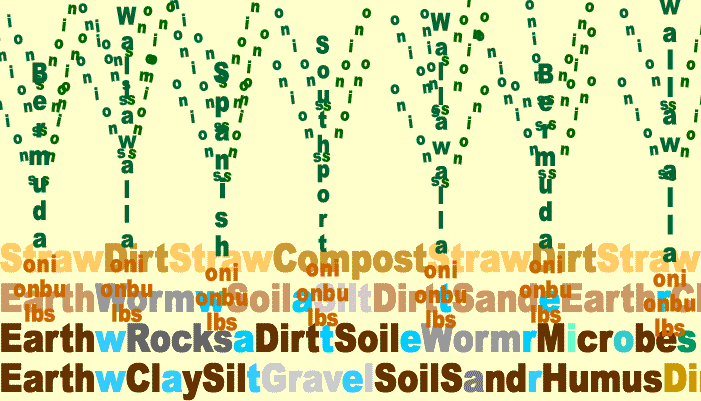
The Onion Garden, a concrete poem by .m.p.g.
Your pocket knife will be its dullest at just the right time.
Gardening is the right sport for a lifetime of pleasures.
Gardening sometimes takes a few hours of a day,
but adds weeks of pleasure to your life.
The time you have wasted on your garden
is what makes it priceless.
One purpose of a garden is to stop time in one place.
Annuals disappear, shrubs perish, trees die, and
gardeners are buried; death is the flower of time.
In an instant there is nothing - Time produces Nature.
By the time you peel off five layers of reality,
it's hard to recall the first.
It's a long time between my garden
and the Pacific Ocean.
Time will tell, but we often fail to listen.
The "eternal truths" are sometimes clearly false.
Gardening teaches us to take our time, slow down,
and wait in peace.
Gardeners learn to live in worm time,
bee time, and seed time.
Time will not pass you, but it will follow
very close behind you.
Preparation and follow up take up
more time than doing the deed.
Springtime flows in our veins.
Silence - never misquoted, sometimes misunderstood,
often meaningful.
Leave enough time for some pointless behavior
to reveal your deeper desires.
The seed idea for "God" is springtime.
Things always go downhill, fall apart, wear out...
the arrow of Time pierces everything.
Time prevents too much from happening at once.
A million years and a second have the same
feeling for the dead gardener.
All metaphors aside - only living beings rise up in the Springtime;
dead beings stay quite lie down dead.
Any gardener who is not using the scientific method
will waste time and money.
Take the time to melt into the Details.
Time is rooted in Place.
Most of the time, we just borrow from the past.
Sometimes the present alters our interpretation of the past;
most often the past surrounds and infects the present.
Time is on your side when you are young.
Leisure can open a window to the breezes of insights,
and a clear view of the Trees of Time.

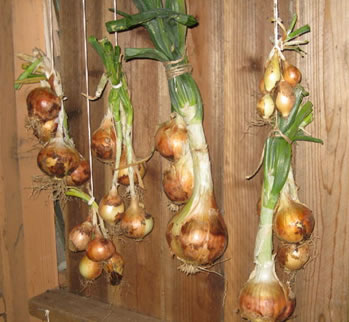
Harvesting Onions 2006
Red Bluff, California
.m.p.g.
We get things done when there is little time left.
Our cash limits and time constraints both prune our gardens.
The second hand of time ticks on---
measuring our past, time after time.
Beings are Becomings---for the time-being.
Perfection can be the opponent of betterment.
Without vagueness we are bored with literalness.
Borderline cases are where events become really interesting.
I may not be able to precisely define religious nonsense,
but I know it when I hear it.
A coastline may be impossible to measure,
but is still beautiful.
You can’t slowly boil the frog unless
it can’t jump out of the pot.
A “heap” of something desired becomes an issue
when the price is discussed.
Gratefully, shit happens!
The ten thousand things are more enchanting
than the Silent One.
Walking needs earth, space, and the walker.
Sometimes, just one 'thing' is critical
because twenty other 'things' are just so.
Gardening is a kind of deadheading---
keeping us from going to seed.
Don't interfere, be still, and listen to the litanies of bees.
Tooth and nail, and the stench of a dead animal on the wind.
When life gives you onions, it stinks.
A rake is spaces held together by steel.
In the student's mind there are few possibilities,
in the teacher's mind there are many;
but only time to realize very few.
Mother Nature is always pregnant.
Time creeps, walks, runs and flies -
it is all about moving things.
Dogmatists are less useful than dogs.
Take life with a grain of salt, and a icy margarita.
The best things in life are more expensive than you think.
Rather than "love mankind," I'd rather admire a few good people.
Some flourish when crowded together, others don't.
Garbage In, Compost Out.
It is more about You and Now, rather than Them and Back Then.
While gardening the borders between work
and play become blurred.
When gardening, look up more often.
Just the right words can be worth more
than a thousand pictures.
Death's door is always unlocked.
A flower needs roots; beauty a society of minds.
A callused palm and dirty fingernails precede a Green Thumb.
A working hypothesis is far better than a belief.
Only two percent of all insects are harmful.
Why are they all in my garden?
Create your own garden, the god's certainly won't.
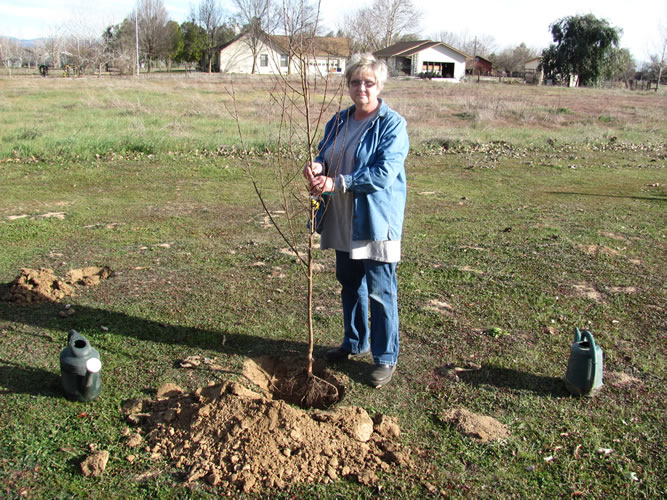
{{{ Karen Garofalo, Red Bluff, CA, 1999-2016.
We purchased $300 to $400 every year
on trees and shrubs; and we planted them
mostly in January or February. We sold our
house and property to two working women
with four children. I hope these children had
wonderful memoriers of growing up in the
gardens and orchards that Karen and I made
before April of 2017 . }}}
That something is eternal is unverifiable.
Most laws of Gardening are merely local ordinances.
Too save some time, don’t let them get a foot in the door.
Some slippery slopes are actually improvements or fun.
Butterflies and bees flapping their wings don’t actually
create hurricanes, but we are very thankful they facilitate
the emergence of fruits in the billions.
Without metaphors we can barely speak.
Just because you reject the big request, don’t be
fooled into accepting the smaller request.
Finding a middle ground for agreement may
be just half of a solution, and the wrong solution.
Sometimes the wisdom of the crowd is quite unwise and unfair.
Chaos breaks its own rules to allow Order to play.
Failures, disorder and death are the
Grim Reaper of Entropy at work.
Somehow, someway, everything gets eaten up, someday.
The meaning is lost in the saying - a nature mystic's dilemma.
Vigorous gardening might help more than a psychiatrist's couch.
A gardener is no farmer, he is much too impractical.
No garden lasts for long - neither will you.
Shade, in the summer, is as precious as a glass of water.
A wise gardener knows when to stop.
Gardens are demanding pets.
Unclench your fist to give a hand.
The little choices day after day are the biggest issue.
Gardening is but one battle against Chaos.
When life gives you onions, you ain't making lemonade.
Many friendships are sustained by a mutual
hatred of another person or group.
Read until you go to seed.
What you see depends on when you look.
Beauty is the Mistress, the gardener her slave.
One's "true self" is changing and elusive.
A little of this and a little of that, and some exceptions -
these are the facts.
Does a plum tree with no fruit have Buddha Nature? Whack!
Pulling Onions by Mike Garofalo
Over 1,000 random quips, one-liners, aphroisms, sayings,
bullets, onions, and "insights" from an old gardener.
Speaking of Time: The Poetic Investigations, Part 2
The History of Gardening
A Timeline From Ancient Times to 2000
Speaking of Time: The Poetic Investigations, Part 1
Saturday, April 25, 2026
Dào Dé Jing en Español
Tao Te Ching en Español
Dao De Jing (Tao Te Ching) in Spanish
Tao Te Ching by Lao Tzu
Dao De Jing by Laozi
Concordance, Selected Translations, Bibliography, Commentaries
Compilation and Indexing by Michael P. Garofalo
For Each of the 81 Chapters:
25 English Translations
5 Spanish Translations
Chinese Characters
Pinyin & Wade-Giles
Concordance
Bibliography & Links
Directory
Commentary
Chapter Indexes
25 English Translations
5 Spanish Translations
Chinese Characters
Pinyin & Wade-Giles
Concordance
Bibliography & Links
Directory
Commentary
Chapter Indexes
Daodejing 81 Website
Concordance to the Tao Te Ching
Daodejing 81 Website
English Language Versions of the Tao Te Ching - Translator's Index
Spanish Language Versions of the Dao De Jing
Chapter Index to the Tao Te Ching
Thematic Index to the Tao Te Ching
Ripening Peaches: Taoist Studies and Practices
Taoism: A Bibliography
An Old Philosopher's Notebooks
Cloud Hands Blog Posts About the Daodejing
How to Live a Good Life: Advice from Wise Persons
Tao Te Ching Chapter Number Index Standard Traditional Chapter Arrangement of the Tao Te ChingChapter Order in Wang Bi's Daodejing Commentary in 246 CE Chart by Mike Garofalo Subject Index | |||||||||
| 1 | 2 | 3 | 4 | 5 | 6 | 7 | 8 | 9 | 10 |
| 11 | 12 | 13 | 14 | 15 | 16 | 17 | 18 | 19 | 20 |
| 21 | 22 | 23 | 24 | 25 | 26 | 27 | 28 | 29 | 30 |
| 31 | 32 | 33 | 34 | 35 | 36 | 37 | 38 | 39 | 40 |
| 41 | 42 | 43 | 44 | 45 | 46 | 47 | 48 | 49 | 50 |
| 51 | 52 | 53 | 54 | 55 | 56 | 57 | 58 | 59 | 60 |
| 61 | 62 | 63 | 64 | 65 | 66 | 67 | 68 | 69 | 70 |
| 71 | 72 | 73 | 74 | 75 | 76 | 77 | 78 | 79 | 80 |
| 81 | |||||||||
A typical webpage created by Mike Garofalo for each one of the 81 Chapters (Verses, Sections) of the Tao Te Ching (Daodejing) by Lao Tzu (Laozi) includes 25 or more different English language translations or interpolations for that Chapter, 5 or more Spanish language translations for that Chapter, the Chinese characters for that Chapter, the Wade-Giles and Hanyu Pinyin transliterations (Romanization) of the Mandarin Chinese words for that Chapter, and 2 German and 1 French translation of that Chapter.
Each webpage for each one of the 81 Chapters of the Tao Te Ching includes extensive indexing by key words, phrases, and terms for that Chapter in English, Spanish, and the Wade-Giles Romanization.
An electronic Concordance for all 81 Chapters of the Tao Te Ching is provided.
Each webpage on a Chapter of the Daodejing includes recommended reading in books and websites, a detailed bibliography, some commentary, research leads, translation sources, a Google Translate drop down menu, and other resources for that Chapter.
Chapter 7, Tao Te Ching by Lao Tzu

Friday, April 24, 2026
Getting the Life You Want
Happiness Activities
1. Expressing Gratitude
2. Cultivating Optimism
3. Avoiding Over-Thinking and Social Comparisons
4. Practicing Acts of Kindness
5. Nurturing Social Relationships
6. Developing Strategies for Coping
7. Learning to Forgive
8. Increasing Flow Expectations
9. Savoring Life's Joys
10. Committing to Your Goals
11. Practicing Spirituality
12. Taking Care of Your Body (Psychological Methods)
13. Taking Care of Your Body (Physical Activity)
14. Taking Care of Your Body (Acting Like a Happy Person)
15. The Hows Behind Sustainable Happiness: Positive Emotions,
Optimal Timing and Variety, Social Support, Motivation, Effort,
Commitment, and Habit.
The How of Happiness: A Scientific Approach to Getting the Life You Want By Sonja Lyubomirsky. New York, Penguin Books, 2008. Index, extensive notes, appendix, 366 pages. ISBN: 978-1594201486. Ms. Lyubomirsky, Ph.D., is a Professor of Psychology at the University of California at Riverside, and a leader in the field of positive psychology.
Professor Lyubomirsky analyzes what determines happiness. Her research indicates that "happiness" is determined approximately 50% by our internal biological "Set Point", 10% by our circumstances in life, and 40% by our intentional activity. Her explanations and suggestions are clear, reasonable, and grounded in psychological research. Gaining effective use of our intentional activities is the focus of this book. "This much happiness - up to 40% - is within your power to change."
How to Live a Good Life: Advice from Wise Persons
Virtues and a Good Life
An Old Philosopher's Notebooks
Pleasure
Reading
Epicureanism

1. Expressing Gratitude
2. Cultivating Optimism
3. Avoiding Over-Thinking and Social Comparisons
4. Practicing Acts of Kindness
5. Nurturing Social Relationships
6. Developing Strategies for Coping
7. Learning to Forgive
8. Increasing Flow Expectations
9. Savoring Life's Joys
10. Committing to Your Goals
11. Practicing Spirituality
12. Taking Care of Your Body (Psychological Methods)
13. Taking Care of Your Body (Physical Activity)
14. Taking Care of Your Body (Acting Like a Happy Person)
15. The Hows Behind Sustainable Happiness: Positive Emotions,
Optimal Timing and Variety, Social Support, Motivation, Effort,
Commitment, and Habit.
The How of Happiness: A Scientific Approach to Getting the Life You Want
By Sonja Lyubomirsky. New York, Penguin Books, 2008. Index, extensive notes, appendix, 366 pages. ISBN: 978-1594201486. Ms. Lyubomirsky, Ph.D., is a Professor of Psychology at the University of California at Riverside, and a leader in the field of positive psychology. Professor Lyubomirsky analyzes what determines happiness. Her research indicates that "happiness" is determined approximately 50% by our internal biological "Set Point", 10% by our circumstances in life, and 40% by our intentional activity. Her explanations and suggestions are clear, reasonable, and grounded in psychological research. Gaining effective use of our intentional activities is the focus of this book. "This much happiness - up to 40% - is within your power to change."
How to Live a Good Life: Advice from Wise Persons
Virtues and a Good Life
An Old Philosopher's Notebooks
Pleasure
Reading
Epicureanism

Thursday, April 23, 2026
Common Ground
"With a cultured of mistrust, how do we create community?
How do we find common ground?
Common ground.
Perhaps that is the place to start. No matter what we think of one
another's religious beliefs or practices, we do all stand on the same ground. We share the same earth. The same sun rises and sets
on all of us. Doesn't this transcend our doctrinal differences?
Millennia ago, early people's personified the sun and earth─ made deities of
them, worshipped them. Our modern scientific understanding of natural
phenomenon makes it unreasonable for us to do that. But surely we can
share their reverence. Surely we can follow their example of respect for
the earth, the air, the water─ and be healthier and happier for it.
If there is a theme that runs through the history of rituals
related to the earth's seasons, it is renewal. The wheel turns and the old
season gives way to the new, the old year to the new, the old life to the new.
Each planting of seeds promises new possibilities. Each harvest brings
sustenance for yet another year. each fallow time regenerates the life of
the soil. The sun deities retreat and return. The grain goddesses
are lost and restored. The vegetation gods die and rise again. The
cycle of life goes on and on, birth after death after birth. Perhaps what
all the rituals celebrate is this continuity of life, the miraculous natural
world that makes it possible, and our abiding connection to it."
- By Patricia Montley,
In Nature's Honor, 2005.
Process Philosophy

Wednesday, April 22, 2026
Yoga Postures - A Likely History
Repost from 2014:
Recently, I have been reading many books about yoga, exercise and
spirituality. The following book by Mark Singleton has influenced my
understanding of the evolution of the practice of hatha yoga since 1880:
Yoga Body: The Origins of Modern Posture Practice By Mark Singleton. New York, Oxford University Press, 2012. Index,
bibliography, notes, 262 pages. ISBN: 9780195395341. VSCL.
By Mark Singleton. New York, Oxford University Press, 2012. Index,
bibliography, notes, 262 pages. ISBN: 9780195395341. VSCL.
Mr. Singleton's well argued and carefully documented thesis is that transnational yoga as we know it today, asana practices, emerged from physical culture practices from Europe, Indian nationalism, gymnastics, bodybuilding, medicine, health regimens, New Thought, a Hindu studies revival, fitness and gym business promoters, and the development and expansion of visual media. This process began in the 1880's and continues to this day.
"Consider the term Yoga as it refers to modern postural practice as a homonyn, and not a synonym, of the "yoga" associated with the philosophical system of Pantanjali, or the "yoga" that forms and integral component of the Saiva Tantras, or the "yoga" of the Bhagavad Gita, and so on. In other words, although the word "yoga" as it is used popularly today is identical in spelling and pronunciation in each of these instances, it has quite different meanings and origins." p.15
"As Joseph Alter has recently argued, a key methodological issue is therefore "how to exercise ethnographic relativism, historical perspectivity and intellectual skepticism all at the same time." This means critically examining modern yoga's truth claims while seeking to understand under what circumstances and to what ends such claims are made." p.14
The esoteric, magical, religious, New Age, imaginary and spiritual dimensions of "yoga" are definitely part of the currents of contemporary yoga practice and trends in non-church spirituality since the 1880's; but, the bigger picture of its popularity is due to our enthusiasm for fitness, bodybuilding, stress reduction, sexuality, improved health, relaxation, and the "good life."
Another book that points us in the right direction regarding contemporary yoga practices is:
The Science of Yoga: The Risks and the Rewards By William J. Broad. New York, Simon and Schuster, 2012.
Index, bibliography, notes, 298 pages. ISBN; 9781451641424.
VSCL.
By William J. Broad. New York, Simon and Schuster, 2012.
Index, bibliography, notes, 298 pages. ISBN; 9781451641424.
VSCL.
This book is a must read for those who question the often outlandish claims for the benefits of yoga, are concerned about risky yoga postures, and favor a more scientific approach to yoga practice.
Finally, I enjoyed reading:
Original Yoga: Rediscovering Traditional Practices of Hatha Yoga By Richard Rosen. Illustrations by Evan Yee. Boston, Shambhala,
2012. Index, bibliography, glossary, appendices, 286 pages. ISBN:
9781590308134. VSCL.
By Richard Rosen. Illustrations by Evan Yee. Boston, Shambhala,
2012. Index, bibliography, glossary, appendices, 286 pages. ISBN:
9781590308134. VSCL.
"The changes the traditional practice went through over the centuries might be considered organic, common to any living organism’s natural evolution. What happened to Hatha Yoga in the early years of the twentieth century, by contrast, happened virtually overnight and was totally "person-made," or artificial. The full story is too long to tell here and has already been masterfully recounted from slightly different perspectives by British researchers Elizabeth de Michelis in A History of Modern Yoga (Continuum, 2004) and Mark Singleton in Yoga Body (Oxford University Press, 2010. Suffice it to say that by the end of the nineteenth century in India, Hatha had fallen on hard times and was on its last trembling leg. Several Indian teachers set out to save Hatha from oblivion; among them was Tirumular Krishnamacharya, whose work provided the impetus for three of our most popular and influential modern teachers: T. K. V. Desikachar (whose teaching was once known as Viniyoga, a term that has since been abandoned); the late K. Pattabhi Jois (who taught Ashtanga-Vinyasa Yoga); and B. K. S. Iyengar, who (though he often adamantly insists there’s no such thing) created Iyengar Yoga. And save Hatha the teachers did. You may have heard or read somewhere that yoga is five thousand years old, a number that’s continually cited by people who should know better, since there’s not a shred of concrete evidence to back it up. What we do know for certain is that the yoga we practice in the West is no more than one hundred years old. Our Indian teachers took what was once the province of a relatively small, loose-knit, mostly male ascetic community that was resolutely living on the fringes of respectable Indian society and transformed it into a worldwide mass movement open to anyone of any age, gender, or physical condition. This is the second meaning of original yoga, the yoga that’s "original" to the twentieth century, or what we call modern Hatha Yoga." Original Yoga by Richard Rosen
This book includes instructions on some practices for "energizing" aspects of the esoteric body that are typical in Qigong and Yoga. Those interested in organic energy, Prana, Chi, and nadis/meridians will find it interesting.
After you set aside the preaching about worshipping Krishna, Shiva, or other Tantric dieties; strange chakras, gunas, and pranic realms; divine grace or higher consciousness; the power of meditation, mudras, and mantras; and Hindu pride ... just stick with the physical practices of yoga to effect significant transformation of your body and mind.
Consider the situation and determination of the following fellow:
Yoga Body: The Origins of Modern Posture Practice
By Mark Singleton. New York, Oxford University Press, 2012. Index,
bibliography, notes, 262 pages. ISBN: 9780195395341. VSCL.Mr. Singleton's well argued and carefully documented thesis is that transnational yoga as we know it today, asana practices, emerged from physical culture practices from Europe, Indian nationalism, gymnastics, bodybuilding, medicine, health regimens, New Thought, a Hindu studies revival, fitness and gym business promoters, and the development and expansion of visual media. This process began in the 1880's and continues to this day.
"Consider the term Yoga as it refers to modern postural practice as a homonyn, and not a synonym, of the "yoga" associated with the philosophical system of Pantanjali, or the "yoga" that forms and integral component of the Saiva Tantras, or the "yoga" of the Bhagavad Gita, and so on. In other words, although the word "yoga" as it is used popularly today is identical in spelling and pronunciation in each of these instances, it has quite different meanings and origins." p.15
"As Joseph Alter has recently argued, a key methodological issue is therefore "how to exercise ethnographic relativism, historical perspectivity and intellectual skepticism all at the same time." This means critically examining modern yoga's truth claims while seeking to understand under what circumstances and to what ends such claims are made." p.14
The esoteric, magical, religious, New Age, imaginary and spiritual dimensions of "yoga" are definitely part of the currents of contemporary yoga practice and trends in non-church spirituality since the 1880's; but, the bigger picture of its popularity is due to our enthusiasm for fitness, bodybuilding, stress reduction, sexuality, improved health, relaxation, and the "good life."
Another book that points us in the right direction regarding contemporary yoga practices is:
The Science of Yoga: The Risks and the Rewards
By William J. Broad. New York, Simon and Schuster, 2012.
Index, bibliography, notes, 298 pages. ISBN; 9781451641424.
VSCL. This book is a must read for those who question the often outlandish claims for the benefits of yoga, are concerned about risky yoga postures, and favor a more scientific approach to yoga practice.
Finally, I enjoyed reading:
Original Yoga: Rediscovering Traditional Practices of Hatha Yoga
By Richard Rosen. Illustrations by Evan Yee. Boston, Shambhala,
2012. Index, bibliography, glossary, appendices, 286 pages. ISBN:
9781590308134. VSCL. "The changes the traditional practice went through over the centuries might be considered organic, common to any living organism’s natural evolution. What happened to Hatha Yoga in the early years of the twentieth century, by contrast, happened virtually overnight and was totally "person-made," or artificial. The full story is too long to tell here and has already been masterfully recounted from slightly different perspectives by British researchers Elizabeth de Michelis in A History of Modern Yoga (Continuum, 2004) and Mark Singleton in Yoga Body (Oxford University Press, 2010. Suffice it to say that by the end of the nineteenth century in India, Hatha had fallen on hard times and was on its last trembling leg. Several Indian teachers set out to save Hatha from oblivion; among them was Tirumular Krishnamacharya, whose work provided the impetus for three of our most popular and influential modern teachers: T. K. V. Desikachar (whose teaching was once known as Viniyoga, a term that has since been abandoned); the late K. Pattabhi Jois (who taught Ashtanga-Vinyasa Yoga); and B. K. S. Iyengar, who (though he often adamantly insists there’s no such thing) created Iyengar Yoga. And save Hatha the teachers did. You may have heard or read somewhere that yoga is five thousand years old, a number that’s continually cited by people who should know better, since there’s not a shred of concrete evidence to back it up. What we do know for certain is that the yoga we practice in the West is no more than one hundred years old. Our Indian teachers took what was once the province of a relatively small, loose-knit, mostly male ascetic community that was resolutely living on the fringes of respectable Indian society and transformed it into a worldwide mass movement open to anyone of any age, gender, or physical condition. This is the second meaning of original yoga, the yoga that’s "original" to the twentieth century, or what we call modern Hatha Yoga." Original Yoga by Richard Rosen
This book includes instructions on some practices for "energizing" aspects of the esoteric body that are typical in Qigong and Yoga. Those interested in organic energy, Prana, Chi, and nadis/meridians will find it interesting.
After you set aside the preaching about worshipping Krishna, Shiva, or other Tantric dieties; strange chakras, gunas, and pranic realms; divine grace or higher consciousness; the power of meditation, mudras, and mantras; and Hindu pride ... just stick with the physical practices of yoga to effect significant transformation of your body and mind.
Consider the situation and determination of the following fellow:
TTT by .m.p.g. The Tick-Tock Tractatus by mpgarofalo. Speaking about Time!
Speaking About Time: The Poetic Investigations
By Michael P. Garofalo

August Offerings, Red Bluff CA, 2010, MPG
Sections
1. Time: time-space, movement, measurement
2. Past: memories, habits, fixed, specific, tradition
3. Present: now, here-now, day, duration
4. Future: maybe, planned, anticipated, uncertain
5. Passing: change, cycles, aging, growth, death
6. Beginning: renewal, starting, enthusiasm
7. Psychology: learning, experience, knowing
8. Middle: in progress, half-way, steady, living
9. Language: poetry, philosophy, ordinary
10. Silence: inexpressive, nonsense, illogical
11. Mystical: numinous, profound, intense, insightful,
12. Beauty: art, crafts, music, reading/writing
13. Social: ethics, morality, economics, manners, value
14. Philosophy: ethics, history, analysis, arguments, logic
15. History: landmark events, books/printing, memory
16. Eternity: forever, infinite, unimaginable, death
Bundled Up Quintains about Time
Subscribe to:
Posts (Atom)