Saturday, June 06, 2026

Thunderbird Stories, Legends, and Myths


Thunderbird Stories of Pacific Northwest Native Peoples

Thunderbird Stores from the Hoh, Quileute, and Tillamook Tribes


"For the native cultures of the Pacific Northwest and the Great Plains, the Thunderbird was a mythical creature that embodied strength and power. The Thunderbird is a very large and powerful bird. It was said to be so large, in fact, that it could pluck an orca whale from the sea with as much ease as an eagle catching salmon in its talons. As the name implies, Thunderbirds were associated with storms. The massive wings of the Thunderbird made the sound of thunder when they flapped, and according to some stories, the Thunderbird even shot lightning from its eyes. For peoples of the Great Plains, the Thunderbird was a harbinger of rain, which could be a welcomed sight or a destructive force, depending on the conditions. In some cultures, Thunderbirds go to war with other forces of nature. “To the Arapaho, Thunderbird is the summer bird who challenges White Owl Woman, the winter bird, to see whose powers are greater. Thunderbird stirs up great black clouds with tremendous noise and wind. White Owl Woman stirs up thick, fast-moving white clouds that blow a piercing wind. The Thunderbird represented the power of nature and the violence of storms, but it was, for the most part, not a fearsome or malevolent creature. This mythical creature was revered as sacred. The tribes of the Pacific Northwest topped their totem poles with carved images of Thunderbirds. Drawings, artwork, songs, stories, and dances featuring the Thunderbird are common in the tribes of the Great Plains and Pacific Northwest."
Ten Native American Mythical Creatures


"The thunderbird is a mythological bird-like spirit in North American indigenous peoples' history and culture. It is considered a supernatural being of power and strength. The thunderbird is said to create thunder by flapping its wings (Algonquian[1]), and lightning by flashing its eyes (Algonquian, Iroquois[2]). Across cultures, thunderbirds are generally depicted as birds of prey, or hybrids of humans and birds. Thunderbirds are often viewed as protectors, sometimes intervening on people's behalf, but expecting veneration, prayers, and gifts. Petroglyphs of thunderbirds are found near Twin Bluffs, Wisconsin. Similar beings appear in mythologies the world over. Examples include the Chinese thunder-god Leigong, the Hindu Garuda and the African lightning bird.[14]"
- Thunderbird in Wikipedia


"According to many legends, the Thunderbird is so large that one feather from their wingspan would have to be folded in half to properly fit into a quiver. Additionally, these creatures were so large and mighty that they could easily carry a whale in their talons. Because of this, many scholars find it unlikely that the Thunderbird could exist in modern day without being seen.

In spite of these things, the Thunderbird continues to be a point of fascination for all. The Thunderbird appears to be a creature of extreme intelligence and intrigue. There are many stories that tell of the Thunderbird in Native American legends, which make the creature appear to be one of the key deities in their beliefs. The Thunderbird is mysterious in that it is not merely a protector, but is also seen as enforcer of morality – one that should never be angered."
- Thunderbirds in Myths


Other Transformer Changers Creatures are the Raven and Coyote.

My favorite harmonica is the Hohner Thunderbird in the Key of C Low.


Friday, June 05, 2026

The Staff Turned Into a Dragon and Swallowed the Universe


Blue Cliff Record, Case 60
Yunmen's Staff Turns Into a Dragon


"Yúnmén Wényan (864–949 CE), (雲門文偃; Japanese: Ummon Bun'en; also known in English as "Unmon", "Ummon Daishi", "Ummon Zenji")

Introduction 

"Engo's Introduction:  Buddhas and sentient beings are not, by nature, different.  Mountains, rivers, and your own self are all just the same.  Why should they be separation and constitute two worlds?  Even if you are well versed in Zen koans and know how to deal with them, if you stop then everything is spoiled.  If you do not stop, the whole world will be dissolved, with not a particle of it left behind.  Now tell me, what does it mean to be well versed in Zen koans?  See the following.

MAIN SUBJECT:  Ummon held out his staff and said to the assembled monks, "The staff has transformed itself into a dragon and swallowed up the universe!  Where are the mountains, the rivers, and the great world?"
Two Zen Classics: Mumonkan and Hekiganroku, Translated by Katsuki Sekida, 1977, p.

Commentary on Yunmen's Staff Turns Into a Dragon by Mike Garofalo

Zen Koans:  Bibliography, Index, Links, Commentary, Information

The Blue Cliff Record.  Translated by Thomas Cleary and J. C. Cleary.  Foreword by Taizan Maezumi Roshi.  Boston, Shambhala, 2005.  Glossary, biographies, bibliography, 648 pages.  ISBN: 9781590302323.  Case 60, p. 341-346.  "Yun Men's Staff Turns Into a Dragon."


Way of the Staff


Setchō's Verse 
"The staff has swallowed up the universe?
Don't say peach blossoms float on the waters.
The fish that gets it tail singed
May fail to grasp the mist and clouds.
The ones that lie with gills exposed
Need not loose heart.
My verse is done.
But do you really hear me?
Only be carefree!  Stand unwavering!
Why so bewhildered?
Seventy-two blows are not enough
I want to give you a hundred and fifty.
Setchō descended from the rostrum waving his staff. The whole crowd ran away."
Two Zen Classics: Mumonkan and Hekiganroku, Translated by Katsuki Sekida, 1977, p.


"A monk asked Kenpo, "The one road of Nirvana leads into the ten quarters. But where does it begin?" 
Kenpo raised his staff and traced a horizontal line in the air and said, "Here."
Disappointed, the monk went to Yunmen and asked him the same question.
Ummon held up his staff and said, "This staff leaps up to the 33rd heaven and hits the presiding deity on the nose,
then it dives down into the Eastern Sea where it hits the holy carp.
The carp becomes a dragon which then brings a flood of rain." 
List of Koans by Yunmen Wenyan  


Yunmen said, "A true person of the Way can speak fire without burning his mouth.  He can speak all day with moving his lips and teeth or uttering a word.  The entire day he just wears his clothes and eats his food, but never comes in contact with a single grain of rice or thread of cloth.
When we speak in this fashion it is jut the manner of our school.  It must be set forth like this to be realized.  But if you meet a true patch-robed monk of our school and try to reveal the essence through words, it will be a waste of time and effort.  Even if you get some great understanding by means of a single word you are still just dozing."
Zen's Chinese Heritage: The Masters and Their Teachings By Andy Ferguson, 2000, p. 262


Roshi Robert Baker Aitken
(1917-2010)
Roshi Aitken holds a ceremonial stick. 


Thursday, June 04, 2026

Standing Fully on a Single Leg


"The Taichi Classics say that the proper root is in the foot.  A beginner can develop root by simply spending three to five minutes, morning and night, standing fully on a single leg.  Alternate legs and gradually increase the time as you sink lower.  This 'bitter work' not only develops a root, it stimulates the cardiovascular system, with benefits the brain.  It is essential that your ch'i sinks to the tan-t'ien, both feet adhere to the floor, and you exert absolutely no force.  When practicing this Standing Posture, you may assist your balance by lightly touching a chair or table with the middle and index fingers.  After a while us only the middle finger.  When you can stand unassisted, you my choose either the Lift Hands Posture or Playing the Guitar Posture to continue your practice.  Do not fear bitter work.  If you do you will never progress."

-  Professor Cheng Man-ch'ing, New Method of Taichi Ch'uan Self-Cultivation, 1965, 1999, p. 11  


Practitioners might also do the Golden Rooster Stands on One Leg Posture or the White Stork Spreads Its Wings Posture.

Standing on one leg, holding static poses, is also a common practice in Hatha Yoga, e.g., Tree Pose, Vriksasana. 

Standing Meditation

You stand on one leg.  You can hold the arms in a variety of positions.  I suppose you could even hold weights in the hands.  You can hold the lifted leg in a variety of positions.  There are many possibilities for different static postures. You could use a cane or staff to help with balance.  You "can develop root by simply spending three to five minutes, morning and night, standing fully on a single leg."  


Effectively Using Rooting, Sinking, Centered, and Vertical Forces in Taijiquan


Effectively Using Rotating, Spiraling, Spinning, and Circular Forces in Taijiquan


Wednesday, June 03, 2026

Dao De Jing, Chapter 26

Tao Te Ching by Lao Tzu
Chapter 26


"The heavy is the root of the Light.
The quiet the master of motion.
Therefore the wise man in all the experience of the day will not depart from dignity.
Though he be surrounded with sights that are magnificent,
he will remain calm and unconcerned.
How does it come to pass that the Emperor,
master of ten thousand chariots,
has lost the mastery of the Empire?
Because being flippant himself, he has lost the respect of his subjects;
being passionate himself, he has lost the control of the Empire."
-  Translated by Dwight Goddard, 1919, Chapter 26


"What is heavy acts as a starting point for lightness.
What is calm acts as a controlling influence over impetuosity. 
It is natural for a person of character to move about all day long without losing sight of his heavy baggage.
Although he may be surrounded by police, he takes a comfortable stance; as a result he seems to be clear and bright. 
How is it that a king has ten thousand chariots, yet as for his own body, he moves lightly in the world?
When he is light he then loses his roots.
When he is impetuous he then loses control."
-  Translated by Nina Correa, 2005, Chapter 26 


"The heavy is the root of the light.
The still is the master of unrest.
Therefore the sage, traveling all day,
Does not lose sight of his baggage.
Though there are beautiful things to be seen,
He remains unattached and calm.
Why should the lord of ten thousand chariots act lightly in public?
To be light is to lose one's root.
To be restless is to lose one's control."
-  Translated by Gia-Fu Feng and Jane English, 1989, Chapter 26 


A typical webpage created by Mike Garofalo for each one of the 81 Chapters (Verses, Sections) of the Tao Te Ching (Daodejing) by Lao Tzu (Laozi) includes over 25 different English language translations or interpolations for that Chapter, 5 Spanish language translations for that Chapter, the Chinese characters for that Chapter, the Wade-Giles and Hanyu Pinyin transliterations (Romanization) of the Mandarin Chinese words for that Chapter, and 2 German and 1 French translation of that Chapter.  Each webpage for each one of the 81 Chapters of the Tao Te Ching includes extensive indexing by key words, phrases, and terms for that Chapter in English, Spanish, and the Wade-Giles Romanization.  Each webpage on a Chapter of the Daodejing includes recommended reading in books and websites, a detailed bibliography, some commentary, research leads, translation sources, a Google Translate drop down menu, and other resources for that Chapter.   

Chapter 26, Tao Te Ching by Lao Tzu


Chapter and Thematic Index (Concordance) to the Tao Te Ching by Lao Tzu

English Language Daodejing Translators' Source Index

Spanish Language Daodejing Translators' Source Index

Ripening Peaches: Taoist Studies and Practices


Taoism: A Selected Reading List


One Old Daoist Druid's Final Journey  


Monday, June 01, 2026

Dao De Jing, Laozi, Chapter 51

Tao Te Ching by Lao Tzu
Chapter 51


"The Way produces all things.
Power nourishes them.
Matter gives them physical form.
Environment shapes their abilities.
Therefore all things respect the Way and honor power.
The Way is respected, and power is honored
without anyone's order and always naturally.
Therefore the Way produces all things,
and power nourishes them,
caring for them and developing them,
sheltering them and comforting them,
nurturing them and protecting them,
producing them but not possessing them,
helping them but not obligating them,
guiding them but not controlling them.
This is mystical power." 
-  Translated by Sanderson Beck, Chapter 51  


"A guide starts it,
virtuosity cultivates it,
Natural kinds model it
and circumstances complete it.
For this reason, among the ten-thousand natural kinds,
None fail to respect a guide and value virtuosity.
This respecting of guides
and valuing of virtuosity
is not, in general, commanded in words instead it treats self-so as constant.
Hence a guide starts it,
virtuosity cultivates it,
Acts as its elder, educates it,
shades it, poisons it,
nourishes it and returns it.
Gives rise to and not 'exist,'
Deem: act and not rely on anything.
Acts as elder and does not rule.
This would be called 'profound virtuosity.'"
-  Translated by Chad Hansen, Chapter 51  


"Tao produces them (all things);
Virtue feeds them;
All of them appear in different forms;
Each is perfect by being given power.
Therefore none of the numerous things does not honour Tao and esteem virtue.
The honouring of Tao and the esteem of virtue are done, not by command, but always of their own accord.
Therefore Tao produces them, makes them grow, nourishes them, shelters them, brings them up and protects them.
When all things come into being, Tao does not reject them.
It produces them without holding possession of them.
It acts without depending upon them, and raises them without lording it over them.
When merits are accomplished, it does not lay claim to them.
Because it does not lay claim to them, therefore it does not lose them."
-  Translated by Ch'u Ta-Kao, 1904, Chapter 51  


道生之.
德畜之.
物形之.
勢成之. 
是以萬物莫不尊道而貴德.
道之尊.
德之貴.
夫莫之命而
常自然. 
故道生之.
德畜之.
長之育之.
亭之毒之.
養之覆之. 
生而不有.
為而不恃.
長而不宰.
是謂玄德. 
-  Chinese characters, Tao Te Ching, Chapter 51  


tao shêng chih.
tê hsü chih.
wu hsing chih.
shih ch'êng chih.
shih yi wan wu mo pu tsun tao erh kuei tê.
tao chih tsun.
tê chih kuei.
fu mo chih ming erh ch'ang tzu jan.
ku tao shêng chih.
tê ch'u chih.
ch'ang chih yü chih.
t'ing chih tu chih.
yang chih fu chih.
shêng erh pu yu.
wei erh pu shih.
ch'ang erh pu tsai.
shih wei hsüan tê.
-  Wade-Giles Romanization, Tao Te Ching, Chapter 51 


"Tao brings forth and Teh nourishes.
All things take up their several forms, and natural forces bring them to perfection.
Therefore all things conspire to exalt Tao and to cherish virtue.
But this regard of Tao and Teh is not in deference to any mandate.
It is unconstrained, and therefore it endures forever.
For Tao produces all things, and Teh nourishes, increases, feeds, matures, protects, and watches over them.
To produce without possessing; to work without expecting; top enlarge without usurping; this is the absolute virtue!"
-  Translated by Walter Gorn Old, 1904, Chapter 51 


"Tao gives all things life
Te gives them fulfillment
Nature is what shapes them
Living is what brings them to completion
Every creature honours Tao and worships Te not by force but through its own living and breathing
Though Tao gives life to all things
Te is what cultivates them
Te is that magic power which raises and rears them completes and prepares them comforts and protects them
To create without owning
To give without expecting
To fill without claiming
This is the profound expression of Tao
The highest perfection of Te"
-  Translated by Jonathan Star, 2001, Chapter 51 


"El Tao engendra.
La virtud nutre.
La materia conforma.
La Energía perfecciona.
Por esto, los diez mil seres
respetan al Tao
y honran la virtud.
Este respeto al Tao y honor a la Virtud
no ha de ser impuesto por nadie, sino que es espontáneo,
por ser la propia naturaleza.
Porque el Tao los engendra,
la virtud los nutre,
los hace crecer, los perfecciona,
los conserva, los madura
y los protege.
Engendrar y criar,
Engendrar sin apropiarse,
Obrar sin pedir nada a cambio,
Guiar sin dominar,
Esta es la Gran Virtud."
-  Translation from Wikisource, 2013, Capitulo 51


"The Tao gives birth to all of creation.
 The virtue of Tao in nature nurtures them,
 and their families give them their form.
 Their environment then shapes them into completion.
 That is why every creature honors the Tao and its virtue.

 No one tells them to honor the Tao and its virtue,
 it happens all by itself.
 So the Tao gives them birth,
 and its virtue cultivates them,
 cares for them,
 nurtures them,
 gives them a place of refuge and peace,
 helps them to grow and shelters them.

 It gives them life without wanting to posses them,
 and cares for them expecting nothing in return.
 It is their master, but it does not seek to dominate them.
 This is called the dark and mysterious virtue."
 -  Translated by John H. McDonald, 1996, Chapter 51 


Chapter and Thematic Index (Concordance) to the Tao Te Ching


Taoism: A Selected Reading List


Tao Te Ching English Language Corncordance by Gerold Claser.  An excellent English language concordance providing terms, chapter and line references, and the proximal English language text.  No Chinese language characters or Wade-Giles or Pinyin Romanizations.  Based on the translation by John H. McDonald, available on the Internet in the public domain.  


Taijiquan Fan: Tai Chi Kung Fu 52 Movements Fan Form

There are many T'ai Chi Ch'uan exercise forms which make use of a fan.   Most are shorter forms, under 25 movements, but some, like the famous Tai Chi Kung Fu Fan Form have over 50 movements.  Most are done slowly and softly, but some include vigorous and fast movements.  The majority favor the Yang Style of Tai Chi Chuan.  


Tai Chi Fan: Bibliography, Links, Resources, Notes, Lore, Quotations. Research by Mike Garofalo.  I welcome any comments, suggestions, additions, or ideas regarding this webpage.


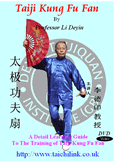
One of the most popular Tai Chi Fan forms was created by Professor Li Deyin (1938-).  It has 52 movements.  I includes slow and gentle movements in the first half of the form, then the second half is much more vigorous.  This Tai Chi Fan form is for athletic and intermediate Tai Chi students. 


Here are some instructional resources for learning the Tai Chi Kung Fu Fan Form.  


Tai Chi Kung Fu Fan. Routine 1, created by Grandmaster Li Deyin (1938-). Instructional DVD, 65 minutes, by Master Jesse Tsao. Tai Chi Healthways, San Diego, California. "The most popular Tai Chi Fan form ever practiced in China. The routine was created by Grandmaster Li Deyin, Jesse Tsao's teacher since 1978. There are 52 movements in the whole routine based on the characteristic Tai Chi posture with the fan's artistic and martial functions. Master Tsao presents demonstrations at the beginning and end. He teaches step-by-step in slow motion, in English. There are plenty of repetitions of movements in both front and back view. It is a good reference for home study, or a resource for instructor's teaching preparation." Cost: 35.00 US. Demonstration.

Tai Chi Kung Fu Fan Instructional DVD by Professor Li Deyin. Narration in English. "A fan routine, created by Professor Li, which combines the gracefulness, centrality and continuity of Taiji with the power, speed and fierceness of Wushu. It is designed as an addition to the exercises for health, and has received massive interest and support throughout the world. In this DVD, Professor Li provides in-depth teaching with Mrs. Fang Mishou performing detail demonstration." Vendor 1. Cost: $35.00 US.


Tai Chi Kung Fu Fan List, Routine 1.  A list of the 52 movement names in four languages.  

Tai Chi Kung Fun Fan List, Routine 1.  A list of the 52 movement names in English.   

Tai Chi Kung Fu Fan List, Routine 1, Movements 1-26.  A list of 26 movement names in English.