Tuesday, December 19, 2006

Spirit of Gardening Website

The Cloud Hands: Mind/Body Movement Arts Blog includes gardening in its mix of Mind/Body Arts. My wife, Karen, and I are avid gardeners, and our home in Red Bluff, California, is on five acres of land. I have many comments and suggestions about the mind/body art of gardening and most of these are posted to the Green Way Blog, the Spirit of Gardening website, and the Valley Spirit Journal rather than to the Cloud Hands Blog.

The Spirit of Gardening Website


Spirit of Gardening Wins Another Award.


"This is Cindy from Garden Site Awards. You probably didn't know, but one of your website visitors nominated your website for our "Best Garden Website Award" last week. We get over 150 nominations each week but only a couple websites are given our award. After reviewing your site, The Spirit of Gardening, we've decided you deserve this month's Best Garden Website Award. Congratulations!! Keep up the great work on your website! You have some excellent content already on it and I'm sure it will only get better."
- Cindy Meadows, 12/6/06

Other reviews and awards for the Spirit of Gardening Website.


Spirit of Gardening Gardening History Timeline Wins Another Award.

Spirit of Gardening Award

Quotes for Gardeners - Index

History of Gardening Timeline

Green Way Blog by Mike Garofalo

Word Press has a module, ShortStat, which provides daily usage information. Currently, the Green Way Blog is requested, on the average, by 560 persons each day. Since the Green Way Blog started in August, 2005, there have been 202,400 requests for this blog.

Monday, December 18, 2006

Rooting Deeply with the Legs

"The most basic method of training is zhan zhuang. Zhan zhuang is an exercise common to many Chinese martial arts, including Taijiquan. Usually, the practitioner stands with the arms held as if holding a large ball. However, the zhan zhuang exercise can be practiced using any of the end postures of the Taiji form. During "standing" practice a static posture is maintained for a period of time while using just enough strength to maintain the posture. ... Benefits of zhan zhuang include deep relaxation, strengthening of the legs, and increased internal qi. The first requirement is to have a calm mind. This can be achieved in a number of ways - for instance, concentrating on the Dantian, paying attention to one's breath, or silently counting. Through standing practice, emphasis is place upon developing awareness of maintaining the most efficient and relaxed structural alignment necessary to hold the position. Prolonged practice, along with enhancing postural awareness and tranquility of mind, greatly develops the strength of the legs. When the legs are strong and can bear weight firmly, then the upper body can relax and sink down into them, making the top more flexible. ... Taijiquan requires lightness and sensitivity in the upper body. At the same time, the lower body should have a feeling of extreme heaviness and connection to the ground. This feeling is often compared to a large tree with deep roots. While the branches move and sway in the wind, the trunk is solidly anchored by its roots."
- Davidine Siaw-Voon Sim and David Gaffney, Chen Style Taijiquan, 2002, p. 106.

Zhan Zhuang: Standing Like a Tree. Bibliography, Links, Quotes, Notes. By Mike Garofalo. 136Kb.

Sunday, December 17, 2006

In and Out of My Shadow

"I measure myself
Against a tall tree
I find that I am much taller,
For I reach right up to the sun
With my eye;
And I reach to the shore of the sea
With my ear.
Nevertheless, I dislike
The way the ants crawl
In and out of my shadow."
- Wallace Stevens

My tabby cat, Tut, walks in and out between my feet as I practice taijiquan and qigong outside of my home. He enjoys playing with me as I move. Sometimes his antics can cause me to stumble a bit, mentally and physically, but mostly our playful dance makes me smile.

As for the ants, I'm sorry that I step on a few of them as I move about. I mean them no harm as they go about their work to make a living on the earth and clean up the dead. We all have a place, in and out of the shadows.

Saturday, December 16, 2006

Walking With Soft Vision

"Start out walking a little faster than normal, and gradually slow down to a normal walking speed, and then continue to slow down until you start to feel artificial or off balance. Speed up just enough to feel comfortable, physically and psychologically. At first you may need to walk fairly fast to feel smooth in your gait, but with practice, as your balance improves, you should be able to walk more slowly. Be mindful of your breathing, without trying to control it. Allow the breath to become diaphragmatic if possible, but always make sure your breathing feels natural, not artificial. Allow the breath to become circular, and fluid.

Walk with 'soft vision' allowing the eyes to relax and focus upon nothing, while aware of everything. Smile softly with your eyes. Gradually allow the smile to spread from your eyes to your face and throughout your body. This is called an "organic smile" or a "thalamus smile". Imagine every cell of your body smiling softly. Let all worry and sadness fall away from you as you walk.

Walk in silence, both internal and external. Be mindful of your walking, make each step a gesture, so that you move in a state of grace, and each footprint is an impression of the peace and love you feel for the universe. Walk with slow, small, deliberate, balanced, graceful foot steps."
- Charles MacInerney, Walking Meditation

Walking Meditation: Links, Bibliography, Quotes, Resources, Notes

Friday, December 15, 2006

Je Ne Sais Quoi

"Flinging open the front door I strode purposefully down the walk stopping every few steps to perform a little Tai Chi. Tiger Crane paper fetching. I have found that this sort of behavior keeps the neighbors at bay. I’m trying to cultivate a little je ne sais quoi and I think I’m succeeding."
- Bill, Sugar Land, Texas

HooYa! Way to go Bill.

je ne sais quoi: 'I do not know what'; indescribable attractive attribute or quality; 'a certain something'.

We've got that "certain something" ... unique, playful, delightful, expressive. Play on T'ai Chi Ch'uan players ... play on!

Thursday, December 14, 2006

Paths of the Everyday

“We men of Earth have here the stuff
Of Paradise - we have enough!
We need no other stones to build
The Temple of the Unfulfilled -
No other ivory for the doors -
No other marble for the floors -
No other cedar for the beam
And dome of man’s immortal dream.

Here on the paths of every-day -
Here on the common human way
Is all the stuff the gods would take
To build a Heaven, to mold and make
New Edens. Ours is the stuff sublime
To build Eternity in time!”
- Edwin Markham, Earth is Enough

Green Way Wisdom - Religion

Walking, dancing, taijiquan, qigong, gardening or yoga
at daybreak are all a taste of paradise for me.
"We men of Earth have here the stuff of paradise..."
Peace to everyone.
Blessed Be!

Wednesday, December 13, 2006

Tai Chi Chuan Cat Walk

Grandmaster Yang Cheng Fu described in his book, “The Practice of Taijiquan”, that “the two legs be differentiated into yin and yang, and should raise and lower as if walking like a cat”.

"The Taiji Classics state that “if the hands advance three percent, then the legs advance seven percent”. This demonstrates the importance of stance work and stepping in Taijiquan. There is also a saying which says that if one can perform a proper “Taiji Cat Walk”, it does not necessarily mean one’s Taijiquan is good, but in order to be very good at Taijiquan, one must have a proper “Taiji Cat Walk”. The legs move slowly and evenly under the control of the waist and spine while performing the “Taiji Cat Walk”. Close to half of the largest muscles groups found within the body are below the waist and abdomen. The “Taiji Cat Walk” will allow all the muscles, ligaments, joints, etc. to obtain maximum range of exercise with the least amount of resistance. The action which occurs in the legs is similar to the motion of twisting (draining) a wet towel. All of the fibers within the towel (legs) will receive varying degrees of twisting and pressure."

Tai Chi Chuan Journal, Volume 4, Number 3, Summer 2003, "Walk Like a Cat" by Greta Hill.

Walking and Tai Chi Chuan

Tuesday, December 12, 2006

Tai Chi Chuan 24 Standard Form

Standard Simplified Chinese National Version, 24 Form Taijiquan, 1956. The 24 Form is based on the Yang Style of T'ai Chi Ch'uan.

Links, Bibliography, Quotes, Notes, List of Movements

By Mike Garofalo

I recently added some links to online video resources and a couple of books and articles.

Monday, December 11, 2006

Tai Chi Chuan 32 Sword Form

If you are studying the standard 32 T'ai Chi Ch'uan sword form, you might find my webpage on the subject to be of value. If you have additional references to books, videos, DVD, articles, notes, and information about the standard 32 Taijiquan Sword (Jian, Gim) form, adapted from the Yang style of swordsmanship, please send me an email.

"The Attack Doesn't Come From Oneself:
In accordance with the principles of T'ai Chi Ch'uan, you first move after the opponent moves. It is elementary that the initiative to fight doesn't come from oneself. This shows that the T'ai Chi sword is a true method of self-defense."
- Petra and Toyo Kobayashi, Classical T'ai Chi Sword

Sword Weapons: T'ai Chi Ch'uan: Bibliography, Links, Quotes, Notes. By Mike Garofalo. 218Kb.

Sunday, December 10, 2006

Yang-Dong Tai Chi Fast Form

Catherine from Sonoma County, California, wants to know if
anyone has a list of the sequence of movements of the Yang-Dong
style Fast Set. She has not had success in searching around
to find a list.

Does anyone know where this might be found? A book? A
magazine article? A webpage? If you have a list, please
email to me.

Down But Not Out

Problems getting online all week via Wild Blue satellite ISP and my LinkySys router.
A frustrating hassle for me!

Monday, December 04, 2006

Tai Chi Chuan - Philosophical Foundations

"Tai chi existing without its philosophical foundation would become a hollow form of adult exercise, lacking not only the profundity of the art but its great health and martial arts benefits as well."
- Wolfe Lowenthal

"If you do not know how to manifest this internal understanding into martial actions, then you have only reached a low level. Similarly, if you practice tai chi chuan only focussing on the martial aspects, without pondering and understanding the theories, then the martial manifestation will be shallow."
- Yang Jwing-Ming

Taoism: Some Key Terms

Definitons provided by Roger T. Ames and David L. Hall in Daodejing "Making Life Significant": A Philosophical Translation (2003), p. 67:

wuming: Naming without fixed reference.

wushi: To be non-interfering in going about your business.

wuwei: Noncoercive action that is in accordance with the de of things.

wuyu: Objectless desire.

wuzheng: Striving without contentiousness.

wuzhi: Unprincipled knowing.


Chapter 63, Dao De Jing

"Do that which consists in taking no action;
Pursue that which is not meddlesome;
Savor that which has no flavor.

Make the small big and the few many;
Do good to him who has done you an injury.

Lay plans for the accomplishment of the difficult before it becomes difficult;
Make something big by starting with it when small.

Difficult things in the world must needs have their beginnings in the easy;
Big things must needs have their beginnings in the small.

Therefore it is because the sage never attempts to be great that he succeeds in becoming great.

One who makes promises rashly rarely keeps good faith;
One who is in the habit of considering things easy meets with frequent difficulties.

Therefore even the sage treats some things as difficult.
That is why in the end no difficulties can get the better of him."

Translated by D. C. Lau

Sunday, December 03, 2006

Meditation Benefits

Physical and Psychological Benefits of Meditation


"Deep rest-as measured by decreased metabolic rate, lower heart rate, and reduced work load of the heart.
Lowered levels of cortisol and lactate-two chemicals associated with stress.
Reduction of free radicals.
Decreased high blood pressure.
Higher skin resistance. Low skin resistance is correlated with higher stress and anxiety levels.
Drop in cholesterol levels. High cholesterol is associated with cardiovascular disease.
Improved flow of air to the lungs resulting in easier breathing.
Higher levels of DHEAS in the elderly.
Increased brain wave coherence. Harmony of brain wave activity in different parts of the brain is associated with greater creativity, improved moral reasoning, and higher IQ.
Decreased anxiety.
Decreased depression.
Decreased irritability and moodiness.
Improved learning ability and memory.
Increased self-actualization.
Increased feelings of vitality and rejuvenation.
Increased happiness.
Increased emotional stability."

Saturday, December 02, 2006

Wearing Yourself Out in Vain

"As for walking around stupas, the stupa is your body and mind. When your awareness circles your body and mind without stopping, this is called walking around a stupa. The sages of long ago followed this path to nirvana. But people today don't understand what this means. Instead of looking inside they insist on looking outside. They use their material bodies to walk around material stupas. And they keep at it day and night, wearing themselves out in vain and coming no closer to their real self."
- Bodhidharma, 515 CE

The Zen Teaching of Bodhidharma, p. 101. Translated and with an Introduction by Red Pine.


One of many stories told about Bodhidharma, the first Zen Patriarch in China and the legendary founder of Shaolin qigong and gungfu, is that he spent seven years in seated meditation while facing a stone wall. Talk about wearing yourself out in vain!

The only thing that would "wear out" while walking around a stupa, or a mountain, or a bagua circle, or a lake, or a soccer field would be one's shoes. Thankfully, the Bodhidharma finally Woke Up after his seven years of staring at a blank wall, and resolved that all Shaolin monks thereafter would be required to exercise, garden, and move about much more.


Walking the Circle: Ba Gua Zhan

Walking Meditation: Links, Bibliography, Quotes, Resources

Friday, December 01, 2006

Water Boxing

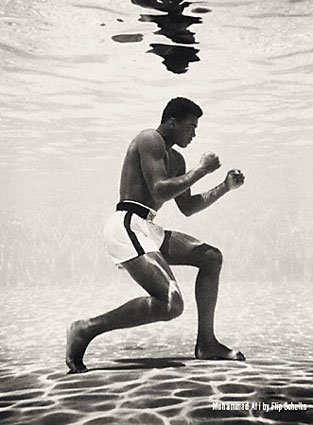
Water Boxing
Muhammad Ali by Flip Schulke

When we learned the long and beautiful Liu Ho Ba Fa style of Taijiquan from Master Robert Moore in 1988, he taught us that we should imagine ourselves moving through water as we practiced the form. He often called this Taijiquan form "Water Boxing."

One of the most frequently used metaphors for Qi is Water: Qi flows. Qi is stored in the Dan Tien reservoir. Qi flows in meridian channels. Qi moves. Qi can be blocked. Qi can be stagnant. Qi can be sensed as hot or cold. Qi is nourishing. Qi revitalizes us. Qi is fluid and powerful.