Saturday, February 14, 2015

Cloud Hands Blog Usage

The Cloud Hands Blog has now served up over 500,000 page views of blog posts to readers from around the world.  In July of 2014, it had served up a total of 400,000 page views.

I have made 2,031 posts to this Cloud Hands Blog.  My first post to the Cloud Hands Blog was made on October 26, 2005.   

There were 12,425 page views of the Cloud Hands Blog in the last month, and 419 page views yesterday.  There are now 99 persons that follow this blog by email. 

I have had some positive feedback and awards for the Cloud Hands Blog


Thank you very much to all those persons that have read the posts to this blog.  


Last year, I added a Translate button at the top of the right sidebar so that non-English readers can read the post in the language of their choice, albeit within the limitations of automatic machine translations.


I use Blogger for a number of reasons.  First, blogging provides a permanent record of one's written contributions with backup files.  Second, your posts can be indexed in a variety of ways.  Third, it provides a useful and flexible structure for linking to other related websites and blogs.  Fourth, people can subscribe to your posts via an email blog aggregator.  Fifth, your posts and content links are added automatically and immediately to the Google and Bing indexes.  Sixth, you can display photos, graphics, and UTube embeds in your blog.  Seventh, web publishers can use their blog to create a alternative front-end index to their other websites and webpages.  Eight, it serves as my readily available online notebook. 

The nice aspect of any Blogger blog is the fact that all posts are thoroughly indexed by topics shown in the lower right side bar.  The blog has a search box at the top left hand corner of the blog that provides full access to all past posts.  Also, there are links in the right sidebar to other blogs and webpages by others that are worth exploring and reading.


My Cloud Hands Blog is primarily a online vehicle for referring people to my hundreds of webpages with specific, extensive, and focused content on subjects of interest to me, and updating my readers on the webpages I am currently creating or improving.  Links in each post point to relevant material in my webpages on a particular subject. A partial index to my many webpages can be found at Green Way Research

I have been creating webpages at the Spirit of Gardening website since 1999.  Over 31 million webpages were served to people all around the world from the Spirit of Gardening website from 1999-2015. 
I use BlueHost for hosting my webpages. 


I have been creating webpages at Green Way Research since 2001.  Each year over 1 million webpages are served up from the Cloud Hands website which includes Cloud Hands Taijiquan, Valley Spirit Qigong, Ripening Peaches: Taoist Studies and Practices, A Philosopher's Notebooks, The Good Life, and One Old Druid's Final Journey

Over 4,100 persons have written to me since 1999 to tell me how these hundreds of webpages have provided them with enjoyment, inspiration, information, and insights; or, to ask me questions.   


My main webpage efforts in 2014 had been weekly work on the 81 Chapters of the Tao Te Ching by Lao Tzu.  By June of 2014, I completed adding 16 English language translations for each Chapter, two Spanish language translations for each of the 81 chapters of the Daodejing, and indexing by Spanish language terms for all the Chapters.  Each Friday, I submit a post on the Daodejing to the Cloud Hands Blog

In 2015, my reading, research, and writing will be focused on on embodied cognition, pragmatism, metaphors, fitness practices, and the senses

Hopefully, posts to this blog will benefit my readers in some positive way, lead to discovering other mind-body fitness options they might explore, and providing a little insight on topics of mutual interest.

Yes, I do repeat previous blog posts.  Few busy people have the time to post original material each day unless the blog is a steady source of income for them. Since I am semi-retired and still work two part-time jobs for 30 hours total each week, and exercise six days a week, my time available for original creative writing is somewhat limited.  Also, I focus on a more limited set of topics, and seldom comment on current events unless it is relevant to local personal situations surrounding my various practices, e.g., gardening, seasons, body-mind arts, etc.. 


I recently upgraded my computer to a new HP Pavillion desktop computer running Windows 8.1.  I moved all my software and files over to the new computer.  I am now using the Microsoft Office Suite 2007.  In the past, I used the Microsoft Office Suite 2003 running on Windows XP on a Gateway desktop computer.  I purchased a number of good low priced used books from Amazon about the Microsoft Office Suite 2007. I also use Dreamweaver, Photoshop, and other software programs.  We also use a portable computer and tablet computer in various locations around our home.  


Friday, February 13, 2015

Tao Te Ching by Lao Tzu, Chapter 25

Dao De Jing, Laozi
Chapter 25

"There was something undefined and complete, coming into existence before Heaven and Earth.
How still it was and formless, standing alone, and undergoing no change, reaching everywhere and in no danger of being exhausted!
It may be regarded as the Mother of all things.
I do not know its name, and I give it the designation of the Tao. 
Making an effort to give it a name, I call it The Great.
Great, it passes on in constant flow.  
Passing on, it becomes remote.
Having become remote, it returns.
Therefore the Tao is great, Heaven is great, Earth is great, and the sage king is also great.
In the universe there are four that are great, and the sage king is one of them.
Man takes his law from the Earth.
Earth takes its law from Heaven.
Heaven takes its law from the Tao.
The law of the Tao is its being what it is."
-  Translated by James Legge, 1891, Chapter 25 


"Something formless yet complete,
existing before heaven and earth.
Silent and limitless,
it stands alone and does not change.
Reaching everywhere, it does not tire.
Perhaps it is the Mother of all things under heaven.
I do not know its name
so I call it "Tao."
When I have to describe it I call it "great."
Being great it flows.
It flows far away.
Having gone far away, it returns.
Therefore, the Tao is great.
Heaven is great.
Earth is great.
People are also great.
Thus, people constitute one of the
four great things of the universe.
People conform to the earth.
The earth conforms to heaven.
Heaven conforms to the Tao.
The Tao conforms to its own nature."
-  Translated by Tolbert McCarroll, 1982, Chapter 25   

 
"There was a Thing, all-holding, all-complete,
Which was before existed Heaven and Earth,
Changeless! Formless! Solitary! Calm!
All-pervading! Unlimited! the birth
Of all the mighty universe concealed
Within the Motherhood not yet revealed.
I do not know its name; the Way; the Course;
The Tao, I call it; if constrained to make
A name, I call it furthermore The Great!
And Great, it passes onward and away,
Tis afar, and from afar returning flows,
The ebb of that great tide which sourceless rose.
Now then the Tao is great, and Heaven is great,
And Earth is great, and greatness is of Kings;
Within the world the greatnesses are four,
And one is he who rules over men and things;
Man takes his law from Earth; from Heaven this:
Heaven from the Tao; the Tao from what it is."
-  Translated by Isaac Winter Heysinger, 1903, Chapter 25 


"Before creation a prescience existed,
Self-contained, complete,
Formless, voiceless, mateless,
Changeless,
Which yet pervaded itself
With unending motherhood.
Though there can be no name for it,
I have called it 'the way of life.'
Perhaps I should have called it 'the fullness of life,'
Since fullness implies widening into space,
Implies still further widening,
Implies widening until the circle is whole.
In this sense
The way of life is fulfilled,
Heaven is fulfilled,
Earth fulfilled
And a fit man also is fulfilled:
These are the four amplitudes of the universe
And a fit man is one of them:
Man rounding the way of earth,
Earth rounding the way of heaven,
Heaven rounding the way of life
Till the circle is full."
-  Translated by Witter Bynner, 1944, Chapter 25  


有物混成.
先天地生.
寂兮.
兮獨立不改.
周行而不殆.
可以為天下母.
吾不知其名.
字之曰道.
強為之名曰大.
大曰逝.
逝曰遠.
遠曰反.
故道大, 天大, 地大, 王亦大.
域中有四大, 而王居其一焉.
人法地.
地法天天法道.
道法自然.
-  Chinese characters, Tao Te Ching, Chapter 25 


yu wu hun ch'êng.
hsien t'ien ti shêng.
chi hsi.
liao hsi tu li pu kai.
chou hsing erh pu tai.
k'o yi wei t'ien hsia mu.
wu erh chuh ch'i ming.
tzu chih yüeh tao.
ch'iang wei chih ming yüeh ta.
ta yüeh shih.
shih yüeh yüan.
yüan yüeh fan
ku tao ta, t'ien ta, ti ta, wang yi ta.
yü chung yu ssu ta, erh wang chü ch'i yi yen.
jên fa ti.
ti fa t'ien t'ien fa tao.
tao fa tzu jan.
-  Wade-Giles Romanization, Tao Te Ching, Chapter 25 


"There is a thing inherent and natural,
Which existed before heaven and earth.
Motionless and fathomless,
It stands alone and never changes;
It pervades everywhere and never becomes exhausted.
It may be regarded as the Mother of the Universe.
I do not know its name.
If I am forced to give it a name,
I call it Tao, and name it as supreme.
Supreme means going on;
Going on means going far;
Going far means returning.
Therefore Tao is supreme; heaven is supreme; earth is supreme; and man is also supreme.
There are in the universe four things supreme, and man is one of them.
Man follows the laws of earth;
Earth follows the laws of heaven;
Heaven follows the laws of Tao;
Tao follows the laws of its intrinsic nature."
-  Translated by Ch'u Ta-Kao, 1904, Chapter 25 

 
"Antes aún que el cielo y la tierra ya existía un ser inexpresable.
Es un ser vacío y silencioso, libre, inmutable y solitario.
Se encuentra en todas partes y es inagotable.
Puede que sea la Madre del universo.
No sé su nombre, pero lo llamo Tao.
Si me esfuerzo en nombrarlo lo llamo grande.
Es grande porque se extiende.
Su expansión le lleva lejos.
La lejanía le hace retornar.
El Tao, pues, es grande y el cielo es grande.
La tierra es grande y también lo es el hombre.
En el universo hay cuatro cosas grandes, y el hombre del reino es una de ellas.
El hombre sigue la ley de la tierra.
La tierra sigue la ley del cielo.
El cielo sigue la ley del Tao.
El Tao sigue su propia ley."
-  Spanish Version Online at RatMachines, Capitulo 25 

 
"What's behind it all?
There is a thing-kind made up of a mix.
It emerges before the cosmos.
Solitary! Inchoate!
Self grounded and unchanging.
Permeating all processes without extremity.
We can deem it the mother of the social world.
I don't know its name. When put in characters we say dao.
Forced to deem it as named, we say 'great.'
Being great, we say 'comprehensive.'
Being comprehensive, we say 'far reaching.'
Being far reaching, we say 'reverting.'
So our dao is great;
Nature (heaven) is great,
Earth is great,
and kings are also great.
Within a region are four 'greats.'
And the King occupies one of those [lofty] statuses.
Humans treat earth as a standard.
Earth treats constant nature as a standard.
Constant nature treats dao as a standard.
Dao treats being so of itself as a standard."
-  Translated by Chad Hansen, Chapter 25  


Chapter and Thematic Index (Concordance) to the Tao Te Ching


Taoism: A Selected Reading List


 A typical webpage created by Mike Garofalo on a Chapter of the Tao Te Ching (Daodejing) by Lao Tzu (Laozi) includes at least 16 different translations or interpolations of the Chapter in English, two Spanish translations, the Chinese characters for the Chapter, a Wade-Giles and Hanyu Pinyin Romanization of the Mandarin Chinese words for the Chapter, recommended reading lists, a detailed bibliography; indexing by key words and terms for the Chapter in English, Spanish, and the Wade-Giles Romanization; some commentary, and other resources for the Chapter. 


Wednesday, February 11, 2015

Palpable in Our Own Flesh

"Before beginning this journey inward, we must clarify its nature.  There is a frequent misunderstanding of the journey inward or the spiritual path, which suggests to most people a rejection of the natural world, the mundane, the practical, the pleasurable.  On the contrary, to a yogi (or indeed a Taoist master or Zen monk) the path toward spirit lies entirely in the domain of nature.  It is the exploration of nature from the world of appearances, or surface, into the subtlest heart of living matter.  Spirituality is not some external goal that one must seek be a part of the divine core of each of us, which we must reveal.  For the yogi, spirit is not separate from the body.  Spirituality, as I have tried to make clear, is not ethereal and outside nature but accessible and palpable in our very own bodies."
-  B.K.S. Iyengar, Light on Life, 2005, p. 18


Valley Spirit Yoga

Body-Mind, Soma, Somaesthetics  

Light on Life: The Yoga Journey to Wholeness, Inner Peace, and Ultimate Freedom  By B.K.S. Iyengar.  With John J. Evans and Douglas Abrams.  Rodale Books, 2005.  Index, 282 pages.  ISBN: 1594862486.  VSCL. 

Yoga: The Path to Holistic Health  By B.K.S. Iyengar.  London, Dorling Kindersley, 2001.  Index, glossary, appendices, 415 pages.  ISBN: 0789471655. 
Lavishly illustrated compendium of essential poses, routines, prop use, and yoga routines to help specific health problems.  VSCL.    


Tuesday, February 10, 2015

February Scenes and Winter Moods

It rained last weekend.  We got about 2.5" of rain.  Heavy rain in the local mountains, with snow above 6,500 feet.  Winds from the southwest from 15 to 40 MPH.    

“There is a privacy about winter which no other season gives you …..
In spring, summer and fall people sort of have an open season on each
other; only in the winter, in the country, can you have longer, quiet
stretches when you can savor belonging to yourself.”
- Ruth Stout


At the end of the culdesac lane that I walk on, I come to Highway 99 West (shown above). This portion of Hwy 99 was constructed in 1926, mostly right along the side of the Union Pacific railroad tracks that go back to 1870. Highway 99 is a major highway in the far western U.S., from San Diego to Seattle.  Interstate 5 replaced Highway 99 in the 1960's. 


The nearby Shasta Yolla Bolly mountains, and the Trinity Alps behind them, to the north west of our home in Red Bluff, sometimes get snow down to 3,000 feet (shown above). We rarely get any snow in the valley where I live.


The many nearby almond orchards are in full bloom in February. 


The prune plum orchards have yet to flower.


"Timeless thoughts of a winter’s stare;
eyes gazing over a landscape bare.
Memories drift on a blustery breeze;
dying light ushers in the freeze.
Reaching out for a grasp on the present;
stillness sets in, alone, and desolate.
Future unknown, outcome uncertain;
brilliance shadowed by a drawn curtain.
Path now set, laid before me known;
closing light now emanating from home.
Enter my homestead, heart filled with glee;
two eyes of the future peering upward at me.
Trusting in him to forge forward until fulfilled;
Basis of strength, values I have instilled.
A wary mind at last permitted to rest;
reflecting on the realization of how I am blessed.
-  Michael A. Barron, Winter's Epiphany    
 

"Winter is the time for comfort - it is the time for home."
-  Edith Sitwell

Sunday, February 08, 2015

Raise Hands and Lower Hands - Taijiquan


Variations of names for this movement include: WuJi, Standing Quietly, Reconnecting with Oneness and Emptiness, Quiet Standing Mediation
Beginning, Commencement, Starting Posture, Commencing (Qishi), Taijiquan Opening Movement, and 预 备 : Yu Bei : Preparation Form.  


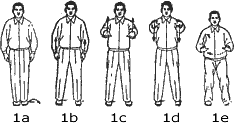
Face N 12 (1a) .  For an explanation of the directional scheme used in Cloud Hands webpages, please see below. 
Stand at attention for awhile.  In Taiji and Qigong, standing quietly in a meditative posture for awhile is the first phase Relax (Sung).  Shoulders are down, hands relaxed and gently touching the side of leg, and head is erect.  This is the phase of WuJi (empty state), or standing like a tree (Zhan Zhuang), and Reconnecting with Oneness and Emptiness.  Breathe easily and comfortably. 
Sink weight into right leg, and then step out to the left to shoulder width (1b). 
Gently raise both arms up (1c), palms facing down, to about shoulder height (1d). 
Lower both arms, palms down, to Dan Tien height, and lower knees (1e).  The lower Dan Tien is a sphere of energy located a few inches behind and below the level of the navel or belly button; the middle Dan Tien is located in the heart area, and the upper Dan Tien is located behind the eyes in the brain. The most important for Taijiquan is the lower Dan Tien.   Practitioners of Kundalini Yoga might consider correspondences of the 3rd Chakra (Manipurna) [Power, Will] with the Lower Dan Tien, the 4th Chakra (Anahata) [Compassion, Love] with the Middle Dan Tien, and the 6th Chakra (Aina) [Intuition, Vision, 6th Sense] with the Upper Dan Tien.  The Chinese energetic system is quite different from the Indian energetic system, so correspondences are weak in this case.  [Chris Akley wrote on 4/3/2012 that "Though I wouldn't say that this is wrong, I think there is a more accurate way to describe it. You could also say that the Dan Tien is in the second charka Swadhisthana which is where kundalini resides once it is awakened. But more accurately, I would say it is between the second and third chakra as this Qigong healer says, in between the energies of fire and water.]
     
This is movement often called "Raising Hands and Lowering Hands."
Breathe normally as you stand, relax, and center in position 1a.  Breathe in through nose, and out through the nose.  Slow the respiration rate to inhaling for 4-5 seconds, holding the full in-breath for 1-2 seconds, exhaling slowly for 4 to 5 seconds, pausing 1-2 seconds before beginning the yin/yang cycle of breathing again.  Breathe in at 1a, breathe out as you step to 1b. 
Breathe in as arms float up 1b-1c, and breathe out as arms float down (1d-1e).  

 
Here is a description of the beginning of the Opening Posture of Taijiquan (#1, 1b) from the book Traditional Chen Style Taijiquan by Fan Chun-Lei and A. Frank Shiery, p.37: 
    "1.  Preliminary Stance:  Stand naturally upright with the feet placed shoulder-width apart, toes pointed slightly inward, and arms hanging naturally at the side.  The body should be kept upright with the shoulders relaxed, eyes slightly closed and breathing naturally.  The body should face north.  The mind should remain empty, calm and clear.  This is the state of WuJi, (Negative Terminus in Taoist Teaching). 
    2.  Commencing Form:  The body should exhibit being relaxed externally while solid within.  The head is held naturally erect as if pulled upward by an invisible string.  Close the lips slightly with the tongue touching the upper palate.  The toes firmly grasp the ground with Yongquan point pulled upward.   The eyes are looking straight ahead with the chin drawn slightly inward.  The hip is turned up and the coccyx turned back and upward with the waist directed downwards.  The whole body should remain relaxed.  A mind state of intent is maintained while the vital energy flows upward from the Dantian to the Baihui point, while the turbid energy flows downward from the Dantian to the Yongquan point.  During this time, the body exhibits no external movement.  Yin/Yang, for example, closing/opening, supple-firm and fast-slow are manifested internally, portraying the image of the Taiji, (Grand Terminus) (1b).     
    Key Points to Remember:  For the beginner, the primary concern should be to cleanse the mind and spirit of tension and anxiety, removing all negative thoughts.  This develops even-temperedness and an alert mind for quick movement and response.  Once this technique has been mastered, the practitioner can begin to understand and practice Taijiquan more effectively."
-   Fan Chun-Lei and A. Frank Shiery, Traditional Chen Style Taijiquan


"Try this simple experiment now.  Raise your right hand toward the ceiling.  Just do it.  Then take it back down/  What did you see?  What did you experience?  Now, raise your right hand to the ceiling very slowly.  Take at least thirty seconds to do it.  Then take it back down again, just as slowly.  Don't think abou it, or try to analyze it.  "Just do it"─ but very slowly.
    Now, what did you notice; what did you see this time?  Were you able to notice the impulse that precedes the movement?  The complex mental/physical twinge that sets the arm in motion?  Did you see and feel the weight and volume of the arm?  Were there any changes in the quality of your mind or breath as the arm slowly rose or descended?  Were there mental formations, perhaps of boredom, irritation, curiosity, pleasure?  A whole cosmos arises, changes, and passes away in one simple movement, and generally we are completely blind to all of it.  Generally, until there has been a deep and real transformation at the base, when we simply "do what we are doing," we are merely dong conditioned, habitual actions.  Moving slowly allows us to see this more clearly and leads to ceto-vimutti, liberation of the mind.  It does this by giving us the time and space to see the constant process of conditioning arising here in this body-mind.  And in seeing the conditioning, we can begin the process of freely choosing how to respond, rather than blindly react."
-  Frank Jude Boccio, Mindfulness Yoga: The Awakened Union of Breath, Body, and Mind, 2004, p.89


Standard Bejing 24 Movement T'ai Chi Ch'uan Form in the Yang Style 

Taijiquan: Lessons, Styles, Forms, Practices


Saturday, February 07, 2015

The Unlearned Becomes Learned

“Proprioception is, literally, how we “sense ourselves.”  There are three main sources of input into our proprioceptive system.  One of them, kinesthesia, is the feeling of movement derived from all skeletal and muscular structures.  Kinesthesia also includes the feeling of pain, our orientations in space, the passage of time, and rhythm.  A second source, visceral feedback, consists of the miscellaneous impressions from our internal organ.  Labyrinthine or vestibular feedback?  The feeling of balance as related to our position in space is provided by the chochlea, and organ of the inner ear.  The physiological term “proprioception” refers to the ability to evaluate, and respond to stimuli sensed by the proprioceptives, actual nerves imbedded in our tissues (muscles, joints and tendons).  These cells constantly communicate with the brain, orienting the body to its movement, position, and tone.  It is our sixth sense.  The other five senses provide information about the outer world.  Proprioception provides information about the inner world, which we alone inhabit.  Physicist David Bohm used the term “proprioceptive intelligence” to describe an optimal state of self-sensing, self-correcting, and self-organizing awareness? allowing for coherent participation in life through the integral functioning of all modes of intelligence.”
- Risa Kaparo, Awakening Somatic Intelligence, 2012, p.25


"Awareness is the function of isolating "new" sensory-motor phenomena in order to learn to recognize and control them.  It is only through the exclusionary function of awareness that the involuntary is made voluntary, the unknown made known, and the never-done the doable.  Awareness serves as a probe, recruiting new material for the repertoire of voluntary consciousness.  The upshot of this is somatic learning begins by focusing awareness of the unknown.  This active functioning identifies traits of the unknown that can be associated with traits already known in one's conscious repertoire.  Through the process the unknown becomes known by the voluntary consciousness.  In a word, the unlearned becomes learned."
-  Thomas Hanna  


Body-Mind, Somaesthetics, Somatics: Quotations, Bibliography, Resources    


Thursday, February 05, 2015

How to Feel 10 Years Younger

"Hiroshi Nose, M.D., Ph.D, a professor of sports medical sciences at Sinshu University Graduate School of Medicine in Japan, who has enrolled thousands of older Japanese citizens in an innovative, five-month-long program of brisk, interval-style walking (three minutes of fast walking followed by three minutes of slower walking, repeated 10 times).  The results have been striking.  Dr. Nose reported that "Physical fitness ― maximal aerobic power and thigh muscle strength ― increased by about 20 percent, which is sure to make you feel about 10 years younger than before training.  The walker's symptoms of lifestyle related diseases (hypertension, hyperglycemia and obesity) decreased by about 20 percent, while their depression scores dropped by half." 
-  Reported by Gretchen Reynolds, New York Times Magazine, "What's the Single Best Exercise?", 2011


"Many of the Anglican meditation manuals used by Druids in the early years of the Revival gave special instructions for meditating while walking in a garden or some other quiet area.  To meditate while walking, choose a route over level ground where you won't have to bend, climb stairs, duck around trees, or do anything else that will interrupt your thoughts.  A paved or gravel path in a garden is ideal.   It should lead in a circle, so that you can keep walking as long as necessary.  Walk slowly and smoothly, taking relatively small steps at a steady rhythm.  As with the seated posture, you spine should be straight without being stiff, the crown of your head level, and your eyes lowered.  Let your arms move easily and naturally at your sides." 
-   John Michael Greer, The Druidry Handbook: Spiritual Practice Rooted in the Living Earth


"It is no use walking anywhere to preach unless our walking is our preaching."
-  St. Francis of Assisi  
"Make your feet your friend."
-  J.M. Barrie 

"Our feet are our body's connection to the earth."
-  Andrew Weil 

"Be strong then, and enter into your own body; there you have a solid place for your feet."
-  Kabir

Walking  Hundreds of quotations, sayings, facts, lore, and praises for walking. 


Wednesday, February 04, 2015

Chase All the Cloud's From the Sky


To experience the Five Animal Frolics we need to keep in mind the "Frolics" aspect of this movement art: being playful and exuberant, freeing up our time for fun, delighting in bodily movements, enjoying games of imitation, taking pleasure in the moment, and delighting in the exercise of fantasy and imagination.  We should be smiling as we enjoy our playful frolics.  We should strive to return to our youth, and rekindle those memories of our joyful childhood games, innocence, freedom of fancies, and silliness.  We are never too old to embrace that precious child within each of us.  

Bear Frolics: Lessons, Bibliography, Notes

The Complete Tales of Winnie-the-Pooh.  By A. A. Milne.  With decorations by Ernest H. Shepard.  New York, Dutton's Children's Books, 1994.  344 pages.  Color illustrations, hardbound.  ISBN: 9780525457237.  Originally published in 1926, 1954.  This book includes: Winnie-the-Pooh, and The House at Pooh Corner, VSCL.  
 
The Te of Piglet.  By Benjamin Hoff.  New York, Penguin Books, 1992.  257 pages.  ISBN: 0140230165.  VSCL.  

The Tao of Pooh.  By Benjamin Hoff.  New York, Penguin Books.  VSCL 
  

The most famous literary Bear is Winnie the Pooh.  Over 26 million English language books by A. A. Milne about the Pooh Bear and his friends have been sold since 1926, the books have been translated into scores of languages, and Disney Films has made him even more famous and a lucrative commodity line.  Benjamin Hoff has explored how Pooh Bear is a quintessential "Taoist Bear."   

So ... it is just fine for you to Dance like a Bear.
Become a Silly Bear for a awhile.
Enjoy the real honey of just being right were you are,
   here and now, content,
   Pooh, it is quite easy.


"Christopher Robin and I walked along
Under branches lit up by the moon
Posing our questions to Owl and Eeyore
As our days disappeared all too soon
But I've wandered much further today than I should
And I can't seem to find my way back to the Wood

So help me if you can
I've got to get back
To the House at Pooh Corner by one
You'd be surprised
There's so much to be done
Count all the bees in the hive
Chase all the clouds from the sky
Back to the days of Christopher Robin and Pooh."
- Return to Pooh Corner Words and lyrics by Kenny Loggins, 1969, MCA Musi


Tuesday, February 03, 2015

Grateful for the Books


“The man who has not the habit of reading is imprisoned in his immediate world, in respect to time and space. His life falls into a set routine; he is limited to contact and conversation with a few friends and acquaintances, and he sees only what happens in his immediate neighborhood. From this prison there is no escape. But the moment he takes up a book, he immediately enters a different world, and if it is a good book, he is immediately put in touch with one of the best talkers of the world. This talker leads him on and carries him into a different country or a different age, or unburdens to him some of his personal regrets, or discusses with him some special line or aspect of life that the reader knows nothing about. An ancient author puts him in communion with a dead spirit of long ago, and as he reads along, he begins to imagine what the ancient author looked like and what type of person he was.”
Lin Yutang (1895-1976), The Importance of Living

"There is so much to love and to admire in this life that it is an act of ingratitude not to be happy and content in this existence."
-  Lin Yutang, Pleasures of a Nonconformist 

How to Live the Good Life


Sunday, February 01, 2015

Head's Up

Advice for how the head should be used during Taijiquan practice:

Lift the head.  Push the top of your head upward (ding jin). 
Tuck you chin in and slightly downward.
Relax the neck.  
Hold your head as if it were suspended by a string from above.  
Slightly part your lips and softly smile.  Your tongue should rest gently on the roof of your mouth behind your teeth.
Swallow all clear, thin and watery saliva.
Keep your eyes open, and hold a wide angle and soft focus in the field of vision. 
Imagine an opponent in front of you and imagine using the self-defense movements of Taijiquan being used against an aggressive opponent. 

Breathe in through your nose and out through your mouth.Breathe naturally as needed.  Gradually, tend to exhale when extending limbs out, inhale when drawing limbs to a more centered position.
You head should be aligned along an axis through your center and down to your feet.
The head should not extend beyond the feet.
The head, torso and waist should move as one piece.  


"The upright direction has always been the most salient, constant, and unique direction in our world."
-   Roger Shepard and Shelley Hurwitz


"Professor Cheng often talked about the position of the head, "as if pressing up against heaven," "as if being suspended by the pigtail: worn by Chinese during the Manchu dynasty.  He said that, while there are a number of good images for the head position, he especially recommended the idea of "hanging" because it counteracted the tendency to hold the head stiffly in place."
-  Wolfe Lowenthal, Gateway to the Miraculous, 1994, p. 5.  


"With respect to the position of the head, Cheng Man-ch'ing says, 'Cause the energy at the crown of the head to be light and sensitive.  The head should not incline backwards or hang forward.  It should not wag to the left or right, but should be as if suspended from above.  When this is supplemented by keeping the wei-lü vertical, the spirit extends to the crown of the head, that is, it reaches all the way to the zi-wan point.' "
Cheng Man-ch'ing, Advanced T'ai-Chi Form Instructions, Wile 1985, p. 21.