Monday, March 23, 2015

Actualizing Emptiness in Standing Postures

"Great emphasis is paid by some practitioners in achieving Wuji (or obtaining emptiness or the void) at the beginning and/or end of any Taijiquan practice session.  Since Wuji means to embrace a limitless form of emptiness, some try to literally achieve an empty state and ignore their predisposition and position before they embark on practicing the Taijiquan form.  As such, this may be difficult for some who don't get the leap to nothingness, and cannot relax their breath or slow down their pulse enough to begin such contemplation.  Therefore, seeking equality throughout the practitioner's standing structure is one approach to achieving an "empty state." 
    At the onset, stand straight from the top of the head through the perineum point, with the feet parallel and separated one shoulder's width.  Suspend the top of the head, as if by a string.  Let the hands hand down at the sides.  Stand still and quiet.  The legs are straight but the knees are slightly bent, and an equal amount of weight is placed on both feet.  Let the chest be full, but relaxed, and allow the upper back to lift, but do no raise the shoulders or tighten the neck.  Release the tailbone, and sink the pubic region.  Center the tailbone under the length of the spine and relax in order to straighten, forming one vertical reference line from top to bottom.
    Look out and down on a 45 degree angle towards the earth, about 10 meters (approximately 30 feet) in front of you, and tuck the chin slightly.  As you stand, release any tension or stress, but remain erect.  As you stand quietly, balance the energies in you body without over exertion of thought.  Start by balancing left and right on both sides of the brain and what you hear in either ear, see in both eyes, and the quality of breath in the nostrils.  Relax the shoulders and balance their tensions.  Relax the ribs, elbows and hips and the stress in either side.  Carry this attenion all the way down through the soles of the feet, and in effect, "empty" while balancing the lateral aspects of the organism.  Taiji is finding substantiality within insubstantially (and vice-a-versa), while Wuji is emptying through actualizing equality, and, as much as one can accept (or let go of), dispelling any differentiation whatsoever.  If the practitioner wishes to be thorough, this process is then repeated through the ventral and dorsal, superior and inferior, and inner and outer aspects of the practitioner's standing structure. 
    Once the practitioner has counterbalanced all aspect of their organism, emptiness can be actualized.  Because there's less (or no) differentiation, there is nothing for the practitioner to hold onto.  The mind does not have to engage in any activity, because the practitioner has processed going though and releasing all that was pent up, all that was asymmetrical, and as such, the mind has nothing to grabble with─even minutely─and, therefore, the practitioner can let go and give way to emptiness."
Up and Down Hands": The Alpha and Omega of Taijiquan Practice.  By Gerald A. Sharp.  Qi: The Journal of Traditional Eastern Health and Fitness, Volume 25, No. 1, Spring, 2015, pp. 18-24. 


Standing Meditation: Lessons, Guide, Bibliography, Quotations, and Research.  By Michael P. Garofalo.  Information about Wuji, Tadasana, Zhan Zhuang (Stance Keeping, Standing Post), San Ti Shi,  Embrace the One, Open Hands and Close Hands, Hold the Magic Pearl, Yi Quan, Hugging the Tree, Bear Posture, Empty State, and other Standing Meditation Postures.  


Sunday, March 22, 2015

Lao Jia Yi Lu Taijiquan

Chen Style Taijiquan, Old Frame First Form, Lao Jia Yi Lu
By Michael P. Garofalo.  


This webpage includes a detailed bibliography of books, media, and articles.  Extensive selection of Internet links. 
List of movement names in English, Chinese characters, Chinese Pinyin, French, German, and Spanish; and citations for sources of the movement names. 
Detailed list of DVDs and videos available online.

Extensive notes on the author's learning the Old Frame, First Routine, Lao Jia Yi Lu; and on learning Chen Style Taijiquan. 
Record of performance times of this form by many masters. 
Breakdown by sections of the form, with separate lists for each section.  General information, history, facts, information, pointers, and quotations.  


Saturday, March 21, 2015

Dao De Jing, Laozi, Chapter 20

Tao Te Ching by Lao Tzu
Chapter 20

"Give up learning, and put an end to your troubles.
Is there a difference between yes and no?
Is there a difference between good and evil?
Must I fear what others fear? What nonsense!
Other people are contented, enjoying the sacrificial feast of the ox.
In spring some go to the park, and climb the terrace,
But I alone am drifting, not knowing where I am.
Like a newborn babe before it learns to smile,
I am alone, without a place to go.
Others have more than they need, but I alone have nothing.
I am a fool. Oh, yes! I am confused.
Others are clear and bright,
But I alone am dim and weak.
Others are sharp and clever,
But I alone am dull and stupid.
Oh, I drift like the waves of the sea,
Without direction, like the restless wind.
Everyone else is busy,
But I alone am aimless and depressed.
I am different.
I am nourished by the great mother."
-  Translated by Gia-fu Feng and Jane English, 1989, Chapter 20  


"Get rid of "learning" and there will be no anxiety.
How much difference is there between "yes" and "no"?
How far removed from each other are "good" and "evil"?
Yet what the people are in awe of cannot be disregarded.
I am scattered, never having been in a comfortable center.
All the people enjoy themselves, as if they are at the festival of the great sacrifice,
Or climbing the Spring Platform.
I alone remain, not yet having shown myself.
Like an infant who has not yet laughed.
Weary, like one despairing of no home to return to.
All the people enjoy extra
While I have left everything behind.
I am ignorant of the minds of others.
So dull!
While average people are clear and bright, I alone am obscure.
Average people know everything.
To me alone all seems covered.
So flat!
Like the ocean.
Blowing around!
It seems there is no place to rest.
Everybody has a goal in mind.
I alone am as ignorant as a bumpkin.
I alone differ from people.
I enjoy being nourished by the mother."
-  Translated by Charles Muller, 1891, Chapter 20  


"Cease learning, no more worries
Respectful response and scornful response
How much is the difference?
Goodness and evil
How much do they differ?
What the people fear, I cannot be unafraid
So desolate! How limitless it is!
The people are excited
As if enjoying a great feast
As if climbing up to the terrace in spring
I alone am quiet and uninvolved
Like an infant not yet smiling
So weary, like having no place to return
The people all have surplus
While I alone seem lacking
I have the heart of a fool indeed so ignorant!
Ordinary people are bright
I alone am muddled
Ordinary people are scrutinizing
I alone am obtuse
Such tranquility, like the ocean
Such high wind, as if without limits
The people all have goals
And I alone am stubborn and lowly
I alone am different from them
And value the nourishing mother"
-  Translated by Derek Linn, 2006, Chapter 20 


唯之與阿, 相去幾何.
善之與惡, 相去若何.
人之所畏, 不可不畏.
荒兮其未央哉.
衆人熙熙.
如享太牢.
如春登臺.
我獨怕兮其未兆, 如嬰兒之未孩.
儽儽兮若無所歸.
衆人皆有餘, 而我獨若遺.
我愚人之心也哉, 沌沌兮.
俗人昭昭.
我獨昏.
俗人察察.
我獨悶悶.
澹兮其若海.
飂兮若無止.
衆人皆有以.
而我獨頑似鄙.
我獨異於人,而貴食母.
-  Chinese characters, Tao Te Ching, Chapter 20


wei chih yü a, hsiang ch'ü chi ho.
 shan chih yü wu, hsiang ch'ü jo ho.
 jên chih so wei, pu k'o pu wei.
 huang hsi ch'i wei yang tsai.
 chung jên hsi hsi.
 ju hsiang ta lao.
 ju ch'un têng t'ai.
 wo tu p'o hsi ch'i wei chao, ju ying erh chih wei hai.
 lei lei hsi jo wu so kuei.
 chung jên chieh yu yü, erh wo tu jo yi.
 wo yü jên chih hsin yeh tsai, t'un t'un hsi.
 su jên chao chao.
 wo tu hun.
 hun su jên ch'a ch'a.
 wo tu mên mên.
 tan hsi ch'i jo hai.
 liu hsi jo wu chih.
 chung jên chieh yu yi.
 erh wo tu wan ssu pi.
 wo tu yi yü jên, erh kuei shih mu.
 -  Wade-Giles Romanization, Tao Te Ching, Chapter 20  

 
"Leave off fine learning! End the nuisance
Of saying yes to this and perhaps to that,
Distinctions with how little difference!
Categorical this, categorical that,
What slightest use are they!
If one man leads, another must follow,
How silly that is and how false!
Yet conventional men lead an easy life
With all their days feast days,
A constant spring visit to the Tall Tower,
While I am a simpleton, a do-nothing,
Not big enough yet to raise a hand,
Not grown enough to smile,
A homeless, worthless waif.
Men of the world have a surplus of goods,
While I am left out, owning nothing.
What a booby I must be
Not to know my way round,
What a fool!
The average man is so crisp and so confident
That I ought to be miserable
Going on and on like the sea,
Drifting nowhere.
All these people are making their mark in the world,
While I, pig-headed, awkward,
Different from the rest,
Am only a glorious infant still nursing at the breast."
-  Translated by Witter Bynner, 1944, Chapter 20 


"Renounce knowledge and your problems will end.
What is the difference between yes and no?
What is the difference between good and evil?
Must you fear what others fear?
Nonsense, look how far you have missed the mark!

Other people are joyous,
as though they were at a spring festival.
I alone am unconcerned and expressionless,
like an infant before it has learned to smile.

Other people have more than they need;
I alone seem to possess nothing.
I am lost and drift about with no place to go.
I am like a fool, my mind is in chaos.

Ordinary people are bright;
I alone am dark.
Ordinary people are clever;
I alone am dull.
Ordinary people seem discriminating;
I alone am muddled and confused.
I drift on the waves on the ocean,
blown at the mercy of the wind.
Other people have their goals,
I alone am dull and uncouth.

I am different from ordinary people.
I nurse from the Great Mother's breasts."
-  Translated by John H. McDonald, 1996, Chapter 20 


"Suprime el adoctrinamiento y no habrá preocupaciones.
¿Qué diferencia hay entre el sí y el no?
¿Qué diferencia hay entre el bien y el mal?
¡El dicho “lo que otros evitan, yo también deberé evitar”
cuán falso y superficial es!
No es posible abarcar todo el saber.
Todo el mundo se distrae y disfruta,
como cuando se presencia un gran sacrificio,
o como cuando se sube a los jardines de una torre en primavera.
Sólo yo doy cabida a la duda,
no copiando lo que otros hacen,
como un recién nacido que aún no sabe sonreír.
Como quien no sabe a dónde dirigirse,
como quien no tiene hogar.
Todo el mundo vive en la abundancia,
sólo yo parezco desprovisto.
Consideran mi mente como la de un loco
por sentir umbrías confusiones y críticas.
Todo el mundo brilla porque solo las luces buscan,
sólo yo me atrevo a transitar por las tinieblas.
Todo el mundo se conforma con su felicidad,
sólo yo me adentro en mi depresión.
Soy como quien deriva en alta mar,
voy contra la corriente sin un rumbo predestinado.
Todo el mundo es puesto en algún uso;
sólo yo soy un ermitaño intratable y aburrido.
Sólo yo soy diferente a todos los demás
porque aprecio a la Madre Naturaleza que me nutre."
-  Translation from Wikisource, 2013, Capitulo 20  


"Give up learning, and you will be free from all your worries.
What is the difference between yes and no about which the rhetoricians have so much to say?
What is the difference between good and evil on which the critics never agree?
These are futilities that prevent the mind from being free.
Now freedom of mind is necessary to enter into relation with the Principle.
Without doubt, among the things which common people fear, there are things that should be feared; but not as they do, with a mind so troubled that they lose their mental equilibrium.
Neither should one permit oneself to lose equilibrium through pleasure, as happens to those who have a good meal or view the surrounding countryside in spring from the top of a tower with the accompaniment of wine, etc.).
I, the Sage, seem to be colourless and undefined; neutral as a new-born child that has not yet experienced any emotion; without design or aim.
The common people abound in varied knowledge, but I am poor having rid myself of all uselessness and seem ignorant, so much have I purified myself.
They seem full of light, I seem dull.
They seek and scrutinize, I remain concentrated in myself.
Indeterminate, like the immensity of the oceans, I float without stopping.
They are full of talent, whereas I seem limited and uncultured.
I differ thus from the common people, because I venerate and imitate the universal nourishing mother, the Principle."
-  Translated by Derek Bryce, 1999, Chapter 20 


Chapter and Thematic Index (Concordance) to the Tao Te Ching


Taoism: A Selected Reading List


A typical webpage created by Mike Garofalo for each one of the 81 Chapters of the Tao Te Ching (Daodejing) by Lao Tzu (Laozi) includes 20 different translations or interpolations of each Chapter in English, 3 Spanish translations for each Chapter, the Chinese characters for each Chapter, and a Wade-Giles and Hanyu Pinyin Romanization of the Mandarin Chinese words for each Chapter; indexing by key words and terms for each Chapter in English, Spanish, and the Wade-Giles Romanization; recommended reading in books and websites, a detailed bibliography, some commentary, research leads, translation sources, and other resources for each Chapter. 


Thursday, March 19, 2015

The Sqawk of the Jay Opened My Mind's Eye

"The smell of the sea hugged the fog in the redwood trees,
All cool and dank, dimly lit and rank with green,
And in shadowed limbs the Stellar jays jabbered free,
And me, standing silently, an alien in this enchanted scene.

From behind the mossy grey stumps
the sounds of footsteps crunching fronds of ferns
caught my suddenly wary mind ...
What?

"Hello, old friend," said Chang San Feng.
"Master Chang, what a surprise," said I.
Master Chang sat on a stump, smiled, and said,

"Can you hear the Blue Dragon singing in the decaying tree;
Or is it the White Tiger roaring in the wilderness of your bright white skull?
No matter!  The answer is in the questioning; don't you Chan men see?

In the red ball flesh of this decaying tree
Sapless woody shards of centuries of seasons
Nourish the new roots of mindfulness sprouting. 
Yes, Yes, but how can it be?
The up-surging waves of life sprout forth from the decaying tree,
As sure as sunrise rolling over the deep black sea. 
Coming, coming, endlessly coming; waves of Chi

Tan Qian's raven roosts for 10,000 moons
     in the withered branches of the rotting tree;
     then, one day, the weathered tree falls,
     nobody hearing, soundlessly crashing
     on the forest floor, on some unknown noon. 

Over and over, over and over, life bringing death, death bringing life,
Beyond even the miraculous memories of an old Xian like me;
Watching, watching, sequestered from the strife,
Turning my soul away sometimes because I cannot bear to see. 

Even minds may die, but Mind is always free
Bounding beyond, beyond, far beyond you and me;
Somehow finding the Possibility Keys
And unlocking the Door out of the Voids of Eternities."

Master Chang somehow, someway,
slowly disappeared into the red brown heart of the decaying tree.

Then the squawk of the jay
opened my mind's eye to the new day -
Namaste."

-  Michael P. Garofalo
   Meetings with Master Chang San Feng   
   Remembering Prairie Creek Redwoods State Park, California


Wednesday, March 18, 2015

Naked Against the Sky

"Have you ever noticed a tree standing naked against the sky,
How beautiful it is?
All its branches are outlined, and in its nakedness
There is a poem, there is a song.
Every leaf is gone and it is waiting for the spring.
When the spring comes, it again fills the tree with
The music of many leaves,
Which in due season fall and are blown away.
And this is the way of life."
-   Krishnamurti


Trees: Quotes, Poems, Sayings, Lore


"Larger and finer meanings are read into the older legends of the plants, and the universality of certain myths is expressed in the concurrence of ideas in the  beginnings of the great religions.   One of the first figures in the leading cosmologies is a tree of life guarded by a serpent.  In the Judaic faith this was the tree in the garden of Eden; the Scandinavians made it an ash, Ygdrasil;  Christians usually specify the tree as an apple, Hindus as a soma, Persians as a homa, Cambodians as a talok; this early tree is the vine of Bacchus, the snake-entwined caduceus of Mercury, the twining creeper of the Eddas, the bohidruma of Buddha, the fig of Isaiah, the tree of Aesculapius with the serpent around his trunk." 
-   Charles M. Skinner, Myths and Legends of Flowers, Trees, Fruits and Plants, 1911    


"Because they are primeval, because they outlive us, because they are fixed, trees seem to emanate a sense of permanence.  And though rooted in earth, they seem to touch the sky.  For these reasons it is natural to feel we might learn wisdom from them, to haunt about them with the idea that if we could only read their silent riddle rightly we should learn some secret vital to our own lives; or even, more specifically, some secret vital to our real, our lasting and spiritual existence."
-  Kim Taplin,  Tongues in Trees, 1989, p. 14.     


Tuesday, March 17, 2015

Singing for St. Patrick's Day

A auditorium full of middle school students in Ireland help bring out the "Irish" in all of us.  Teamwork epitomized!  Smiles and Joy!  A "Cup Song" (Amhran na gCupan) in Irish or Gaelic or Gaeilge:


Sunday, March 15, 2015

Saturday, March 14, 2015

Organic Harmony and the Tao


"The secret of the Tao Te Ching is its idea of Tao, modeled on the life of a plant.  Just as a living plant is tender and yielding (Chapter 76), so is Tao weak and yielding (Chapter 40).  With plants the hidden roots support the visible leaves and flowers, which return to the roots upon perishing (Chapter 16).  Likewise, Tao is the hidden root (Chapter 6), the non-being from which all beings spring (Chapter 40 and Chapter 21) and to which all beings return (Chapter 34).  The life of a plant is conditioned by seasonal rotation.  So is the movement of Tao in four stages: great (summer), disappearing (fall), far away (winter), and return (spring) (Chapter 25).  In the same way does the Taoist model spiritual life after a plant.  A living plant is tender and pliant, whole a dead plant is stiff and hard (Chapter 76); one who is with the Tao is also tender and pliant, while one who departs from the Tao is stiff and hard.  The plant kingdom is a quiet kingdom (Chapter 16) that sleeps in beauty; Taoist quietude is the spiritual condition for regeneration.  A plant grows at its own pace.  One must not, like the farmer in the Mencius (2A.2), help the growth of the corn stalks by pulling them up.  In the same way the Taoist allows events to unfold according to their inner rhythms; he acts by non-action (wu-wei), which is acting with, not against, the inner rhythms of things.  A plant is always renewing itself; the Taoist celebrates perpetual childhood (Chapter 55)."
-  Ellen M. Chen, The Tao Te Ching: A New Translation with Commentary, 1989, p. 41


Spirituality and Gardening
 
Nature Mysticism


A typical webpage created by Mike Garofalo for each one of the 81 Chapters of the Tao Te Ching (Daodejing) by Lao Tzu (Laozi) includes 20 different translations or interpolations of each Chapter in English, 3 Spanish translations for each Chapter, the Chinese characters for each Chapter, and a Wade-Giles and Hanyu Pinyin Romanization of the Mandarin Chinese words for each Chapter; extensive indexing by key words and terms for each Chapter in English, Spanish, and the Wade-Giles Romanization is provided; recommended reading in books and websites, a detailed bibliography, some commentary, research leads, translation sources, and other resources for each Chapter are included. 


"The first act of awe, when man was struck with the beauty or wonder of Nature, was the first spiritual experience."
-  Henryk Skolimowski   


"A little too abstract, a little too wise,
It is time for us to kiss the earth again,
It is time to let the leaves rain from the skies,
Let the rich life run to the roots again."
-  Robinson Jeffers

"In the assemblies of the enlightened ones there have been many cases of mastering the Way bringing forth the heart of plants and trees; this is what awakening the mind for enlightenment is like.  The fifth patriarch of Zen was once a pine-planting wayfarer; Rinzai worked on planting cedars and pines on Mount Obaku.   ...  Working with plants, trees, fences and walls, if they practice sincerely they will attain enlightenment." 
-  Dogen Zenji, Japanese Zen Buddhist Grand Master , Awakening the Unsurpassed Mind, #31 

"Gardening helps us realize somatically, viscerally, the laws of growth and gradual unfolding.  We can't pull the plants up to make them grow, but we can help facilitate and midwife their blooming, each in his own way, time, and proper season.  I have learned a little about patience and humility from my gardens.  It's so obviously not something I'm doing that creates this miracle!  I also like to reflect upon and appreciate the exquisitely, evanescent, transitory, and poignant nature of things in the garden.  If you love the Dharma, you have to farm it. Go to a garden.  Just stand in it.  Breathe in the air, the fragrances, the light, the temperature, the music of the different plants, insects, birds, worms, caterpillars, grasshoppers, and butterflies.  Inhale the prana (cosmic energy) of all the abundantly growing things.  Recharge your inner batteries.  This is the joy of natural meditation."
-  Lama Surya Das, Awakening to the Sacred, 1999


Thursday, March 12, 2015

Taijiquan Cane Practices

The only martial arts weapon that I practice with is a cane.  I practice all the Taijiquan sword and broadsword forms that I know with a cane. 

Every time I take a walk I carry my cane with me.  Using various cane strikes and stretches while walking is an excellent way to exercise the upper torso.


I use an Instructor's Walking Cane, 40" (103 cm) long and 1" (2.54 cm) in diameter, from Cane Masters.  This cane weights 1lb, 2 oz (510 gm).  This beautiful martial arts combat cane is made of pure hickory heartwood, has multiple notches at three key gripping points, has a rounded hooked horn, and has a rubber covered tip.  I also own the same Instructor's Walking Cane made of oak - a gift from my children.
 
Way of the Short Staff.  By Michael P. Garofalo, M.S.  A comprehensive guide to the practice of the short staff, cane, jo, walking stick, gun, zhang, whip staff, 13 Hands Staff, and related wood short staff weapons.  A detailed and annotated guide, bibliographies, lists of links, resources, instructional media, online videos, and lessons.   Includes use of the short staff and cane in martial arts, self-defense, walking and hiking.  Separate sections on Aikido Jo, Cane, Taijiquan cane and staff, Jodo, exercises with a short staff, selected quotations, techniques, selecting and purchasing a short staff, tips and suggestions, and a long section on the lore, legends, and magick of the short staff.  Includes "Shifu Miao Zhang Points the Way."  Published by Green Way Research, Valley Spirit Taijiquan, Red Bluff, California.  Updated on a regular basis since October, 2008.  Filesize: 265Kb.  Related to Mike's popular webpage on the Staff.


"The correct use of the bo (sai, tonfa, kama, naginata, sword) can produce a stimulating and practical means of "extension" training. It offers a means of martial arts training and discipline. Weapons training teaches the meaning of control, timing, distance, and flexibility as one unit. The practitioner is required to possess speed, coordination, strength, and endurance in utilizing the respective weapons."
History of the Bo Staff


"The jo can be used to strike like a sword, sweep like a naginata, thrust like a spear (yari). Its two ends can be used, unlike the single point of a sword, and its ma-ai (fighting distance) can be varied according to the hand grip you take. Because of its speed and changeable ma-ai, it is a formidable weapon."
Muso Shindo-Ryu Jodo   


"In Chinese shamanism, a staff represents the power of the universe. With a staff, a shaman had the power to pass on the universal knowledge to others. Later, when teachers took over part of the shaman's job, they always taught with a small staff in their hands like a shaman."
- Master Zhongxian Wu, Vital Breath of the Dao, p. 106


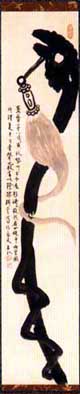
Hakuin's Dragon Staff Inka Scroll


Zen Master Hakuin (1686-1768) painted a Dragon Staff with a horsehair whisk attached.  He gave the above painting to a lay student who passed the Zen koan, "What is the sound of one hand clapping.


Wednesday, March 11, 2015

Tai Chi Fan

There are many T'ai Chi Ch'uan exercise forms which make use of a fan.   Most are shorter forms, under 25 movements, but some, like the famous Tai Chi Kung Fu Fan Form have over 50 movements.  Most are done slowly and softly, but some include vigorous and fast movements.  The majority favor the Yang Style of Tai Chi Chuan.  

Tai Chi Fan: Bibliography, Links, Resources, Notes, Lore, Quotations. Research by Mike Garofalo.  I welcome any comments, suggestions, additions, or ideas regarding this webpage.


One of the most popular Tai Chi Fan forms was created by Professor Li Deyin (1938-).  It has 52 movements.  I includes slow and gentle movements in the first half of the form, then the second half is much more vigorous.  This Tai Chi Fan form is for athletic and intermediate Tai Chi students. 


Here are some instructional resources for learning the Tai Chi Kung Fu Fan Form.  
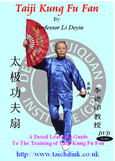
Tai Chi Kung Fu Fan. Routine 1, created by Grandmaster Li Deyin (1938-). Instructional DVD, 65 minutes, by Master Jesse Tsao. Tai Chi Healthways, San Diego, California. "The most popular Tai Chi Fan form ever practiced in China. The routine was created by Grandmaster Li Deyin, Jesse Tsao's teacher since 1978. There are 52 movements in the whole routine based on the characteristic Tai Chi posture with the fan's artistic and martial functions. Master Tsao presents demonstrations at the beginning and end. He teaches step-by-step in slow motion, in English. There are plenty of repetitions of movements in both front and back view. It is a good reference for home study, or a resource for instructor's teaching preparation." Cost: 35.00 US. Demonstration.

Tai Chi Kung Fu Fan Instructional DVD by Professor Li Deyin. Narration in English. "A fan routine, created by Professor Li, which combines the gracefulness, centrality and continuity of Taiji with the power, speed and fierceness of Wushu. It is designed as an addition to the exercises for health, and has received massive interest and support throughout the world. In this DVD, Professor Li provides in-depth teaching with Mrs. Fang Mishou performing detail demonstration." Vendor 1. Cost: $35.00 US.

Tai Chi Kung Fu Fan, Form 1. List of 52 movement names, directions, instructions, and notes by Mike Garofalo.


Tuesday, March 10, 2015

Tendon and Muscle Enhancing Chi Kung Exercises

Yi Jin Jing

The Yi Jin Jing Qigong is a popular qigong exercise set from China. "Yi Jin Jing Qigong" means "Muscle and Tendon Transforming Exercises."

In most cases, this qigong regimen consists of 12 movement sequences. There are some versions of the Yi Jin Jing with many more movements (22, 49, 108, 216). Some of the longer versions of the Yi Jin Jing include movements from the Eight Section Brocade Routine, the Animal Frolics Routines, the Louhan Routine, or the Bone Marrow and Brain Washing Routine.

Most people practice a 12 movement version of the Yi Jin Jing that was described in a book published by Pan Weiru in 1858 called "Essential Techniques for Guarding Life." Also, Wang Zuyuan published a book in the 1880's titled "Illustrated Exposition of Internal Techniques" that described the same qigong routine as did Pan Weiru. 


Names of the Yi Jin Jing Qigong Movements
Opening Form
1. Wei Tuo Presenting the Pestle 1
2. Wei Tuo Presenting the Pestle 2
3. Wei Tuo Presenting the Pestle 3
4. Plucking Stars on Each Side
5. Pulling Nine Cows by Their Tails
6. Showing Talons and Spreading Wings
7. Nine Ghosts Drawing Sabers
8. Sinking the Three Bodily Zones
Three Plates Falling on the Floor

9. Black Dragon Displaying Its Claws
10. Tiger Springing On Its Prey
11. Bowing Down in Salutation
12. Swinging the Tail
Closing Form

Some claim that the Yi Jin Jing was created by the famous Zen Patriarch Bodhidharma (Da Mo) around 520 CE, and refined over centuries by Shaolin monks, while others argue for an even more ancient Daoist lineage.

There are numerous instructional DVDs available now for the 12 movement verion of the Yi Jin Jing. I like the instructional book and DVD by the Chinese Health Qigong Association:

Yi Jin Jing: Chinese Health Qigong. Compiled by the Chinese Health Qigong Association. Beijing, China, Foreign Languages Press, 2007. 95 pages, charts, includes an instructional DVD. ISBN: 9787119047782. VSCL. "Qigong is an aspect of traditional Chinese medicine that involves coordinating breathing patterns with physical postures to maintain health and well-being. Yi Jin Jing/ Tendon-Muscle Strengthening Exercises is an accessible, fully-illustrated guide to a particular qigong exercise that focuses on turning and flexing the spine. Based on the twelve traditional routines of Yi Jin Jing, the exercises covered in the book feature soft, extended, even movements that invigorate the limbs and internal organs. In particular, practice of the Yi Jin Jing exercises improves flexibility, balance and muscular strength, and has a beneficial effect on the respiratory system. Each routine is described step-by-step and is illustrated with photographs and key points. The authors also point out common mistakes and offer advice on how to correct these. Complemented by an appendix of acupuncture points and accompanied by a DVD, this book will be of interest to Qigong and Tai Chi practitioners at all levels, students of martial arts and anyone interested in Chinese culture." - Singing Dragon.

For a good book on the theory of the Yi Jin Jing, read Qigong: The Secret of Youth: Da Mo's Muscle/Tendon Changing and Marrow Brain Washing Classics. By Yang, Jwing-Ming, Ph.D., 1946-. An Advanced Qigong Regimen for the Serious Practitioner. Boston, Massachusetts, YMAA Publication Center, 2000. Second Edition 2000, First Edition 1989. Index, appendices, charts, 312 pages. ISBN: 1886969841. VSCL.


Monday, March 09, 2015

As We Think, So We Become

"The thought manifests as the word;
The word manifests as the deed;
The deed develops into habit;
And the habit into character.


So, watch the thought and its ways with care
And let it spring from love
Born out of concern for all Beings.
As the shadow follows the body,
As we think, so we become."
-  The Buddha, from the Dhammapada


How to Live a Good Life: Advice from Wise Persons


Buddhism: Reading List

Paramitas: Ten Buddhist Virtues

Virtues and Character

Dammapada Sutta


Thursday, March 05, 2015

Stillness, Standing, Awareness

Standing Training in Chinese Qigong and Martial Arts
Stillness, Standing, Awareness, Rooting, Relaxation, Discipline, Nature Mysticism


"If I had to choose one qigong technique to practice, it would undoubtedly be this one. Many Chinese call standing meditation "the million dollar secret of qigong." Whether you are practicing qigong for self healing, for building healing ch'i, for massage or healing work on others, standing is an essential practice.  Acupuncturists feel that by practicing standing meditation they can connect with the ch'i of the universe, and be able to send it through their bodies when they hold the acupuncture needle ... Standing is probably the single most important qigong exercise.  One of the reasons that standing is such a powerful way to gather and accumulate fresh ch'i in the body is that during the practice of standing the body is in the optimal posture for ch'i gathering and flow."
-   Kenneth S. Cohen, The Way of Qigong


"The most basic method of training is zhan zhuang.  Zhan zhuang is an exercise common to many Chinese martial arts, including Taijiquan.  Usually, the practitioner stands with the arms held as if holding a large ball.  However, the zhan zhuang exercise can be practiced using any of the end postures of the Taiji form.  During "standing" practice a static posture is maintained for a period of time while using just enough strength to maintain the posture.  ...  Benefits of zhan zhuang include deep relaxation, strengthening of the legs, and increased internal qi.  The first requirement is to have a calm mind.  This can be achieved in a number of ways - for instance, concentrating on the Dantian, paying attention to one's breath, or silently counting.  Through standing practice, emphasis is place upon developing awareness of maintaining the most efficient and relaxed structural alignment necessary to hold the position.  Prolonged practice, along with enhancing postural awareness and tranquility of mind, greatly develops the strength of the legs.  When the legs are strong and can bear weight firmly, then the upper body can relax and sink down into them, making the top more flexible.  ... Taijiquan requires lightness and sensitivity in the upper body.  At the same time, the lower body should have a feeling of extreme heaviness and connection to the ground.  This feeling is often compared to a large tree with deep roots.  While the branches move and sway in the wind, the trunk is solidly anchored by its roots."
-   Davidine Siaw-Voon Sim and David Gaffney, Chen Style Taijiquan, 2002, p. 106.


Secrets to Living Younger Longer: The Self-Healing Path of Qigong Standing Meditation and Tai Chi.  By Michael Mayer, Ph.D..  Orinda, California, Body Mind Healing Publications, 2004.  Index, bibliography, 281 pages.  ISBN: 0970431066.  This book has a companion instructional video/DVD called "Body Mind Healing Qigong." Website:  Body Mind Healing.  VSCL.  Good coverage of standing meditation and Animal Frolics exercises.  

Warriors of Stillness: Meditative Traditions in the Chinese Martial Arts.  Volume 1.  The Teachings of Grandmaster Cai Song Fang.  Qigong Qi of the Center, Essence of Taijiquan.   By Jan Diepersloot.  Walnut Creek, California, Center for Healing and the Arts.  Glossary, 226 pages.  ISBN:  0964997606.  A study of Wu Ji meditation and its T'ai Chi Ch'uan applications.     

Opening the Energy Gates of Your Body (The Tao of Energy Enhancement.  By Bruce Kumar Frantzis.  Illustrated by Husky Grafx.  North Atlantic Books, 1993.  Second Edition.  174 pages.  ISBN: 1556431643.

"Zhan Zhuang: What Really Happens When We Stand?"
By Mark Cohen
Qi: Journal of Traditional Eastern Health and Fitness, Volume 23, No. 4, Winter, 2013-2014, pp.36-44.

Inside Zhan Zhuang: First Edition  By Mark Cohen.  MSC Creative Enterprises, 2013.  258 pages.  ISBN: 978-0988317888.
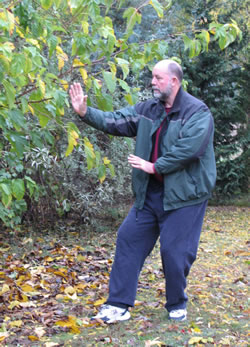
Standing Meditation
By Mike Garofalo.  Resources, Bibliography, Links, Methods, Quotations, Comments.  


Qigong (Chi Kung) by Mike Garofalo


Wednesday, March 04, 2015

Chi Kung Exercises with a Cane

I enjoy practicing the following cane exercise form:

Taiji Yangsheng Zhang: Taiji Stick Qigong (Chinese Health Qigong)  By the Chinese Health Qigong Association.  Singing Dragon, 2014.  96 pages.  1 instructional DVD.  ISBN: 978-1848191945.  Brief history, warmup and cane handling, ten movement form.  VSCL. 
"A set of exciting and unusual Taiji Stick qigong exercises is presented in this accessible introduction. Embodying the concepts of taiji, the movements emphasize the harmony of yin and yang, man and nature. Appropriate for all levels of experience and for all age groups, this new set of easy-to-learn exercises distils the essence of traditional stick practice, guides body movements and the movement of the stick, and coordinates directed breathing and imagination. The book provides step-by-step, fully-illustrated instruction, and includes an account of the origins of the movements and guidance for practice. An accompanying DVD features a video demonstrating the form and additional information on its history and origins, and a CD provides options for verbal instructions to lead the practitioner through the exercises, or music to accompany them. The book is an authoritative resource that will help students and practitioners of taiji, qigong, martial arts and Chinese medicine perfect and deepen their practice. It is also an excellent practical introduction for anyone with an interest in the ancient health and martial practices of China. 

The Chinese Health Qigong Association is dedicated to the popularization of and research into Health Qigong, and is a group member of the All-China Sports Federation. Its aim is to promote and carry forward the Chinese traditional culture of health promotion and facilitate the communication between Western and Eastern Cultures."


The movements of the Taiji Yangsheng Zhang form are as follows:
Initial Stance and Opening
1.  Boatman Rows with an Oar  (Shao Gong Yao Lu)  
2.  Boat Rows Slowly  (Qing Zhou Huan Xing
3.  Wind Kisses the Lotus Leaves  (Feng Bai He Ye
4.  Boatman Tows a Boat  (Chuan Fu Bei Qian
5.  Iron Stick Calms the Sea  (Shen Zhen Ding Hai
6.  Golden Dragon Wags Its Tai  (Jin Long Jiao Wei
7.  Search for Treasure in the Sea  (Tan Hai Xun Bao
8.  Qi Returns to the Dantian  (Qi Gui Dan Tian
Closing and Ending Stance


"The Taiji Stick Health Preservation exercises embodies the concept of harmony between yin and yang, man and nature.  All the movements involved are soft and slow, and easy to practice.  This is not a "martial art," per se, and the stick is not wielded like a weapon. 
In practicing with the Taiji Stick, we should twist, turn, bend, and stretch around the waist as a center, and move our spine accordingly.
In practicing with the Taiji Stick, we need to relax our waist and hips, and keep the body upright and comfortable, adjusting the movement of the waist in harmony with the use of the stick.  If we lift the stick, we need to sink the waist and lower the qi down to the Dantian (lower belly); and if we lower the stick, we need to straighten the waist and pull up the qi to the Baihui acupoint [top of the head].  If we rotate the stick in a circle, our waist becomes the anchor, moving our body and arms.  All this illustrates the pivotal role of the waist." p. 6.  


Tai Chi Chuan Cane

Way of the Short Staff

Staff Weapons

Taijiquan Practices