“A little group of thatched cottages in the middle of the village had an
orchard attached; and I remember well the peculiar purity of the blue
sky seen through the white clusters of apple blossom in spring. I
remember being moonstruck looking at it one morning early on my
way to school. It meant something for me; what, I couldn’t say. It
gave me such an unease at heart, some reaching out towards
perfection such as impels men into religion, some sense of the
transcendence of things, of the fragility of our hold on life.”
- A. L. Rowse
The apple tree near our pepper garden is in full blossom now. The tiny green peppers nearby enjoy their company.
I will be on retreat for a few days. Time for taking long walks at daybreak, practicing Sun Taijiquan and staff, gardening, reading, reflection and meditation.
For some Green Way Wisdom, please visit The Spirit of Gardening.
Thursday, March 29, 2007


Tuesday, March 27, 2007
Getting Balanced and Strong
"The natural course of things is always followed. This prevents one from harming their post-heaven strength. Focus is on beneficial cultivation of one's natural life force as the core of training.
All people - men, women, the old, and the young - may practice in order to replace temerity with bravery; and stiffness with pliability. Those of you who are weak, who suffer from fatigue and injury or illness, or who have weakened your qi from the practice of other martial arts to the point that you no longer have the strength to train, all of you may practice Tai Ji Quan. With practice, the qi will quickly return to a balanced state and will become strong, while the spirit naturally returns to a state of wholeness. Disease will be eliminated and the length of life increased."
- Sun Lu-Tang, A Study of Taijiquan, 1924. Translated by Tim Cartmell, p. 60.
Sun Style Tai Ji Quan
All people - men, women, the old, and the young - may practice in order to replace temerity with bravery; and stiffness with pliability. Those of you who are weak, who suffer from fatigue and injury or illness, or who have weakened your qi from the practice of other martial arts to the point that you no longer have the strength to train, all of you may practice Tai Ji Quan. With practice, the qi will quickly return to a balanced state and will become strong, while the spirit naturally returns to a state of wholeness. Disease will be eliminated and the length of life increased."
- Sun Lu-Tang, A Study of Taijiquan, 1924. Translated by Tim Cartmell, p. 60.
Sun Style Tai Ji Quan
Monday, March 26, 2007
Ladders to Heaven
Bai Zi Bei
The Hundred Character Tablet
By Lu Dongbin
Translated by Jill Gonet, MFA
Qi Magazine, 2017, Volume 27, No. 3, p.44-51
"Guidance and Instruction on Internal Cultivation by Lu Donbin"
"To nourish the vital breath, keep watch in silence;
In order to subdue the mind, act with non-action.
Of movement and stillness, be aware of their origin;
There is no work to do, much less someone to seek.
The true and consistent must respond to phenomena;
Responding to phenomenon, you must be unconfused.
When unconfused, the nature will stabilize by itself;
When the nature stabilizes, energy returns by itself.
When energy returns, the elixir crystallizes by itself;
Within the pot, the trigrams of water and fire are joined.
Yin and yang arise, alternating over and over again;
Every transformation comes like a clap of thunder.
White clouds form and com to assemble at the peak;
Sweet nectar sprinkles down Mount Sumeru.
Swallowing for yourself this wine of immortality,
You wander so freely - who is able to know you?
Sit and listen to the tune played without strings,
Clearly understanding the mechanism of creation.
It comes entirely from these twenty lines;
A true ladder going straight to Heaven!"
"Nurturing energy, forget words and guard it.
Conquer the mind, do non-doing.
In activity and quietude, know the source progenitor.
There is no thing; whom else do you seek?
Real constancy should respond to people;
In responding to people, it is essential not to get confused.
When you don't get confused, your nature is naturally stable;
When your nature is stable, energy naturally returns.
When energy returns, Elixir spontaneously crystallizes,
In the pot pairing water and fire.
Yin and yang arise, alternating over and over again,
Everywhere producing the sound of thunder.
White clouds assemble on the summit,
Sweet dew bathes the polar mountain.
Having drunk the wine of longevity,
You wander free; who can know you?
You sit and listen to the stringless tune,
You clearly understand the mechanism of creation.
The whole of these twenty verses
is a ladder straight to heaven."
- Master Chang San-Feng
100 Character Tablet, Translated by Thomas Cleary
Sunday, March 25, 2007
Staff Weapons
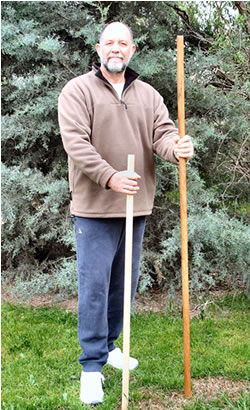
I practice with two staff weapons:
White Oak Staff, 50" long x 1.25" in diameter, from wle
Red Oak Staff, 72" long x 1.25" in diameter, from wle
A stout stick, along with the bow and arrow and spear, are three of the earliest weapons and hunting tools of mankind. Talk about returning to the "primitive" via staff weapons practice and play ....
Staff Weapons: Bibliography, Links, Resources, Quotes and Notes Research by Mike Garofalo. March 2007, 118 Kb.
Lately, I have been learning the Chen Long Pole 18 Movement Form. I don't have a 10 foot long wax wood pole like Chen Qingzhou uses, but I get by with my stout red oak staff. You can't do the vibration and shaking action with a red oak staff like you can with the longer wax wood poles, or slam your red oak staff on the ground with the same gusto, but you can do everything else.
Taijiquan and Relaxation (Sung)
Relaxation in Taijiquan: Bibliography, Links, Resources, Quotations, and Notes. By Mike Garofalo. 127Kb.
Song or Sung: Loose, Relaxed, Open, Yielding, Free, Responsive. A Defining Characteristic of Taijiquan.
"First, last, and always the student must relax. Various calisthenics aid him in achieving this. All rigidity and strength must be emptied from the upper torso and must sink to the very soles of the feet, one of which is always firmly rooted to the ground. Without proper relaxation the student can never hope to achieve the trueness of the T'ai-chi postures. The student relaxes completely and breathes as a child - naturally through the nose, the diaphragm being aided by the abdominal rather than the intercostal muscles. Man's intrinsic energy, the ch'i, should be stored just below the navel. The mind directs this energy throughout the body according to need. But the ch'i cannot circulated in an unrelaxed body."
- Robert W. Smith, Chinese Boxing: Masters and Methods, 1974, p. 26.
"Human beings are
soft and supple when alive,
stiff and straight when dead.
The myriad creatures, the grasses and trees are
soft and fragile when alive
dry and withered when dead.
Therefore, it is said:
The rigid person is a disciple of death;
The soft, supple, and delicate are lovers of life.
An army that is inflexible will not conquer;
A tree that is inflexible will snap.
The unyielding and mighty shall be brought low;
The soft, supple, and delicate will be set above."
- Lao Tzu, Tao Te Ching, Section 41 (76)
Translated by Victor H. Mair, 1990
Relaxation (Sung) in Taijiquan Practice To be "Sung" is to be open, without any unnecessary tension, alert, free flowing, able to act quickly and powerfully as needed, aware of one's surroundings, flexible. "Sung" is not not sleepy, weak, tensionless, noodle like, withdrawn, powerless.
Sun Style Taijiquan
Song or Sung: Loose, Relaxed, Open, Yielding, Free, Responsive. A Defining Characteristic of Taijiquan.
"First, last, and always the student must relax. Various calisthenics aid him in achieving this. All rigidity and strength must be emptied from the upper torso and must sink to the very soles of the feet, one of which is always firmly rooted to the ground. Without proper relaxation the student can never hope to achieve the trueness of the T'ai-chi postures. The student relaxes completely and breathes as a child - naturally through the nose, the diaphragm being aided by the abdominal rather than the intercostal muscles. Man's intrinsic energy, the ch'i, should be stored just below the navel. The mind directs this energy throughout the body according to need. But the ch'i cannot circulated in an unrelaxed body."
- Robert W. Smith, Chinese Boxing: Masters and Methods, 1974, p. 26.
"Human beings are
soft and supple when alive,
stiff and straight when dead.
The myriad creatures, the grasses and trees are
soft and fragile when alive
dry and withered when dead.
Therefore, it is said:
The rigid person is a disciple of death;
The soft, supple, and delicate are lovers of life.
An army that is inflexible will not conquer;
A tree that is inflexible will snap.
The unyielding and mighty shall be brought low;
The soft, supple, and delicate will be set above."
- Lao Tzu, Tao Te Ching, Section 41 (76)
Translated by Victor H. Mair, 1990
Relaxation (Sung) in Taijiquan Practice To be "Sung" is to be open, without any unnecessary tension, alert, free flowing, able to act quickly and powerfully as needed, aware of one's surroundings, flexible. "Sung" is not not sleepy, weak, tensionless, noodle like, withdrawn, powerless.
Sun Style Taijiquan
Saturday, March 24, 2007
Taijiquan Standard 24 Form, Yang Style
T'ai Chi Ch'uan, 24 Form, Yang Style
Standard Simplified Taijiquan Form
24 Movement Form
In the Yang Style
Developed in 1956
Bibliography, Links, Lists, Resources, Notes
By Mike Garofalo
Standard Simplified Taijiquan Form
24 Movement Form
In the Yang Style
Developed in 1956
Bibliography, Links, Lists, Resources, Notes
By Mike Garofalo
Friday, March 23, 2007
Sun Style Taijiquan
More students have been attending my Sun Taijiquan classes:
Wednesday 6:30 - 7:30 p.m. Tehama Family Fitness Center, Red Bluff, California
Sunday 7:00 - 8:30 a.m. Valley Spirit Center, Red Bluff, California
Therefore, I will be spending some extra time updating my Sun Taijiquan webpages in the next year.
Sun Lu Tang (1861-1933)
Sun Style of T'ai Chi Ch'uan
Bibliography, Resources, Links, Quotes, Instructions, Notes
Description of the Sun Style Taijiquan Standard International 73 Movement Competition Form
Research by Mike Garofalo
3/23/07, 123Kb
Biographical Timeline for Grandmaster Sun Lu Tang (1861-1933)
Bagua Zhang by Sun Lu Tang
Hsing Yi Quan by Sun Lu Tang
Wednesday 6:30 - 7:30 p.m. Tehama Family Fitness Center, Red Bluff, California
Sunday 7:00 - 8:30 a.m. Valley Spirit Center, Red Bluff, California
Therefore, I will be spending some extra time updating my Sun Taijiquan webpages in the next year.
Sun Lu Tang (1861-1933)
Sun Style of T'ai Chi Ch'uan
Bibliography, Resources, Links, Quotes, Instructions, Notes
Description of the Sun Style Taijiquan Standard International 73 Movement Competition Form
Research by Mike Garofalo
3/23/07, 123Kb
Biographical Timeline for Grandmaster Sun Lu Tang (1861-1933)
Bagua Zhang by Sun Lu Tang
Hsing Yi Quan by Sun Lu Tang
Thursday, March 22, 2007
Building Gong
"The training exercises of Taiji, like those from all the internal martial arts traditions of China, are designed to build gong. What does it mean to built gong? Physically, the accumulation of gong refers to constant improvements in balance, coordination, agility, flexibility, sensitivity, and strength or power. Mentally and spiritually, the accumulation of gong refers to improved awareness and confidence, and constant advancements toward realizing tranquility of heart and mind. These physical, mental and spiritual improvements are the benefits and purpose of practice. The priority of accumulating gong (as opposed to martial technique or trickery) is repeatedly emphasized in many of the most famous sayings from the oral tradition of the Chinese internal martial arts."
- Yang Yang, Taijiquan: The Art of Nurturing, The Science of Power, 2005, p. 5.
- Yang Yang, Taijiquan: The Art of Nurturing, The Science of Power, 2005, p. 5.
Wednesday, March 21, 2007
Chen Zhaokui's Sixteen Requirements
Chen Family Style of Taijiquan
Requirements for Body/Mind Coordination During Taijiquan Movements/Postures
Chen Zhaokui's Sixteen Requirements:
"Chen Zhaokui (1928-1981) lists sixteen requirements that must be present throughout each posture:
Eye movement (the direction of the eyes)
The shape of the hands, and how the hand changes as the movement is being performed
Footwork (how to execute changes when stepping)
Shun-chan and ni-chan of the legs
Open and closing of the chest and back
Rising and falling of the buttocks
Dantian rotation (waist and lower abdomen)
Shifting weight (the relationship of substantial and insubstantial)
Beginning and end points, as well as the transition movements of the upper and lower limbs
How much strength to us, and where the strength should be concentrated (i.e., where is the attack point)
Position and direction of posture
The rise and fall of spiral movement (top and bottom coordination)
The change in tempo (alternating slow and fast)
Breathing (coordination of breathing and movement)
Listening"
Chen Style Taijiquan: The Source of Taiji Boxing. By Davidine Siaw-Voon Sim and David Gaffney. Berkeley, CA, North Atlantic Books, 2002. Index, charts, 224 pages. ISBN: 1556433778. pp. 116-117.
Chen Style of Taijiquan
Requirements for Body/Mind Coordination During Taijiquan Movements/Postures
Chen Zhaokui's Sixteen Requirements:
"Chen Zhaokui (1928-1981) lists sixteen requirements that must be present throughout each posture:
Eye movement (the direction of the eyes)
The shape of the hands, and how the hand changes as the movement is being performed
Footwork (how to execute changes when stepping)
Shun-chan and ni-chan of the legs
Open and closing of the chest and back
Rising and falling of the buttocks
Dantian rotation (waist and lower abdomen)
Shifting weight (the relationship of substantial and insubstantial)
Beginning and end points, as well as the transition movements of the upper and lower limbs
How much strength to us, and where the strength should be concentrated (i.e., where is the attack point)
Position and direction of posture
The rise and fall of spiral movement (top and bottom coordination)
The change in tempo (alternating slow and fast)
Breathing (coordination of breathing and movement)
Listening"
Chen Style Taijiquan: The Source of Taiji Boxing. By Davidine Siaw-Voon Sim and David Gaffney. Berkeley, CA, North Atlantic Books, 2002. Index, charts, 224 pages. ISBN: 1556433778. pp. 116-117.
Chen Style of Taijiquan
Tuesday, March 20, 2007
Just Walk on the Earth
"Walking meditation means to enjoy walking without any intention to arrive. We don't need to arrive anywhere. We just walk. We enjoy walking. That means walking is already stopping, and that needs some training. Usually in our daily life we walk because we want to go somewhere. Walking is only a means to an end, and that is why we do not enjoy every step we take. Walking meditation is different. Walking is only for walking. You enjoy every step you take. So this is a kind of revolution in walking. You allow yourself to enjoy every step you take.
The Zen master Ling Chi said that "the miracle is not to walk on burning charcoal or in the thin air or on the water; the miracle is just to walk on earth." You breathe in. You become aware of the fact that you are alive. You are still alive and you are walking on this beautiful planet. That is already performing a miracle. The greatest of all miracles is to be alive. We have to awaken ourselves to the truth that we are here, alive. We are here making steps on this beautiful planet. This is already performing a miracle. But we have to be here in order for the miracle to be possible. We have to bring ourselves back to the here and the now."
- Thich Nhat Hanh, Resting in the River
The Zen master Ling Chi said that "the miracle is not to walk on burning charcoal or in the thin air or on the water; the miracle is just to walk on earth." You breathe in. You become aware of the fact that you are alive. You are still alive and you are walking on this beautiful planet. That is already performing a miracle. The greatest of all miracles is to be alive. We have to awaken ourselves to the truth that we are here, alive. We are here making steps on this beautiful planet. This is already performing a miracle. But we have to be here in order for the miracle to be possible. We have to bring ourselves back to the here and the now."
- Thich Nhat Hanh, Resting in the River
Monday, March 19, 2007
Standing Like A Strong Tree
"The most basic method of training is zhan zhuang. Zhan zhuang is an exercise common to many Chinese martial arts, including Taijiquan. Usually, the practitioner stands with the arms held as if holding a large ball. However, the zhan zhuang exercise can be practiced using any of the end postures of the Taiji form. During "standing" practice a static posture is maintained for a period of time while using just enough strength to maintain the posture. ... Benefits of zhan zhuang include deep relaxation, strengthening of the legs, and increased internal qi. The first requirement is to have a calm mind. This can be achieved in a number of ways - for instance, concentrating on the Dantian, paying attention to one's breath, or silently counting. Through standing practice, emphasis is place upon developing awareness of maintaining the most efficient and relaxed structural alignment necessary to hold the position. Prolonged practice, along with enhancing postural awareness and tranquility of mind, greatly develops the strength of the legs. When the legs are strong and can bear weight firmly, then the upper body can relax and sink down into them, making the top more flexible. ... Taijiquan requires lightness and sensitivity in the upper body. At the same time, the lower body should have a feeling of extreme heaviness and connection to the ground. This feeling is often compared to a large tree with deep roots. While the branches move and sway in the wind, the trunk is solidly anchored by its roots."
- Davidine Siaw-Voon Sim and David Gaffney, Chen Style Taijiquan, 2002, p. 106.
- Davidine Siaw-Voon Sim and David Gaffney, Chen Style Taijiquan, 2002, p. 106.
Sunday, March 18, 2007
Wearing of the Green
A St. Patrick's Day blessing upon everyone: Beannachtaí na Féile Pádraig oraibh!
Yesterday, of course, was St. Patrick's day. Many people from Ireland, Wales, Scotland, and England immigrated to the United States over the centuries. Also, many Catholics, who celebrate St. Patrick's Day, came to America; and, I went to Catholic Schools through the 12th grade.
The street where we now live in Red Bluff, California, is "Kilkenny Lane," and the late Irishman, Jack Murphy, and his two sons, Mike and Mark and their families, are our neighbors.
My wife, Karen, was born on St. Patrick's Day, as was her sister Ginger, and their father, Delmer, always like to think of himself as an Protestant Irishman.
My daughter, Alicia, married a good Irishman, Sean Flinn.
Therefore, the "Irish" influence is significant in my past and present background.
Annetta, from Albuquerque, New Mexico, sent me an delightful email today. She told me about her background in the landscaping business and about some recent gardening experiences. She also included a bit of Irish lore and wisdom:
"Mike, I so enjoy your website. It has been a welcome sight during this long winter.
I live in Albuquerque and we have been having weird weather since last summer. We had excessive rains in the summer and lots of snow this winter. I have not had to do any watering most of the winter. Usually we have to water at least twice monthly during the heart of winter.
The snow wreaked havoc on many of the trees in our neighborhood. I went around and got snow off branches throughout the brunt of the storm to save branches. I am glad. I didn't have too many losses or the neighbors around me for that matter.
My daffodils are up and the tulips are growing nicely. They are running a little late but I am sure they enjoyed the extra coldness of this winter.
I had been cautious not to peek yet under the various mulches at some of my plants such as Jupiter' Beard or my peonies. But I had to look because we have been having incredible high 70s and the temperature hit 80 degrees this past week. They are a comin'.
It is St. Patrick's Day and I plant a few shamrocks each year in its honor.
The Shamrock: in fact, the first written mention of this story did not appear until nearly a thousand years after Patrick's death. The shamrock, which was also called the "seamroy" by the Celts, was a sacred plant in ancient Ireland because it symbolized the rebirth of spring. By the seventeenth century, the shamrock had become a symbol of emerging Irish nationalism. As the English began to seize Irish land and make laws against the use of the Irish language and the practice of Catholicism, many Irish began to wear the shamrock as a symbol of their pride in their heritage and their displeasure with English rule.
St. Patrick used the three-leafed shamrock to explain the Holy Trinity to the pagans of Ireland.
A St. Patrick's Day blessing upon you: Beannachtaí na Féile Pádraig oraibh!
"May you never forget what is worth remembering,
Or remember what is best forgotten.
May you have the hindsight to know where you've been,
The insight to know where you are,
and the foresight to know when you've gone too far.
May you have warm words on a cold evening,
A full moon on a dark night,
And the road downhill all the way to your door.
May you never make an enemy
When you could make a friend
Unless you meet a fox among your chickens.
May your fire be as warm as the weather is cold."
Mike, Thank you again for your wonderful resource."
- Annetta, 3/18/07
Thanks to you, Annetta, for sharing your thoughts. Thanks to all the kind people who write to me each week. May this Springtime bring you all much delight. Peace, Prosperity and many Blessings to all!
And for all the internal martial artists and qigong players around the world, who delight in practicing outdoors this spring (north) or autumn (south) day, may your practice be a delight to you. Cheers!!
Yesterday, of course, was St. Patrick's day. Many people from Ireland, Wales, Scotland, and England immigrated to the United States over the centuries. Also, many Catholics, who celebrate St. Patrick's Day, came to America; and, I went to Catholic Schools through the 12th grade.
The street where we now live in Red Bluff, California, is "Kilkenny Lane," and the late Irishman, Jack Murphy, and his two sons, Mike and Mark and their families, are our neighbors.
My wife, Karen, was born on St. Patrick's Day, as was her sister Ginger, and their father, Delmer, always like to think of himself as an Protestant Irishman.
My daughter, Alicia, married a good Irishman, Sean Flinn.
Therefore, the "Irish" influence is significant in my past and present background.
Annetta, from Albuquerque, New Mexico, sent me an delightful email today. She told me about her background in the landscaping business and about some recent gardening experiences. She also included a bit of Irish lore and wisdom:
"Mike, I so enjoy your website. It has been a welcome sight during this long winter.
I live in Albuquerque and we have been having weird weather since last summer. We had excessive rains in the summer and lots of snow this winter. I have not had to do any watering most of the winter. Usually we have to water at least twice monthly during the heart of winter.
The snow wreaked havoc on many of the trees in our neighborhood. I went around and got snow off branches throughout the brunt of the storm to save branches. I am glad. I didn't have too many losses or the neighbors around me for that matter.
My daffodils are up and the tulips are growing nicely. They are running a little late but I am sure they enjoyed the extra coldness of this winter.
I had been cautious not to peek yet under the various mulches at some of my plants such as Jupiter' Beard or my peonies. But I had to look because we have been having incredible high 70s and the temperature hit 80 degrees this past week. They are a comin'.
It is St. Patrick's Day and I plant a few shamrocks each year in its honor.
The Shamrock: in fact, the first written mention of this story did not appear until nearly a thousand years after Patrick's death. The shamrock, which was also called the "seamroy" by the Celts, was a sacred plant in ancient Ireland because it symbolized the rebirth of spring. By the seventeenth century, the shamrock had become a symbol of emerging Irish nationalism. As the English began to seize Irish land and make laws against the use of the Irish language and the practice of Catholicism, many Irish began to wear the shamrock as a symbol of their pride in their heritage and their displeasure with English rule.
St. Patrick used the three-leafed shamrock to explain the Holy Trinity to the pagans of Ireland.
A St. Patrick's Day blessing upon you: Beannachtaí na Féile Pádraig oraibh!
"May you never forget what is worth remembering,
Or remember what is best forgotten.
May you have the hindsight to know where you've been,
The insight to know where you are,
and the foresight to know when you've gone too far.
May you have warm words on a cold evening,
A full moon on a dark night,
And the road downhill all the way to your door.
May you never make an enemy
When you could make a friend
Unless you meet a fox among your chickens.
May your fire be as warm as the weather is cold."
Mike, Thank you again for your wonderful resource."
- Annetta, 3/18/07
Thanks to you, Annetta, for sharing your thoughts. Thanks to all the kind people who write to me each week. May this Springtime bring you all much delight. Peace, Prosperity and many Blessings to all!
And for all the internal martial artists and qigong players around the world, who delight in practicing outdoors this spring (north) or autumn (south) day, may your practice be a delight to you. Cheers!!
Saturday, March 17, 2007
Sun Style Tai Chi Chuan
Sun Lu Tang (1861-1933)
Sun Style of Taijiquan
Bibliography, Resources, Links, Quotes, Notes
List of Movements in Standard Sun Style 73 Movement Competition Form
Research by Mike Garofalo
3/17/07, 149Kb
Biographical Timeline for Grandmaster Sun Lu Tang (1861-1933)
Bagua Zhang by Sun Lu Tang
Hsing Yi Quan by Sun Lu Tang
Sun Style of Taijiquan
Bibliography, Resources, Links, Quotes, Notes
List of Movements in Standard Sun Style 73 Movement Competition Form
Research by Mike Garofalo
3/17/07, 149Kb
Biographical Timeline for Grandmaster Sun Lu Tang (1861-1933)
Bagua Zhang by Sun Lu Tang
Hsing Yi Quan by Sun Lu Tang
Friday, March 16, 2007
Chen Style of Taijiquan
Chen Style of T'ai Chi Ch'aun
Bibliography, Links, Quotes, Notes, Resources
Research by Michael P. Garofalo
Website Address: http://www.egreenway.com/taichichuan/chen1.htm
I started studying Chen Style Taijiquan in March, 2007, at age 61. The Chen Taijiquan practices are fairly challenging for an old man, and invigorating. Aging gracefully requires one to be open to new ways of moving, new ideas and practices, and new people. Learning is fun, humbling, and gets one back to "beginner's mind."
What I have found the hardest to consistently practice in these first few first weeks of study is doing Standing Meditation (Zhan Zhuang), Standing Like a Tree, Chen Style. I have read books by Jan Diepersloot and Michael Mayer about standing meditation (Yiquan), and am familiar with a variety of meditation techniques, since I teach Hatha Yoga, have studied Zen since 1962, and majored in Philosophy. I would much rather move than stay still, standing in a semi-squat, but I am making some effort in the practice.
Holding and moving in the lower stances typical of the Chen style of Taijiquan is also difficult. My thighs, hips and lower back have ached a bit more from being in the high squatting positions with legs wide. As with all new exercises, it will take four months to get basic conditioning and tolerance for the new movement patterns and postures. Patience and practice will improve the situation. Chen Taijiquan appears to me to be very sophisticated in its movement arts and will require many years of determined study and practice to gain modest proficiency.
Carmine Farruggia has provided me with instructions and guidance. I will get some additional instruction from him this month in Sacramento.
Bibliography, Links, Quotes, Notes, Resources
Research by Michael P. Garofalo
Website Address: http://www.egreenway.com/taichichuan/chen1.htm
I started studying Chen Style Taijiquan in March, 2007, at age 61. The Chen Taijiquan practices are fairly challenging for an old man, and invigorating. Aging gracefully requires one to be open to new ways of moving, new ideas and practices, and new people. Learning is fun, humbling, and gets one back to "beginner's mind."
What I have found the hardest to consistently practice in these first few first weeks of study is doing Standing Meditation (Zhan Zhuang), Standing Like a Tree, Chen Style. I have read books by Jan Diepersloot and Michael Mayer about standing meditation (Yiquan), and am familiar with a variety of meditation techniques, since I teach Hatha Yoga, have studied Zen since 1962, and majored in Philosophy. I would much rather move than stay still, standing in a semi-squat, but I am making some effort in the practice.
Holding and moving in the lower stances typical of the Chen style of Taijiquan is also difficult. My thighs, hips and lower back have ached a bit more from being in the high squatting positions with legs wide. As with all new exercises, it will take four months to get basic conditioning and tolerance for the new movement patterns and postures. Patience and practice will improve the situation. Chen Taijiquan appears to me to be very sophisticated in its movement arts and will require many years of determined study and practice to gain modest proficiency.
Carmine Farruggia has provided me with instructions and guidance. I will get some additional instruction from him this month in Sacramento.
Thursday, March 15, 2007
Movement Over Stillness
"What makes Chen unique, in my opinion, is that it starts with more of a physical training regimen through forms training. This can be called houtian/post heaven/body building in nature and it stresses building the body up in ways that Chen style needs. Apsects that are stressed include extending the postures, holding lower stances, spreading the feet wider, going lower in movements to work the dang, working on peng or groundpath, and perhaps using exaggerated fajing and chansijing by some groups in order to get a feel for
those requirements. These attributes will often be exaggerated to some extent because doing so allows beginners to get a better feel for them. It's easier to grasp bigger movements than smaller, exageratted over subtle. This is movement over stillness."
- Chen Style as External, Part III, Formosa Neijia
I added a few references and links to my webpage on the Chen Style Taijiquan Saber.
those requirements. These attributes will often be exaggerated to some extent because doing so allows beginners to get a better feel for them. It's easier to grasp bigger movements than smaller, exageratted over subtle. This is movement over stillness."
- Chen Style as External, Part III, Formosa Neijia
I added a few references and links to my webpage on the Chen Style Taijiquan Saber.
Subscribe to:
Posts (Atom)