Time for a good laugh today. Julia Sweeney tells us a humorous story about a conversation with her eight year old daughter about the "birds and the bees" and the frogs.
Saturday, May 12, 2012


Friday, May 11, 2012
Tao Te Ching by Lao Tzu, Chapter 63
Dao De Jing, Laozi
Chapter 63
"Do without "doing."
Get involved without manipulating.
Taste without tasting.
Make the great small,
The many, few.
Respond to anger with virtue.
Deal with difficulties while they are still easy.
Hand the great while it is still small.
The difficult problems in life
Always start off being simple.
Great affairs always start off being small.
Therefore the sage never deals with the great
And is able to actualize his greatness.
Now light words generate little belief,
Much ease turns into much difficulty.
Therefore the sage treats things as though they were difficult,
And hence, never has difficulty."
- Translated by Charles Mueller, 2004, Chapter 63
"Practice no-action;
Attend to do-nothing;
Taste the flavorless,
Magnify the small,
Multiply the few,
Return love for hate.
Deal with the difficult while it is yet easy;
Deal with the great while it is yet small.
The difficult develops naturally from the easy,
And the great from the small;
So the sage, by dealing with the small,
Achieves the great."
- Translation by Peter A. Merel, 1992, Chapter 63
"It is the way of the Tao to act without thinking of acting;
To conduct affairs without feeling the trouble of them;
To taste without discerning any flavor;
To consider what is small as great, and a few as many;
And to recompense injury with kindness.
The master of it anticipates things that are difficult while they are easy,
And does things that would become great while they are small.
All difficult things in the world are sure to arise from a previous state in which they were easy,
And all great things from one in which they were small.
Therefore the sage, while he never does what is great, is able on that account to accomplish the greatest things.
He who lightly promises is sure to keep but little faith;
He who is continually thinking things easy is sure to find them difficult.
Therefore the sage sees difficulty even in what seems easy, and so never has any difficulties."
- Translated by James Legge, 1891, Chapter 63
"Act without considering it to be acting.
Work without considering it to be working.
Taste without considering it to be tasting.
Big or small, many or few - respond to complaints with virtue.
Plan for difficult times when they're still easy to change.
What becomes enormous was once something minute.
All the difficulties in the world arise from what was originally easy to change.
Everything enormous in the world arises from what was originally minute.
It's natural for the wise person to end up not having to act on what's become enormous, and therefore has the ability to achieve what's great.
You see, lightly making promises must show a lack of sincerity.
If many things are taken lightly, then many things will cause difficulty.
It's natural for a wise person to keep in touch with what might become difficult.
Therefore, he ends up without difficulties."
- Translation by Nina Correa, 2008, Chapter 63
"Accomplish do-nothing.
Attend to no-affairs.
Taste the flavorless.
Whether it is big or small, many or few,
Requite hatred with virtue.
Deal with the difficult while yet it is easy;
Deal wit the big while yet it is small.
The difficult (problems) of the world
Must be dealt with while they are yet easy;
The great (problems) of the world
Must be dealt with while they are yet small.
Therefore the Sage by never dealing with great (problems)
Accomplishes greatness.
He who lightly makes a promise
Will find it often hard to keep his faith.
He who makes light of many things
Will encounter many difficulties.
Hence even the Sage regards things as difficult,
And for that reason never meets with difficulties."
- Translated by Lin Yutang, 1948, Chapter 63
"Do that which consists in taking no action;
Pursue that which is not meddlesome;
Savor that which has no flavor.
Make the small big and the few many;
Do good to him who has done you an injury.
Lay plans for the accomplishment of the difficult before it becomes difficult;
Make something big by starting with it when small.
Difficult things in the world must needs have their beginnings in the easy;
Big things must needs have their beginnings in the small.
Therefore it is because the sage never attempts to be great that he succeeds in becoming great.
One who makes promises rashly rarely keeps good faith;
One who is in the habit of considering things easy meets with frequent difficulties.
Therefore even the sage treats some things as difficult.
That is why in the end no difficulties can get the better of him."
- Translated by D. C. Lau, Chapter 63

Pursue that which is not meddlesome;
Savor that which has no flavor.
Make the small big and the few many;
Do good to him who has done you an injury.
Lay plans for the accomplishment of the difficult before it becomes difficult;
Make something big by starting with it when small.
Difficult things in the world must needs have their beginnings in the easy;
Big things must needs have their beginnings in the small.
Therefore it is because the sage never attempts to be great that he succeeds in becoming great.
One who makes promises rashly rarely keeps good faith;
One who is in the habit of considering things easy meets with frequent difficulties.
Therefore even the sage treats some things as difficult.
That is why in the end no difficulties can get the better of him."
- Translated by D. C. Lau, Chapter 63
Thursday, May 10, 2012
Walking at Daybreak
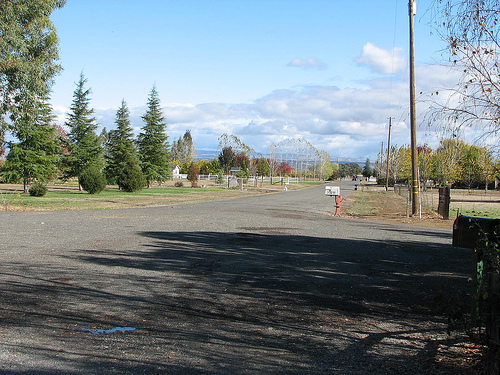
I enjoy walking in the early morning hours. It is one of my lifelong pleasures and a spiritual practice for me. My mind is calmed by the steady physical rhythms of walking. My pace is steady, unhurried, and not physically stressful. My senses come alive. I settle into a cheerful and energized state, a joyful trance. The complexity and beauty of Nature is deeply satisfying.
Yogis and Zen folks are known to sit and meditate in the morning, Taoists like to stand and meditate, I prefer a four mile walk at dawn to clear away the cobwebs of confusion or discontent from my mind, and lift me to contentment and insight.
"Aurora hail, and all the thousand dies,
Which deck thy progress through the vaulted skies:
The morn awakes, and wide extends her rays,
On ev'ry leaf the gentle zephyr plays;
Harmonious lays the feather'd race resume,
Dart the bright eye, and shake the painted plume."
- Phyllis Wheatley
"Waking up in the morning, I vow with all beings to be ready for sparks of the Dharma from flowers or children or birds.
Yogis and Zen folks are known to sit and meditate in the morning, Taoists like to stand and meditate, I prefer a four mile walk at dawn to clear away the cobwebs of confusion or discontent from my mind, and lift me to contentment and insight.
"Aurora hail, and all the thousand dies,
Which deck thy progress through the vaulted skies:
The morn awakes, and wide extends her rays,
On ev'ry leaf the gentle zephyr plays;
Harmonious lays the feather'd race resume,
Dart the bright eye, and shake the painted plume."
- Phyllis Wheatley
"Waking up in the morning, I vow with all beings to be ready for sparks of the Dharma from flowers or children or birds.
- Robert Aitken
"Who will tell whether one happy moment of love or the joy of breathing or walking on a bright morning and smelling the fresh air, is not worth all the suffering and effort which life implies."
- Eric Fromme
- Eric Fromme
"To find new things, take the path you took yesterday."
- John Burroughs
"All walking is discovery. On foot we take the time to see things whole."
- Hal Borland
Wednesday, May 09, 2012
Dragon Chi Kung
Dragon Chi Kung features exercises that involve twisting, turning, screwing, spiraling, curving, wiggling, undulating, spinning, sinking down and rising up, swimming, circling, swinging, or twining movements are often associated with snakes, serpents and dragons. There are many Qigong sets and specific Qigong movements that have been called "Dragon" forms, sets, or exercises. Baguazhang martial arts feature much twisting, turning and circling; and, also include many "Dragon" sets and movements. Silk Reeling exercises in Chen Style Taijiquan include twisting, twining, circling, and screwing kinds of movements.
"Laozi's Dao Te Jing in the third chapter says "Empty the mind, fill the belly. Weaken the ambition, strengthen the character." So then, this is the motto for practicing China's Wudang Daoist Qigong. To study each method, each method must be understood, the energy processed must be understood. If there is one type of practice Daoist qigong method not mastered, temporarily don't practice other training methods. If one type of movement has not been mastered, concentrate on that posture, do not study or practice other postures. Do not reach too high, must empty the mind, have patience, cultivate both inside and outside, step-by-step achieve an abdomen relaxed inside and breath ascending correctly, so then cultivate the breath continuously, and you will not contract illness. When the dan tian is full and sufficient, the inner breath is unimpeded and not obstructed. Breath and strength are sent out from the spine, following that which the mind desires. Strive for the substantial, don't let practice become lax, maintain it so it will be lasting; abide by the regulations, follow the rules; refine the breath, cultivate the body; cultivate the Mind, develop the character; thus seek emptiness and stillness, complete emptiness, and long life.
Wudang Qigong has eighteen types of practice exercises and methods: Extreme Emptiness, Pushing the Mountain, Wild Goose Flying, Crane Bending, Supporting Heaven, Both Appear, Four Directions, Ward Off and Pull Down, Pipa, Shaking Tail Feathers, Offering Fruit, Facing the Sun, Stirring the Grass, Dragon and Tiger, Coiling Snake, Spitting a Core, Climbing a Tree, and Bowing To The Top."
- Wudang Qigong: China's Wudang Mountain Daoist Breath Exercises. By Yuzeng Liu, and Terri Morgan.
Wudang Qigong has eighteen types of practice exercises and methods: Extreme Emptiness, Pushing the Mountain, Wild Goose Flying, Crane Bending, Supporting Heaven, Both Appear, Four Directions, Ward Off and Pull Down, Pipa, Shaking Tail Feathers, Offering Fruit, Facing the Sun, Stirring the Grass, Dragon and Tiger, Coiling Snake, Spitting a Core, Climbing a Tree, and Bowing To The Top."
- Wudang Qigong: China's Wudang Mountain Daoist Breath Exercises. By Yuzeng Liu, and Terri Morgan.

Tuesday, May 08, 2012
Rules for Livng the Good Life
Ten Golden Rules for Living the Good Life
“1. Examine life, engage life with vengeance; always search for new pleasures and new destines to reach with your mind.
2. Worry only about the things that are in your control, the things that can be influenced and changed by your actions, not about the things that are beyond your capacity to direct or alter.
3. Treasure Friendship, the reciprocal attachment that fills the need for affiliation. Friendship cannot be acquired in the market place, but must be nurtured and treasured in relations imbued with trust and amity.
4. Experience True Pleasure. Avoid shallow and transient pleasures. Keep your life simple. Seek calming pleasures that contribute to peace of mind. True pleasure is disciplined and restrained.
5. Master Yourself. Resist any external force that might delimit thought and action; stop deceiving yourself, believing only what is personally useful and convenient; complete liberty necessitates a struggle within, a battle to subdue negative psychological and spiritual forces that preclude a healthy existence; self mastery requires ruthless cador.
6. Avoid Excess. Live life in harmony and balance. Avoid excesses. Even good things, pursued or attained without moderation, can become a source of misery and suffering.
7. Be a Responsible Human Being. Approach yourself with honesty and thoroughness; maintain a kind of spiritual hygiene; stop the blame-shifting for your errors and shortcomings.
8. Don’t Be a Prosperous Fool. Prosperity by itself, is not a cure-all against an ill-led life, and may be a source of dangerous foolishness. Money is a necessary but not a sufficient condition for the good life, for happiness and wisdom.
9. Don’t Do Evil to Others. Evildoing is a dangerous habit, a kind of reflex too quickly resorted to and too easily justified that has a lasting and damaging effect upon the quest for the good life. Harming others claims two victims—the receiver of the harm, and the victimizer, the one who does harm.
10. Kindness towards others tends to be rewarded. Kindness to others is a good habit that supports and reinforces the quest for the good life. Helping others bestows a sense of satisfaction that has two beneficiaries—the beneficiary, the receiver of the help, and the benefactor, the one who provides the help.”
- By M.A. Soupious and Panos Mourdoukoutas
The Ten Golden Rules: Ancient Wisdom from the Greek Philosophers on Living the Good Life, 2009
Lifestyle Advice from Wise Persons
The Good Life
Ten Basic Epicurean Values
1) Prudence
2) Self-management
3) Self-sufficiency
4) Serenity
5) Simplicity
6) Friendliness
7) Honesty
8) Generosity
9) Cheerfulness
10) Gentleness
2) Self-management
3) Self-sufficiency
4) Serenity
5) Simplicity
6) Friendliness
7) Honesty
8) Generosity
9) Cheerfulness
10) Gentleness

Monday, May 07, 2012
Taijiquan 32 Sword Form
Tai Chi Chuan 32 Sword (Jian) Form
32 Sword Form, Simplified, Yang Style, Taijiquan Jian. This popular webpage by Mike Garofalo includes a comprehensive bibliography, scores of links to webpages; an extensive listing of the names and name variations for each movement in English, Chinese, French, German, and Spanish; a detailed analysis of each posture and movement sequence with explanations, and numbered illustrations and detailed instructions; selected quotations; comments on 20 Taijiquan sword techniques; a comprehensive media bibliography; a chart of performance times; and, a comparison of the 32 and 55 sword forms in the Yang style. This is the standard, simplified, orthodox, 1957, 32 Taiji Sword Form, in the Yang Style of T'ai Chi Ch'uan.
32 Taijiquan Simplified Sword Form
20 T'ai Chi Ch'uan Sword Techniques
55 Classical Yang Taiji Sword

The Wild Horse Jumps Over the Mountain Stream

Zhong Kui
Vanquisher of Demons
Protector of the Home
32 Taijiquan Simplified Sword Form
20 T'ai Chi Ch'uan Sword Techniques
55 Classical Yang Taiji Sword

The Wild Horse Jumps Over the Mountain Stream

Zhong Kui
Vanquisher of Demons
Protector of the Home
Sunday, May 06, 2012
Jack Kerouac on Writing and Living
In 1955, Jack Kerouac ((1922-1969), gave us his "List of Essentials" for his style of writing, and, in many ways for how he enjoyed living from the aesthetic and beatnick beatific zen point of view.
"1. Write on, can't change or go back, involuntary, unrevised, spontaneous, subconscious, pure
2. Scribbled secret notebooks, and wild typewritten pages, for you own joy
3. Submissive to everything, open, listening
4. Be in love with your life every detail of it
5. Something that you feel will find its own form
6. Be crazy dumbsaint of the mind
7. Blow as deep as you want to blow
8. Write what you want bottomless from the bottom of the mind
9. The unspeakable visions of the individual
10. Not time for poetry but exactly what is
11. Visionary tics shivering in the chest
12. In tranced fixation dreaming upon object before you
13. Remove literary, grammatical and syntactical inhibition
14. Like Proust be an old teahead of time
15. Telling the true story of the world in interior monolog
16. Work for pithy middle eye out, from the jewel center of interest, swimming in language sea
17. Accept loss forever
18. Believe in the holy contour of life
19. Write in recollection and amazement of yourself
20. Profound struggle with pencil to sketch the flow that already exists intact in mind
21. Don't think of words when you stop but to see picture better
22. No fear or shame in the dignity of your experience, language and knowledge
23. Write for the world to read and see your exact pictures
24. In praise of Character in the Bleak inhuman Loneliness
25. Composing wild, undisciplined, pure, coming in from under, crazier the better
26. You're a Genius all the time
27. Writer-Director of Earthly Movies produced in Heaven, different forms of the same Holy Gold"
- Jack Kerouac, List of Essentials, 1955
I have always enjoyed reading the following book: "Big Sky Mind: Buddhism and the Beat Generation," edited by Carole Tonkinson, Riverhead Books, 1995.

"1. Write on, can't change or go back, involuntary, unrevised, spontaneous, subconscious, pure
2. Scribbled secret notebooks, and wild typewritten pages, for you own joy
3. Submissive to everything, open, listening
4. Be in love with your life every detail of it
5. Something that you feel will find its own form
6. Be crazy dumbsaint of the mind
7. Blow as deep as you want to blow
8. Write what you want bottomless from the bottom of the mind
9. The unspeakable visions of the individual
10. Not time for poetry but exactly what is
11. Visionary tics shivering in the chest
12. In tranced fixation dreaming upon object before you
13. Remove literary, grammatical and syntactical inhibition
14. Like Proust be an old teahead of time
15. Telling the true story of the world in interior monolog
16. Work for pithy middle eye out, from the jewel center of interest, swimming in language sea
17. Accept loss forever
18. Believe in the holy contour of life
19. Write in recollection and amazement of yourself
20. Profound struggle with pencil to sketch the flow that already exists intact in mind
21. Don't think of words when you stop but to see picture better
22. No fear or shame in the dignity of your experience, language and knowledge
23. Write for the world to read and see your exact pictures
24. In praise of Character in the Bleak inhuman Loneliness
25. Composing wild, undisciplined, pure, coming in from under, crazier the better
26. You're a Genius all the time
27. Writer-Director of Earthly Movies produced in Heaven, different forms of the same Holy Gold"
- Jack Kerouac, List of Essentials, 1955
I have always enjoyed reading the following book: "Big Sky Mind: Buddhism and the Beat Generation," edited by Carole Tonkinson, Riverhead Books, 1995.
Saturday, May 05, 2012
Tea House Beside the Pond

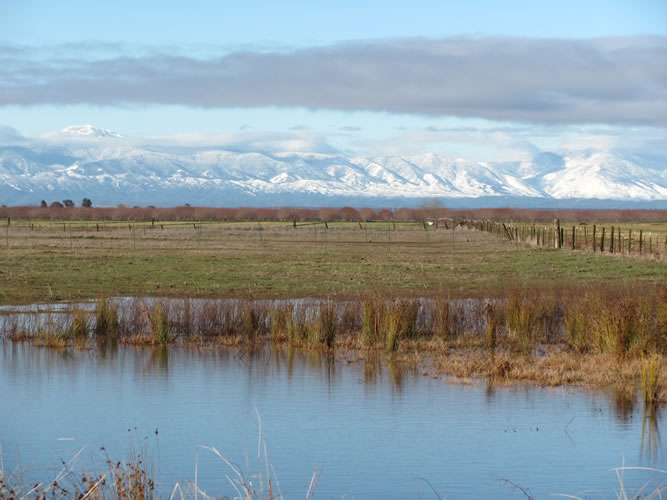
Our "tea house," at our home in Red Bluff, California, is hidden by weeping willows, eucalyptus and other trees and shrubs. The tea house is next to a small pond and gives a clear view to the west across the North Sacramento Valley to the Yolly Bolly Mountain range.
I in the cooler months I drink more coffee than tea, and in the warmer months more cold water and iced tea.

"The first bowl sleekly moistened throat and lips,
The second banished all my loneliness
The third expelled the dullness from my mind,
Sharpening inspiration gained
from all the books I've read.
The fourth brought forth light perspiration,
Dispersing a lifetime's troubles through my pores."
- Lu Tung, Chinese Poet, On Drinking Tea
It is a nice quiet area to read, listen to music, write, and practice taijiquan. The shade is invaluable in the warm months.
Here is what the view to the west looks like in the winter. About .3 miles from our fence is a large almond orchard. Snow on the Yolly Bolly range was down to about 2,500 feet on this day in January.
Friday, May 04, 2012
Dao De Jing, Laozi, Chapter 64
Tao Te Ching by Lao Tzu
Chapter 64
Chapter 64
"When sitting still, they are easy to hold down
No omens yet, it is easy to plan
When fragile, they are easy to break
When small, they are easy to scatter.
Work on it when it isn't yet
Put it in order when it is not yet disordered.
A tree you can barely get your arms around grows from a tiny shoot
A nine-story tower begins as a heap of earth
A thousand mile journey begins under your feet.
Working ruins, grasping loses.
The wise person does not work, so does not ruin
Does not grasp, so does not lose.
'When the people are engaged in some task,
They are always on the point of finishing when they ruin it.'
Careful at the end just as at the beginning,
Then there will be no ruining of the work.
The wise person desires to be desireless
Does not prize goods hard to come by
Learns to be un-learned
Turns back to the place all others have gone on from.
So as to help the naturalness
Of the thousands of things
Without presuming to be a worker."
- Translated by Michael LaFargue, 1992, Chapter 64
"It is easy to sustain what is at rest.
It is easy to plan for that of which there is not even a sign.
What is fragile is easily broken.
What is minute is easily dispersed.
Act upon it before it exists.
Regulate it before it becomes chaos.
A massive tree grows from a little sprout.
A nine-story building rises from a clod of earth.
A thousand fathoms begin with a single step.
Those who impose action upon it will fail.
Thos who cling to it will loose it.
So the sage, through non-action, does not fail.
Not clinging, he does not lose.
The common people's engagement in affairs fails prior to success.
So the saying goes,
"give as much careful attention to the end as to the beginning: then the affairs will not fail"
It is on that account that the sage desires not to desire and does not value goods that are hard to get.
He learns not to learn and restores the common people's losses.
He is able to support the nature of all things and , not by daring, to impose action."
- Translated by Edward Brennan and Tao Huang, 2002, Chapter 64
"That which is at rest is easily kept hold of;
Before a thing has given indications of its presence, it is easy to take measures against it;
That which is brittle is easily broken;
That which is very small is easily dispersed.
Action should be taken before a thing has made its appearance;
Order should be secured before disorder has begun.
The tree which fills the arms grew from the tiniest sprout;
The tower of nine stories rose from a small heap of earth;
The journey of a thousand li commenced with a single step.
He who acts with an ulterior purpose does harm;
He who takes hold of a thing in the same way loses his hold.
The sage does not act so, and therefore does no harm;
He does not lay hold so, and therefore does not lose his bold.
But people in their conduct of affairs are constantly ruining them when they are on the eve of success.
If they were careful at the end, as they should be at the beginning, they would not so ruin them.
Therefore the sage desires what other men do not desire, and does not prize things difficult to get;
He learns what other men do not learn, and turns back to what the multitude of men have passed by.
Thus he helps the natural development of all things, and does not dare to act with an ulterior purpose of his own."
- Translated by James Legge, 1891, Chapter 64
"What is still at rest is easily kept quiet.
What has not as yet appeared is easily prevented.
What is still feeble is easily broken.
What is still scant is easily dispersed.
Treat things before they exist.
Regulate things before disorder begins.
The stout tree has originated from a tiny rootlet.
A tower of nine stories is raised by heaping up bricks of clay.
A thousand miles' journey begins with a foot.
He that makes mars.
He that grasps loses.
The holy man does not make; therefore he mars not.
He does not grasp; therefore he loses not.
The people when undertaking an enterprise are always near completion, and yet they fail.
Remain careful to the end as in the beginning and you will not fail in your enterprise.
Therefore the holy man desires to be desireless, and does not prize articles difficult to obtain.
He learns, not to be learned, and seeks a home where multitudes of people pass by.
He assists the ten thousand things in their natural development, but he does not venture to interfere."
- Translated by D. T. Suzuki and Paul Carus, 1913, Chapter 64
"Tackle difficulties when they are easy,
Accomplish great things when they are small.
Handle what is going to be rough
when it is still smooth.
Control what has not yet formed its force.
Deal with a dangerous situation while it is safe.
Manage what is hard while it is soft.
Eliminate what is vicious
before it becomes destructive.
This is called "attending to great things at small beginnings.
A tree so big it can fill the span of a man's arms
grows from a tiny sprout.
A terrace nine stories high
rises from a shovel-full of earth.
A journey of a thousand miles
begins with a single step.
Thus, one of integral virtue
never sets about grandiose things,
yet is able to achieve great things.
Lightly made promises inspire little confidence.
Making light of things at the beginning,
one will meet with failure in the end.
Being prepared for hardship,
one will not be overcome by it.
In handing their affairs, people often ruin them
just as they are on the verge of success.
With heedfulness in the beginning
and all the way through to the end,
nothing is ruined."
- Translation by Hua-Ching Ni, 1979, Chapter 64
The Complete Works of Lao Tzu: Tao Teh Ching and Hua Hu Ching.
"That which has balance is easy to maintain.
That which has not arisen is easy to forestall.
That which is brittle is easy to shatter.
That which is minuscule is easy to scatter.
Therefore, manage problems before they arise;
Create order before disorder sets in.
A tree as large as the arms' embrace grows from a downy shoot.
A terrace nine stories high rises from a shovelful of earth.
A journey of a thousand miles begins with a single step.
One who acts from the delusion of grandiosity fails.
One who clings to the delusion of grandiosity loses.
The sage does not act from delusion, and therefore he does not fail,
Nor does he cling to delusion, and therefore he does not lose.
Because of the delusion of grandiosity,
On the verge of success, people often fail.
If they would take as much care at the end as at the beginning,
They would not fail in their affairs.
The sage does not desire what the masses desire;
He does not treasure what the masses treasure.
He studies what the masses do not study;
He returns to the source of knowledge ignored by the masses.
Thus, without acting in delusion,
The sage supports all beings as they naturally exist."
- Translated by Yasuhiko Genku Kimura, Chapter 64

Thursday, May 03, 2012
Tai Chi Kung Fu Fan Form of Professor Li Deyin
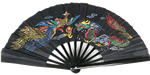
The Taiji Kung Fu Fan Form was created by Professor Li Deyin in 2001. This is a popular Internal Martial Arts fan exercise routine for middle aged persons and seniors. It is also used in competitions.

Taiji Kung Fu Fan Form, List of Movements. List of the 52 movement names in English.
Taiji Kung Fu Fan Form, Section I, List of Movements. List of Movements 1-26 in English.
Tai Chi Chuan and Kung Fu Fan (Shan) Exercise Routines. Guides, Bibliography, Links, Research, Quotations, Instructions. Research by Mike Garofalo.
Wednesday, May 02, 2012
Nutrition Tips for Exercisers
Ten Take Home Post-Workout Nutrition Points
- "Glycogen restoration is all too easy to achieve and may not be as critical as once thought
- Protein synthesis needs to be the focus of our recovery intervention
- Pre-workout meals actually enhance muscle blood flow and nutrient delivery during exercise
- Pre-workout meals, nocturnal feeding, and multiple post workout drinks are more beneficial than a single post workout drink
- The “post workout window” lasts at least 24 hours
- Consuming a protein shake immediately after training hinders optimal results
- Strength training acutely enhances insulin sensitivity for at least 24 hours
- Whey protein is generally only moderate speed, while whey hydrolysate and pure amino acids are “fast”
- Antioxidants taken after exercise may increase muscle damage and delay recovery
- Aspirin and ibuprofen can prevent the exercise-induced elevation in muscle protein synthesis thus hindering growth and prolonging recovery"
Dave Barr, Top 10 Post-Workout Nutrition Myths
Tuesday, May 01, 2012
Live Well, Laugh Often, and Love Much
“That man is successful who has lived well, laughed often, and loved much, who has gained the respect of the intelligent men and the love of children; who has filled his niche and accomplished his task; who leaves the world better than he found it, whether by an improved poppy, a perfect poem, or a rescued soul; who never lacked appreciation of earth’s beauty or failed to express it; who looked for the best in others and gave the best he had.”
- Robert Louis Stevenson
- Robert Louis Stevenson
Monday, April 30, 2012
As Brisk as Boys
"The sum of the whole is this: walk and be happy, walk and be healthy. "The best of all ways to lengthen our days" is not, as Mr. Thomas Moore has it, "to steal a few hours from night, my love;" but, with leave be it spoken, to walk steadily and with a purpose. The wandering man knows of certain ancients, far gone in years, who have staved off infirmities and dissolution by earnest walking,--hale fellows close upon eighty and ninety, but brisk as boys."
- Charles Dickens
The Ways of Walking
"It’s all still there in heart and soul. The walk, the hills, the sky, the solitary pain and pleasure–they will grow larger, sweeter, lovelier in the days and years to come."
- Edward Abbey
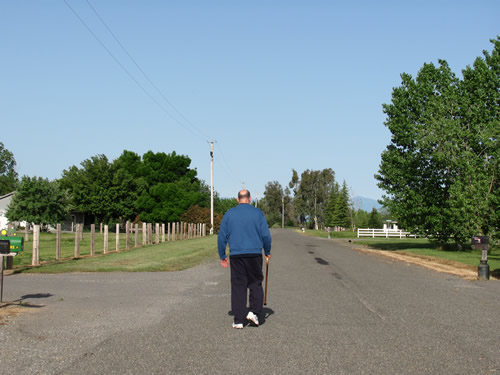
When I am not scheduled to work at my part-time job for the elementary school district, I get outdoors and start walking at 6 am. In between each lap of my walking track (.6 miles round trip [pictured below]) I practice Taijiquan forms [e.g., Sun Style Single Whip Left pictured below].


- Charles Dickens
The Ways of Walking
"It’s all still there in heart and soul. The walk, the hills, the sky, the solitary pain and pleasure–they will grow larger, sweeter, lovelier in the days and years to come."
- Edward Abbey
When I am not scheduled to work at my part-time job for the elementary school district, I get outdoors and start walking at 6 am. In between each lap of my walking track (.6 miles round trip [pictured below]) I practice Taijiquan forms [e.g., Sun Style Single Whip Left pictured below].

Sunday, April 29, 2012
Springtime Gardening Work
Karen and I worked outdoors for 5 hours on Saturday and 8 hours on Sunday. We finished preparations of our Sunny Garden and planted many seedlings. We mowed all the grass and weeds in our main outdoor yards. We pulled the small DC pump from our field well because it was not working. We cleaned up the Sacred Circle garden. Busy, busy ... It was fun!
"All good work is done the way ants do things: Little by little."
- Lafcadio Hearn
- Lafcadio Hearn
"This is the real secret of life - to be completely engaged with what you are doing in the here and now. And instead of calling it work, realize it is play."
- Alan Watts, Work as Play
- Alan Watts, Work as Play
"Every kind of work can be a pleasure. Even simple household tasks can be an opportunity to exercise and expand our caring, our effectiveness, our responsiveness. As we respond with caring and vision to all work, we develop our capacity to respond fully to all of life. Every action generates positive energy which can be shared with others. These qualities of caring and responsiveness are the greatest gift we can offer."
- Tarthang Tulku
Our Iris garden is in grand form at this time of year.
- Tarthang Tulku
Our Iris garden is in grand form at this time of year.


Saturday, April 28, 2012
From the Decaying Tree
"The smell of the sea hugged the fog in the redwood trees,
All cool and dank, dimly lit and rank with green,
And in shadowed limbs the Stellar jays jabbered free,
And me, standing silently, an alien in this enchanted scene.
From behind the mossy grey stumps
the sounds of footsteps crunching fronds of ferns
caught my suddenly wary mind ...
What?
"Hello, old friend," said Chang San Feng.
"Master Chang, what a surprise," said I.
Master Chang sat on a stump, smiled, and said,
"Can you hear the Blue Dragon singing in the decaying tree;
Or is it the White Tiger roaring in the wilderness of your bright white skull?
No matter! The answer is in the questioning; don't you Chan men see?
In the red ball flesh of this decaying tree
Sapless woody shards of centuries of seasons
Nourish the new roots of mindfulness sprouting.
Yes, Yes, but how can it be?
The up-surging waves of life sprout forth from the decaying tree,
As sure as sunrise rolling over the deep black sea.
Coming, coming, endlessly coming; waves of Chi.
Tan Qian's raven roosts for 10,000 moons
in the withered branches of the rotting tree;
then, one day, the weathered tree falls,
nobody hearing, soundlessly crashing
on the forest floor, on some unknown noon.
Over and over, over and over, life bringing death, death bringing life,
Beyond even the miraculous memories of an old Xian like me;
Watching, watching, sequestered from the strife,
Turning my soul away sometimes because I cannot bear to see.
Even minds may die, but Mind is always free
Bounding beyond, beyond, far beyond you and me;
Somehow finding the Possibility Keys
And unlocking the Door out of the Voids of Eternities."
Master Chang somehow, someway,
slowly disappeared into the red brown heart of the decaying tree.
Then the squawk of the jay
opened my mind's eye to the new day -
Namaste."
- Michael P. Garofalo
Meetings with Master Chang San Feng
Remembering Prairie Creek Redwoods State Park, California
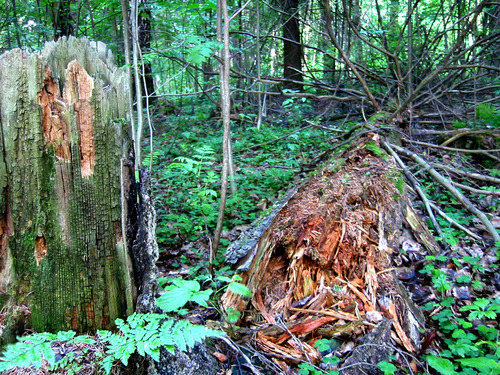
All cool and dank, dimly lit and rank with green,
And in shadowed limbs the Stellar jays jabbered free,
And me, standing silently, an alien in this enchanted scene.
From behind the mossy grey stumps
the sounds of footsteps crunching fronds of ferns
caught my suddenly wary mind ...
What?
"Hello, old friend," said Chang San Feng.
"Master Chang, what a surprise," said I.
Master Chang sat on a stump, smiled, and said,
"Can you hear the Blue Dragon singing in the decaying tree;
Or is it the White Tiger roaring in the wilderness of your bright white skull?
No matter! The answer is in the questioning; don't you Chan men see?
In the red ball flesh of this decaying tree
Sapless woody shards of centuries of seasons
Nourish the new roots of mindfulness sprouting.
Yes, Yes, but how can it be?
The up-surging waves of life sprout forth from the decaying tree,
As sure as sunrise rolling over the deep black sea.
Coming, coming, endlessly coming; waves of Chi.
Tan Qian's raven roosts for 10,000 moons
in the withered branches of the rotting tree;
then, one day, the weathered tree falls,
nobody hearing, soundlessly crashing
on the forest floor, on some unknown noon.
Over and over, over and over, life bringing death, death bringing life,
Beyond even the miraculous memories of an old Xian like me;
Watching, watching, sequestered from the strife,
Turning my soul away sometimes because I cannot bear to see.
Even minds may die, but Mind is always free
Bounding beyond, beyond, far beyond you and me;
Somehow finding the Possibility Keys
And unlocking the Door out of the Voids of Eternities."
Master Chang somehow, someway,
slowly disappeared into the red brown heart of the decaying tree.
Then the squawk of the jay
opened my mind's eye to the new day -
Namaste."
- Michael P. Garofalo
Meetings with Master Chang San Feng
Remembering Prairie Creek Redwoods State Park, California
Subscribe to:
Posts (Atom)