Wednesday, May 13, 2015

Dragon Qigong Exercises

Exercises that involve twisting, turning, spiraling, screwing, sliding, swinging, swimming, sinking down and rising up, wiggling, undulating, circling, or twining are often associated with snakes and dragons.  There are many Qigong sets and specific Qigong movements given a name that includes a 'Dragon.'  Baguazhang and Shaolin Kung Fu also include many "Dragon" forms, sets and movements.  Silk Reeling Qigong is also related to Dragon like movements. 

Dragon Qigong is often associated with Wudang Taoist mind/body arts.  Maybe the cliffs and valleys of the Wudang Mountain area are home to many dragons? Dragons have a well established place in Taoist symbolism and lore, as well as in Chinese culture in general.    

My updated webpage on Dragon Qigong includes an extensive bibliography, links, resources, an introduction, quotations, and a detailed description of my own Dragon Qigong set.  

I welcome suggestions for additions and changes to the Dragon Qigong webpage. 


Monday, May 11, 2015

Just This Blazing Everywhere

"Thanks to a severely under-funded and poorly planned skiing trip, I was sleep-deprived and probably hypoglycemic that morning in 1959 when I stepped out alone, walked into the streets of Lone Pine, Calif., and saw the world — the mountains, the sky, the low scattered buildings — suddenly flame into life. There were no visions, no prophetic voices or visits by totemic animals, just this blazing everywhere. Something poured into me and I poured out into it. This was not the passive beatific merger with “the All,” as promised by the Eastern mystics. It was a furious encounter with a living substance that was coming at me through all things at once, too vast and violent to hold on to, too heartbreakingly beautiful to let go of.  It seemed to me that whether you start as a twig or a gorgeous tapestry, you will be recruited into the flame and made indistinguishable from the rest of the blaze. I felt ecstatic and somehow completed, but also shattered. Of course I said nothing about this to anyone. Since I recognized no deities, and even the notion of an “altered state of consciousness” was unavailable at the time, I was left with only one explanation: I had had a mental breakdown, ultimately explainable as a matter of chemical imbalances, overloaded circuits or identifiable psychological forces. There had been some sort of brief equipment failure, that was all, and I determined to pull myself together and put it behind me, going on to finish my formal education as a cellular immunologist and become a responsible, productive citizen. It took an inexcusably long time for me to figure out that what had happened to me was part of a widespread category of human experience. Some surveys find that nearly half of Americans report having had a mystical experience."
-  Barbara Ehrenreich, 
A Rationalist's Mystic Moment


Nature Mysticism: Quotes, Bibliography, Resources


Sunday, May 10, 2015

Walking Activates the Imagination

I walk 3.6 miles outdoors four days every week: Friday - Monday.  At this time of year, I get out and walking at daybreak, before the sun rises above Mt. Lassen, while the day is cool.  I have done this for the last 15 years.  

"What is it about walking, in particular, that makes it so amenable to thinking and writing? The answer begins with changes to our chemistry. When we go for a walk, the heart pumps faster, circulating more blood and oxygen not just to the muscles but to all the organs—including the brain. Many experiments have shown that after or during exercise, even very mild exertion, people perform better on tests of memory and attention. Walking on a regular basis also promotes new connections between brain cells, staves off the usual withering of brain tissue that comes with age, increases the volume of the hippocampus (a brain region crucial for memory), and elevates levels of molecules that bothstimulate the growth of new neurons and transmit messages between them.

The way we move our bodies further changes the nature of our thoughts, and vice versa. Psychologists who specialize in exercise music have quantified what many of us already know: listening to songs with high tempos motivates us to run faster, and the swifter we move, the quicker we prefer our music. Likewise, when drivers hear loud, fast music, they unconsciously step a bit harder on the gas pedal. Walking at our own pace creates an unadulterated feedback loop between the rhythm of our bodies and our mental state that we cannot experience as easily when we’re jogging at the gym, steering a car, biking, or during any other kind of locomotion. When we stroll, the pace of our feet naturally vacillates with our moods and the cadence of our inner speech; at the same time, we can actively change the pace of our thoughts by deliberately walking more briskly or by slowing down."
-  Ferris Jabr, Why Walking Helps Us Think

"Walking is a spiritual practice that yields so many dividends: replenishment of the soul, connection with the natural world, problem-solving, self-esteem, health and healing, and heightened attention. Movement seems to encourage dialogue and conviviality, leading to richer conversations with soul mates, friends, and even strangers. Artists report that walking activates the imagination and opens up the creative process. It is deeply restorative.  Throughout time, walking has played an enormous role in the devotional life of people from all the world's religions: prayers and mantra practice while walking, pilgrimage to sacred sites, walking the labyrinth, walking meditation, and informal spiritual practices that make the most of strolling, sauntering, or cavorting."
Walking and Spirituality
 

Walking:  Quotes, Sayings, Lore, Poems, Bibliography, Resources.  Hundreds of quotes to inspire and inform walkers everywhere. 

Walking Meditation

The Five Senses


Saturday, May 09, 2015

May Gardening Chores


May Gardening Chores in Red Bluff

Divide and replant clumps of perennials that have finished flowering.
Take cuttings from some plants.
Watering as needed, especially potted plants.
Plant vegetables in a sunny garden area. 
Read garden books from the library. 
Mowing lawns and weeding.
Planting seeds in containers in the greenhouse. 
Fertilize some actively growing plants. 
Mulch trees, shrubs and garden. 
Weed garden.  Weed garden.  Weed garden. 
Take a nap in the shade.
Pick up tree branches blown down by high winds. 
Remove dead branches or trees. 
Thin out plants growing in the vegetable garden.
Mow lawns and field.  
Write a poem.   Keep a garden journal. 
Clean and scrub down garden chairs. 
Watering as needed.   Deeply soak trees. 
Celebrate May Day. 
Use straw mulch to conserve water and shade roots.
Don't get sun burnt.  Wear wide brimmed hats and long sleeve shirts.
Dig in composted manure.
Fertilize grass in lawns.   
Shape shrubs.
Weed garden.  Weed the garden.  Weed the garden. 
Rake and sweep up sitting areas in the shade. 
Prune vines. 
Search for poems and songs and quotes about the month of May. 
Clean up garden workbench area. 
Read some Springtime poetry out loud. 
Place extended release fertilizer in potted plants. 
Move tender plants into semi-shade. 
Thin excess fruit on trees. 
Sit and observe.
Thin our excess vegetables.   
Make sure lath/shade house is ready.  

We have five cherry trees that consistently produce delicious fruit.  


Many Horrors Come To An End

On May 7, 1945, Germany unconditionally surrendured to the Allied forces.  On May 8, 1945, everywhere in countries aligned with the Allied Forces the people celebrated Victory in Europe Day.

The horrors of World War II never ended in many ways.  Over 60 million people had died as a result of the worldwide conflict initiated by Nazi Germany and Japan.  Many major cities had been destroyed.  Homelessness and famine remained.  Sorrows upon sorrows were fresh in everyone's minds. The guilt and shame sunk deep in millions of minds. 

Thursday, May 07, 2015

Principles of Self-Esteem

Six Pillars of Self-Esteem

1.  Living Consciously: The practice of being aware of what one is doing while one is doing it; or, mindfulness. 

2.  Accept Yourself:  The practice of owning truths regarding one's thoughts, emotions, and behaviors; of being kind toward oneself with respect to them; and of being "for" oneself in a basic sense.

3.  Take Responsibility for Your Experiences: The practice of owning one's authorship of one's actions and of owning one's capacity to be the cause of the effects one desires.

4.  Assert Who You Are: the practice of treating one's needs and interests with respect and of expressing them in appropriate ways.

5.  Live Purposely: The practice of formulating goals and of formulating and implementing action plans to achieve them.

6.  Maintain Your Integrity: The practice of maintaining alignment between one’s behaviors and convictions.


-  Nathaniel Branden, Six Pillars of Self-Esteem, 1995


How to Live the Good Life:  Advice from Wise Persons

Wednesday, May 06, 2015

Chi Kung with Ball

Martial Arts, physical culture, and Qigong enthusiasts can benefit from using a medicine ball when doing exercises.  There are many routines developed by Taijiquan and Qigong masters using a medicine ball.   Qigong Ball exercisers can get into a calm mode, mellow their mood, and go with the Flow. 

Medicine Ball Training and Exercises: Bibliography, Links, Resources
.  Prepared by Mike Garofalo.  A general introduction to the use of medicine balls in exercise programs. 

I developed my own medicine ball routine called:
Magic Pearl Qigong. 


Magic Pearl Qigong, Part I, Movements 1-8
.   Instructions, Bibliography, Links, Handouts, Resources, Mythological Associations, Lore.  Prepared by Mike Garofalo. 

The Magic Pearl Qigong can be a very vigorous physical culture routine if you increase the weight of the ball, lower the stances, and increase the number of repetitions of each movement.  Serious Qigong Ball enthusiasts use a very light wooden ball, move slowly, stay relaxed, sink, play.  

In addition, upper body strength and athletic fitness is also be improved by practicing longer Taijiquan Forms using weapons like the saber, sword, cane, and staff. 


Tuesday, May 05, 2015

Do Bees Have the Buddha Nature

A monk asked, "Can inanminate things expound Dharma?"
Daopi said, "The jade dog roams at night, never knowing the daylight."


"Zen Master Yunmen Wenyan (864-949 CE) once took his staff and struck a pillar in the hall, saying, "Are the three vehicles and twelve divisions of scripture talking?"
He then answered himself by saying, "No, they're not talking."
Then he shouted, "Bah!  A wild fox spirit!"
A monk asked, "What does the master mean?"
Yunmen said, "Mr. Shang drinks the wine, and Mr. Li gets drunk."


"In the works of Emerson, Thoreau, and Whitman in particular, nature is portrayed as a beneficent living force that can, if studied and understood through careful and intentional reflection, offer enduring lessons about what it means to be human. In “Self-Reliance,” and the main ideas behind Thoreau’s “Walden”, as well as “Leaves of Grass”, the respective authors are deeply reverent of nature, and it is through their intimate relationship with the natural world that they construct their own identities and their philosophies about how to live a right life in the natural world. For Emerson, Thoreau, and Whitman, nature is viewed as possessing all the knowledge that man needs to know, if only he is attentive and willing enough to study its messages and apply them to his life."
-  Nicole Smith, The Role of Nature in Transcendental Poetry


Yunmen said, "A true person of the Way can speak fire without burning his mouth.  He can speak all day with moving his lips and teeth or uttering a word.  The entire day he just wears his clothes and eats his food, but never comes in contact with a single grain of rice or thread of cloth.
When we speak in this fashion it is jut the manner of our school.  It must be set forth like this to be realized.  But if you meet a true patch-robed monk of our school and try to reveal the essence through words, it will be a waste of time and effort.  Even if you get some great understanding by means of a single word you are still just dozing."
 

"Zen's Chinese Heritage: The Masters and Their Teachings."  Translated by Any Ferguson.  Boston, Wisdom Publications, 2000, p. 262.  


Way of the Short Staff.  By Michael P. Garofalo, M.S.  A comprehensive guide to the practice of the short staff, cane, jo, walking stick, gun, zhang, whip staff, 13 Hands Staff, and related wood short staff weapons.  A detailed and annotated guide, bibliographies, lists of links, resources, instructional media, online videos, and lessons.   Includes use of the short staff and cane in martial arts, self-defense, walking and hiking.  Separate sections on Aikido Jo, Cane, Taijiquan cane and staff, Jodo, exercises with a short staff, selected quotations, techniques, selecting and purchasing a short staff, tips and suggestions, and a long section on the lore, legends, and magick of the short staff.  Includes "Shifu Miao Zhang Points the Way."  Published by Green Way Research, Valley Spirit Taijiquan, Red Bluff, California.  Updated on a regular basis since October, 2008.  Filesize: 265Kb.  Related to Mike's popular webpage on the Staff.


"Zhaozhou, who had been in poor health, asked his friend Miao Zhang, "Do the bees have Buddha nature?"  Miao Zhang smiled and said, "The roses are so fragrant today, and the cherries so sweet.  Let's walk in the garden and leave our crutches behind." 

    Gathering together in an orchard of blooming sweet lime trees, the students waited for their esteemed teacher, Kasyapa.  Slowly walking down the dirt path, relying on his danda walking staff for balance, Kasyapa joined his students.  He sat quietly for a long time, enjoying the fragrance of the lime blossoms.  Finally, he raised his danda staff.  Everyone stared at Kasyapa - serious, intent, focused, and silent.  Only Shifu Miao Zhang smiled, and then lifted his cane and pointed at a lime blossom.  Kasyapa pointed his danda at Shifu Zhang.  Another transmission was completed.  The sacred thread remained unbroken."
- Shifu Miao Zhang Points the Way


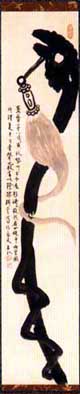
Hakuin's Dragon Staff Inka Scroll


Zen Master Hakuin (1686-1768) painted a Dragon Staff with a horsehair whisk attached.  He gave the above painting to a lay student who passed the Zen koan, "What is the sound of one hand clapping." 


Monday, May 04, 2015

Raku: Music for the Relaxing Arts


Music for the Relaxing Arts

Raku by PC Davidoff and Friends

Meditation

Nature Mysticism

A fine way to start of the day: sitting in the garden at daybreak and listening to
Raku


Sunday, May 03, 2015

Sacred Circle Gardens

"Myths serve four purposes: 
To awaken wonder by bringing us back in touch with the child within. 
To fill all corners or niches of an image with the Mystery.
To validate social order.
To teach us how to conduct ourselves during the stages of our lives."
-  Joseph Campbell, The Masks of God: Creative Mythology   


Sacred Circles: Bibliography, Links, Quotations, Resources

Valley Spirit Sacred Circle Garden in Red Bluff, California


Divine Incantations to the Protective Gods of the Five Directions
From Wushang Biyao (Secret Essentials of the Most High)
Translated by Livia Kohn, "The Taoist Experience: An Anthology," 1993, pp.112-115
The Wushang Biyao is a Taoist encyclopedia commissioned by Emperor Wu of the Northern Zhou in 574 CE.  


Oh, Great God of the East!
Bright Star of the Ninefold Energy of Azure Heaven!
You brilliantly illuminate the Eastern Regions,
Penetratingly shine through the Nine Gates,
In your revolutions, glittering with the brightness of Pure Yang! 

Oh, come and cleanse out all filth, do away with all evil vapors!
Open the light for your divine lads
To come and protect me and my house!
Restrain the demons and tie up all nasty specters! 
As I rise to face the imperial lords above. 

May I reverently follow the rightful Tao,
As set forth in the Red Writings and Jade Scriptures,
The talismans and instructions of the Nine High Heavens! 

May I hitch up the dragons and get ready to rise,
Rise up to the peaceful abode of Heaven,
And soon be a flying immortal! 


Oh, Fiery Star of the South! 
Floating Brilliance of the Threefold Energy of Cinnabar Heaven!
In your revolutions, you shine forth and illumine all with Highest Yang! 
Above you are the power of Red Essence! 

Oh, open the light for your divine lads,
Marshall your host of fiery soldiers,
To come and protect my three palaces within! 
Behead all obnoxious powers and tie up all nasty specters,
Cut the King of Illusion into little pieces
And all that obeys the Dark Lord of the North. 

May all the winds and fires in the eight directions
Blow and shine together, blending in a blaze!
How dare anyone not obey
The rightful Tao in its progression? 

May I enjoy the highest merit,
Be preserved by Heaven forever and ever,
Through a million kalpas without end! 


Oh, Great Whiteness of the West!
Floating Essence of the Sevenfold Energy of the Heavens!
Your radiance shines forth through the Golden Gateway,
Penetrates with brightness even the deepest dark -
The Pure Star in your midst,
Known as the Emperor of all Numen.

Oh, guard my spirits and secure my house,
Protect my body from all harm!
Oh, destroy the source of all obnoxious powers!
Let the Way of the King be upright and enlightened,
And all the halls and residences clear and dignified.

May the Three Luminaries join their radiance.
And the Tao harmonize with the spontaneous flow of all!
With the talismans and instructions of Numinous Treasure!

May my goodwill spread over the myriad living beings!
May my merit aid them all -
And Heaven and Earth be greatly now at peace!


Oh, Thunderous Star of the North!
Active Power of the Fivefold Energy of Dark Heaven!
You splendid brilliance reaches even into Great Abstrusity!
Oh, Venerable God of Black Numen!
Flying darkness in feathery garb!

Oh, come and protect all my five gateways,
Assemble the good essence and apprehend the bad!
Humbly, I dare put forward this request:
Expel and scatter, destroy and behead all evils,
As the jade talismans command!


Oh, Spiritual Perfected of Eightfold Majesty!
Seal off my gates of viciousness and all hindering obstructions,
Let me be open to the brightness of the Tao!

Shine and sparkle through my body
Like the Three Luminaries shining forth together!
May I steer the empty air and stride upon the winds,
Lift up my body into the flight of the immortals!

Oh, Protector Star of the Center!
Mysterious Perfected and Powerful Ruler
 

Of the Unified Energy of the Yellow Middle!
You spread brilliance and flowing brightness. 

Oh, open the light for your divine lads,
Twelve in number,
For your primordial energy, clear essence of yang.
And let it float aloft in wafts of vermillion mist.


Oh, let your light pervade my residence,
Reach as far as into my very own body!
Drive out and destroy the hundred obnoxious forces,
Kill all the demons, however many millions!

May this divine incantation to the Mountain of the Center
Penetrate to Heaven and give me protection!
May the five sacred animals be securely on guard
To let me fly up and ascend to the immortals!"  
-   Translated by Livia Kohn, "The Taoist Experience: An Anthology," 1993, pp.112-115  


Sacred Circles: Bibliography, Links, Quotations, Resources

Valley Spirit Sacred Circle Garden in Red Bluff, California


 Our Sacred Circle Garden in 2010 in Red Bluff, California


Saturday, May 02, 2015

Sit and Listen

"Teach us to care and not to care.
Teach us to sit still."
- T.S. Eliot


"You are sitting on the earth and you realize that this earth deserves you and you deserve this earth.  You are there - fully, personally, genuinely."
-  Chogyam Trungpa


"Remain sitting at your table and listen. 
Do not even listen, simply wait, 
be quiet still and solitary. 
The world will freely offer itself 
to you to be unmasked, 
it has no choice, it will roll in ecstasy 
at your feet."
-  Franz Kafka


Sitting in the Garden


Friday, May 01, 2015

Tao Te Ching by Lao Tzu, Chapter 17

Daodejing, Laozi
Chapter 17

"Those of preeminent wisdom and purity knew this Tao intuitively from their birth,
and so possessed it.
Those of the second rank—the men of virtue—approached it nearly, and eulogised it.
Those of the third rank—who were still above the commonalty—stood in awe of it.
Those of the lowest rank held it in light esteem.
Their belief in it was superficial, or imperfect; while there were even some who did not believe in it at all.
The first spoke only with forethought and calculation, as though honouring their words.
When their public labours were achieved, and affairs progressed unimpeded, the people all said,
"This is our natural and spontaneous condition.""
-  Translated by Frederic Henry Balfour, 1884, Chapter 17


"A leader is best
When people barely know that he exists,
Not so good when people obey and acclaim him,
Worst when they despise him.
'Fail to honor people,
They fail to honor you;'
But of a good leader, who talks little,
When his work is done, his aim fulfilled,
They will all say, 'We did this ourselves.'"
-  Translated by Witter Bynner, 1944, Chapter 17  


"In the highest antiquity people scarce knew
That rulers existed among them; In the next age attachment and praise for them grew, In the next people feared they might wrong them;  And then in the next age the people despised The rulers whom fate set above them, For when faith by the rulers no longer is prized, The people no longer can love them. Those earliest rulers! what caution they had In weighing the words they were using; How successful their deeds! while the people all said We are what we are by our choosing.
"
-  Translated by Isaac Winter Heysinger, 1903, Chapter 17


"With the highest rulers -
Those below simply know they exist.
With those one step down -
They love and praise them.
With those one further step down -
They fear them.
And with those at the bottom -
They ridicule and insult them.

Who does not trust enough
will not be trusted.
Hesitant and undecided!
Like this is his respect for speaking.
He completes his tasks and finishes his affairs
Yet the common people say,
"These things all happened by nature."
-  Translated by Bram den Hond, Chapter 17 


太上下知有之.
其次親而譽之.
其次畏之.
其次侮之.
信不足焉有不信焉.
悠兮其貴言.
功成事遂百姓皆謂我自然. 
-  Chinese characters, Tao Te Ching, Chapter 17


t'ai shang hsia chih yu chih.
ch'i tz'u ch'in erh yü chih.
chi tz'u wei chih.
ck'i tz'u wu chih.
hsin pu tsu yen yu pu hsin yen.
yu hsi ch'i kuei yen. 
kung ch'êng shih sui pai hsing chieh wei wo tzu jan.
-  Wade-Giles Romanization, Tao Te Ching, Chapter 17


"Of great rulers the subjects do not notice the existence.
To lesser ones people are attached; they praise them.
Still lesser ones people fear, and the meanest ones people despise.
For it is said: 'If your faith be insufficient, verily, you will receive no faith.' 
How reluctantly the great rulers considered their words!
Merit they accomplished; deeds they performed; and the hundred families thought: 'We are independent.' "  
-  Translated by D. T. Suzuki and Paul Carus, 1913, Chapter 17    


"Of the best ruler,
The people only know he exists.
Next comes one the love and praise.
Next comes one they fear.
Next comes one they abhor.
When you are lacking in trust,
Others have no trust in you.
Of the work of one who is short with his words,
The hundred families say,
We have done it ourselves!"
-  Translated by Herrymoon Maurer, 1985, Chapter 17 


"Acerca de los antiguos todo lo que se sabe es que existían.
Los sucesores fueron amados y alabados, y los siguientes fueron temidos.
Los que vinieron después aborrecidos.
Sí no te tienes plena confianza, otros te serán infieles.
Entonces las palabras rituales estaban medidas.
El mérito de las obras tenía plenitud.
Todo el mundo decía:
"Estamos en armonía con nosotros mismos"."
Translation from Logia Medio Dia, 2015,
Capítulo 17


"In ancient times
The people knew that they had rulers.
Then they loved and praised them,
Then they feared them,
Then they despised them.
The rulers did not trust the people,
The people did not trust the rulers.
The rulers were grave, their words were precious.
The people having finished their work,
and brought it to a successful issue, said:
"We affirm the Self.""
-  Translated by Isabella Mears, 1916, Chapter 17 


Chapter and Thematic Index (Concordance) to the Tao Te Ching


Taoism: A Selected Reading List


A typical webpage created by Mike Garofalo for each one of the 81 Chapters of the Tao Te Ching (Daodejing) by Lao Tzu (Laozi) includes 20 different English translations or interpolations of each Chapter, 3 Spanish translations for each Chapter, the Chinese characters for each Chapter, and the Wade-Giles and Hanyu Pinyin Romanization of the Mandarin Chinese words for each Chapter; extensive indexing by key words and terms for each Chapter in English, Spanish, and the Wade-Giles Romanization is provided; recommended reading in books and websites, a detailed bibliography, some commentary, research leads, translation sources, and other resources for each Chapter are included.  


Wednesday, April 29, 2015

The Hand and the Heart of Man Go Together

"There are several basic kinds of touch that you may experience:  Intimate -- Here, your pressure receptors respond to a handshake, hug or kiss. If the person giving the touch is someone you care about, you'll probably feel warm and comforted. Your pressure sensors send the feeling of how hard the embrace is, and your brain interprets the nature of the touch as soothing.  Healing or therapeutic -- This type of touch is often associated with massage or acupuncture. Sometimes, the pressure is gentle and meant to soothe sore muscles. Other times, the pressure is deep in order to work out knots. Despite differences in severity of pressure, you likely to be aware that the outcome is healing, so your body allows you to relax.  Exploratory or inquisitive -- We all learn about the world through our sense of touch. Many people test out foods, fabrics or other objects by feeling different textures. Sometimes it's possible to rely solely on the sense of touch. This is why it's easy for you to reach into your bag and find a pair of keys without looking. You know the cold feeling of the metal key and hard smooth feel of your plastic key chain.  Aggressive or painful -- Of course, we all know that touch can also equate to pain if the pressure is too much and the intent is wrong. A handshake that's too firm can be uncomfortable instead of reassuring."
Psychology of Touching


"The hand is so widely represented in the brain, the hand's neurologic and biomechanical elements are so prone to spontaneous interaction and reorganization, and the motivations and efforts which give rise to individual use of the hand are so deeply and widely rooted, that we must admit that we are trying to explain a basic imperative of human life."
-  Frank R. Wilson, M.D., The Hand, p. 10


“If a thing can be said to be, to exist, then such is the nature of these expansive times that this thing which is must suffer to be touched. Ours is a time of connection; the private, and we must accept this, and it’s a hard thing to accept, the private is gone. All must be touched. All touch corrupts. All must be corrupted."
-  Tony Kushner, Homebody/Kabul

"Fine art is that in which the hand, the head, and the heart of man go together."
-  John Ruskin 


Monday, April 27, 2015

Reiki Information from Karen Garofalo

Reiki: Bibliography, Quotations, Information, Resources

By Karen Garofalo
Reiki Master

In the Usui Shiki Ryoho Reiki Tradition
Valley Spirit Center
Red Bluff, California