"Other theories suggest that the Eight Brocades are a collection of various Taoist breath exercises with influences coming from the Buddhist patriarch Bodhidharma's works, the I chin ching and Hsi sui ching (Muscles Changing Classic and Marrow Cleansing Classic); or, that the Sung dynasty military leader General Yueh Fei invented the exercises. These two highly improbably founders serve more to validate the practice of the Eight Brocades within the Buddhist and martial arts schools.
The development of the Eight Brocades is rather clouded. All the various schools have claimed it as their own invention, and have inserted their own ideas. It has even been presented as twelve exercises, or the Twelve Brocades (shih erh tuan chin). The exercises also appear in a more dissected manner with many additions, under the heading Internal Kung for the Four Seasons (nei kung szu ling), as twenty four exercises for specific periods of the year. In martial arts, the Eight Brocades have become a system of not only standing postures but also sword and staff forms. They are now being presented as a form of qigong, a term that did not appear until 1910 in a book entitled Shaolin Tsung fa (Shaolin Orthodox Methods). The author used the term generically to cover a wide range of ideas, including respiratory and meditative exercises directed at mobilizing the breath. Qigong is not in any sense a traditional Taoist term, but has since been adapted to many Taoist works.
Since no clear evidence exists as to when the Eight Brocades were first developed, the answer as to their origin really depends on which school or thought of Taoism, Buddhism, Confucianism, medicine, or martial art you wish to believe. Each school seems to have its own unique evidence and prejudice."
- Stuart Alve Olson, Qigong Teachings of a Taoist Immortal, p. 26
My detailed webpage on the Eight Section Brocade Qigong will give you many additional leads to the history and practice of this popular qigong form.
Friday, May 15, 2009


Wednesday, May 13, 2009
Zhang San Feng and Wudang
"Mount Wudang, also known as Can Shang Mountain or Tai He Mountain, is located in the Qin Ling Mountain Range of northwestern Hubei Province. Because the scenery around Mount Wudang is so majestic and beautiful, it has been given the name The Famous Mountain Under Heaven. Wudang is a major center for the sudy of Daoism and self-cultivation.
The legendary founder of Wudang wushu was Zhang San Feng. Zhang San Feng was a Daoist who lived in these mountains to cultivate the Dao during the Ming Dynasty. Zhang San Feng was born in 1247 A.D. in the area of what is known today as Liao Ning. Zhang San Feng is a very famous figure in the history of Chinese wushu. His martial abilities and healing techniques were superb and he was known to have cured many people of illnesses. This brought about great admiration from the common people. The emperor of the Ming Dynasty erected a monument on the mountain to commerate the contributions of Zhang San Feng. During Zhang's younger years he met Daoist Huo Lung (Fire Dragon) with whom he studied the Dao. After attaining the Dao, Zhang moved to Wudang Mountain and cultivated an additional nine years. Many historical documents suggest that Zhang San Feng was the person responsible for synthesizing the wushu of the common people with the internal methodology and philosphical principles of Daoism. Wudang wushu is primarily known for its internal styles.
Zhang San Feng created Wudang wushu by researching the basic theory of Yin and Yang, the Five Elements, and the Eight Diagrams (Ba Gua). Wudang wushu has a very close relationship with the theories of Taiji, Yin and Yang, the Five Elements, the Eight Diagrams, and the Nine Palaces. Zhang San Feng was able to incorporate the Daoist practice of changing the Essence into Internal Energy , Internal Energy into Spirit , and Spirit into Emptiness to form the theory of Wudang wushu."
- Introduction to Wudang Martial Arts
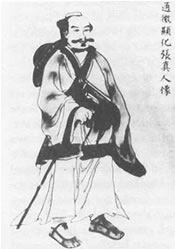
Grandmaster Zhang San Feng: Bibliography, Resources, Links, Quotes, Notes
Wudang Qigong
The legendary founder of Wudang wushu was Zhang San Feng. Zhang San Feng was a Daoist who lived in these mountains to cultivate the Dao during the Ming Dynasty. Zhang San Feng was born in 1247 A.D. in the area of what is known today as Liao Ning. Zhang San Feng is a very famous figure in the history of Chinese wushu. His martial abilities and healing techniques were superb and he was known to have cured many people of illnesses. This brought about great admiration from the common people. The emperor of the Ming Dynasty erected a monument on the mountain to commerate the contributions of Zhang San Feng. During Zhang's younger years he met Daoist Huo Lung (Fire Dragon) with whom he studied the Dao. After attaining the Dao, Zhang moved to Wudang Mountain and cultivated an additional nine years. Many historical documents suggest that Zhang San Feng was the person responsible for synthesizing the wushu of the common people with the internal methodology and philosphical principles of Daoism. Wudang wushu is primarily known for its internal styles.
Zhang San Feng created Wudang wushu by researching the basic theory of Yin and Yang, the Five Elements, and the Eight Diagrams (Ba Gua). Wudang wushu has a very close relationship with the theories of Taiji, Yin and Yang, the Five Elements, the Eight Diagrams, and the Nine Palaces. Zhang San Feng was able to incorporate the Daoist practice of changing the Essence into Internal Energy , Internal Energy into Spirit , and Spirit into Emptiness to form the theory of Wudang wushu."
- Introduction to Wudang Martial Arts
Grandmaster Zhang San Feng: Bibliography, Resources, Links, Quotes, Notes
Wudang Qigong
Monday, May 11, 2009
Water Your Garden
In the subtitle of this Cloud Hands blog, I include the extremely popular mind-body movement art of gardening. Many people who practice internal martial arts and yoga are also avid walkers and gardeners.
Over 90% of the internal martial arts practice I do is is at home, alone, in my yard. Many millions of people also practice Taijiquan and Qigong in their gardens, in parks and in fields.
I do post a great deal on the subject of gardening. However, these contributions are made to the Green Paths in the Valley Blog and The Spirit of Gardening Website.
Gardening also provides one with valuable physical exercise, as well as the pleasures of sights, sounds, smells and and tastes one gets from a garden.
This past weekend, we spent the day at home. We did quite a bit of gardening (mowing, weeding, pruning, removing dead trees, cleanup, watering, etc.), played, read, learned about some new software, and took some photographs.

Karen standing at the entrance to the old vegetable garden area.
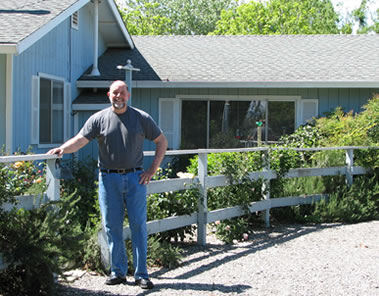
Mike standing at the entrance to the front yard.
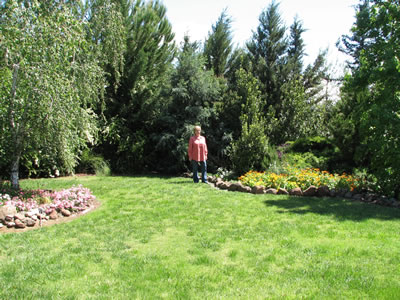
Karen's calendulas and Spanish lavender are really colorful in the Springtime.
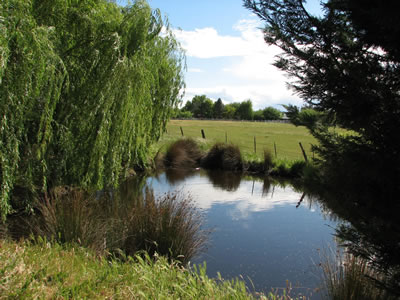
The pond by the teahouse is now quite full. The teahouse is hidden by two massive Golden Willows.
To see how our gardens, yard, and home have changed since 1998, take a look at one of our photographic studies.
"The Art of Peace begins with you. Work on yourself and your appointed task in the Art of Peace.
Everyone has a spirit that can be refined, a body that can be trained in some manner, a suitable path to follow.
You are here for no other purpose than to realize your inner divinity and manifest your innate enlightenment.
Foster peace in your own life and then apply the Art to all that you encounter.
One does not need buildings, money, power, or status to practice the Art of Peace.
Heaven is right where you are standing, and that is the place to train.
To truly implement the Art of Peace, yu must be able to sport freely
in the manifest, hidden, and divine realms."
- Morihei Ueshiba, 1883-1969, The Art of Peace
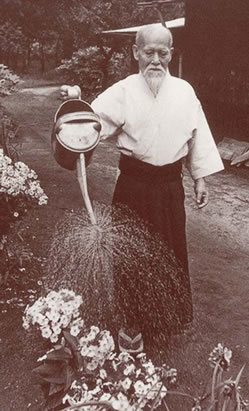
Aikido Founder Morihei Ueshiba watering his garden.
Over 90% of the internal martial arts practice I do is is at home, alone, in my yard. Many millions of people also practice Taijiquan and Qigong in their gardens, in parks and in fields.
I do post a great deal on the subject of gardening. However, these contributions are made to the Green Paths in the Valley Blog and The Spirit of Gardening Website.
Gardening also provides one with valuable physical exercise, as well as the pleasures of sights, sounds, smells and and tastes one gets from a garden.
This past weekend, we spent the day at home. We did quite a bit of gardening (mowing, weeding, pruning, removing dead trees, cleanup, watering, etc.), played, read, learned about some new software, and took some photographs.
Karen standing at the entrance to the old vegetable garden area.
Mike standing at the entrance to the front yard.
Karen's calendulas and Spanish lavender are really colorful in the Springtime.
The pond by the teahouse is now quite full. The teahouse is hidden by two massive Golden Willows.
To see how our gardens, yard, and home have changed since 1998, take a look at one of our photographic studies.
"The Art of Peace begins with you. Work on yourself and your appointed task in the Art of Peace.
Everyone has a spirit that can be refined, a body that can be trained in some manner, a suitable path to follow.
You are here for no other purpose than to realize your inner divinity and manifest your innate enlightenment.
Foster peace in your own life and then apply the Art to all that you encounter.
One does not need buildings, money, power, or status to practice the Art of Peace.
Heaven is right where you are standing, and that is the place to train.
To truly implement the Art of Peace, yu must be able to sport freely
in the manifest, hidden, and divine realms."
- Morihei Ueshiba, 1883-1969, The Art of Peace
Aikido Founder Morihei Ueshiba watering his garden.
Friday, May 08, 2009
Moving Meditation: Tai Chi Chuan
There are many techniques, methods and styles of "Meditation." Taijiquan is often called "Moving Meditation." If you practice Taijiquan on a regular basis, you can expect some of the following results or improvements that many people believe are beneficial:
Calmness and poise under a variety of circumstances.
Increased sensory awareness of external conditions and circumstances.
Improved skills in deflecting or avoiding opposing or stressful forces.
Ability to concentrate on immediate tasks.
Being more present and accepting.
Mastery of a traditional art.
Completion of self-assigned tasks and self-discipline.
Enjoyment of "Peak Experiences."
Encouraging spontaneity, flexibility, playfulnes, and openness.
Patience in learning new skills.
Calmness and poise under a variety of circumstances.
Increased sensory awareness of external conditions and circumstances.
Improved skills in deflecting or avoiding opposing or stressful forces.
Ability to concentrate on immediate tasks.
Being more present and accepting.
Mastery of a traditional art.
Completion of self-assigned tasks and self-discipline.
Enjoyment of "Peak Experiences."
Encouraging spontaneity, flexibility, playfulnes, and openness.
Patience in learning new skills.
Wednesday, May 06, 2009
Loosen Up with a Smile
"What allows the energy you work with, gather and create a life of its own is humour. Humour is a lightness that admits of other possibilities. Combine that admission with hearty connectedness and those possibilities become incorporated into a body teeming and seething with life. If humour is maintained then those incorporated possibilities – each one a thread of energy if you like – remain in some way distinct – do not agglutinate into one amorphous mass – and there quickly comes a point where the combined intensity and complexity of these interacting threads develops into what feels like awareness.
Humour is not taking things, especially the self, seriously. It confounds the logical, rational, linear mind, which always struggles to force your movements into some preconceived template, with an element of play which revels in the surprises inherent in the unfolding of creative and natural processes. In a way humour is the most valuable possession you have because it allows you to put up with anything, not with resignation but with a smile – a mood and energy that is always opening and searching not for comfort and ease but for those threads that can be brought into the whole to transform it into a vehicle capable of thrusting you to the next level; humour finds fuel everywhere. Humour also admits that sneaking feeling that you are getting it wrong – that your efforts to do and to make are coming from a part of you – your conditioning – foreign to your essential nature. Humour is a natural and gentle way of applying shocks to your conditioning – unsettling it and loosening its iron grip sufficiently for your essential nature to momentarily peek through. This essential nature, so used to being plastered over, pushed into the background and over-ridden by the bullying conditioned and conditional mind, has a completely different relationship with reality than that mind: soft, playful, interactive, ringing with laughter – imagine children at play – but it needs years of gentle coaxing and encouragement before it will venture forth and take the lead in your life. Scars don't heal overnight. Humour – the touch of lightness that refuses to linger for too long and never repeats itself (jokes are rarely funny second time round). Your conditioning needs repetition to survive and it uses up most of your vital energy in the process of constantly reviewing and recounting its domain – imagine the lonely miser pointlessly counting his money each evening before he can sleep. Your conditioning is telling you the same joke over and over and because you don't realise it's a joke you listen and approve. Humour is the only effective way to cut through this – because it is so gentle its blade is very keen."
- Steven Moore, 6/11/06, Tai Chi Heartwork
Humour is not taking things, especially the self, seriously. It confounds the logical, rational, linear mind, which always struggles to force your movements into some preconceived template, with an element of play which revels in the surprises inherent in the unfolding of creative and natural processes. In a way humour is the most valuable possession you have because it allows you to put up with anything, not with resignation but with a smile – a mood and energy that is always opening and searching not for comfort and ease but for those threads that can be brought into the whole to transform it into a vehicle capable of thrusting you to the next level; humour finds fuel everywhere. Humour also admits that sneaking feeling that you are getting it wrong – that your efforts to do and to make are coming from a part of you – your conditioning – foreign to your essential nature. Humour is a natural and gentle way of applying shocks to your conditioning – unsettling it and loosening its iron grip sufficiently for your essential nature to momentarily peek through. This essential nature, so used to being plastered over, pushed into the background and over-ridden by the bullying conditioned and conditional mind, has a completely different relationship with reality than that mind: soft, playful, interactive, ringing with laughter – imagine children at play – but it needs years of gentle coaxing and encouragement before it will venture forth and take the lead in your life. Scars don't heal overnight. Humour – the touch of lightness that refuses to linger for too long and never repeats itself (jokes are rarely funny second time round). Your conditioning needs repetition to survive and it uses up most of your vital energy in the process of constantly reviewing and recounting its domain – imagine the lonely miser pointlessly counting his money each evening before he can sleep. Your conditioning is telling you the same joke over and over and because you don't realise it's a joke you listen and approve. Humour is the only effective way to cut through this – because it is so gentle its blade is very keen."
- Steven Moore, 6/11/06, Tai Chi Heartwork
Monday, May 04, 2009
Doorway into the Liminal
"I suppose the simple truth of the matter is that I have always been enthralled by doorways, windows, gates, thresholds, hearths, chimneys, hidden forest trails, gaps in the hedgerow, garden hollows and portals of any kind. It isn't unusual to find me standing lost in thought in front of a newly discovered gateway or curled up in my Morris chair at home with a mug of tea and a faraway look in my eye, thinking about such places and where they go. I'm entranced by their situation, their architecture, the materials of which they are formed, and even their color, as much as I am by what lies beyond them.
Liminal spaces can be compelling, and they can exert a powerful tug on the sensibilities. Every hero's journey or heroine's journey begins with a call to adventure, with one breathtaking, serendipitous, watershed moment in which she or he recognizes a liminal space, responds to its eldritch music and steps across the threshold into another realm. No hero or a heroine here (at least in this lifetime), but the presence of a gateway, any old gateway, calls to me in a voice as lyrical and compelling as that of the mythic sirens, a mere glimpse or a casual mention of one, and off I go.
Mircea Eliade once wrote of doors and thresholds as being both symbols and passages, as places where the passage from the profane to the sacred world becomes possible. The philosopher Martin Heidegger described thresholds as joinings or spaces between two worlds, potent common or middle grounds which hold, join and separate two worlds, all at the same time. In other words, thresholds are sacred places which form a boundary between what is "here" and what is "there", but they are in themselves neither here or there.
Within the seemingly empty space of a doorway or a threshold, one sometimes senses ancient, wild and chaotic forces in motion, and thresholds have the power to open a cranny or passage between this world and the other side, allowing those tumultuous forces to blow through. Cultures from ancient times to our own knew it, and they took special measures to secure such places, carving arcane protective sigils on their door lintels, inserting sprigs of rowan and Brigid's crosses into the doors themselves, burying pins and needles beneath their hearth stones, sweeping and blessing their thresholds, and nailing horseshoes above their doorways."
- Kerrdelune, Beyond the Fields We Know III

When I begin a Taijiquan form, moving from standing still (Wuji) to raise hands and then lower hands (Yang and Yin), this is a threshold or doorway for me. Through this beginning movement I enter into a new level of being and open myself up to new experiences. I leave the realm of the ordinary and step into the realm of the spirit.
Liminal spaces can be compelling, and they can exert a powerful tug on the sensibilities. Every hero's journey or heroine's journey begins with a call to adventure, with one breathtaking, serendipitous, watershed moment in which she or he recognizes a liminal space, responds to its eldritch music and steps across the threshold into another realm. No hero or a heroine here (at least in this lifetime), but the presence of a gateway, any old gateway, calls to me in a voice as lyrical and compelling as that of the mythic sirens, a mere glimpse or a casual mention of one, and off I go.
Mircea Eliade once wrote of doors and thresholds as being both symbols and passages, as places where the passage from the profane to the sacred world becomes possible. The philosopher Martin Heidegger described thresholds as joinings or spaces between two worlds, potent common or middle grounds which hold, join and separate two worlds, all at the same time. In other words, thresholds are sacred places which form a boundary between what is "here" and what is "there", but they are in themselves neither here or there.
Within the seemingly empty space of a doorway or a threshold, one sometimes senses ancient, wild and chaotic forces in motion, and thresholds have the power to open a cranny or passage between this world and the other side, allowing those tumultuous forces to blow through. Cultures from ancient times to our own knew it, and they took special measures to secure such places, carving arcane protective sigils on their door lintels, inserting sprigs of rowan and Brigid's crosses into the doors themselves, burying pins and needles beneath their hearth stones, sweeping and blessing their thresholds, and nailing horseshoes above their doorways."
- Kerrdelune, Beyond the Fields We Know III

When I begin a Taijiquan form, moving from standing still (Wuji) to raise hands and then lower hands (Yang and Yin), this is a threshold or doorway for me. Through this beginning movement I enter into a new level of being and open myself up to new experiences. I leave the realm of the ordinary and step into the realm of the spirit.
Sunday, May 03, 2009
Fully-Functioning Individual
Characteristics of the More Fully-Functioning Individual
Nonconformity and Individuality
Self-Awareness
Acceptance of Ambiguity and Uncertainty
Tolerance
Acceptance of Human Animality
Commitment and Intrinsic Enjoyment
Creativity and Originality
Social Interest and Ethical Trust
Enlightened Self-Interest
Self-Direction
Flexibility and Scientific Outlook
Unconditional Self-Acceptance
Risk-Taking and Experimenting
Long-Range Hedonism
Work and Practice
- Albert Ellis, The Albert Ellis Reader, p181-194.
Thursday, April 30, 2009
Walking on the Earth
"Walking meditation means to enjoy walking without any intention to arrive. We don't need to arrive anywhere. We just walk. We enjoy walking. That means walking is already stopping, and that needs some training. Usually in our daily life we walk because we want to go somewhere. Walking is only a means to an end, and that is why we do not enjoy every step we take. Walking meditation is different. Walking is only for walking. You enjoy every step you take. So this is a kind of revolution in walking. You allow yourself to enjoy every step you take.
The Zen master Ling Chi said that "the miracle is not to walk on burning charcoal or in the thin air or on the water; the miracle is just to walk on earth." You breathe in. You become aware of the fact that you are alive. You are still alive and you are walking on this beautiful planet. That is already performing a miracle. The greatest of all miracles is to be alive. We have to awaken ourselves to the truth that we are here, alive. We are here making steps on this beautiful planet. This is already performing a miracle. But we have to be here in order for the miracle to be possible. We have to bring ourselves back to the here and the now."
- Thich Nhat Hanh, Resting in the River
The Ways of Walking: Quotations, Bibliography, Guides
The Zen master Ling Chi said that "the miracle is not to walk on burning charcoal or in the thin air or on the water; the miracle is just to walk on earth." You breathe in. You become aware of the fact that you are alive. You are still alive and you are walking on this beautiful planet. That is already performing a miracle. The greatest of all miracles is to be alive. We have to awaken ourselves to the truth that we are here, alive. We are here making steps on this beautiful planet. This is already performing a miracle. But we have to be here in order for the miracle to be possible. We have to bring ourselves back to the here and the now."
- Thich Nhat Hanh, Resting in the River
The Ways of Walking: Quotations, Bibliography, Guides
Saturday, April 25, 2009
Taiji Kung Fu Fan
We enjoyed a vacation in Portland, Oregon, last week. We visited with the families of our daughter and son. We also camped at Cape Lookout State Park on the coast near Netart's Bay in northwest Oregon.
Lately, I've been researching the Taiji Kung Fu Fan Form, created by Professor Li Deyin in 2001. This is a popular Internal Martial Arts fan exercise routine for middle aged persons and seniors.

Taiji Kung Fu Fan Form, List of Movements. List of the 52 movement names in English.
Taiji Kung Fu Fan Form, Section I, List of Movements. List of Movements 1-26 in English. Our Tai Chi Studies Group in Red Bluff, California, will begin the study of practice of Section I in May of 2009.
Taiji Kung Fu Fan Form, List of Movements in Five Languages. The names of the 52 will be given in Chinese (Pinyin, Romanized), Chinese characters, English, French, German, and Spanish. I intend to complete this list by June, 2009.
Taiji Kung Fu Fan Form: Notes, Comments, and Research.
Tai Chi Chuan and Kung Fu Fan (Shan) Exercise Routines. Guides, Bibliography, Links, Research, Quotations, Instructions.
Lately, I've been researching the Taiji Kung Fu Fan Form, created by Professor Li Deyin in 2001. This is a popular Internal Martial Arts fan exercise routine for middle aged persons and seniors.

Taiji Kung Fu Fan Form, List of Movements. List of the 52 movement names in English.
Taiji Kung Fu Fan Form, Section I, List of Movements. List of Movements 1-26 in English. Our Tai Chi Studies Group in Red Bluff, California, will begin the study of practice of Section I in May of 2009.
Taiji Kung Fu Fan Form, List of Movements in Five Languages. The names of the 52 will be given in Chinese (Pinyin, Romanized), Chinese characters, English, French, German, and Spanish. I intend to complete this list by June, 2009.
Taiji Kung Fu Fan Form: Notes, Comments, and Research.
Tai Chi Chuan and Kung Fu Fan (Shan) Exercise Routines. Guides, Bibliography, Links, Research, Quotations, Instructions.
Wednesday, April 08, 2009
Tai Chi Kung Fu Fan Form by Professor Li Deyin
Tai Chi Fan: Bibliography, Links, Resources, Notes, Lore, Quotations. 65Kb+. Research by Mike Garofalo. I welcome any comments, suggestions, additions, or ideas regarding this webpage.
Does anyone know more about this popular fan form? When was it created? Are there other resources available for studying this fan form?
Our Tai Chi Study Group in Red Bluff, California, will begin studying this Tai Chi Kung Fu Fan Form in May of 2009. I will prepare notes and handouts for our group was we progress in our studies of this form.
Tai Chi Kung Fun Fan Form created by Professor Li Deyin (1938-)
52 Movements Fan Dance Form
Tai Chi Kung Fu Fan Instructional DVD by Professor Li Deyin. Narration in English. "A fan routine, created by Professor Li, which combines the gracefulness, centrality and continuity of Taiji with the power, speed and fierceness of Wushu. It is designed as an addition to the exercises for health, and has received massive interest and support throughout the world. In this DVD, Professor Li provides in-depth teaching with Mrs. Fang Mishou performing detail demonstration." Vendor 1. Cost: $35.00 US.
Does anyone know more about this popular fan form? When was it created? Are there other resources available for studying this fan form?
Our Tai Chi Study Group in Red Bluff, California, will begin studying this Tai Chi Kung Fu Fan Form in May of 2009. I will prepare notes and handouts for our group was we progress in our studies of this form.
Tai Chi Kung Fun Fan Form created by Professor Li Deyin (1938-)
52 Movements Fan Dance Form
Tai Chi Kung Fu Fan Dance, Form I
Tai Chi Kung Fu Fan. Routine 1, created by Grandmaster Li Deyin (1938-). Instructional DVD, 65 minutes, by Master Jesse Tsao. Tai Chi Healthways, San Diego, California. "The most popular Tai Chi Fan form ever practiced in China. The routine was created by Grandmaster Li Deyin, Jesse Tsao's teacher since 1978. There are 52 movements in the whole routine based on the characteristic Tai Chi posture with the fan's artistic and martial functions. Master Tsao presents demonstrations at the beginning and end. He teaches step-by-step in slow motion, in English. There are plenty of repetitions of movements in both front and back view. It is a good reference for home study, or a resource for instructor's teaching preparation." Cost: 35.00 US. Demonstration.
Tai Chi Kung Fu Fan Instructional DVD by Professor Li Deyin. Narration in English. "A fan routine, created by Professor Li, which combines the gracefulness, centrality and continuity of Taiji with the power, speed and fierceness of Wushu. It is designed as an addition to the exercises for health, and has received massive interest and support throughout the world. In this DVD, Professor Li provides in-depth teaching with Mrs. Fang Mishou performing detail demonstration." Vendor 1. Cost: $35.00 US.
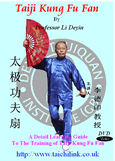
Tai Chi Kung Fu Fan, Form 1. List of 52 movement names, directions, instructions, and notes by Mike Garofalo.
Tai Chi Kung Fun Fan, Form 1. UTube Video, 4:02 min. Lady in white on a stage in Japan. My favorite! "First Form of the Xiyangmei Taiji Kungfu Shan (Taiji Shan). Recorded in Tokyo, Japan when the group headed by Li Deyin went to give an exhibition in 2006."
Tai Chi Kung Fu Fan, Form 1. UTube Video, 3:59 min. Three performers in white outfits.
Tai Chi Kung Fu Fan, Form 1. UTube Video, 3:59 min. Demonstrated by Patty Lee. Lady in a yellow outfit in a field with a backdrop of mountains.
Tai Chi Kung Fu Fan, Form 1. UTube Video, 4:02 min. Lady in black practicing in a dance studio. What is the song used in many of these videos (by Jackie Chan)??
Tai Chi Kung Fu Fan, Form 1. UTube Video, 3:42. A group of Master Fay Li Yip's students performing outdoors.
Tai Chi Kung Fu Fan, Form 1. UTube Video, 3:53 min. A group in black outfits performs outdoors in Madrid, Spain. Some members need more group practice.
Tai Chi Kung Fu Fan, Form 1. UTube Video, 5:57 min. Two ladies in red outfits perform outdoors in Rotterdam, The Netherlands.
Tai Chi Kung Fu Fan, Form 1. 中國太極功夫扇
Tai Chi Kung Fu Fan, Form 1. UTube Video Subject Search.
Monday, April 06, 2009
The Heart of the Matter
I don't know about the accuracy of the following "facts" about the heart, but, if true, they are quite amazing:
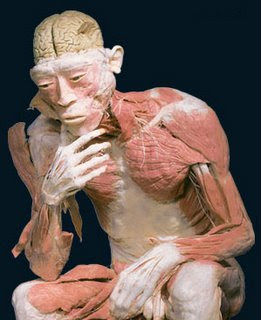
Bodies Revealed
"What a piece of work is man! How like an angel, how like a god.
The beauty of the world."
- William Shakespeare
I find the following book quite useful: Strength Training Anatomy. By Frederic Delavier. Champaign, Illinois, Human Kinetics, 2001. 124 pages. ISBN: 0736041850. Revised edition of "Guide des mouvements de musculation" Paris, Ditions Bigot, 1998. An outstanding illustrated guide to muscles at work. Both male and female models are used.
- "The entire blood system is estimated at 62,100 miles.
- There are 12 pints of blood in an adult male and 9 in an adult female.
- 5 - 10% of the body's total energy is used to keep the heart beating.
- 5 - 7.5 gallons of blood are pumped per minute during strenuous exercise.
- A heart contracts 2.5 billion times during the average lifetime.
- The heart pumps 3.1 billion gallons of blood over a lifespan of 75 years.
- 46 of the world's largest oil tankers could be filled with blood pumped by the human heart in a normal lifetime.
- There are about a billion red blood cells in 2 - 3 drops of blood.
- 300 million cells die each minute. Two percent of blood cells die each day and are replaced."
Mew Hing's 18 Daoist Palms System
Think about it! Like this fellow once did:

Bodies Revealed
"What a piece of work is man! How like an angel, how like a god.
The beauty of the world."
- William Shakespeare
I find the following book quite useful: Strength Training Anatomy. By Frederic Delavier. Champaign, Illinois, Human Kinetics, 2001. 124 pages. ISBN: 0736041850. Revised edition of "Guide des mouvements de musculation" Paris, Ditions Bigot, 1998. An outstanding illustrated guide to muscles at work. Both male and female models are used.
Sunday, April 05, 2009
Baguazhang #3
I was slowed down somewhat this week by a strained calf muscle. I reduced my training, applied heat, and massaged the calf. I did do quite a bit of weight lifting, but less walking.
Watched the DVD on Chen Pan-Ling's Bagua and Bagua Staff (very long at 6:32 min). Comments added to the Way of the Short Staff webpage on Chen Pan-Ling's staff forms.
Found some beautiful 1 pound stones for Bagua training at Gaumer's Rock Shop in Red Bluff.
I did a bit more reading and re-reading. I recommend:
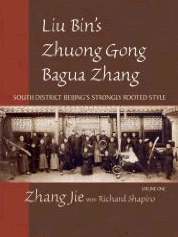
Liu Bin's Zhuang Gong Bagua Zhang: Foundation Practices, Volume One.
South District Beijing's Strongly Rooted Style. By Zhang, Jie. Contributions by Richard Shapiro. Blue Snake Books, 2008. Glossary, xxix, 232 pages. ISBN: 1583942181. Professor Zhang, is very knowledgeable about the philosophy, history, and art of Bagua Zhang, and has a deep appreciation for many aspects of traditional Chinese culture. This book provides a very good introduction to this style of Bagua in the line of Cheng Ting Hua, Liu Bin, and Liu Xing Han. After providing an informative introduction to the history and philosophy (I Ching, Yin/Yang, Morality, etc.) of Bagua, Dr, Zhang gives clear instructions on circle walking, single palm changes, and twenty four movements of the eight animals. Emphasis is placed on a slow, rooted, and deliberate pace with enhanced awareness. The instructions are very clear and detailed, and keyed to accompanying black and white photographs. An unique part of this book are the sixteen Zhan Zhuang (standing meditation) exercises, and the considerable emphasis and explanations on inner work, chi gong, and mind training. Most of the emphasis in this book is on providing clear instructions on how to practice essential Bagua so as to stay fit, improve the mind, harmonize with nature, build strength and balance, and enhance one's understanding of Chinese philosophy. Dr. Zhang lived and worked his whole life in China, and published many books in Chinese. He currently teaches Chinese culture, calligraphy, chi gong, martial arts, and Tui Na massage in Seattle, Washington. A good book for older persons seeking a sound introduction to Bagua.
Watched the DVD on Chen Pan-Ling's Bagua and Bagua Staff (very long at 6:32 min). Comments added to the Way of the Short Staff webpage on Chen Pan-Ling's staff forms.
Found some beautiful 1 pound stones for Bagua training at Gaumer's Rock Shop in Red Bluff.
I did a bit more reading and re-reading. I recommend:
Liu Bin's Zhuang Gong Bagua Zhang: Foundation Practices, Volume One.
South District Beijing's Strongly Rooted Style. By Zhang, Jie. Contributions by Richard Shapiro. Blue Snake Books, 2008. Glossary, xxix, 232 pages. ISBN: 1583942181. Professor Zhang, is very knowledgeable about the philosophy, history, and art of Bagua Zhang, and has a deep appreciation for many aspects of traditional Chinese culture. This book provides a very good introduction to this style of Bagua in the line of Cheng Ting Hua, Liu Bin, and Liu Xing Han. After providing an informative introduction to the history and philosophy (I Ching, Yin/Yang, Morality, etc.) of Bagua, Dr, Zhang gives clear instructions on circle walking, single palm changes, and twenty four movements of the eight animals. Emphasis is placed on a slow, rooted, and deliberate pace with enhanced awareness. The instructions are very clear and detailed, and keyed to accompanying black and white photographs. An unique part of this book are the sixteen Zhan Zhuang (standing meditation) exercises, and the considerable emphasis and explanations on inner work, chi gong, and mind training. Most of the emphasis in this book is on providing clear instructions on how to practice essential Bagua so as to stay fit, improve the mind, harmonize with nature, build strength and balance, and enhance one's understanding of Chinese philosophy. Dr. Zhang lived and worked his whole life in China, and published many books in Chinese. He currently teaches Chinese culture, calligraphy, chi gong, martial arts, and Tui Na massage in Seattle, Washington. A good book for older persons seeking a sound introduction to Bagua.
Saturday, April 04, 2009
Tai Chi Fan
A number of my Taijiquan students have asked me about a Tai Chi Fan Dance.
I know little about the subject. Therefore, I started to do some research on the subject.
I saw quite a bit online about the Tai Chi Kung Fu Fan Dance, Form 1, created by Professor Li Deyin.
I welcome your comments, observations, ideas and suggestions about learning a Tai Chi Fan form or teaching seniors a Tai Chi Fan form.
I know little about the subject. Therefore, I started to do some research on the subject.
I saw quite a bit online about the Tai Chi Kung Fu Fan Dance, Form 1, created by Professor Li Deyin.
I welcome your comments, observations, ideas and suggestions about learning a Tai Chi Fan form or teaching seniors a Tai Chi Fan form.
Friday, April 03, 2009
Tai Chi Chuan Classes in Red Bluff, California
Taijiquan and Qigong Class and Practice Schedule
Red Bluff, California
Mike Garofalo, M.S., Instructor
Starting April 1, 2009
Indoor Classes:
Indoors, Mondays, 5:30 - 7:00 pm, Tehama Family Fitness Center
Indoors, Saturdays, 9:30 - 11 am, Tehama Family Fitness CenterTehama Family Fitness Center
2498 South Main Street, Red Bluff, California
Adjacent to St. Elizabeth's Hospital and Medical Complex
530-528-8656
Outdoor Practice and Lessons:
Outdoors, Mondays, 7:00 - 8:30 am, Valley Spirit Taijiquan CenterOutdoors, Fridays, 7:00 - 8:30 am, Valley Spirit Taijiquan Center
Outdoors, Saturdays, 7:30 - 8:30 am, Valley Spirit Taijiquan Center
Outdoors, Sunday, 6:00 - 7:30 am, Valley Spirit Taijiquan Center
Valley Spirit Taijiquan Center
23005 Kilkenny Lane
Red Bluff, CA 96080
Phone: 530-200-3546
Instruction Offered:
We practice the Yang Style of Taijiquan (24 Form and 108 Form), 32 Sword Form and Eight Immortals 36 Cane Form; and the Sun Style Taijiquan 73 Competition Form.
Currently I am studying Ba Gua Zhang with Shifu Kent Howard, the Shaolin Kung Fu Cane form as taught by Shifu Ted Mancuso, and reviewing the Sun Taijiquan 73 Form. I began my studies of Taijiquan and Qigong in 1986, and have been teaching Taijiquan and Qigong since 2000.
Instructor: Michael P. Garofalo, M.S.
Taijiquan Class Indoors Information
Taijiquan Class Flyer
Taijiquan Outdoors Practice and Class Information
Cloud Hands Website
Class Schedule Changes
Valley Spirit Taijiquan Curriculum, Instructors, Class Schedule
Call Mike for more information at: 530-200-3546

Wednesday, April 01, 2009
Shoes for Yoga Practice
A yoga student of mine asked me why I wore shoes during yoga practice. She said that she thought that yoga was supposed to be done barefoot.
I use the Feiyue brand shoes for yoga, taijiquan, pilates, and qigong practice indoors. The room where I teach yoga and taijiquan at the Tehama Family Fitness Center in Red Bluff, recently was remodeled and now has laminate wood floors. The room previously had a rug with a pad underneath. At home, indoors, on laminate wood floors I use the Feiyue shoes. When doing weight training, spin cycling, cardio kick boxing, or aerobics indoors, I wear a sturdy cross training style of shoe.
When walking, or doing Taijiquan, Bagua, calisthenics, or short staff weapons training outdoors, I wear a sturdy cross training style of shoe. When these shoes wear out a bit, they become my gardening shoes.
I did yoga barefoot on a rug for two years. Unfortunately, I would get fissures in my toes. The fissures would get infected and then I would need help from my podiatrist as well as extra daily efforts at cleaning my feet, soaking my feet, applying medicine to my feet, and applying bandages to my feet. Since I am a Type II diabetic, foot injuries are a more serious issue for me. To prevent these foot problems I started wearing Feiyue shoes. I have not had one problem with my feet in five years since I started wearing Feiyue shoes.
Feiyue brand shoes are very light, very flexible, and grip the floor well. They will not slip or slide on smooth floors. They will not scuff floors. They are very inexpensive. They have both black or white colored versions for purchase. Feiyue offers a couple of styles. These shoes look cool! For my indoor training needs, these shoes are perfect. A number of my students now also use Feiyue shoes and feedback from them is very positive.
Other internal martial arts bloggers have also written about the topic of training shoes:
Wujimon Blog
ChanSiGong Blog
I purchase Feiyue brand shoes at Amazon.
I use the Feiyue brand shoes for yoga, taijiquan, pilates, and qigong practice indoors. The room where I teach yoga and taijiquan at the Tehama Family Fitness Center in Red Bluff, recently was remodeled and now has laminate wood floors. The room previously had a rug with a pad underneath. At home, indoors, on laminate wood floors I use the Feiyue shoes. When doing weight training, spin cycling, cardio kick boxing, or aerobics indoors, I wear a sturdy cross training style of shoe.
When walking, or doing Taijiquan, Bagua, calisthenics, or short staff weapons training outdoors, I wear a sturdy cross training style of shoe. When these shoes wear out a bit, they become my gardening shoes.
I did yoga barefoot on a rug for two years. Unfortunately, I would get fissures in my toes. The fissures would get infected and then I would need help from my podiatrist as well as extra daily efforts at cleaning my feet, soaking my feet, applying medicine to my feet, and applying bandages to my feet. Since I am a Type II diabetic, foot injuries are a more serious issue for me. To prevent these foot problems I started wearing Feiyue shoes. I have not had one problem with my feet in five years since I started wearing Feiyue shoes.
Feiyue brand shoes are very light, very flexible, and grip the floor well. They will not slip or slide on smooth floors. They will not scuff floors. They are very inexpensive. They have both black or white colored versions for purchase. Feiyue offers a couple of styles. These shoes look cool! For my indoor training needs, these shoes are perfect. A number of my students now also use Feiyue shoes and feedback from them is very positive.
Other internal martial arts bloggers have also written about the topic of training shoes:
Wujimon Blog
ChanSiGong Blog
I purchase Feiyue brand shoes at Amazon.
Subscribe to:
Posts (Atom)