Wednesday, June 18, 2014

The Homeland of Time's Past

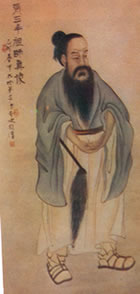
"I saw Master Chang San-feng
Enter the Sidhe, Fairies by his side,
Crossing over the pond at dawn.
Astonished I was!
On the teahouse table by the pond I later found
Some of his neatly printed notes
Folded in a well worn tome 
Of the Tao Te Ching, in Chapter 14. 


He had written:
”Even for an Immortal, the Past is the Key.

The Future
Grasp at it, but you can’t get it,
Colorless as an invisible crystal web,
Unformed, thin, a conundrum of ideas,
The Grand White Cloud Temple of Possibilities,
Flimsy as a maybe, strong as our hopes,
Silent as eternal Space.
When you meet it, you can’t see its face.
You want to stand for it, but cannot find a place. 

The Present
It appears and disappears through the moving ten thousand things,
Quick as a wink, elusive as a hummingbird,
Always Now with no other choice,
Moving ground, unstable Plates,
Real as much as Real gets to Be,
This Day has finally come,
Room for something, for the moment, waits
Gone in a flash, assigned a date,
Gulp, swallowed by the future.
Unceasing, continuous, entering and leaving
The vast empty center of the Elixir Field.

The Past
Becoming obscurer, fading, falling apart,
A mess of memories in the matrix of brains;
Some of it written, fixed in ink, chiseled in stone,
Most of it long lost in graves of pure grey bones.
Following it you cannot see its back,
Only forms of the formless, stories, tales,
Images of imageless, fictions, myths.
A smattering of forever fixed facts,
Scattered about the homes of fading ghosts. 
The twists and turns of millions of tongues
Leaving us languages, our passports to the past.
The future becomes past, the present becomes past,

Every thing lives, subtracting but seconds for Nowness, in the Past. 
The Realms of the Gods, the kingdoms of men,
The Evolutionary Tree with roots a million years long
Intertwined with turtles, dragons, trees, stars and toads;
     crickets, coyotes, grasses, tigers, bears, monkeys and men.  

These profoundest Three of Time
An unraveled red Knot of Mystery,
Evading scrutiny in the darkness of days
Eluding capture in the brightness of nights,
In beginnings and endings are only One, the Tao,
Coming from Nowhere, Returning to Nothing.  

What dimension of Time
Does your mind dwell within?
Future, Present or Past
Where is your homeland?  

The Past holds the accomplishments, the created, the glories, and the Great.
The Present is but a thin coat of ice on the Pond of Fate. 
The Future is an illusion, a guess, a plethora of possible states.

Recreate the Past
By playing within the Present. 
Twisting and reeling one’s silky reality
From the Black Cocoons of the Acts
From which we create our Pasts.
Follow the Ancient Ways. 
The Past is the Key.”   
-  By Michael P. Garofalo, Meetings with Master Chang San-feng


Tuesday, June 17, 2014

One by One We Must All File On

"Laugh, and the world laughs with you;
Weep, and you weep alone.
For the sad old earth must borrow it's mirth,
But has trouble enough of its own.
Sing, and the hills will answer;
Sigh, it is lost on the air.
The echoes bound to a joyful sound,
But shrink from voicing care.

Rejoice, and men will seek you;
Grieve, and they turn and go.
They want full measure of all your pleasure,
But they do not need your woe.
Be glad, and your friends are many;
Be sad, and you lose them all.
There are none to decline your nectared wine,
But alone you must drink life's gall.

Feast, and your halls are crowded;
Fast, and the world goes by.
Succeed and give, and it helps you live,
But no man can help you die.
There is room in the halls of pleasure
For a long and lordly train,
But one by one we must all file on
Through the narrow aisles of pain."

Solitude by Ella Wheeler Wilcox, 1850-1919


Monday, June 16, 2014

Beauty for the Ears

Thanks to some nice Father's Day gifts from my wife and daughter, I've been listening to some outstanding music.

 The No. 13 String Quartet in A Minor by Franz Schubert (1797-1828) from 1824 is very appealing to me.  I have listened to this composition many times and with great pleasure.  I have been listening to the Guarneri String Quartet version recorded in 2009. Schubert's No. 14 String Quartet, Death and the Maiden, and No. 15 in G Major, along with No. 13, all premiered around 1825, and have been recorded by many fine string quartets and are a concert favorite. 


Another favorite of mine are the three string quartets by Johannes Brahms (1833-1897): Opus 51, No. 1 and No. 2, and Opus 67.  These three quartets were composed around 1873.  I am listening to the Emerson String Quartet recording from 2007.  A real bargain in MP3 format for $15.00 ... something to enjoy for years to come. 


One fascinating book I read this week, borrowed from our local public library, was "The Larousse Encyclopedia of Music."  It was edited by Geoffrey Hindley.  Crescent Books, 1990, 576 pages, with extensive black and white illustrations.  This books focuses on regional traditional music and "classical" music.  Modern popular music (e.g., the rock music quartet) is not discussed.  This book is valuable to those interested in the history of ideas

I do also listen to 20th century string quartet compositions; however, the Classical and Romantic compositions from Haydn, Mozart, Beethoven, Schubert, and Brahms are essential listening in this genre. 

Sunday, June 15, 2014

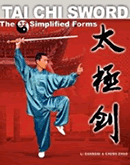
Taijiquan Sword Form, 32 Movements


This popular webpage includes a comprehensive bibliography, scores of links to webpages; an extensive listing of the names and name variations for each movement in English, Chinese, French, German, and Spanish; a detailed analysis of each posture and movement sequence with explanations and numbered illustrations and detailed instructions; selected quotations; comments on 20 Taijiquan sword techniques; a comprehensive media bibliography; a chart of performance times; recommendations for starting to learn this form at home one your own with instructional DVDs, books and practice methods; and, a comparison of the 32 and 55 sword forms in the Yang style. 

This is the standard, simplified, orthodox, 1957, 32 Taiji Sword Form, in the Yang Style of T'ai Chi Ch'uan. 

© Michael P. Garofalo, Valley Spirit Taijiquan, Green Way Research, Red Bluff, California, October 2, 2011.  235Kb+. 
The Wild Horse Jumps Over the Mountain Stream 


Thursday, June 12, 2014

Blanche Karen Garofalo Retires

Karen Garofalo, my wife, retired today, Thursday, on June 12, 2014.  

Her last employment was with the Tehama County Department of Education (TCDE) in Red Bluff, California, from 1998-2014.  She worked 30 hours per week, 5 days a week, as a Special Education Instructional Assistant helping physically and mentally handicapped students.  

She worked with preschool students at the special education center at the Barrendos Middle School campus in Red Bluff.  She helped severely handicapped primary school students at the TCDE Special Education Center at the Gerber School in the Gerber/Proberta area.  Then, she worked with adults, ages 18-21, at the Tehama Adult Learning Center (TALC) in Red Bluff.  She enjoyed working with and supporting the following teachers:  Gary Ulloa, Holly Allison, Judy Howry, Mary Craig, Ann Lieker, and the administrator Julie Howard.  

Karen has also worked for the Pacific Bell Telephone Company as a telephone operator; at the Popps Ferry Elementary School in Biloxi, Mississippi, as a instructional assistant; and, for an optometrist as a receptionist.  She, of course, has "worked" for many years, and will continue to do so, as a homemaker, mother, and wife.  She was very active for many years as the President of the Hacienda Heights Friends of the Library, and was given the annual Citizen's Award in 1993 by the Los Angeles County Public Library System.  

Karen has raised two fine children, Alicia June and Michael Delmer.  Our two children, their spouses, and two grandchildren live in Portland, Oregon.  

I hope that Karen has a long, enjoyable, productive and energizing retirement.  


Wednesday, June 11, 2014

The Hieroglyphics of Place

"I live so much in my habitual thoughts that I forget there is any outside to the globe, and am surprised when I behold it as now--yonder hills and river in the moonlight, the monsters. Yet it is salutary to deal with the surface of things. What are these rivers and hills, these hieroglyphics which my eyes behold? There is something invigorating in this air, which I am peculiarly sensible is a real wind, blowing from over the surface of a planet. I look out at my eyes. I come to my window, and I feel and breathe the fresh air. It is a fact equally glorious with the most inward experience. Why have we ever slandered the outward?"
Henry David Thoreau (1817-1862), Journal Vol. 4, 1852


"Look hard at what pleases you and harder at what doesn't."
-  Colette    

"It is easy to suppose that few people realize on that occasion, which comes to all of us, when we look at the blue sky for the first time, that is to say: not merely see it, but look at it and experience it and for the first time have a sense that we live in the center of a physical poetry, a geography that would be intolerable except for the non-geography that exists there - few people realize that they are looking at the world of their own thoughts and the world of their own feelings." 
-   Wallace Stevens, The Necessary Angel 


Spirituality and Nature


Tuesday, June 10, 2014

The Fourth Act of Awe

"What is divinity if it can come
Only in silent shadows and in dreams?
Shall she not find in comforts of the sun,
In pungent fruit and bright, green wings, or else
In any balm or beauty of the earth,
Things to be cherished like the thought of heaven?
Divinity must live within herself:
Passions of rain, or moods in falling snow;
Grievings in loneliness, or unsubdued
Elations when the forest blooms; gusty
Emotions on wet roads on autumn nights;
All pleasures and all pains, remembering
The bough of summer and the winter branch,
These are the measures destined for her soul."   
-  Wallace Stevens, Sunday Morning, 1915 


"Even before I could speak, I remember crawling through blueberry patches in the wild meadows on our hillsides.  I quickly discovered Nature was filled with Spirit; I never saw any separation between Spirit and Nature.  Much later I discovered our culture taught there was supposed to be some kind of separation - that God, Spirit and Nature were supposed to be divided and different.  However, at my early age it seemed absolutely obvious that the church of the Earth was the greatest church of all; that the temple of the forest was the supreme temple.  When I went to the sanctuary of the mountain, I found Earth's natural altar - Great Spirit's real shrine.  Years later I discovered that this path of going into Nature, bonding deeply with it, and seeing Spirit within Nature - God, Goddess, and Great Spirit - was humanity's most ancient, most primordial path of spiritual cultivation and realization."
-  John P. Milton, Sky Above, Earth Below
 
"In all things of nature there is something marvelous."  
-  Aristotle

"The first act of awe, when man was struck with the beauty or wonder of Nature, was the first spiritual experience."
-  Henryk Skolimowski  


"When the healthy nature of man acts as a whole, when he feels himself to be in the world as in a great, beautiful, noble, and valued whole, when harmonious ease affords him a pure and free delight, then the universe, if it could experience itself, would exult, as having attained its goal, and admire the climax of its own becoming and essence."
-  Goethe 

Spirituality and Nature


Awe and Wonder


Monday, June 09, 2014

Working, Reading, Listening

I have been very busy with home improvement projects, gardening, reading, loading and testing software on my new HP desktop computer, weightlifting, walking, and writing.

It has been very hot, over 100F, each day in the afternoon.  These high temperatures make outdoor work or exercise after 11 am quite difficult for us.   

Karen and I work Tuesday and Wednesday at our school jobs this week.  Starting on Thursday, we are off work at our school jobs for summer vacation.  Karen retires this Thursday, 6/14.

I have enjoyed reading the following two books about the history of string quartets.  First, "The Cambridge Companion to the String Quartet" edited by Robin Stowell, 2003, 373 pages.  This was a Father's Day gift from Karen.  My daughter gave me three string quartet albums for Father's Day.  Second, I am also reading Paul Griffith's "The String Quartet: A History," 1983, 240 pages.  Both are difficult reading for me when it comes to the detailed explanations about the musical theory of particular compositions.  I can neither play music nor can I read music.  I'm more interested in the historical development, biographical and cultural backgrounds, the technology of the instruments and recording, and innovations.

This week, I listened to Beethoven's String Quartets, Opus 18, No. 1-6.  They were played by the Tokyo String Quartet.  I listened to the MP3 digital recordings.  Clear, crisp, exciting!  These string quartets were composed by Beethoven from 1798 to 1800.


Also, I have been listening to Kitaro's "The Sacred Journey of Ku-Kai," Volumes I - IV, 2006-2010.  This music is classified as "New Age Music."  The Ku-Kai albums were nominated for New Age Grammy awards.


Sunday, June 08, 2014

Walking at Daybreak

Starting in June, I begin my morning walks at 5 am.  I walk 4 miles in the morning.  Today, for example, the morning temperature was 69F; the expected temperature at 4 pm today will be 106F.  I want to walk during the coolest time of the day.  Also, the flies and mosquitoes are less bothersome in the early morning.  

I wear lightweight long pants, a light white long sleeve T shirt, a light white cap, New Balance 423 cross training shoes, socks, and, of course, my earphones and a Sony Walkman MP3 player.  Today, I listened to the Mendelssohn string quartets No. 1 and 2, and Kitaro's Mt. Kukai, No. 2.  

It was a beautiful and energizing early morning walk.  Delightful.  


"An early morning walk is a blessing for the whole day."
-   Henry David Thoreau


"There is an intense but simple thrill in setting off in the morning on a mountain trail, knowing that everything you need is on your back. It is a confidence in having left the inessentials behind and of entering a world of natural beauty that has not been violated, where money has no value, and possessions are a dead weight. The person with the fewest possessions is the freest. Thoreau was right."
-   Paul Theroux, The Happy Isles of Oceania


"Who will tell whether one happy moment of love or the joy of breathing or walking on a bright morning and smelling the fresh air, is not worth all the suffering and effort which life implies."
-   Eric Fromme


"And I walked, I walked through the light air;
I moved with the morning."
-  Theodore Roethke, A Field of Light


"To find the universal elements enough; to find the air and the water exhilarating; to be refreshed by a morning walk or an evening saunter; to be thrilled by the stars at night; to be elated over a bird’s nest or a wildflower in spring — these are some of the rewards of the simple life."
–   John Burroughs 


"Take a two-mile walk every morning before breakfast."
-   Harry Truman (Advice on how to live to be 80.)


"The morning woods were utterly new.  A strong yellow light pooled beneath the trees; my shadow appeared and vanished on the path, since a third of the trees I walked under were still bare, a third spread a luminous haze wherever they grew, and another third blocked the sun with new, whole leaves.  The snakes were out - I saw a bright, smashed one on the path - and the butterflies were vaulting and furling about; the phlox was at its peak, and even the evergreens looked greener, newly created and washed."
-  Annie Dillar, Pilgrim at Tinker Creek


"In the morning a man walks with his whole body; in the evening, only with his legs."
-   Ralph Waldo Emerson


 The Ways of Walking: Quotations, Facts, Methods, Spirituality, Meditative


Saturday, June 07, 2014

Zen Tenets for Artists

1.   The realities of the life are most truly seen in everyday things and actions.
2.   Everything exists according to its own nature.  One's individual perceptions of worth, correctness, beauty, size, and value exist inside our heads, not outside them.
3.   Everything exists in relation to other things.
4.   The self and the rest of the universe are not separate entities but one functioning whole.
5.   Man arises from nature and gets along most effectively by collaborating with nature, rather than by trying to master it.
6.   There is no ego in the sense of an endlessly enduring, unchanging private soul or personality that temporarily inhabits the body.
7.   True insight does not issue from specialized knowledge, from membership in coteries, from doctrines or dogmas.  It comes from the preconscious intuitions of one's whole being, from one's own code.
8.   In emptiness, forms are born.  When one becomes empty of the assumptions, inferences, and judgments he has acquired over the years, he comes close to his original nature and is capable of conceiving original ideas and reacting freshly. 
9.   Being a spectator while one is also a participant spoils one's performance.
10.  Security and changelessness are fabricated by the ego-dominated mind and do not exist in nature.  To accept insecurity and commit oneself to the unknown creates a relaxing faith in the universe.
11.  One can live only in the present moment.
12.  Living process and words about it are not the same and should not be treated equal in worth.
13.  When we perceive the incongruity between theories about life and what we feel intuitively to be true on the nonverbal, nonjudging plane, there is nothing to do but laugh. 
14.  Zen art has this characteristic quality, that it can fuse delight in a work of visual art, knowledge of life, and personal experiences and intuitions into one creative event. 
15.  Each of us develops into a unique individual who enters into unique transactions with the world as it exists for him.  
-  Stewart W. Holmes and Chimyo Horioka, Zen Art for Meditation, 1973 


 Photograph of Alan Watts (1915-1973)

Thursday, June 05, 2014

Training to Be the Best

Performing a Taijiquan routine or dance routine really well requires hundreds of hours of practice, physical conditioning, and guidance from a teacher.

John Travolta trained hard to perfect this dance routine, for a specific single performance. 


This Chen Taijiquan player trained hard to perfect his Cannon Fist II routine, and is still practicing, enjoying and benefiting from his practice. 


Paty Lee trained hard to perfect her Tai Chi Kung Fu Fan form performance.  A lifetime of pleasure and recreation will be hers.   


Train, practice, train, practice, learn, listen, train, practice, improve, perfect, practice.


Wednesday, June 04, 2014

Family Visitors for Graduation and Retirement

My son, Michael, and his wife, April, stayed at our home in Red Bluff from May 26 until June 3rd.  They attended the graduation ceremony of their niece, Chloe, in Red Bluff.  April enjoyed a family gathering of her side of the family.  We had up to 10 people stay at our home. 

We enjoyed hanging around the house and yard, gardening, plant gathering, watching our two dogs playing, conversations, and fine meals.  We went fishing one day up to Battle Creek. 

Mick helped me with cutting down some dead trees.

A pleasant visit for all.

We also celebrated Karen's upcoming retirement.  She retires, at age 66, from her job as a Special Education Instructional Assistant at the Tehama County Department of Education.  She has worked 5 days a week, 30 hours per week, for over 15 years.  She worked at special education centers at West Street in Corning, Barrendos in Red Bluff, Gerber School, and TALC in Red Bluff.  She has worked with handicapped children from preshool to the primary grades, and adults.  She will retire on  June 12th, 2014.  A job well done!! 


Tuesday, June 03, 2014

Wild Goose Chi Kung Exercises

Dayan (Wild Goose) Qigong Exercises


Bibliography, Links, Quotes, Notes, List of Movements
Research by Mike Garofalo


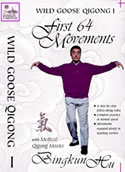
The Wild Goose Qigong form is one long continuous sequence of movements, much like a Taiji form.  There are many aspects of the Wild Goose Qigong system as presented by Dr. Bingkun Hu of San Francisco.  


"In Ancient Egypt as well as in Ancient China the goose was considered a messenger between Heaven and Earth. In China geese are still a symbol of marriage, because of their lifelong pair-bond.  In the Roman empire, the goose was the sacred animal of Juno, a goddess of light, marriage and childbirth, who was later considered adviser and protectress of the Roman people. A story tells of how geese saved the Romans with their warning cries when the Gauls attacked the citadel of the Capitol.  The Celts associated the goose with war, possibly because of its watchful nature and aggressive temperament. Warrior gods were sometimes depicted with geese as companions. Remains of geese have been found in warrior's graves. The Britons kept geese, but did not eat them. They were, however, sometimes used as sacrificial offerings.  The goose, with its steady, powerful flight and migratory habits, can be associated with travelling, undertaking a journey to a new destination. This journey can be difficult and may take long.  The goose can help people find the perseverance needed to go on with their quests. In earlier times, shamans were aided by spirit geese on their journeys to other worlds."
-   Geese - The Animal Files    


"Wild Goose Qigong claims that “there are no intentional movements without awareness. Wild Goose Qigong advocates “wu-wei” (or “doing nothing”) and “tuo-yi” (“reduce one’s awareness to the minimum”). A good example is Wild Goose-1 (the first 64 Movements). We often tell our beginning learners that the movements in this set of qigong are supposed to describe the daily activities of a wild goose. There are three parts to this qigong.  Part One is “The Goose Wakes Up”. It stretches itself, it brushes up its wings and shakes them. It plays innocently.  A made-up story is even included: “Then the goose looks at the moon, which is reflected in the water and tries to scoop it up."  Part Two is “The Flying Goose”.  Flapping its wings, the care-free wild goose skims over a smooth lake.  It looks at the water and dips down to drink the water.  Then the goose is playing with he “qi”.  It tries to grasp the qi.  It holds and rotates the qi-ball.  It pushes out the dirty qi, and tries to receive the fresh qi from its lower back.  In Part Three, the goose is first flying up into the sky. Now it is flying over the water.  Then it is looking for some food.  After that, it is looking for its nest. At last, the goose goes to sleep.  When beginning, learners are encouraged to be pre-occupied with the daily activity of an innocent wild goose, when they are imagining that they are “flapping their wings” beside shimmering lake under a full moon, their heart beat will be naturally slow down, and their mind will gradually be quieting down too. At the same time, they will be more responsive to the instructor’s words on how to relax themselves through the shifting of body weight. Wild Goose Qigong is a medical qigong. We practice it because of its health benefits. When we have better qi flow, our blood circulation will improve. We will have more oxygen supply to our brain. Our mind will be more alert. We will get stronger, and we will have more physical strength, etc.."
-   Bingkun Hu, Ph.D., A Safe and Delightful Approach to Good Health   


Monday, June 02, 2014

Working in the Summer Garden

June Gardening Chores in Red Bluff, California, USDA Zone 9

Watering on a regular basis in the early morning hours.
Mowing lawns.
Weeding around vegetables and shrubs.
Wearing a hat and long sleeved shirts. 
Maintenance on lawn mowing equipment.
Enjoying vegetables and fruits.
Thinning out excess fruit on trees.
Mulching with straw.
Training vines on support structures, and pruning vigorous grape vines.
Relaxing in the shade.
Enjoying annuals in bloom.
Turning and watering the compost pile. 
Removing spent roses. 
Reading, resting, and meditating in the shade. 
Sipping cool water and tea.   
Deep soaking trees and shrubs. 
Painting and other maintenance as needed. 
Keeping tender potted plants in the afternoon shade. 
Planting annuals.
Listening to music outdoors. 


June: Quotes, Poems, Lore, Sayings

Summer Solstice

The Spirit of Gardening


Sunday, June 01, 2014

Software and Chopin

One of my favorite albums is The Nocturnes by Frederic Chopin as played so beautifully on piano by Maria Joao Pires
A splendid and sensitive interpretation by Ms. Pires, with an outstanding sound recording by Deutsche Grammophon.
All 21 Nocturnes, 109 minutes, are found on the following delightful classical music album:  


In the string quartet genre, my favorite, I have greatly enjoyed listening to the Danubius Quartet playing the string quartets of Heitor Villa-Lobos
Try listening to the 11th, 16th, and 17th Quartets by Villa-Lobos for starters:


A brief list of modern string quartet albums, recommended by rm508, might be useful to you. 

I listen to music recorded in the the MP3 digital format and played back on my Sony Walkman 16GB player.  I carry this reliable and versatile player with me everywhere.  Most stereo players offer a Audio-In plug for use with these MP3 players. 

I'm a Microsoft Windows user at home and at work, and the Sony Walkman unit works just fine with that common software.  I like to organize specific ordered and sequenced playlists of music for use in my yoga and taijiquan classes, and just organize them within folders in numbered order using Windows Explorer.  Renaming and copying files is an elementary task with great benefits.  


I am now setting up a new desktop computer.  I'm moving up from a 9 year old Gateway desktop computer operating on Windows XP ..... to .... a new 2014 HewPac HP desktop computer operating on Windows 8.  

All of my working C:/ drive files were all backed up {while listening the the Chopin Nocturnes} and moved between the computers yesterday.  

Tomorrow, starting to load my old familiar daily and primary software tools: Cute FTP, Microsoft Front Page 2003, Macromedia Dreamweaver/Fireworks 4 Suite.  We shall see.