Monday, August 18, 2014

Sacred Circle Gardens

I've put together a webpage on the subject of Sacred Circles.

This webpage provides links, bibliographic citations, resources, quotations, notes, and comments on medicine wheels, henges, labyrinths, neopagan sacred circles, holy circles, the symbolism and myths about circles and spheres, sacred circle gardens, the four elements, and related topics.

This webpage includes information and photographs of our sacred circle garden at our home in Red Bluff, California.

Those folks who walk the circle in labyrinths, walking meditation or baguazhang might find some of the information in sacred circles to be of interest to them.

Here are a few pictures from our sacred circle garden.  They were all taken a few years ago.


Sunday, August 17, 2014

Wisdom from the Goddess

Nine Heart Paths to Healing and Abundance

Joy
Self-Control
Generosity
Peace
Faithfulness
Patience
Kindness
Gentleness
Love

-  Karen Speerstra, "Sophia: The Feminine Face of God: Nine Heart Paths to Healing and Abundance," 2011


Last week, I began reading two books about the Goddess of Wisdom, Sophia.  In my spiritual imagination, I need both a Goddess and God, Yin and Yang, Earth and Sky.  The Dao is both feminine and masculine, and neither. 

Sophia: The Feminine Face of God: Nine Heart Paths to Healing and Abundance  By Karen Speerstra.  Nine Heart Paths to Healing and Abundance.  Studio City, California, Michael Wise Productions, 2011.  Index, bibliography, 340 pages.  ISBN: 9781611250046.  VSCL.  


Sophia: Goddess of Wisdom, Bride of God  By Caitlin Matthews.  New Revised Edition.  Wheaton, Illinois, Quest Books, Theosophical Publishing House, 2001.  Index, bibliography, notes, 430 pages.  ISBN:  0835608018.  VSCL. 

Lifestyle Advice from Wise Persons

Goddess, Earth Mother, Devi, Tara, Sophia

One Old Druid's Final Journey 


Saturday, August 16, 2014

Lugh's Day Gone By

“Under the summer sun,
thirty birds feeding
on figs.

Young tree branches
sagging so low -
ripe peaches.

Still in the shade,
on wet soil,
a black dragonfly. 

 
An old mind
surprised by seeing
a purple fairy at sunset,
dancing to the crickets’ tunes,
leaping as guinea hens screech,
wary of the bats,
hovering to say,
“Lugh’s Day, Lugh’s Day.”


Crackling fires
glowing
under the full moon.


Peace in the Valley.”
- Mike Garofalo, Lugh’s Fairy   


Lammas, Lughnasadth, Mid-Summer Festival: A NeoPagan Summer Celebration

Above the Fog: Short Poems by Mike Garofalo 

Cuttings:  Haiku by Mike Garofalo


"All paganism is at bottom a worship of nature in some form or other, and in all pagan religions the deepest and most awe-inspiring attribute of nature was its power of re-production. The mystery of birth and becoming was the deepest mystery of nature; it lay at the root of all thoughtful paganism, and appeared in various forms, some of a more innocent, others of a most debasing type. To ancient pagan thinkers, as well as to modern men of science, the key to the hidden secret of the origin and preservation of the universe lay in the mystery of sex. Two energies or agents, one an active and generative, other a feminine, passive, or susceptible one, were everywhere thought to combine for creative purposes; and heaven and earth sun and moon, day and night, were believed to co-operate to the production of being. Upon some such basis as this rested almost all the polytheistic worship of the old civilization; and to it may be traced back, by stage, the separation of divinity into male and female gods; the deification of distinct powers of nature, and the idealization of man's own faculties, desires, and lusts; where every power of his understanding was embodied as an object of adoration, and every impulse of his will became an incarnation of deity."
-   A.T. Jones, Ancient Sun Worship and Its Impact on Christianity


Thursday, August 14, 2014

Precious and Magical Water

Every morning I walk out in my back yard and check the irrigation ditch that runs through my property.  Every thirty or forty days or so in the dry months the ditch will be filled with flowing water.  The rancher to the southwest breeds horses and rancher to the northwest raises cattle.  They irrigate their large fields to raise wheat and other grains to feed their animals.  Some of the overflow runs through the ditch to a nearby creek.  

Numerous neighbors, including myself, have dug small ponds which capture this water and provide water for wildlife and for human enjoyment. 
 

I pump water out of this ditch and irrigate our trees and shrubs.  We will sometimes have six hoses running at the same time, and move them around every forty minutes or so.  Over the last fourteen years I have put in many white PVC pipes underground to bring this treasured water to where it is need. 


 "If there is magic on the planet, it is contained in the water."
-  Loren Eisley


"A river seems a magic thing. A magic, moving, living part of the very earth itself."
- Laura Gilpin


Wednesday, August 13, 2014

Nine Temple Chi Kung Exercises

The Temple Qigong (Chi Kung) form consists of nine exercises.  It was popularized by Grand Master Marshall Ho'o (1910-1993) of Los Angeles, California.  It is also referred to as the Nine Temple Exercises, or the Marshall Ho'o Temple Exercises.  

My webpage on Temple Qigong provides a bibliography, links, the names of the movements, and an explanation of each movement.  

Marshall Ho'o wrote a book 1968 which included an explanation with photographic illustrations of the Temple Qigong set.  The black and white photos in that book were of poor quality and the editing was unsatisfactory.  An instructional DVD also teaches this form.  

"Dr. Ho'o was instrumental in the certification of acupuncture in the State of California. He was the first Tai Chi Master to have been elected to the Black Belt Hall of Fame.  He was Dean of the Aspen Academy of Martial & Healing Arts, on the faculty of California Institute of the Arts, and taught Tai Chi and Acupressure at many educational institutions.  In 1973, he created a series for KCET public television, in Los Angeles, teaching Tai Chi.  He was a consultant to Prevention Magazine's The Doctor's Book of Home Remedies.  A Chinese American, Dr. Ho'o was America's first Tai Chi Chuan Grandmaster.  His influence is far-reaching in both the fields of healing and martial arts."
The Lineage, Teachers of Two Birds Tai Chi

Tai Chi Chuan  By Marshall Hoo.  Burbank, California, Ohara Publications, Inc., 1986, 1993.  111 pages.  ISBN: 0897501098.  VSCL.  The Nine Temple exercise set is briefly described in this book on pages 18-42.  Each movement is clearly illustrated by four to eight clear black and white photographs of a woman doing the form.  The Taijiquan is the Standard 24 Form in the Yang Style. 

Tai Chi Chuan: The 27 forms by Marshall Hoo .   Instructional DVD, released in 2005, by Marshall Ho'o.  Black Belt Videos, 90 minutes.  Includes the Nine Temple Qigong.   

Tuesday, August 12, 2014

Love What Abides

"We that change,
Hate change.
And we that pass,
Love what abides.
...
Ashes,
Darkness,
Dust."
R. H. Blyth (1898-1964), Mortality

I first read books by R. H. Blyth when I was fourteen years old.  He inspired me then; and, he inspires me when I read him at the ripe old age of 68.  I find his writing quirky, insightful, clever, down to earth, over-reaching at times, puzzling, disjointed, full of Zen, strong on comparisons between Western and Eastern poets, steeped in Japanese culture, and brilliant.  He was my first intellectual and literary contact with Zen, along with books by Alan Watts and D.T. Suzuki. 

Zen Poetry

Haiku and Short Poems by Mike Garofalo


Monday, August 11, 2014

Is Sitting Meditation the Best

"We're fooling ourselves a bit to think that we're meditating as we're gardening or waling or out on the golf course or volunteering or even reading "spiritual books."  Those are all cause and conditions that, with the right mindset - a mindset based on wise intention and anchored to a committed sitting practice - can enable us to relax, to be more at peace, to have some insights, to even have an occasional experience of oneness with all that is.  But those activities, in and of themselves, with anchoring in strong intention and committed sitting practice, are unable to transform and free our minds.  They are not in themselves, the necessary causes of awakening, let's not deceive ourselves in the time we have left.

We need the focused, concentrated energy of awareness that seems only to be cultivated with a daily practice if we wish to walk through the world with clarity and compassion.  We need to carve out the time to sit if we have not yet done so, , or carve out more time if we have already begun.  Sitting - the silent, noble stilling of the body and the mind for the purpose of liberating awareness into beyond-self, into deeper, more illuminated consciousness - allows an opening in the limited, limiting paradigm of separate self and only form.

Sitting practice is where transformation is effected, where neural connections are rewired.  Sitting practice is the launching pad for piercing insight, direct knowing, and the opening of the heart.  It is the base of operations."

-  Kathleen Dowling Singh, "The Grace in Aging: Awaken as You Grow Older," Wisdom Publications, 2014, p. 33.  A very good book about Buddhist theory and practices.  

Many Taijiquan, Qigong, and Yoga teachers strongly recommend seated meditation as part of a rigorous mind-body-spirit practice.

"Practice is the seedbed of miracles."
-  Michael Murphy


Undoubtedly, many people find the consistent, daily, and serious practice of seated meditation of great benefit to mind, body, and spirit.  Only practice and experience will reveal and bear fruit. 

I favor keeping the "mindset" Ms. Singh admirably describes while walking, gardening, practicing mind-body arts, reading, writing, and sitting.  There are many useful paths to enlightened awareness, mystical experiences, openness, cultivating loving kindness, or the Eightfold Path.  The practice of enlightened living is cultivated in our daily lives, relations with other beings, and in our understanding of the changing and impermanent circumstances of our being-in-the-world.  I find the desired "mindset" or "no-mind-set" while sitting in my garden, sometimes listening to music, sometimes reading poetry (see R. H. Blyth), or "spiritual books," sometimes just sitting and listening to bird songs and the rustling of leaves in the morning breeze.  It is my personal preference to not regard seated meditation as the highest and most effective and most superior pathway to enlightenment and whatever "enlightenment" means.  To each is own!  

Walking Meditation

Standing Meditation

Lifestyle Advice from Wise Persons

Buddhism:  Reading List and Bibliography  

 
"Basho used to sit cross-legged from morning till night in constant meditation.  His master Nagaku saw him and asked: "Why are you sitting cross-legged in meditation?"  "I am trying to become a Buddha," he answered.  The master picked up a brick and began polishing it on a stone nearby.  "What are you doing, Master?asked Basho.  "I am trying to turn this brick into a mirror," was the answer.  "No amount of polishing will turn the brick into a mirror, sir."  "If so, no amount of sitting cross-legged will make you into a Buddha," retorted the master."
Games Zen Masters Play: The Writings of R. H. Blyth.,  p.13.   

 
"In theory there is no difference between theory and practice.
In practice there is."
-  Yogi Berra


Sunday, August 10, 2014

Family Fun

Our two granddaughters, Katelyn and Makenna, have been visiting at our home since July 27th.  Their mother, our daughter, Alicia, has been visiting since August 1st.  Their father, Sean, joined us all on August 8th.  All four return to Portland, Oregon, on Monday, August 11th.

We had many local trips and special activities with all of them.  For example, on Friday 8/8, we toured the Jelly Belly factory in Fairfield and the State Railroad Museum in Sacramento.  Yesterday, we all we to Whiskeytown Lake near Redding.  Alicia and the girls attended three of my yoga classes.  Karen led crafts, garden play, coloring, swimming in a blow up pool in our yard, and other fun activities.

We had all camped together at South Beach State Park in Newport, Oregon, from 7/23 until 7/27.

Karen and I had a great time visiting with everyone.  


Saturday, August 09, 2014

A Yoga Routine for Diabetics

Yoga as Medicine: The Yogic Prescription for Health and Healing  By Timothy McCall, M.D. and Yoga Journal.  Bantam, 2007.  592 pages.  ISBN: 0553384066.  VSCL.  Diabetes discussed on pages 281-298.  This sequence of asanas for diabetics was suggested by the Yoga Master Sandra Summerfield Kozak.  
 
1.  Kapalabhati Breathing 
2.  Alternate Nostril Breathing  (Nadi Shodhana) 
3.  Mindfulness Meditation
4.  Modified Sun Salutations
5.  Cobra Pose  (Bhujangasana) 
6.  Locust Pose  (Salabasana) 
7.  Seated Forward Bend  (Paschimottanasana) 
8.  Tree Pose  (Vrksasana) 
9.  Triangle Pose  (Trikonsasana) 
10.  Warrior I  (Virabhadrasana I) 
11.  Warrior II  (Virabhadrasana II) 
12.  Extended Side Angle Pose  (Utthita Parsvakonasana) 
13.  Standing Twist  (Marichyasana) 
14.  Bridge Pose  (Setu Bandha Sarvangasana) 
15.  Seated Twist 
16.  Alligator Twist  (Jathara Parivartasana) 
17.  Relaxation Pose  (Savasana) 
Practice Karma Yoga (Serving, Volunteering, Helping, Giving, Sharing)   

My Diabetes Management Program for 2014


Thursday, August 07, 2014

Standard Tai Chi Sword Form


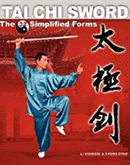
This popular webpage includes a comprehensive bibliography, scores of links to webpages; an extensive listing of the names and name variations for each movement in English, Chinese, French, German, and Spanish; a detailed analysis of each posture and movement sequence with explanations and numbered illustrations and detailed instructions; selected quotations; comments on 20 Taijiquan sword techniques; a comprehensive media bibliography; a chart of performance times; recommendations for starting to learn this form at home one your own with instructional DVDs, books and practice methods; and, a comparison of the 32 and 55 sword forms in the Yang style. 

This is the standard, simplified, orthodox, 1957, 32 Taiji Sword Form, in the Yang Style of T'ai Chi Ch'uan. 

© Michael P. Garofalo, Valley Spirit Taijiquan, Green Way Research, Red Bluff, California, October 2, 2011.  235Kb+. 
The Wild Horse Jumps Over the Mountain Stream 


Wednesday, August 06, 2014

Wudang Qigong: Eight Section Brocade

"The Eight Verses of Wudang Mountain Badunjin :

1. Lift the ground and hold the sky to take care of the three internal cavities
2. Draw a bow to the left and right, just like shooting a vulture
3. Lift the hand up singly to tone and caress the spleen and the stomach
4. Look backwards to cure the five strains and seven injuries
5. Reach down the leg by both hands to strengthen the kidney and the reproductive organ
6. Swivel the head and rock the bottom to calm down
7. Rotate fists and stare to add stamina
8. Vibrate the back seven times to expel illness


The first segment takes care of the three chiaos (internal organs), the second segment strengthens the heart and the lung, the third regulates the spleen and the stomach, the fourth cures strains and injuries, the fifth toughens the kidney and reproductive organ, the sixth calms the nervous system, the seventh increases stamina, the eighth gets rid of illnesses. It has materialised the merging of the theory and movements of Badunjin with clinical sports, as well as specified the importance of life-nourishment and health-preservation. Badunjin Qigong, uplifted by the modern medical confirmation from Chinese and western professionals and scholars, continues to be revitalised and made to perfection. Thus it has been made even more suitable and practical to serve the needs of the modern era, and advances with time.

The theory and movements of Wudang Badunjin is thorough; it is safe and easy to learn, and has a wide application on medical cure. Externally, it exercises the skin, muscles, tendons and bones; internally, it strengthens the organs, improves the circulatory system, and consolidates the spirit of well being. Its movements involve breathing naturally, and are smart & light, continuous and lively, elegant and beautiful, stretchy and graceful, alternating relaxing with tightening, synchronising harmoniously, can be fast or slow but with distinct rhythm, can be complicated or simple, active or quiet, and cohere the opening with the closing. It stresses on the mutual use of toughness and gentleness, the training of the internal and external body parts, the merging of activity and quietness, the balancing of the left and the right, the top and the bottom, alternating the real and the virtual, and nourishing both the body and the spirit. The amount of exercise and the length of the practice session can be adjusted anytime, and it can be practised alongside with other exercises. Age, sex, body nature, location, equipment, time, season, etc do not restrict the practice. It can be practised individually, with the whole family, or with a group. The all-encompassing effect and value of its body-strengthening and medical aspects is evergreen."
-  Wudang Mountain Badunjin Qigong 20Kb. Original (in Chinese) written in Hong Kong by Woo Kwong Fat, the 28th Generation Master of Dragon Gate Branch, Wudang Mountain.

Wudang Qigong

Eight Section Brocade Qigong (Baduanjin)

Tuesday, August 05, 2014

The Miracle is Just to Walk on the Earth

"Walking meditation means to enjoy walking without any intention to arrive. We don't need to arrive anywhere.  We just walk. We enjoy walking. That means walking is already stopping, and that needs some training.  Usually in our daily life we walk because we want to go somewhere. Walking is only a means to an end, and that is why we do not enjoy every step we take. Walking meditation is different. Walking is only for walking. You enjoy every step you take. So this is a kind of revolution in walking. You allow yourself to enjoy every step you take.
The Zen master Ling Chi said that the miracle is not to walk on burning charcoal or in the thin air or on the water; the miracle is just to walk on earth. You breathe in. You become aware of the fact that you are alive. You are still alive and you are walking on this beautiful planet. That is already performing a miracle. The greatest of all miracles is to be alive. We have to awaken ourselves to the truth that we are here, alive. We are here making steps on this beautiful planet. This is already performing a miracle.  But we have to be here in order for the miracle to be possible. We have to bring ourselves back to the here and the now."
-  Thich Nhat Hanh, Resting in the River


Walking Meditation:  Quotes, Bibliography, Links, Information, Methods 
Compiled by Mike Garofalo.


"Walking meditation is walking in full awareness of breath, body and everything the senses present.  It is not an aerobic exercise - though it would be a fine lead-in to aerobic walking.  Rather, walking meditation is done slowly and consciously, with each step fully feeling the earth.  During this precious time, body and mind come together, joined in the present moment.  Although the benefits of walking meditation will deepen over time, even from the start, you can experience some measure of the relaxation, balance and quiet energy that builds through this practice."
-  Ginny Whitelaw, Body Learning, p. 55.   


"Research conducted at Harvard Medical School’s Mind/Body Medical Institute has found that focused walking meditations are highly effective for reducing anxiety and producing  what’s called the “relaxation response.”
Borgess Health   
 

The Ways of Walking  Compiled by Mide Garofalo.


Monday, August 04, 2014

Shaken Right Down to the Bone

"Freedom - to walk free and own no superior."
-   Walt Whitman
"For someone who walks regularly, their body is better able to deliver oxygen to all systems, including the brain, because they’ve improved their cardiovascular function. Not surprisingly, regular walkers report better mental clarity and ability to focus. Creativity is enhanced because walkers have the ability to relax their mind and let it wander around while they’re walking. Outdoor strollers can have the benefit of beautiful scenery as well as just seeing things from a different perspective, which stimulates creative thought and the imagination.  Whether you want to improve your body, your mind or both, the benefits of walking should encourage you to make the time to do it."
Mental Benefits of Walking, Creating a Good Life


"People need wild places. Whether or not we think we do, we do. We need to be able to taste grace and know again that we desire it. We need to experience a landscape that is timeless, whose agenda moves at the pace of speciation and glaciers. To be surrounded by a singing, mating, howling commotion of other species, all of which love their lives as much as we do ours, and none of which could possibly care less about us in our place. It reminds us that our plans are small and somewhat absurd. It reminds us why, in those cases in which our plans might influence many future generations, we ought to choose carefully. Looking out on a clean plank of planet earth, we can get shaken right down to the bone by the bronze-eyed possibility of lives that are not our own."
-   Barbara Klingsolver   


"Afoot and light-hearted, I take to the open road,
Healthy, free, the world before me,
The long brown path before me, leading wherever I choose.
Henceforth I ask not good-fortune— I myself am good fortune;
Henceforth I whimper no more, postpone no more, need nothing,
Strong and content, I travel the open road. 

The earth—that is sufficient; 
I do not want the constellations any nearer;
I know they are very well where they are; 
I know they suffice for those who belong to them.  

(Still here I carry my old delicious burdens; 
I carry them, men and women—I carry them with me wherever I go; 
I swear it is impossible for me to get rid of them; 
I am fill’d with them, and I will fill them in return.) 

 
You road I enter upon and look around!
I believe you are not all that is here; 
I believe that much unseen is also here."
-   Walt Whitman, "Song of the Open Road," Leaves of Grass, 1890.  


Sunday, August 03, 2014

Take Upon Us the Mystery of Things

"So we'll live, and pray and sing, and tell old tales, and laugh
At gilded butterflies ...
And take upon us the mystery of things
As if we were God's spies."
-  Shakespeare, King Lear, V 3  


Spirituality and Gardening

Lifestyle Advice from Wise Persons


Lifestyle factors that contribute to healthy aging:
Exercise, Diet, Time in Nature, Relationships, Recreation, Stress Management,
Service to Others, Spiritual Involvement.
- Roger Walsh, M.D., University of California


"Aging as a Spiritual Practice," Lewis Richmond, Gotham Books, 2013.  Ideas and suggestions for wise aging, from a Buddhist perspective.  


Saturday, August 02, 2014

August Gardening Chores in Zone 9


August Gardening Chores

Red Bluff, North Sacramento Valley, California, USA
USDA Zone 9
Typical Weather for Our Area
Red Bluff, California.  Natural History Studies at our Home and Gardens
The Spirit of Gardening


August Gardening Chores for Us

Water plants: take advantage of cool early morning hours, use daytime shade, water plants deeply and less frequently. 
Avoid watering leaves during the heat of the day.
Water in the early morning. 
Use any ditch water carefully and wisely. 
Move potted plants to areas that get some shade in the afternoon, e.g, along the east side of a fence that runs north/south. 
Water potted plants carefully on very hot days.
Mow lawns infrequently with high cut settings.
Prune branches of trees. 
Mulch and compost: cuttings, leaves, twigs, chips, shredded paper, garbage.
Water compost pile areas.
Manage cutworms, larva, grasshoppers and other garden pests.
Weed around vegetables.
Use mulch to help control weeds and cool soil.
Maintain the lawn mowing equipment and power tools.
Work on carpentry projects.
Pick and save or eat fresh vegetables and fruits.
Thin out excess fruit on trees.
Mulch with straw, chips, compost.
Train vines on support structures.
Read, listen to music, relax and rest in the shade during the heat of the day.
Tend to and enjoy annuals in bloom.
Maintain lawn: water, fertilize, mow, clean, plant, spray, etc..
Mulch, mulch, mulch, mulch....
Water, water, water, water ....
Harvest and preserve fruits and vegetables.
Paint outdoor art objects. 
Cut and stack wood so it can dry thoroughly. 


"Great is the sun, and wide he goes
Through empty heaven with repose;
And in the blue and glowing days
More thick than rain he showers his rays.

Though closer still the blinds we pull
To keep the shady parlour cool,
Yet he will find a chink or two
To slip his golden fingers through.

The dusty attic spider-clad
He, through the keyhole, maketh glad;
And through the broken edge of tiles
Into the laddered hay-loft smiles.

Meantime his golden face around
He bares to all the garden ground,
And sheds a warm and glittering look
Among the ivy's inmost nook.

Above the hills, along the blue,
Round the bright air with footing true,
To please the child, to paint the rose,
The gardener of the World, he goes."
-  Robert Louis Stevenson, Summer Sun 


August: Quotes, Poems, Sayings


Lammas: Extensive Bibliography, Links, Lore, Poems, Prayers, Preparations, Crafts, Quotes, Notes


Our Back Porch - July 2006