Saturday, December 20, 2014

Walking for Peace of Mind

A cornerstone of my weekly fitness practices is walking.  


Looking east on Kilkenny Lane near Red Bluff, California.  I walk 3.6 miles on this cul de sac lane, four days each week, in the morning.  I walk at daybreak on Friday, Saturday, Sunday, and Monday morning throughout the entire year.  

Occasionally, a car might use this country lane, and I move to the side of the road.  It is a very safe, peaceful, and quiet place.  

Sometimes I listen to my MP3 player while I walk.  Sometimes I walk in silence.   

Sometimes I take my dog, Bruno, for a walk.  Most often, I walk alone.  


"Putting facts by the thousands,
into the world, the toes take off
with an appealing squeak which the thumping heel
follows confidentially, the way men greet men.
Sometimes walking is just such elated
pumping."
-   Lyn Hejinian, Determination


"Every day, in the morning or evening, or both, take a walk in a safe and peaceful environment for less than an hour.  The can be a great fountain of youth.  Choose a place to walk that has no kind of disturbance.   Walking done in a work environment and when your mind is busy is different; it is not as nutritious as the walking you do for yourself in the morning or evening in a quiet, peaceful, and safe place."
-  Master Hua-Ching Ni, Entering the Tao, 1997, p. 135


Looking to the northeast on Kilkenny Lane.  Mt. Lassen (10,000 feet) in the distance is capped with a little snow.  These photos were taken in the Autumn.   

"Walking is the natural recreation for a man who desires not absolutely to suppress his intellect but to turn it out to play for a season." 
-  Leslie Stephen  


`


Looking west on Kilkenny Lane.  The red leafed autumn colors are from Raywood Ash trees. The Yolly Bolly mountain range (7,000 feet) is to the west of the North Sacramento Valley.  

"The interior solitude, along with the steady rhythm of walking mile after mile, served as a catalyst for deeper awareness.  The solitude I found and savored on the Camino had an amazing effect on me.  The busyness of my life slowly settled down as the miles went on.  For a good portion of my life I had longed for a fuller experience of contemplation, that peaceful prayer of the heart in which one is able to look intently and see each piece of life as sacred.  Ten days into the journey, totally unforeseen, the grace of seeing the world with startling lucidity came to me.  My eyes took in everything with wonder.  The experience was like looking through the lens of an inner camera – my heart was the photographer.  Colors and shapes took on nuances and depths never before noticed.  Each piece of beauty appeared to be framed: weeds along roadsides, hillsides of harvested fields with yellow and green stripes, layers of mountains with lines of thick mist stretching along their middle section, clumps of ripe grapes on healthy green vines, red berries on bushes, roses and vegetable gardens.  Everything revealed itself as something marvelous to behold.  Each was a work of art.  I noticed more and more details of light and shadow, lines and edges, shapes, softness, and texture.  I easily observed missed details on the path before me – skinny worms, worn pebbles, tiny flowers of various colors and shapes, black beetles, snails, and fat, grey slugs.  I became aware of the texture of everything under my feet – stones, slate, gravel, cement, dirt, sand, grass.  I responded with wonder and amazement.  Like the poet Tagore, I felt that everything “harsh and dissonant in my life” was melting into “one sweet harmony”."
-  Joyce Rupp  


Study Tai Chi Chuan and Chi Kung with Mike Garofalo


Friday, December 19, 2014

Dao De Jing, Laozi, Chapter 33

Tao Te Ching by Lao Tzu
Chapter 33

"One who knows others is clever, but one who knows himself is enlightened. 
One who conquers others is powerful, but one who conquers himself is mighty. 
One who knows contentment is rich and one who pushes with vigor has will. 
One who loses not his place endures. 
One who may die but will not perish, has life everlasting."
-  Translated by Daisetsu Teitaro Suzuki and Paul Carus, 1913, Chapter 33 


"It is wisdom to know others;
It is enlightenment to know one's self.
The conqueror of men is powerful;
The master of himself is strong.
It is wealth to be content;
It is willful to force one's way on others.
Endurance is to keep one's place;
Long life it is to die and not perish."
-  Translated by R. B. Blakney, 1955, Chapter 33   


"He who knows others is wise;
He who knows himself is enlightened.
He who conquers others is strong;
He who conquers himself is mighty.
He who knows contentment is rich.
He who keeps on his course with energy has will.
He who does not deviate from his proper place will long endure.
He who may die but not perish has longevity."
-  Translated by Ch'u Ta-Kao, 1904, Chapter 33 


"Know others by knowing yourself.
Overcome others by overcoming yourself.
Understanding what is enough is enough.
Presence is perseverance.
Coming to stillness is forging ahead.
Find life by accepting death."
-  Translated by Starwell Crispin, Chapter 33 


知人者智.
自知者明. 
勝人者有力.
自勝者強. 
知足者富. 
強行者有志. 
不失其所者久. 
死而不亡者壽. 
-  Chinese characters, Tao Te Ching, Chapter 33 


zhi ren zhe zhi.
zi zhi zhe ming.
sheng ren zhe you li.
zi sheng zhe qiang.
zhi zu zhe fu.
qiang xing zhe you zhi.
bu shi qi suo zhe jiu.
si er bu wang zhe shou.
-  Pinyin Romanization, Daodejing, Chapter 33  


"He who knows others is intelligent;
he who understands himself is enlightened;
he who is able to conquer others has force,
but he who is able to control himself is mighty.
He who appreciates contentment is wealthy.
He who dares to act has nerve;
if he can maintain his position he will endure,
but he, who dying does not perish, is immortal."
-  Translated by Dwight Goddard, 1919, Chapter 33  


"Knowledge frequently results
from knowing others,
but the man who is awakened,
has seen the uncarved block.
Others might be mastered by force,
but to master one's self
requires the Tao.
He who has many material things,
may be described as rich,
but he who knows he has enough,
and is at one with the Tao,
might have enough of material things,
and have self-being as well.
Will-power may bring perseverance;
but to have tranquility is to endure,
being protected for all his days.
He whose ideas remain in the world,
is present for all time."
-  Translated by Stan Rosenthal, 1984, Chapter 33  


"Quien conoce a los demás es inteligente.
Quien se conoce a sí mismo tiene visión interna.
Quien conquista a los demás tiene fuerza; quien se conquista a sí mismo es realmente poderoso.
Quien sabe cuándo ha obtenido bastante es rico, y quien sigue asiduamente
     el sendero del Tao es alguien de propósito constante.
Quien permanece en el lugar en el que ha encontrado su verdadera casa vive mucho tiempo,
     y quien muere, pero no perece, goza de la auténtica longevidad."
-  Translation from Chinese to English by John C. H. Wu, translated into Spanish by Alfonso Colodrón, Capitulo 33 


"Knowing others makes you smart, but knowing yourself makes you wise.
To rule others, you must be powerful, but to rule yourself, you must be strong.
If you have only what you need, you have true wealth.
If you never give up, you will find a way.
If you stay true to yourself, you will never be lost.
If you live your entire life, you’ve really lived."
-  Translated by Ron Hogan, 1995, Chapter 33


Chapter and Thematic Index (Concordance) to the Tao Te Ching


Taoism: A Selected Reading List


 A typical webpage created by Mike Garofalo on a Chapter of the Tao Te Ching (Daodejing) by Lao Tzu (Laozi) includes at least 16 different translations or interpolations of the Chapter in English, two Spanish translations, the Chinese characters for the Chapter, a Wade-Giles and Hanyu Pinyin Romanization of the Mandarin Chinese words for the Chapter, recommended reading lists, a detailed bibliography; indexing by key words and terms for the Chapter in English, Spanish, and the Wade-Giles Romanization; some commentary, and other resources for the Chapter. 


Thursday, December 18, 2014

Yang Style T'ai Chi Ch'uan Short Form


I practice this Taijiquan form twice every day.  It takes from 5 to 7 minutes to perform. 
You can do this indoors by adjusting to the space available, or outdoors.  When done slowly and gently you don't need to do any warmup exercises unless your knees are problematic.  A lovely Taijiquan form!  Good for persons of all ages.  This form is a cornerstone of my personal T'ai Chi Ch'uan practices. 


The first Taijiquan form I learned in 1986 was the Standard 24 Movement T'ai Chi Ch'uan Form in the Yang Style of T'ai Chi Ch'uan.  At that time there were no books or instructional videotapes on this popular form.  Since that time, nearly 25 years have past.  Now there are dozens of books and instructional DVDs and webpages on the subject of the 24 Form. 

Mike Garofalo 'Playing the Pipa'


My webpage on the Standard 24 Taijiquan Form has been the most popular webpage on the Cloud Hands Website for many years. In the sidebar of this blog, you will find a quick index to this webpage.

Standard Simplified Taijiquan 24 Form.  Research by Michael P. Garofalo, M.S. This webpage includes a detailed bibliography of books, media, links, online videos, articles, and resources.  It provides a list of the 24 movement names in English, Chinese, French, German and Spanish, with citations for sources of the movement names.  It provides detailed descriptions of each movement with black and white line illustrations and  photographs.  It includes relevant quotations, notes, performance times, section breakdowns, basic Tai Chi principles, and strategies for learning the form.  The Peking (Bejing) Chinese National orthodox standard simplified 24 movement T'ai Chi Ch'uan form, created in 1956, is the most popular form practiced all around the world.  This form uses the Yang Style of Taijiquan.  Published by Green Way Research, Valley Spirit Taijiquan, Red Bluff, California:  Webpage URL:  http://www.egreenway.com/taichichuan/short.htm.  File size: 269 Kb. 

This webpage provides many good suggestions for a person learning this form on their own if there is no Tai Chi class in their area. 

The best book that I have seen on the subject is:

The Yang Taiji 24 Step Short Form: A Step by Step Guide for All Levels
By James Drewe
London, Singing Dragon Press, 2011.
382 pages, black and white photographs, charts, detailed descriptions, training tips.
I give information on many other fine books by other good authors on the 24 Form in my webpage: Cheng Zhao,
Foen Tjoeng Lie, Eric Chaline, Le Deyin, etc.. 

My students tell me that their favorite instructional DVD on the 24 Form is:

Tai Chi - The 24 Forms
By Dr. Paul Lam


I have taught this lovely Tai Chi form to hundreds of people since 2000.  Everyone tells me how much they enjoy learning and practicing this gentle form.

I also teach and enjoy playing the
Chen Style Taijiquan 18 Movement Form created by Grandmaster Chen Zhenglei. Actually, in the last year, I prefer practicing the Chen 18 Form more. 

Wednesday, December 17, 2014

Hands: The Lightning Rod to the Soul

"The hand is the cutting edge of the mind."
-  Jacob Bronowski

"The mind has exactly the same power as the hands: not merely to grasp the world, but to change it."
-  Colin Wilson 
"By rubbing up against the world, I define myself to myself."
-  Deane Juhan

"The upper limb is the lightning rod to the soul."
-  Robert Markison

"A callused palm and dirty fingernails precede a Green Thumb."
-  Mike Garofalo

“We leave traces of ourselves wherever we go, on whatever we touch.”
Lewis Thomas 


Hands On 
Fingers, Hands, Touching, Feeling, Somatics
Quotations, Bibliography, Links, Reflections


Tuesday, December 16, 2014

Find Your Center

"Finding your central equilibrium (zhongding) is as subtle as it is vital to your gongfu.  I consider it the foundation of any higher level martial art and the source of the ‘effortless power’ that is the hallmark of the internal styles.  It plugs us into the ‘Big Qi’– the universal energy source of earth and sky that makes it all go. So, beyond its value to martial artists, it also is a tremendous asset to energy healers and to any human being who wants to feel more vitality and ease of movement. 
    Yet it is very elusive. Hidden in plain sight. It is veiled by our own sense of personal safety. Most of us learn to stand upright and walk around when we are a year or so old. Our sense of balance is established when our primary concern is to not fall over and hurt ourselves. This was a valid concern then and it is now. But the body of a one or two year old is undeveloped and the way we supported ourselves then is not the best way to do it now. 
    There is a ‘sweet spot’ you find when you allow your body to center over the balls of your feet. But most of us feel like we’re ‘off-balance’ when at true center because it’s so unfamiliar. We are so used to leaning backward that any adjustment forward seems threatening. That old program kicks in and say’s “Whoa!  What’re you crazy? You’re gonna fall on your face!” But to an observer you would look straight and tall. 
    When I want to build a wall or hang a door I need to establish plumb and square. I use a plumb bob to determine the line that is vertical to earth. It doesn’t matter if the floor is tilted. I want my vertical line to be as plumb as possible. Once I have my absolute reference line, I can use a square to establish lines perpendicular to it. This way my door can swing freely and my walls don’t require a lot of additional bracing to keep from falling over."
-  Rick Barrett, Tai Chi Alchemy, Zhongding - Finding Your Central Equilibrium


Rooting and Centering in Taijiquan

"When you train, free yourself from distracting thoughts:
Keep your hear buoyant, your body buoyant, too.
Do not forget the principle of "return to the center":
Strive and strive, with single-minded devotion.
This is the true path of softness.
This is the true path of softness."
-   Kyuzo Mifune (1883-1965), Judo Master, The Song of Judo
   
Budo Secrets: Teachings of the Martial Arts Masters, p. 30


I remain "centered" when I am engaged in the activities that make my life meaningful to me and sometimes to others.

Monday, December 15, 2014

Dragon Qigong Exercises

"It is easier to leave a circle than to enter it.
The emphasis is on the hip movement whether front or back.
The difficulty is to maintain the position without shifting the centre.
To analyze and understand the above situation is to do with movement and not with a stationary posture.
Advancing and retreating by turning sideways in line with the shoulders, one is capable of turning like a millstone, fast or slow, as if whirling like a dragon in the clouds or sensing the approach of a fierce tiger.
From this, one can learn the usage of the movement of the upper torso.
Through long practice, such movement will become natural."
- Yang Family Old Manual, The Coil Incense Kung


"The East Asian Dragons are often associated with water, rain, vapors, fog, springs, streams, waterfalls, rivers, swamps, lakes, and the ocean.  Water can take many shapes and states, and Dragons are shape shifters and linked with transformation, appearing and disappearing, changing into something new.  Water is found in three states, depending upon the surrounding temperature: a solid (ice, snow), a fluid (flowing liquid), and a gas (fog, vapor, steam).  Since rainfall is often accompanied by thunder and lightening (thunderstorms and typhoons), the Dragon is sometimes associated with fire; and, since hot water and steam are major sources of energy in human culture, this further links the Dragon with the essential energy of Fire.  The Dragon is thus linked with the chemical and alchemical transformative properties of two of the essential Elements, both Water and Fire.  Dragons are generally benign or helpful to humans in East Asia, but their powers can also be destructive (e.g., flooding, tsunami, typhoon, lightening, steam, drowning, etc.).  There are both male and female Dragons, kinds or species of Dragons, Dragons of different colors and sizes, and mostly good but some evil Dragons.  Some Dragons can fly, some cannot fly; most live in or near water, a few on land.  The body of a Dragon combines features from many animals, representing the many possibilities for existential presence.  The Dragon in the East has serpentine, snake, or eel like movement qualities: twisting, spiraling, sliding, circling, swimming, undulating, flowing freely like water."  [See: The Dragon in China and Japan by Marinus De Visser, 1913]

Dragon Chi Kung features exercises that involve twisting, turning, screwing, spiraling, curving, wiggling, undulating, spinning, sinking down and rising up, swimming, circling, swinging, or twining movements are often associated with snakes, serpents and dragons.  There are many Qigong sets and specific Qigong movements that have been called "Dragon" forms, sets, or exercises.  Baguazhang martial arts feature much twisting, turning and circling; and, also include many "Dragon" sets and movements.  Silk Reeling exercises in Chen Style Taijiquan include twisting, twining, circling, and screwing kinds of movements. 

Friday, December 12, 2014

Tao Te Ching by Lao Tzu, Chapter 34

Daodejing, Laozi
Chapter 34

"How all-pervading is the great Reason!
It can be on the left and it can be on the right. 
The ten thousand things depend upon it for their life, and it refuses them not.
When its merit is accomplished it assumes not the name.
Lovingly it nourishes the ten thousand things and plays not the lord.
Ever desireless it can be classed with the small.   
The ten thousand things return home to it.
It plays not the lord.
It can be classed with the great.  
The holy man unto death does not make himself great and can thus accomplish his greatness."
-  Translated by Daisetsu Teitaro Suzuki and Paul Carus, 1913, Chapter 34 


"Great Tao is like a boat that drifts;
 It can go this way; it can go that.
 The ten thousand creatures owe their existence to it and it does not disown them;
 Yet having produced them, it does not take possession of them.
 Makes no claim to be master over them,
 (And asks for nothing from them.)
 Therefore it may be called the Lowly.
 The ten thousand creatures obey it,
 Though they know not that they have a master;
 Therefore it is called the Great.
 So too the Sage just because he never at any time makes a show of greatness
 In fact achieves greatness."
 -  Translated by Arthur Waley, 1934, Chapter 34 
 

"The Great Tao (the Laws of the Universe) is universal like a flood.
How can it be turned to the right or to the left?
All creatures depend on it, and it denies nothing to anyone.
It does its work,
But it makes no claims for itself.
It clothes and feeds all,
But it does not rule them
Thus, it may be called "the Little."
All things return to it as to their home,
But it does not rule them 
It may be called "the Great."
It is just because it does not wish to be great
That its greatness is fully realized.
The Complete Thinker would not control the world;
They are in harmony with the world."
-  Translated by John Louis Albert Trottier, 1994, Chapter 34  

 "The great Tao pervades everywhere, both on the left and on the right.
 By it all things came in to being, and it does not reject them.
 Merits accomplished, it does not possess them.
 It loves and nourishes all things but does not dominate over them.
 It is always non-existent; therefore it can be named as small.
 All things return home to it, and it does not claim mastery over them;
 therefore it can be named as great.
 Because it never assumes greatness, therefore it can accomplish greatness."
 -  Translated by Ch'u Ta-Kao, 1904, Chapter 34 


大道汎兮其可左右. 
萬物恃之而生而不辭. 
功成不名有. 
衣養萬物而不為主.
常無欲, 可名於小.  
萬物歸焉而不為主, 可名為大. 
以其終不自為大.
故能成其大. 
-  Chinese characters, Tao Te Ching, Chapter 34


ta tao fan hsi ch'i k'o tso yu.
wan wu shih chih erh shêng erh pu tz'u.
kung ch'êng pu ming yu.
yi yang wan wu erh pu wei chu.
ch'ang wu yü, k'o ming yü hsiao.
wan wu kuei yen erh pu wei chu, k'o ming wei ta.
yi ch'i chung pu tzu wei ta.
ku nêng ch'êng ch'i ta.
-  Wade-Giles Romanization, Tao Te Ching, Chapter 34


"Great Tao flows everywhere,
It extends to the left and to the right.
All beings receive It in order to live and be free.
It works out perfectness in them although It possesses not a Name.
It protects them with love and sustains them, but does not claim to be Ruler of their actions.
Always seeking the innermost, you may say that Its Name is in the Small.
All beings return again into It, yet It does not claim to be Ruler of their actions.
You may say that Its Name is in the Great.
That is why, to the end of his life, the self-controlled man is not great in action,
Thus he is able to perfect his greatness."
-  Translated by Isabella Mears, 1916, Chapter 34 

"El Gran Tao es como un río que fluye en todas las direcciones.
Los diez mil seres y las diez mil cosas le deben la existencia
y él a ninguno se la niega.
El Tao cumple su propósito sin apropiarse de nada.
Cuida y alimenta a los diez mil seres
sin adueñarse de ellos.
Carece de ambiciones,
por eso puede ser llamado pequeño.
Los diez mil seres retornan a él sin que los reclame,
y por eso puede ser llamado grande.
De la misma forma, el sabio nunca se considera grande,
y así, perpetúa su grandeza."
-  Translation from Wikisource, 2013, Capitulo 34

"The great Tao flows everywhere
It fills everything to the left and to the right
All things owe their existence to it and it cannot deny any one of them
Tao is eternal
It does not favour one over the other
It brings all things to completion without their even knowing it
Tao nourishes and protects all creatures yet does not claim lordship over them
So we class it with the most humble
Tao is the home to which all things return yet it wants nothing in return
So we call it he Greatest
The Sage is the same way ?
He does not claim greatness over anything
He not eve aware of his own greatness
Tell me, what could be greater than this?"
-  Translated by Jonathan Star, 2001, Chapter 34  


"Great Tao is all-pervading,
At once on left and right
It may be found, and all things wait
On it for life and light.
No one is refused the gift,
And when the work is done
It does not take the name of it,
Nor claim the merit won.
All things it loves and nurses,
But does not strive to own,
Has no desires, and can be named
With the tiniest ever known.
All things return home to it,
But it does not strive to own,
And can be named with the mightiest,
For it is the Tao alone.
And thus the sage is able
To accomplish his great deeds,
To the end he claims no greatness,
And his great work thus succeeds."
-  Translated by Isaac Winter Heysinger, 1903, Chapter 34 


Chapter and Thematic Index (Concordance) to the Tao Te Ching


Taoism: A Selected Reading List


 A typical webpage created by Mike Garofalo on a Chapter of the Tao Te Ching (Daodejing) by Lao Tzu (Laozi) includes at least 16 different translations or interpolations of the Chapter in English, two Spanish translations, the Chinese characters for the Chapter, a Wade-Giles and Hanyu Pinyin Romanization of the Mandarin Chinese words for the Chapter, recommended reading lists, a detailed bibliography; indexing by key words and terms for the Chapter in English, Spanish, and the Wade-Giles Romanization; some commentary, and other resources for the Chapter. 


Wednesday, December 10, 2014

Leap Into the Boundless

"The Way has its reality and its signs
but is without action or form.
You can hand it down but you cannot receive it,
you can ignore it but you cannot see it.
It is its own source, its own root.
Before heaven and earth existed it was there,
from the ancient times.
It gave spirituality to the spirits and to God,
it gave birth to heaven and to earth.
It exists beyond the highest point,
and yet you cannot call it lofty;
it exists beneath the limit of the six directions,
and yet you cannot call it deep.
It was born before heaven and earth,
and yet you cannot say it has been there for long,
it is earlier than the earliest time,
and yet you cannot call it old."

- The Crookbacked Woman and the Sage
Chuang Tzu, Translated by Burton Watson, 1964

"Forget the years, forget distinctions.  Leap into the boundless and make it your home."
-  Zhuangzi


Ripening Peaches:  Daoism


Sunday, December 07, 2014

Taiji Stick Health Preservation Exercises

I enjoy practicing the following cane exercise form:

Taiji Yangsheng Zhang: Taiji Stick Qigong (Chinese Health Qigong)  By the Chinese Health Qigong Association.  Singing Dragon, 2014.  96 pages.  1 instructional DVD.  ISBN: 978-1848191945.  Brief history, warmup and cane handling, ten movement form.  VSCL. 
"A set of exciting and unusual Taiji Stick qigong exercises is presented in this accessible introduction. Embodying the concepts of taiji, the movements emphasize the harmony of yin and yang, man and nature. Appropriate for all levels of experience and for all age groups, this new set of easy-to-learn exercises distils the essence of traditional stick practice, guides body movements and the movement of the stick, and coordinates directed breathing and imagination. The book provides step-by-step, fully-illustrated instruction, and includes an account of the origins of the movements and guidance for practice. An accompanying DVD features a video demonstrating the form and additional information on its history and origins, and a CD provides options for verbal instructions to lead the practitioner through the exercises, or music to accompany them. The book is an authoritative resource that will help students and practitioners of taiji, qigong, martial arts and Chinese medicine perfect and deepen their practice. It is also an excellent practical introduction for anyone with an interest in the ancient health and martial practices of China. 

The Chinese Health Qigong Association is dedicated to the popularization of and research into Health Qigong, and is a group member of the All-China Sports Federation. Its aim is to promote and carry forward the Chinese traditional culture of health promotion and facilitate the communication between Western and Eastern Cultures."


The movements of the Taiji Yangsheng Zhang form are as follows:
Initial Stance and Opening
1.  Boatman Rows with an Oar  (Shao Gong Yao Lu)  
2.  Boat Rows Slowly  (Qing Zhou Huan Xing
3.  Wind Kisses the Lotus Leaves  (Feng Bai He Ye
4.  Boatman Tows a Boat  (Chuan Fu Bei Qian
5.  Iron Stick Calms the Sea  (Shen Zhen Ding Hai
6.  Golden Dragon Wags Its Tai  (Jin Long Jiao Wei
7.  Search for Treasure in the Sea  (Tan Hai Xun Bao
8.  Qi Returns to the Dantian  (Qi Gui Dan Tian
Closing and Ending Stance


"The Taiji Stick Health Preservation exercises embodies the concept of harmony between yin and yang, man and nature.  All the movements involved are soft and slow, and easy to practice.  This is not a "martial art," per se, and the stick is not wielded like a weapon. 
In practicing with the Taiji Stick, we should twist, turn, bend, and stretch around the waist as a center, and move our spine accordingly.
In practicing with the Taiji Stick, we need to relax our waist and hips, and keep the body upright and comfortable, adjusting the movement of the waist in harmony with the use of the stick.  If we lift the stick, we need to sink the waist and lower the qi down to the Dantian (lower belly); and if we lower the stick, we need to straighten the waist and pull up the qi to the Baihui acupoint [top of the head].  If we rotate the stick in a circle, our waist becomes the anchor, moving our body and arms.  All this illustrates the pivotal role of the waist." p. 6.  


Tai Chi Chuan Cane

Way of the Short Staff

Staff Weapons

Taijiquan Practices


Saturday, December 06, 2014

Strength Training for Seniors

I am an active weightlifter.  I train with weights five days every week.  I am 69 years of age.

Strength Training (Weightlifting, Bodybuilding, Physical Conditioning) for Persons Over 55 Years of Age. 
By Mike Garofalo. 
Quotations, Bibliography, Links, Resources, my Training Program for 2015. 

Mike Garofalo's Mind-Body Fitness Class Schedule for 2015

In Red Bluff, California

On Friday and Monday I lift weights to strengthen my legs as follows:

    Reference Source:  Frédéric Delavier, "Strength Training Anatomy," 3rd Edition, 2010.  E.g., Delavier p. 130

Leg Strength Training Workout - Some Possible Combinations for 50 Minutes
     Leg training workout at the TFFC gym every Monday and Friday @ 4:00 pm
     Warm Up segment   I frequently walk on a treadmill for 30 minutes then stretch.
     Seated Forward Leg Press  4Sx 8-10R  Up to 400lbs
     Lying Leg Curls (Reverse Lying Leg Curls)  4Sx 8-10R  Up to 80lbs  Delavier, p. 140
     Barbell Squats 4S x 5-8R  High Limit: 245lbs x 6R   Delavier, p. 126 
     Leg Extensions, Seated  4Sx 8-10R  Delavier, p.138 
     Hack Squat - Decline Angled Leg Press  4Sx 8-10R   High Limit: 320 pounds x 6R   Delavier, p. 130
     Incline Leg Pres - Incline Angled, Push Upward from Below  4Sx 8-10R   High Limit: 540lbs x 6R   Delavier, p. 135 
     Dumbbell or Barbell Shrugs  4Sx 8-10R  Up to 300 lbs barbell x 4-8R.  Delavier, p. 116-119
     Lunges  4Sx 8-10R  Use 10 to 25 lb dumbbell or no weights   Delavier, 2006 (2nd), p. 99
     Seated or Standing Calf Raises  4Sx 8-10R  45 -150 lbs  Delavier, p. 149-153
     Triceps Cable Pushdowns  4s x 8-10R  Delavier, p. 20
     On some days, when feeling more energetic, I do heaver weights with lower reps and more sets
     I intersperse arm or back work between leg sets to rest the legs. 


Cultivating a Positive Mindset
"Think in a calm, pacified, and reflective manner instead of being disturbed, agitated, and impulsive in one's reactions.
Put ideas together rationally and arrive at the right judgment even in the absence of obvious evidence or proof. 
Decide, plan, and execute a course of action in a patient, persistent, and disciplined manner. 
Recognize the changes and be flexible in adapting to them.
Observe and perceive things with a sense of humor instead of outrage, indignation, and anger.
Let go of useless and counterproductive thoughts, desires, and ambitions instead of being preoccupied with them.
Relax and meditate or rest.
Resist temptation and coercion."

- Michael Fekete
  Strength Training for Seniors, Hunter House, 2006, p. 36


Here are two books I refer to frequently to learn about anatomy and strength training:  

Strength Training Anatomy   By Frédéric Delavier.  Champaign, Illinois, Human Kinetics, Third Edition, 2010.  192 pages.  ISBN: 978-0736092265.  Revised edition of "Guide des mouvements de musculation" Paris, Ditions Bigot, 1998.  An outstanding illustrated guide to muscles at work.   Both male and female models are used.   This is one of my favorite books to use to understand strength training anatomical facts and exercise effects on the musculature.  Extremely detailed color illustrations of the human body.  The muscles and bones most effected and worked by a particular exercise are clearly indicated.  Instructions and tips are given for each exercise.  Exercises are arranged by general areas of the body:  Arms, Shoulders, Chest, Back, Legs, Buttocks and Abdomen.  There is no general index at the end of the book.   VSCL:  I own the 2nd edition (2006) and 3rd edition (2010).

Anatomy for Strength and Fitness Training: An Illustrated Guide to Your Muscles in Action  By Mark Vella.  New York, McGraw Hill, 2006.  Index, glossary, 144 pages.  ISBN: 0071475338.  VSCL.  An excellent reference tool for understanding how specific exercises effect muscles and joints.  Outstanding illustrations.  


Friday, December 05, 2014

Daodejing, Laozi, Chapter 35

Tao Te Ching by Lao Tzu
Chapter 35

"To him who holds in his hands the Great Image of the invisible Tao, the whole world repairs.
Men resort to him, and receive no hurt, but find rest, peace, and the feeling of ease. 
Music and dainties will make the passing guest stop for a time.
But though the Tao as it comes from the mouth, seems insipid and has no flavor;
Though it seems not worth being looked at or listened to, the use of it is inexhaustible."  
-  Translated by James Legge, 1891, Chapter 35  


"Holding on to the great Symbol,
The whole world carries on.
On and on without doing harm.
Being happy at peace,
Enjoying greatly the music and food
Travelers stop by.
When the Dao is spoken forth plainly
It has no flavor at all.
Look, but that is not sufficient for seeing.
Listen, but that is not sufficient for hearing. 
Use it, but it is not exhausted."
-  Translated by Edward Brennan and Tao Huang, 2002, Chapter 35  


"If the Great Simulacrum be obtained, the Empire will be for ever free from harm.
There will be tranquility, peace, and universal joy, the attraction of which, acting as a bait, will detain the passing traveler.
The utterance of Tao is insipid; it has no flavor.
If looked at, it appears not worth seeing; if listened to, it appears not worth hearing;
but if used, it is found inexhaustible in resources."
-  Translated by Frederic Henry Balfour, 1884, Chapter 35 


"Lay hold of the Great Form of Tao!
And the world will follow your train,
It will follow along, and suffer no wrong,
And in peace and content remain.
For music and dainties offered at your gate
The passing guest will tarry awhile and wait.
Though Tao in passing is tasteless,
With nothing to fill the eye,
And with nothing to hear worth filling the ear,
You can use it exhaustlessly."
-  Translated by Isaac Winter Heysinger, 1903, Chapter 35  


執大象, 天下往. 
往而不害, 安平大. 
樂與餌, 過客止. 
道之出口, 淡乎其無味.
視之不足見.
聽之不足聞.
用之不足既. 
-  Chinese characters, Tao Te Ching, Chapter 35


zhi da xiang, tian xia wang.
wang er bu hai, an ping tai.
le yu er, guo ke zhi.
dao zhi chu kou, dan hu qi wu wei.
shi zhi bu zu jian.
ting zhi bu zu wen.
yong zhi bu zu ji.
-  Pinyin Romanization, Daodejing, Chapter 35  


"Hold the Great Symbol
and all the world follows,
Follows without meeting harm,
And lives in health, peace, commonwealth.
Offer good things to eat
And the wayfarer stays.
But Tao is mild to the taste.
Looked at, it cannot be seen;
Listened to, it cannot be heard;
Applied, its supply never fails."
-  Translated by Lin Yutang, 1955, Chapter 35  


"El que obtenga la Gran Forma Original
adquirirá el paradigma para el mundo.
El mundo no sufrirá mal alguno
y quedará en paz, prosperidad y equilibrio.
La música y los manjares
detienen al caminante,
pero lo que exhala el Tao
no tiene sabor.
Se mira el Tao y no complace a la vista.
Se escucha el Tao y no complace al oído.
Se bebe del Tao y es inagotable."
-  Translation from Wikisource, 2013, Capitulo 35


"She who is centered in the Tao
can go where she wishes, without danger.
She perceives the universal harmony,
even amid great pain,
because she has found peace in her heart.
Music or the smell of good cooking
may make people stop and enjoy.
But words that point to the Tao
seem monotonous and without flavor.
When you look for it, there is nothing to see.
When you listen for it, there is nothing to hear.
When you use it, it is inexhaustible."
-  Translated by Steven Mitchell, Chapter 35


"Who holds to the Great Pattern
will attract all things to them.
They go to them and receive no harm, in them they find
peace,
security and
happiness.
Music and
snacks can only
make a passing guest pause.
The words of Tao (the Laws of the Universe)
have lasting effects,
They are mild and
flavorless,
We look and see nothing.
We listen and hear nothing.
But if we use it, It is without end."
-  Translated by John L. Trottier, 1994, Chapter 35  


Chapter and Thematic Index (Concordance) to the Tao Te Ching


Taoism: A Selected Reading List


 A typical webpage created by Mike Garofalo on a Chapter of the Tao Te Ching (Daodejing) by Lao Tzu (Laozi) includes at least 16 different translations or interpolations of the Chapter in English, two Spanish translations, the Chinese characters for the Chapter, a Wade-Giles and Hanyu Pinyin Romanization of the Mandarin Chinese words for the Chapter, recommended reading lists, a detailed bibliography; indexing by key words and terms for the Chapter in English, Spanish, and the Wade-Giles Romanization; some commentary, and other resources for the Chapter.  

English and Chinese (Wade-Giles) Terms for Chapter 35:  Grasp or Hold (chih), Ease, Great (ta), Peace, Form or Image (hsiang), Music (lo), Heaven (t'ien), Tao, World or Under Heaven or Below (hsia), Value, Follow or Attract (wang), Inexhaustible, Harm or Injury (hai), Finding Comfort, Content or Enjoy (an), Virtue of Benevolence, Peaceful or Serene or Even (p'ing), Abundant or Good Health (t'ai), Inaudible, Cake or Pastries (erh), Indeterminable, Pass (kuo), Strangers or Guests (k'o), Stop or Stay (chih), Tao, Mouth (k'uo), Boundless, Tasteless or Insipid (tan), Tranquility, Taste or Flavor (wei), Dao, Invisible, Symbol, Cooking, Taste, Sufficient or Enough (tsu), Boring, Dainty, See or Appear (chien), Profound, Court or Tribunal (t'ing), Endless, Heard (wên), Sign, Use or Apply (yung), Worthless, Insipid, Exhausted or Finished (chi), Unnoticed,  仁德     


Thursday, December 04, 2014

Mind Writing Slogans, Part I, by Allen Ginsberg

      I Background (Situation, Or Primary Perception)
  1. "First Thought, Best Thought" — Chogyam Trungpa, Rinpoche
  2. "Take a friendly attitude toward your thoughts." — Chogyam Trungpa, Rinpoche
  3. "The Mind must be loose." — John Adams
  4. "One perception must immediately and directly lead to a further perception." — Charles Olson, "Projective Verse"
  5. "My writing is a picture of the mind moving." — Philip Whalen
  6. "Surprise Mind" — Allen Ginsberg
  7. "The old pond, a frog jumps in, Kerplunk!" — Basho
  8. "Magic is the total delight (appreciation) of chance." — Chogyam Trungpa, Rinpoche
  9. "Do I contradict myself? Very well, then I contradict myself. I am large. I contain multitudes." –– Walt Whitman
  10. "...What quality went to form a man of achievement, especially in literature? ... Negative capability, that is, when a man
    is capable of being in uncertainties, mysteries, doubts, without any irritable reaching after fact & reason." — John Keats
  11. "Form is never more than an extension of content. — Robert Creeley to Charles Olson
  12. "Form follows function." — Frank Lloyd Wright
  13. "Ordinary Mind includes eternal perceptions." — Allen Ginsberg
  14. "Nothing is better for being Eternal Nor so white as the white that dies of a day." — Louis Zukofsky
  15. "Notice what you notice." — Allen Ginsberg
  16. "Catch yourself thinking." — Allen Ginsberg
  17. "Observe what’s vivid." — Allen Ginsberg
  18. "Vividness is self-selecting." — Allen Ginsberg
  19. "Spots of Time" — William Wordsworth
  20. "If we don’t show anyone, we’re free to write anything." Allen Ginsberg
  21. "My mind is open to itself." — Gelek Rinpoche
  22. "Each on his bed spoke to himself alone, making no sound." — Charles Reznikoff
     
Mind Writing Slogans, Part I, compiled by Alllen Ginsberg, 1926-1997. 

Allen Ginsberg. "Mind Writing Slogans," copyright © 1993 by Allen Ginsberg, in
What Book: Buddha Poems From Beat To Hiphop
, Gary Gach, ed., copyright © 1998, Parallax Press.]
"First Thought is Best in Art, Second in Other Matters." ─ William Blake 

Wednesday, December 03, 2014

Dubstep Dance: Set Fire

Marquese "Non-Stop" Scott does a new Dubstep Dance called "Set Fire."  Tai Chi Chuan dancers might pick up a few new moves from Marquese ...


Tuesday, December 02, 2014

Eight Trigrams and Chi Kung

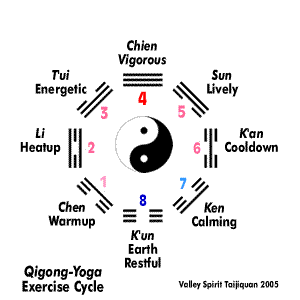
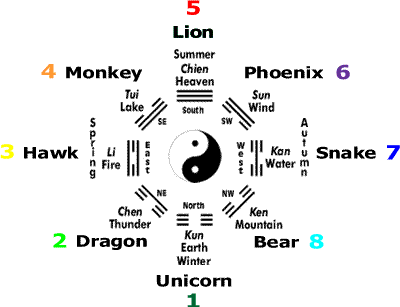
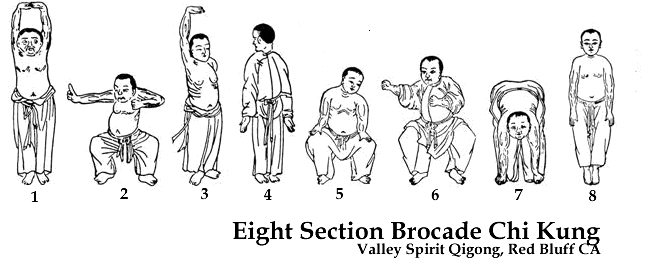
Sequence C:  Trigrams, Bagua, and Eight Section Brocade (Ba Duan Jin) Exercises Correlations

Soft Qigong (Rou Gong), Inner Qigong (Nei Gong); Slow Pace, Gentle, Soft, At Ease, Relaxed (Sung), Rooted/Sunk, Yin Style


Eight Section Brocade Exercise
I Ch'ing Trigram 
Parts of the Body Affected


1.  Pressing Up to the Heavens with
Two Hands
South, Summer
Ch'ien, Qián, Heaven, Sky, Air
Intense Yang
Lion
Heart, Small Intestine, Stomach, Lungs
(The Triple Warmer)
              

2.  Drawing the Bow and Letting the Arrow Fly Southwest, Mid-Summer
Sun, Wind
Yang
Phoenix
Kidneys, Spleen, Waist, Eyes, Legs
                     

4.  Wise Owl Gazes Backward West, Autumn
K'an, Water
Yang-Yin
Snake
Lungs, Immune System, Large Intestine
                   

5.  Big Bear Turns from Side to Side Northwest, Mid-Autumn
Ken, Gèn, Mountain
Yin-Yang
Bear
Heart, Waist, Legs
                   

3.  Separating Heaven and Earth North, Winter
K'un, Earth
Intense Yin
Unicorn, Qilin
Spleen, Kidneys, Bladder, Pancreas
                        

8.  Shaking the Body Northeast, Mid-Winter
Chen, Zhèn, Thunder
Yin
Dragon
Immune System, Calves, Feet
                         

6.  Punching with Angry Gaze Spring, East
Li, Fire
Yin-Yang
Hawk, Falcon
Liver, Gallbladder, Blood, Eyes
                      

8.  Touching Toes then Bending Backwards Southeast, Mid-Spring
Tui, Lake
Yang-Yin
Monkey

 
Kidneys, Waist, Legs, Back

The above three charts were proposed in 2005 by Mike Garofalo, in his webpage on the Eight Section Brocade.  See also Mike's webpage on the Eight Trigrams.  


In 2014, Christina Barea-Young and Peyton Young provided another set of associations for the Eight Section Brocade movements with the Eight Trigrams in Qi Magazine (Volume 24, No. 2, 2014, p. 48).  

I find these kinds of correlations, associations, and relational charts quite inconsistent between various authors.  Yoga, Western Esoteric Magic, and Qigong have many of the same kind of charts and tables of correlations; again, with considerable inconsistency between various "masters."  Other than the "traditions of specific esoteric schools", I find the associations rather arbitrary and fanciful, primarily aids to remembering clusters of ideas, poetic devices, magical-metaphysical lore, and lacking in much pragmatic-scientific meaningfulness.  Contrast these charming and pre-scientific tables with the modern and justifiably famous "Periodic Table of the Elements" for a real lesson in an objective and empirical approach to understanding the world.  Nevertheless, these clusters of ideas may stimulate the imagination, and are fun for playing thought games.  


"The names of the 108 Forms are each symbolic and signify concepts removed from the literal  physicality of the object - horse, tiger, bird, and so forth.  Each name has its separate allusion, and metaphorically may connote an aspiration, a philosophical attitude towards self and  conduct, a turn of mind, a sense of being, some thought about life and spirit.  The true meanings are revealed when the T'ai-Chi Ch'uan exponent has advanced to that stage of experience comprehension where he can utilize the implication of the philosophical  intentions, and where the symbols can be part of his growing consciousness.  This happens only when the mind and body have "changed" and absorbed the reasons for mental, emotional, and physical unity."
-   Sophia Delza, The T'ai Chi Ch'uan Experience, 1996, p. 24

 
The above long chart is more readable on my Eight Section Brocade webpage, 441 KB, last updated on June 20, 2014. 


Monday, December 01, 2014

December Gardening Chores

A late autumn storm brought mild winds and steady gentle rain (3") to our home in the North Sacramento Valley over the last six days. More rain is expected this week. 

December Gardening Chores
Red Bluff, North Sacramento Valley, California, USA
USDA Zone 9

December: Quotes, Poetry, Sayings, Lore

Yule and Winter Solstice Celebrations: Quotes, Poetry, Sayings, Lore


Pruning leafless trees and shrubs.
Adding compost and fertilizer to the vegetable and flower gardens.
Planting bare root trees and shrubs.
Pruning back grape vines.
Cleaning, sharpening, and storing tools.
Start taking cuttings from dormant vines and shrubs.
Reading seed and gardening catalogs.
Digging trenches for underground plastic pipe.
Making sure drainage systems are working.
Pruning evergreens for shape.
Moving tender potted plants to protected areas.
Burning large piles of cuttings and weeds.
Protect tender plants (e.g., citrus) from frosts.
Protect valuable garden tools and equipment from the rain and fog.
Tending winter vegetables: cabbage, lettuce, peas, spinach, brocoli, etc.
Putting some bulbs in the ground.
Plant onion and garlic sets.
Watering potted plants as needed if rain is insufficient.
Pruning back flowering plants, like mums.
Prepare new strawberry and berry vine beds.
Spraying some fruit trees (e.g., peaches) to prevent leaf curl.
Dividing dormant herbs.
Raking and composting leaves.
Setting out some color plants, e.g., calendulas. 
Removing dead or dying branches or trees to burn pile.
Cutting Firewood


"How like a winter hath my absence been
 From thee, the pleasure of the fleeting year!
 What freezings have I felt, what dark days seen!
 What old December’s bareness every where!
 And yet this time remov’d was summer’s time;
 The teeming autumn, big with rich increase,
 Bearing the wanton burden of the prime,
 Like widow’d wombs after their lords’ decease:
 Yet this abundant issue seem’d to me
 But hope of orphans and unfather’d fruit;
 For summer and his pleasures wait on thee,
 And, thou away, the very birds are mute:
 Or, if they sing, ’tis with so dull a cheer,
 That leaves look pale, dreading the winter’s near."
 - William Shakespeare, How Like a Winter Hath my Absence Been (Sonnet 97)