Wednesday, September 17, 2014

Ponderable To Our Touch

"The human body is not an instrument to be used, but a realm of one's being to be experienced, explored, enriched and, thereby, educated."
-  Thomas Hanna

"There is deep wisdom within our very flesh,  if we can only come to our senses and feel it."
 -  Elizabeth A. Behnke

"He who feels it, knows it more."
-  Bob Marley  

"No matter how closely we look, it is difficult to find a mental act that can take place without the support of some physical function."
-  Moshe Feldenkrais  

"I would have touched it like a child
But knew my finger could but have touched
Cold stone and water.   I grew wild,
Even accusing heaven because
It had set down among its laws:
Nothing that we love over-much
Is ponderable to our touch."
-  W. B. Yeats  


Tuesday, September 16, 2014

The Hand is the Cutting Edge of the Mind

"The hand is the cutting edge of the mind."
-  Jacob Bronowski

"The mind has exactly the same power as the hands: not merely to grasp the world, but to change it."
-  Colin Wilson 
"By rubbing up against the world, I define myself to myself."
-  Deane Juhan

"The upper limb is the lightning rod to the soul."
-  Robert Markison

"A callused palm and dirty fingernails precede a Green Thumb."
-  Mike Garofalo

“We leave traces of ourselves wherever we go, on whatever we touch.”
Lewis Thomas 


Hands On 
Fingers, Hands, Touching, Feeling, Somatics
Quotations, Bibliography, Links, Reflections


Monday, September 15, 2014

Dao De Jing by Laozi: Bibliography, Concordance, Index, Resources, Translations

Daodejing, Laozi

Chapter Index and Electronic Concordance

Indexing and research by Michael P. Garofalo, Librarian of Gushen Grove, Valley Spirit Center, Red Bluff, California.  

All 81 Chapters of the Daodejing are Indexed

Searchable by English language terms, Spanish language terms, Romanized Chinese (Wade-Giles and Pinyin) terms.  I use the word 'terms' in my Chapter Index to loosely refer to: keywords, themes, phrases, chapter titles, subjects, topics, words, nouns, verbs, adverbs, or adjectives.  I tend to favor inclusiveness, related meanings, interrelated concepts, and generality when including Terms in this index; reflecting the fascinating complexity of translating and reinterpretation.  

Chapter and Thematic Index (Concordance) to the Tao Te Ching


Taoism: A Selected Reading List 


Daodejing Webpages: General Index


A typical webpage created by Mike Garofalo on a Chapter of the Tao Te Ching (Daodejing) by Lao Tzu (Laozi) includes at least 16 different translations or interpolations of the Chapter in English, two Spanish translations, the Chinese characters for the Chapter, a Wade-Giles and Hanyu Pinyin Romanization of the Mandarin Chinese words for the Chapter, recommended reading lists, a detailed bibliography, indexing by key words and terms for the Chapter, and other resources for the Chapter.  


Sunday, September 14, 2014

You Cannot Call It Lofty

"The Way has its reality and its signs
but is without action or form.
You can hand it down but you cannot receive it,
you can ignore it but you cannot see it.
It is its own source, its own root.
Before heaven and earth existed it was there,
from the ancient times.
It gave spirituality to the spirits and to God,
it gave birth to heaven and to earth.
It exists beyond the highest point,
and yet you cannot call it lofty;
it exists beneath the limit of the six directions,
and yet you cannot call it deep.
It was born before heaven and earth,
and yet you cannot say it has been there for long,
it is earlier than the earliest time,
and yet you cannot call it old."

- The Crookbacked Woman and the Sage
Chuang Tzu, Translated by Burton Watson, 1964


Saturday, September 13, 2014

Taijiquan Short Form: Bejing Standard 24 Form

The first Taijiquan form I learned in 1986 was the Standard 24 Movement T'ai Chi Ch'uan Form in the Yang Style of T'ai Chi Ch'uan.  At that time there were no books or instructional videotapes on this popular form.  Since that time, nearly 25 years have passed.  Now there are dozens of books and instructional DVDs and webpages on the subject of the 24 Form. 


Mike Garofalo 'Playing the Pipa'


My webpage on the Standard 24 Taijiquan Form has been the most popular webpage on the Cloud Hands Website for many years. In the sidebar of this blog, you will find a quick index to this webpage.


Standard Simplified Taijiquan 24 Form.  Research by Michael P. Garofalo, M.S. This webpage includes a detailed bibliography of books, media, links, online videos, articles, and resources.  It provides a list of the 24 movement names in English, Chinese, French, German and Spanish, with citations for sources of the movement names.  It provides detailed descriptions of each movement with black and white line illustrations and  photographs.  It includes relevant quotations, notes, performance times, section breakdowns, basic Tai Chi principles, and strategies for learning the form.  The Peking (Bejing) Chinese National orthodox standard simplified 24 movement T'ai Chi Ch'uan form, created in 1956, is the most popular form practiced all around the world.  This form uses the Yang Style of Taijiquan.  Published by Green Way Research, Valley Spirit Taijiquan, Red Bluff, California:  Webpage URL:  http://www.egreenway.com/taichichuan/short.htm.  File size: 269 Kb. 


This webpage provides many good suggestions for a person learning this form on their own if there is no Tai Chi class in their area. 


The best book that I have seen on the subject is:

The Yang Taiji 24 Step Short Form: A Step by Step Guide for All Levels
By James Drewe  London, Singing Dragon Press, 2011.  382 pages, black and white photographs, charts, detailed descriptions, training tips.
 
I give information on many other fine books by other good authors on the 24 Form in my webpage: Cheng Zhao, Foen Tjoeng Lie, Eric Chaline, Le Deyin, etc.. 

My students tell me that their favorite instructional DVD on the 24 Form is:

Tai Chi - The 24 Forms
By Dr. Paul Lam


I have taught this lovely Tai Chi form to hundreds of people since 2000.  Everyone tells me how much they enjoy learning and practicing this gentle form.

I also teach and enjoy playing the Chen Style Taijiquan 18 Movement Form created by Grandmaster Chen Zhenglei. Actually, in the last year, I prefer practicing the Chen 18 Form more.  


Friday, September 12, 2014

Daodejing, Laozi, Chapter 45

Tao Te Ching by Lao Tzu
Chapter 45


"What is most perfect seems imperfect,
But using it doesn't use it up.
What is most full seems empty,
But using it doesn't wear it down.
Great straightness seems crooked;
Great skill seems clumsy;
Great eloquence seems hesitant.
Movement conquers cold,
But stillness conquers heat.
Clearness and serenity
Are beneath-heaven's norm."
-  Translated by Herrymon Maurer, 1985, Chapter 45   


"Sit quietly
focus and forget
rest with the great achievement.
The ancient child asks
"what is the great achievement?"
It is beyond description in any language
it can only be felt intuitively
it can only be expressed intuitively. 
Engage a loose, alert, and aware
body, mind, and sound
then look into the formless
and perceive no thing.
See yourself as a sphere
small at first
growing to encompass
the vastness of infinite space. 
Sit quietly
focus and forget then
in a state of ease and rest
secure the truth of the great achievement.
Employing the truth will not exhaust its power
when it seems exhausted it is really abundant
and while human art will die at the hands of utility
the great achievement is beyond being useful.
Great straightness is curved and crooked
great intelligence is raw and silly
great words are simple and naturally awkward. 
Engaged movement drives out the frozen cold
mindful stillness subdues the frenzied heart.
Sit quietly
focusing
forgetting
summon order from the void
that guides the ordering of the universe."
-  Translated by John Bright-Fey, 2006, Chapter 45  


"The greatest perfection seems inadequate,
But it is unfailing in its usefulness;
What is brimful seems empty,
But it is inexhaustible in its usefulness.
The completely straight seems crooked, the greatest skill seems awkward,
The greatest eloquence seems like stammering.
Activity overcomes cold,
But stillness overcomes heat.
Only by purity and stillness will the world be governed."
-  Translated by Herman Ould, 1946, Chapter 45  


"Esteem lightly your greatest accomplishment, your patience will not fail.
Reckon your great fullness to be emptiness, your strength will not become exhausted.
Count your rectitude as foolishness,
Know your cleverness to be stupidity,
Recognize your eloquence to be stammering words,
And you will find that
As movement overcomes cold, and as stillness overcomes heat, even so, he who knows the true secret of tranquility
Will become a pattern for all mankind."
-  Translated by Isabella Mears, 1916, Chapter 45  


大成若缺.
其用不弊. 
大盈若沖.
其用不窮. 
大直若屈.
大巧若拙.
大辯若訥. 
躁勝寒.
靜勝熱. 
清靜為天下正. 
-  Chinese characters, Tao Te Ching, Chapter 45


ta ch'êng jo ch'üeh.
ch'i yung pu pi. 
ta ying jo ch'ung.
ch'i yung pu ch'iung.
ta chih jo ch'u.
ta ch'iao jo cho.
ta pien jo no.
tsao shêng han.
ching shêng jê.
ch'ing ching wei t'ien hsia chêng.
-  Wade-Giles Romanization, Tao Te Ching, Chapter 45


"The highest perfection is like imperfection,
And its use is never impaired.
The greatest abundance seems meager,
And its use will never fail.
What s most straight appears devious,
The greatest skill appears clumsiness;
The greatest eloquence seems like stuttering.
Movement overcomes cold,
But keeping still overcomes heat.
Who is calm and quiet becomes the guide for the universe."
-  Translated by Lin Yutang, 1955, Chapter 45 


"La Gran Perfección parece insuficiente,
pero surte un efecto infinitamente eficaz.
La Gran Plenitud es de apariencia vacía,
pero su acción es inagotable.
La Gran Rectitud es en apariencia torcida.
La Gran Habilidad es en apariencia torpe.
La Gran Elocuencia es en apariencia incongruente.
El movimiento vence al frío.
La quietud vence al calor.
Lo pacífico y sereno son las cosas que restauran
el orden del Universo."
-  Translation from Wikisource, 2013, Capitulo 45


"He who sees that his highest attainments are always incomplete may go on working indefinitely.
He who sees his greatest possessions to be inadequate may go on acquiring forever.
His highest rectitude is but crookedness.
His greatest wisdom is but foolishness.
His sweetest eloquence is but stammering.
Action overcomes cold; inaction overcomes heat.
With virtue and quietness one may conquer the world."
-  Translated by Walter Gorn Old, 1904, Chapter 45  


Chapter and Thematic Index (Concordance) to the Tao Te Ching


Taoism: A Selected Reading List


 A typical webpage created by Mike Garofalo on a Chapter of the Tao Te Ching (Daodejing) by Lao Tzu (Laozi) includes at least 16 different translations or interpolations of the Chapter in English, two Spanish translations, the Chinese characters for the Chapter, a Wade-Giles and Hanyu Pinyin Romanization of the Mandarin Chinese words for the Chapter, recommended reading lists, a detailed bibliography, indexing by key words and terms for the Chapter, and other resources for the Chapter. 


Thursday, September 11, 2014

My Morning Walk


Looking east on Kilkenny Lane near Red Bluff, California.  I walk 3.6 miles on this cul de sac lane, four days each week, in the morning.  I walk at daybreak on Friday, Saturday, Sunday, and Monday morning throughout the entire year.  


Occasionally, a car might use this country lane, and I move to the side of the road.  It is a very safe, peaceful, and quiet place.  

Sometimes I listen to my MP3 player while I walk.  Sometimes I walk in silence.  


"Putting facts by the thousands,
into the world, the toes take off
with an appealing squeak which the thumping heel
follows confidentially, the way men greet men.
Sometimes walking is just such elated
pumping."
-   Lyn Hejinian, Determination


"Every day, in the morning or evening, or both, take a walk in a safe and peaceful environment for less than an hour.  The can be a great fountain of youth.  Choose a place to walk that has no kind of disturbance.   Walking done in a work environment and when your mind is busy is different; it is not as nutritious as the walking you do for yourself in the morning or evening in a quiet, peaceful, and safe place."
-  Master Hua-Ching Ni, Entering the Tao, 1997, p. 135


Looking to the northeast on Kilkenny Lane.  Mt. Lassen (10,000 feet) in the distance is capped with a little snow.  These photos were taken in the Autumn.   

"Walking is the natural recreation for a man who desires not absolutely to suppress his intellect but to turn it out to play for a season." 
-  Leslie Stephen  


`


Looking west on Kilkenny Lane.  The red leafed autumn colors are from Raywood Ash trees. The Yolly Bolly mountain range (7,000 feet) is to the west of the North Sacramento Valley.  

"The interior solitude, along with the steady rhythm of walking mile after mile, served as a catalyst for deeper awareness.  The solitude I found and savored on the Camino had an amazing effect on me.  The busyness of my life slowly settled down as the miles went on.  For a good portion of my life I had longed for a fuller experience of contemplation, that peaceful prayer of the heart in which one is able to look intently and see each piece of life as sacred.  Ten days into the journey, totally unforeseen, the grace of seeing the world with startling lucidity came to me.  My eyes took in everything with wonder.  The experience was like looking through the lens of an inner camera – my heart was the photographer.  Colors and shapes took on nuances and depths never before noticed.  Each piece of beauty appeared to be framed: weeds along roadsides, hillsides of harvested fields with yellow and green stripes, layers of mountains with lines of thick mist stretching along their middle section, clumps of ripe grapes on healthy green vines, red berries on bushes, roses and vegetable gardens.  Everything revealed itself as something marvelous to behold.  Each was a work of art.  I noticed more and more details of light and shadow, lines and edges, shapes, softness, and texture.  I easily observed missed details on the path before me – skinny worms, worn pebbles, tiny flowers of various colors and shapes, black beetles, snails, and fat, grey slugs.  I became aware of the texture of everything under my feet – stones, slate, gravel, cement, dirt, sand, grass.  I responded with wonder and amazement.  Like the poet Tagore, I felt that everything “harsh and dissonant in my life” was melting into “one sweet harmony”."
-  Joyce Rupp  


Study Tai Chi Chuan and Chi Kung with Mike Garofalo


Wednesday, September 10, 2014

Yi Jin Jing Chi Kung: Muscle and Tendon Transformation

The Yi Jin Jing Qigong is a popular qigong exercise set from China. "Yi Jin Jing Qigong" means "Muscle and Tendon Transforming Exercises."

In most cases, this qigong regimen consists of 12 movement sequences. There are some versions of the Yi Jin Jing with many more movements (22, 49, 108, 216). Some of the longer versions of the Yi Jin Jing include movements from the Eight Section Brocade Routine, the Animal Frolics Routines, the Louhan Routine, or the Bone Marrow and Brain Washing Routine.

Most people practice a 12 movement version of the Yi Jin Jing that was described in a book published by Pan Weiru in 1858 called "Essential Techniques for Guarding Life." Also, Wang Zuyuan published a book in the 1880's titled "Illustrated Exposition of Internal Techniques" that described the same qigong routine as did Pan Weiru.

Names of the Yi Jin Jing Qigong Movements
Opening Form
1. Wei Tuo Presenting the Pestle 1

2. Wei Tuo Presenting the Pestle 2
3. Wei Tuo Presenting the Pestle 3
4. Plucking Stars on Each Side
5. Pulling Nine Cows by Their Tails
6. Showing Talons and Spreading Wings
7. Nine Ghosts Drawing Sabers
8. Sinking the Three Bodily Zones
Three Plates Falling on the Floor
9. Black Dragon Displaying Its Claws
10. Tiger Springing On Its Prey
11. Bowing Down in Salutation
12. Swinging the Tail
Closing Form

Some claim that the Yi Jin Jing was created by the famous Zen Patriarch Bodhidharma (Da Mo) around 520 CE, and refined over centuries by Shaolin monks, while others argue for an even more ancient Daoist lineage.

There are numerous instructional DVDs available now for the 12 movement verion of the Yi Jin Jing. I like the instructional book and DVD by the Chinese Health Qigong Association:

Yi Jin Jing: Chinese Health Qigong. Compiled by the Chinese Health Qigong Association. Beijing, China, Foreign Languages Press, 2007. 95 pages, charts, includes an instructional DVD. ISBN: 9787119047782. VSCL. "Qigong is an aspect of traditional Chinese medicine that involves coordinating breathing patterns with physical postures to maintain health and well-being. Yi Jin Jing/ Tendon-Muscle Strengthening Exercises is an accessible, fully-illustrated guide to a particular qigong exercise that focuses on turning and flexing the spine. Based on the twelve traditional routines of Yi Jin Jing, the exercises covered in the book feature soft, extended, even movements that invigorate the limbs and internal organs. In particular, practice of the Yi Jin Jing exercises improves flexibility, balance and muscular strength, and has a beneficial effect on the respiratory system. Each routine is described step-by-step and is illustrated with photographs and key points. The authors also point out common mistakes and offer advice on how to correct these. Complemented by an appendix of acupuncture points and accompanied by a DVD, this book will be of interest to Qigong and Tai Chi practitioners at all levels, students of martial arts and anyone interested in Chinese culture." - Singing Dragon.

For a good book on the theory of the Yi Jin Jing, read Qigong: The Secret of Youth: Da Mo's Muscle/Tendon Changing and Marrow Brain Washing Classics. By Yang, Jwing-Ming, Ph.D., 1946-. An Advanced Qigong Regimen for the Serious Practitioner. Boston, Massachusetts, YMAA Publication Center, 2000. Second Edition 2000, First Edition 1989. Index, appendices, charts, 312 pages. ISBN: 1886969841. VSCL.


Tuesday, September 09, 2014

Autumn Approaches


Months and Seasons
Quotes, Poems, Sayings, Verses, Lore, Myths, Holidays
Celebrations, Folklore, Reading, Links, Quotations
Information, Weather, Gardening Chores
Compiled by Mike Garofalo
 
Winter Spring Summer Fall
January April July October
February May August November
March June September December 


"Only two percent of all insects are harmful.  Why are they all in my garden?
Dearly respect the lifestyle of worms.
The spiders, grasshoppers, mantis, and moth larva are all back:  the summer crowd has returned!
Snail - Squash!  Tomato Worm - Squash!  Grasshopper - Squash! The Garden Trooper is  at War!"
Michael P. Garofalo, Pulling Onions 


Monday, September 08, 2014

Friendship is a Slow Ripening Fruit

"May I perfect the sublime virtue of generosity,
which liberates and releases craving, grasping,
and attachment,
and brings joyous contentment."
-  Lama Surya Das, Buddha is as Buddha Does, p. 21


"Hospitality is a form of worship."
-  The Talmud   


"Wishing to be friends is quick work, but friendship is a slow ripening fruit."
-  Aristotle 


"We should give as we would receive, cheerfully, quickly, and without hesitation; for there is no grace in a benefit that sticks to the fingers."
-  Seneca   


"Gardening helps us to carefully attend to the close at hand.  
The best thing that grows in the garden is a careful gardener. 
Your rich, famous, and handsome; and, your garden doesn't care. 
Gardens are not inherently meaningful in many ways; but, making a garden and caring
     for it creates meaningfulness. 
If you plant it, they will come."  

-   Michael P. Garofalo,
Pulling Onions   


Advice from Wise Persons

The Good Life


Saturday, September 06, 2014

Having Fun and Changing Behaviors


Today, when I took my morning walk, starting at 6 am, I skipped some, walked backwards some, and walked in a zigzag manner some.  Have some fun with what you do.

Walking:  Quotes, Poems, Lore, Information.  Compiled by Mike Garofalo.


Friday, September 05, 2014

Tao Te Ching by Lao Tzu, Chapter 46

Daodejing, Laozi
Chapter 46

"When the world yields to Tao, race horses will be used to haul manure.
 When the world ignores Tao war horses are pastured on the public common.
 There is no sin greater than desire.
 There is no misfortune greater than discontent.
 There is no calamity greater than acquisitiveness.
 Therefore to know extreme contentment is simply to be content."
 -  Translated by Dwight Goddard, 1919, Chapter 46  


"When the Way rules the world,
Coach horses fertilize the fields;
When the Way does not rule,
War horses breed in the parks.
No sin can exceed
Incitement to envy;
No calamity's worse
Than to be discontented,
Nor is there an omen
More dreadful than coveting.
But once be contented,
And truly you'll always be so."
-  Translated by Raymond B. Blakney, Chapter 46   


"Swift horses are curbed for hauling dung-carts in the field.
When Tao does not reign in the world,
War horses are bred on the commons outside the cities.
There is no greater crime than seeking what men desire;
There is no greater misery than knowing no content;
There is no greater calamity than indulging in greed.
Therefore the contentment of knowing content will ever be contented."
-  Translated by Ch'u Ta-Kao, 1904, Chapter 46 


"When Tao is in the world, horses are used in the pastureland.
When Tao has left the world, chargers are reared in the wilderness.
There is no greater sin than indulging desire.
There is no greater pain than discontent.
There is nothing more disastrous than the greed of gain.
Hence the satisfaction of contentment is an everlasting competence."
-  Translated by Walter Gorn Old, 1904, Chapter 46  


天下有道. 
卻走馬以糞. 
天下無道.
戎馬生於郊. 
禍莫大於不知足.
咎莫大於欲得. 
故知足之足, 常足矣. 
-  Chinese characters, Tao Te Ching, Chapter 46   


tian xia you dao.
que zou ma yi fen.
tian xia wu dao.
rong ma sheng yu jiao.
huo mo da yu bu zhi zu.
jiu mo da yu yu de.
gu zhi zu zhi zu, chang zu yi.
-  Pinyin Romanization, Daodejing, Chapter 46  


"When there is Tao in the empire
The galloping steeds are turned back to fertilize the ground by their droppings.
When there is not Tao in the empire
War horses will be reared even on the sacred mounds below the city walls.
No lure is greater than to possess what others want,
No disaster greater than not to be content with what one has,
No presage of evil greater than men should be wanting to get more.
Truly:
“He who has once known the contentment that comes simply through being content,
Will never again be otherwise than contented”."
-  Translated by Arthur Waley, 1934, Chapter 46 


"Cuando el Tao reina en el mundo
los caballos de guerra acarrean estiércol.
Cuando no hay Tao en el mundo
Los campos se usan para criar caballos de guerra.
No hay mayor error que consentir los deseos.
No hay mayor desgracia que ser insaciable.
No hay mayor vicio que ser codicioso.
Quien sepa moderarse al obtener lo suficiente,
siempre estará saciado."
-  Translation from Wikisource, 2013, Capitulo 46


"With the world in step with Tao horses work upon the farms,
When the Tao is disregarded they respond to war's alarms,
And are bred in border waste and wilderness;
There is no greater sin than to sanction fell desire,
Than a discontented life no calamity more dire,
None greater than the grasping to possess;
And he who knows contentment has the all-sufficient cure,
And satisfied, will evermore endure."
-  Translated by Isaac Winter Heysinger, 1903, Chapter 46  


Chapter and Thematic Index (Concordance) to the Tao Te Ching


Taoism: A Selected Reading List


Thursday, September 04, 2014

Tao Te Ching Index and Concordance

Daodejing by Laozi

Chapter Index and Electronic Concordance

Indexing and research by Michael P. Garofalo, Librarian of Gushen Grove, Valley Spirit Center, Red Bluff, California.  

All 81 Chapters of the Daodejing are Indexed

Searchable by English language terms, Spanish language terms, Romanized Chinese (Wade-Giles and Pinyin) terms.  I use the word 'terms' in my Chapter Index to loosely refer to: keywords, themes, phrases, chapter titles, subjects, topics, words, nouns, verbs, adverbs, or adjectives.  I tend to favor inclusiveness, related meanings, interrelated concepts, and generality when including Terms in this index; reflecting the fascinating complexity of translating and reinterpretation.  

Chapter and Thematic Index (Concordance) to the Tao Te Ching


Taoism: A Selected Reading List


Wednesday, September 03, 2014

Medicine Ball Exercises and Qigong

Martial Arts, physical culture, and Qigong enthusiasts can benefit from using a medicine ball when doing exercises.  There are many routines developed by Taijiquan and Qigong masters using a medicine ball.   Qigong Ball exercisers can get into a calm mode, mellow their mood, and go with the Flow. 

Medicine Ball Training and Exercises: Bibliography, Links, Resources .  Prepared by Mike Garofalo.  A general introduction to the use of medicine balls in exercise programs. 

I developed my own medicine ball routine called: Magic Pearl Qigong. 


Magic Pearl Qigong, Part I, Movements 1-8 .   Instructions, Bibliography, Links, Handouts, Resources, Mythological Associations, Lore.  Prepared by Mike Garofalo. 

The Magic Pearl Qigong can be a very vigorous physical culture routine if you increase the weight of the ball, lower the stances, and increase the number of repetitions of each movement.  Serious Qigong Ball enthusiasts use a very light wooden ball, move slowly, stay relaxed, sink, play. 

In addition, upper body strength and athletic fitness is also be improved by practicing longer Taijiquan Forms using weapons like the saber, sword, cane, and staff.

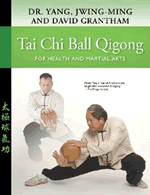
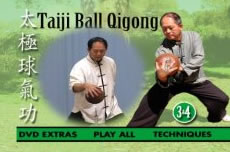
Tai Chi Ball Qigong: for Health and Martial Arts.  By Yang Jwing-Ming and David Grantham.  Wolfeboro, New Hampshire, YMAA Publication Center, 2010.  Index, glossary, bibliography, appendices, 301 pages.  ISBN: 1594391998.  The best book on the subject.  Linked to the two instructional DVDs listed below.  VSCL.


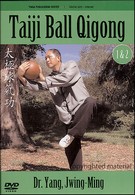
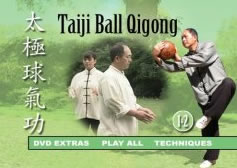
Taji Ball Qigong Course.   By Yang, Jwing-Ming, Ph.D.  Courses 1 and 2.  YMAA Publication Center, 2006.  180 minutes.  1 DVD, NTSC.  Directed by Yang Jwing-Ming and David Silver.   ASIN:B000EHT3DY.   VSCL. 
    "Deepen Your Tai Chi Training with Taiji Ball Qigong. Taiji Ball training is common practice in both external and internal martial arts in China. It can strengthen the torso, condition the muscles, and increase physical power by using the mind to lead the Qi. In Taijiquan (Tai Chi Chuan), Taiji Ball Qigong training was once a major training tool to enhance Pushing Hands ability. However, due to its secrecy, fewer and fewer people have learned it. Today the art of Taiji Ball training is almost unknown. In Course 1, Dr. Yang, Jwing-Ming teaches fundamental Taiji Ball breathing techniques, and 16 basic patterns of stationary and moving Taiji Ball Circling, both Vertical and Horizontal. Breathing patterns demonstrated: Wuji breathing Yongquan breathing Laogong breathing Four Gates breathing Taiji Grand Circulation breathing Course 2 focuses on 16 basic patterns of stationary and moving Taiji Ball Rotating, both Vertical and Horizontal. Dr. Yang offers detailed instruction as students demonstrate in the classroom, accompanied by an easy-to-follow demonstration of each pattern shown in a lush outdoor setting, with beautiful classical Chinese music. Regular Qigong practice accelerates the health benefits of Taiji. You'll enjoy reduced stress, a stronger immune system, and a deeper awareness of breath and body coordination. This authoritative guide can be used with any style of Taijiquan, and it is a great way for anyone to energize the body, raise the spirit, and deepen your understanding of Qigong and Taiji. DVD features: Over 100 Chapter Markers . Narration: English and French. Multi-Language Menus and Subtitles: English, French, Spanish, Portuguese, Polish. Over 1 hour of additional DVD-only content. Hidden DVD-Outtakes bloopers Segment. Interactive YMAA Product catalog with Previews of All Other YMAA Video Titles."   


Taji Ball Qigong Course.   By Dr. Yang, Jwing-Ming.  Courses 3 and 4.  YMAA Publication Center, 2007.  200 minutes.  1 DVD, NTSC.   ASIN:B000NVRONM.   Featuring: Dr. Yang Jwing-Ming, Ramel Rones, Aaron Damus, Kathy Yang, Ben Warner and Richard Krupp.  Directed by David Silver.  MGC.  "Deepen Your Taiji with Taiji Ball Qigong. Taiji Ball training can strengthen the torso, condition the muscles, and teach the practitioner to use the mind to lead the Qi. In Taijiquan, Taiji Ball training was once a major training tool to enhance Pushing Hands ability, but it is rarely taught in modern times. This multi-language DVD by Dr. Yang, Jwing-Ming contains two complete video courses, and builds upon the foundation taught in the Taiji Ball Qigong Courses 1 & 2 DVD. Dr. Yang offers you detailed instruction as you follow along with a YMAA class lesson. In Course 3, Dr Yang teaches 16 patterns of Taiji Ball Wrap-Coiling, both Vertical and Horizontal. Course 4 focuses on solo and partner applications, which help to develop coiling and neutralizing taiji skills. You will learn several Self-practice exercises: Flying Dragon Plays with the Ball. Taiji Ball Along the Edge. and 2-person Taiji Ball partner drills. DVD SPECIAL FEATURES: Over 100 Scene Selections. Narration: English. Multi-Language Menus and Subtitles: English, French, Spanish, Portuguese, Polish. Interactive YMAA Product catalog with Previews of All Other YMAA Video Titles."   VSCL. 


Monday, September 01, 2014

Gardening and Celebrations in September

Temperatures in Red Bluff, California, will continue to be high in the daytime (85F-95) and lowering in the night (53F-60F).  It is too hot to plant any trees or shrubs.  Watering will be essential.  We start our pruning cycle.  

This month I will add an electrical outlet and a water feature to the front yard sitting area.  We enjoy sipping our coffee and reading or listening to music while sitting in our front yard garden in the early morning hour.

We gather plants from the garden and create art for the Autumn Equinox Celebration.  

September - Poems, Sayings, Quotations.  Compiled by Mike Garofalo.

The Autumn Equinox Celebrations:  Mabon

Months of the Year


September Gardening Chores

Removing dead and non-productive vegetable crops. 
Apply manure and compost to clay soils.  
Planting crops for late autumn harvest:  cabbages, peas, fennel,
     cauliflower, lettuce, Swiss chard, onions, leeks, Chinese peas, and endive.  
Drying peppers and squash.
Start new strawberry beds.  
Dig up and divide garlic, perennials, iris, daylilies,  bulbs and onions.
Keep watering properly even as the weather begins to cool.  
Clean up all dead fruit.  
Fruit trees fed and sprayed with tonics. 
Seed lawns with rye grass for winter color.  
Remove any dead shrubs or trees.   
Dig holes for planting trees and shrubs.  
Purchase potted trees and shrubs for planting in autumn.  
Continue to mulch trees and shrubs.
Raking fallen leaves and add to compost pile.  
Purchase bulbs from nurseries.  
Feed lawn with slow release fertilizer. 
Remove spent blooms from roses.  
Weed vegetables and shrubs, mow lawns.  
Start to prepare sheds, tools, and equipment for Winter weather.
Repair roofs.