Tuesday, October 14, 2025

The Dumpling Discourse

 The Fireplace Records, Chapter 44


The Dumpling Discourse


It was a hot day in July when Carol and Adolf met in a tea shop in Portland. They sipped iced tea and chatted about Taoism for an hour.

Adolf asked Carol, "What is beyond the Tao?" Carol answered, "Either the Dark Void or preparing hot oatmeal."

Adolf sarcastically replied, "Yunmen is direct, he says '"Dumplings.' You are caught in either/or, dualisms, and straying from the spot!" Carol said "Purported Zen Masters seldom cook."

Adolf raised his right hand, like Gutei, and gave Carol the middle finger. Carol slapped the finger of his right hand.

Adolf got up and went to the toilet. While urinating, like Master Omori Sogen, he was suddenly awakened. While he was away, Carol left for home.

She worked in her home garden. She weeded and watered. She picked two squash. Like the Tao, she grew living beings. She went indoors and cooked some hot oatmeal. She added raisins to the mush. She ate. She smiled. Her dark blue bowl was then empty. She was ordinary and clear mined. 

Comments, Sources, Observations, Koans, Poems, Quips:

Omori Sogen, "Introduction to Zen Training" Tuttle, 2001,2020.

"What is talk transcending the Buddhas and Patriarchs?", Yunmen's translated answers "Sesame Cakes", "Rice cakes", "Dumplings."
See BOS 78, ZE 42, ENT 88, WWSF 348, BCR 77

Gutei's One Finger Zen
BCR 19, BOS 84, DSMS 245, GB 30, SOH 21

If the answer can be 'the oak tree in the courtyard,' then the answer can be 'eating oatmeal with raisins.'

Irrelevant answers are a staple spontaniety of Zen tricksters. 

Some say nonsensical Zen Koan answers are free and natural poety; however, they are often just bad poetry.

Which finger was the "one finger?"

People are Makers, Imitating the Dao - The Great Maker, Doer, Creator.  Sometimes even seeming to go Beyond the Dao.


636 Riddles, Jokes, Witticisms, Humor

Refer to my Cloud Hands Blog Posts on the topic of Koans/Stories. 

Subject Index to 1,975 Zen Buddhist Koans

Zen Buddhist Koans: Indexes, Bibliography, Commentary, Information

The Daodejing by Laozi

Pulling Onions  Over 1,043 One-line Sayings, Quips, Maxims, Humor

Chinese Chan Buddhist and Taoist Stories and Koans

The Fireplace Records (Blog Version) By Michael P. Garofalo

The Spirit of Gardening


Monday, October 13, 2025

Tao Te Ching by Lao Tzu, Chapter 40

Daodejing, Laozi
Chapter 40

"The movement of the Tao
By contraries proceeds;
And weakness marks the course
Of Tao's mighty deeds.
All things under heaven sprang from It as existing and named.
That existence sprang from It as non-existent and not named."
-  Translated by James Legge, 1891, Chapter 40    


"Reversion is the action of Tao.
   Gentleness is the function of Tao.
The things of this world come from Being,
   And Being (comes) from Non-being."
-  Translated by Lin Yutang, 1955, Chapter 40    


"In Tao the only motion is returning;
The only useful quality, weakness.
For though all creatures under heaven are the products of Being,
Being itself is the product of Not-being."
-  Translated by Arthur Waley, 1934, Chapter 40  


"Reversion is the action of the Dao.
 Softness is the function of the Dao.
 The myriad things under Heaven achieve life in existence.
 Existence arises from nothingness."
 -  Translation Richard Lynn, Chapter 40  


反者道之動.
弱者道之用. 
天下萬物生於有.
有生於無.
-  Chinese Characters, Tao Te Ching, Chapter 40  


fan zhe dao zhi dong, 
ruo zhe dao zhi yong. 
tian xia wan wu sheng yu you.   
you sheng yu wu.
-  Pinyin Romanization, Daodejing, Chapter 40   


"The movement of Tao in the course of time is to return to Simplicity;
 The working of Tao is so subtle that is ostensible effect may not be immediately noticeable.
 Myriad things and creatures on Earth were originated from something;
 This something describable by us was launched ultimately from nothing which is beyond our description."
 -  Translated by Lee Sun Chen Org, Chapter 40 


"Interaction of the opposites is the sphere of Tao activity.
The Highest Subtlety is one of the most important qualities of Tao.
It is opposed by coarse qualities of evil people. 
All the development of incarnate beings goes on in interaction of these opposites.
Yet, the very world of matter originated from the Subtlest Source."
-  Translated by Mikhail Nilolenko, Chapter 40    


"El movimiento del Tao es retornar;
El uso del Tao es aceptar;
Todas las cosas derivan del Tao,
El Tao no deriva de ninguna."
-  Translated by Antonio Rivas Gonzálvez, 1998, Capitulo 40


"The movement of the Tao is a returning,
And weakness marks its course, to our discerning,
But heaven and earth and everything from its existence came,
And existence, from the non-existent spurning."
-  Translated by Isaac Winter Heysinger, 1903, Chapter 40  


"Tao moves in cycles;
Tao functions through softness.
All is born of nothing.
Something is born of nothing."
-  Translated by Tam C. Gibbs, 1981, Chapter 40   


Chapter and Thematic Index (Concordance) to the Tao Te Ching


Taoism: A Selected Reading List


 A typical webpage created by Mike Garofalo on a Chapter of the Tao Te Ching (Daodejing) by Lao Tzu (Laozi) includes at least 16 different translations or interpolations of the Chapter in English, two Spanish translations, the Chinese characters for the Chapter, a Wade-Giles and Hanyu Pinyin Romanization of the Mandarin Chinese words for the Chapter, recommended reading lists, a detailed bibliography, indexing by key words and terms for the Chapter in English, Spanish, and the Wade-Giles Romanization, and other resources for the Chapter.  


Sunday, October 12, 2025

One Picture of Me


One Picture of Me

By Mike Garofalo


When Laurence asked for poems on the theme of "Self-Portrait" I though of a long philosophical poem I wrote about the interrelated subjects of Picturing and Describing. 

One set of examples I used in that long poem was the human skull. I spoke of memories of Halloween in East Los Angeles, where Mexican Skulls, calaveras, filled displays on El Dia De La Muerte. Meaningful from artistic and religious perspectives.

The brief poem I'm sharing today is a excerpt about my own skull as Pictured by medical imaging, and described by me and interpreted by the oral surgeon.


"This bony skull of mine
electrified
pictured onscreen for me.
     Doctor recommends
     some oral surgery.

The brain disappeared,
an empty space
sliced from
X Ray images retraced.
Eyeless in inner space.

Monkey nose holes,
bony eye glasses,
teeth glowing in the dark.
     Inner spaces never seen
     underneath my very being.

Skinless, noseless, earless,
a shape, a form—
     the images informed.
Stripping away the unneeded,
revealing my inner core."


So, as we all know, a single picture or image can cause a flow of ideas, interpretations, and feelings in our minds.

Or, just two words can please, excite or inflame our minds. Our lover's name can explode our feelings.

But, just two other words can frighten our moral being.

For example, 

Donald Trump ...
[pause, raise your elbow]

Kick Him Out. 

See you on the street next Saturday.


The above "brief poem" will be printed in
The SkullCrushing Hummingbird
Zine #7
, in Portland, Oregon,
on 10/12/2025.


Commentary: Off the Cuff


So, considering, have you ever seen
a picture or a video or a drawing
of a Skull Crushing Hummingbird,
crushing an insect's Skull
with its tiny beak or flashing wings?

No, you have not,
and that is just one reason why,
you don't believe
that Skull Crushing Hummingbirds
are really alive.

However,
Words, context, technical knowledge,
and intent claim meaningfulness,
even truth,
in addition to any pictures viewed.
The surgeon and I see differently.

Sometimes, though, we reader's prefer
fantasies and fictional
Skull Crushing Hummingbirds
to any ho-hum boring beings-
a moniker for fun memories.


***********************


Pictures mirroring things
displaying aspects of reality
uncovering hidden realms of being
pointing to more clear correspondence.
Show me a good picture - Please!

We drew pictures in caves
Heroes pictured in statues
Books illustrated pictured facts
Drones picture our towns from above
Hubble sends us clear pictures of Space

Our brains are
Picture processing ... Machines-
and you can picture mindfulness
you can picture your intent verbally...
picturing is a form of meaningfulness.

Science and technology have
invented new ways of picturing
so we can see into Reality
and open our ordinary eyes
to new ways of seeing.

Picturing - Defining
Planning - Imagining
Painting - Photography
Reflecting - Mimicking
Do I see what I mean?

Wittgenstein in the Tractatus of 1921
Used Pictures and Picturing as the
criterion of meaningfulness and truth.
Wittgenstein in the Investigations of 1953
changed to talking about our talking
about, in ordinary words, aspects of Picturing.

The best pictures, the best descriptions,
how we talk in everyday ways,
point to correspondence, mirroring,
a theory of epistemology.
Richard Rorty disagreed.


**********************************


Bundled Up, Volume 1
Quintains, Pentastichs, Tankas

Gushen Grove Sonnets

Highway 101 and 1: A Docu-Poem
California, Oregon, Washington

25 Steps and Beyond
The Poetry by Mike Garofalo


Travels on Highway 101: At the Edges of the West


At the Edges of the West

By Mike Garofalo

Travels on US Highway 101 and 1

Memories of Pacific Coast Places
West Coast Snapshots & Snippets
Delightful Coastal Spur Roads

Docu-Poem, Haiku, Short Poems, Photos,
Sonnets, Quintains, Graphics, Concrete Poems

Highway 101 and 1: Docu-Poem
By Mike Garofalo

Alphabetical Index of Titles


Beachcombing and Tidepooling

Big Sur

Bottom Line

Bridges Over Rivers

East Los Angeles Revisited

El Camino Real

Campfires Smoking

Clear Cut

Cliffside at Bandon Beach

The Clock Ticks Within the Mind

Concrete/Shape Poetry

Coos Bay South to Point Reyes

Disappearing Darkness

Down for the Count

Down South

Embodied Time

The Eucalyptus Trees at Tomales Bay

Eye to Eye Memories

Fields of Cream

Fire! Fire!

Flowers in the Sky

A Fork in the Crypto Road

Funky Artist's Enclaves

Fun Times Ahead

Grayland Beach Guides

Gushen Grove Sonnets

Haiku and Senryu

Hip Woke West

Hood Canal: Beauty and Bounty

In a Watery Grave

In the Shadows of Mountains

Industries Booming

Cliffside at Bandon Beach

Lighthouses On the Cliffs

Meeting at the Golden Gate

Myrtlewood and Shells Alive

Night Camp at Pistol River

Notes and Reminders

The Olympic Curve on 101

Petaluma Cool

Places and Times Intertwined

Quatrains Bundled Up

Raven Broke Open the Magical Clam

Reminder from the Other World

River People North

The Rotting Redwood Tree

Salinas Valley Farms

The Salmon are Back

SanFran and L.A. Lives

Sciences Strong

The Scissors of My Decisions

Secrets of Night

Shallow Willapa Bay at Low Tide

Sitting by the Still Bay

Skeletons in Love

Slouching Into Incoherence

Snapshots from the Shore

Stepping Over Epiphanies

Summer in the Sun

Surfing Way

Timber Empire

25 Steps and Beyond

2+2 = 4: Now and Forever More

West Coast Ideologies

Winter at the Shore


Saturday, October 11, 2025

Darwin Revisited

While resting quietly, I have been reading books on the history of science, evolutionary biology, and a biography of Charles Darwin (1809-1882).  These books will keep me fascinated and busy for a few weeks.  I have read all or parts of these books before 2017.  

The "Annotated Origin" is an outstanding volume.  I am always amazed at Darwin's use of many interesting and cogent examples to illustrate his key points of theory.  Beings change over generations based on lived circumstances.  We don't need supernatural causes to explain how beings have existed and changed over time.  


"The History of Science" by Stephen F. Mason.  Collier, 1956.

"The Annotated Origin: A Facsimile of the First Edition of On the Origin of the Species."  By Charles Darwin.  Annotated by James  T. Costa.  Belknap Press of the Harvard University Press, 2009.  Indices, references, biographies, appendices, 537 pages.  ISBN: 9780674032811.  

"The Greatest Show on Earth" by Richard Dawkins.  

"Darwin: The Life of a Tormented Evolutionist" by Adrian Desmond and James Moore.  Norton, 1994, 868 pages.  The Darwin biography was detailed, comprehensive, historically fascinating, and very interesting to me.  Life in London, and Down House, from 1840-1880, is well documented in this book.  


Friday, October 10, 2025

Does Your College Women's Soccer Team Need a Very Good Center Defender?


Subject: Recruiting: A Noteworthy Center Defender: Makenna Flinn

Makenna Erin Flinn is an excellent Center Defender for the Skyview High School Girl’s Varsity Soccer Team in Vancouver, Washington. 

Makenna Flinn was awarded First Team Soccer Defender in 2024 in the 4A Greater St. Helens District League. Skyview won the St. Helens League title in 2024.

Makenna is a Senior, and she is a straight A student. She plans to study to become a Physician’s Assistant. She is an officer for both the DECA Entrepreneurial Business Club and the Medical Club at Skyview.

She has lettered in three varsity seasons in both soccer and track and field. In soccer, she has played the entire game in every game for two years.

Makenna is tall, fast, strong, smart, quick, and calm. She is a good leader, and a skilled defender. She is a Captain of the Skyview team in 2025.

Information on 2025 Skyview High School Girls Varsity Soccer Team:

As of 10/10/2025, the Skyview record is 8-0-4. In 12 games this year, Skyview has scored 38 goals, given up only 5, and are undefeated. They are currently ranked 3th in the State of Washington in the 4A Division, and 5th in the entire State. This is despite losing two key offensive players suffering season ending injuries, and another key defender being injured for many games.

Makenna (#17) has defended extremely well against top forwards from other schools (Chiawana, Somner, Camas, Ridgefield, and Columbia River) who are already having scholarship offers.

Makenna knows how to help, cooperate with, and encourage the other two Defenders and the Goalie. Her passing to mid-fielders and defenders is accurate and fast. She can play tough and aggressively and keeps fouls to a minimum in critical situations. She often steals the ball and can drive it forward skillfully for 15-25 yards when needed. She closely guards the best Forward Striker in every game.

She is also an offensive threat. In the second half of games, when Skyview is ahead in scoring, she sometimes is switched to playing a Forward Striker. She has scored three goals this year: one off a header into the goal, and one off her foot into the goal, on Skyview offensive corner side kicks; and, one direct shot for goal after good passing back and forth with other Forwards. Not many top-notch Center Defenders score goals.

Makenna has a good work ethic and puts in the gym work and conditioning for extra strength and speed. She is intelligent and coachable. She has played for the Salmon Creek Nemesis Club since the 4th grade, and as a mid-fielder on other Portland teams. She was coached for many years in Nemesis by Coach Tina Frimpong Ellertson; and, now at Skyview for two years by Coach Matt Houghton.

I hope your scouts will watch Makenna Flinn (#17) show her superior defensive prowess in one of Skyview’s upcoming games. The game at Kiggins Stadium in Vancouver on October 21, 2025, will pit Camas against Skyview; and these two teams tied 1-1 on 10/9. Also, I am sure Skyview will be competing in the Washington State Girls Varsity Soccer Finals.


A person in a blue uniform kicking a football ball

AI-generated content may be incorrect.


For more information and video/film clips of Makenna, please request information from her father: Sean Flinn at Email:  seanflinn12@msn.com


Mike Garofalo

P.S. I have watched Makenna Erin Flinn play for the last seven years.  I am her grandfather. I am supporting her efforts in seeking university studies in medicine and biological science. Obviously, I am also a fan of women’s soccer … go Portland Thorns, go Skyview Storm!!


October Morning Mild

A repost from 2013

"O hushed October morning mild,
Thy leaves have ripened to the fall;
Tomorrow's wind, if it be wild,
Should waste them all.
The crows above the forest call;
Tomorrow they may form and go.
O hushed October morning mild,
Begin the hours of this day slow.
Make the day seem to us less brief.
Hearts not averse to being beguiled,
Beguile us in the way you know.
Release one leaf at break of day;
At noon release another leaf;
One from our trees, one far away."
-   Robert Frost, October

October: Poems, Quotes, Sayings, Lore

"Gardening is the slowest of the performing arts."
-  Mac Keith Griswold

The month of October, for us, in Red Bluff, California, means cooler daytime temperatures, some rain, brisk mornings, falling leaves, ripening apples and persimmons, closing down the summertime vegetable garden, planting a winter garden, blooming chrysanthemums, longer walks, pruning, fertilizing, and cleaning up the yard and gardens.  

A few photographs of our garden are included below.  The photographs were all taken by Karen Garofalo in October 2013.


Wednesday, October 08, 2025

Don't Do Unto Others

                      The Fireplace Records, Chapter 33


Don't Do Unto Others


An acquaintance of mine, a devout Catholic, ends all his email letters with "Love, Arthur."

He has frequently mentioned the Biblical verse "Thou shalt love thy neighbor as thyself." (Matthew 22: 38)  Love and loving phrases pepper his conversations. 

My underlying feeling was that these references to "love" were rather insincere and somewhat ungrounded, since I could not understand how two people with radically different opinions about life, religion, and politics could actually "love" one another; socialize and tolerate maybe, but "love," unlikely.  

In my teenage years, I questioned how this verse would apply to people who don't like themselves, hate themself, are ashamed of themself, denigrate themself, or don't love themselves in the slightest, etc. They would seem quite handicapped or incapable of loving their neighbor, insofar as they don't love themselves. On the opposite side, self-respect and self-love has some positive connotations, and can lead to loving others; however, carried to excess it becomes flawed and appears as egotism and narcissism.

I grew up in East Los Angeles, in the Bandini Barrio, for 20 years. It was a low income suburban LA neighborhood. I had a few friends and some good neighbors. However, as with most suburban neighborhoods, I did not know or have any relationships with 96% of my neighbors. I did not love them, nor did I have any opinion or emotion regarding them other than live and let live, let's stay at peace, and mind your own business. "Loving" them was not my concern; and, I had no ill will towards people I did not know. 

I also read, "In everything, do to others what you would have them do to you." (Matthew 7:12) If I wanted hard drugs, does this mean I should give or sell hard drugs to others? If I thought I should be severely punished if I chose not to follow Catholic doctrines, does this give me license to severely punish non-believers? If someone liked perverted sexual play, should they being doing these acts with others? Knowing that others have cheated me, should I cheat others? This moral maxim had some good applications; and, some bad/evil/wrong/destructive applications.  

In high school in 1961, I read Confucian texts.  I came across the Confucian maxim "Don't do to others what you don't want done to you." (Analects, V. 12, VI. 30, 500 BCE)  This ethical/moral/behavioral advice seemed to resonate with me more than the Christian advice. I thought I could apply this maxim more effectively in my daily life with the many people I encountered but did not know, or love. It was a way of caring for others by not harming them. I have tied to follow this practical maxim for six decades.


Comments, Sources, Observations

Gold is malleable, soft, valued, and long lasting; but, limited in other ways.
Rather than a ruler of gold, a flexible cloth tape is more practical.
Rules are useful if properly and intelligently applied.
Acknowledging exceptions to rules is a good rule to apply sometimes. 
The disadvantages loving yourself to excess are numerous.
"Love" is often just another boring cliche, a charming metaphor.
A church sign says "God is Love!" The Devil also loves his work.
Liking, preferring, and loving are cousins, sometimes distant cousins.
Yes, gold is valuable; but of what value is this value?

"Love" is rarely mentioned in Zen Koans; maybe 6 times out of 1,975 Koans. Egoistic-restraint, kindness without reciprocity, control of desires, patience, gentleness, helpfulness, asceticism, toughening, and wisdom are emphasized more.  


Golden Rule - Wikipedia

Ten Reasons Why Self-Love is Bad


Refer to my Cloud Hands Blog Posts on the topic of Koans/Stories. 

Subject Index to 1,975 Zen Buddhist Koans

Zen Buddhist Koans: Indexes, Bibliography, Commentary, Information


The Daodejing by Laozi

Pulling Onions  Over 1,043 One-line Sayings by Mike Garofalo

Chinese Chan Buddhist and Taoist Stories and Koans

The Fireplace Records  By Michael P. Garofalo


Tuesday, October 07, 2025

Dao De Jing, Laozi, Chapter 39

Tao Te Ching by Lao Tzu
Chapter 39


"These are they which from of Old have obtained Unity.
Heaven obtained Unity by purity;
he earth obtained Unity by repose;
Spiritual beings obtained Unity by lack of bodily form;
The valleys obtained Unity by fulness;
All beings obtained Unity by life;
Princes and people obtained Unity by being under the rule of Heaven.
These all obtained permanence by Unity.
The innermost of Heaven is purity, if not so, it would be obscured;
The innermost of Earth is repose, it not so, it would disintegrate;
The innermost of spiritual beings is lack of bodily form, if not so, they would die;
The innermost of valleys is fulness of water, if not so, they would be sterile;
The innermost of creatures is life, if not so, they would perish.
The high honour of prince and people is in their being together under the rule of Inner Life, if not so, they would soon lose harmony,
The root of honour is in humility,
The standpoint of high estate is in lowliness.
That is why prince and people call themselves orphans, solitary men, chariots without wheels.
The active principle of their Unity is in lowliness.
Who can deny this?
If you take a chariot to pieces, you have no chariot (it has lost its Unity).
Do not desire to be isolated as a single gem, nor to be lost in a crowd as pebbles on the beach."
-  Translated by Isabella Mears, 1916, Chapter 39


"The things which from of old have got the One, the Tao, are: 
Heaven which by it is bright and pure;
Earth rendered thereby firm and sure;
Spirits with powers by it supplied;
Valleys kept full throughout their void
All creatures which through it do live
Princes and kings who from it get
The model which to all they give.
All these are the results of the One, the Tao.  
If heaven were not thus pure, it soon would rend;
If earth were not thus sure, it would break and bend;
Without these powers, the spirits soon would fail;
If not so filled, the drought would parch each vale;
Without that life, creatures would pass away;
Princes and kings, without that moral sway,
However grand and high, would all decay.
Thus it is that dignity finds its firm root in its previous meanness, and what is lofty finds its stability in the lowness from which it rises. 
Hence princes and kings call themselves 'Orphans,' 'Men of small virtue,' and as 'Carriages without a nave.'
Is not this an acknowledgment that in their considering themselves mean they see the foundation of their dignity?
So it is that in the enumeration of the different parts of a carriage we do not come on what makes it answer the ends of a carriage.
They do not wish to show themselves as elegant-looking as jade, but prefer to be coarse-looking as an ordinary stone."
-   Translated by James Legge, 1891, Chapter 39 


"Of old, these attained the One: Heaven attaining the One Became clear.
Earth attaining the One Became stable.
Spirits attaining the One Became sacred.
Valleys attaining the One Became bountiful.
Myriad beings attaining the One Became fertile.
Lords and kings attaining the One Purified the world.
If Heaven were not clear, It might split.
If Earth were not stable, It might erupt.
If spirits were not sacred, They might fade.
If valleys were not bountiful, They might wither.
If myriad beings were not fertile, They might perish.
If rulers and lords were not noble, They might stumble.
Therefore, Noble has humble as its root, High has low as its foundation.
Rulers and lords call themselves Poor and lonely orphans.
Isn't this using humility as a root?
They use many carriages, But have no carriage;.
They do not desire to glisten like jade, But drop like a stone."
-  Translated by Stephen Addis, 1993, Chapter 39  


"The wholeness of life has, from of old, been made manifest in its parts:
Clarity has been made manifest in heaven,
Firmness in earth,
Purity in the spirit,
In the valley conception,
In the river procreation;
And so in a leader ate the people made manifest
For wholeness of use.
But for clarity heaven would be veiled,
But for firmness earth would have crumbled,
But for purity spirit would have fumbled,
But for conception the valley would have failed,
But for procreation the river have run dry;
So, save for the people, a leader shall die:
Always the low carry the high
On a root for growing by.
What can stand lofty with no low foundation?
No wonder leaders of a land profess
Their stature and their station
To be servitude and lowliness!
If rim and spoke and hub were not,
Where would be the chariot?
Who will prefer the jingle of jade pendants if
He once has heard stone growing in a cliff!"
-  Translated by Witter Bynner, 1944, Chapter 39 


昔之得一者.
天得一以清.
地得一以寧.
神得一以靈.
谷得一以盈.
萬物得一以生.
侯王得一以為天下貞. 
其致之. 
天無以清 將恐裂.
地無以寧 將恐發.
神無以靈 將恐歇.
谷無以盈 將恐竭. 
萬物無以生將恐滅.
侯王無以貴高將恐蹶. 
故貴以賤為本.
高以下為基. 

是以侯王自稱孤寡不穀. 
此非以賤為本耶非乎.
故致數譽無譽. 
不欲琭琭如玉.
珞珞如石. 
-  Chinese characters, Tao Te Ching, Chapter 39 


xi zhi de yi zhe.   
tian de yi yi qing.   
di de yi yi ning.   
shen de yi yi ling.
gu de yi yi ying.   
wan wu de yi yi sheng.   
hou wang de yi yi wei tian xia zhen. 
qi zhi zhi.
tian wu yi qing jiang kong lie.   
di wu yi ning jiang kong fa.   
shen wu yi ling jiang kong xie.   
gu wu yi ying jiang kong jie.   
wan wu wu yi sheng jiang kong mie.   
hou wang wu yi gui gao jiang kong jue. 
gu gui yi jian wei ben.   
gao yi xia wei ji.  
shi yi hou wang zi wei gu gua bu gu. 
ci fei yi jian wei ben ye fei hu? 
gu zhi shu yu wu yu. 
bu yu lu lu ru yu.   
luo luo ru shi.
-   Pinyin Romanization, Daodejing, Chapter 39  


"The masters of old attained unity with the Tao.
Heaven attained unity and became pure.
The earth attained unity and found peace.
The spirits attained unity so they could minister.
The valleys attained unity that they might be full.
Humanity attained unity that they might flourish.
Their leaders attained unity that they might set the example.
This is the power of unity.

Without unity, the sky becomes filthy.
Without unity, the earth becomes unstable.
Without unity, the spirits become unresponsive and disappear.
Without unity, the valleys become dry as a desert.
Without unity, human kind can't reproduce and becomes extinct.
Without unity, our leaders become corrupt and fall.

The great view the small as their source,
and the high takes the low as their foundation.
Their greatest asset becomes their humility.
They speak of themselves as orphans and widows,
thus they truly seek humility.
Do not shine like the precious gem,
but be as dull as a common stone."
-  Translated by John H. McDonald, 1996, Chapter 39  


"In harmony with the Tao,
the sky is clear and spacious,
the earth is solid and full,
all creature flourish together,
content with the way they are,
endlessly repeating themselves,
endlessly renewed.

When man interferes with the Tao,
the sky becomes filthy,
the earth becomes depleted,
the equilibrium crumbles,
creatures become extinct.

The Master views the parts with compassion,
because he understands the whole.
His constant practice is humility.
He doesn't glitter like a jewel
but lets himself be shaped by the Tao,
as rugged and common as stone."
-   Translated by Stephen Mitchell, Chapter 39 


"Desde antiguo, los seres que han alcanzado el Uno son:
El cielo por el Uno tuvo la claridad;
La tierra por el Uno tuvo la estabilidad;
El Espíritu por el Uno tuvo la actividad;
El Valle por el Uno tuvo la plenitud.
Por el Uno, todos los seres entraron en la existencia:
Si el cielo no fuese puro, podría desgarrarse.
Si la tierra no fuese estable, podría derrumbarse:
Si el Espíritu no fuese activo, dejaría de existir;
Si el Valle no fuese pleno, se consumiría. 
Sin la potencia creadora de vida, los seres se extinguirían. 
Se reyes y príncipes no fueran gobernantes podrían ser depuestos. 
El noble debe formarse en términos del humilde. 
El de alta posición debe considerar al inferíor como su fundamento. 
Por tanto, reyes y príncipes se llaman a sí mismos (el ignorante, el injusto, el indigno). 
No significa esto que toman al humilde como su origen?"
-  Translated from Chinese into English by Ch'u Ta-Kao, Translated from English into Spanish by Caridad Diaz Faes, Capitulo 39  


"There were those in ancient times possessed of the One;
Through possession of the One, the Heaven was clarified,
Through possession of the One, The Earth was stabilized,
Through possession of the One, the gods were spiritualized,
Through possession of the One, the valleys were made full,
Through possession of the One, all things lived and grew,
Through possession of the One, the princes and dukes
   became the ennobled of the people.
   - that was how each became so.
Without clarity, the Heavens would shake,
Without stability, the Earth would quake,
Without spiritual power, the gods would crumble,
Without being filled, the valleys would crack,
Without the life-giving power, all things would perish,
Without the ennobling power, the princes and dukes would stumble.
therefore the nobility depend upon the common man for support,
And the exalted ones depend upon the lowly for their base.
That is why the princes and dukes call themselves
   "the orphaned," "the lonely one," "the unworthy."
Is is not true then that they depend upon the common man for support?
Truly, take down the parts of a chariot,
   And there is no chariot (left).
Rather than jingle like the jade,
   Rumble like the rocks."
-  Translated by Lin Yutang, 1955, Chapter 39   


Chapter and Thematic Index (Concordance) to the Tao Te Ching


Taoism: A Selected Reading List


 A typical webpage created by Mike Garofalo on a Chapter of the Tao Te Ching (Daodejing) by Lao Tzu (Laozi) includes at least 16 different translations or interpolations of the Chapter in English, two Spanish translations, the Chinese characters for the Chapter, a Wade-Giles and Hanyu Pinyin Romanization of the Mandarin Chinese words for the Chapter, recommended reading lists, a detailed bibliography, indexing by key words and terms for the Chapter in English, Spanish, and the Wade-Giles Romanization, and other resources for the Chapter.  


Monday, October 06, 2025

Quintain Sonnet Fom One (5252) by Mike Garofalo

 Michael P. Garofalo began his detailed study of Quintains and Sonnets in 2021. He began composing poetry in the three "Quintain Sonnet Forms," (555, 5252, 553) which began appearing in 2021 in his online collection of Poetry, The Gushen Grove Sonnets and Bundled Up, Volume 1: Quintains, Pentastichs, and Tankas

His invented term "Quintain Sonnet Forms," refers simply to a short sequence of quintain stanzas, with the total lines of the poem being from 15 to 13 (555, 5252, 553). 5 = quintain,pentastich, tanka, waka; 2 = a couplet; and 3 = a triplet (haiku or senryu). 

The poet composer is free to write quintains with rhyme by formula, free rhyme, blank verse, free verse, or nonsensical word smithing.

Here are some notes on Mike Garofalo's quintain writing style and options.


SM8 Sonnet Model 8

Garofalo Quintain Sonnet Form First

5 2 5 2 = 14 Lines

Quintain Couplet Quintain Couplet

The Couplets are often connected thematically with each other.
Getting the Couplets to rhyme is the best target.

Mike Garofalo has authored and published online over 1,300 Quintains, and has a his own style and options for writing quintains.

Can be rhymed verse, blank verse, or free verse.

Typographically, mostly Left Justified; but with some variations in indentation, spacing, layout.

Makes free use of punctuation.

Some use of hypertext and reference links.

Some authors and Ms. Ai (AI) have suggested using fixed rhyme schemes for 5252 such as:

5 ABABB
2 CC
5 DEDEE
2 FF

Or

5 ABABA
2 CC
5 DDEED
2 FF

"The interlocking rhymes withing each quintain provide a sense of musicality and development, while the two rhyming couplets at the end of each section offer a sense of resolution. Ultimately, the structure (5252) is the defining element of this modern sonnet form. The specific rhyme scheme is left to the poet's creative interpretation. There is no single "official" rhyme scheme for Michael P. Garofalo's 5252 quintain sonnet, as he is the originator of this modern form. Poets writing in this form can adapt the rhyme scheme to fit their own needs and creative expression." - Ms. Ai


A Google drop-down Translation Menu. Read the poetry on the webpage in over 50 different languages.

Many of these Sonnets are cellphone readable with ease. However, due to the limitations on the width of the lines on a cellphone screen, these Sonnets can appear to be longer with indentations for the ending of long lines. Viewed on a larger desktop screen, with CTrl+- text adjustment, the same Quintain Sonnet can been seen as just 14 lines. Consequently, this cellphone line length limitation affects the writing style.


Examples of the Garofalo Sonnet Form 5252 in The Gushen Grove Sonnets: #1, 2, 4, 9, 10, 13, 21, 23, 32, 39, 931.

Listening to Change #931

I listened to another say
what I resisted to hear
what was alien to me
what outlined my ire
what I wanted to fight

But then I settled down
loosened my blockhead mind

Thought things over patiently,
listened more carefully,
saw matters from other sides,
respected the integrity
and sincerity of other kinds

Of thinking outside my closed boxes
Of my habits of opinions needing overhaul.


Sunday, October 05, 2025

Ten Golden Rules

 Ten Golden Rules for Living the Good Life

  
“1. Examine life, engage life with vengeance; always search for new pleasures and new destines to reach with your mind.

 2.  Worry only about the things that are in your control
the things that can be influenced and changed by your actions, not about the things that are beyond your capacity to direct or alter.  

 3.  Treasure Friendship, the reciprocal attachment that fills the need for affiliation. Friendship cannot be acquired in the market place, but must be nurtured and treasured in relations imbued with trust and amity.  

 4.  Experience True Pleasure
Avoid shallow and transient pleasures. Keep your life simple. Seek calming pleasures that contribute to peace of mind. True pleasure is disciplined and restrained.  

 5.  Master Yourself. Resist any external force that might delimit thought and action; stop deceiving yourself, believing only what is personally useful and convenient; complete liberty necessitates a struggle within, a battle to subdue negative psychological and spiritual forces that preclude a healthy existence; self mastery requires ruthless cador.  

 6.  Avoid Excess. Live life in harmony and balance. Avoid excesses. Even good things, pursued or attained without moderation, can become a source of misery and suffering.  

 7.  Be a Responsible Human Being
Approach yourself with honesty and thoroughness; maintain a kind of spiritual hygiene; stop the blame-shifting for your errors and shortcomings.  

 8.  Don’t Be a Prosperous Fool. Prosperity by itself, is not a cure-all against an ill-led life, and may be a source of dangerous foolishness. Money is a necessary but not a sufficient condition for the good life, for happiness and wisdom.  

 9.  Don’t Do Evil to Others. Evildoing is a dangerous habit, a kind of reflex too quickly resorted to and too easily justified that has a lasting and damaging effect upon the quest for the good life. Harming others claims two victims—the receiver of the harm, and the victimizer, the one who does harm.  

 10.  Kindness towards others tends to be rewarded
Kindness to others is a good habit that supports and reinforces the quest for the good life. Helping others bestows a sense of satisfaction that has two beneficiaries—the beneficiary, the receiver of the help, and the benefactor, the one who provides the help.” 


-   By M. A. Soupious and Panos Mourdoukoutas, The Ten Golden Rules: Ancient Wisdom from the Greek Philosophers on Living the Good Life, 2009. 


Tuesday, September 30, 2025

Ba Gua Zhang


A repost from 2006:  

Ba Gua Zhang (Pa Kua Chang)
This webpage features many links, an extensive bibliography, quotations, notes, and some charts about Eight Trigrams (Bagua or Pa Kua) Boxing (Zhang or Chang)


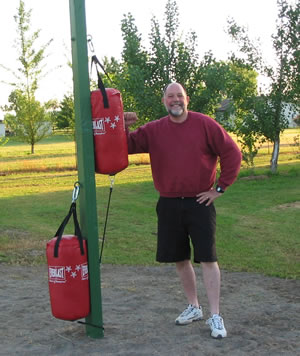
Mike Garofalo, Bagua Circle Training Area

Here is my Bagua Zhang Circle training area in my backyard in Red Bluff, California. I had hung the Everlast punching bags to the post before I started the baguazhang practice. Then, as I do my baguazhang circle training practice, I get a energy boost by smashing the upper bag with palm strikes and the lower bag with side heel kicks or sweeping take-down kicks as I circle around the post. This practice session took place at around 7 in the morning.

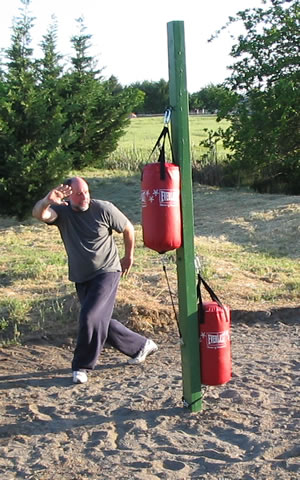
Mike Garofalo, Bagua Circle Training Area

Here I'm practicing the Yin style of Baguazhang, the Bear Posture/Forms. This practice session took place at around 7 in the evening.


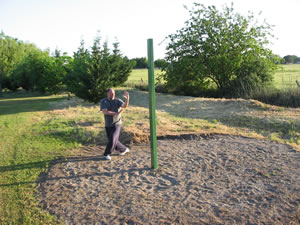
Mike Garofalo, Bagua Circle Training Area

I am fortunate to have a large outdoor area for practicing Baguazhang, Taijiquan and Qigong. This baguazhang practice session took place at around 7 in the evening.

The sandy surface is slower than hard clay, bricks or concrete. Just toss shovelfulls of sand around every so often, rake smooth and level, and then resume your practice on a like-new circle. This has been a much better solution than the mucky clay in the wet winters in Red Bluff.

Monday, September 29, 2025

Tao Te Ching by Lao Tzu, Chapter 38


Daodejing, Laozi
Chapter 38

"A truly good man is not aware of his goodness,
And is therefore good.
A foolish man tries to be good,
And is therefore not good.
A truly good man does nothing,
Yet leaves nothing undone.
A foolish man is always doing,
Yet much remains to be done.
When a truly kind man does something, he leaves nothing undone.
When a just man does something, he leaves a great deal to be done.
When a disciplinarian does something and no one responds,
He rolls up his sleeves in an attempt to enforce order.
Therefore when Tao is lost, there is goodness.
When goodness is lost, there is kindness.
When kindness is lost, there is justice.
When justice is lost, there ritual.
Now ritual is the husk of faith and loyalty, the beginning of confusion.
Knowledge of the future is only a flowery trapping of Tao.
It is the beginning of folly.
Therefore the truly great man dwells on what is real and not what is on the surface,
On the fruit and not the flower.
Therefore accept the one and reject the other."
-  Translated by Gia-fu Feng and Jane English, 1989, Chapter 38  


"Those who possessed in highest degree the attributes of the Tao did not seek to show them, and therefore they possessed them in fullest measure.
Those who possessed in a lower degree those attributes sought how not to lose them, and therefore they did not possess them in fullest measure.
Those who possessed in the highest degree those attributes did nothing with a purpose, and had no need to do anything.  
Those who possessed them in a lower degree were always doing, and had need to be so doing.
Those who possessed the highest benevolence were always seeking to carry it out, and had no need to be doing so.
Those who possessed the highest righteousness were always seeking to carry it out, and had need to be so doing.
Those who possessed the highest sense of propriety were always seeking to show it, and when men did not respond to it, they bared the arm and marched up to them.
Thus it was that when the Tao was lost, its attributes appeared;
When its attributes were lost, benevolence appeared;
When benevolence was lost, righteousness appeared;
When righteousness was lost, the proprieties appeared.
Now propriety is the attenuated form of leal-heartedness and good faith, and is also the commencement of disorder.
Swift apprehension is only a flower of the Tao, and is the beginning of stupidity.
Thus it is that the Great man abides by what is solid, and eschews what is flimsy; dwells with the fruit and not with the flower.
It is thus that he puts away the one and makes choice of the other."
-  Translated by James Legge, 1891, Chapter 38 


"A man of sure fitness, without making a point of his fitness,
Stays fit;
A man of unsure fitness, assuming an appearance of fitness,
Becomes unfit.
The man of sure fitness never makes an act of it
Nor considers what it may profit him;
The man of unsure fitness makes an act of it
And considers what it may profit him.
However a man with a kind heart proceed,
He forgets what it may profit him;
However a man with a just mind proceed,
He remembers what it may profit him;
However a man of conventional conduct proceed, if he be not complied with
Out goes his fist to enforce compliance.
Here is what happens:
Losing the way of life, men rely first on their fitness;
Losing fitness, they turn to kindness;
Losing kindness, they turn to justness;
Losing justness, they turn to convention.
Conventions are fealty and honesty gone to waste,
They are the entrance of disorder.
False teachers of life use flowery words
And start nonsense.
The man of stamina stays with the root
Below the tapering,
Stays with the fruit
Beyond the flowering:
He has his no and he has his yes."
-  Translated by Witter Bynner, 1944, Chapter 38


"The highest virtue is un-virtue, therefore it has virtue,
Inferior virtue virtue loses not, and so has none,
The highest virtue is non-action, and thereby does nothing,
Inferior virtue acts it, and exists by acting done.
The highest benevolence acts it, but thereby does nothing,
The highest righteousness acts it, and acting has thereby,
The highest propriety acts it, and then, when none respond,
It stretches forth its arm, and enforces its reply.
 
So, when the Tao is lost to sight, its attributes are shown,
When these are lost to sight, we find Benevolence appear,
When Benevolence is lost to sight, then Righteousness comes on,
And when Self-righteousness is lost, Propriety is here.
Now, these propriety-things are shams of loyalty and faith,
Forerunners of disorder, which soon will come to be,
Quick-wittedness is but the flimsy flower of the Tao,
And is the first beginning of man's incapacity.
With the solid dwells the solid man, not with the empty shell,
With the mature fruit he abides, but with the flower not he,
The latter he avoids, that the former his may be."
-  Translated by Isaac Winter Heysinger, 1903, Chapter 38  


上德不德, 是以有德.
下德不失德, 是以無德. 
上德無為而無以為.
下德為之, 而有以為. 
上仁為之, 而無以為.
上義為之, 而有以為.   
上禮為之.
而莫之應.
則攘臂而扔之. 
故失道而後德. 
失德而後仁.
失仁而後義失義.
而後禮. 
夫禮者, 忠信之薄, 而亂之首.   

前識者, 道之華而愚之始. 
是以大丈夫處其厚, 不居其薄.
處其實, 不居其華. 
故去彼取此. 
-  Chinese characters, Tao Te Ching, Chapter 38


shang tê pu tê, shih yi yu tê.
hsia tê pu shih tê, shih yi wu tê.
shang tê wu wei erh wu yi wei.
hsia tê wei chih, erh yu yi wei.
shang jên wei chih, erh wu yi wei.
shang yi wei chih, erh yu yi wei.
shang ki wei chih.
erh mo chih ying.
tsê jang pi erh jêng chih.
ku shih tao erh hou tê. 
shih tê erh hou jên.
shih jên erh hou yi shih yi.
erh hou li.
fu li chê, chung hsin chih pao, erh luan chih shou. 
ch'ien shih chê, tao chih hua erh yü chih shih.
shih yi ta chang fu ch'u ch'i hou, pu chü ch'i pao.
ch'u ch'i shih, pu chü ch'i hua.
ku ch'ü pi ch'ü tz'u.
-  Wade-Giles Romanization, Tao Te Ching, Chapter 38 


"Superior energy is non-action, hence it is energy.
Inferior energy will not resign action; hence, it is not energy.
Superior energy is actionless because motiveless.
Inferior energy acts from motive.
Superior magnanimity is active but motiveless.
Superior equity is active from motive.
Superior propriety is active; is bares its arm and asserts itself when it meets with no response.
Thus as the Tao recedes there are energies; as the energies recede there  is magnanimity; 
as magnanimity recedes there is equity; as equity recedes there is propriety.
Inasmuch as propriety is the attenuation of conscientiousness it is the origin of disorder.
The beginnings of consciousness are flower of Tao, but the commencement of delusion.
Therefore the men who are great live with that which is substantial, 
they do not abide with realities, 
they do not remain with what is showy. 
The one they discard, the other they hold."
-  Translated by C. Spurgeon Medhurst, 1905, Chapter 38 
 
 
"La virtud superior no se precia de virtuosa,
esa es su virtud.
La virtud inferior aprecia su propia virtud,
por eso no tiene virtud.
La virtud superior no actúa por intereses personales.
La virtud inferior sí actúa por intereses personales.
La bondad actúa sin requerir de motivaciones para hacerlo.
La justicia actúa, pero requiere de motivaciones para hacerlo.
El ritual actúa
y, al no hallar respuesta, la impone por la fuerza.
Así, perdido el Tao, queda la virtud.
Perdida la virtud, queda la bondad.
Perdida la bondad, queda la justicia.
Perdida la justicia, queda el ritual.
El ritual es sólo la apariencia de la fe y la lealtad,
pero es en realidad el origen de todo desorden y confusión.
La precognición es sólo una flor del Tao
y suele dar origen a la necedad.
Así, el sabio
observa lo profundo y no lo superficial.
Se atiene al fruto y no a la flor,
rechaza esto y prefiere aquello."
-  Translation from Wikisource, 2013, Capitulo 38


"When conduct is of high virtue, one is unconscious of virtue, thus he can accomplish virtue.
When conduct is of low virtue, one is conscious of virtue, thus he cannot accomplish virtue.
High virtue does not contrive and has no desire for gain.
Low virtue also does not contrive but has desire for gain.
High benevolence does contrive yet it has no desire for gain.
High righteousness does contrive and also has desire for gain.
High ritual does not only contrive and desire, but is also violent:
if it finds no response at all, it resorts to fighting its way out with stretched arms.
Hence when Dao is losing, then its virtues are losing.
When virtues are losing, benevolence is encouraged.
When benevolence is losing, the righteousness is encouraged.
When righteousness is losing, then rituals are encouraged.
Rituals stand for the lack of loyalty and reliability and are the beginning of disorder.
Divination stands for the emotional performance of Dao and is the beginning of stupidity.
Therefore the superior man prefers to possess few things rather than an abundance, to have insight rather than to see superficially.
Thus he prefers insight to superficiality."
-  Translated by Tang-Zi Chang, Chapter 38


Chapter and Thematic Index (Concordance) to the Tao Te Ching


Taoism: A Selected Reading List


 A typical webpage created by Mike Garofalo on a Chapter of the Tao Te Ching (Daodejing) by Lao Tzu (Laozi) includes at least 16 different translations or interpolations of the Chapter in English, two Spanish translations, the Chinese characters for the Chapter, a Wade-Giles and Hanyu Pinyin Romanization of the Mandarin Chinese words for the Chapter, recommended reading lists, a detailed bibliography, indexing by key words and terms for the Chapter in English, Spanish, and the Wade-Giles Romanization, and other resources for the Chapter.