Tuesday, October 31, 2006

Halloween Party Time

Party for Infants

My grand-daughter's first Halloween party.

"October gave a party;
The leaves by hundreds came-
The Chestnuts, Oaks, and Maples,
And leaves of every name.
The Sunshine spread a carpet,
And everything was grand,
Miss Weather led the dancing,
Professor Wind the band."
- George Cooper, October's Party


"Radiant joy is everywhere.
Spirits in tune to the spicy air,
Thrill in the glory of each day.
Life's worth living when we say, October!"
- Joseph Pullman Porter

October: Poems, Sayings, Lore, Links, Quotations

Monday, October 30, 2006

Positive Mindset

"What are the qualities that make one's mindset positive?
They include being able to:

Think in a calm, pacified, and reflective manner instead of being disturbed, agitated, and impulsive in one's reactions.

Put ideas together rationally and arrive at the right judgment even in the absence of obvious evidence or proof.

Decide, plan, and execute a course of action in a patient, persistent, and disciplined manner.

Recognize the changes and be flexible in adapting to them.

Observe and perceive things with a sense of humor instead of outrage, indignation, and anger.

Let go of useless and counterproductive thoughts, desires, and ambitions instead of being preoccupied with them.

Relax and meditate or rest.

Resist temptation and coercion."

- Michael Fekete, Strength Training for Seniors, Hunter House, 2006, p. 36


Strength and Muscle Building Search Portal

Sunday, October 29, 2006

Feather River - North Fork

Karen and I enjoyed a day trip in Northern California. We explored Highway 70 from Oroville up to Quincy. This road follows the North Fork of the Feather River. The dramatic rock canyons and the varied autumn colors were a special highlight of the trip.

Saturday, October 28, 2006

Walking the Sacred Circle


Sacred Circle
Originally uploaded by Karen and Mike Garofalo.

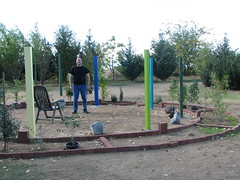
Mike Garofalo standing in the center of the Sacred Circle at the Valley Spirit Center in Red Bluff, California. Looking East.


This new addition of a "Sacred Circle" or "Cosmos Circle" is part of the the emphasis I have placed upon the mind/body movement arts of Walking Meditation.

Friday, October 27, 2006

Thursday, October 26, 2006

Work and/or Play

"The supreme accomplishment is to
blur the line between work and play."
- Arnold Toynbee

"In Hindu philosophy the whole creation is regarded as the Vishnu Lila,
the play of Vishnu. Lila means dance or play. Also in Hindu philosophy,
they call the world illusion; and in Latin the root of the word
illusion is ludere, to play."
- Alan Watts, Work as Play

"We may play with and pass on a garden, possessing one is an illusion.
Gardeners must dance with feedback, play with results, turn as they learn.
Some gardeners don't grow old and stop playing; they stop playing and grow old.
Nature's playfulness is a gardener's delight.
A garden is a sporting field, an area for play."

- Michael P. Garofalo, Pulling Onions: The Maxims of Gardening

Wednesday, October 25, 2006

Internet Librarians Conference

I enjoyed my recent trip to Monterey, California, to attend the Internet Librarian Conference 2006. I benefitted from the presentations about library fundrasing, wikis, social software, Flickr, RSS, and gaming.

I walked during lunch hours and after the conference presentations, used the hotel exercise room, and attended a local yoga class. We all enjoyed the beautiful weather in Monterey.

Friday, October 20, 2006

Salutations to the Sun

Greeting the Sun

"Keep your face to the sunshine and you cannot see the shadow."
- Helen Keller

"I believe in the cosmos. All of us are linked to the cosmos. Look at
the sun: If there is no sun, then we cannot exist. So nature is my god.
To me, nature is sacred; trees are my temples and forests are
my cathedrals."
- Mikhail Gorbachev

Green Way Wisdom - Sun

I often take a long walk, and practice tai chi chuan and qigong/yoga, at daybreak. I find that the early morning is the best time for mind/body practices. This helps me reflect on The Way (Tao).


The Way

Thursday, October 19, 2006

Sun Style Taijiquan

Lately, I have been studying and practicing the Sun Style Tai Chi Chuan 73 Competition Form. I have been using instructional videotapes by Paul Lam, Liang Shou-Yu, Jesse Tsao, Men Hui-Feng, Li Cheng-Xiang, and Jiang Jian-Ye to learn the form.

Sun Style Taijiquan is done at a "lively step" pace. The average time for the performance of the form is around 6 minutes for 73 movements.

Complete Performance of Sun Taijiquan International Competition 73 Form

Time Performer Source

5:31 Liang, Shou-Yu Sun Style Taijiquan with Applications, VHS, 1996
5:17 Tsao, Jesse Tai Chi Sun Style Competition Form 73, VHS, 2002
9:22 Jiang, Jian-Ye Sun Sytle Tai Chi Competition Form 73, VHS, 1997
7:30 Lam, Paul Sun Style Tai Chi - 73 Forms, The Competition Form, VHS, 2000
5:42 Men, Hui-Feng Sun Style Tai Chi - 73 Forms, The Competition Form, VHS, 2000
3:52 Li, Cheng-Xiang Sun Style Long Competition Form 73, VCD


My favorite instructional videotape is Sun Style Tai Chi - 73 Forms. The Competition Forms. An instructional videotape by Dr. Paul Lam. Narwee, Australia, East Action Video, 2000. A competition form created by Professor Men Hui Feng of Beijing University based on the Sun style. "This detailed instructional video includes a demonstration of the set by its creator, Professor Men Hui-Feng. Sun style is characterised by its powerful qigong elements, agile steps and flowing movements." VHS, 103 minutes. Contents: Introduction to Tai Chi and the Sun style. Comprehensive instructions. Demonstrations of the complete set by Dr. Paul Lam from front and back views. A demonstration by the creator of the set, Professor Men Hu--Feng. ASIN: B000066G1T."

My webpage on the subject of Sun Style Tai Chi Chuan provides a list of the movements in the Sun Style 73 competition form.

Wednesday, October 18, 2006

Strength Training for Seniors

I enjoy and benefit from strength training activities four to
five days every week.

Persons over 60 will need to develop a program of strength training
appropriate to their physical condition, time available, equipment
available, knowledge, goals, and age.

Persons beginning a strength training program might find the
following book to be useful to them:

Strength Training for Seniors: How to Rewind Your Biological Clock.
By Michael Fekete, CSCS, ACE.
Alamedia, California, Hunter House, 2006. Index, 134 pages.
ISBN: 0897934784.

Tuesday, October 17, 2006

Chang San Feng

"The legends of “Zhang Sanfeng’s creation of taiji quan” continued in some of the most important modern taiji quan books, such as Xu Yusheng’s 許禹生 Taijiquan Tushi Jie 太极拳势图解, or a Elucidation of Taijiquan Postures in 1921, Sun Loutang’s 孫祿堂 Taiji Quanxue 太極拳學, or the Learning of Taiji Quan in 1924, Ceng Weiming’s 陳微明 Taiji Quan Shu 太極拳術, or the Art of Taiji Quan in 1925, and Yang Chengfu’s 揚澄甫 Tiaji Quan Tiyong Quanshu 太極拳體用全書, or the Essence and Applications of Taiji Quan in 1934, and in the oral traditions as well. According to Xu Zhen 許震 (1898-1967), the source of Zhang Sanfeng’s association with Taiji quan must have been the Yang family partisans no earlier than Guangxu 光緒 reign (1875-1904) of the Qing dynasty. (Xu Zhen, 112) The attribution of “Zhang Sanfeng’s creation of taiji quan” was seriously taken as a creed, and this creed has been concretized via lineage records, ceremonies, altars, and iconography to the majority of taiji quan enthusiasts."

Literati Tradition: The Origins of Taiji. The Origins of Tai Chi - The Chang San Feng Camp. By Bing YeYoung. A well researched article. Includes bibliographical references. 36Kb.


Chang San-Feng, Taoist Master. Brief biography, links, bibliography, quotations, and a study of the "Treatise on Tai Chi Chuan". Compiled by Michael P. Garofalo. Includes poems and commentary by Mike Garofalo. Red Bluff, California, Green Way Research, 2005. 75Kb.

Monday, October 16, 2006

Sun Style Tai Chi Chuan

Sun Style Taijiquan: Bibliography, Links, Quotations, Resources, List of Movements of 73 competition form, information on Sun Lu Tang, and Notes.
By Mike Garofalo. 142 Kb.

Sun Style Bagua Zhang

Sun Style Sword

Sun Style Hsing Yi Chuan

Sunday, October 15, 2006

Walking Meditation

"You may also want to bring the practice of wogging into your life.
Half slow walking (going uphill) and freely surrendered, speedy
jogging (going downhill), it may become your preferred meditation
posture or form of dance. The goal of the practice is not to condition
the body aerobically; that happens as a natural byproduct. The goal
of the practice is to open to and merge with the breath, letting your
natural, surrendered breath determine how fast or slow your body
moves, to stay as loose and relaxed as possible, to let every part of
the body move as fluidly as possible, to surrender to the sensation
and energies of the body as you keep playing with balance, to keep
emptying the mind and staying in clear perception of vision and sound.
Full-bodied breath comes easier during a wog than during any other
activity. Sensations can be felt through the entire body. Vision can
become very clear, and the mind can stay very empty."
- Will Johnson, Yoga of the Mahamudra, 2005, p. 134

"The rhythm of walking generates a kind of rhythm of thinking, and
the passage through a landscape echoes or stimulates the passage
through a series of thoughts. The creates an odd consonance between
internal and external passage, one that suggests that the mind is
also a landscape of sorts and that walking is one way to traverse it.
A new thought often seems like a feature of the landscape that was
there all along, as though thinking were traveling rather than making."
- Rebecca Solnit, Wanderlust: A History of Walking, p. 5.

Saturday, October 14, 2006

Walking: Links, Bibliography, Quotations

Walking: Bibliography, Links, Resources, Quotations, Notes.
By Michael P. Garofalo. 120Kb.

Walking Meditation

"A person's heart and mind are in chaos.
Concentration on one thing makes the mind pure.
If one aspires to reach the Tao,
one should practice walking in a circle."
- Taoist Canon

"Above all do not lose your desire to walk. Everyday I walk myself into
a state of well being and walk away from every illness. I have walked
myself into my best thoughts and I know of no thought so burdensome
that one cannot walk away from it. But by sitting still, and the more
one sits still, the closer one comes to feeling ill...if one keeps on
walking everything will be alright."
- Soren Kierkegaard

Walking Quotations

Friday, October 13, 2006

Sun Lu Tang 1861-1933

Chronology of Granmaster Sun Lu Tang's Life:

1861 Born. His given name was Sun Fu Quan. He was born in a simple home,
near the city of Bao Ding, in Wan County, in Hebei Province.

1861-1871
His father was a poor farmer in Dingxian County in Hebei Province
His father died when he was a child and the family lost their farm.
Worked as a servant for a rich man.
Learned Shaolin Hung Boxing from Master Wu.
Lived with and worked for his uncle, and studied calligraphy.
Started learning Hsing I Quan martial arts from Li Kui Yuan.
Sun Lu-Tang became a formal discipline of Li Kui Yuan

1882 Started learning Hsing I Quan from Guo Yun Shen.

1891 Started learning Dragon style Pa Kua Chuan from the famous
Pa Kua master Cheng T'ing Hua.(1848-1900)
Master Cheng's nickname for Sun was "More Clever Than an Active Monkey."

1891 Married Zhang Zhou Xien (1863-1934)
First son, Sun Xing Yi (1891-1929)
Second son, Sun Cun Zhou (1893-1963)
Daughter, Sun Jian Yun (1913-2003)
Third son, Sun Huan Min (1897-1922)

1894 Started using the name 'Sun Lu Tang' given to him by Cheng T'ing Hua

1894 Studied Yi Jing theory and Emei Qigong in mountains of Sichuan

1895 Studied Taoism in the Wu Dang Mountains

1896 Established the Pu Yang Boxing Association in Bao Ding

1899 Moved to Xing Tang, 80 miles from Beijing, and taught martial arts

1907 Taught in Northern China for the General Governor, Xu Shi Chang

1910 Established three marital arts schools in Beijing and Tianjin
He lived in eastern Beijing from 1910-1932.
Sun Lu-Tang possessed extraordinary abilities and knowledge of the martial
arts, including legendary fast footwork, leaping, climbing, and endurance skills.
He had many talented and devoted students. He was a successful businessman.
He was know by numerous nicknames: "Tiger Head Hero, First Hand Under
the Sky, and Smarter than an Active Monkey." Sun weighted 140 pounds.

1911 Learned Wu Yu-xiang style of Taijiquan from Hao Wei Chen (1849-1920)
Sun was 50 years of age when he learned Wu Yu-xiang style Taiji.

1913 Sun Jian Yun, daughter is born. She died on 10/2/2003. She was a Sun Grandmaster.

1914 Sun began creating Sun style Taijiquan. He was 52 years of age.

1915 Xing Yi Quan Xue: The Study of Form-Mind Boxing by Sun Lu Tang is published.
Sun Lu-Tang taught in Beijing, Nanjing, Shanghai, Suzhou and Hangzhou between
1915-1932.

1916 The Study of Ba Gua Boxing is published.

1919 Sun was a Lieutenant in the Army in Beijing, teaching martial arts from 1919-1924

1921 The Study of Tai Ji Quan is published.

1921 During his 60th birthday party his personal notebooks and diaries were stolen.

1924 The True Essence of Boxing is published.

1927 The Study of Ba Gua Sword is published.

1929 Wrote The Study of the Xing Yi Spear; but, the work was not published.

1931 He was the first noted teacher to offer martial arts courses for women at
Zhe Jiang Martial Arts School.

1933 Sun Lu-Tang died on December 16, 1933. He was 72 years old.
He became ill and then fasted and meditated until he died peacefully.
Sun Lu Tang's gravestone shows his life-span to be: 1862-1933.
Some documents say he was born in 1861 and died in 1932.
Sun Lu Tang returned to the house he was born in the last few months of
his life, and died in the room where he was born.


The Sun Style Taijiquan webpage includes a detailed bibliography, links, resources, quotations, a list of movements in the 73 Sun competition form, photos, and notes. 145Kb. By Michael P. Garofalo.