Monday, December 11, 2017

Looking for a Place to Happen with the Tragically Hip


The Place was Dodge City, Kansas; and the Happening was in June of 1972. 

Karen and I, driving in our orange Volkswagon bug, at the 100th meridian.

Driving for hours. Incredible thunder and lightening in Kansas.  Nervous.  Country kitchen breakfasts. Delightful lovemaking in small town motel rooms.  Smiling Americans.  Being young.  Wheat and Big Spaces!!! 

Karen and I have never been to Winnipeg in Canada like the Hip band, but we've been across parts of the Great Plains and the Great Basin and Mojave deserts many times.

“At the hundredth meridian,” by the Tragically Hip band, 1992.


“Me debunk an American myth?
And take my life in my hands?
Where the great plains begin,
At the hundredth meridian
At the hundredth meridian,
Where the great plains begin.

Driving down a corduroy road,
Weeds standing shoulder high
Ferris wheel is rusting off in the distance
At the hundredth meridian
Where the great plains begin.

Left alone to get gigantic
Hard, huge and haunted
A generation so much dumber than it's parents came
Crashing through the window
A raven strains along the line of the road,
Carrying a muddy, old skull
The wires whistle their approval,
Off down the distance
At the hundredth meridian
Where the great plains begin
At the hundredth meridian.
At the hundredth meridian
Where the great plains begin

I remember, I remember Buffalo
And I remember Angelo
It would seem to me I remember every
Single fucking thing I know.

If I die of vanity, promise me, promise me,
They bury me some place I don't want to be,
You'll dig me up and transport me, unceremoniously,
Away from the swollen city-breeze, garbage bag trees,
Whispers of disease and the acts of enormity
And lower me slowly, sadly and properly
Get Ry Cooder to sing my eulogy,
At the hundredth meridian
Where the great plains begin.”

At the Hundredth Meridaian, the Tragically Hip band. Writers: Gord Downie, Robert Baker, Paul Langlois, Johnny Fay, Gordon Sinclair. 1992. 
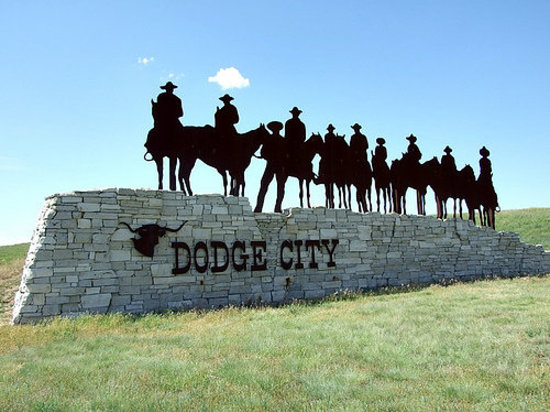


Image result for dodge city ks


"I've got a job, I explore, I follow every little whiff
And I want my life to smell like this
To find a place, ancient race, the kind you'd like to gamble with
Where they'd stamp on burning bags of shit

Lookin' for a place to happen, makin' stops along the way

Wayward, away we go, it's a shame to leave this masterpiece
With it's gallery gods and it's garbage-bag trees
So I'll paint a scene from memory, so I'd know who murdered me
It's a vain pursuit but it helps me sleep

Lookin' for a place to happen, makin' stops along the way

Jacques Cartier, right this way, I'll put your coat up on the bed
Hey man, you've got a real bum's eye for clothes
And come on in, sit right down, no you're not the first to show
We've all been here since, God, who knows

Lookin' for a place to happen, makin' stops along the way

Jacques Cartier, right this way, I'll put your coat up on the bed
You've got a real bum's eye for clothes
Come on in, sit right down
We've all been here since, God, who knows."


Looking for a Place to Happen, by the Tragically Hip band. Writers: Gord Downie, Robert Baker, Paul Langlois, Johnny Fay, Gordon Sinclair, 1993


"Long Time Running is a Canadian documentary film, which premiered at the 2017 Toronto International Film Festival. Directed by Jennifer Baichwal and Nicholas de Pencier, the film profiles the Canadian rock band The Tragically Hip during their final tour in 2016, the Man Machine Poem Tour." The lead singer, Gord Downie, passed away from brain cancer at age 53 in October of 2017.


The two songs shared above by the Tragically Hip band where from the compilation album Fully Completely released in 2014.

Sunday, December 10, 2017

Yang Style Taijiquan Characteristics

Characteristics of Yang Style Taijiquan

     "The distinctive characteristics of Yang Chengfu style Taijiquan are: the postures are relaxed and expansive, simple and clean, precise in composition; the body method is centered and aligned, not inclining or leaning; the movements are harmonious and agreeable, containing hard and soft, uniting lightness of spirit and heaviness of application.  In training, one attains softness from loosening/relaxing (song).  In accumulating softness one develops hardness; hardness and softness benefit one another [mutually interact].  

     The postures may be high, middle or low, so that one is able to make appropriate adjustments in the measure of the movements according to factors of age differences, sex, bodily strength, or differing demands of the student.  Because of this, it is as suitable for treating illness or protecting health as it is for increasing strength and fitness or increasing the artistic skill of one who is relatively strong to begin with.

     The postures of Yang style Taijiquan are expansive and open, light yet heavy, nature, centered and upright, rounded and even, simple, vigorous, and dignified,─because of this, one is able to quite naturally express and individual style that is grand and beautiful."

-  Introduction by Gu Liuxin, pp. 7-8.  Found in Mastering Yang Style Taijiquan.  Bu Fu Zhongwen (1903-1994).  Translated by Louis Swaim.  Berkeley, California, Blue Snake Books, North Atlantic Books, 1999, 2006.  Glossary, bibliography, 226 pages.  Translations of many Tai Chi classics are included.  A list of the 85 movement long form and detailed notes and descriptions of each movement are provided. 


Saturday, December 09, 2017

Five Beneficial Methods in the Study of Taijiquan

 Five Aims in the Study of Tai Chi Chuan

"1.  Your study should be broad and diversified.  Do not limit yourself.  This principle (virtue) can be compared to your stance, which moves easily in many different directions.  

2.  Examine and question.  Ask yourself how and why Tai Chi works.  This principle can be compared to your sensitivity, which is receptive to that which others ignore.  

3.  Be deliberate and careful in your thinking.  Use your mind to discover proper understanding.  This principle can be compared to your understanding power.

4.  Clearly examine.  Separate concepts distinctly, then decide upon the proper course.  This principle can be compared to the continuous motion of Tai Chi.

5.  Practice sincerely.  This principle can be compared to heaven and earth, the eternal."
T'ai Chi Classics, translations and commentary by Waysun Liao, p. 125 


Tai Chi Classics.  By Waysun Liao.  New translations of three essential texts of T'ai Chi Ch'uan with commentary and practical instruction by Waysun Liao.  Illustrated by the author.  Boston, Shambhala, 1990.  210 pages.  ISBN: 087773531X.  VSCL. 


Fair Lady Works the Shuttles
My upper torso and head are leaning a bit to much to the the right.
My lunge stance is strong.
A cold day in Winter in Red Bluff, California

Wednesday, December 06, 2017

Cardiac Rehabilitation Program


I participate in the Cardiac Rehabilitation program at the Peace Health Hospital in Vancouver on Mill Plain Avenue.  I had a stent implanted in my left arterial descending (LAD) in my heart on 10/18, and a pacemaker implanted in my heart on 6/9.  

I attend physical exercise classes on Monday, Wednesday, and Friday morning from 10 to 11:30 am.  I attend a heart health lecture on Wednesday from 9 to 10 am.  

I take a blood sugar test before and after the class, blood pressure is taken three times during the class, exertion levels are monitored, and I wear a electronic heart monitor that shows results on a computer monitor observed by experienced staff.  Staff members check and observe participants, and encourage you, and keep participation safe.  They contact heart physicians as needed.  

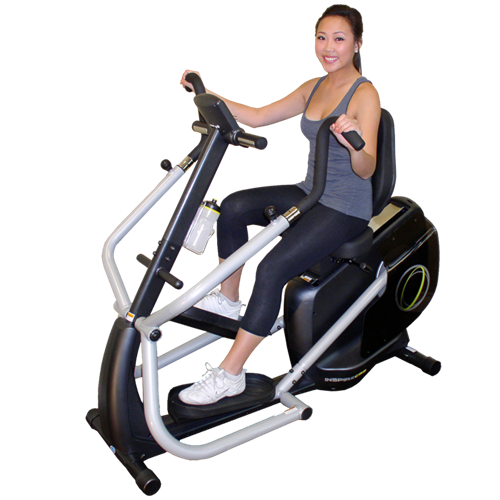
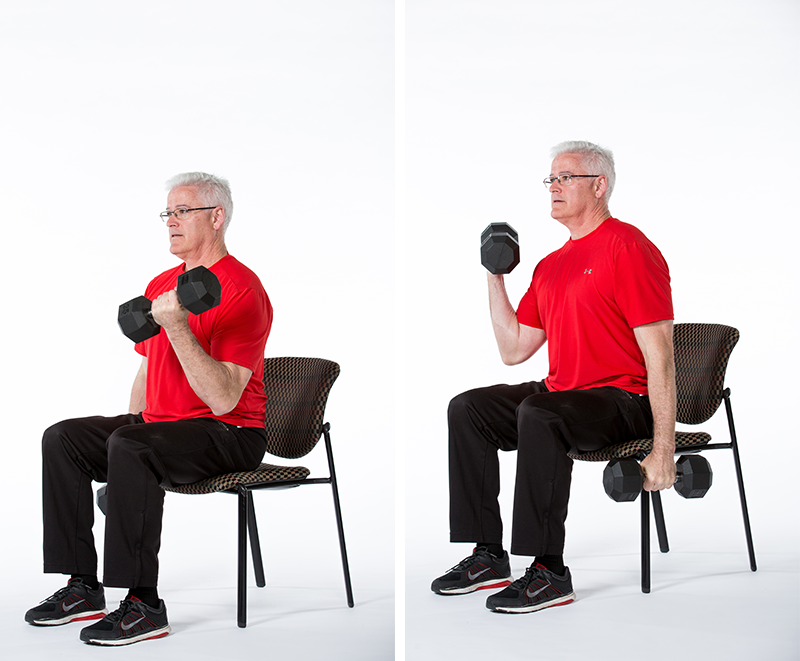
The physical exercises include 30 minutes of treadmill using pre-assigned levels of intensity settings (speed and incline).  25 minutes of seated incumbent bike.  30 minutes of chair exercises with weights or bands, and stretching.  

Diet is very important.  I try to eat under 1700 calories per day, reducing fat and salt and cheap carbohydrates.  My goal is to get my body weight to under 240 pounds, and I now weight 247.  

I take 4 medicines for heart problems.  This is an essential part of my medical program.  The medicines lower blood pressure, reduce clotting in the stent, prevent increased heartbeat, and includes a mild diuretic.   

I trust the team of therapists, nurses, physician's assistants, and physicians.  

Starting this weekend, I plan to add a similar workout on Saturday and Sunday at the LA Fitness gym on Fourth Plain Avenue near the Lewiston Highway (503).  


Image result for seated weight lifting for seniors

Tuesday, December 05, 2017

Walking Slowly

"Walking meditation means to enjoy walking without any intention to arrive. We don't need to arrive anywhere.  We just walk. We enjoy walking. That means walking is already stopping, and that needs some training.  Usually in our daily life we walk because we want to go somewhere. Walking is only a means to an end, and that is why we do not enjoy every step we take. Walking meditation is different. Walking is only for walking. You enjoy every step you take. So this is a kind of revolution in walking. You allow yourself to enjoy every step you take.
The Zen master Ling Chi said that the miracle is not to walk on burning charcoal or in the thin air or on the water; the miracle is just to walk on earth. You breathe in. You become aware of the fact that you are alive. You are still alive and you are walking on this beautiful planet. That is already performing a miracle. The greatest of all miracles is to be alive. We have to awaken ourselves to the truth that we are here, alive. We are here making steps on this beautiful planet. This is already performing a miracle.  But we have to be here in order for the miracle to be possible. We have to bring ourselves back to the here and the now."
-  Thich Nhat Hanh, Resting in the River


Walking Meditation:  Quotes, Bibliography, Links, Information, Methods 
Compiled by Mike Garofalo.


"Walking meditation is walking in full awareness of breath, body and everything the senses present.  It is not an aerobic exercise - though it would be a fine lead-in to aerobic walking.  Rather, walking meditation is done slowly and consciously, with each step fully feeling the earth.  During this precious time, body and mind come together, joined in the present moment.  Although the benefits of walking meditation will deepen over time, even from the start, you can experience some measure of the relaxation, balance and quiet energy that builds through this practice."
-  Ginny Whitelaw, Body Learning, p. 55.   


"Research conducted at Harvard Medical School’s Mind/Body Medical Institute has found that focused walking meditations are highly effective for reducing anxiety and producing  what’s called the “relaxation response.”
-  Borgess Health   


The Ways of Walking  Compiled by Mike Garofalo.


Saturday, December 02, 2017

Cape Blanco Lighthouse

Karen and I celebrated our 50th wedding anniversary together in Bandon, Oregon, in January, 2017.  We toured the area from Coos Bay to Bandon.  Karen and I stayed in a yurt at Bullard's Beach State Park. 

We visited the remote Cape Blanco lighthouse.  We both enjoyed the scenery around Shore Acres State Park in January, 2017.  

By April of 2017 we sold our home in Red Bluff, California, after living there for 18 years.  By June of 2017, we purchased a home in Vancouver, Washington.  We are settled in our new home as we approach the Yuletide, Solstice, Christmas, and the New Year holiday of 2018.  


Wednesday, November 29, 2017

Eight Immortals Cane Form


Tai Chi Chuan Cane/Stick/Staff/Zhang Weapons

Bibliography, Links, Styles, Instruction, Notes, Media, Resources, Lore

A hypertext notebook (374 KB) by Michael P. Garofalo, M.S., 11/24/2017


Mike Garofalo in Red Bluff, California.


Mike Garofalo con el bastón


Tuesday, November 28, 2017

Taiji Cane - Gene Burnett


Taiji Cane, Tai Chi Chuan Cane/Stick/Staff/Zhang
Bibliography, Links, Styles, Instruction, Notes, Resources
By Mike Garofalo


"Gene Burnett teaches T'ai-Chi in Ashland, Oregon, and has been teaching since 1985. He was certified to teach T'ai-Chi by Andrew Dale, chief instructor of the Xin Qi Shen Dojo in Seattle, Washington.  
He combines traditional Chinese principles of health, balance and self-defense with a Western, psychological, Bioenergetic approach in an on-going exploration of the body/mind connection."

Water Study Chi Kung with Gene Burnett

Gene Burnett teaches a two part cane form which can be used in partner practice.  He said that Andrew Dale created this interesting and valuable cane form, and it was based on an Aikido short staff form.  


I do not know how to do this cane form.  I am attracted to the types of strong offensive strikes.  You would need to be trained, practiced, calm, gentle, trusting, and follow formal rules for "safe' partner practice of this cane form.  

Anyone in Vancouver, Washington, want to learn and practice this cane form?  Write me.  


Gene Burnett offers many instructional videos on the Taiji Cane on Utube.  

Monday, November 27, 2017

Bau Daun Jin Research


Eight Section Brocade Chi Kung


Bibliography, Instructions, Links, Benefits, Exercises, History, Lore
A Hypertext Notebook
By Michael P. Garofalo, M.S.


463 Kb, November 28, 2017


Chi Kung (Dao-yin, Yang Sheng Gong, Qigong) are Various Ancient Chinese Exercise and Fitness Practices

The Eight Pieces of Beautiful Silk Brocade Chi Kung (Ba Duan Jin Qigong) is a popular Chi Kung Form.    

The Eight Treasures Dao-yin (Ways for Pulling, Stretching, and Guiding the Body-Mind Energies)

The Eight Useful Chi Kung Exercises for Improved Fitness, Vitality, Healing, and Longevity 

Eight Immortal Ones Taoist Longevity Practices  

Eight Beautiful Tapestries Chi Kung for Nourishing Life Training (Yang Sheng Gong)

A Shaolin Temple, Taijiquan and Martial Arts Warm-up Routine


Sunday, November 26, 2017

Eight Section Brocade


Draw the Bow and Let the Arrow Fly #2
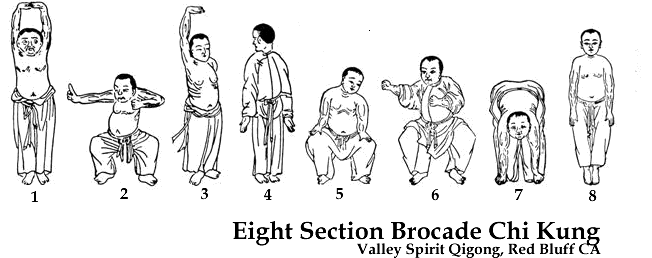
Eight Section Brocade, Ba Duan Jin

Sifu Fetyko leads us in the practice of the Ba Duan Jin, Eight Beautiful Tapestries, every time we practice Taijiquan together on Tuesday and Thursday morning from 8:45 am to 10:15 am in Vancouver, WA.  His version is slightly different from the many other versions I have been taught since 1975.  


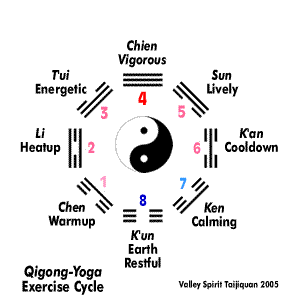
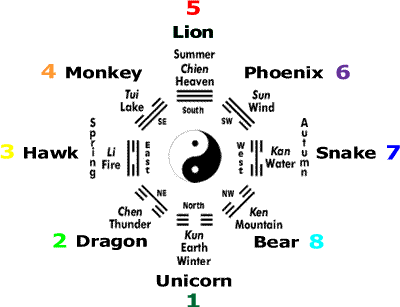
Sequence C:  Trigrams, Bagua, and Eight Section Brocade (Ba Duan Jin) Exercises Correlations

Soft Qigong (Rou Gong), Inner Qigong (Nei Gong); Slow Pace, Gentle, Soft, At Ease, Relaxed (Sung)Rooted/Sunk, Yin Style


Eight Section Brocade Exercise
I Ch'ing Trigram 
Parts of the Body Affected
1.  Pressing Up to the Heavens with
Two Hands
South, Summer
Ch'ienQián, Heaven, Sky, Air
Intense Yang
Lion
Heart, Small Intestine, Stomach, Lungs
(The Triple Warmer)
              
2.  Drawing the Bow   and Letting the Arrow FlySouthwest, Mid-Summer
Sun, Wind
Yang
Phoenix
Kidneys, Spleen, Waist, Eyes, Legs
                     
4.  Wise Owl Gazes BackwardWest, Autumn
K'an, Water
Yang-Yin
Snake
Lungs, Immune System, Large Intestine
                   
5.  Big Bear Turns from Side to SideNorthwest, Mid-Autumn
KenGèn, Mountain
Yin-Yang
Bear
Heart, Waist, Legs
                   
3.  Separating Heaven and EarthNorth, Winter
K'un, Earth
Intense Yin
Unicorn, Qilin
Spleen, Kidneys, Bladder, Pancreas
                        

8.  Shaking the BodyNortheast, Mid-Winter
ChenZhèn, Thunder
Yin
Dragon
Immune System, Calves, Feet
                         
6.  Punching with Angry GazeSpring, East
Li, Fire
Yin-Yang
Hawk, Falcon
Liver, Gallbladder, Blood, Eyes
                      

8.  Touching Toes then Bending BackwardsSoutheast, Mid-Spring
Tui, Lake
Yang-Yin
Monkey
Kidneys, Waist, Legs, Back

The above three charts were proposed in 2005 by Mike Garofalo, in his webpage on the Eight Section Brocade.  See also Mike's webpage on the Eight Trigrams.  


In 2014, Christina Barea-Young and Peyton Young provided another set of associations for the Eight Section Brocade movements with the Eight Trigrams in Qi Magazine (Volume 24, No. 2, 2014, p. 48).  

I find these kinds of correlations, associations, and relational charts quite inconsistent between various authors.  Yoga, Western Esoteric Magic, and Qigong have many of the same kind of charts and tables of correlations; again, with considerable inconsistency between various "masters."  Other than the "traditions of specific esoteric schools", I find the associations rather arbitrary and fanciful, primarily aids to remembering clusters of ideas, poetic devices, magical-metaphysical lore, and lacking in much pragmatic-scientific meaningfulness.  Contrast these charming and pre-scientific tables with the modern and justifiably famous "Periodic Table of the Elements" for a real lesson in an objective and empirical approach to understanding the world.  Nevertheless, these clusters of ideas may stimulate the imagination, and are fun for playing thought games.  


"The names of the 108 Forms are each symbolic and signify concepts removed from the literal  physicality of the object - horse, tiger, bird, and so forth.  Each name has its separate allusion, and metaphorically may connote an aspiration, a philosophical attitude towards self and  conduct, a turn of mind, a sense of being, some thought about life and spirit.  The true meanings are revealed when the T'ai-Chi Ch'uan exponent has advanced to that stage of experience comprehension where he can utilize the implication of the philosophical  intentions, and where the symbols can be part of his growing consciousness.  This happens only when the mind and body have "changed" and absorbed the reasons for mental, emotional, and physical unity."
-   Sophia Delza, The T'ai Chi Ch'uan Experience, 1996, p. 24

 
The above long chart is more readable on my Eight Section Brocade webpage, 441 KB, last updated on June 20, 2014.  


Saturday, November 25, 2017

Highway to Hades

Malcolm Young, lead guitarist and co-founder of the rock band AC/DC, died last week at the age of 64 from dementia. 

I purchased three albums by AC/DC.  High Energy!  Yes!!!!  Hell's Bells!


\

Friday, November 24, 2017

Dao De Jing, Chapter 5


Tao Te Ching by Lao Tzu
Chapter 5


"Nature is non-benevolent. 
It regards the masses as straw dogs.
The Holy Man is non-benevolent.
He regards the masses as straw dogs.
The space between the heaven and the earth is like a bellows;
though unsupported, it does not warp; when in motion the more it expels.
Though words could exhaust this theme, they would not be so profitable
As the preservation of its inner essence."
-  Translated by C. Spurgeon Medhurst, 1905, Chapter 5


"Nature is indifferent to life.
It realizes everything is as a straw dog
(a sacrificial animal-image).
The truly wise are also indifferent to life.
They realize humanity is as a straw dog.
The universe is like a bellows:
empty, yet quite full.
As it proceeds, it produces.
Much talk, much exhaustion.
Keep your thoughts within!"
-  Translated by C. Ganson, Chapter 5 


"Heaven and Earth do not claim to be kindhearted or pitiful.
To them all things and all creatures are as straw dogs brought to the sacrifice and afterwards discarded.
Nor is the Sage kindhearted or pitiful.
To him to the people are as straw dogs.
But the space between Heaven and Earth may be likened to a bellows:
It seems empty, and yet it gives all that is required of it.
The more it is worked, the more it yields.
Whereas the force puffed up by words is soon exhausted.
Better to hold fast to that which dwells within the heart."
-  Translated by Herman Ould, 1946, Chapter 5  


天地不仁, 以萬物為芻狗.
聖人不仁, 以百姓為芻狗.
天地之間, 其猶橐籥乎.
虛而不屈.
動而愈出.
多言數窮.
不如守中.  
-  Chinese characters, Chapter 5, Tao Te Ching


t'ien ti pu jên, yi wan wu wei ch'u kou.
shêng jên pu jên, yi pai hsing wei ch'u kou.
t'ien ti chih chien, ch'i yu t'o yo hu.
hsü erh pu ch'u.
tung erh yü ch'u.
to yen shu ch'iung.
pu ju shou chung.
-  Wade-Giles Romanization, Chapter 5, Tao Te Ching


"Heaven and Earth have no humanity;
They regard all things as straw-dogs.
The sage has no humanity;
He regards the people as straw-dogs.
Between Heaven and Earth, it is like a bellows or a flute!
Empty, but not exhausted;
With movement, more comes out.
Too much talk always exhausts;
It is better to keep to the inside."
-  Translated by Yi Wu, Chapter 5


"Heaven and earth are not merciful,
They treat all things as straw dogs;
The sage is not merciful,
He treats the people as straw dogs.
Does not the space between heaven and earth form like a bellows?
It is empty but the air in it can never be exhausted;
The more air it expels, the more comes out.
That is why too many government decrees only result in more failures.
It is better, therefore, to hold fast to moderation and the void."
-  Translated by Gu Zhengkun, Chapter 5


"Heaven and Earth are not humane.
They regard all things a straw dogs.
The sage is not humane.
He regards all people as straw dogs.
How Heaven and Earth are like a bellows.
While vacuous, it is never exhausted.
When active, it produces even more.
Much talk will of course come to a dead end.
It is better to keep to the centre."
-  Translated by Chan Wing-Tsit, 1963, Chapter 5   


"El universo no tiene afecciones humanas:
todas las cosas del mundo son para él como un perro de paja.
El santo no tiene affeciones humanas;
el pueblo es para él como un perro de paja.

El universo es iqual que un fuelle de forja;
vacío, pero no aplanado.
Cuanto máa se le mueve, más exhala,
cuanto más se habla de él, menos se le comprende,
más vale insertarse en el."
-  Translated by Alba, 1998, Tao Te Ching, Capítulo 5 


"Heaven and Earth are impartial; 
They see the ten thousand things as straw dogs.
The wise are impartial;
They see the people as straw dogs.
The space between heaven and Earth is like a bellows.
The shape changes but not the form;
The more it moves, the more it yields.
More words count less.
Hold fast to the center."
-  Translated by Gia-fu Feng and Jane English, 1989, Chapter 5  


"The Sage does not take sides,
He welcomes both saints and sinners.
The Tao works upon man as it works upon the grasses of the fields.
Sages act out of the need for rightness, not purely compassion.
The Tao is like a bellows, even though it appears empty, its workings are obvious,
Yet the more you use it the more it produces, it is inexhaustible.
Yet speaking of it will not increase the comprehension.
Hold to the center path."
-  Translated by John Dicus, 2002, Chapter 5 


"Heaven and Earth are not (willfully) benevolent
The myriad things are treated no differently
Than grass for dogs
Sages are not (willfully) benevolent
The hundred clans are treated no differently
Than grass for dogs
The gate of Heaven and Earth
Is it not like a bagpipe:
Empty yet not finished.
It moves, and again more is pushed forth
To speak countless words is worthless
This is not as good ad guarding balance within."
-  Translated by Dan G. Reid, 2016, Chapter 5 


"Heaven and earth are ruthless, and treat the myriad creatures as straw dogs;
the sage is ruthless, and treats the people as straw dogs.
Is not the space between heaven and earth like a bellows?
It is empty without being exhausted:
The more it works the more comes out.

Much speech leads inevitably to silence.
Better to hold fast to the void."
-  Translated by D. C. Lau, 1963, Chapter 5 


A typical webpage created by Mike Garofalo for each one of the 81 Chapters (Verses, Sections) of the Tao Te Ching (Daodejing) by Lao Tzu (Laozi) includes 25 different English language translations or interpolations for that Chapter, 5 Spanish language translations for that Chapter, the Chinese characters for that Chapter, the Wade-Giles and Hanyu Pinyin transliterations (Romanization) of the Mandarin Chinese words for that Chapter, and 2 German and 1 French translation of that Chapter.  Each webpage for each one of the 81 Chapters of the Tao Te Ching includes extensive indexing by key words, phrases, and terms for that Chapter in English, Spanish, and the Wade-Giles Romanization.  Each webpage on a Chapter of the Daodejing includes recommended reading in books and websites, a detailed bibliography, some commentary, research leads, translation sources, a Google Translate drop down menu, and other resources for that Chapter.  These are hypertext documents, and available online under Creative Commons 4.


Chapter 5, Tao Te Ching by Lao Tzu.  Complied by Mike Garofalo.  

Chapter and Thematic Index (Concordance) to the Tao Te Ching by Lao Tzu


English Language Daodejing Translators' Source Index


Spanish Language Daodejing Translators' Source Index


Ripening Peaches: Taoist Studies and Practices


Taoism: A Selected Reading List


Wednesday, November 22, 2017

Eight Immortals Cane

Here is a T'ai Chi Ch'uan Cane form that I enjoy practicing and have taught to many of my students: 

The Eight Immortals Cane Form.  Created by Master Jesse Tsao from San Diego, California.  Part I of this cane form is based on the Yang style of T'ai Chi Ch'uan.  This form has 36 movements.

Traditional Tai Chi Eight Immortals Cane, Routine One.  Demonstrated by Master Jesse Tsao.  Instructional DVD, 64 minutes.  Produced by Tai Chi Healthways, San Diego, 2008.  Routine One is based on the Yang Style of Taijiquan.  Master Tsao developed this cane form himself, with grandmaster Zhu Tiancai's support. 


Traditional Tai Chi Eight Immortals Cane, Routine Two (Cannon Cane).  Demonstrated by Master Jesse Tsao.  Instructional DVD, 65 minutes.  Produced by Tai Chi Healthways, San Diego, 2008.  Routine Two, Cannon Cane, is based on the Chen Style of Taijiquan.  Master Tsao developed this cane form himself, with grandmaster Zhu Tiancai's support.  


Way of the Short Staff.  By Michael P. Garofalo, M.S.  A comprehensive guide to the practice of the short staff, cane, jo, walking stick, gun, zhang, whip staff, 13 Hands Staff, and related wood short staff weapons.  A detailed and annotated guide, bibliography, lists of links, resources, instructional media, online videos, and lessons.   Includes use of the short staff and cane in martial arts, self-defense, walking and hiking.  Separate sections on Aikido Jo, Cane, Taijiquan cane and staff, Jodo, exercises with a short staff, selected quotations, techniques, selecting and purchasing a short staff, tips and suggestions, and a long section on the lore, legends, and magick of the short staff.  Includes "Shifu Miao Zhang Points the Way."  Published by Green Way Research, Valley Spirit Taijiquan, Red Bluff, California.  Updated on a regular basis since October, 2008.  Related to Mike's popular webpage on the Staff.


Toju Zenchu brandished his staff before Daoist Shifu Miao Zhang and challenged him "Miao Zhang, speak and you get whacked with Nanten's staff.  Do not speak and you still get whacked with Nanten's staff."
Shifu Zhang stood up quickly, lifted his cane strongly in defense, and quietly said, "Yunmen's shit stick stinks and Nanten's staff is cracked!  I am leaving now to take my evening walk. Goodbye." 


Taijiquan Cane Weapon Research, Bibliography, and Practices

Way of the Short Staff

Long Staff Weapons Practices 

Dr. Andy Fitz-Gibbon teaches Taijiquan and maintains a blog for the Way of Peace Taijiquan Association.  He is also the Abbot for the Lindisfarne Community in Ithaca, New York.  He is shown performing the Eight Immortals Cane form in the UTube video below. 


Monday, November 20, 2017

Tai Chi Chuan Cane


Taiji cane forms are typically performed slowly and deliberately.  Hard and powerful strikes are seldom used in T'ai Chi Ch'uan walking stick forms.  The pace of the Taijiquan cane forms are seldom fast and vigorous.  There are few if any vigorous leaps and jumps.  Taiji forms seldom use very low stances.  Taiji cane forms are particularly suitable for fit persons over 50 years of age.  Good examples of a Taiji Cane Form are: the Standard Beijing 24 Form with Cane created by Master Wen-Ching Wu; the Eight Immortals Cane Form, Part I, created by Master Jesse Tsao;  the Plum Blossom Taiji Cane Form; the Tai Chi Stick 18 Form;  the Bodhi Dharma Walking Stick Form; Master Michael Gilman's Three Powers Cane Form; the Wu Tang Cane Form of Master T.T. Liang; the Standard 32 Sword Form; etc.  

There are also many examples of more vigorous "Taiji" cane forms, with hard strikes, leaps, fast moves, spins, and low moves.  Taijiquan saber or broadsword forms are readily adapted for use with a cane, and some are fast and vigorous.  Normally, Taijiquan sword forms are not very well adapted as cane forms, but I practice the Standard 32 Sword Form with my cane as do many others.  Karate, kung fu, Shaolin, Bagua and HsingI cane or stick forms are often fast, vigorous, powerful, twisting, agile, and with some very low stances.  Of course, when first learning any new cane form, begin with a slower, more deliberate, less vigorous practice to help the body adapt to the moves of the new form.  Thus, even a fast and vigorous cane form from any style can be done more in the "Taiji" fashion outlined and shown above.  

Many Qigong (Chi Kung) forms can also we done while holding a cane.  Adaptations are quite easily arranged.  Most often, however, Qigong forms are adapted or created for use with a short 6"-12" wooden stick called a Tai Chi Ruler or Bang.  

I consider a cane or walking stick to be, normally, a straight strong wooden stick with a curved (hook) handle that is from 30" (76 cm) to 42" (107 cm) long.  The cane will typically extend from the floor to the height of your hip socket and maybe up to your belly button.  The cane might also be made out of plastic, aluminum, steel, or rattan.  The cane might have a straight rather than curved or hooked end with a round ball shaped (pommel) end or some sort of straight or carved handle at the end.  The cane might be very simple, natural and plain; or be carved, painted or decorated.  


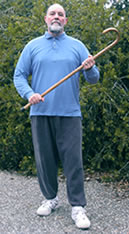
Each day I use an Instructor's Walking Cane, 40" (103 cm) long and 1" (2.54 cm) in diameter, purchased from Cane Masters.  This cane weights 1lb, 2 oz (510 gm).  This beautiful martial arts combat cane is made of pure hickory heartwood, has multiple notches at three key gripping points, has a ample rounded hooked horn, and has a rubber covered tip inserted over the tip end.  I also own the same Instructor's Walking Cane made of oak - a gift from my children.  I am 6'6" (198 cm) tall, and a 40" cane (103 cm) is perfect for using on my long walks and for my Taiji cane practices.  The only weapon I practice with on a daily basis is a wooden cane; and the only weapon I teach now in my Taijiquan classes is the cane.  Also, whenever I take a walk, anywhere, I bring my cane along for support, exercising the arms, and for self-defense.     


Taijiquan Cane Weapon Research, Bibliography, and Practices

Way of the Short Staff

Long Staff Weapons Practices