Wednesday, October 03, 2012

October Gardening Chores

Red Bluff, North Sacramento Valley, California, USA


Removing dead and non-productive vegetable crops. 
Planting starts and seeds of winter vegetable crops. 
Ordering seed and garden catalogs.
Remove all peppers in case of frost.
Reduce watering as temperature drops.
Watering plants as needed.
Being attentive to the effects of the cold dry winds. 
Planting potted trees and shrubs in the ground.
Placing cold sensitive potted plants in protected areas or indoors.
Planting bulbs.
Prune and mulch perennials. 
Storing and repairing tools.
Fertilize with 20-9-9 or 15-15-15. 
Trees without leaves need little or no watering.
Picking pumpkins, squash, colored corn, and other crops for Thanksgiving decorations.
Finish all digging and construction projects before the first rain.
Bring in wood and kindling to rain free storage areas.
Repair roofs on sheds and house.
Add fallen leaves to the compost pile.
Be prepared for chilling frosts.
Collect seeds from plants.
Start pruning berry vines.


"Since we do experience droughts nearly every summer, it is crucial to provide supplemental irrigation to newly installed (spring) landscapes. Generally this means a couple of hours of watering once or twice a week. Keep in mind that trees and shrubs planted in the spring and summer use a significant amount of their resources for above-ground growth. Since root growth is favored during the dormant season, it’s best to install landscape plants in the fall. It has been demonstrated that shrubs and trees planted during the fall suffer less environmental stress than those planted in the spring or summer."
-   Dr. Linda Chalker-Scott


We favor planting potted trees and shrubs in the ground starting in late October in Red Bluff.  Basically, after daytime temperatures drop into the low 80sF. 


The Raywood Ash trees in our backyard provide a fine fall display.  This tree does very well in our summertime heat and is not prone to trunk destruction by borers. This photo was taken in mid-November. 

Tuesday, October 02, 2012

Daily Routines - Stay Busy

The first day of October was a busy one for me.  I began my morning walk at 6am.  There was a full moon in the western sky.  The temperature was around 57F.  I walked for four miles and practiced some Taijiquan.  Listened to an audio CD on Buddhism by Pema Chodron.  Then I watered my garden and weeded.  I went to the TFFC gym and participated in Theresa Wood's spin cycling class (45 minutes) and her yoga class (60 minutes).  Then off to Home Depot for purchasing home supplies and manure.  More watering and gardening.  Reading and writing. Temperatures reached 100F in the afternoon, with very low humidity.  Then back to the TFFC gym for squating (5 sets w 225lbs) and other weightlifting, then teach a yoga class (60 minutes).  Eating four meals with under 2,100 calories total for the day.  Reading and going to bed.

A typical day at home for me.  No CUESD school job today.

Published Version 6, 10/1/2012, of my Hatha Yoga Postures List.   

I need to work on my Taijiquan practice more!!

Studying the anatomy of the lower body from the hips to the toes. 

Reading books on Vajrayana Buddhism by Reggie Ray, the Ten Paramitas by Lama Sura Das, Yoga by Iyengar, and anatomy by Coulter.  

Lots of email correspondence lately.  Questions and comments from older men and women wanting to learn Qigong and/or Taijiquan.

Actions that I took to free up more time: don't look at Google News, don't look at Facebook, don't watch television, do far less Internet browsing.  I am committed to focus on activities where I am directly engaged in both mind and body by doing, creating, and physically improving.  First hand experiences, not second hand watching.  

Monday, October 01, 2012

Guide Yourself

"Be a light unto yourself."
-  Buddha


"There is also a self-contained guru principle that operates within each individual.  In his book Healing Mantras, Thomas Ashley-Farrand writes, "The true guru is not some person to whom you give complete and slavish obedience.  The true guru is a principle that resides in your own heart.  ...  In Sanskrit, this guru principle is called the upaguru, or "teacher without form.'"  So in the ultimate sense you can serve as your own guru, the finder of light and truth in your own heart."
-  Donald Altman, Living Kindness, p.68 

Sunday, September 30, 2012

Refrain from One Thing

"For one day, or for one day for a week, refrain from something you habitually do to run away, to escape. Pick something concrete, such as overeating or excessive sleeping or overworking or spending too much time texting or checking e-mails. Make a commitment to yourself to gently and compassionately work with refraining from this habit for this one day. Really commit to it. Do this with the intention that it will put you in touch with the underlying anxiety or uncertainty that you've been avoiding. Do it and see what you discover."
-  Pema Chodron, Living Beautifully with Uncertainty and Change, p. 36

So, this past week, I gave up reading Google News each day and read books on Vajrayana Buddhism instead.  In October, I will not drink any alcohol.  I will spend no more than 10 minutes a day on blogging.  I will not watch any Raiders football games.   

"Desired substance, things, patterns, or sequences of experience that are in some sense "good" for the organism - items of diet, conditions of life, temperature, entertainment, sex, and so forth - are never such that more of the something is always better than less of the something.  Rather, for all objects and experiences, there is a quantity that has optimum value.  Above that quantity, the variable becomes toxic.  To fall below that value is to be deprived."
-  Gregory Bateson, Mind and Nature   


"I have come to terms with the future.  From this day onward I will walk easy on the earth.  Plant trees.  Kill no living things.  Live in harmony with all creatures.  I will restore the earth where I am.  Use no more of its resources than I need.  And listen, listen to what it is telling me."
-  M.J. Slim Hooey   


Simplicity: Quotes, Sayings  

Ten Paramitas 

Saturday, September 29, 2012

Eight Immortals Cane Form

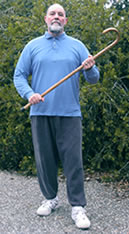
Here is a T'ai Chi Ch'uan Cane form that I enjoy practicing and have taught to many of my students: 

The Eight Immortals Cane Form.  Created by Master Jesse Tsao from San Diego, California.  Part I of this cane form is based on the Yang style of T'ai Chi Ch'uan.  This form has 36 movements.  

Traditional Tai Chi Eight Immortals Cane, Routine One.  Demonstrated by Master Jesse Tsao.  Instructional DVD, 64 minutes.  Produced by Tai Chi Healthways, San Diego, 2008.  Routine One is based on the Yang Style of Taijiquan.  Master Tsao developed this cane form himself, with grandmaster Zhu Tiancai's support. 

Traditional Tai Chi Eight Immortals Cane, Routine Two (Cannon Cane).  Demonstrated by Master Jesse Tsao.  Instructional DVD, 65 minutes.  Produced by Tai Chi Healthways, San Diego, 2008.  Routine Two, Cannon Cane, is based on the Chen Style of Taijiquan.  Master Tsao developed this cane form himself, with grandmaster Zhu Tiancai's support.  

Way of the Short Staff.  By Michael P. Garofalo, M.S.  A comprehensive guide to the practice of the short staff, cane, jo, walking stick, gun, zhang, whip staff, 13 Hands Staff, and related wood short staff weapons.  A detailed and annotated guide, bibliography, lists of links, resources, instructional media, online videos, and lessons.   Includes use of the short staff and cane in martial arts, self-defense, walking and hiking.  Separate sections on Aikido Jo, Cane, Taijiquan cane and staff, Jodo, exercises with a short staff, selected quotations, techniques, selecting and purchasing a short staff, tips and suggestions, and a long section on the lore, legends, and magick of the short staff.  Includes "Shifu Miao Zhang Points the Way."  Published by Green Way Research, Valley Spirit Taijiquan, Red Bluff, California.  Updated on a regular basis since October, 2008.  Related to Mike's popular webpage on the Staff.


Toju Zenchu brandished his staff before Daoist Shifu Miao Zhang and challenged him "Miao Zhang, speak and you get whacked with Nanten's staff.  Do not speak and you still get whacked with Nanten's staff."
Shifu Zhang stood up quickly, lifted his cane strongly in defense, and quietly said, "Yunmen's shit stick stinks and Nanten's staff is cracked!  I am leaving now to take my evening walk. Goodbye."  

Friday, September 28, 2012

I Try to Remember That

"Straight up from this road
Away from the fitted particles of frost
Coating the hull of each chick pea,
And the stiff archer bug making its way
In the morning dark, toe hair by toe hair,
Up the stem of the trillium,
Straight up through the sky above this road right now,
The galaxies of the Cygnus A cluster
Are colliding with each other in a massive swarm
Of interpenetrating and exploding catastrophes.
I try to remember that."
-  Pattiann Rogers, Firekeeper


Awe, Wonder, Amazement: Quotations, Sayings, Poems

Thursday, September 27, 2012

Dao De Jing, Laozi, Chapter 48

Tao Te Ching by Lao Tzu
Chapter 48

"Act academic, daily gain
Act tao, daily lose.
Losing, again lose
It happens, reaching relating to the absence of acting
Absence of acting yet absence of being without acting.
Grabbing the world, an entire absence of effort happens
Liking entirely the presence of effort
Is insufficient to precede grabbing the world."
-   Translated by David Lindauer, Chapter 48 

"The student of knowledge acquires day by day.
The student of Tao loses day by day.
Less and less, until nothing is done.
Do nothing, and everything is done.
The world is ruled by letting things take their course.
It cannot be ruled by interfering."
-   Translated by Ned Ludd, Chapter 48
 
"In the pursuit of learning,
every day something is added.
In the pursuit of the Tao,
every day something is dropped.
Less and less is done
until you come to action with striving.
When you follow this practice,
nothing remains undone.
All under heaven is won by
letting things take their course.
Nothing can be gained by interfering."
-   Translated by Tolbert McCarroll, Chapter 48  

"One who seeks knowledge learns something new every day.
One who seeks the Tao unlearns something new every day.
Less and less remains until you arrive at non-action.
When you arrive at non-action,
nothing will be left undone.
Mastery of the world is achieved
by letting things take their natural course.
You can not master the world by changing the natural way."
-   Translated by John H. McDonald, Chapter 48


Wednesday, September 26, 2012

Taijiquan Practice

I have been so busy with yoga studies and practice, weightlifting, walking, gardening, teaching, reading, and working part-time that I have not been practicing my Chen Taijiquan forms.  Starting today, I will renew my efforts in this area of mind-body arts by the daily practice of the Chen 18 Form.  

We don’t "really learn” Tai Chi by listening to, imitating, and following a live Tai chi instructor, or reading Tai Chi books, or watching Tai Chi instructional DVDs.  The “learning” comes from practicing Tai Chi, playing Tai Chi, moving by Tai chi, and feeling Tai Chi.  We move from being awkward and uncomfortable to moving gracefully, fluidly, easily, confidently, and beautifully.  Live and virtual Tai Chi instructors provide us with information and ideas about what Tai Chi has been for others and could be for us, its rich history, and provide us with a model of how a "form" might look and be realized as expressed by their body-mind.  
Our instructor's "mind" set or intention is important - depending, for example, on whether they emphasize martial applications or they are a New Age energy arts dancer.  Likewise, our own progress in "learning" will depend upon our own "mind set" of intentions, dedication, toughness, the courage to go beyond our limitations and failures, and our willpower.  
Learning Tai Chi is always a complex matrix of interactions, lived experiences, daily training, and accumulated muscle memories.  Less thinking and more practice, training, and doing will result in the greatest learning.  Repeated movements are the foundation for Tai Chi learning.  


"Movement is a medicine for creating change in a person's physical, emotional, and mental states."
-  Carol Welch 

"Knowing is not enough, we must apply.  Willing is not enough, we must do." 
-  Bruce Lee  

"It takes a lot of courage to release the familiar and seemingly secure, to embrace the new.  But there is no real security in what is no longer meaningful.  There is more security in the adventurous and exciting, for in movement there is life, and in change there is power."
-  Alan Cohen 


Chen Style Taijiquan Short Hand Form, 18 Movements
Created by Grandmaster Chen Zhenglei

Bibliography, Resources, List of Movements, Resources, Links, Instructions, Comments
Webpage by Michael Garofalo
 
Chen Style Taijiquan
Grandmaster Chen Zhenglei's Short 18 Movements Tai Chi Hand Form
List of 18 Movements

3.     Lazily Tying One's Coat  
5.     Single Whip 
7.     Walk Diagonally  
8.     Brush Knee
11.   High Pat on the Horse  
14.   Cloud Hands  
18.   Closing Posture of Taiji    


Tuesday, September 25, 2012

Winter Garden Started

Karen and I worked this past weekend in our garden on Saturday and Sunday morning.  We weeded the "Sunny Garden."  We removed plants that were not doing well anymore.  We picked all the pumpkins and gourds and removed the vines.  We added fertilizer.  We planted starts of Swiss chard, cabbage, lettuce, beets, kale, and onions.  We planted seeds of sugar snap peas, Detroit dark red beets, and Oregon sugar pod II peas.

Here is what the garden looked like when we started the work:


Here is what the garden looked like when we finished our work:


October in the Garden

Monday, September 24, 2012

Hatha Yoga Postures List

I continue to work a little each day on my Hatha Yoga Postures List.  This list is in alphabetical order by both the English and Sanskrit names for many common Hatha Yoga postures for beginning and intermediate yoga students.  The list includes coding for the kind of yoga posture, e.g., balancing, standing, supine, backbend, etc.  For each posture, the list includes reference to descriptions in yoga textbooks.  The list also includes some Chi Kung postures that I teach in many of my yoga classes.  My Hatha Yoga Postures List is now 12 pages long, in PDF format, print only, at Version 5, 9/23/2012.   

Sunday, September 23, 2012

Goodbye Georg

The renowned yoga scholar, Georg Feuerstein, Ph.D., passed away in August, 2012, at the age of 65.  He was the author of over 35 books on yoga, and Indian, Tantric, and Buddhist religions and philosophy.  He was a serious and accomplished practitioner of the yoga lifestyle.  He was an influential educator.  
I have read his books for many years, sometimes two or three times, and highly recommend his insightful and scholarly efforts to all serious students of yoga, philosophy, religion, and consciousness. He has inspired me many times.  
"Whatever the situation, however grim, spiritual practice gives hope, because it promises liberation or at least personal transformation."
-  Georg Feuerstein 
Thank you, Georg, for all you have done for us, your guidance, your energy, your intelligence, your decency, your diligence.  You have made great contributions to our future.  Bravo!!!

Saturday, September 22, 2012

Day of the Apple

Autumnal Equinox Celebrations (Mabon, Harvest Home, Alban Elfed, Apple Feast): Quotes, Resources, Lore, Poetry

One Old Druid's Final Journey:  Notebooks of the Librarian of Gushen Grove

September Lore

October Lore


"The quest for wisdom was realized by pursuing the white doe (as the blue roebuck) under a wild Apple tree.   In the Welsh Câd Goddeu (The Battle of the Trees), the Apple is described as the noblest tree of them all, the tree that symbolized poetic immortality.   The Apple Tree is closely linked to Druids, in their aspect as magicians and shamans."In Druid lore, the essence of three sacred apples growing on the Tree of Knowledge came from three drops that fell from Cerridwen's cauldron, which correspond with the Druid's most holy symbol, the Three Rays of Light."   Bards (poets) and Ovates (shamans) carried apple branches, (with bronze, silver, or gold bells), called the Craobh Ciuil (Branch of Reason) as symbols of their office.   Pulling the Ogham stave Quert is a mandate to rest and heal yourself from strife, illness, fatigue, or injury. It is an invitation to regain your sense of wholeness and connection with nature. Associated with the holy isle of Avalon, the apple represents rest and healing, recovery, and a peaceful relaxing Otherworld journey to the magical isle.  Within the Apple Branch you are invited to work with "the divine madness of the shaman." It calls you to journey to the Otherworld by its many names - Avalon, Avallach, Tir na Og, Eamhain Abhlach. Apple also represents the spiritual warrior who fears not to travel beyond the mortal realm to face death, sacrifice, and hardship, in order to benefit his or her tribe. The apple branch represents shelter and protection on these intense shamanic journeys."
The Apple Branch in the Dianic Tradition 


May your apples be sweet
May your autumn harvest be ample
May peace and prosperity fill your days
Aum Tara Tuttara Ture Svaha

Friday, September 21, 2012

Dragon Qigong

"It is easier to leave a circle than to enter it.
The emphasis is on the hip movement whether front or back.
The difficulty is to maintain the position without shifting the centre.
To analyze and understand the above situation is to do with movement and not with a stationary posture.
Advancing and retreating by turning sideways in line with the shoulders, one is capable of turning like a millstone, fast or slow, as if whirling like a dragon in the clouds or sensing the approach of a fierce tiger.
From this, one can learn the usage of the movement of the upper torso.
Through long practice, such movement will become natural."
- Yang Family Old Manual, The Coil Incense Kung

Dragon Chi Kung features exercises that involve twisting, turning, screwing, spiraling, curving, wiggling, undulating, spinning, sinking down and rising up, swimming, circling, swinging, or twining movements are often associated with snakes, serpents and dragons.  There are many Qigong sets and specific Qigong movements that have been called "Dragon" forms, sets, or exercises.  Baguazhang martial arts feature much twisting, turning and circling; and, also include many "Dragon" sets and movements.  Silk Reeling exercises in Chen Style Taijiquan include twisting, twining, circling, and screwing kinds of movements. 

Thursday, September 20, 2012

Tao Te Ching by Lao Tzu, Chapter 49

Dao De Jing, Laozi
Chapter 49


"The Wise Person has no Ego, he identify himself with the universe.
He is equally good with good or bad people.
His virtue is goodness.
He is equally honest with honest and dishonest people.
His virtue is honesty.
He sees everybody equally, living simply and in harmony.
He is like a mother with her children.
In his heart he keeps the whole world."
-  Translated by Octavian Sarbatoare, 2002, Chapter 49 

"The Complete Thinker has no interests of their own,
But takes the interests of the people as their own.
They are kind to the kind;
They are also kind to the not kind:
Kindness is Power.
They are faithful to the faithful
They are also faithful to the not faithful:
Faithfulness is Power. 
In the middle of the world, the Complete Thinker
is shy and does not brag.
For the world they keep their heart
in its largest state.
All the people try to listen and see:
The Complete Thinker acts without prejudice."
-   Translated by John Trottier, Chapter 49  

"Sages never have a mind of their own;
they consider the minds of the common people to be their mind.
Treat well those who are 'good.'
Also treat well those who are 'not good.'
This is Goodness Attained. 
Be sincere to the sincere.
Also be sincere to the insincere.
This is Sincerity attained. 
Sages are self-effacing in their dealings with all under heaven,
and bemuddle their own minds for the sake of others.
The common people all rivet their eyes and ears upon them,
and Sages make them giggle like children!"
-   Translated by Jerry C. Welch, Chapter 49 

"The sage has no mind of her own.
She is at one with all of humanity.
Give to those who are considered good.
Give to those who are considered bad.
This is true oneness.
Trust those who are trustworthy.
Trust those who are not trustworthy.
This is also true oneness.
The sage is peaceful and harmonious;
but to the world she seems indifferent.
The world pays attention to her and listens to her
even though she resembles a child."
-   Translated by John WorldPeace, Chapter 49   

"The Taoist has no opinions
He simply listens, and acts
He treats those who are good as worthy
He treats those who aren't good as worthy, too
And so he finds their goodness
He gives those who are honorable his trust
He gives those who are dishonorable his trust, too
And so he gains their trust."
-   Translated by Ted Wrigley, Chapter 49