Saturday, December 06, 2014

Strength Training for Seniors

I am an active weightlifter.  I train with weights five days every week.  I am 69 years of age.

Strength Training (Weightlifting, Bodybuilding, Physical Conditioning) for Persons Over 55 Years of Age. 
By Mike Garofalo. 
Quotations, Bibliography, Links, Resources, my Training Program for 2015. 

Mike Garofalo's Mind-Body Fitness Class Schedule for 2015

In Red Bluff, California

On Friday and Monday I lift weights to strengthen my legs as follows:

    Reference Source:  Frédéric Delavier, "Strength Training Anatomy," 3rd Edition, 2010.  E.g., Delavier p. 130

Leg Strength Training Workout - Some Possible Combinations for 50 Minutes
     Leg training workout at the TFFC gym every Monday and Friday @ 4:00 pm
     Warm Up segment   I frequently walk on a treadmill for 30 minutes then stretch.
     Seated Forward Leg Press  4Sx 8-10R  Up to 400lbs
     Lying Leg Curls (Reverse Lying Leg Curls)  4Sx 8-10R  Up to 80lbs  Delavier, p. 140
     Barbell Squats 4S x 5-8R  High Limit: 245lbs x 6R   Delavier, p. 126 
     Leg Extensions, Seated  4Sx 8-10R  Delavier, p.138 
     Hack Squat - Decline Angled Leg Press  4Sx 8-10R   High Limit: 320 pounds x 6R   Delavier, p. 130
     Incline Leg Pres - Incline Angled, Push Upward from Below  4Sx 8-10R   High Limit: 540lbs x 6R   Delavier, p. 135 
     Dumbbell or Barbell Shrugs  4Sx 8-10R  Up to 300 lbs barbell x 4-8R.  Delavier, p. 116-119
     Lunges  4Sx 8-10R  Use 10 to 25 lb dumbbell or no weights   Delavier, 2006 (2nd), p. 99
     Seated or Standing Calf Raises  4Sx 8-10R  45 -150 lbs  Delavier, p. 149-153
     Triceps Cable Pushdowns  4s x 8-10R  Delavier, p. 20
     On some days, when feeling more energetic, I do heaver weights with lower reps and more sets
     I intersperse arm or back work between leg sets to rest the legs. 


Cultivating a Positive Mindset
"Think in a calm, pacified, and reflective manner instead of being disturbed, agitated, and impulsive in one's reactions.
Put ideas together rationally and arrive at the right judgment even in the absence of obvious evidence or proof. 
Decide, plan, and execute a course of action in a patient, persistent, and disciplined manner. 
Recognize the changes and be flexible in adapting to them.
Observe and perceive things with a sense of humor instead of outrage, indignation, and anger.
Let go of useless and counterproductive thoughts, desires, and ambitions instead of being preoccupied with them.
Relax and meditate or rest.
Resist temptation and coercion."

- Michael Fekete
  Strength Training for Seniors, Hunter House, 2006, p. 36


Here are two books I refer to frequently to learn about anatomy and strength training:  

Strength Training Anatomy   By Frédéric Delavier.  Champaign, Illinois, Human Kinetics, Third Edition, 2010.  192 pages.  ISBN: 978-0736092265.  Revised edition of "Guide des mouvements de musculation" Paris, Ditions Bigot, 1998.  An outstanding illustrated guide to muscles at work.   Both male and female models are used.   This is one of my favorite books to use to understand strength training anatomical facts and exercise effects on the musculature.  Extremely detailed color illustrations of the human body.  The muscles and bones most effected and worked by a particular exercise are clearly indicated.  Instructions and tips are given for each exercise.  Exercises are arranged by general areas of the body:  Arms, Shoulders, Chest, Back, Legs, Buttocks and Abdomen.  There is no general index at the end of the book.   VSCL:  I own the 2nd edition (2006) and 3rd edition (2010).

Anatomy for Strength and Fitness Training: An Illustrated Guide to Your Muscles in Action  By Mark Vella.  New York, McGraw Hill, 2006.  Index, glossary, 144 pages.  ISBN: 0071475338.  VSCL.  An excellent reference tool for understanding how specific exercises effect muscles and joints.  Outstanding illustrations.  


Friday, December 05, 2014

Daodejing, Laozi, Chapter 35

Tao Te Ching by Lao Tzu
Chapter 35

"To him who holds in his hands the Great Image of the invisible Tao, the whole world repairs.
Men resort to him, and receive no hurt, but find rest, peace, and the feeling of ease. 
Music and dainties will make the passing guest stop for a time.
But though the Tao as it comes from the mouth, seems insipid and has no flavor;
Though it seems not worth being looked at or listened to, the use of it is inexhaustible."  
-  Translated by James Legge, 1891, Chapter 35  


"Holding on to the great Symbol,
The whole world carries on.
On and on without doing harm.
Being happy at peace,
Enjoying greatly the music and food
Travelers stop by.
When the Dao is spoken forth plainly
It has no flavor at all.
Look, but that is not sufficient for seeing.
Listen, but that is not sufficient for hearing. 
Use it, but it is not exhausted."
-  Translated by Edward Brennan and Tao Huang, 2002, Chapter 35  


"If the Great Simulacrum be obtained, the Empire will be for ever free from harm.
There will be tranquility, peace, and universal joy, the attraction of which, acting as a bait, will detain the passing traveler.
The utterance of Tao is insipid; it has no flavor.
If looked at, it appears not worth seeing; if listened to, it appears not worth hearing;
but if used, it is found inexhaustible in resources."
-  Translated by Frederic Henry Balfour, 1884, Chapter 35 


"Lay hold of the Great Form of Tao!
And the world will follow your train,
It will follow along, and suffer no wrong,
And in peace and content remain.
For music and dainties offered at your gate
The passing guest will tarry awhile and wait.
Though Tao in passing is tasteless,
With nothing to fill the eye,
And with nothing to hear worth filling the ear,
You can use it exhaustlessly."
-  Translated by Isaac Winter Heysinger, 1903, Chapter 35  


執大象, 天下往. 
往而不害, 安平大. 
樂與餌, 過客止. 
道之出口, 淡乎其無味.
視之不足見.
聽之不足聞.
用之不足既. 
-  Chinese characters, Tao Te Ching, Chapter 35


zhi da xiang, tian xia wang.
wang er bu hai, an ping tai.
le yu er, guo ke zhi.
dao zhi chu kou, dan hu qi wu wei.
shi zhi bu zu jian.
ting zhi bu zu wen.
yong zhi bu zu ji.
-  Pinyin Romanization, Daodejing, Chapter 35  


"Hold the Great Symbol
and all the world follows,
Follows without meeting harm,
And lives in health, peace, commonwealth.
Offer good things to eat
And the wayfarer stays.
But Tao is mild to the taste.
Looked at, it cannot be seen;
Listened to, it cannot be heard;
Applied, its supply never fails."
-  Translated by Lin Yutang, 1955, Chapter 35  


"El que obtenga la Gran Forma Original
adquirirá el paradigma para el mundo.
El mundo no sufrirá mal alguno
y quedará en paz, prosperidad y equilibrio.
La música y los manjares
detienen al caminante,
pero lo que exhala el Tao
no tiene sabor.
Se mira el Tao y no complace a la vista.
Se escucha el Tao y no complace al oído.
Se bebe del Tao y es inagotable."
-  Translation from Wikisource, 2013, Capitulo 35


"She who is centered in the Tao
can go where she wishes, without danger.
She perceives the universal harmony,
even amid great pain,
because she has found peace in her heart.
Music or the smell of good cooking
may make people stop and enjoy.
But words that point to the Tao
seem monotonous and without flavor.
When you look for it, there is nothing to see.
When you listen for it, there is nothing to hear.
When you use it, it is inexhaustible."
-  Translated by Steven Mitchell, Chapter 35


"Who holds to the Great Pattern
will attract all things to them.
They go to them and receive no harm, in them they find
peace,
security and
happiness.
Music and
snacks can only
make a passing guest pause.
The words of Tao (the Laws of the Universe)
have lasting effects,
They are mild and
flavorless,
We look and see nothing.
We listen and hear nothing.
But if we use it, It is without end."
-  Translated by John L. Trottier, 1994, Chapter 35  


Chapter and Thematic Index (Concordance) to the Tao Te Ching


Taoism: A Selected Reading List


 A typical webpage created by Mike Garofalo on a Chapter of the Tao Te Ching (Daodejing) by Lao Tzu (Laozi) includes at least 16 different translations or interpolations of the Chapter in English, two Spanish translations, the Chinese characters for the Chapter, a Wade-Giles and Hanyu Pinyin Romanization of the Mandarin Chinese words for the Chapter, recommended reading lists, a detailed bibliography; indexing by key words and terms for the Chapter in English, Spanish, and the Wade-Giles Romanization; some commentary, and other resources for the Chapter.  

English and Chinese (Wade-Giles) Terms for Chapter 35:  Grasp or Hold (chih), Ease, Great (ta), Peace, Form or Image (hsiang), Music (lo), Heaven (t'ien), Tao, World or Under Heaven or Below (hsia), Value, Follow or Attract (wang), Inexhaustible, Harm or Injury (hai), Finding Comfort, Content or Enjoy (an), Virtue of Benevolence, Peaceful or Serene or Even (p'ing), Abundant or Good Health (t'ai), Inaudible, Cake or Pastries (erh), Indeterminable, Pass (kuo), Strangers or Guests (k'o), Stop or Stay (chih), Tao, Mouth (k'uo), Boundless, Tasteless or Insipid (tan), Tranquility, Taste or Flavor (wei), Dao, Invisible, Symbol, Cooking, Taste, Sufficient or Enough (tsu), Boring, Dainty, See or Appear (chien), Profound, Court or Tribunal (t'ing), Endless, Heard (wên), Sign, Use or Apply (yung), Worthless, Insipid, Exhausted or Finished (chi), Unnoticed,  仁德     


Thursday, December 04, 2014

Mind Writing Slogans, Part I, by Allen Ginsberg

      I Background (Situation, Or Primary Perception)
  1. "First Thought, Best Thought" — Chogyam Trungpa, Rinpoche
  2. "Take a friendly attitude toward your thoughts." — Chogyam Trungpa, Rinpoche
  3. "The Mind must be loose." — John Adams
  4. "One perception must immediately and directly lead to a further perception." — Charles Olson, "Projective Verse"
  5. "My writing is a picture of the mind moving." — Philip Whalen
  6. "Surprise Mind" — Allen Ginsberg
  7. "The old pond, a frog jumps in, Kerplunk!" — Basho
  8. "Magic is the total delight (appreciation) of chance." — Chogyam Trungpa, Rinpoche
  9. "Do I contradict myself? Very well, then I contradict myself. I am large. I contain multitudes." –– Walt Whitman
  10. "...What quality went to form a man of achievement, especially in literature? ... Negative capability, that is, when a man
    is capable of being in uncertainties, mysteries, doubts, without any irritable reaching after fact & reason." — John Keats
  11. "Form is never more than an extension of content. — Robert Creeley to Charles Olson
  12. "Form follows function." — Frank Lloyd Wright
  13. "Ordinary Mind includes eternal perceptions." — Allen Ginsberg
  14. "Nothing is better for being Eternal Nor so white as the white that dies of a day." — Louis Zukofsky
  15. "Notice what you notice." — Allen Ginsberg
  16. "Catch yourself thinking." — Allen Ginsberg
  17. "Observe what’s vivid." — Allen Ginsberg
  18. "Vividness is self-selecting." — Allen Ginsberg
  19. "Spots of Time" — William Wordsworth
  20. "If we don’t show anyone, we’re free to write anything." Allen Ginsberg
  21. "My mind is open to itself." — Gelek Rinpoche
  22. "Each on his bed spoke to himself alone, making no sound." — Charles Reznikoff
     
Mind Writing Slogans, Part I, compiled by Alllen Ginsberg, 1926-1997. 

Allen Ginsberg. "Mind Writing Slogans," copyright © 1993 by Allen Ginsberg, in
What Book: Buddha Poems From Beat To Hiphop
, Gary Gach, ed., copyright © 1998, Parallax Press.]
"First Thought is Best in Art, Second in Other Matters." ─ William Blake 

Wednesday, December 03, 2014

Dubstep Dance: Set Fire

Marquese "Non-Stop" Scott does a new Dubstep Dance called "Set Fire."  Tai Chi Chuan dancers might pick up a few new moves from Marquese ...


Tuesday, December 02, 2014

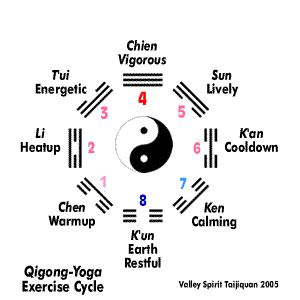
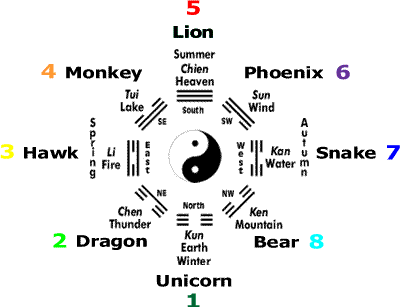
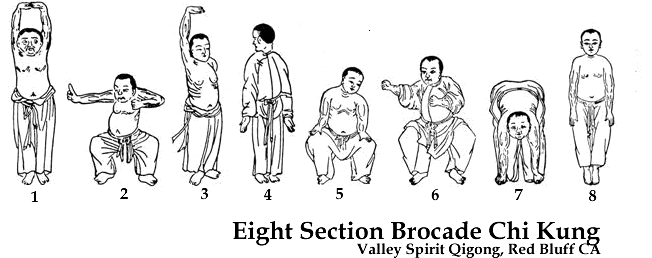
Eight Trigrams and Chi Kung

Sequence C:  Trigrams, Bagua, and Eight Section Brocade (Ba Duan Jin) Exercises Correlations

Soft Qigong (Rou Gong), Inner Qigong (Nei Gong); Slow Pace, Gentle, Soft, At Ease, Relaxed (Sung), Rooted/Sunk, Yin Style


Eight Section Brocade Exercise
I Ch'ing Trigram 
Parts of the Body Affected


1.  Pressing Up to the Heavens with
Two Hands
South, Summer
Ch'ien, Qián, Heaven, Sky, Air
Intense Yang
Lion
Heart, Small Intestine, Stomach, Lungs
(The Triple Warmer)
              

2.  Drawing the Bow and Letting the Arrow Fly Southwest, Mid-Summer
Sun, Wind
Yang
Phoenix
Kidneys, Spleen, Waist, Eyes, Legs
                     

4.  Wise Owl Gazes Backward West, Autumn
K'an, Water
Yang-Yin
Snake
Lungs, Immune System, Large Intestine
                   

5.  Big Bear Turns from Side to Side Northwest, Mid-Autumn
Ken, Gèn, Mountain
Yin-Yang
Bear
Heart, Waist, Legs
                   

3.  Separating Heaven and Earth North, Winter
K'un, Earth
Intense Yin
Unicorn, Qilin
Spleen, Kidneys, Bladder, Pancreas
                        

8.  Shaking the Body Northeast, Mid-Winter
Chen, Zhèn, Thunder
Yin
Dragon
Immune System, Calves, Feet
                         

6.  Punching with Angry Gaze Spring, East
Li, Fire
Yin-Yang
Hawk, Falcon
Liver, Gallbladder, Blood, Eyes
                      

8.  Touching Toes then Bending Backwards Southeast, Mid-Spring
Tui, Lake
Yang-Yin
Monkey

 
Kidneys, Waist, Legs, Back

The above three charts were proposed in 2005 by Mike Garofalo, in his webpage on the Eight Section Brocade.  See also Mike's webpage on the Eight Trigrams.  


In 2014, Christina Barea-Young and Peyton Young provided another set of associations for the Eight Section Brocade movements with the Eight Trigrams in Qi Magazine (Volume 24, No. 2, 2014, p. 48).  

I find these kinds of correlations, associations, and relational charts quite inconsistent between various authors.  Yoga, Western Esoteric Magic, and Qigong have many of the same kind of charts and tables of correlations; again, with considerable inconsistency between various "masters."  Other than the "traditions of specific esoteric schools", I find the associations rather arbitrary and fanciful, primarily aids to remembering clusters of ideas, poetic devices, magical-metaphysical lore, and lacking in much pragmatic-scientific meaningfulness.  Contrast these charming and pre-scientific tables with the modern and justifiably famous "Periodic Table of the Elements" for a real lesson in an objective and empirical approach to understanding the world.  Nevertheless, these clusters of ideas may stimulate the imagination, and are fun for playing thought games.  


"The names of the 108 Forms are each symbolic and signify concepts removed from the literal  physicality of the object - horse, tiger, bird, and so forth.  Each name has its separate allusion, and metaphorically may connote an aspiration, a philosophical attitude towards self and  conduct, a turn of mind, a sense of being, some thought about life and spirit.  The true meanings are revealed when the T'ai-Chi Ch'uan exponent has advanced to that stage of experience comprehension where he can utilize the implication of the philosophical  intentions, and where the symbols can be part of his growing consciousness.  This happens only when the mind and body have "changed" and absorbed the reasons for mental, emotional, and physical unity."
-   Sophia Delza, The T'ai Chi Ch'uan Experience, 1996, p. 24

 
The above long chart is more readable on my Eight Section Brocade webpage, 441 KB, last updated on June 20, 2014. 


Monday, December 01, 2014

December Gardening Chores

A late autumn storm brought mild winds and steady gentle rain (3") to our home in the North Sacramento Valley over the last six days. More rain is expected this week. 

December Gardening Chores
Red Bluff, North Sacramento Valley, California, USA
USDA Zone 9

December: Quotes, Poetry, Sayings, Lore

Yule and Winter Solstice Celebrations: Quotes, Poetry, Sayings, Lore


Pruning leafless trees and shrubs.
Adding compost and fertilizer to the vegetable and flower gardens.
Planting bare root trees and shrubs.
Pruning back grape vines.
Cleaning, sharpening, and storing tools.
Start taking cuttings from dormant vines and shrubs.
Reading seed and gardening catalogs.
Digging trenches for underground plastic pipe.
Making sure drainage systems are working.
Pruning evergreens for shape.
Moving tender potted plants to protected areas.
Burning large piles of cuttings and weeds.
Protect tender plants (e.g., citrus) from frosts.
Protect valuable garden tools and equipment from the rain and fog.
Tending winter vegetables: cabbage, lettuce, peas, spinach, brocoli, etc.
Putting some bulbs in the ground.
Plant onion and garlic sets.
Watering potted plants as needed if rain is insufficient.
Pruning back flowering plants, like mums.
Prepare new strawberry and berry vine beds.
Spraying some fruit trees (e.g., peaches) to prevent leaf curl.
Dividing dormant herbs.
Raking and composting leaves.
Setting out some color plants, e.g., calendulas. 
Removing dead or dying branches or trees to burn pile.
Cutting Firewood


"How like a winter hath my absence been
 From thee, the pleasure of the fleeting year!
 What freezings have I felt, what dark days seen!
 What old December’s bareness every where!
 And yet this time remov’d was summer’s time;
 The teeming autumn, big with rich increase,
 Bearing the wanton burden of the prime,
 Like widow’d wombs after their lords’ decease:
 Yet this abundant issue seem’d to me
 But hope of orphans and unfather’d fruit;
 For summer and his pleasures wait on thee,
 And, thou away, the very birds are mute:
 Or, if they sing, ’tis with so dull a cheer,
 That leaves look pale, dreading the winter’s near."
 - William Shakespeare, How Like a Winter Hath my Absence Been (Sonnet 97)


Sunday, November 30, 2014

Having Realistic Preferences and Eliminating Bad Habits

Albert Ellis (1913-2007) was one of the five most influential psychologists of the twentieth century.

Albert Ellis and Robert A Harper tell us:

"We should strive conscientiously to:
1.  Increase our objectivity and eliminate confusing facts and inferences
2.  Break any habit with which we habitually put ourselves at risk
3.  Get rid of agendas that conflict with our higher priorities
4.  Replace self-defeating demands and damnation with realistic preferences and appraisals
5.  Accept ourselves and others as the fallible human beings we actually are."
-  Albert Ellis and Robert Harper, A Guide to Rational Living, p. 58

How to Live the Good Life: Advice From Wise Persons


Virtues and Character

"As a human, four basic processes aid your survival and happiness: (1) You perceive or sense - see, taste, smell, feel, hear.  (2) You feel or emote - love, hate, fear, feel joyful or sad.  (3) You move or act - walk, eat, swim, climb, and play.  (4) You reason or think - remember, imagine, hyopthesize, conclude and solve problems."

These four processes typically interrelate and integrate at the same time.  Sometimes, one process can become dominant.  Unhealthy positive and negative thoughts can produce unhealthy emotional and behavioral problems for persons.   

Some related advice for rational living is found in the Enchiridon, written in the 1st century CE, by Epictetus when he said "People are disturbed not by things, but by the views which they take of them."  Shakespeare says, in Hamlet, "There's nothing either good or bad but thinking makes it so."  The theory of Rational Emotive Behavior Therapy (REBT) by Ellis and Harper goes far beyond these old sayings to develop a systematic guide for sensible people. 

I have benefitted from frequently reading the many books by Dr. Ellis and his REBT colleagues, and trying to practice his advice in my life for many years.  I have never participated in individual or group REBT therapy, but I am confident it might help people with serious neurosis and dysfunctional lifestyles. 

A Guide to Rational Living  By Albert Ellis and Robert A. Harper.  3rd Edition, 1975.


Saturday, November 29, 2014

Ours is the Stuff Sublime

"We men of Earth have here the stuff
Of Paradise - we have enough!
We need no other stones to build
The Temple of the Unfulfilled -
No other ivory for the doors -
No other marble for the floors -
No other cedar for the beam
And dome of man's immortal dream.

Here on the paths of every-day -
Here on the common human way
Is all the stuff the gods would take
To build a Heaven, to mold and make
New Edens. Ours is the stuff sublime
To build Eternity in time!" 
-  Edwin Markham, Earth is Enough


Awe: Quotes, Sayings 


"Wonder is the beginning of wisdom."
-  Socrates

"Subject is known by what she sees."
-   Allen Ginsberg, Mind Writing Slogans  


Raining in Red Bluff, California, today 11/28/2014

Friday, November 28, 2014

Tao Te Ching by Lao Tzu, Chapter 36

Daodejing, Laozi
Chapter 36


"When one feels a desire to concentrate it in one's own heart, it is imperatively necessary to display it openly.
When one feels a desire to cultivate it in its pliant phase, it is imperatively necessary to fortify and strengthen one's own powers. 
When one feels a desire to abandon or neglect it, it is imperatively necessary to stir up one's mind afresh in its pursuit. 
If anyone feels a desire to obtain it, it is imperatively necessary that it should be imparted to him.
By this means, the hidden phases of Tao will become clear.
The weak and pliable overcomes the strong and hard.
A fish cannot leave the depths.
The treasures of a State should not be employed to influence the people."
-  Translated by Henry Balfour, 1884, Chapter 36 


 "That which is about to contract has surely been expanded.
That which is about to weaken has surely been strengthened.
That which is about to fall has surely been raised.
That which is about to be despoiled has surely been endowed.  
This is an explanation of the secret that the tender and the weak conquer the hard and the strong.  
As the fish should not escape from the deep, so with the country's sharp tools the people should not become acquainted."
-  Translated by Daisetsu Teitaro Suzuki and Paul Carus, 1913, Chapter 36    


"In order to contract a thing, one should surely expand it first.
 In order to weaken, one will surely strengthen first.
 In order to overthrow, one will surely exalt first.
 'In order to take, one will surely give first.'
 This is called subtle wisdom.
 The soft and the weak can overcome the hard and the strong.
 As the fish should not leave the deep
 So should the sharp implements of a nation not be shown to anyone."
 -  Translated by Ch'u Ta-Kao, 1904, Chapter 36  


"That which is to be shrunk
must first be stretched out.
That which is to be weakened
must first be strengthened.
That which is to be cast down
must first be raised up.
That which is to be taken
must first be given.
There is wisdom in dimming your light.
For the soft and gentle
will overcome the hard and powerful.
Fish are best left in deep waters.
And, weapons are best kept out of sight."
-  Translated by Tolbert McCarroll, 1982, Chapter 36


將欲歙之, 必固張之.
將欲弱之, 必固強之.
將欲廢之, 必固興之.
將欲奪之, 必固與之. 
是謂微明. 
柔弱勝剛強. 
魚不可脫於淵.
國之利器不可以示人. 
-  Chinese characters, Tao Te Ching, Chapter 36


chiang yü hsi chih, pi ku chang chih.
chiang yü jo chih, pi ku ch'iang chih.
chiang yü fei chih, pi ku hsing chih.
chiang yü to chih, pi ku yü chih.
shih wei wei ming.
jou jo shêng kang ch'iang.
yü pu k'o t'o yü yüan.
kuo chih li ch'i, pu k'o yi shih jên.
-  Wade-Giles Romanization, Tao Te Ching, Chapter 36  


"If a thing is capable of being contracted, no doubt is was previously expanded;
 It a thing is capable of being weakened, no doubt it was previously strengthened.
 Exaltation precedes abasement.
 He who would take must first give.
 This is the Secret Law,
 Whereby the soft and the weak overcome the hard and the strong.
 Leave the fish in the depths of the water, out of harm's way;
 And leave the nation's sharpest weapons where they cannot be seen."
 -  Translated by Herman Ould, 1946, Chapter 36  


"If you want something to return to the source,
 you must first allow it to spread out.
 If you want something to weaken,
 you must first allow it to become strong.
 If you want something to be removed,
 you must first allow it to flourish.
 If you want to possess something,
 you must first give it away.
 This is called the subtle understanding
 of how things are meant to be.
 The soft and pliable overcomes the hard and inflexible.
 Just as fish remain hidden in deep waters,
 it is best to keep weapons out of sight."
 -  Translated by John H. McDonald, 1996, Chapter 36 


"Lo que ha de ser al final contraído, tiene que ser primero dilatado.
Lo que ha de ser al final debilitado, tiene que ser primero fortalecido.
Lo que ha de ser al final deschado, comienza por ser primero ensalzado. 
Lo que ha de ser al final despojado, comienza primero por ser dotado. 
Aguí radica la sutil sabiduria de la vida. 
Lo blando y lo débil triunfa sobre lo duro y lo fuerte. 
Lo mismo que el pez no debe abandonar las profundidades, el gobernante no debe mostrar sus armas."
-  Translation from Chinese to English by John C. H. Wu, translated into Spanish by Alfonso Colodrón, Capitulo 36 


"When about to inhale it is certainly necessary to open the mouth;
when about to weaken it is certainly necessary to strengthen;
when about to discard it is certainly necessary to promote;
when about to take away it is certainly necessary to impart – this is atomic perception.
The weak overcome the strong.
Fish cannot leave the deeps.
The innerness of the government cannot be shown to the people."
-  Translated by C. Spurgeon Medhurst, 1905, Chapter 36


"What is to be reduced,
Must first be expanded.
What is to be weakened,
Must first be made strong (ch'iang).
What is to be abolished,
Must first be established.
What is to be taken away,
Must first be given.
This is called the subtle illumination (wei ming).
The soft and weak overcome the hard and strong.
Fish must not leave the stream.
Sharp weapons (ch'i) of a state,
Must not be displayed."
-  Translated by Ellen Marie Chen, 2000, Chapter 36  


Chapter and Thematic Index (Concordance) to the Tao Te Ching


Taoism: A Selected Reading List


 A typical webpage created by Mike Garofalo on a Chapter of the Tao Te Ching (Daodejing) by Lao Tzu (Laozi) includes at least 16 different translations or interpolations of the Chapter in English, two Spanish translations, the Chinese characters for the Chapter, a Wade-Giles and Hanyu Pinyin Romanization of the Mandarin Chinese words for the Chapter, recommended reading lists, a detailed bibliography; indexing by key words and terms for the Chapter in English, Spanish, and the Wade-Giles Romanization; some commentary, and other resources for the Chapter.  


Thursday, November 27, 2014

Happy Thanksgiving Day

May you and your family and your friends enjoy a safe and happy Thanksgiving Day. 

May you enjoy peace and prosperity in your community.

May compassion and tolerance guide our actions.

"How wonderful it would be if we could help our children and grandchildren to learn thanksgiving at an early age. Thanksgiving opens the doors.  It changes a child's personality.  A child is resentful, negative—or thankful.  Thankful children want to give, they radiate happiness, they draw people."
-   Sir John Templeton


T   hanks for time to be together, turkey, talk, and tangy weather.
for harvest stored away, home, and hearth, and holiday.
for autumn's frosty art, and abundance in the heart.
for neighbors, and November, nice things, new things to remember.
for kitchen, kettles' croon, kith and kin expected soon.
for sizzles, sights, and sounds, and something special that about.
   
That spells THANKS for joy in living and a jolly good Thanksgiving.
            
-   Aileen Fisher, All in a Word  


"To educate yourself for the feeling of gratitude means to take nothing for granted, but to always seek out and value the kind that will stand behind the action.  Nothing that is done for you is a matter of course.  Everything originates in a will for the good, which is directed at you.  Train yourself never to put off the word or action for the expression of gratitude."
-  Albert Schweitzer 


Virtues for a Good Life

How to Live the Good Life: Advice from Wise Persons 


Wednesday, November 26, 2014

Strength Training for Older Persons

I am very active with strength training at the Tehama Family Fitness Center in Red Bluff.  My current weightlifting training partner is Roger Andreson.  I am 69 years of age and Roger is 65.  

We lift weights for 50 to 60 minutes 5 days each week.  My current weightlifting goals, objectives and programs are detailed on my strength training webpage.  

Strength Training for Persons Over 55 Years of Age 

Building Muscle Beyond 50 Blog

Senior Health and Fitness Blog


I find all kinds of interesting information, useful tips, and good ideas at the Building Muscle Beyond 50 Blog.


"In a UCLA study, researchers determined the more muscle mass you have the better your chances to live longer.  In other words, the greater your muscle mass, the lower your risk of death,” said Dr. Arun Karlamangla, an associate professor in the geriatrics division at the Geffen School and the study’s co-author. “Thus, rather than worrying about weight or body mass index, we should be trying to maximize and maintain muscle mass.”
This is the first study I’ve read that appears to offer more hope than a few years of extra life for people who work out. This fits in with the question I’ve always had about studies that found working out and/or exercising provided minimal increases in your lifespan (1-4 years). My question, related to many other studies, was if working out can give you a large measure of protection against fatal health conditions why wouldn’t it expand your years as you sidestepped these killer maladies?
Surely if building and/or maintaining muscle mass protects you from an earlier death, you would get many more years of living simply by working out. Of course, there are never any guarantees in these matters, but the results of this research look promising.
Reference:
University of California – Los Angeles Health Sciences. (2014, March 14). Older adults: Build muscle and you’ll live longer. ScienceDaily. Retrieved March 16, 2014.


A Man and Woman on a Tuesday Evening


After I finished teaching my Tuesday evening (5:30-6:30 pm) yoga class, and as the yoga students were leaving, there were two new visitors waiting to enter.  We did some Taijiquan forms (Yang, Wu, Chen) together, talked about interests and circumstances, talked a little philosophical Taoism, mentioned longevity, and did some qigong forms together.  He shared Wu Taijiquan style.  They said they were traveling, van camping, and exploring Taoist resources; and lived in San Diego.  He is an acupuncturist.  I suggested they camp at Woodson Bridge State Recreation Area and gave them directions from the South Street and Interstate 5 exit in Corning, east 7 miles to the campground.  I recall his name was Roger.  I teach Yoga, Taijiquan, Qigong and Philosophy in Red Bluff and at my home. As for philosophical Taoism, for me, best experienced while tending my winter garden.  There is some good reading materials cited in my bibliography. California agriculture produces dried peaches.  He or she may email me at:  email

At the Tuesday evening Yoga class, I led a yoga routine with 30 second holds.  On Monday, we had done 80 second holds.

Take any Taijiquan end posture, for example, take the end position of the flowing left  Parting the Wild Horses Mane movement, Yang style.  That posture is a left forward lunge to the side, left arm extended with palm up, right had down to right thigh, torso upright, rooted, centered, powerful ... hold this posture and stay still for 30 to 60 seconds.  zhong shi training.


THANKSGIVING WEEK:  Wednesday, November 26th, 2014

My son, Mick, and daughter in law, April have been visiting since Sunday night.  We have had thee straight days of beautiful sunny clear cool weather.  Pleasant company, relaxed. 
Mick has been resting and nursing a troublesome left foot problem.  

We have three big dogs with high energy to manage; but all behave very well (indoors and outside) when resting.  

I have insomnia tonight.  Up at 2 am.


New Books I Am Reading

Stretching Anatomy  By Frederic Delavier.  Over 130 exercises for flexibility, agility, and toning.  Authors: Frederic Delavier, Jean-Pierre Clemenceu, and Michael Gundill.  Champaign, Illinois, Human Kinetics, 1st Edition, c 2010.  144 pages.  ISBN: 978-1450413985.  VSCL. 


Raymo, Chet.  When God Is Gone, Everything Is Holy: The Making of a Religious Naturalist  By Chet Raymo.  Nortre Dame, Indiana, Sorin Books, c 2008.  13 chapters, notes, 148 pages.  ISBN: 9781933495132.  Clean used copy from Oregon.  VSCL. 


Tuesday, November 25, 2014

The Postures of the Enlightened Ones

"We're fooling ourselves a bit to think that we're meditating as we're gardening or walking or out on the golf course or volunteering or even reading "spiritual books."  Those are all cause and conditions that, with the right mindset - a mindset based on wise intention and anchored to a committed sitting practice - can enable us to relax, to be more at peace, to have some insights, to even have an occasional experience of oneness with all that is.  But those activities, in and of themselves, with anchoring in strong intention and committed sitting practice, are unable to transform and free our minds.  They are not in themselves, the necessary causes of awakening, let's not deceive ourselves in the time we have left.

We need the focused, concentrated energy of awareness that seems only to be cultivated with a daily practice if we wish to walk through the world with clarity and compassion.  We need to carve out the time to sit if we have not yet done so, , or carve out more time if we have already begun.  Sitting - the silent, noble stilling of the body and the mind for the purpose of liberating awareness into beyond-self, into deeper, more illuminated consciousness - allows an opening in the limited, limiting paradigm of separate self and only form.

Sitting practice is where transformation is effected, where neural connections are rewired.  Sitting practice is the launching pad for piercing insight, direct knowing, and the opening of the heart.  It is the base of operations."

-  Kathleen Dowling Singh, "The Grace in Aging: Awaken as You Grow Older," Wisdom Publications, 2014, p. 33.  A very good book about Buddhist theory and practices.  

Many Taijiquan, Qigong, and Yoga teachers strongly recommend seated meditation as part of a rigorous mind-body-spirit practice.

"Practice is the seedbed of miracles."
-  Michael Murphy


Undoubtedly, many people find the consistent, daily, and serious practice of seated meditation of great benefit to mind, body, and spirit.  Only practice and experience will reveal and bear fruit. 

I favor keeping the "mindset" Ms. Singh admirably describes while walking, gardening, practicing mind-body arts, reading, writing, and sitting.  There are many useful paths to enlightened awareness, mystical experiences, openness, cultivating loving kindness, or the Eightfold Path.  The practice of enlightened living is cultivated in our daily lives, relations with other beings, and in our understanding of the changing and impermanent circumstances of our being-in-the-world.  I find the desired "mindset" or "no-mind-set" while sitting in my garden, sometimes listening to music, sometimes reading poetry (see R. H. Blyth), or "spiritual books," sometimes just sitting and listening to bird songs and the rustling of leaves in the morning breeze.  It is my personal preference to not regard seated meditation as the highest and most effective and most superior pathway to enlightenment and whatever "enlightenment" means.  To each is own!  

Walking Meditation

Standing Meditation

Lifestyle Advice from Wise Persons

Buddhism:  Reading List and Bibliography  

"Basho used to sit cross-legged from morning till night in constant meditation.  His master Nagaku saw him and asked: "Why are you sitting cross-legged in meditation?"  "I am trying to become a Buddha," he answered.  The master picked up a brick and began polishing it on a stone nearby.  "What are you doing, Master?asked Basho.  "I am trying to turn this brick into a mirror," was the answer.  "No amount of polishing will turn the brick into a mirror, sir."  "If so, no amount of sitting cross-legged will make you into a Buddha," retorted the master."
Games Zen Masters Play: The Writings of R. H. Blyth.,  p.13.   

 
"In theory there is no difference between theory and practice.
In practice there is."
-  Yogi Berra


Monday, November 24, 2014

Weapons Practice with a Cane

The only martial arts weapon that I practice with is a cane.  I practice all the Taijiquan sword and broadsword forms that I know with a cane. 

Every time I take a walk I carry my cane with me.  Using various cane strikes and stretches while walking is an excellent way to exercise the upper torso.

I use an Instructor's Walking Cane, 40" (103 cm) long and 1" (2.54 cm) in diameter, from Cane Masters.  This cane weights 1lb, 2 oz (510 gm).  This beautiful martial arts combat cane is made of pure hickory heartwood, has multiple notches at three key gripping points, has a rounded hooked horn, and has a rubber covered tip.  I also own the same Instructor's Walking Cane made of oak - a gift from my children.
 
Way of the Short Staff.  By Michael P. Garofalo, M.S.  A comprehensive guide to the practice of the short staff, cane, jo, walking stick, gun, zhang, whip staff, 13 Hands Staff, and related wood short staff weapons.  A detailed and annotated guide, bibliographies, lists of links, resources, instructional media, online videos, and lessons.   Includes use of the short staff and cane in martial arts, self-defense, walking and hiking.  Separate sections on Aikido Jo, Cane, Taijiquan cane and staff, Jodo, exercises with a short staff, selected quotations, techniques, selecting and purchasing a short staff, tips and suggestions, and a long section on the lore, legends, and magick of the short staff.  Includes "Shifu Miao Zhang Points the Way."  Published by Green Way Research, Valley Spirit Taijiquan, Red Bluff, California.  Updated on a regular basis since October, 2008.  Filesize: 265Kb.  Related to Mike's popular webpage on the Staff.
"The correct use of the bo (sai, tonfa, kama, naginata, sword) can produce a stimulating and practical means of "extension" training. It offers a means of martial arts training and discipline. Weapons training teaches the meaning of control, timing, distance, and flexibility as one unit. The practitioner is required to possess speed, coordination, strength, and endurance in utilizing the respective weapons."
History of the Bo Staff


"The jo can be used to strike like a sword, sweep like a naginata, thrust like a spear (yari). Its two ends can be used, unlike the single point of a sword, and its ma-ai (fighting distance) can be varied according to the hand grip you take. Because of its speed and changeable ma-ai, it is a formidable weapon."
Muso Shindo-Ryu Jodo   


"In Chinese shamanism, a staff represents the power of the universe. With a staff, a shaman had the power to pass on the universal knowledge to others. Later, when teachers took over part of the shaman's job, they always taught with a small staff in their hands like a shaman."
- Master Zhongxian Wu, Vital Breath of the Dao, p. 106


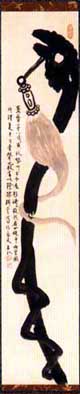
Hakuin's Dragon Staff Inka Scroll


Zen Master Hakuin (1686-1768) painted a Dragon Staff with a horsehair whisk attached.  He gave the above painting to a lay student who passed the Zen koan, "What is the sound of one hand clapping.


Sunday, November 23, 2014

Absolutes Squirm Beneath Realities

Here are some excerpts from a collection of 785 one-liners from Pulling Onions by Mike Garofalo:

Mother Nature is always pregnant. 
Time creeps, walks, runs and flies - it is all about moving things. 
Chaos breaks its own rules to allow Order to play. 
Dogmatists are less useful than dogs. 
Take life with a grain of salt, and a icy margarita. 
The best things in life are more expensive than you think. 
Rather than "love mankind," I'd rather admire a few good people. 
Some flourish when crowded together, others don't. 
Garbage In, Compost Out. 
It is more about You and Now, rather than Them and Back Then. 
Hunting for tomato worms- no mercy. 
A pocket knife will be its dullest at just the right time. 
While gardening the borders between work and play become blurred.
When gardening, look up more often.
Just the right words can be worth more than a thousand pictures. 
Death's door is always unlocked. 
A flower needs roots; beauty a society of minds. 
A callused palm and dirty fingernails precede a Green Thumb. 
A working hypothesis is far better than a belief. 
Only two percent of all insects are harmful.  Why are they all in my garden? 
Create your own garden, the god's certainly won't. 
That something is eternal is unverifiable. 
Most laws of Gardening are merely local ordinances. 
Failures, disorder and death are the Grim Reaper of Entropy at work. 
Somehow, someway, everything gets eaten up, someday. 
The meaning is lost in the saying - a nature mystic's dilemma. 
Vigorous gardening might help more than a psychiatrist's couch. 
A gardener is no farmer, he is much too impractical. 
No garden lasts for long - neither will you. 
Shade, in the summer, is as precious as a glass of water. 
A wise gardener knows when to stop. 
Gardens are demanding pets. 
Unclench your fist to give a hand. 
The little choices day after day are the biggest issue. 
Gardening is but one battle against Chaos. 
When life gives you onions, you ain't making lemonade. 
Many friendships are sustained by a mutual hatred of another person or group.
Read until you go to seed. 
Death's door is always unlocked. 
Autumn Yellow, the mirror image of Spring Green. 
What you see depends on when you look. 
Beauty is the Mistress, the gardener her slave. 
One's "true self" is changing and elusive. 
A little of this and a little of that, and some exceptions - these are the facts. 
Does a plum tree with no fruit have Buddha Nature?  Whack! 
Planting winter branch cuttings - talk about getting something from almost nothing. 
My mind is a sea I cannot see into; I merely skim along its surface.
Be careful not to stand up for that which will cause your downfall.    
God may be very smart, but he is a poor communicator.
What ought to be cannot be derived from what is the case, but a reasonable person ought not to ignore what is the case.  
Most tire from hatefulness; cheerfulness is abiding.
Stubborn facts are loosened up with novelty.
The act, the deed, the doing are the primary considerations. 
Keep moving― just like a cyclist that must keep pedaling and moving and avoiding falling down.
To many the sun is a god and the earth is a goddess; and, our imaginations are boundless.  
Don't kid yourself: seeing is not necessarily believing. 
If you think you are damned if you do or damned if you don't, your not thinking creatively enough. 
The ten thousand things are more enchanting than the Silent One. 
To lift the mind, move the body.
A calloused palm and dirty fingernails precede a Green Thumb. 
Absolutes squirm beneath realities. 
The empty garden is already full.
Evidence may support the pessimists' views, but optimists get to smile more.
A gardener is no farmer, he is much too impractical.
The month determines the mood.
A leaf bud - hope visible. 


Pulling Onions: 785 Quips and Sayings of an Old Gardener by Mike Garofalo

Months and Seasons

The Spirit of Gardening